
A Brief History of Time How to understand
A Brief History of Time How to understand “time” in the study of history
Vocabulary for Standard 6. 01 1. 2. 3. 4. 5. 6. 7. 8. 9. 10. Time designations Historians BC BCE AD CE Circa (c. or ca) Decades Centuries Millenniums
I. Understanding Time
Understanding Time �“Time” is not a simple definition �We cannot see it, hear it, smell it, or taste it but we can feel its effects �Our bodies age, trees grow, homework is due
Understanding Time �Our study of history has to begin with a look at time �“History” begins as an account of the “past” �Events that took place yesterday, happened in the “past” �Today is the present; tomorrow is the future �But when tomorrow comes, what was once the future will be the present, and eventually the past
II. Understanding Timelines
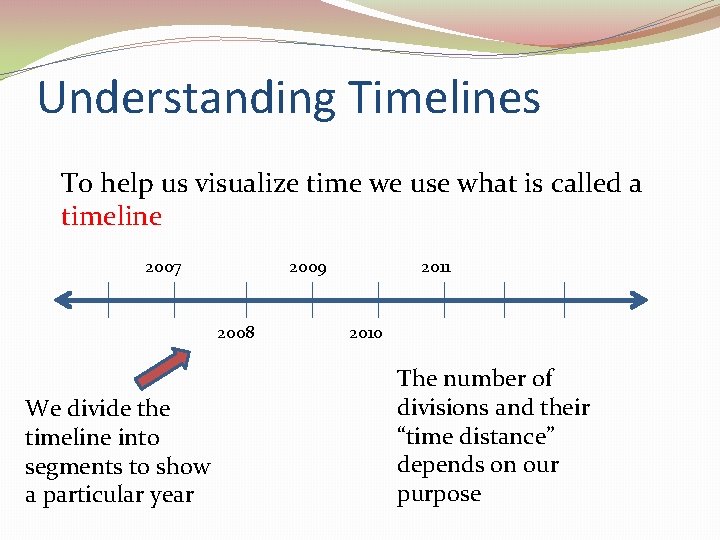
Understanding Timelines To help us visualize time we use what is called a timeline 2007 2009 2008 We divide the timeline into segments to show a particular year 2011 2010 The number of divisions and their “time distance” depends on our purpose
Understanding Timelines �For historians, timelines help visualize events relative to one another �By placing events on a timeline we can “see” when they happened �Timelines help us develop a sense of order of the past
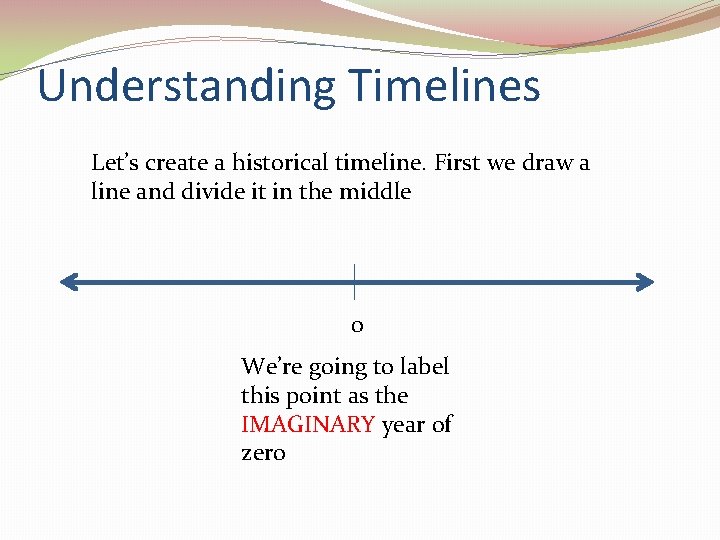
Understanding Timelines Let’s create a historical timeline. First we draw a line and divide it in the middle 0 We’re going to label this point as the IMAGINARY year of zero
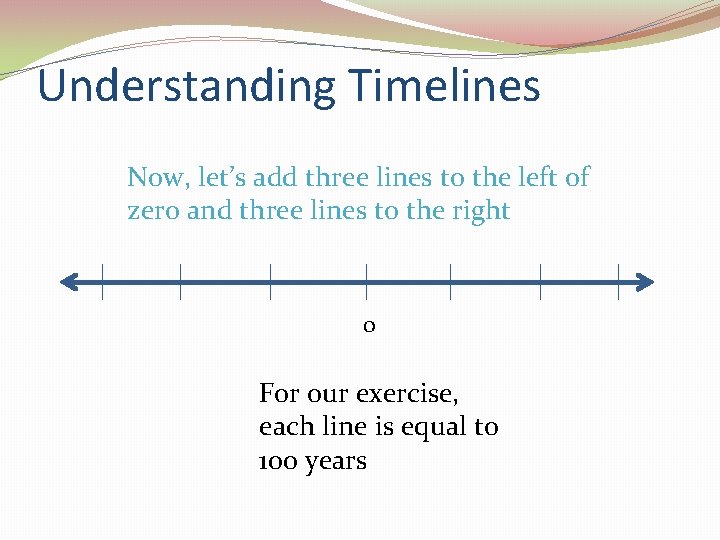
Understanding Timelines Now, let’s add three lines to the left of zero and three lines to the right 0 For our exercise, each line is equal to 100 years
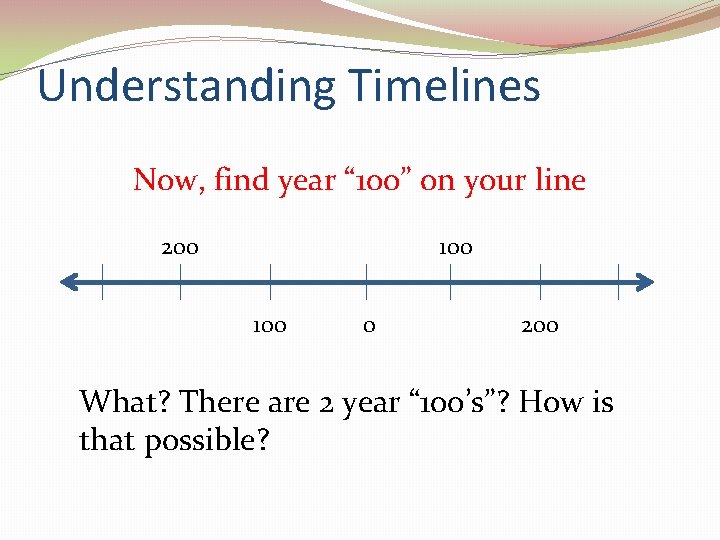
Understanding Timelines Now, find year “ 100” on your line 200 100 0 200 What? There are 2 year “ 100’s”? How is that possible?
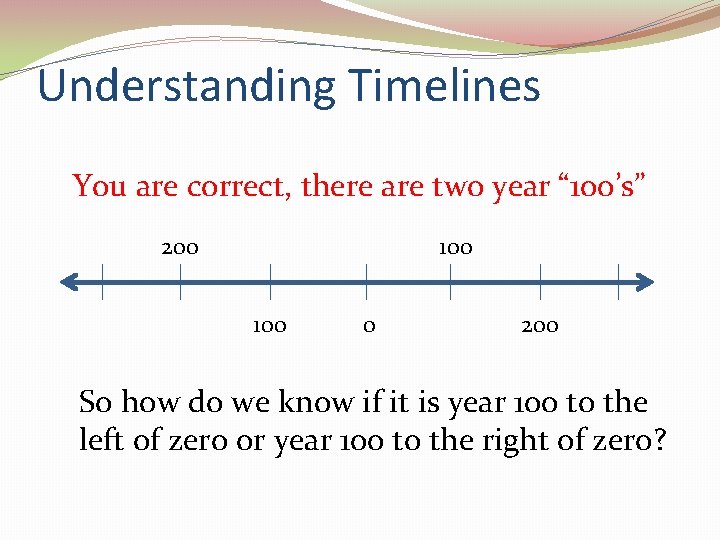
Understanding Timelines You are correct, there are two year “ 100’s” 200 100 0 200 So how do we know if it is year 100 to the left of zero or year 100 to the right of zero?
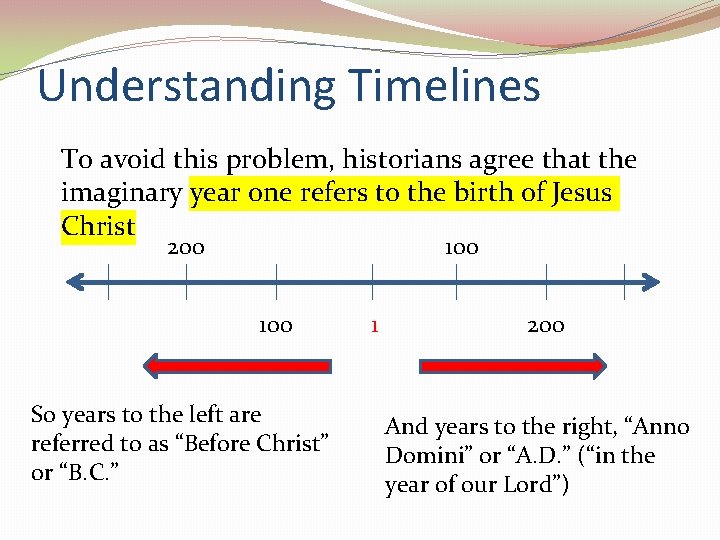
Understanding Timelines To avoid this problem, historians agree that the imaginary year one refers to the birth of Jesus Christ 200 100 So years to the left are referred to as “Before Christ” or “B. C. ” 1 200 And years to the right, “Anno Domini” or “A. D. ” (“in the year of our Lord”)
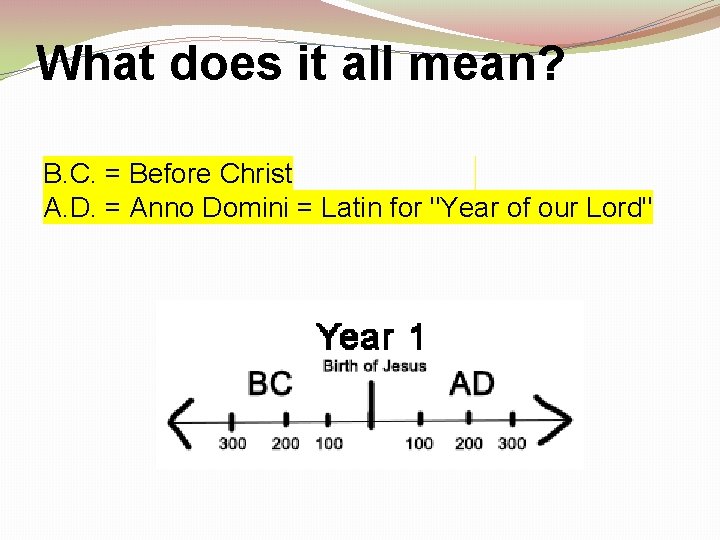
What does it all mean? B. C. = Before Christ A. D. = Anno Domini = Latin for "Year of our Lord"
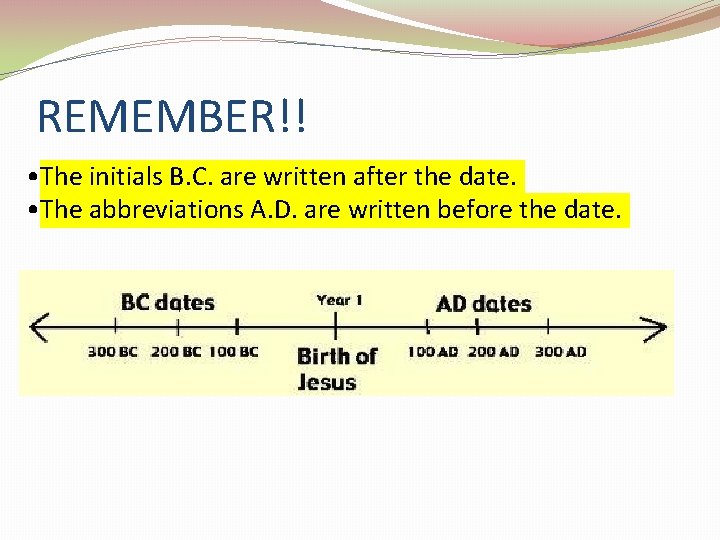
REMEMBER!! • The initials B. C. are written after the date. • The abbreviations A. D. are written before the date.
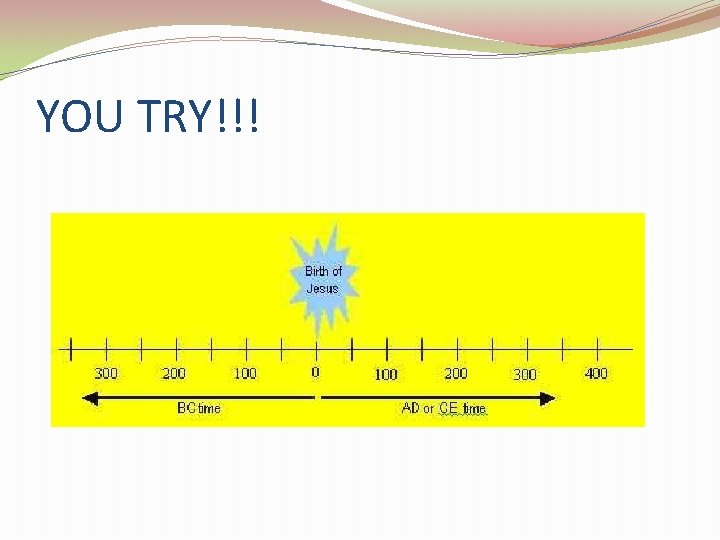
YOU TRY!!!
Understanding Timelines �The divisions B. C. and A. D were obviously developed by Christian historians �To be more sensitive to non-Christians, a more neutral system was developed �“B. C. ” = BCE (before common era) �“A. D. ” = CE (common era)
Although these terms refer to the same years on a timeline, they cannot be intermixed. B. C. and A. D. can only be used together. B. C. E. and C. E. can only be used together.
Quick Check �What does year 1 stand for? �What does B. C. mean? �What does A. D. mean? �B. C. E means? It’s the same as ______? �C. E. means? It’s the same as ______?
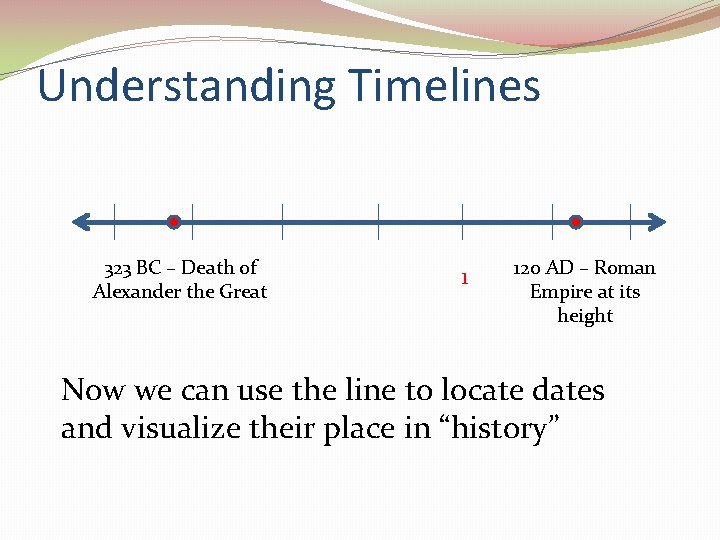
Understanding Timelines 323 BC – Death of Alexander the Great 1 120 AD – Roman Empire at its height Now we can use the line to locate dates and visualize their place in “history”
Understanding Timelines B. C. and B. C. E dates get smaller as they get closer to the present. It is like a countdown. Example: If you were born in 270 B. C. E. and if you lived 70 years, you would have died in 200 B. C. E. (not 340 B. C. E). �BC counts backwards. AD counts forward
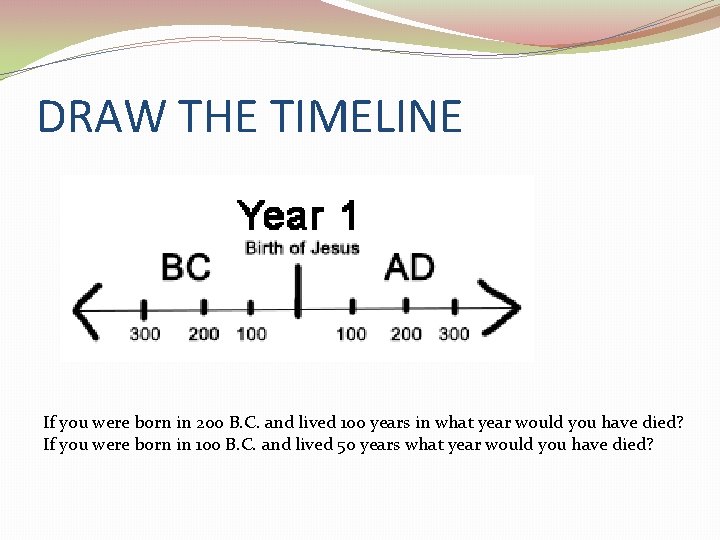
DRAW THE TIMELINE If you were born in 200 B. C. and lived 100 years in what year would you have died? If you were born in 100 B. C. and lived 50 years what year would you have died?
Can you sort these dates in order? (group work) � 1457 B. C. � 1559 B. C. � 2019 B. C � 2012 A. D. � 978 A. D. � 1964 A. D.
DID YOU GET THEM ALL RIGHT? � 2019 B. C � 1559 B. C. � 1457 B. C. � 978 A. D. � 1964 A. D. � 2012 A. D.
Draw a timeline and arrange the following dates in order � 1900 B. C. � 3500 B. C. � 2100 B. C. � 2400 B. C. � 75 A. D.
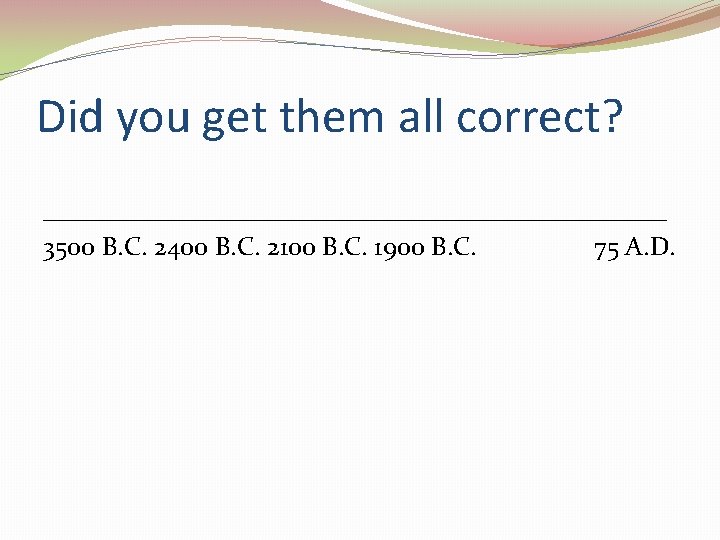
Did you get them all correct? ________________________ 3500 B. C. 2400 B. C. 2100 B. C. 1900 B. C. 75 A. D.
III. Understanding Time Divisions
Time Divisions �Historians also think about time in groups of years � 10 years is a decade � 100 years is a century � 1000 years is a millennium �Approximately or Around = Circa
Time Divisions �Historians also refer to groups of years according to a shared pattern of human life during that time �This time is called an “era” or an “age” �Often times these periods do not have a definite beginning or end point (we have to guess)
Time Divisions �From the evidence recovered by scientists, we believe that humans beings began using a metal known as bronze around 3000 BC �We also believe the use of iron appeared around 1500 BC �Therefore the period between 3000 BC and 1500 BC is known as the Bronze Age �Guess what “age” came after the Bronze?
Independent Practice �CREATE a list of 5 dates all scrambled up to test a partner. You must use both B. C. and A. D. dates. Your table partner will put the dates in chronological order. �Be sure to create an answer key on the back of your paper.
Exit Ticket 1. It means the number of years since the birth of Jesus Christ. 2. It means the same thing as before Christ. 3. It means approximately. 4. 10 years=
Time Divisions �Ok, here’s one for you…. The year 1555 is in what century? �How about this one…. in what year did the 19 th century begin?
Time Divisions �Ok, here’s one for you…. The year 1555 is in what century? �How about this one…. in what year did the 19 th century begin?
Time Divisions � 1555 is in the sixteenth century �The 19 th century began in the year 1800 �Don’t worry if you didn’t get the right answer…many students have this problem �But you’re going to see now how to get these kinds of questions correct…all the time!
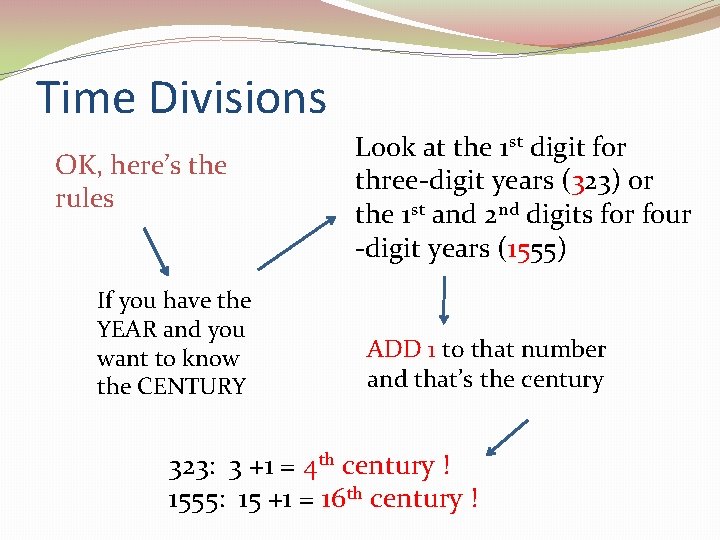
Time Divisions OK, here’s the rules If you have the YEAR and you want to know the CENTURY Look at the 1 st digit for three-digit years (323) or the 1 st and 2 nd digits for four -digit years (1555) ADD 1 to that number and that’s the century 323: 3 +1 = 4 th century ! 1555: 15 +1 = 16 th century !
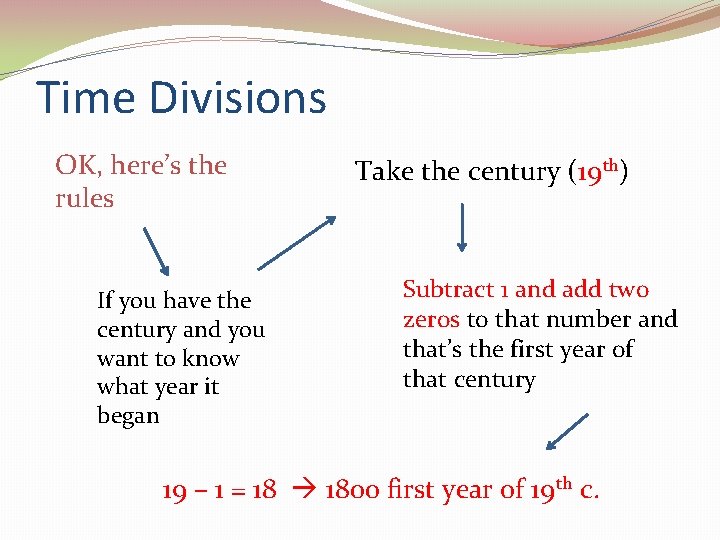
Time Divisions OK, here’s the rules If you have the century and you want to know what year it began Take the century (19 th) Subtract 1 and add two zeros to that number and that’s the first year of that century 19 – 1 = 18 1800 first year of 19 th c.
IV. Understanding Time Between Dates
Time Between Dates �How long ago was 1200 BC? �How many years passed between 1200 BC and 120 AD? �Seem like really hard questions? �Get ready to break it down…
Time Between Dates �What year are we in now? � 2009 AD or CE right? (don’t forget, there was a 2009 BC…) �Ok, what century are we in? � 21 st right? (remember 20 +1) �So let’s look again at a timeline…


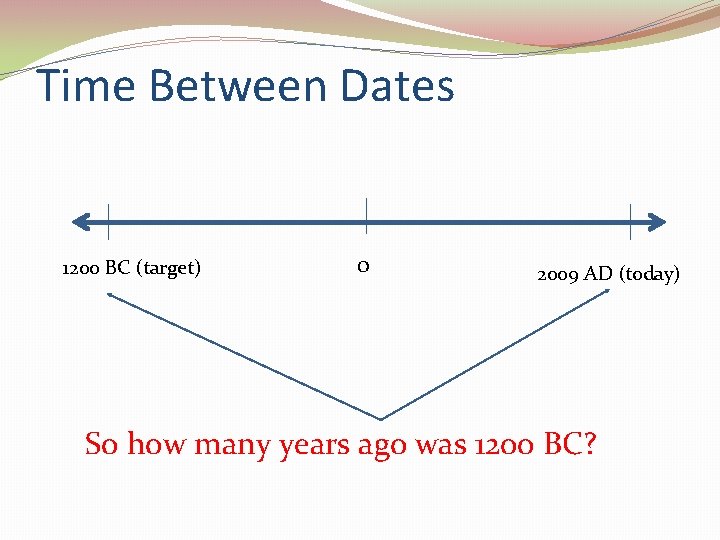
Time Between Dates 1200 BC (target) 0 2009 AD (today) So how many years ago was 1200 BC?
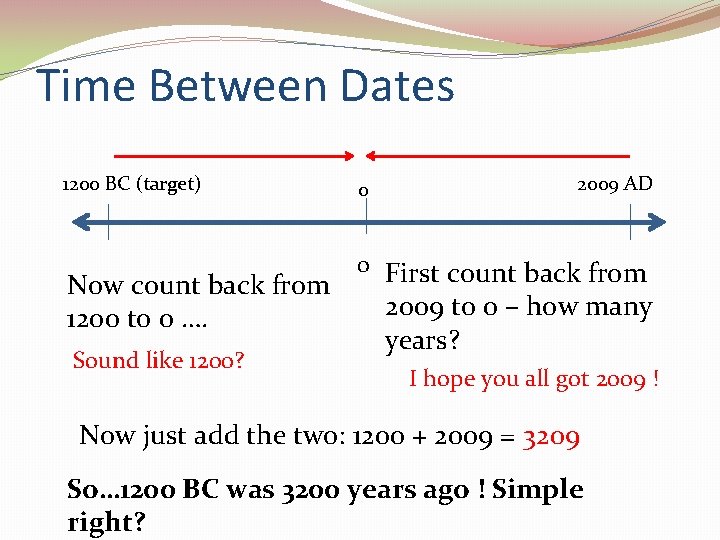
Time Between Dates 1200 BC (target) Now count back from 1200 to 0 …. Sound like 1200? 0 2009 AD 0 First count back from 2009 to 0 – how many years? I hope you all got 2009 ! Now just add the two: 1200 + 2009 = 3209 So… 1200 BC was 3200 years ago ! Simple right?

V. Time to Practice
Time to Practice �Now’s your chance to check what you’ve learned �How many years ago was…. . 1. The beginnings of agriculture (8, 000 BC)? 2. The beginning of the Bronze Age (3, 000 BC)? 3. Christianity become the official religion of the Roman Empire (380 AD)? 4. How many years between the end of WW I (1918) and the beginning of WWII (1939)?
Time to Practice �The Great Pyramid of Khufu at Giza in Egypt was completed in 2556 BC �The Eiffel Tower in Paris was completed in 1889 AD �The Great Pyramid stood as the tallest manmade structure in the world until the Eiffel Tower was completed �How many years did the Great Pyramid hold this status?
- Slides: 47