
A brief history of the EU Pauli Leimio
A brief history of the EU Pauli Leimio, CEO United Magazines Ltd
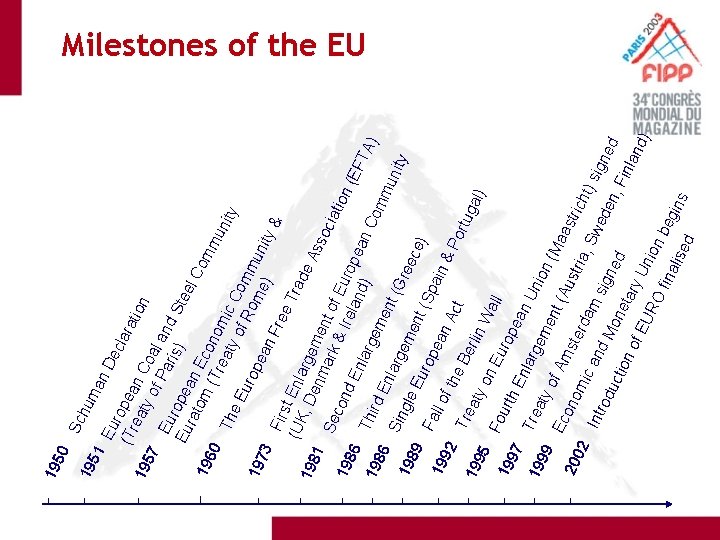
51 hu Sc ma n Eu De rop cla (Tr rat ea ea n. C ion 19 ty o 57 of a Pa l a n Eu ris d S ) tee Eu ropea rat l. C n om Ec om 19 60 mu (Tr ono m e nit aty ic Th y C e. E o o f m uro Ro 197 pe me mun a ity 3 ) n. F & Firs ree t Tra (UK Enla de rge , D 198 As e m 1 nm e soc n ark t of Se iati con &I E on 198 u rela rop d. E (EF 6 e n n a d TA l arg n. C Th ) 19 ) i r e o d. E me 86 mm nla nt ( uni Sin rge G ty 19 r g e m l e e 89 ent ce) Eu ( r S o Fa pai pe ll o 19 a n& n 92 f th A Po c e. B t Tre rtu erl gal 19 a in W ty o ) 95 n a Fo Eu ll urt 19 r o pe 97 h. E an n l T a Un rea rge 19 ion 99 me ty o (M nt f. A Ec aa ( A ms on ust str 20 t o erd ich 02 ria mic , t) s a S m an Int w ign s ed rod d. M ign ed e uct n, e o d n Fin ion eta lan ry of d) Un EU ion RO be fina gi n lise s d 19 50 19 Milestones of the EU
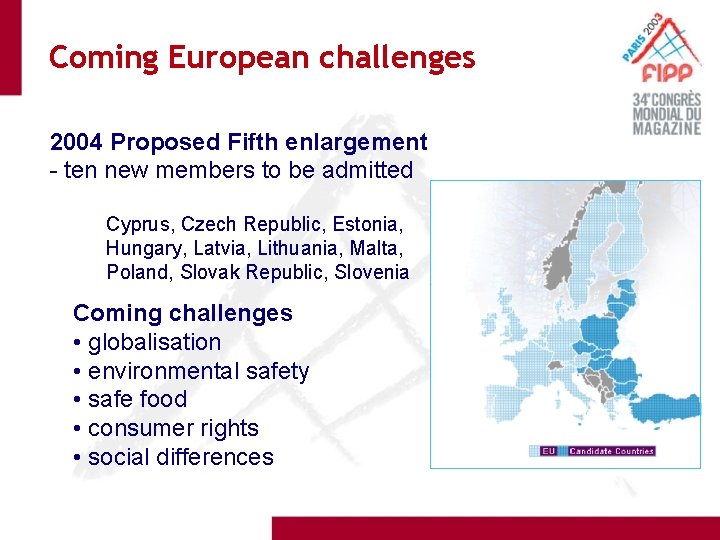
Coming European challenges 2004 Proposed Fifth enlargement - ten new members to be admitted Cyprus, Czech Republic, Estonia, Hungary, Latvia, Lithuania, Malta, Poland, Slovak Republic, Slovenia Coming challenges • globalisation • environmental safety • safe food • consumer rights • social differences
Decision making process within the EU Pauli Leimio, CEO United Magazines Ltd
Three levels of power-sharing The European Commission n plays a role similar to national political parties n only organ that is allowed to initiate draft legislation The European Parliament n plays a role similar to national parliaments n can challenge and amend the initial proposal The Council of Ministers n shares the same powers as the European Parliament Shared powers in codecision

Individual Member States retain total sovereignty over n Education n Health n Culture n Tax n Internal security n Foreign affairs
The European Commission Drafts legal proposals n A Directive must be transposed into national legislation and passed at national level by the national parliament n A Regulation has a direct effect at national level leaves no flexibility for national circumstances
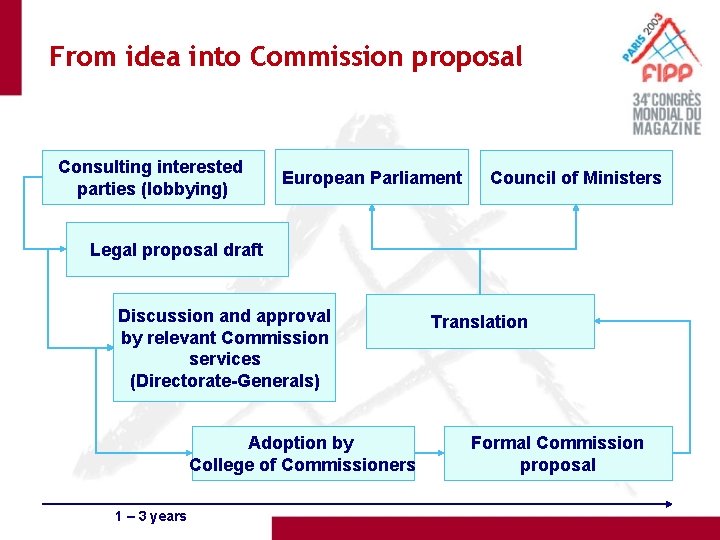
From idea into Commission proposal Consulting interested parties (lobbying) European Parliament Council of Ministers Legal proposal draft Discussion and approval by relevant Commission services (Directorate-Generals) Adoption by College of Commissioners 1 – 3 years Translation Formal Commission proposal
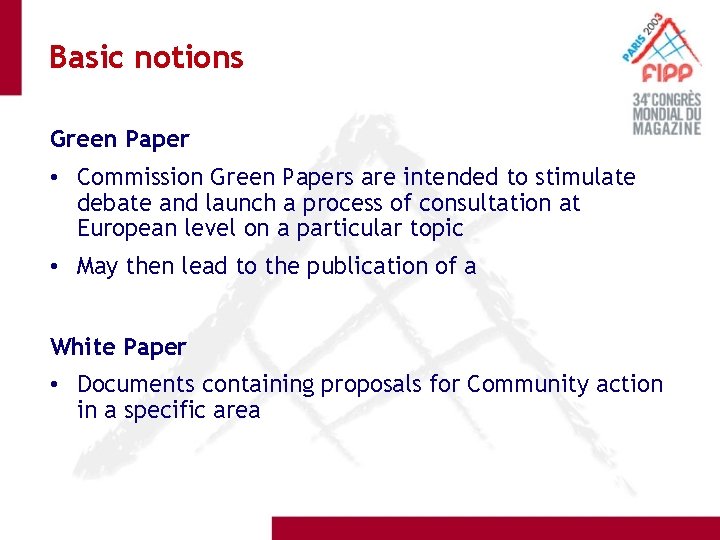
Basic notions Green Paper • Commission Green Papers are intended to stimulate debate and launch a process of consultation at European level on a particular topic • May then lead to the publication of a White Paper • Documents containing proposals for Community action in a specific area
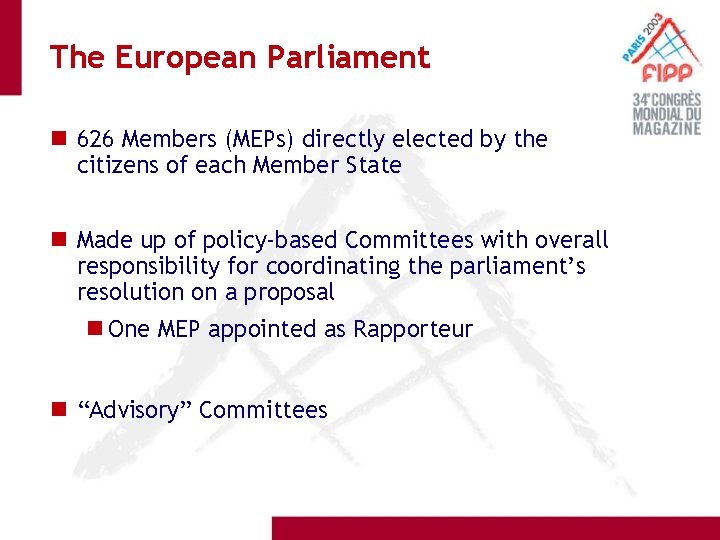
The European Parliament n 626 Members (MEPs) directly elected by the citizens of each Member State n Made up of policy-based Committees with overall responsibility for coordinating the parliament’s resolution on a proposal n One MEP appointed as Rapporteur n “Advisory” Committees
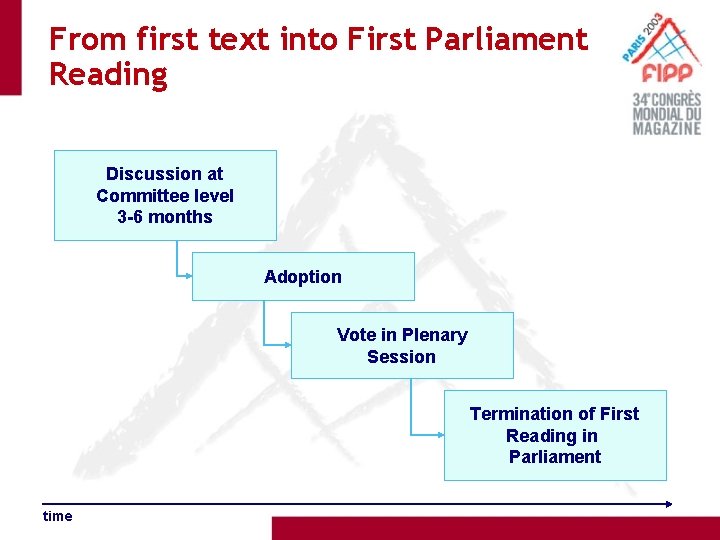
From first text into First Parliament Reading Discussion at Committee level 3 -6 months Adoption Vote in Plenary Session Termination of First Reading in Parliament time
The Council of Ministers n Consists of Working Groups n Discusses proposals simultaneously with the Parliament
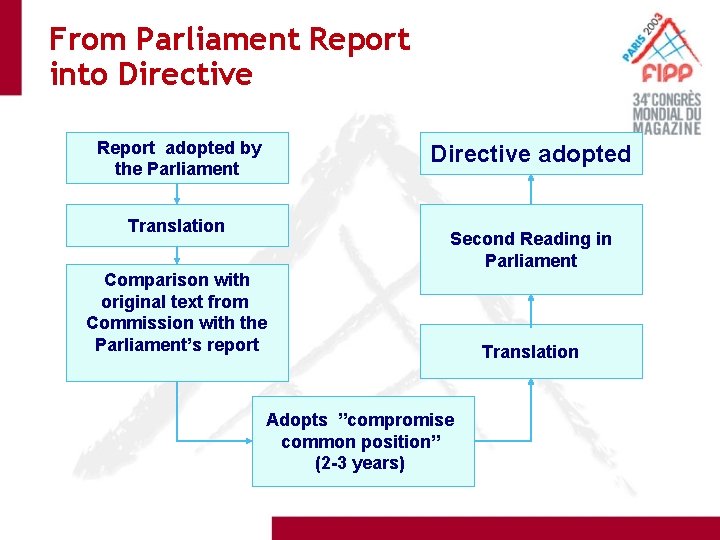
From Parliament Report into Directive Report adopted by the Parliament Directive adopted Translation Comparison with original text from Commission with the Parliament’s report Second Reading in Parliament Adopts ”compromise common position” (2 -3 years) Translation
The Impact of the European Union on Publishing in Europe Francisco Pinto Balsemao President and CEO Impresa, Portugal
What is the European Publishers Council? n Senior group of publishers with interests in common n Express role of reviewing and taking action on EU legislation n Securing the future viability of private media companies n Safeguarding the freedom of expression
Welcome to the European Constitution n The Convention and the “future of Europe” n Greater visibility and transparency n More legal certainty and efficiency in rules and decision-making
1. Competition, Mergers, Acquisitions THE POSITIVE IMPACT OF THE EU n Competition policy – highly responsive to fast changing business environments n Media mergers considered from 3 angles: • ensuring open markets / preventing foreclosure • promoting access to quality content • balancing different interests at stake n Media concentration is not regarded as anticompetitive
1. Competition, Mergers, Acquisitions THE NEGATIVE IMPACT OF THE EU n Frequent calls from the European Parliament for EU-wide legislation to restrict media ownership, particularly crossmedia ownership n MEPs don’t accept that concentration is often a prerequisite to diversification, expansion and… n …ultimately the only way of protecting our own future viability n Many positive aspects to cross-media ownership – eg. new digital channels, internet content n No technical barriers to entry, not even in broadcast media - no spectrum scarcity
1. Competition, Mergers, Acquisitions THE NEGATIVE IMPACT OF THE EU n Systematic anti-competitive behaviour by publicly funded media hurts the private sector as a whole n Many outstanding complaints from TV and publishing companies against state funded broadcasters, including their activities in the online market n Commission failing in its duty to deal with the complaints and to investigate anti competitive practices n Competition is for all!
2. Content THE POSITIVE IMPACT OF THE EU n Limited powers of the Commission to regulate media content n No independent mandate to shape the area of the media n Content regulation is subject to test of proportionality n Can only act in matters necessary for the internal market
2. Content THE NEGATIVE IMPACT OF THE EU n Directive designed to provide transparency in financial markets and to prevent insider trading n If left untouched, would have introduced “content regulation” for journalists reporting on financial markets n Exposed journalists to criminal prosecution n Replaced tried and tested editorial selfregulation with inflexible laws
2. Content THE POSITIVE IMPACT OF THE COUNCIL OF EUROPE n Council of Europe produces Conventions and Recommendations for 45 countries n A new Recommendation to give access to journalists and broadcasters to major events n For every reporter barred, dozens of readers or viewers are denied access to news and what should be public information n Need to reconcile our views on copyright with freedom of expression
3 -Advertising THE NEGATIVE IMPACT OF THE EU n Constant attempts to limit our freedom to carry advertising n Total ban on tobacco advertising n Possible restrictions coming on alcohol and food advertising n Rules to determine when advertising is fair, or unfair n Is advertising to children fair? Or unfair?
4. Marketing, Consumer Protection THE POSITIVE IMPACT OF THE EU n Not all forays into marketing practices are negative! n New rules to facilitate cross border sales promotions, prize draws, competitions n Generally supported by publishers
4. Defamation, invasions of privacy THE NEGATIVE IMPACT OF THE EU n New regulations creating uncertainty in areas including n Defamation n Invasions of privacy n Publishers face claims e. g. for libel in different countries… n Consumers already have the right to go to Court in their country of residence n Publishers should have the right to have cases heard according to the laws of the country of publication
5. VAT THE POSITIVE IMPACT OF THE EU n Zero and/or reduced rates of VAT on the printed press n Proposals expected later in the year n Unlikely to undermine a Member State’s right to continue with existing zero or reduced rates n MEP’s generally supportive
6. Data protection THE POSITIVE IMPACT OF THE EU n Data Protection Directive n Exemption for ‘journalistic purposes’ n Currently under review n Need to fight abuses of data protection ‘rights’ which undermine fundamental rights of publishers
6. Data protection THE NEGATIVE IMPACT OF THE EU n Data protection in electronic communications n Rules on the use of cookies n Stringent ‘opt-in’ requirements for email marketing and n Directory entries n High cost of compliance for industry n Dubious consumer benefit
7. Public sector information THE POSITIVE IMPACT OF THE EU n Directive designed to increase transparency and user-friendliness of public sector information n Benefits to business and tax payers alike n Commission and Parliament support these objectives n Governments resist ! n Some changes are needed
8. Copyright THE POSITIVE IMPACT OF THE EU n Increasing copyright protection in the digital age n Modernising collective management of rights n Digital rights management
8. Copyright THE NEGATIVE IMPACT OF THE EU n The EU should recognise that the ownership of rights is as important as their harmonization
Profound and mixed impact of the European Union n The EU affects every aspect of our business lives n We must not lose sight of the fundamental right to the freedom of expression n No EU regulation should hinder the future viability of Europe’s media companies without which that freedom falls
The Impact of the European Union on Publishing in Europe Francisco Pinto Balsemao President and CEO Impresa, Portugal
HOW TO ACT WHEN YOUR ORGANIZATION NEEDS GUIDANCE IN THE EU ISSUES? Pauli Leimio, CEO United Magazines Ltd
FEDERATION OF EUROPEAN PUBLISHERS
EUROPEAN NEWSPAPER PUBLISHERS’ ASSOCIATION
EADP EUROPEAN ASSOCIATION OF DIRECTORY AND DATABASE PUBLISHERS
FEDERATION OF EUROPEAN MAGAZINE PUBLISHERS
Federation of european magazine publishers n 7, 000 publishers n 50, 000 magazine titles n 80 % European adults reached n € 40 billion revenues n 20 billion copies sold annually n 200, 000 EU citizens employed
FAEP’S MISSION To ensure the long-term survival and prosperity of a diverse and economically successfull magazine publishing industry within the EU
MAGAZINE TRENDS Branch is consolidating and fragmenting. Target groups are getting smaller. Number of magazines is increasing. Publishers are approaching the heart of knowledge society.
Thank you
- Slides: 48