
A Brief History of the English Language Middle
A Brief History of the English Language Middle English 1100 -1500 http: //www. youtube. com/watch? v=6 E AMq. KUimr 8
The Norman Conquest and the Battle of Hastings- 1066 - William the Conqueror, the Duke of Normandy (part of modern France), invaded and conquered England. The Normans brought with them a kind of French, which became the language of the Royal Court, and the ruling of business classes. 2
Norman Influences on English language- lower class French language- upper class Normans looked down upon English speaking people. English did not become prominent until the 14 th century. 3
The Merging of Two Languages -English had to adapt to new functions - no suitable English for many domains -Old English now archaic -Law, architecture, estate management, music, literature - specialized vocabulary -New words change pronunciation -New spellings -Foreign compounds, idioms, formulas 4
King Henry II • 1171 - Henry II declared himself overlord of Ireland, introducing Norman French and English to the country. • Had 8 children. • Youngest son took over his rein- King John • King Richard- tried to run away because he could not speak English 5
Magna Carta- 1215 • Latin for “Great Charter” • a critical document in the long historical process leading to the rule of constitutional law in the English-speaking world. • Signed by King John • http: //www. youtube. com/watch? v=Ff. Aq 0 Lp. Am. A&app=desktop 6
The 100 Years War • Consistent battle between England & France! • http: //video. about. com/europeanhistory/Overvi ew-of-the-Hundred-Years-War. htm 7
The Black Plague 1346 -1353 The plague disease, caused by Yersinia pestis, is enzootic (commonly present) in populations of fleas carried by ground rodents Killed 75 -200 million people… 1/3 of European population 8
Middle English 1399 - King Henry IV became the first king of England since the Norman Conquest whose mother tongue was English. By the end of the 14 th Century, the dialect of London had emerged as the standard dialect of what we now call Middle English. 9
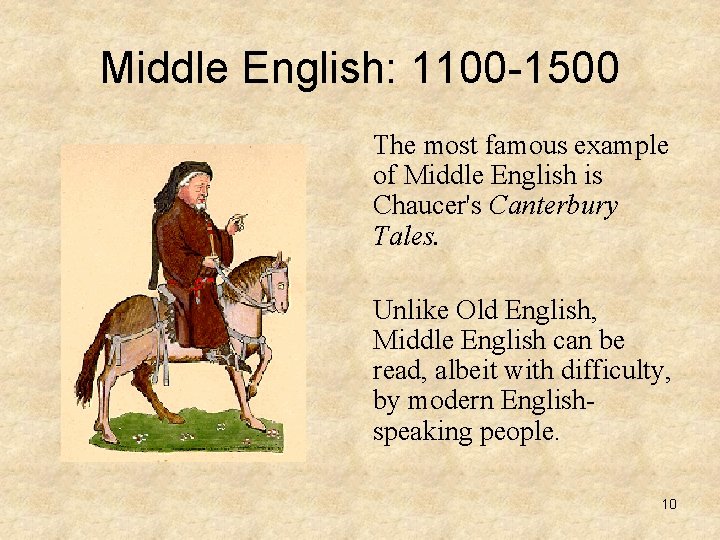
Middle English: 1100 -1500 The most famous example of Middle English is Chaucer's Canterbury Tales. Unlike Old English, Middle English can be read, albeit with difficulty, by modern Englishspeaking people. 10
Geoffrey Chaucer • In, 1359 he was captured by the French at the siege of Reims during the Hundred Years' War while serving in English army; ransomed by King Edward III a year later • Chaucer joined the royal household and became a trusted messenger and minor diplomat • Chaucer was frequently sent to the continent on secret business for the King. • Some of these trips were to Italy where he became acquainted with the works of the great Italian authors: Boccaccio, Dante, Petrarch 11
Canterbury Tales • In The Canterbury Tales, Chaucer wrote about the people he had met along the way. • A Prologue followed by a series of stories and linking dialogues and commentaries • Each character would tell 2 stories going and 2 stories coming home • uh… coming home from WHERE? • Canterbury of course 12
The Great Vowel Shift was a change in pronunciation that began around 1400 and separates Middle English from Modern English. In linguistic terms, the shift was rather sudden. To this day, vowel sounds are still shortening, and the change has become considerably more gradual. 13
- Slides: 13