
A Brief History of Process Models Brainstorming to
A Brief History of Process Models Brainstorming to CPS, Quality, and the Future
Introduction • • These slides were taken from a variety of websites and are combined together to provide a limited history of the origin of processes which led to the recognition of facilitation as a skill set. The neutral skill set of the facilitator, as described by Rees, comes from the initiation of brainstorming, quality and futures, for the purposes of actively creating ways and means of changing the way “things” are done. Modern, twentieth century antecedents come from England, the U. S. Russia and Japan. It can also be said that the enlightenment, romanticism and the scientific method inform these processes and our understanding of human engagement and decision-making.

Alex Osborn: http: //www. accelerateinnovation. com/alex_f_osborn. htm • • • Osborn joined the advertising agency of Barton & Durstine in August of 1919. In 1928, Barton, Durstine and Osborn merged with the George Batten firm and would become known as Batten, Barton, Durstine and Osborn (BBD&O) Osborn became general manager of BBD&O in 1939 and went on to become its chairman, then vice chairman until his retirement in 1960. He served as a council member for the University of Buffalo from 1951 -1959 Mr. Osborn died of cancer on May 5, 1966, at the age of 77

Alex Osborn and Brainstorming • • Brainstorming is a group creativity technique designed to generate a large number of ideas. The method was first popularized in the late 1930 s by Alex Osborn proposed that groups could double their creative output by using the method of brainstorming. Brainstorming has become a popular group technique.
Brainstorming Pros and Cons Issues influencing brainstorming effectiveness – – • distraction, social loafing evaluation apprehension, and production blocking potential benefits of brainstorming – – – enhancing the enjoyment of group work improving morale a useful exercise for team building.
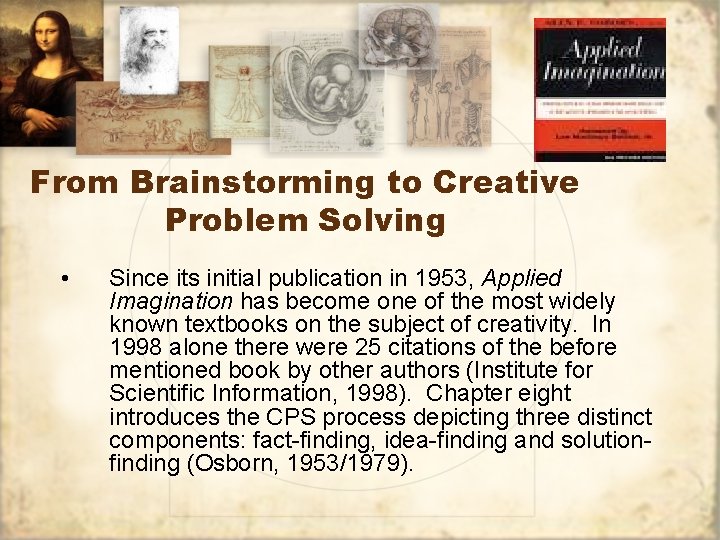
From Brainstorming to Creative Problem Solving • Since its initial publication in 1953, Applied Imagination has become one of the most widely known textbooks on the subject of creativity. In 1998 alone there were 25 citations of the before mentioned book by other authors (Institute for Scientific Information, 1998). Chapter eight introduces the CPS process depicting three distinct components: fact-finding, idea-finding and solutionfinding (Osborn, 1953/1979).
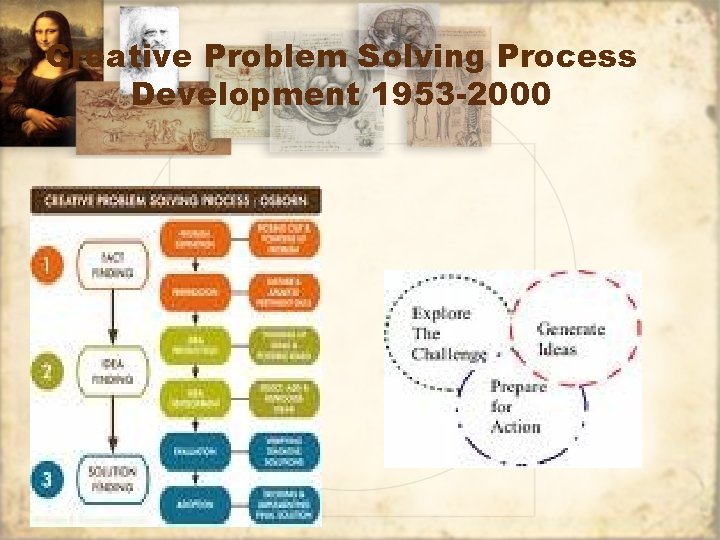
Creative Problem Solving Process Development 1953 -2000
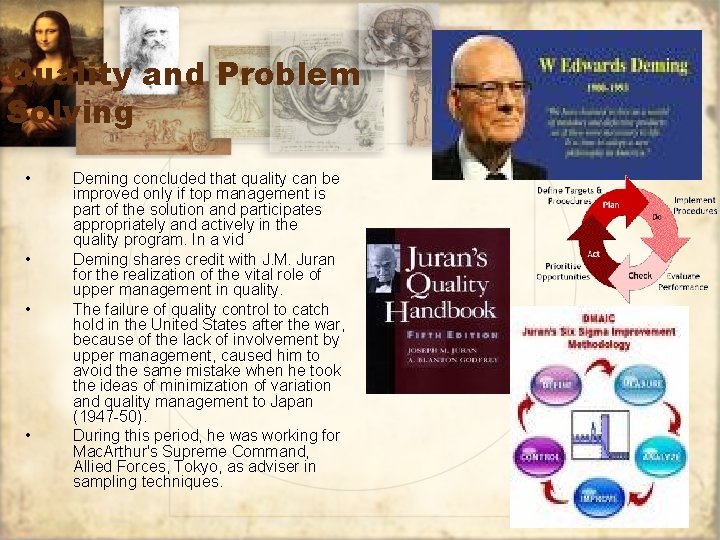
Quality and Problem Solving • • Deming concluded that quality can be improved only if top management is part of the solution and participates appropriately and actively in the quality program. In a vid Deming shares credit with J. M. Juran for the realization of the vital role of upper management in quality. The failure of quality control to catch hold in the United States after the war, because of the lack of involvement by upper management, caused him to avoid the same mistake when he took the ideas of minimization of variation and quality management to Japan (1947 -50). During this period, he was working for Mac. Arthur's Supreme Command, Allied Forces, Tokyo, as adviser in sampling techniques.
TRIZ • TRIZ (IPA: /triːz/) is a romanized acronym for Russian “Теория решения изобретательских задач” (Teoriya Resheniya Izobretatelskikh Zadatch) meaning "Theory of solving inventive problems" or "Theory of inventive problem solving". • It was developed by Soviet engineer and researcher Genrich Altshuller and his colleagues starting in 1946. It has been evolving ever since. Today, TRIZ is a methodology, tool set, knowledge base, and model-based technology for generating innovative ideas and solutions for problem solving. TRIZ provides tools and methods for use in problem formulation, system analysis, failure analysis, and patterns of system evolution (both 'as -is' and 'could be'). • •
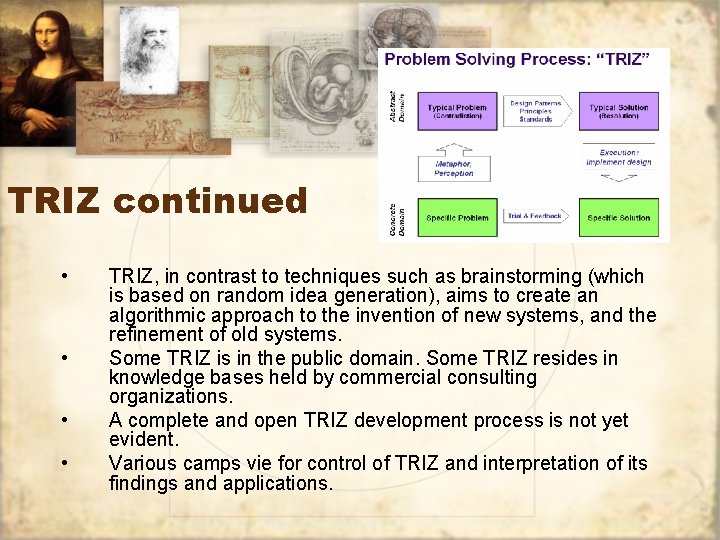
TRIZ continued • • TRIZ, in contrast to techniques such as brainstorming (which is based on random idea generation), aims to create an algorithmic approach to the invention of new systems, and the refinement of old systems. Some TRIZ is in the public domain. Some TRIZ resides in knowledge bases held by commercial consulting organizations. A complete and open TRIZ development process is not yet evident. Various camps vie for control of TRIZ and interpretation of its findings and applications.
From process to facilitation • • • As the diagrams suggest –process, steps and ideals competed for viability. Action Science and Research also developed during the 20 th Century Weisbord and Janoff work to highlight the environment and intentions, leading to a more neutral role for leaders and processes
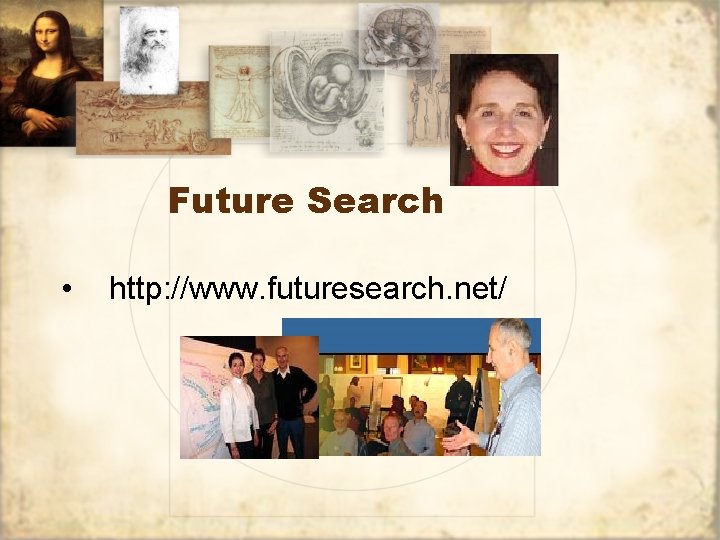
Future Search • http: //www. futuresearch. net/
Future Search Historical Roots and Theoretical Basis • Future Search derives from wellresearched theories on the conditions under which diverse groups will cooperate (Weisbord, et al 1992).
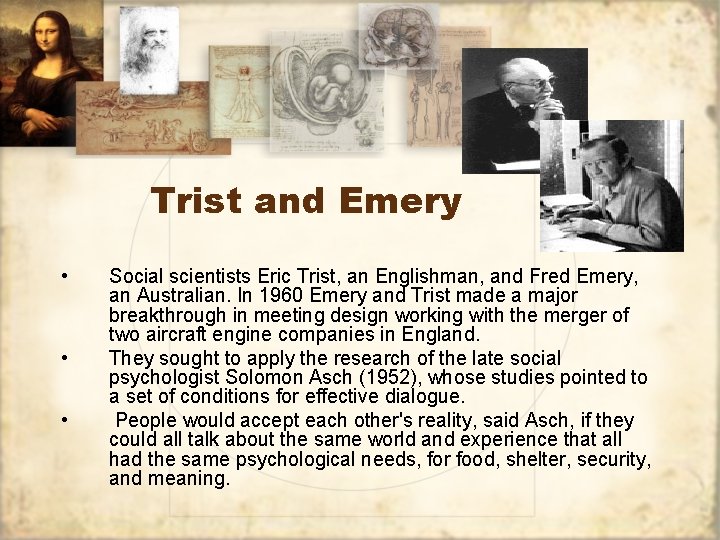
Trist and Emery • • • Social scientists Eric Trist, an Englishman, and Fred Emery, an Australian. In 1960 Emery and Trist made a major breakthrough in meeting design working with the merger of two aircraft engine companies in England. They sought to apply the research of the late social psychologist Solomon Asch (1952), whose studies pointed to a set of conditions for effective dialogue. People would accept each other's reality, said Asch, if they could all talk about the same world and experience that all had the same psychological needs, for food, shelter, security, and meaning.
Trist and Emery, continued • • • People could then begin to treat "my facts" and "your facts" as "our facts", opening the door to effective planning. This first "Search Conference" was designed so that people compared notes on the state of the world and the aircraft industry as a whole before getting down to conflicts between the two merged companies. (One made piston engines, the other jets. ) One outcome of the meeting was a new engine that today powers the BA 146, still in service.
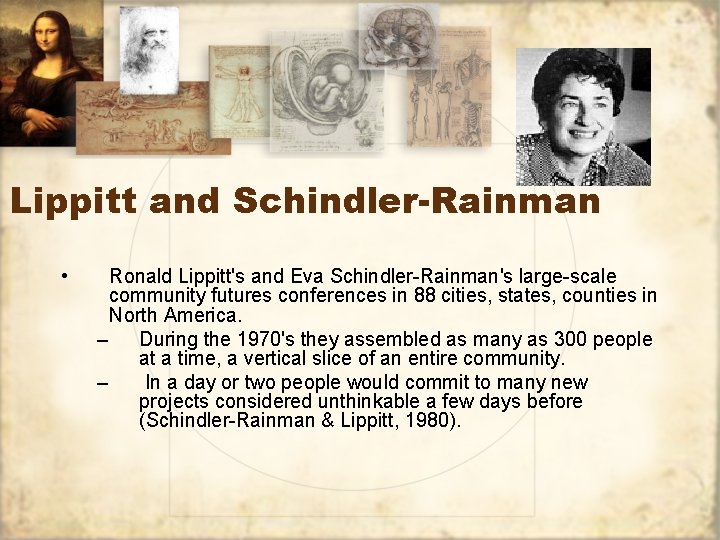
Lippitt and Schindler-Rainman • Ronald Lippitt's and Eva Schindler-Rainman's large-scale community futures conferences in 88 cities, states, counties in North America. – During the 1970's they assembled as many as 300 people at a time, a vertical slice of an entire community. – In a day or two people would commit to many new projects considered unthinkable a few days before (Schindler-Rainman & Lippitt, 1980).
Taken Together • • • We learned to get the whole system in the room and focus on the future, not problems and conflicts. From Trist and Emery we learned the importance of getting everybody to talk about the same world and having people manage their own planning (Weisbord, et al, 1992). The name "future search" honors both sets of ancestors.
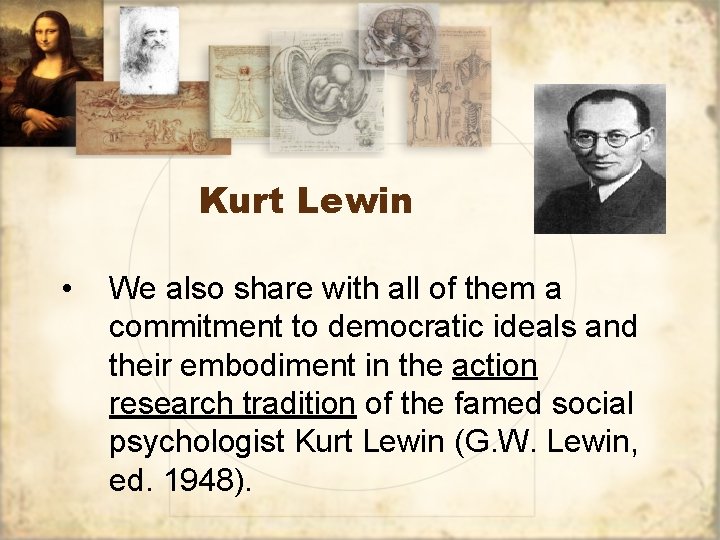
Kurt Lewin • We also share with all of them a commitment to democratic ideals and their embodiment in the action research tradition of the famed social psychologist Kurt Lewin (G. W. Lewin, ed. 1948).
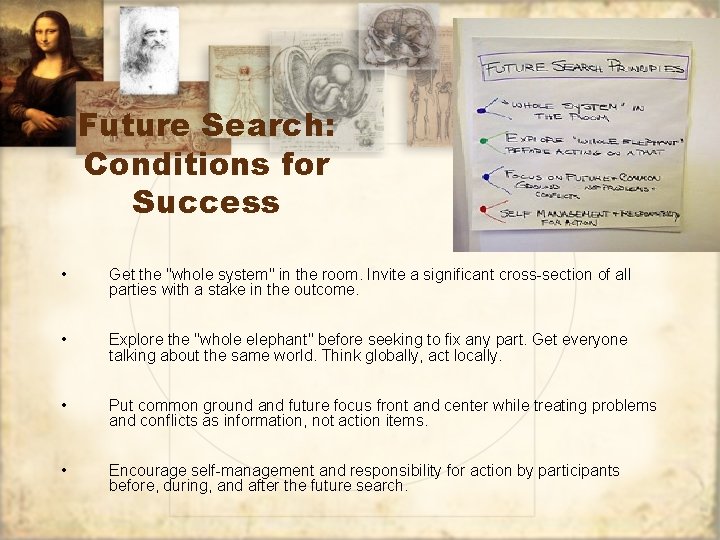
Future Search: Conditions for Success • Get the "whole system" in the room. Invite a significant cross-section of all parties with a stake in the outcome. • Explore the "whole elephant" before seeking to fix any part. Get everyone talking about the same world. Think globally, act locally. • Put common ground and future focus front and center while treating problems and conflicts as information, not action items. • Encourage self-management and responsibility for action by participants before, during, and after the future search.
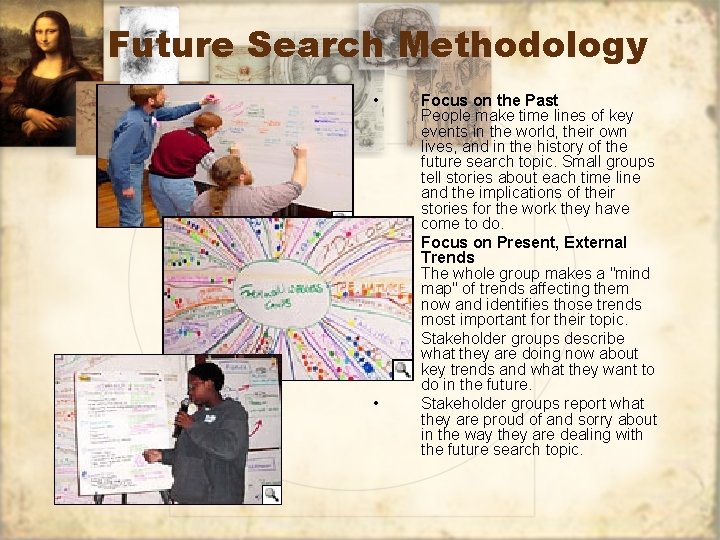
Future Search Methodology • • Focus on the Past People make time lines of key events in the world, their own lives, and in the history of the future search topic. Small groups tell stories about each time line and the implications of their stories for the work they have come to do. Focus on Present, External Trends The whole group makes a "mind map" of trends affecting them now and identifies those trends most important for their topic. Stakeholder groups describe what they are doing now about key trends and what they want to do in the future. Stakeholder groups report what they are proud of and sorry about in the way they are dealing with the future search topic.
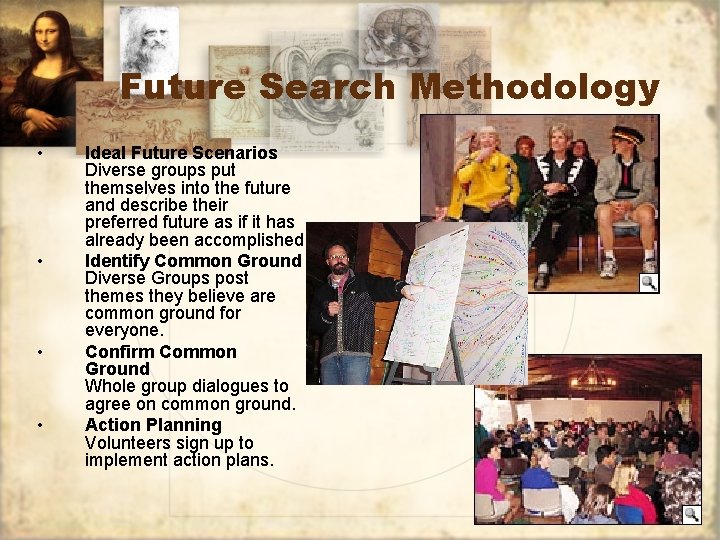
Future Search Methodology • • Ideal Future Scenarios Diverse groups put themselves into the future and describe their preferred future as if it has already been accomplished. Identify Common Ground Diverse Groups post themes they believe are common ground for everyone. Confirm Common Ground Whole group dialogues to agree on common ground. Action Planning Volunteers sign up to implement action plans.
• Facilitating • What to consider….
Philosophy of Facilitating A Theory of Facilitating • Future Search facilitators believe that: • • Every person and every group is doing the best they can with what they have every minute of every day. People do only what they are ready, willing and able to do. People need not change their own minds or anyone else's for a group to discover its common ground and potential for action. - • • • The facilitator's task is to keep the group whole and working together, not to fix problems, resolve differences, or motivate action. Groups stay whole and develop greater capacity when they (a) discover their real differences in belief, skill, and function, and (b) integrate their capabilities for a common purpose. Groups tend to fragment around differences, whether real or imagined. The facilitator's job is make sure no person becomes a scapegoat due to a personal trait, feeling, or point of view. Facilitators are responsible for boundaries of time and task, not for content, analysis, direction, interpretation, meaning, or synthesis.
Role and Responsibilities of the Facilitator • Verbal Techniques: What to Say- Chapter 3 – • Non Verbal Techniques: What to Do Chapter 4 – • Asking Questions, Probing, Paraphrasing, Redirecting Questions/Comments, Referencing Back, Giving Positive Reinforcement, Including Quieter Members, Encouraging Divergent Views, Shifting Perspective, Summarizing, Bridging Active Listening, Voice, Eye Contact, Attentiveness, Facial Expressions, Silence, Body Language, Position and Movement in the Room, Distracting Habits, Enthusiasm, Dress. Recording Techniques: Chapter 5
Your Task • • • Consider last week’s class and our creativity workshop…. Read Rees Part 2: Basic Facilitation Skills Recall me – Diane –as your facilitator Using the previous slide as a guide, describe when I did each of the items listed. Submit your thoughts to the discussion board
- Slides: 25