
A Brief History of Lognormal and Power Law
A Brief History of Lognormal and Power Law Distributions and an Application to File Size Distributions Michael Mitzenmacher Harvard University
Motivation: General • Power laws now everywhere in computer science. – See the popular texts Linked by Barabasi or Six Degrees by Watts. – File sizes, download times, Internet topology, Web graph, etc. • Other sciences have known about power laws for a long time. – Economics, physics, ecology, linguistics, etc. • We should know history before diving in.
Motivation: Specific • Recent work on file size distributions – Downey (2001): file sizes have lognormal distribution (model and empirical results). – Barford et al. (1999): file sizes have lognormal body and Pareto (power law) tail. (empirical) • Understanding file sizes important for – Simulation tools: SURGE – Explaining network phenomena: power law for file sizes may explain self-similarity of network traffic. • Wanted to settle discrepancy. • Found rich (and insufficiently cited) history. • Helped lead to new file size model.

Power Law Distribution • A power law distribution satisfies • Pareto distribution – Log-complementary cumulative distribution function (ccdf) is exactly linear. • Properties – Infinite mean/variance possible

Lognormal Distribution • X is lognormally distributed if Y = ln X is normally distributed. • Density function: • Properties: – Finite mean/variance. – Skewed: mean > median > mode – Multiplicative: X 1 lognormal, X 2 lognormal implies X 1 X 2 lognormal.
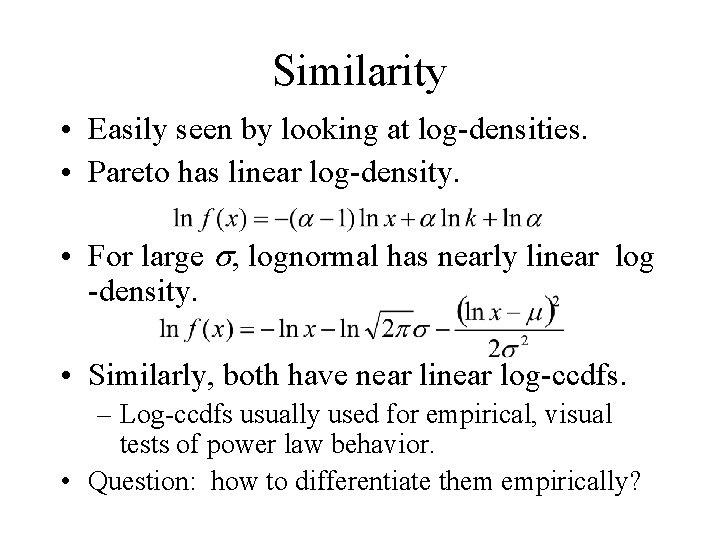
Similarity • Easily seen by looking at log-densities. • Pareto has linear log-density. • For large s, lognormal has nearly linear log -density. • Similarly, both have near linear log-ccdfs. – Log-ccdfs usually used for empirical, visual tests of power law behavior. • Question: how to differentiate them empirically?
Lognormal vs. Power Law • Question: Is this distribution lognormal or a power law? – Reasonable follow-up: Does it matter? • Primarily in economics – Income distribution. – Stock prices. (Black-Scholes model. ) • But also papers in ecology, biology, astronomy, etc.
History • Power laws – Pareto : income distribution, 1897 – Zipf-Auerbach: city sizes, 1913/1940’s – Zipf-Estouf: word frequency, 1916/1940’s – Lotka: bibliometrics, 1926 – Mandelbrot: economics/information theory, 1950’s+ • Lognormal – Mc. Alister, Kapetyn: 1879, 1903. – Gibrat: multiplicative processes, 1930’s.
Generative Models: Power Law • Preferential attachment – Dates back to Yule (1924), Simon (1955). • Yule: species and genera. • Simon: income distribution, city population distributions, word frequency distributions. – Web page degrees: more likely to link to page with many links. • Optimization based – Mandelbrot (1953): optimize information per character. – HOT model for file sizes. Zhu et al. (2001)
Preferential Attachment • Consider dynamic Web graph. – Pages join one at a time. – Each page has one outlink. • Let Xj(t) be the number of pages of degree j at time t. • New page links: – With probability a, link to a random page. – With probability (1 - a), a link to a page chosen proportionally to indegree. (Copy a link. )
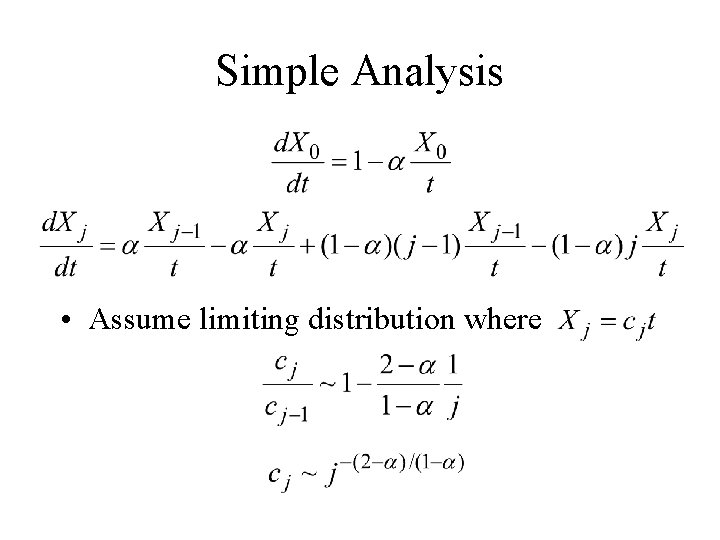
Simple Analysis • Assume limiting distribution where
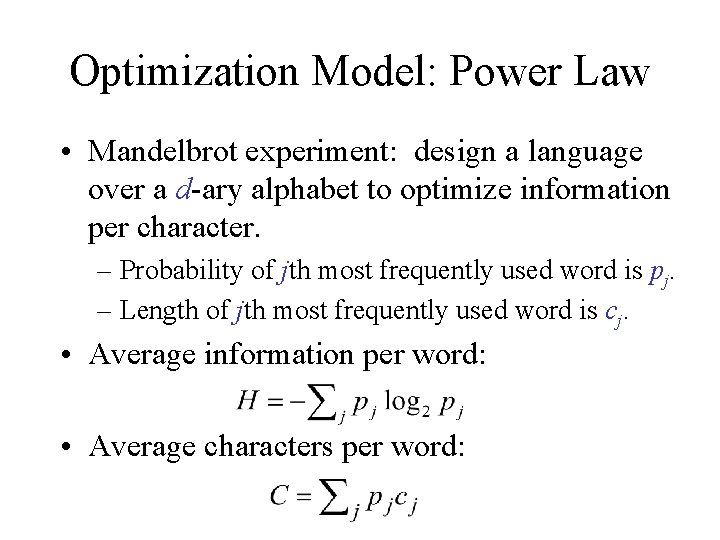
Optimization Model: Power Law • Mandelbrot experiment: design a language over a d-ary alphabet to optimize information per character. – Probability of jth most frequently used word is pj. – Length of jth most frequently used word is cj. • Average information per word: • Average characters per word:
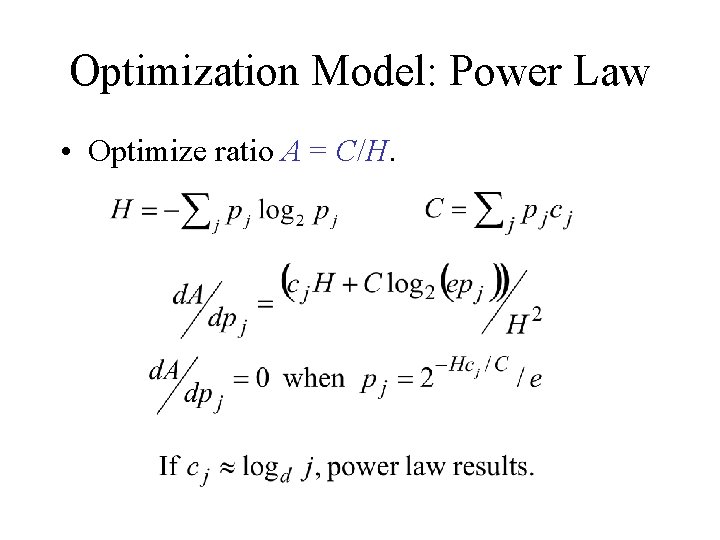
Optimization Model: Power Law • Optimize ratio A = C/H.
Monkeys Typing Randomly • Miller (psychologist, 1957) suggests following: monkeys type randomly at a keyboard. – Hit each of n characters with probability p. – Hit space bar with probability 1 - np > 0. – A word is sequence of characters separated by a space. • Resulting distribution of word frequencies follows a power law. • Conclusion: Mandelbrot’s “optimization” not required for languages to have power law
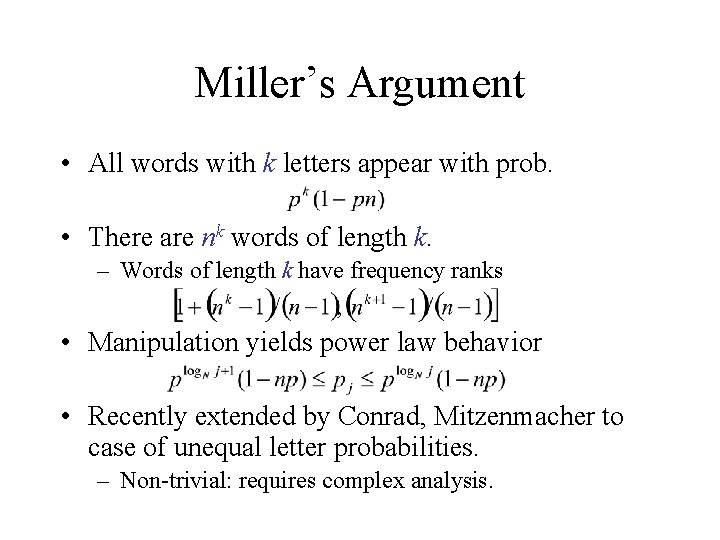
Miller’s Argument • All words with k letters appear with prob. • There are nk words of length k. – Words of length k have frequency ranks • Manipulation yields power law behavior • Recently extended by Conrad, Mitzenmacher to case of unequal letter probabilities. – Non-trivial: requires complex analysis.
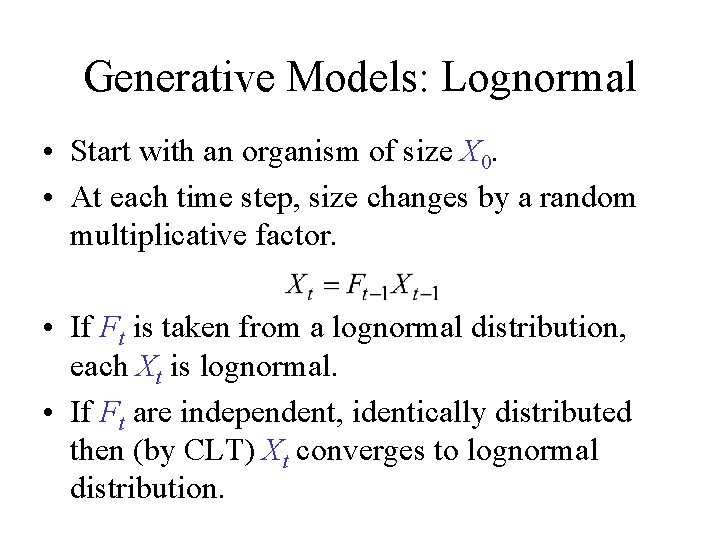
Generative Models: Lognormal • Start with an organism of size X 0. • At each time step, size changes by a random multiplicative factor. • If Ft is taken from a lognormal distribution, each Xt is lognormal. • If Ft are independent, identically distributed then (by CLT) Xt converges to lognormal distribution.
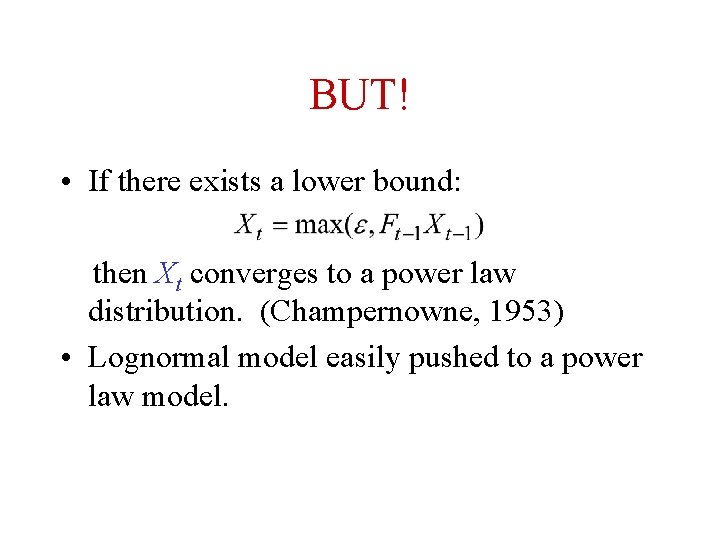
BUT! • If there exists a lower bound: then Xt converges to a power law distribution. (Champernowne, 1953) • Lognormal model easily pushed to a power law model.
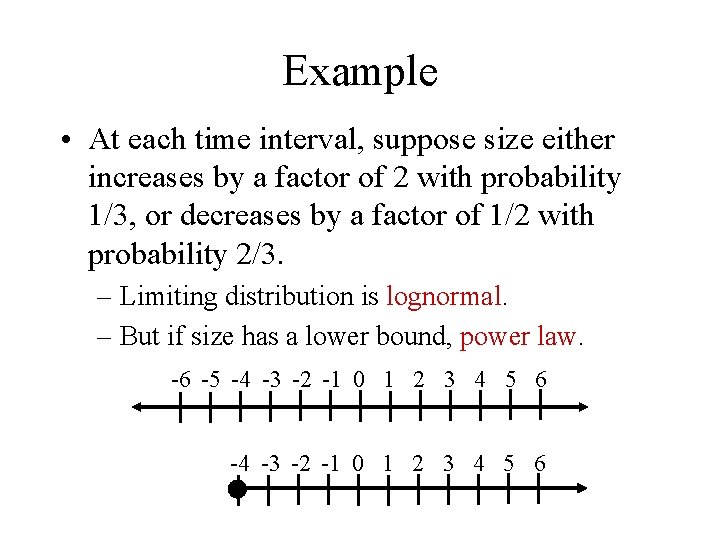
Example • At each time interval, suppose size either increases by a factor of 2 with probability 1/3, or decreases by a factor of 1/2 with probability 2/3. – Limiting distribution is lognormal. – But if size has a lower bound, power law. -6 -5 -4 -3 -2 -1 0 1 2 3 4 5 6
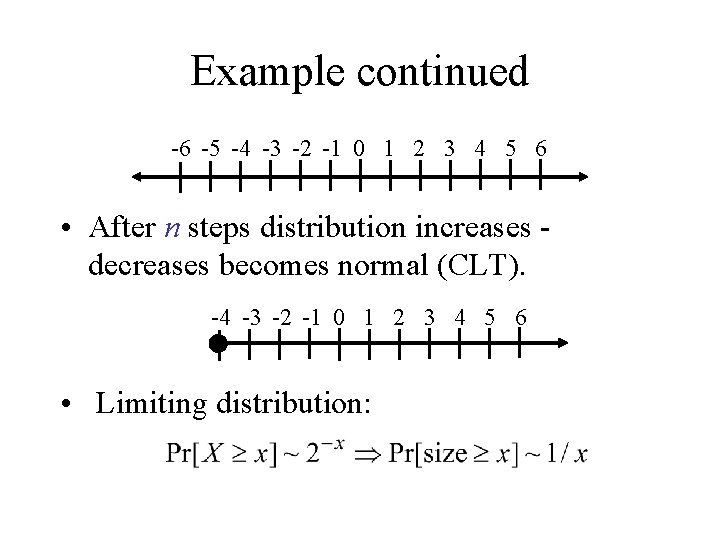
Example continued -6 -5 -4 -3 -2 -1 0 1 2 3 4 5 6 • After n steps distribution increases decreases becomes normal (CLT). -4 -3 -2 -1 0 1 2 3 4 5 6 • Limiting distribution:
Double Pareto Distributions • Consider continuous version of lognormal generative model. – At time t, log Xt is normal with mean mt and variance s 2 t • Suppose observation time is randomly distributed. – Income model: observation time depends on age, generations in the country, etc.
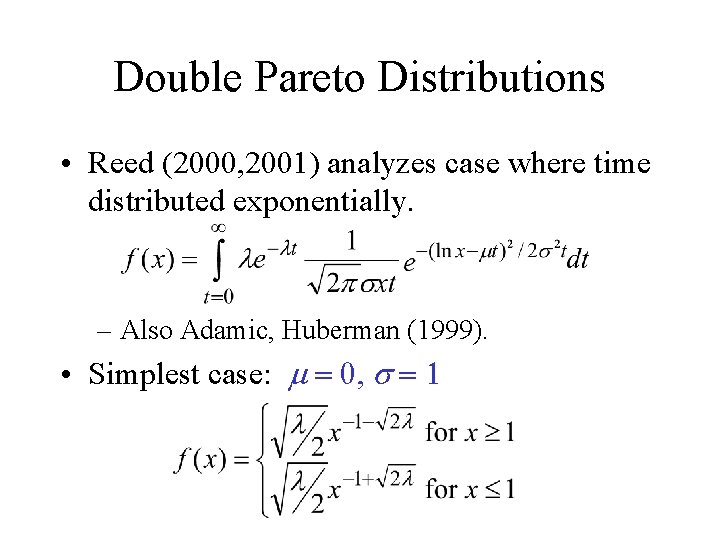
Double Pareto Distributions • Reed (2000, 2001) analyzes case where time distributed exponentially. – Also Adamic, Huberman (1999). • Simplest case: m = 0, s = 1
Double Pareto Behavior • Double Pareto behavior, density – On log-log plot, density is two straight lines – Between lognormal (curved) and power law (one line) • Can have lognormal shaped body, Pareto tail. – The ccdf has Pareto tail; linear on log-log plots. – But cdf is also linear on log-log plots.
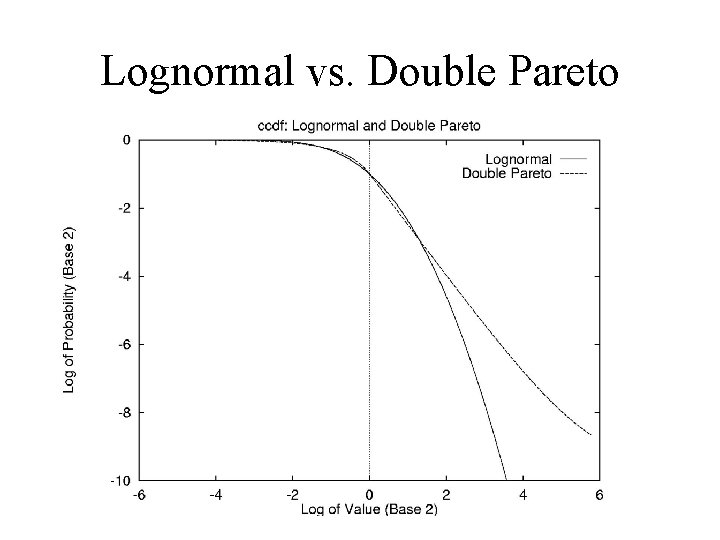
Lognormal vs. Double Pareto
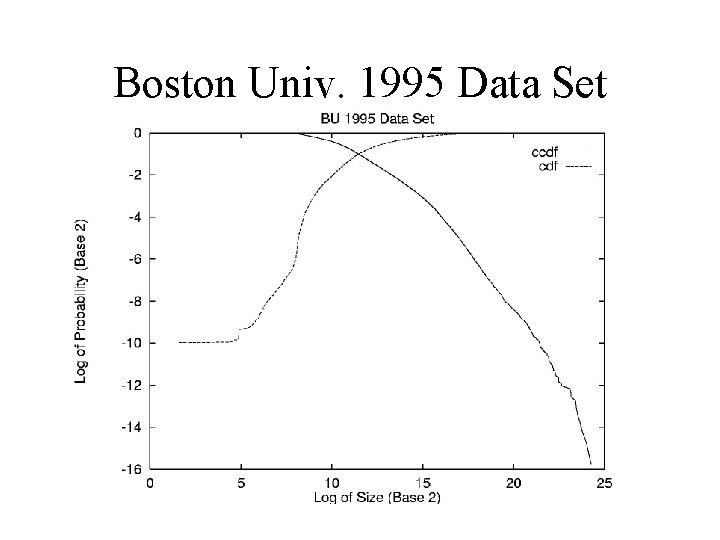
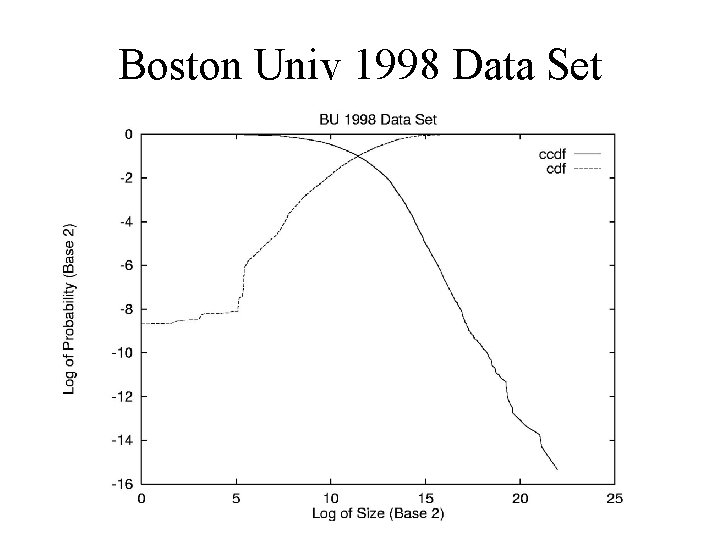
Double Pareto File Sizes • Reed used Double Pareto to explain income distribution – Appears to have lognormal body, Pareto tail. • Double Pareto shape closely matches empirical file size distribution. – Appears to have lognormal body, Pareto tail. • Is there a reasonable model for file sizes that yields a Double Pareto Distribution?
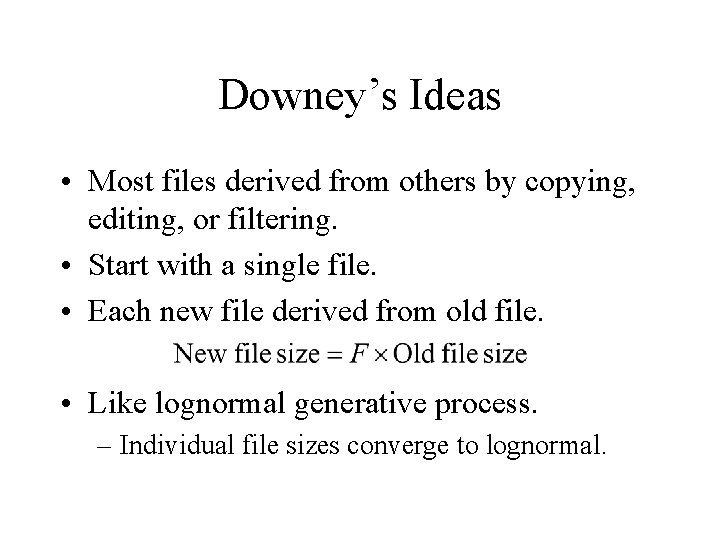
Downey’s Ideas • Most files derived from others by copying, editing, or filtering. • Start with a single file. • Each new file derived from old file. • Like lognormal generative process. – Individual file sizes converge to lognormal.
Problems • “Global” distribution not lognormal. – Mixture of lognormal distributions. • Everything derived from single file. – Not realistic. – Large correlation: one big file near root affects everybody. • Deletions not handled.
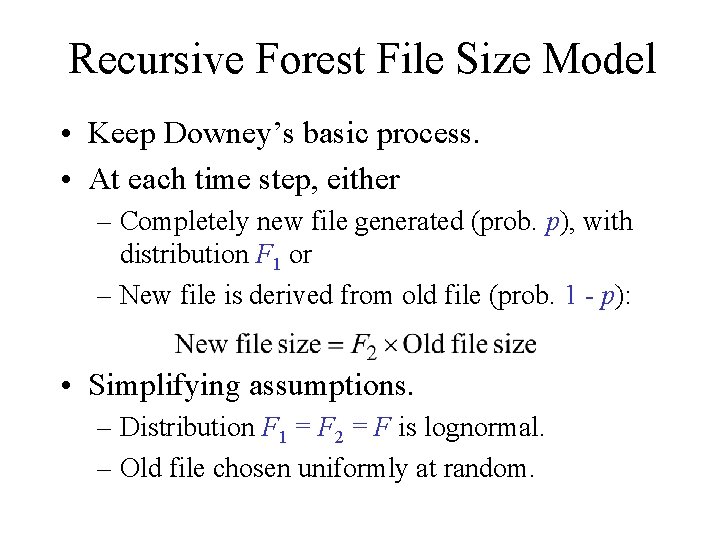
Recursive Forest File Size Model • Keep Downey’s basic process. • At each time step, either – Completely new file generated (prob. p), with distribution F 1 or – New file is derived from old file (prob. 1 - p): • Simplifying assumptions. – Distribution F 1 = F 2 = F is lognormal. – Old file chosen uniformly at random.
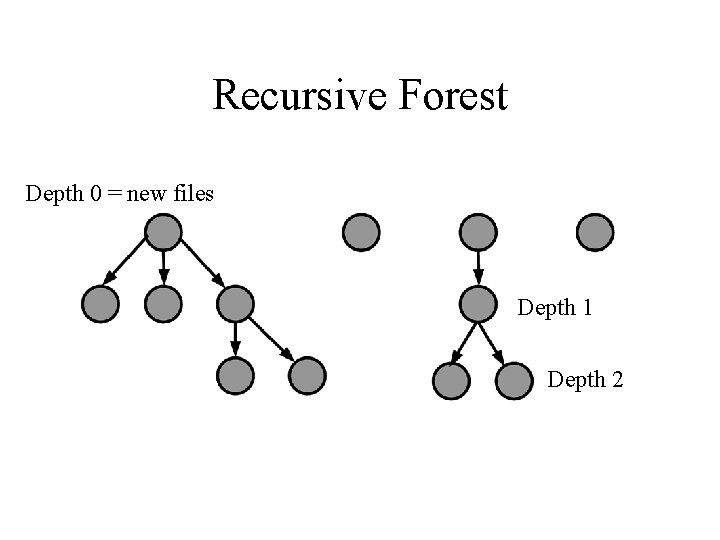
Recursive Forest Depth 0 = new files Depth 1 Depth 2
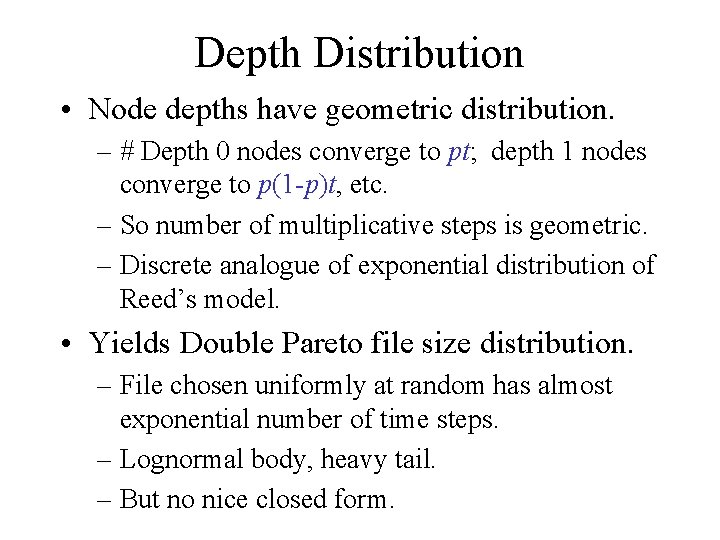
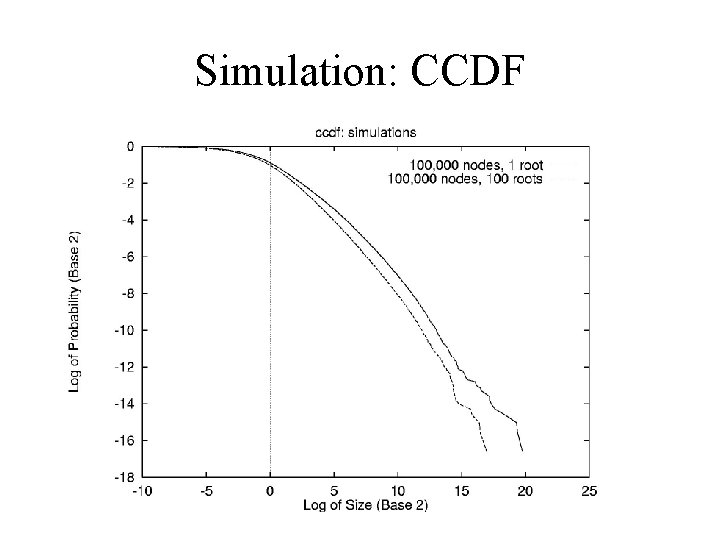
Depth Distribution • Node depths have geometric distribution. – # Depth 0 nodes converge to pt; depth 1 nodes converge to p(1 -p)t, etc. – So number of multiplicative steps is geometric. – Discrete analogue of exponential distribution of Reed’s model. • Yields Double Pareto file size distribution. – File chosen uniformly at random has almost exponential number of time steps. – Lognormal body, heavy tail. – But no nice closed form.
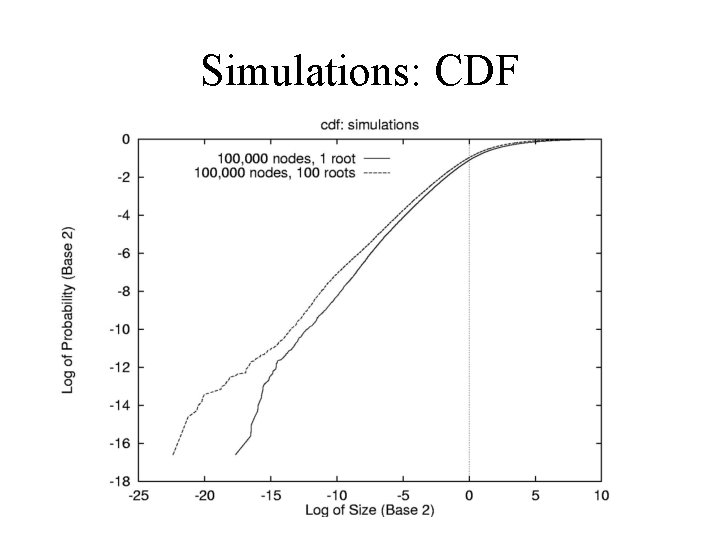
Simulations: CDF
Simulation: CCDF
Boston Univ. 1995 Data Set
Boston Univ 1998 Data Set
Extension: Deletions • Suppose files deleted uniformly at random with probability q. – New file generated with probability p. – New file derived with probability 1 - p - q. • File depths still geometrically distributed. • So still a Double Pareto file size distribution.
Extensions: Preferential Attachment • Suppose new file derived from old file with preferential attachment. – Old file chosen with weight proportional to ax + b, where x = #current children. • File depths still geometrically distributed. • So still get a double Pareto distribution.
Extensions: Correlation • Each tree in the forest is small. – Any multiplicative edge affects few files. • Martingale argument shows that small correlations do not affect distribution. • Large systems converge to Double Pareto distribution.
Extensions: Distributions • Choice of distribution F 1, F 2 matter. • But not dramatically. – Central limit theorem still applies. – General closed forms very difficult.
Previous Models • Downey – Introduced simple derivation model. • HOT [Zhu, Yu, Doyle, 2001] – Information theoretic model. – File sizes chosen by Web system designers to maximize information/unit cost to user. – Similar to early heavy tail work by Mandelbrot. – More rigorous framework also studied by Fabrikant, Koutsoupias, Papadimitriou. • Log-t distributions [Mitzenmacher, Tworetzky, 2003]
Summary of File Model • Recursive Forest File Model – is simple, general. – combines multiplicative models and simple, well-studied random graph processes. – is robust to changes (deletions, preferential attachement, etc. ) – explains lognormal body / heavy tail phenomenon.
Future Directions • Tools for characterizing double-Pareto and double-Pareto lognormal parameters. – Fine tune matches to empirical results. • Find evidence supporting/contradicting the model. – File system histories, etc. • Applications in other fields. – Explains Double Pareto distributions in generational settings.
Conclusions • Power law distributions are natural. – They are everywhere. • Many simple models yield power laws. – New paper algorithm (to be avoided). • Find empirical power law with no model. • Apply some standard model to explain power law. • Lognormal vs. power law argument natural. – Some generative models are extremely similar. – Power law appears more robust. – Double Pareto distributions may explain lognormal body / Pareto tail phenomenon.
New Directions for Power Law Research Michael Mitzenmacher Harvard University
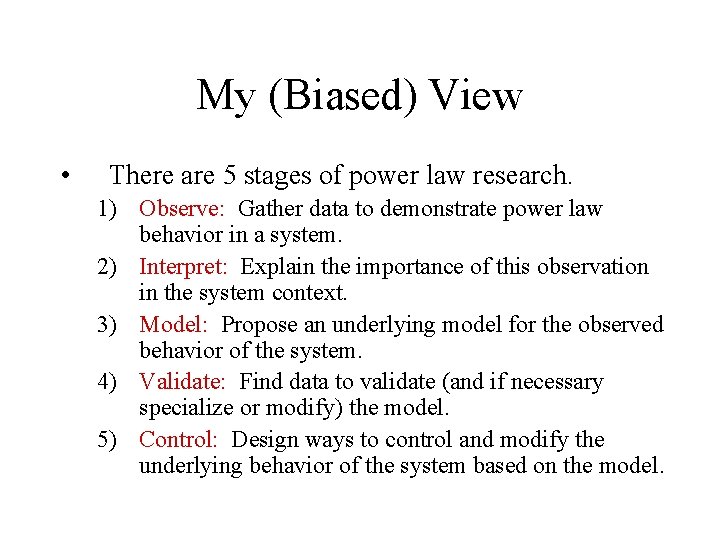
My (Biased) View • There are 5 stages of power law research. 1) Observe: Gather data to demonstrate power law behavior in a system. 2) Interpret: Explain the importance of this observation in the system context. 3) Model: Propose an underlying model for the observed behavior of the system. 4) Validate: Find data to validate (and if necessary specialize or modify) the model. 5) Control: Design ways to control and modify the underlying behavior of the system based on the model.
My (Biased) View • In networks, we have spent a lot of time observing and interpreting power laws. • We are currently in the modeling stage. – Many, many possible models. – I’ll talk about some of my favorites later on. • We need to now put much more focus on validation and control. – And these are specific areas where computer science has much to contribute!
Validation: The Current Stage • We now have so many models. • It may be important to know the right model, to extrapolate and control future behavior. • Given a proposed underlying model, we need tools to help us validate it. • We appear to be entering the validation stage of research…. BUT the first steps have focused on invalidation rather than validation.
Examples : Invalidation • Lakhina, Byers, Crovella, Xie – Show that observed power-law of Internet topology might be because of biases in traceroute sampling. • Chen, Chang, Govindan, Jamin, Shenker, Willinger – Show that Internet topology has characteristics that do not match preferential-attachment graphs. – Suggest an alternative mechanism. • But does this alternative match all characteristics, or are we still missing some?
My (Biased) View • Invalidation is an important part of the process! BUT it is inherently different than validating a model. • Validating seems much harder. • Indeed, it is arguable what constitutes a validation. • Question: what should it mean to say “This model is consistent with observed data. ”
To Control • In many systems, intervention can impact the outcome. – Maybe not for earthquakes, but for computer networks! – Typical setting: individual agents acting in their own best interest, giving a global power law. Agents can be given incentives to change behavior. • General problem: given a good model, determine how to change system behavior to optimize a global performance function. – Distributed algorithmic mechanism design. – Mix of economics/game theory and computer science.
Possible Control Approaches • Adding constraints: local or global – Example: total space in a file system. – Example: preferential attachment but links limited by an underlying metric. • Add incentives or costs – Example: charges for exceeding soft disk quotas. – Example: payments for certain AS level connections. • Limiting information – Impact decisions by not letting everyone have true view of the system.
Conclusion : My (Biased) View • There are 5 stages of power law research. 1) Observe: Gather data to demonstrate power law behavior in a system. 2) Interpret: Explain the import of this observation in the system context. 3) Model: Propose an underlying model for the observed behavior of the system. 4) Validate: Find data to validate (and if necessary specialize or modify) the model. 5) Control: Design ways to control and modify the underlying behavior of the system based on the model. • We need to focus on validation and control. – Lots of open research problems.
A Chance for Collaboration • The observe/interpret stages of research are dominated by systems; modeling dominated by theory. – And need new insights, from statistics, control theory, economics!!! • Validation and control require a strong theoretical foundation. – Need universal ideas and methods that span different types of systems. – Need understanding of underlying mathematical models. • But also a large systems buy-in. – Getting/analyzing/understanding data. – Find avenues for real impact. • Good area for future systems/theory/others collaboration and interaction.
- Slides: 51