
A Brief History of Geopolitics The study of
A Brief History of Geopolitics: The study of the interplay between political relations and the territorial context in which they occur.
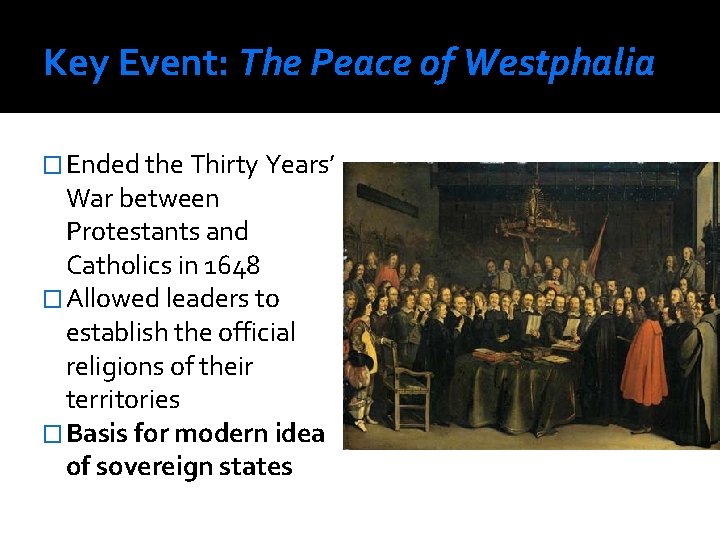
Key Event: The Peace of Westphalia � Ended the Thirty Years’ War between Protestants and Catholics in 1648 � Allowed leaders to establish the official religions of their territories � Basis for modern idea of sovereign states

Sovereignty & self-determination � Sovereignty: the right of a government to exercise power over its people and territory � Self-determination: Free choice of a state’s own actions without external compulsion. A nation’s ability to decide its own future July 2011: The South leaves Sudan
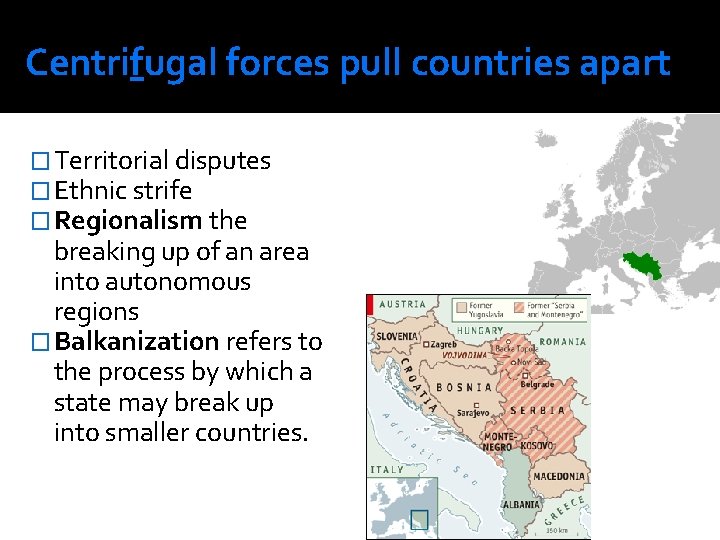
Centrifugal forces pull countries apart � Territorial disputes � Ethnic strife � Regionalism the breaking up of an area into autonomous regions � Balkanization refers to the process by which a state may break up into smaller countries.

Centripetal forces unite countries � Good institutions � Symbols of national pride, loyalty, history � Strong traditions/values � Transportation & communication systems � Strong central government � Nationalism: That one’s country should be cohesive and have autonomy Nationalism also has negative associations with militarism & racism

Colonialism � Expansion and perpetuation of an empire. Most important geopolitical force of the last 500 years Many European countries, Russia, China, Japan Ancient: Rome, Greece, Aztecs � While colonialism involves official government rule of one state over another, imperialism describes cultural and economic dominance Have self-determination, but often remain dependent
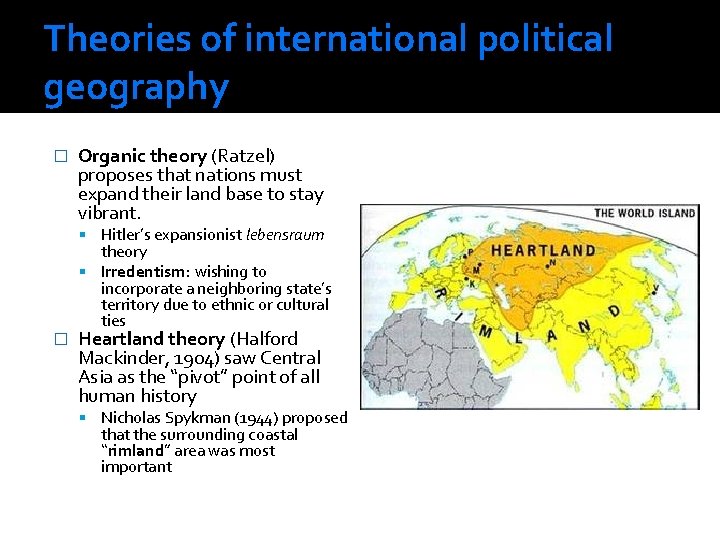
Theories of international political geography � Organic theory (Ratzel) proposes that nations must expand their land base to stay vibrant. Hitler’s expansionist lebensraum � theory Irredentism: wishing to incorporate a neighboring state’s territory due to ethnic or cultural ties Heartland theory (Halford Mackinder, 1904) saw Central Asia as the “pivot” point of all human history Nicholas Spykman (1944) proposed that the surrounding coastal “rimland” area was most important

Frontier � Frontier: Area where borders are shifting and weak where peoples of different cultures meet to lay claim to the land May be filled by buffer states (smaller states sandwiched between larger, potentially opposing countries)
Key Event: The Cold War (1945 -1989) �East/West divide �Creation of competing alliances: NATO (US & allies) Warsaw Pact (Soviet Union & allies) �Both sides made attempts to provoke coups and separatist movements in other countries. Sent radio transmissions into Eastern Europe to communicate benefits of democracy & capitalism
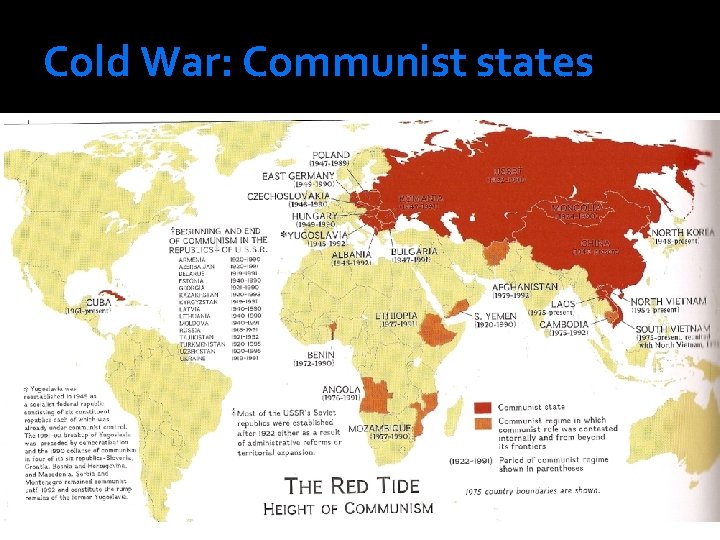
Cold War: Communist states
Alfred Sauvy, French demographer (1952) �First World: industrialized, free market (capitalist) countries of NATO and their allies Western Europe, Japan, Australia, US �Second World: industrialized, centrally controlled (communist-socialist) countries Soviet Union, Eastern Europe, China �Third World: developing countries not allied w/ 1 st or 2 nd World Developing nations of Africa, Asia, Latin America �Fourth World: least developed states, or indigenous groups living within a country.
Cold War details �Domino theory: Concern by Western leaders that if communism caught on in a few key countries, other nearby countries would follow �Satellite states: Eastern European countries funded/controlled by the Soviet Union. Created a “Iron Curtain” (cultural wall) dividing democratic, capitalist Western Europe from totalitarian, communist Eastern Europe Some regions became “shatterbelts” as they got caught between the US and USSR, resulting in changing boundaries. (also Middle East & Central America) �Soviet collapse led to geopolitical reorganization
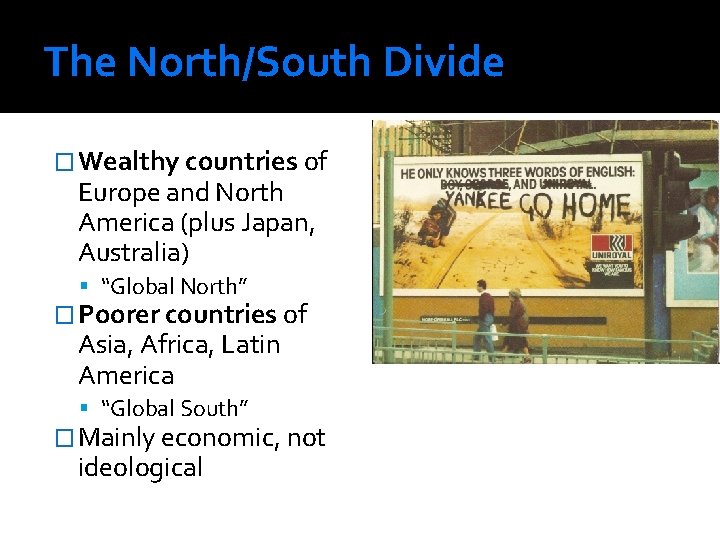
The North/South Divide � Wealthy countries of Europe and North America (plus Japan, Australia) “Global North” � Poorer countries of Asia, Africa, Latin America “Global South” � Mainly economic, not ideological
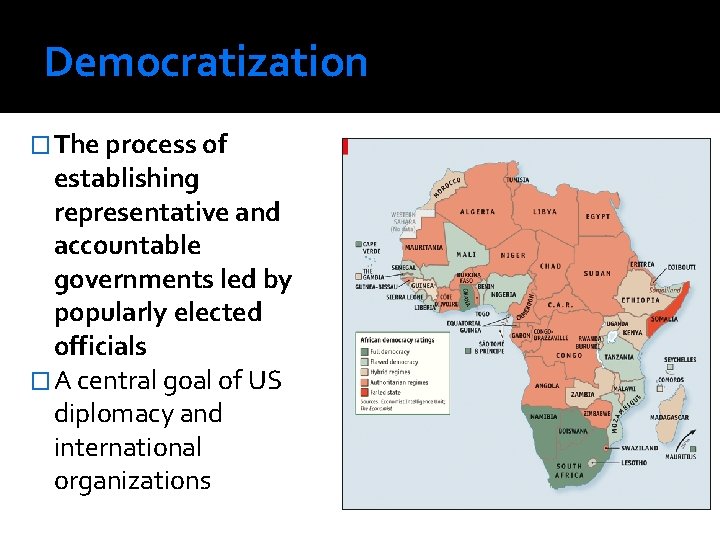
Democratization � The process of establishing representative and accountable governments led by popularly elected officials � A central goal of US diplomacy and international organizations
- Slides: 14