
A brief history of FCM 1 G Danby
A brief history of FCM 1
G. Danby, at BNL, proposed and prototyped a design of a Heavy Ion Storage Ring in 1985 (Danby, 1985). The magnet was based on a cold iron, and Nb-Ti, and was reported to have excellent performance, no training, and to be self-protected (no need for detection and dump system). G. Danby, IEEE Transactions on Nuclear Science, Vol. NS-32, No. 5, October 1985.
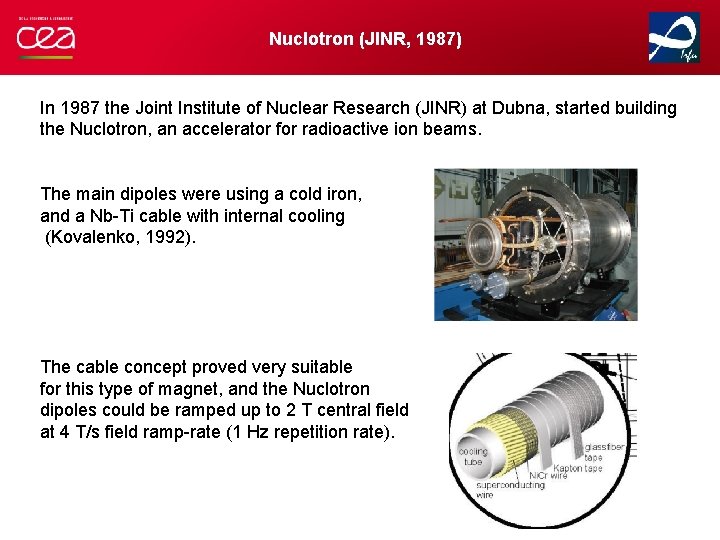
Nuclotron (JINR, 1987) In 1987 the Joint Institute of Nuclear Research (JINR) at Dubna, started building the Nuclotron, an accelerator for radioactive ion beams. The main dipoles were using a cold iron, and a Nb-Ti cable with internal cooling (Kovalenko, 1992). The cable concept proved very suitable for this type of magnet, and the Nuclotron dipoles could be ramped up to 2 T central field at 4 T/s field ramp-rate (1 Hz repetition rate).
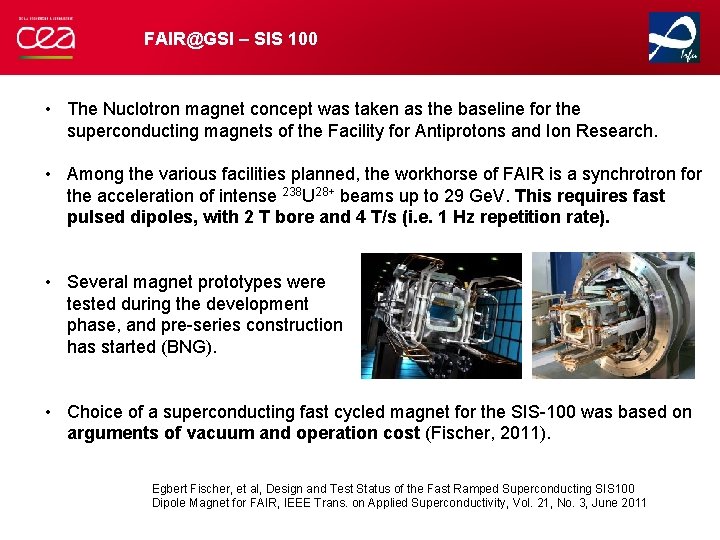
FAIR@GSI – SIS 100 • The Nuclotron magnet concept was taken as the baseline for the superconducting magnets of the Facility for Antiprotons and Ion Research. • Among the various facilities planned, the workhorse of FAIR is a synchrotron for the acceleration of intense 238 U 28+ beams up to 29 Ge. V. This requires fast pulsed dipoles, with 2 T bore and 4 T/s (i. e. 1 Hz repetition rate). • Several magnet prototypes were tested during the development phase, and pre-series construction has started (BNG). • Choice of a superconducting fast cycled magnet for the SIS-100 was based on arguments of vacuum and operation cost (Fischer, 2011). Egbert Fischer, et al, Design and Test Status of the Fast Ramped Superconducting SIS 100 Dipole Magnet for FAIR, IEEE Trans. on Applied Superconductivity, Vol. 21, No. 3, June 2011
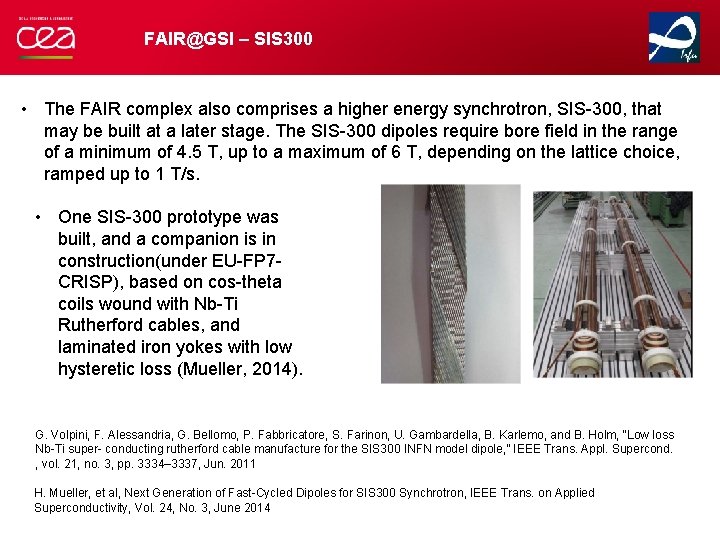
FAIR@GSI – SIS 300 • The FAIR complex also comprises a higher energy synchrotron, SIS-300, that may be built at a later stage. The SIS-300 dipoles require bore field in the range of a minimum of 4. 5 T, up to a maximum of 6 T, depending on the lattice choice, ramped up to 1 T/s. • One SIS-300 prototype was built, and a companion is in construction(under EU-FP 7 CRISP), based on cos-theta coils wound with Nb-Ti Rutherford cables, and laminated iron yokes with low hysteretic loss (Mueller, 2014). G. Volpini, F. Alessandria, G. Bellomo, P. Fabbricatore, S. Farinon, U. Gambardella, B. Karlemo, and B. Holm, “Low loss Nb-Ti super- conducting rutherford cable manufacture for the SIS 300 INFN model dipole, ” IEEE Trans. Appl. Supercond. , vol. 21, no. 3, pp. 3334– 3337, Jun. 2011 H. Mueller, et al, Next Generation of Fast-Cycled Dipoles for SIS 300 Synchrotron, IEEE Trans. on Applied Superconductivity, Vol. 24, No. 3, June 2014
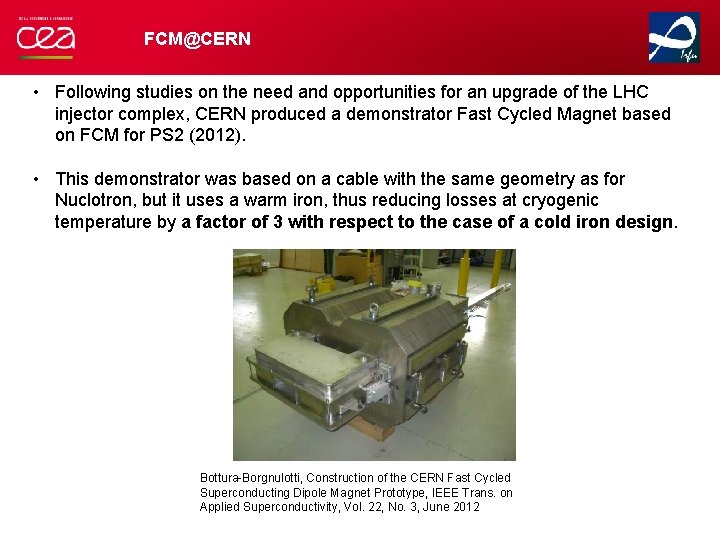
FCM@CERN • Following studies on the need and opportunities for an upgrade of the LHC injector complex, CERN produced a demonstrator Fast Cycled Magnet based on FCM for PS 2 (2012). • This demonstrator was based on a cable with the same geometry as for Nuclotron, but it uses a warm iron, thus reducing losses at cryogenic temperature by a factor of 3 with respect to the case of a cold iron design. Bottura-Borgnulotti, Construction of the CERN Fast Cycled Superconducting Dipole Magnet Prototype, IEEE Trans. on Applied Superconductivity, Vol. 22, No. 3, June 2012
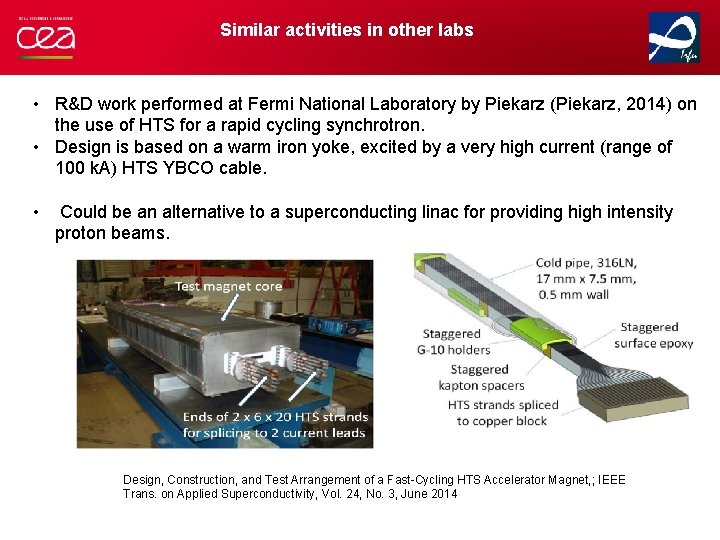
Similar activities in other labs • R&D work performed at Fermi National Laboratory by Piekarz (Piekarz, 2014) on the use of HTS for a rapid cycling synchrotron. • Design is based on a warm iron yoke, excited by a very high current (range of 100 k. A) HTS YBCO cable. • Could be an alternative to a superconducting linac for providing high intensity proton beams. Design, Construction, and Test Arrangement of a Fast-Cycling HTS Accelerator Magnet, ; IEEE Trans. on Applied Superconductivity, Vol. 24, No. 3, June 2014
Similar activities in other labs KEK was very interested to the part on HTS proposed in the Euro. Cir. Col official proposal (“… KEK will explore potentials of alternative superconducting A 15 materials (Nb 3 Al) and work on HTS cycled, low-loss magnets and …”). But recently the collaboration decided better to focus on the main topic (the high field studies). So at the moment the HTS part is not anymore under development. KEK is collaborating with Toshiba on possible developments of HTS magnet technology for medical accelerator gantries. So both points could be eventually reported in our proposal basically as: • Similar ideas and studies are of interest and are also under investigation in Japan • This type of HTS research is not anymore covered inside Euro. Cir. Col Based on Akira Yamamoto’s feedback, KEK will be quite interested eventually to “collaborate” on that. This could be also mentioned when one will present the dissemination program with plan for Ph. D students, stages etc…)
- Slides: 8