
A Brief History of Crime and Punishment Memory
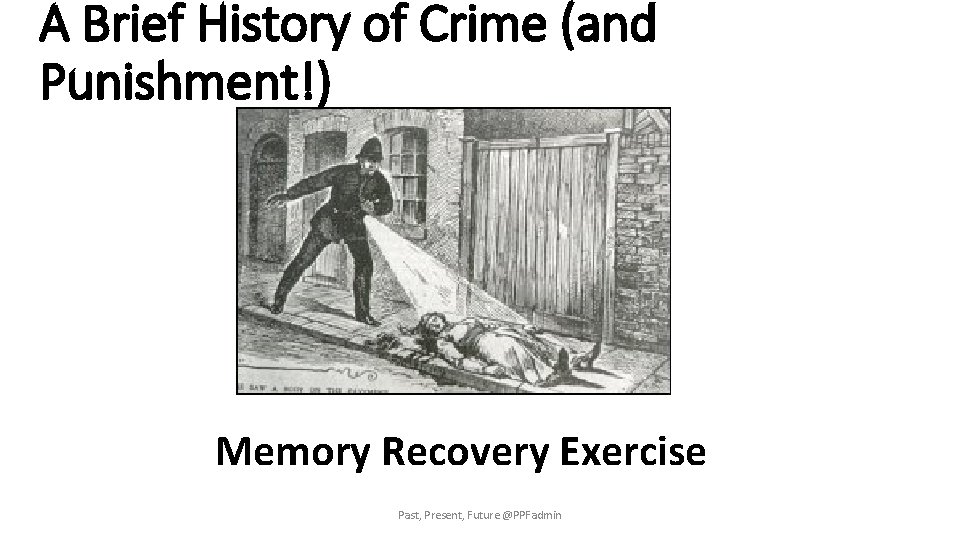
A Brief History of Crime (and Punishment!) Memory Recovery Exercise Past, Present, Future @PPFadmin
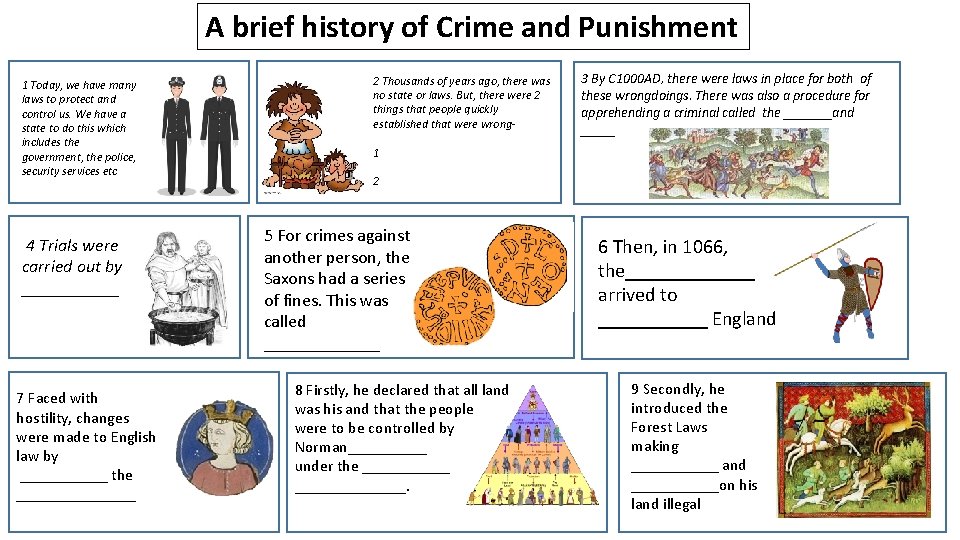
A brief history of Crime and Punishment 1 Today, we have many laws to protect and control us. We have a state to do this which includes the government, the police, security services etc 4 Trials were carried out by ______ 7 Faced with hostility, changes were made to English law by ______ the ________ 2 Thousands of years ago, there was no state or laws. But, there were 2 things that people quickly established that were wrong- 3 By C 1000 AD, there were laws in place for both of these wrongdoings. There was also a procedure for apprehending a criminal called the _______and _____ 1 2 5 For crimes against another person, the Saxons had a series of fines. This was called _______ 8 Firstly, he declared that all land was his and that the people were to be controlled by Norman_____ under the ______________. 6 Then, in 1066, the_______ arrived to ______ England 9 Secondly, he introduced the Forest Laws making ______ and ______on his land illegal
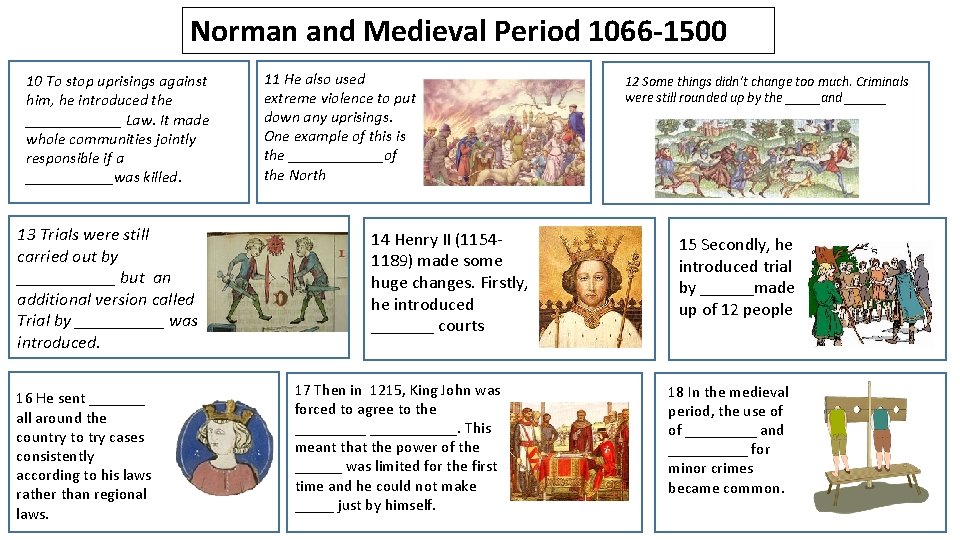
Norman and Medieval Period 1066 -1500 10 To stop uprisings against him, he introduced the ______ Law. It made whole communities jointly responsible if a ______was killed. 13 Trials were still carried out by ______ but an additional version called Trial by _____ was introduced. 16 He sent _______ all around the country to try cases consistently according to his laws rather than regional laws. 11 He also used extreme violence to put down any uprisings. One example of this is the ______of the North 14 Henry II (11541189) made some huge changes. Firstly, he introduced _______ courts 17 Then in 1215, King John was forced to agree to the ___________. This meant that the power of the ______ was limited for the first time and he could not make _____ just by himself. 12 Some things didn’t change too much. Criminals were still rounded up by the _____and ______ 15 Secondly, he introduced trial by ______made up of 12 people 18 In the medieval period, the use of of _____ and _____ for minor crimes became common.
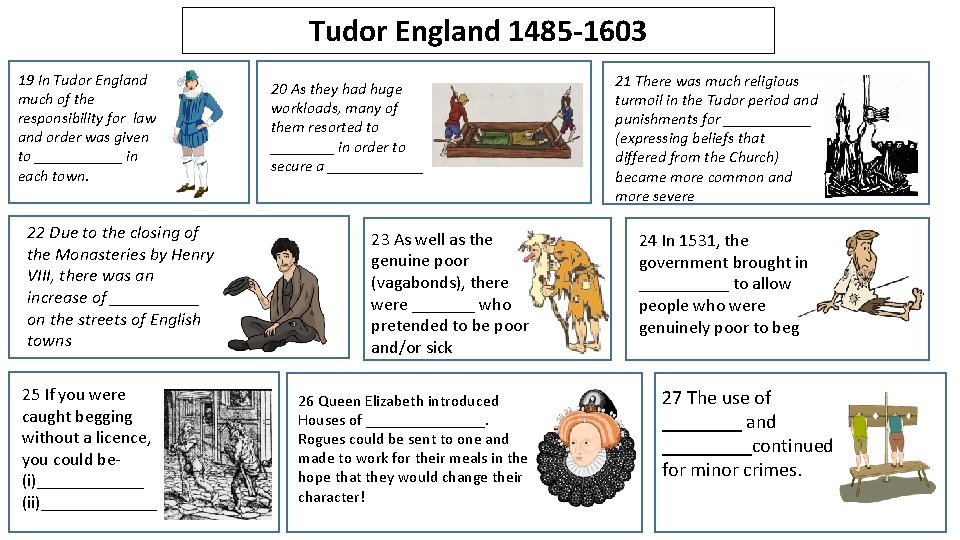
Tudor England 1485 -1603 19 In Tudor England much of the responsibility for law and order was given to ______ in each town. 22 Due to the closing of the Monasteries by Henry VIII, there was an increase of _____ on the streets of English towns 25 If you were caught begging without a licence, you could be(i)______ (ii)_______ 20 As they had huge workloads, many of them resorted to ____ in order to secure a ______ 23 As well as the genuine poor (vagabonds), there were _______ who pretended to be poor and/or sick 26 Queen Elizabeth introduced Houses of ________. Rogues could be sent to one and made to work for their meals in the hope that they would change their character! 21 There was much religious turmoil in the Tudor period and punishments for ______ (expressing beliefs that differed from the Church) became more common and more severe 24 In 1531, the government brought in _____ to allow people who were genuinely poor to beg 27 The use of ____ and _____continued for minor crimes.
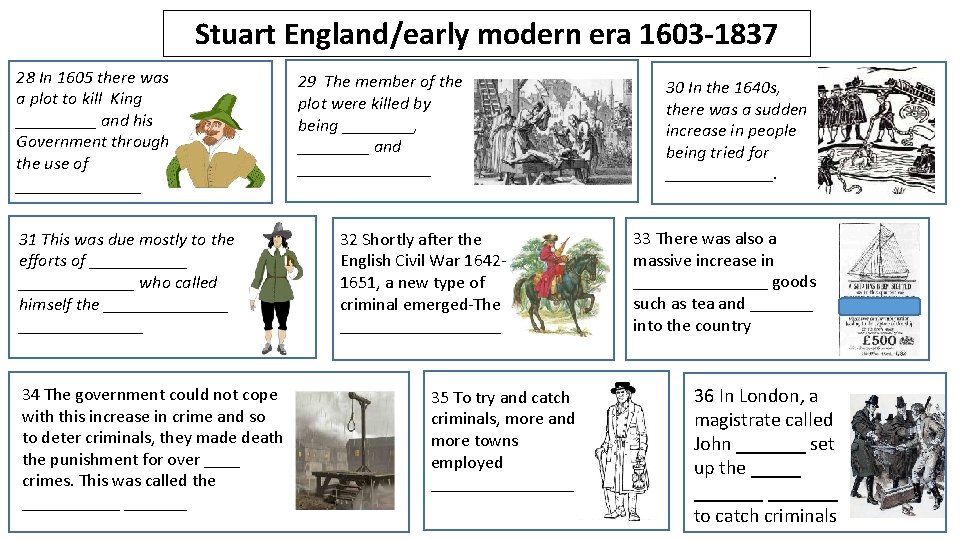
Stuart England/early modern era 1603 -1837 28 In 1605 there was a plot to kill King _____ and his Government through the use of _______ 31 This was due mostly to the efforts of _____________ who called himself the ______________ 34 The government could not cope with this increase in crime and so to deter criminals, they made death the punishment for over ____ crimes. This was called the _______ 29 The member of the plot were killed by being ____, ____ and ________ 32 Shortly after the English Civil War 16421651, a new type of criminal emerged-The _________ 35 To try and catch criminals, more and more towns employed ________ 30 In the 1640 s, there was a sudden increase in people being tried for ______. 33 There was also a massive increase in ________ goods such as tea and _______ into the country 36 In London, a magistrate called John _______ set up the _______ to catch criminals
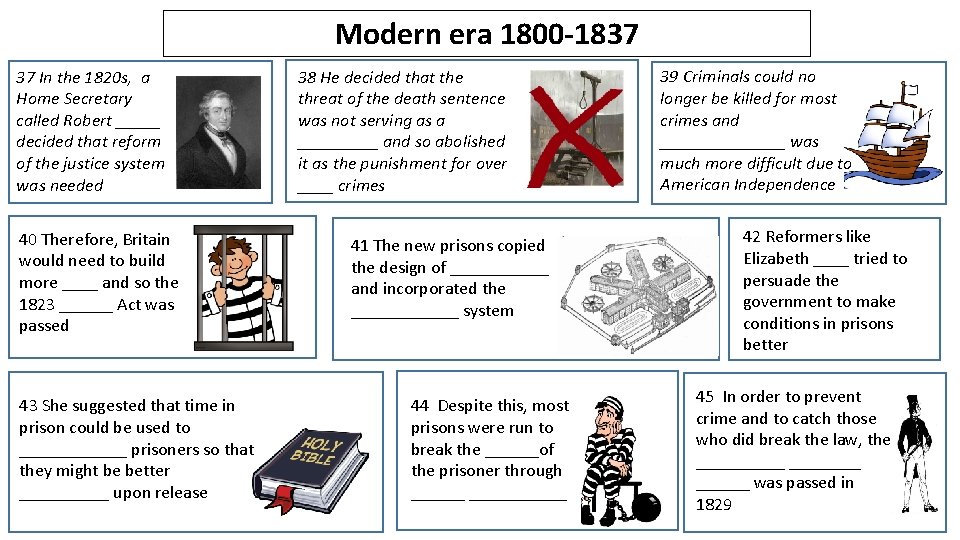
Modern era 1800 -1837 37 In the 1820 s, a Home Secretary called Robert _____ decided that reform of the justice system was needed 40 Therefore, Britain would need to build more ____ and so the 1823 ______ Act was passed 43 She suggested that time in prison could be used to ______ prisoners so that they might be better _____ upon release 38 He decided that the threat of the death sentence was not serving as a _____ and so abolished it as the punishment for over ____ crimes 41 The new prisons copied the design of ______ and incorporated the ______ system 44 Despite this, most prisons were run to break the ______of the prisoner through ___________ 39 Criminals could no longer be killed for most crimes and _______ was much more difficult due to American Independence 42 Reformers like Elizabeth ____ tried to persuade the government to make conditions in prisons better 45 In order to prevent crime and to catch those who did break the law, the _____ ______ was passed in 1829
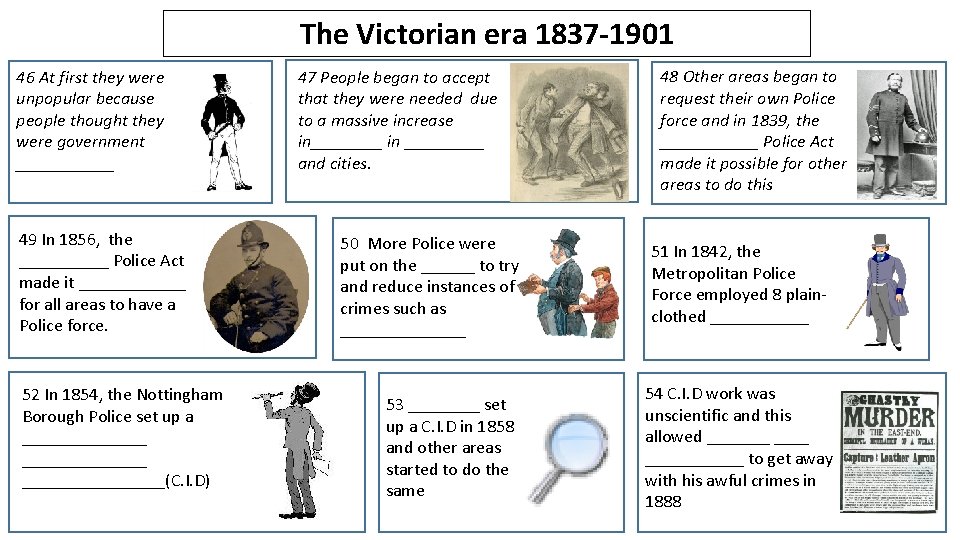
The Victorian era 1837 -1901 46 At first they were unpopular because people thought they were government ______ 49 In 1856, the _____ Police Act made it ______ for all areas to have a Police force. 52 In 1854, the Nottingham Borough Police set up a _______ 2 ________________(C. I. D) 47 People began to accept that they were needed due to a massive increase in____ in _____ and cities. 50 More Police were put on the ______ to try and reduce instances of crimes such as _______ 53 ____ set up a C. I. D in 1858 and other areas started to do the same 48 Other areas began to request their own Police force and in 1839, the ______ Police Act made it possible for other areas to do this 51 In 1842, the Metropolitan Police Force employed 8 plainclothed ______ 54 C. I. D work was unscientific and this allowed _______ to get away with his awful crimes in 1888
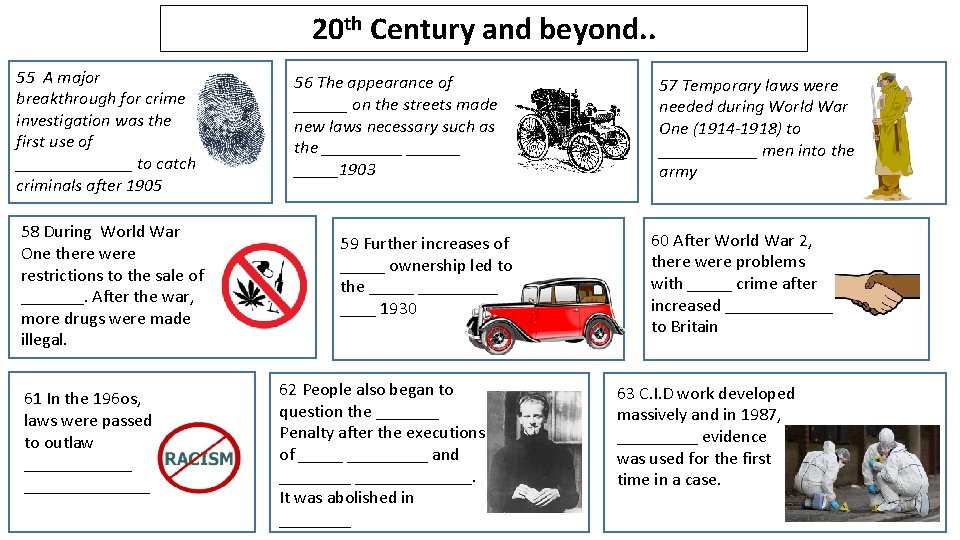
20 th Century and beyond. . 55 A major breakthrough for crime investigation was the first use of _______ to catch criminals after 1905 58 During World War One there were restrictions to the sale of _______. After the war, more drugs were made illegal. 61 In the 196 os, laws were passed to outlaw ______________ 56 The appearance of ______ on the streets made new laws necessary such as the _____1903 59 Further increases of _____ ownership led to the _________ 1930 62 People also began to question the _______ Penalty after the executions of _________ and _____________. It was abolished in ____ 57 Temporary laws were needed during World War One (1914 -1918) to ______ men into the army 60 After World War 2, there were problems with _____ crime after increased ______ to Britain 63 C. I. D work developed massively and in 1987, _____ evidence was used for the first time in a case.
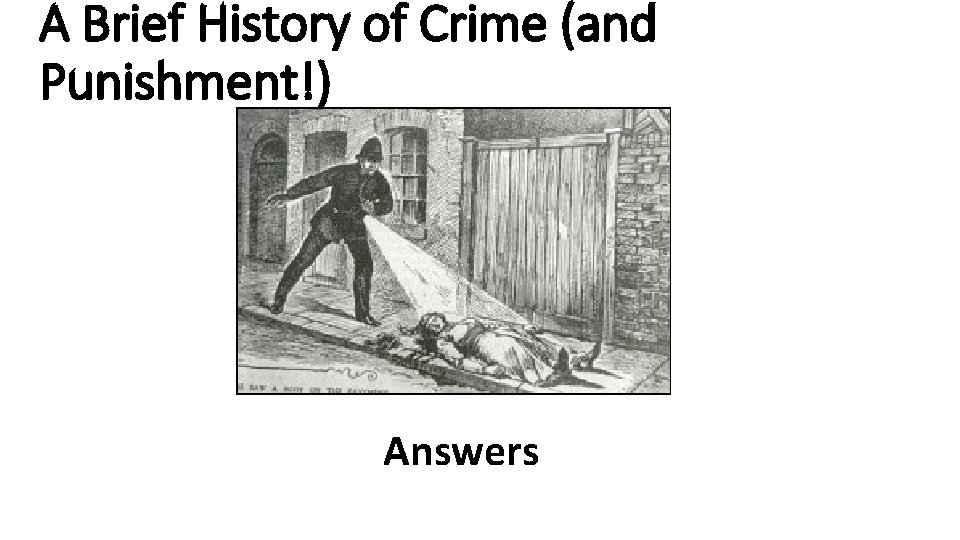
A Brief History of Crime (and Punishment!) Answers
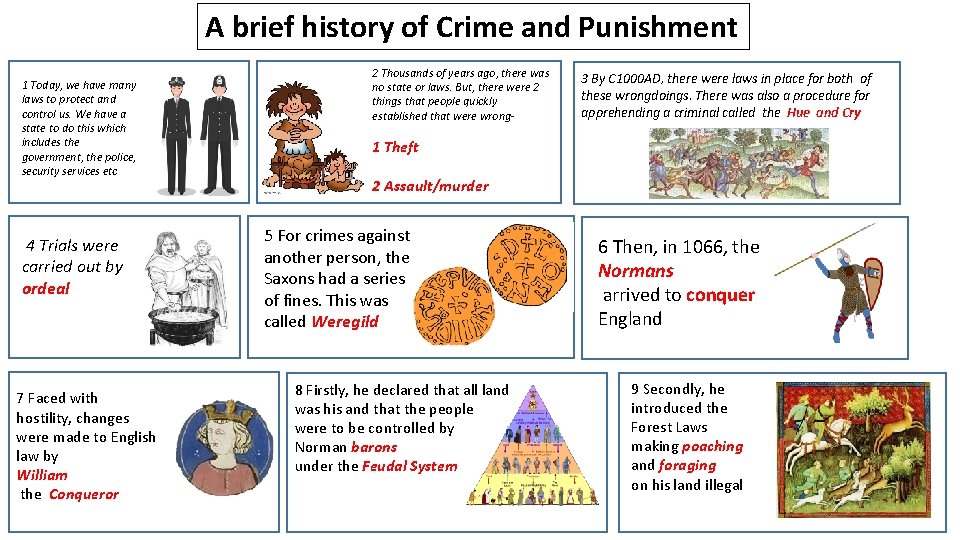
A brief history of Crime and Punishment 1 Today, we have many laws to protect and control us. We have a state to do this which includes the government, the police, security services etc 4 Trials were carried out by ordeal 7 Faced with hostility, changes were made to English law by William the Conqueror 2 Thousands of years ago, there was no state or laws. But, there were 2 things that people quickly established that were wrong- 3 By C 1000 AD, there were laws in place for both of these wrongdoings. There was also a procedure for apprehending a criminal called the Hue and Cry 1 Theft 2 Assault/murder 5 For crimes against another person, the Saxons had a series of fines. This was called Weregild 8 Firstly, he declared that all land was his and that the people were to be controlled by Norman barons under the Feudal System 6 Then, in 1066, the Normans arrived to conquer England 9 Secondly, he introduced the Forest Laws making poaching and foraging on his land illegal
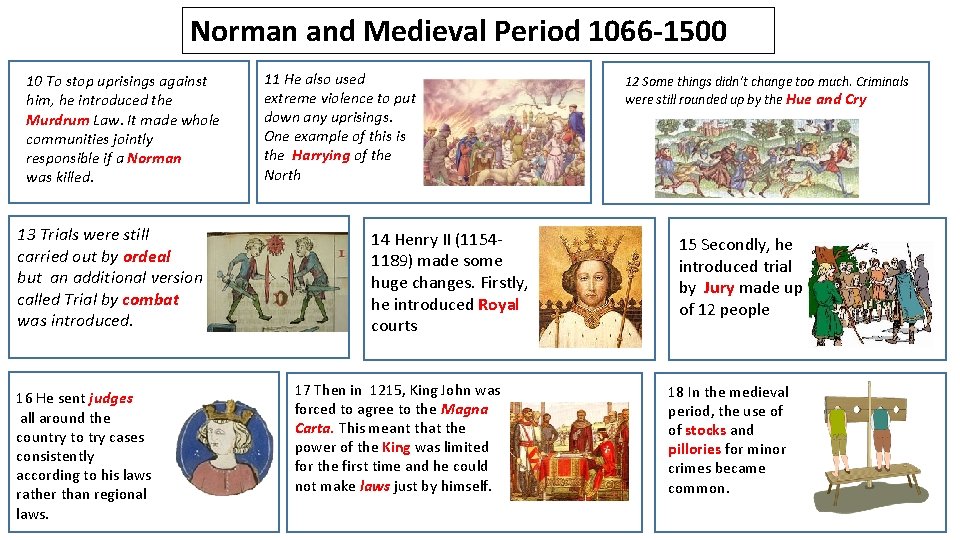
Norman and Medieval Period 1066 -1500 10 To stop uprisings against him, he introduced the Murdrum Law. It made whole communities jointly responsible if a Norman was killed. 13 Trials were still carried out by ordeal but an additional version called Trial by combat was introduced. 16 He sent judges all around the country to try cases consistently according to his laws rather than regional laws. 11 He also used extreme violence to put down any uprisings. One example of this is the Harrying of the North 14 Henry II (11541189) made some huge changes. Firstly, he introduced Royal courts 17 Then in 1215, King John was forced to agree to the Magna Carta. This meant that the power of the King was limited for the first time and he could not make laws just by himself. 12 Some things didn’t change too much. Criminals were still rounded up by the Hue and Cry 15 Secondly, he introduced trial by Jury made up of 12 people 18 In the medieval period, the use of of stocks and pillories for minor crimes became common.
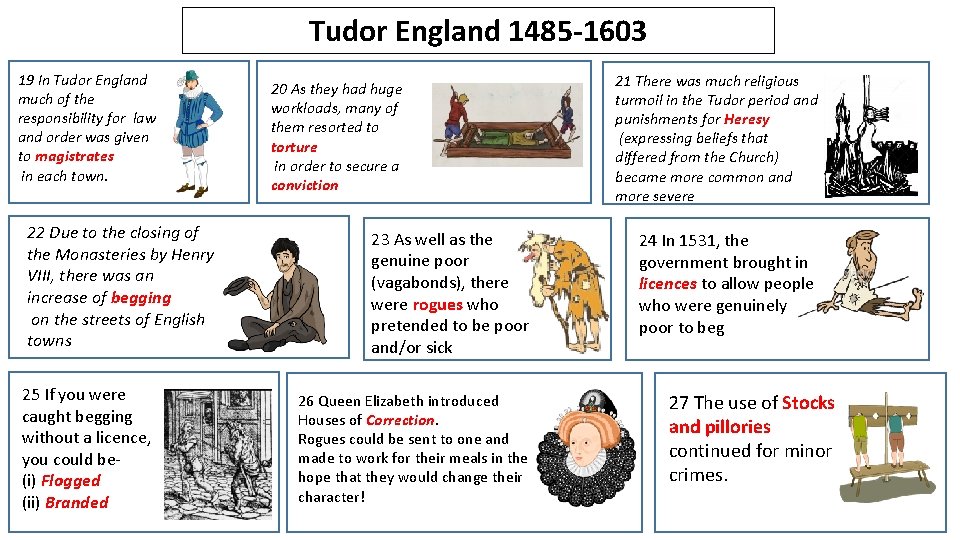
Tudor England 1485 -1603 19 In Tudor England much of the responsibility for law and order was given to magistrates in each town. 22 Due to the closing of the Monasteries by Henry VIII, there was an increase of begging on the streets of English towns 25 If you were caught begging without a licence, you could be(i) Flogged (ii) Branded 20 As they had huge workloads, many of them resorted to torture in order to secure a conviction 23 As well as the genuine poor (vagabonds), there were rogues who pretended to be poor and/or sick 26 Queen Elizabeth introduced Houses of Correction. Rogues could be sent to one and made to work for their meals in the hope that they would change their character! 21 There was much religious turmoil in the Tudor period and punishments for Heresy (expressing beliefs that differed from the Church) became more common and more severe 24 In 1531, the government brought in licences to allow people who were genuinely poor to beg 27 The use of Stocks and pillories continued for minor crimes.
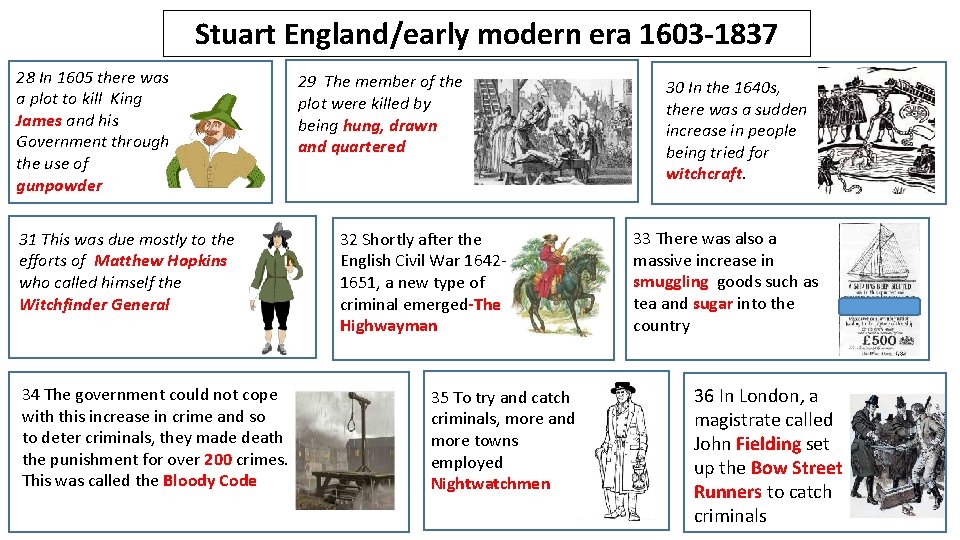
Stuart England/early modern era 1603 -1837 28 In 1605 there was a plot to kill King James and his Government through the use of gunpowder 31 This was due mostly to the efforts of Matthew Hopkins who called himself the Witchfinder General 34 The government could not cope with this increase in crime and so to deter criminals, they made death the punishment for over 200 crimes. This was called the Bloody Code 29 The member of the plot were killed by being hung, drawn and quartered 32 Shortly after the English Civil War 16421651, a new type of criminal emerged-The Highwayman 35 To try and catch criminals, more and more towns employed Nightwatchmen 30 In the 1640 s, there was a sudden increase in people being tried for witchcraft. 33 There was also a massive increase in smuggling goods such as tea and sugar into the country 36 In London, a magistrate called John Fielding set up the Bow Street Runners to catch criminals
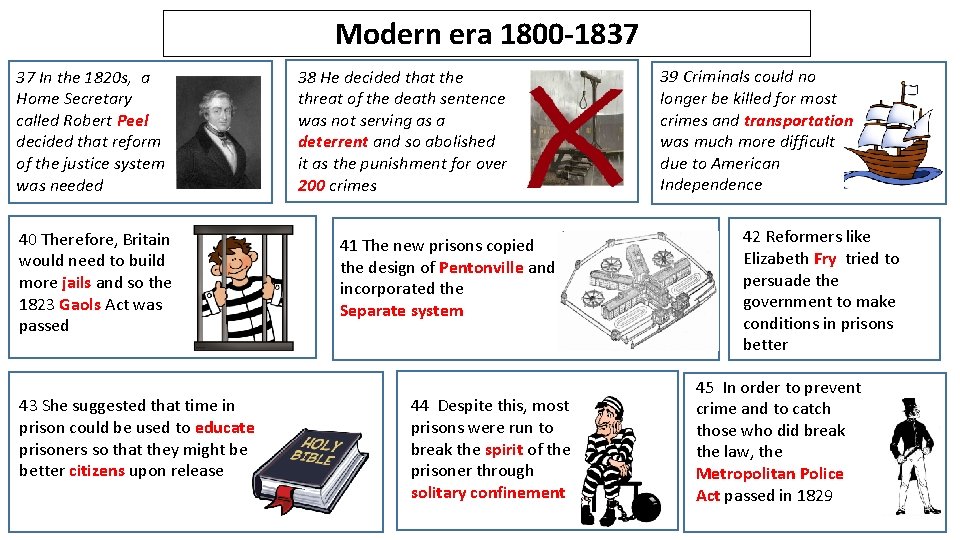
Modern era 1800 -1837 37 In the 1820 s, a Home Secretary called Robert Peel decided that reform of the justice system was needed 40 Therefore, Britain would need to build more jails and so the 1823 Gaols Act was passed 43 She suggested that time in prison could be used to educate prisoners so that they might be better citizens upon release 38 He decided that the threat of the death sentence was not serving as a deterrent and so abolished it as the punishment for over 200 crimes 41 The new prisons copied the design of Pentonville and incorporated the Separate system 44 Despite this, most prisons were run to break the spirit of the prisoner through solitary confinement 39 Criminals could no longer be killed for most crimes and transportation was much more difficult due to American Independence 42 Reformers like Elizabeth Fry tried to persuade the government to make conditions in prisons better 45 In order to prevent crime and to catch those who did break the law, the Metropolitan Police Act passed in 1829
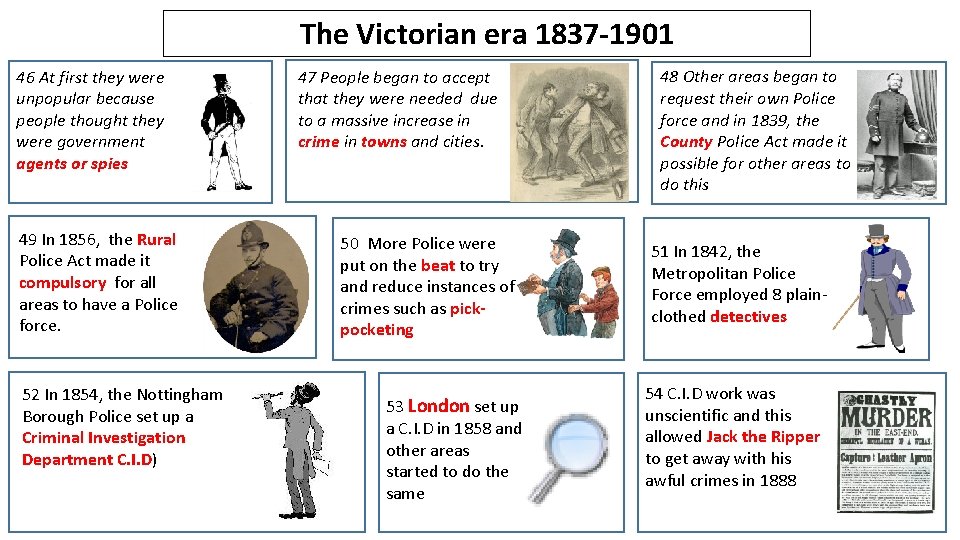
The Victorian era 1837 -1901 46 At first they were unpopular because people thought they were government agents or spies 49 In 1856, the Rural Police Act made it compulsory for all areas to have a Police force. 52 In 1854, the Nottingham Borough Police set up a Criminal Investigation Department C. I. D) 2 47 People began to accept that they were needed due to a massive increase in crime in towns and cities. 50 More Police were put on the beat to try and reduce instances of crimes such as pickpocketing 53 London set up a C. I. D in 1858 and other areas started to do the same 48 Other areas began to request their own Police force and in 1839, the County Police Act made it possible for other areas to do this 51 In 1842, the Metropolitan Police Force employed 8 plainclothed detectives 54 C. I. D work was unscientific and this allowed Jack the Ripper to get away with his awful crimes in 1888
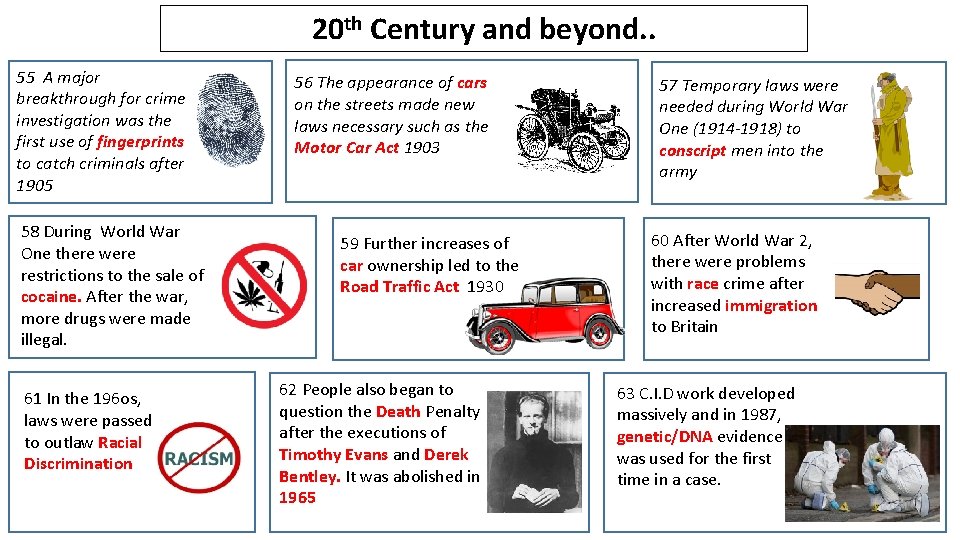
20 th Century and beyond. . 55 A major breakthrough for crime investigation was the first use of fingerprints to catch criminals after 1905 58 During World War One there were restrictions to the sale of cocaine. After the war, more drugs were made illegal. 61 In the 196 os, laws were passed to outlaw Racial Discrimination 56 The appearance of cars on the streets made new laws necessary such as the Motor Car Act 1903 59 Further increases of car ownership led to the Road Traffic Act 1930 62 People also began to question the Death Penalty after the executions of Timothy Evans and Derek Bentley. It was abolished in 1965 57 Temporary laws were needed during World War One (1914 -1918) to conscript men into the army 60 After World War 2, there were problems with race crime after increased immigration to Britain 63 C. I. D work developed massively and in 1987, genetic/DNA evidence was used for the first time in a case.
- Slides: 16