
A Brief History of Aboriginal Issues in Canada

A Brief History of Aboriginal Issues in Canada
Definitions + Terms Three distinct groups: First Nations, Inuit, Métis n Often all grouped under one term: Aboriginal, Native n “Indian” is an outdated term, but it is still used in some official documents (eg. “Indian Act”) n First Nations includes all nations in provinces (eg. Cree, Dene, Saulteaux, Tlingit, Blackfoot, Dakota, Mohawk, etc. ) n Inuit (NOT “eskimo”) – Northern nations n Métis – descendants of First Nations and European ancestry; initially a specific group (descendants of fur traders), but now applies to anyone who self-identifies as Métis n

Brief History of Natives have lived in Canada for over 11, 000 years n Early contact with European explorers in 1500 s n Natives exploited in fur trade in 17 th-19 th centuries n Natives changed lifestyle because of Europeans n Royal Proclamation of 1763 outlined Britain’s plans for North America, but also stopped expansion into Native territory until treaties could be made n “Reservation” system started in 1830 – Natives n
Leading up to the Treaties Natives ignored in Canadian Confederation process (1864 -1867) – no representatives chosen! n Louis Riel and Métis brought issues to light in 1869 -1870 – Métis Bill of Rights, Red River Rebellion, and creation of province of Manitoba n Canadians wanted to expand peacefully into West to have “dominion from sea to sea” n Canada dealt with Natives in two ways: n Treaties – where would they live? n Indian Act – how could they function in society? n
The Treaties A treaty is a legal agreement between peoples or states, often involving land n Canada had a history of treaties with First Nations in Upper and Lower Canada before Confederation n Eleven treaties were made between the government and First Nations between 1871 and 1921 – the “Numbered Treaties” took up much of Rupert’s Land n In return for signing the treaties, the government promised to build schools on reservations and to n
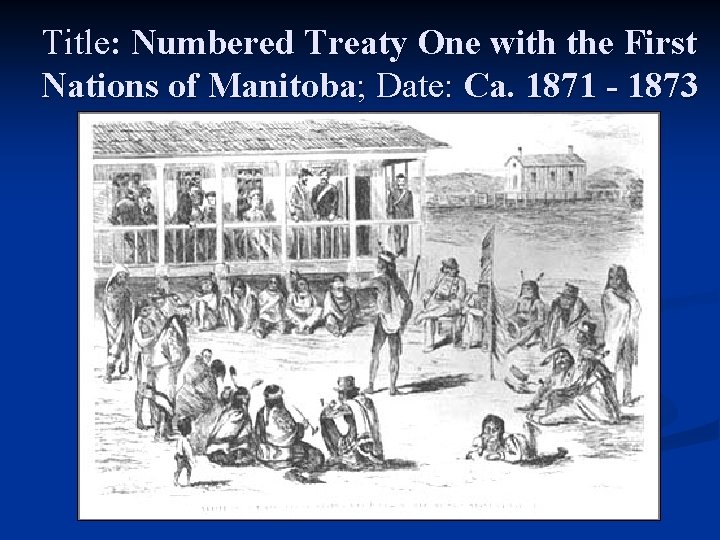
Title: Numbered Treaty One with the First Nations of Manitoba; Date: Ca. 1871 - 1873
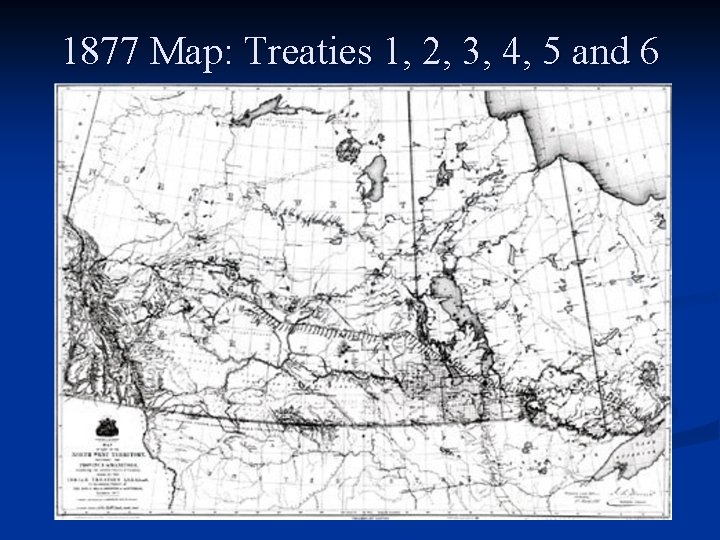
1877 Map: Treaties 1, 2, 3, 4, 5 and 6
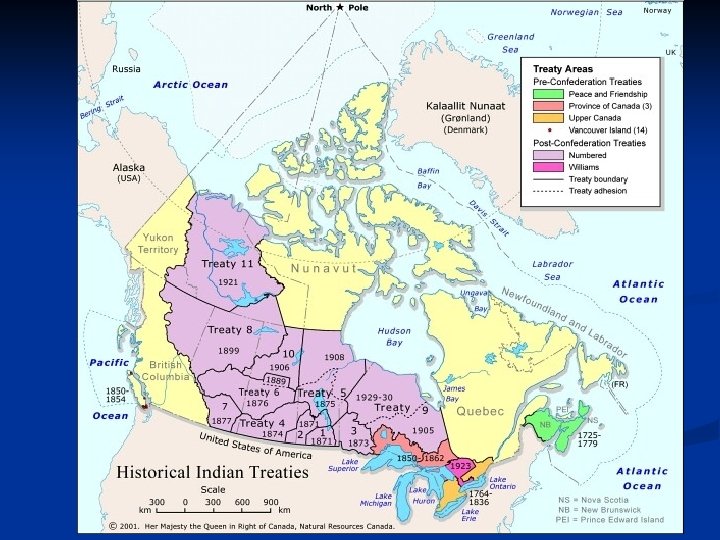
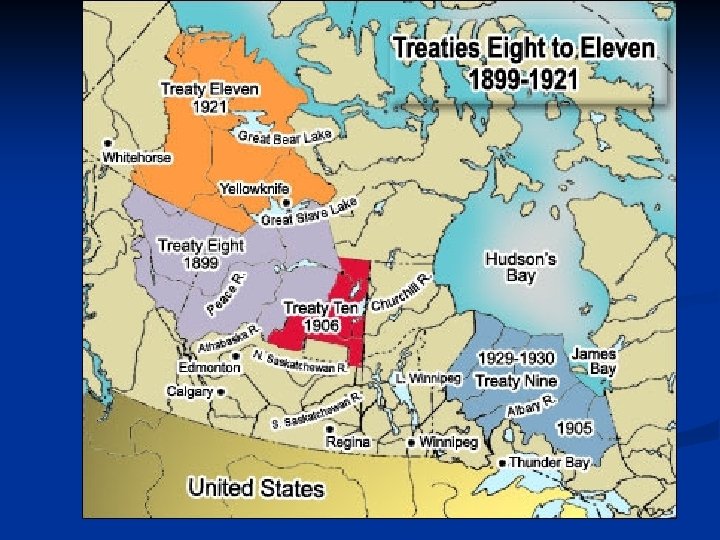

Problems with the Treaties No concept of land ownership in Native culture n Treaties were a sign of friendship from Natives, not a binding legal arrangement n Natives did not understand English n Natives were afraid of treatment like in the US n Natives did not have much choice in the matter: n Canadians were pushing them off their land anyway n Buffalo were becoming extinct n Disease had killed up to 75% of their population n
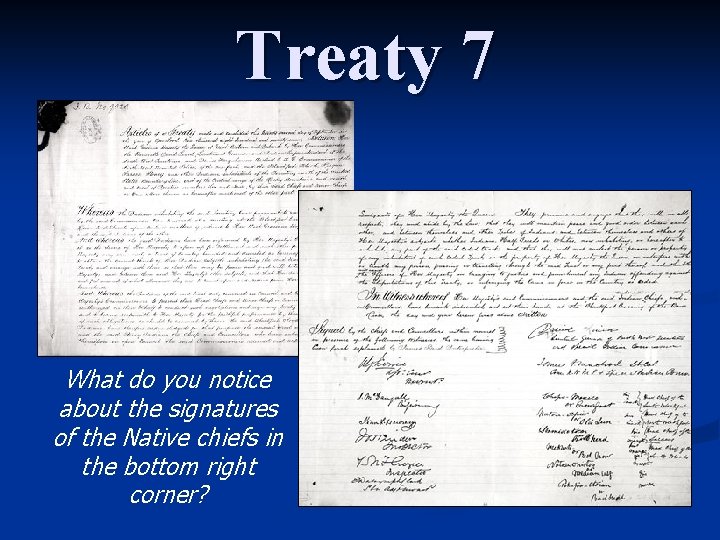
Treaty 7 What do you notice about the signatures of the Native chiefs in the bottom right corner?

Charles Rath, famous buffalo hunter, seated on rack of 40, 000 hides in Robert Wright's Dodge City hide yard in 1878, with M. W. Anchutz (in white shirt, back).
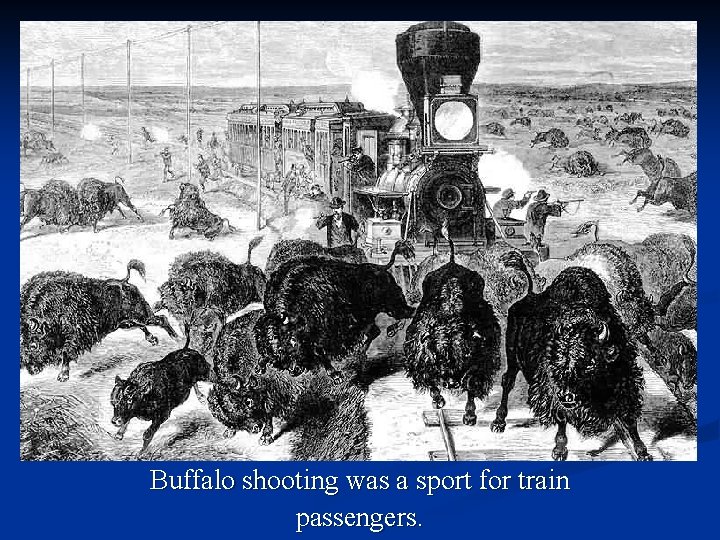
Buffalo shooting was a sport for train passengers.
Impact of the Treaties n n n 1. 2. 3. 4. Severe droughts on the prairies in 1880 s made it difficult for the Native people to take up farming Government agents cheated the Natives and kept supplies for themselves Much distrust of government, but little choice for Natives but to keep making treaties Allowed Canada to peacefully expand into West Relations between Canada and Natives strained Entrenched “reserve” system Many legal issues still arise from treaties
Land Claims n n n Many Natives of Quebec, British Columbia and much of the current Northwest Territories never signed a treaty, but lost their land anyway As a result, their aboriginal and legal rights to lands are still intact as affirmed by law and the Supreme Court of Canada Land rights entrenched in Charter of Rights and Freedoms – “all existing rights” Source of legal issues and conflicts Substandard living conditions on many reserves
Indian Act, 1876 Government felt need to entrench policy toward Natives as an act of Parliament – how Canada should deal with the “Indian problem”, as it was phrased n Canada’s official policy was “assimilation” n n Natives were encouraged to give up their culture to be “Canadian” Pros: schools, medical care, hunting & fishing rights, payments, tax exemptions, and “special status” all provided by Canadian government n Cons: could not own land, could not vote (until 1960), traditional activities (potlatch) were n
“Status” vs. “Non-Status” Indian Act (1876) defined privileges and rights of Natives, including “special status” n “Status Indians” have legal rights under Indian Act or as Registered Indians (where no treaties were signed) n “Non-status Indians” retain their cultural identity, but have given up “special status” for gaining rights as Canadians (moved off-reserve, joined the military, obtained higher education, married a non-status Indian) n Definitions have started to be revisited, but still a n
Residential Schools Federal government assumed responsibility for educating Natives under Indian Act n Enforced policy of assimilation within schools n Schools administered by churches (Protestant and Catholic) n Children were forced to leave home and give up culture and language, and were abused if they did not n Most Natives educated in residential schools until 1970 s; final residential school closed in 1990 s n Cdn. government lost lawsuit + paid all plaintiffs n
War Veterans According to the terms of the Indian Act, aboriginal people were not citizens of Canada n First Nations people volunteered to fight in wars n To do so, they had to “enfranchise”, or give up their status as registered Indians n When they returned from war, aboriginal veterans were not given recognition or veterans’ pensions n Tom Prince fought in WWII and Korea and received 11 medals, the most decorated aboriginal veteran. Yet, Prince died in poverty and obscurity in 1977 n
Government Control Native issues were overseen by Department of Indian Affairs, but racism remained in government: n “[the purpose of the Indian Act is] to continue until there is not a single Indian in Canada that has not been absorbed into the body politic and there is not Indian question and no Indian department. ” – Duncan Campbell Scott, Superintendent of Indian Affairs, 1920 Natives were granted voting franchise in 1960 n Little change in government policy until 1969, when PM Trudeau and Indian Affairs Minister Jean Chrétien introduced the White Paper on Indian Policy n n White Paper is an official statement of policy
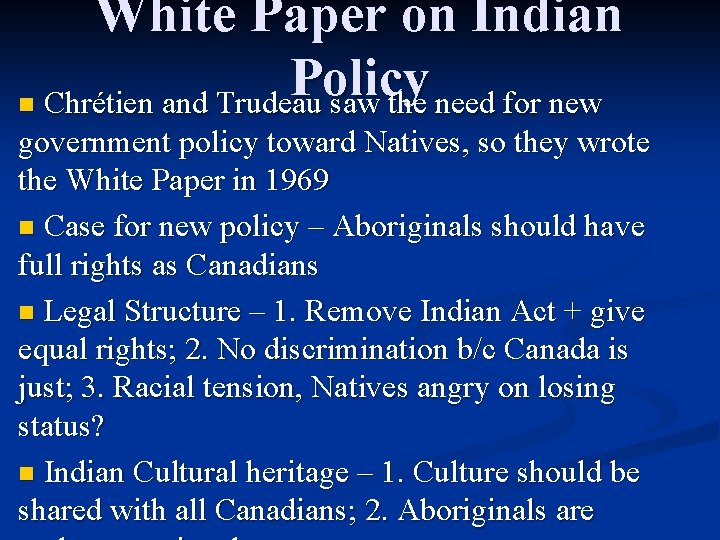
White Paper on Indian Policy n Chrétien and Trudeau saw the need for new government policy toward Natives, so they wrote the White Paper in 1969 n Case for new policy – Aboriginals should have full rights as Canadians n Legal Structure – 1. Remove Indian Act + give equal rights; 2. No discrimination b/c Canada is just; 3. Racial tension, Natives angry on losing status? n Indian Cultural heritage – 1. Culture should be shared with all Canadians; 2. Aboriginals are
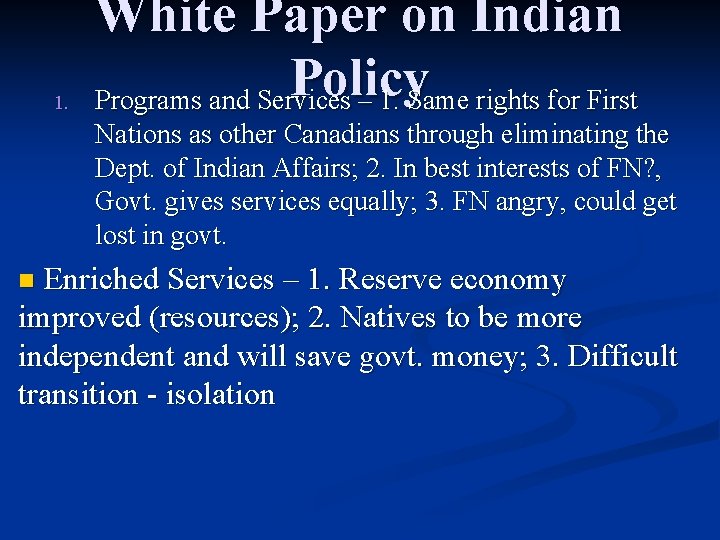
1. White Paper on Indian Policy Programs and Services – 1. Same rights for First Nations as other Canadians through eliminating the Dept. of Indian Affairs; 2. In best interests of FN? , Govt. gives services equally; 3. FN angry, could get lost in govt. Enriched Services – 1. Reserve economy improved (resources); 2. Natives to be more independent and will save govt. money; 3. Difficult transition - isolation n
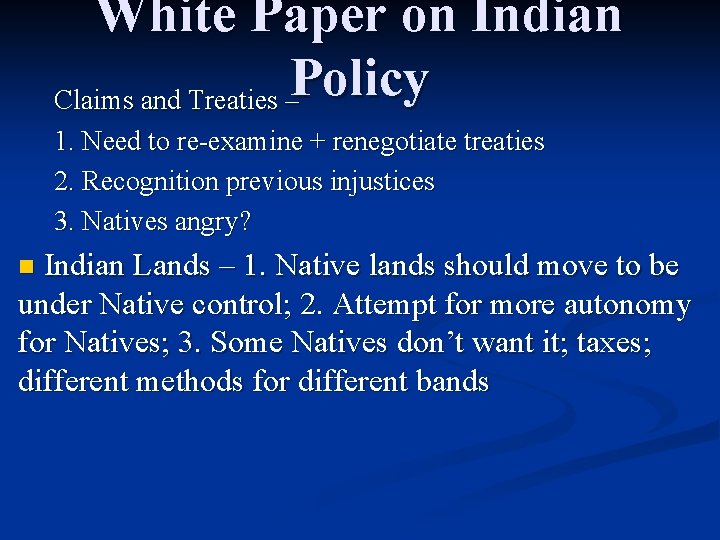
White Paper on Indian Policy Claims and Treaties – 1. Need to re-examine + renegotiate treaties 2. Recognition previous injustices 3. Natives angry? Indian Lands – 1. Native lands should move to be under Native control; 2. Attempt for more autonomy for Natives; 3. Some Natives don’t want it; taxes; different methods for different bands n
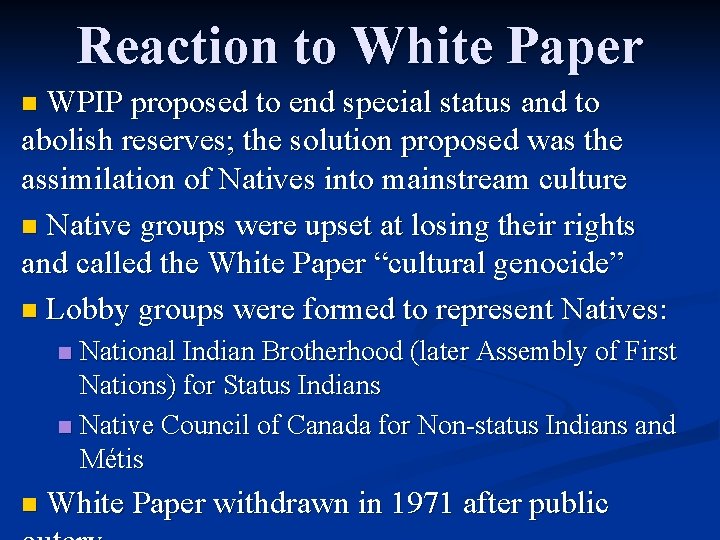
Reaction to White Paper WPIP proposed to end special status and to abolish reserves; the solution proposed was the assimilation of Natives into mainstream culture n Native groups were upset at losing their rights and called the White Paper “cultural genocide” n Lobby groups were formed to represent Natives: n National Indian Brotherhood (later Assembly of First Nations) for Status Indians n Native Council of Canada for Non-status Indians and Métis n n White Paper withdrawn in 1971 after public
Land Claims Can. Government supported self-government n Office of Land Claims established in 1974 to deal with specific and comprehensive land claims n Specific – based on treaties n Comprehensive – based on traditional use + occupancy (often where no treaties had been signed) n n Declaration of First Nations was adopted in 1975 n This Declaration advocated awareness of land claims and self-government Rights were entrenched in Charter (1982), but some disagreement on interpretation of “existing n
Self-government In addition to advocacy organizations, each province has its own political lobby group for Aboriginal concerns n Many aboriginal groups advocate selfgovernment – controlling power to make decisions about land, resources, and communities n Some uncertainty about how this fits into Canadian government structure and division of powers n Discussion of Aboriginal responsibility of policing, health care, justice, and education n
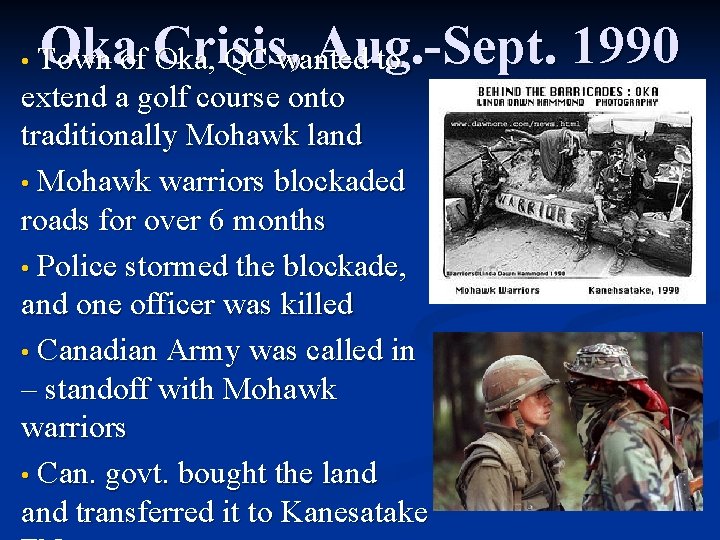
Oka Crisis, Aug. -Sept. 1990 Town of Oka, QC wanted to extend a golf course onto traditionally Mohawk land • Mohawk warriors blockaded roads for over 6 months • Police stormed the blockade, and one officer was killed • Canadian Army was called in – standoff with Mohawk warriors • Can. govt. bought the land transferred it to Kanesatake •
Solutions to self-government In Manitoba, Aboriginals took over the Department of Indian Affairs and Northern Development (1990 s) n Nisga’a Treaty, BC (1998) n Nisga’a signed agreement with federal and provincial governments that assigned powers of self-government n Non-Native settlers allowed to stay in region, but do not have say in local government n n Creation of Nunavut (1999) n Inuit of Nunavut given right to self-government of resources, justice, and education
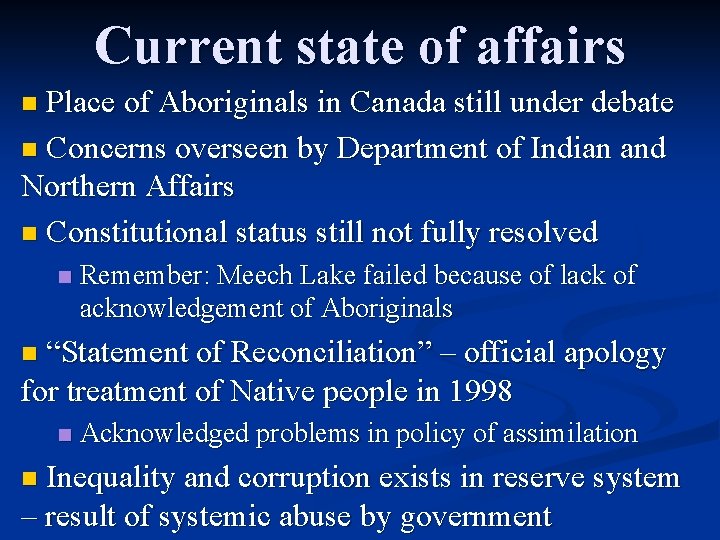
Current state of affairs Place of Aboriginals in Canada still under debate n Concerns overseen by Department of Indian and Northern Affairs n Constitutional status still not fully resolved n n Remember: Meech Lake failed because of lack of acknowledgement of Aboriginals “Statement of Reconciliation” – official apology for treatment of Native people in 1998 n n Acknowledged problems in policy of assimilation Inequality and corruption exists in reserve system – result of systemic abuse by government n
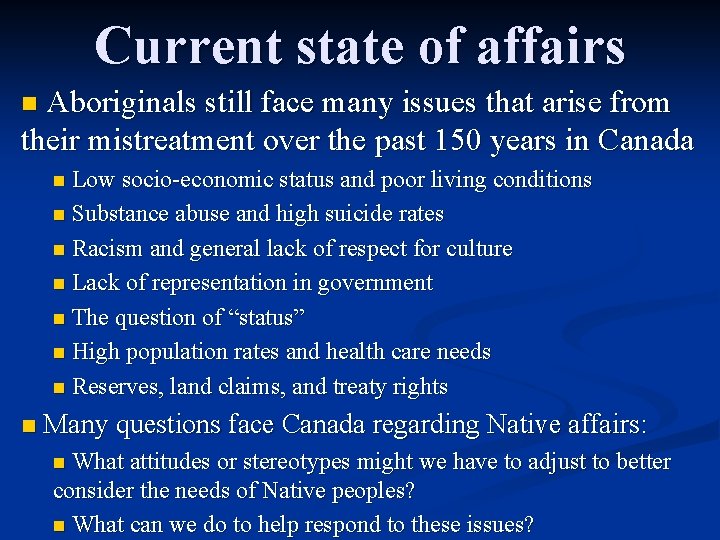
Current state of affairs Aboriginals still face many issues that arise from their mistreatment over the past 150 years in Canada n Low socio-economic status and poor living conditions n Substance abuse and high suicide rates n Racism and general lack of respect for culture n Lack of representation in government n The question of “status” n High population rates and health care needs n Reserves, land claims, and treaty rights n n Many questions face Canada regarding Native affairs: What attitudes or stereotypes might we have to adjust to better consider the needs of Native peoples? n What can we do to help respond to these issues? n
- Slides: 30