
A Birds eye view of the Solar Interior
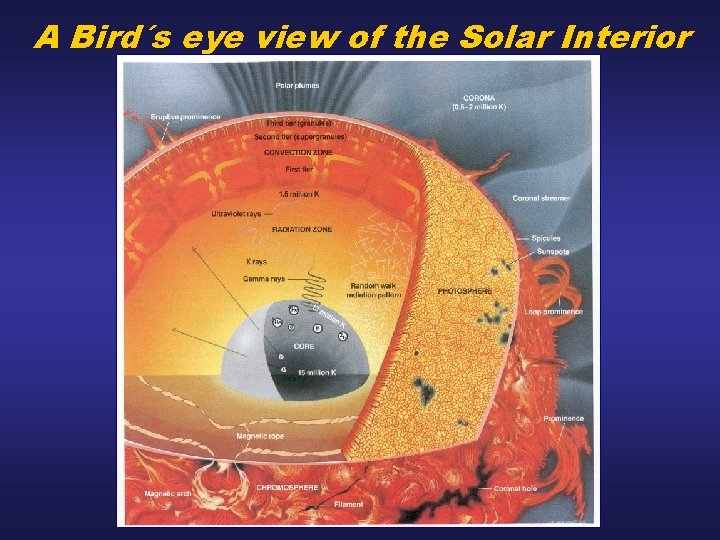
A Bird´s eye view of the Solar Interior
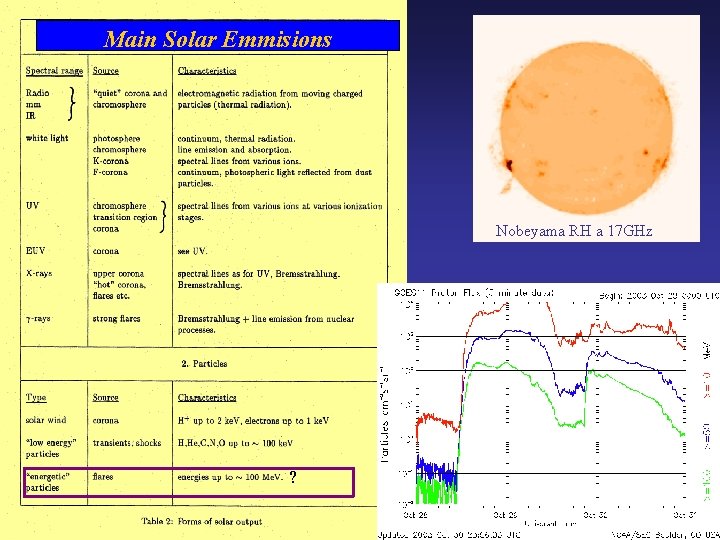
Main Solar Emmisions Nobeyama RH a 17 GHz ?
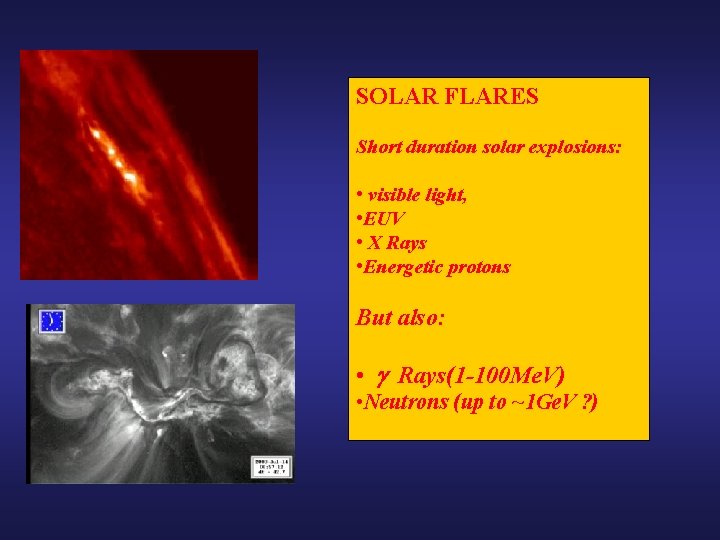
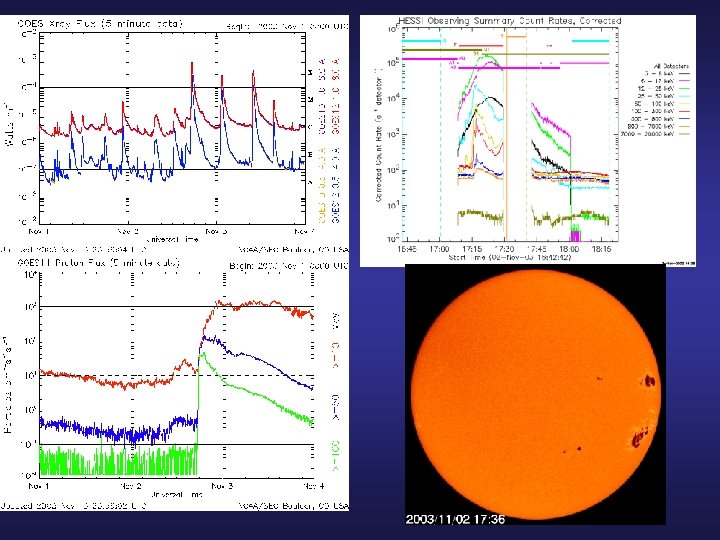
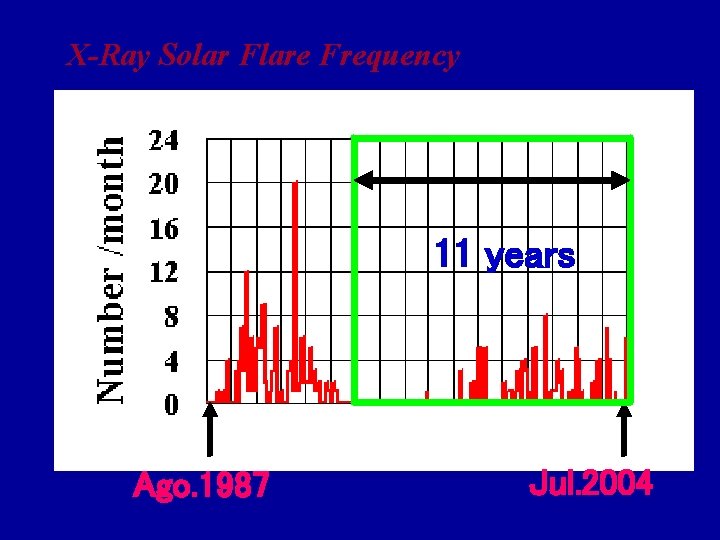
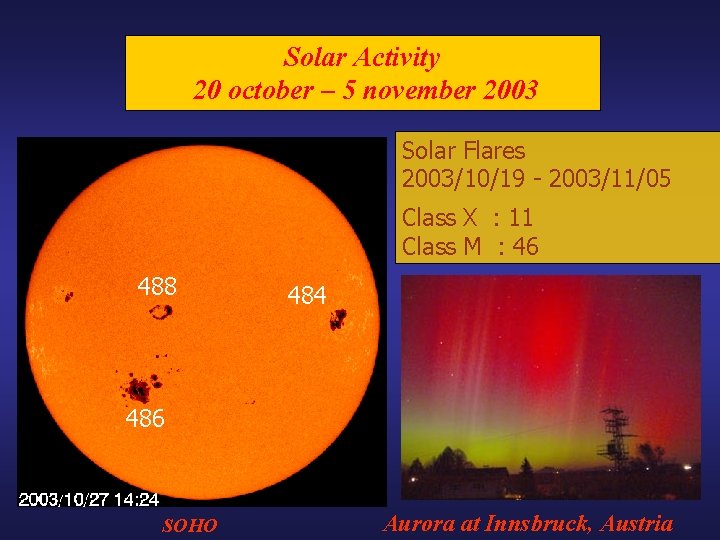
SOLAR FLARES Short duration solar explosions: • visible light, • EUV • X Rays • Energetic protons But also: • Rays(1 -100 Me. V) • Neutrons (up to ~1 Ge. V ? )
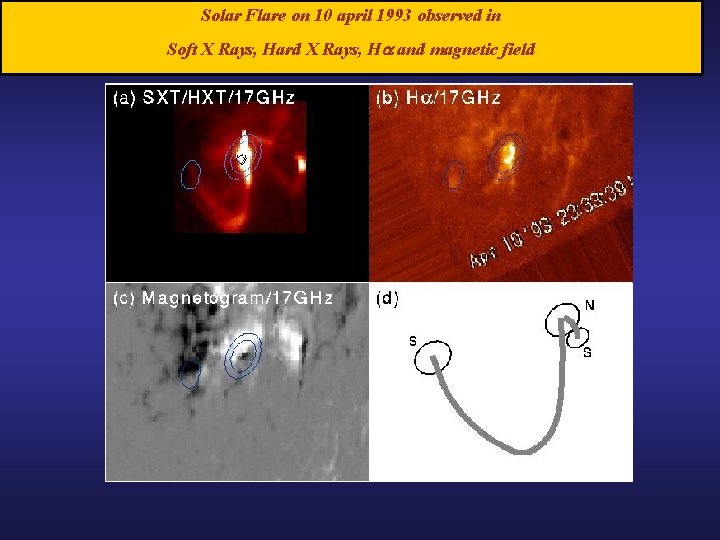
Solar Flare on 10 april 1993 observed in Soft X Rays, Hard X Rays, H and magnetic field
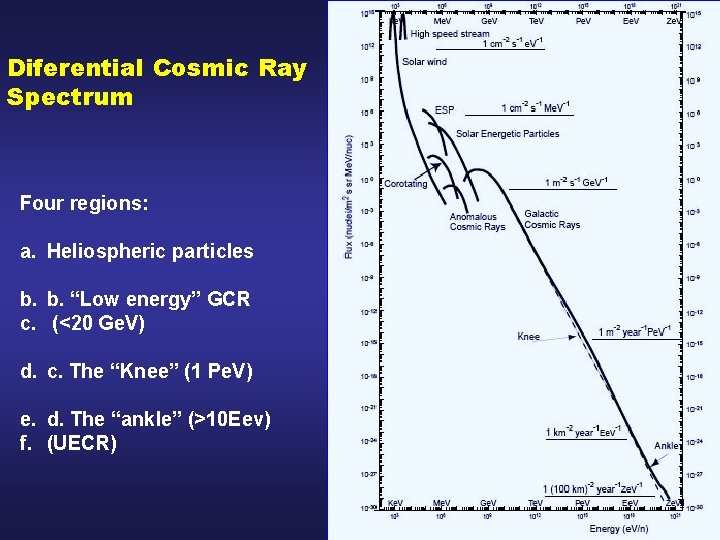
Diferential Cosmic Ray Spectrum Four regions: a. Heliospheric particles b. b. “Low energy” GCR c. (<20 Ge. V) d. c. The “Knee” (1 Pe. V) e. d. The “ankle” (>10 Eev) f. (UECR)
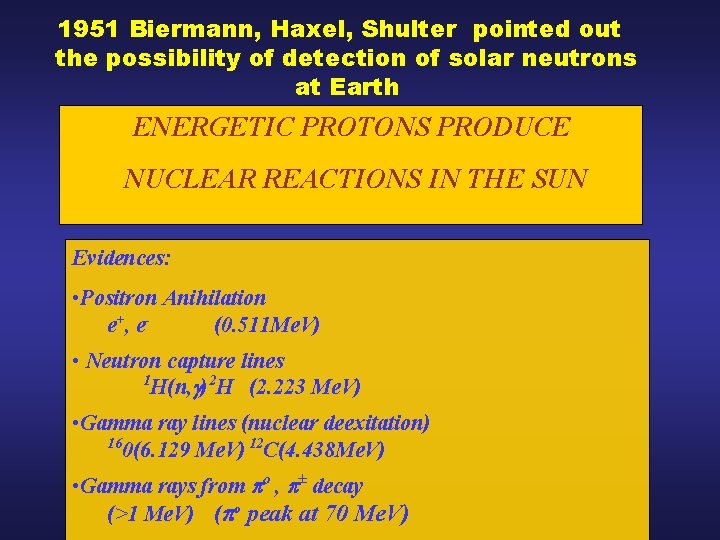
1951 Biermann, Haxel, Shulter pointed out the possibility of detection of solar neutrons at Earth ENERGETIC PROTONS PRODUCE NUCLEAR REACTIONS IN THE SUN Evidences: • Positron Anihilation e+, e(0. 511 Me. V) • Neutron capture lines 1 H(n, )2 H (2. 223 Me. V) • Gamma ray lines (nuclear deexitation) 16 0(6. 129 Me. V) 12 C(4. 438 Me. V) • Gamma rays from o , ± decay (>1 Me. V) ( o peak at 70 Me. V)
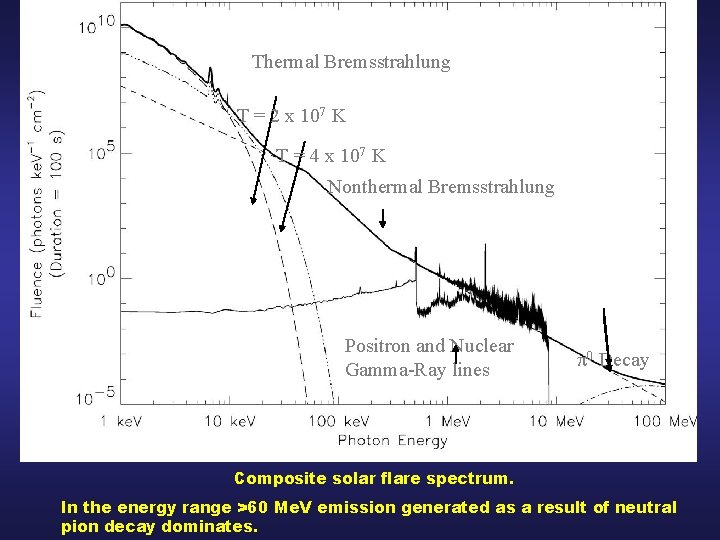
Thermal Bremsstrahlung T = 2 x 10⁷ K • T = 4 x 10⁷ K Nonthermal Bremsstrahlung Positron and Nuclear Gamma-Ray lines π0 Decay Composite solar flare spectrum. In the energy range >60 Me. V emission generated as a result of neutral pion decay dominates.
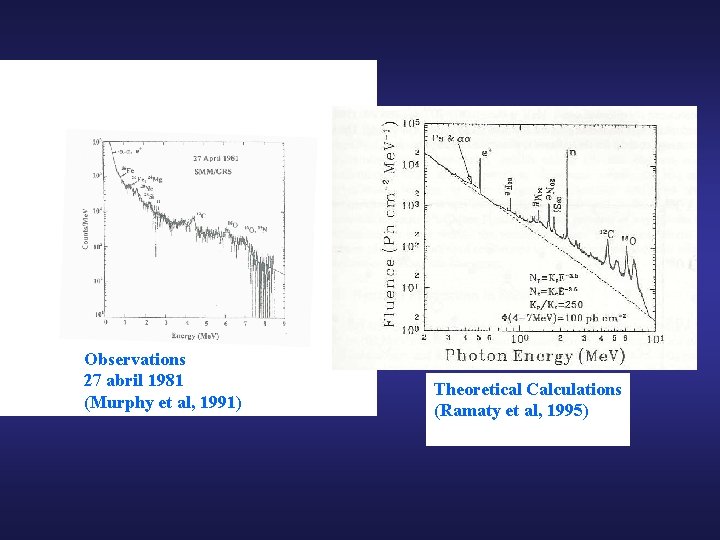
Observations 27 abril 1981 (Murphy et al, 1991) Theoretical Calculations (Ramaty et al, 1995)
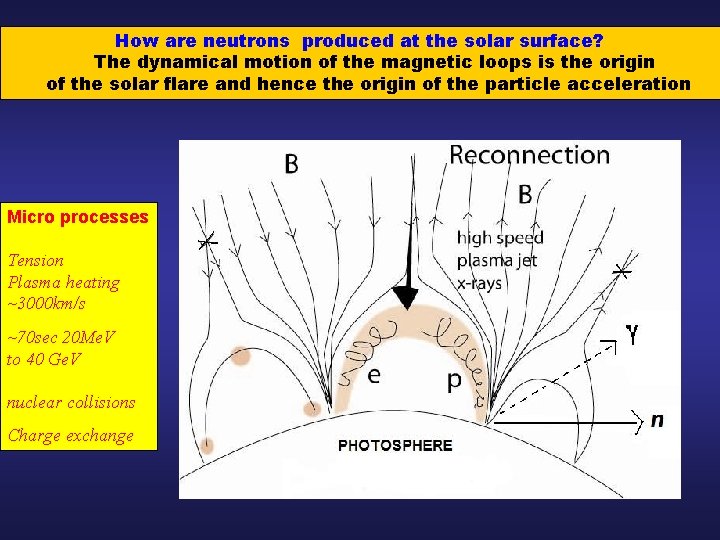
How are neutrons produced at the solar surface? The dynamical motion of the magnetic loops is the origin of the solar flare and hence the origin of the particle acceleration Micro processes Tension Plasma heating ~3000 km/s ~70 sec 20 Me. V to 40 Ge. V nuclear collisions Charge exchange
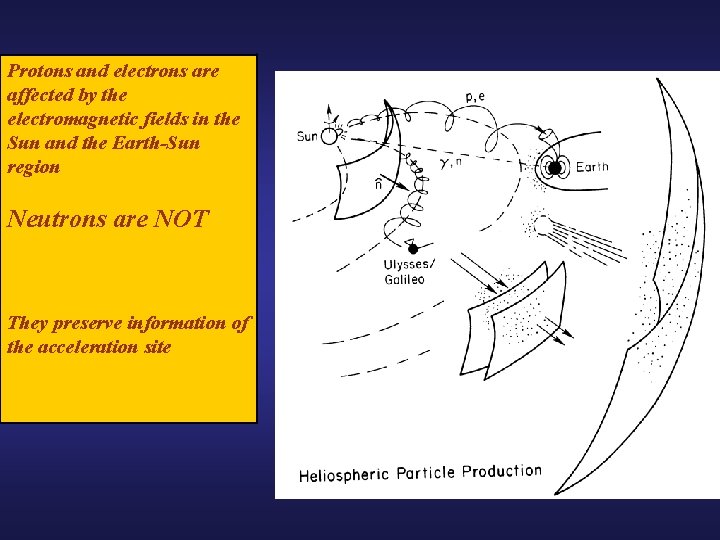
Protons and electrons are affected by the electromagnetic fields in the Sun and the Earth-Sun region Neutrons are NOT They preserve information of the acceleration site

Neutrons produced by energetic protons reach spacecrafts Near Earth Solar Maximum Mission Observations 25 – 140 Me. V 21 june 1980 (Chupp et al, 1982) n Flare start This first observed solar neutron event may be explained by an impulsive production model with -3. 5 0. 1 (TOF)
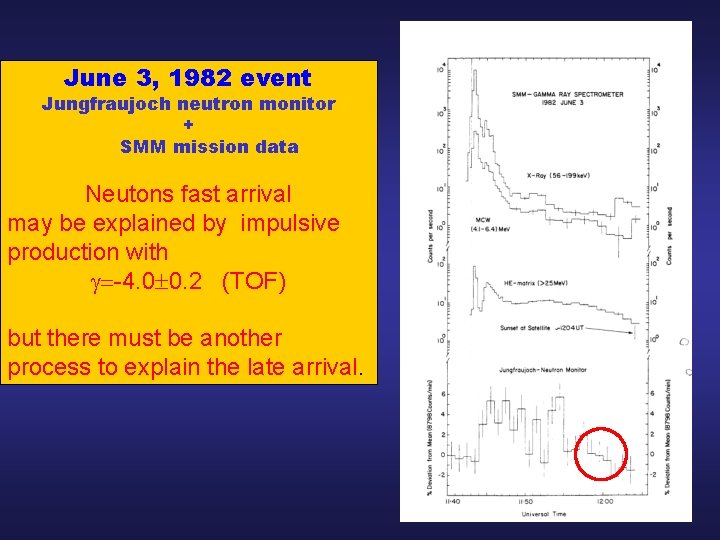
June 3, 1982 event Jungfraujoch neutron monitor + SMM mission data Neutons fast arrival may be explained by impulsive production with -4. 0 0. 2 (TOF) but there must be another process to explain the late arrival.
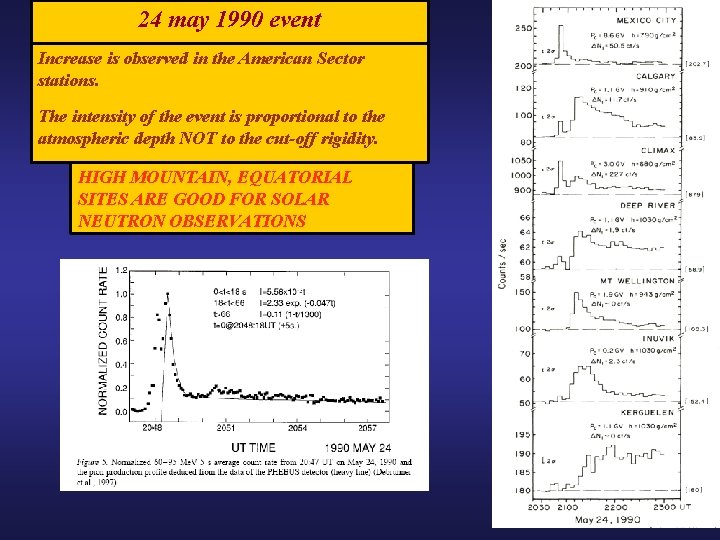
24 may 1990 event Increase is observed in the American Sector stations. The intensity of the event is proportional to the atmospheric depth NOT to the cut-off rigidity. HIGH MOUNTAIN, EQUATORIAL SITES ARE GOOD FOR SOLAR NEUTRON OBSERVATIONS
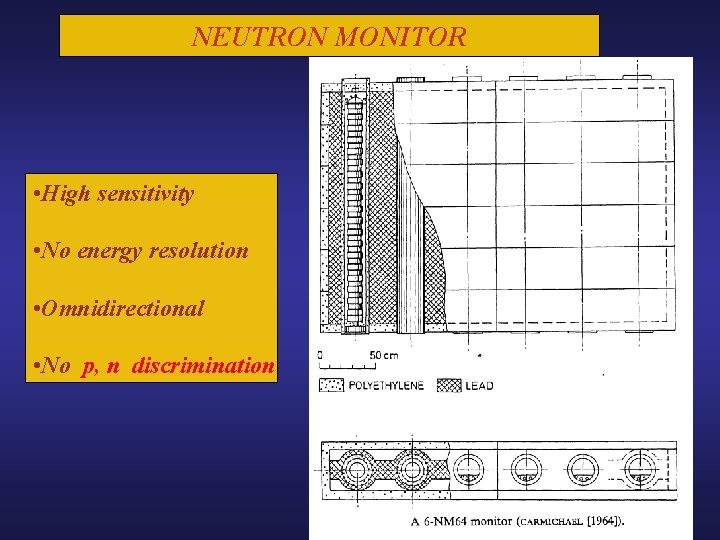
NEUTRON MONITOR • High sensitivity • No energy resolution • Omnidirectional • No p, n discrimination
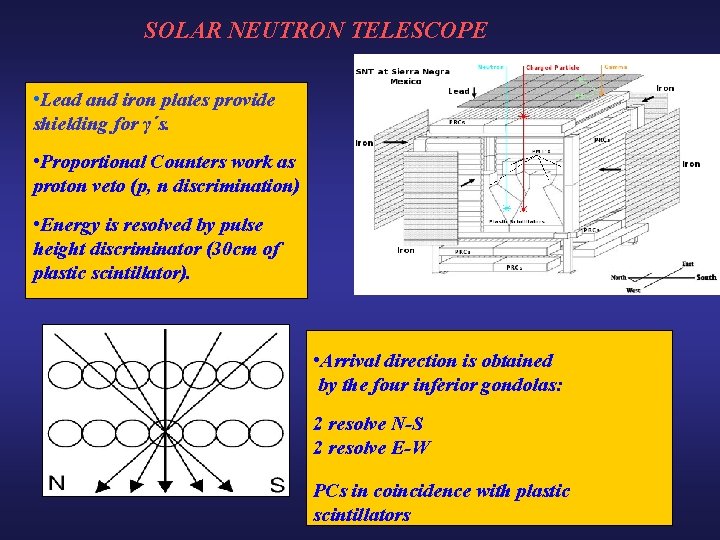
SOLAR NEUTRON TELESCOPE • Lead and iron plates provide shielding for γ´s. • Proportional Counters work as proton veto (p, n discrimination) • Energy is resolved by pulse height discriminator (30 cm of plastic scintillator). • Arrival direction is obtained by the four inferior gondolas: 2 resolve N-S 2 resolve E-W PCs in coincidence with plastic scintillators
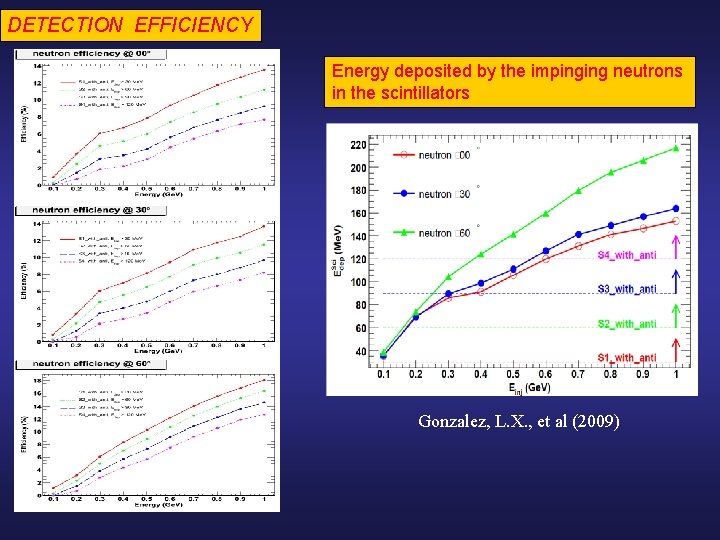
DETECTION EFFICIENCY Energy deposited by the impinging neutrons in the scintillators Gonzalez, L. X. , et al (2009)
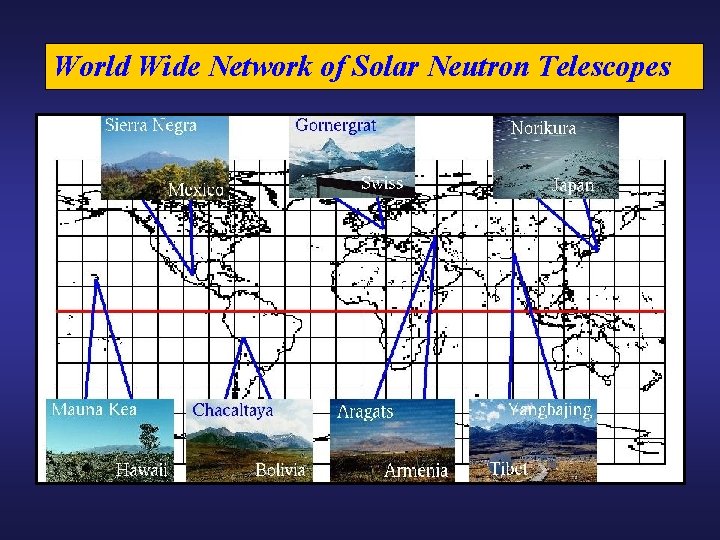
World Wide Network of Solar Neutron Telescopes
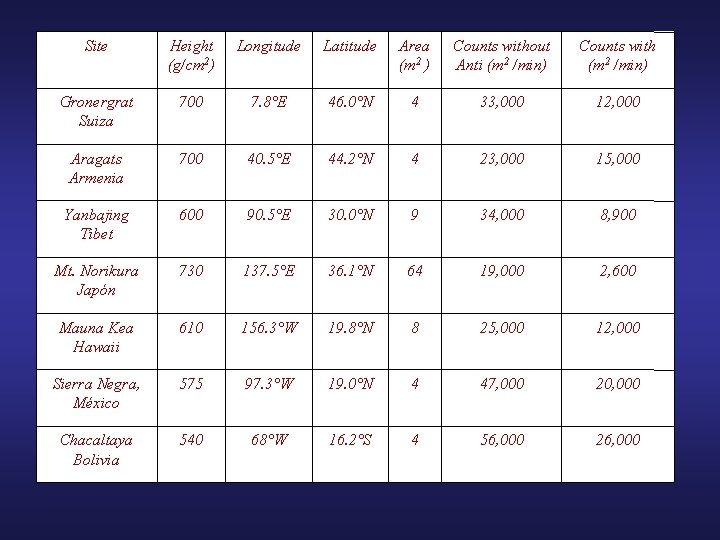
Site Height (g/cm 2) Longitude Latitude Area (m 2 ) Counts without Anti (m 2 /min) Counts with (m 2 /min) Gronergrat Suiza 700 7. 8°E 46. 0°N 4 33, 000 12, 000 Aragats Armenia 700 40. 5°E 44. 2°N 4 23, 000 15, 000 Yanbajing Tibet 600 90. 5°E 30. 0°N 9 34, 000 8, 900 Mt. Norikura Japón 730 137. 5°E 36. 1°N 64 19, 000 2, 600 Mauna Kea Hawaii 610 156. 3°W 19. 8°N 8 25, 000 12, 000 Sierra Negra, México 575 97. 3°W 19. 0°N 4 47, 000 20, 000 Chacaltaya Bolivia 540 68°W 16. 2°S 4 56, 000 26, 000
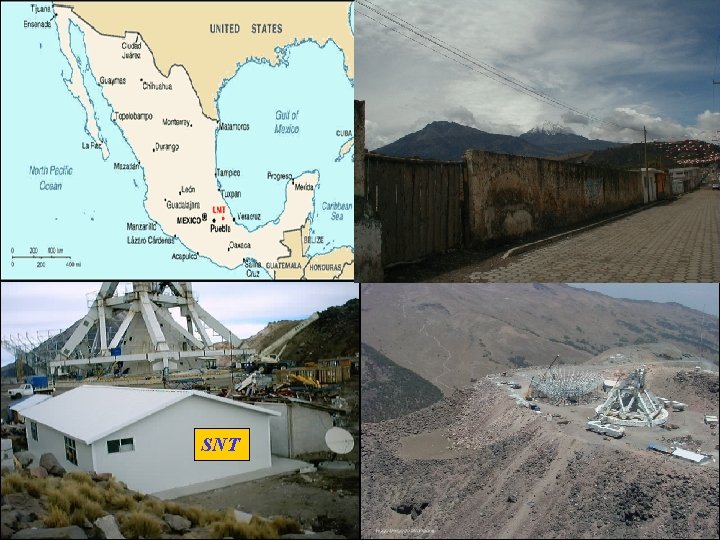
SNT
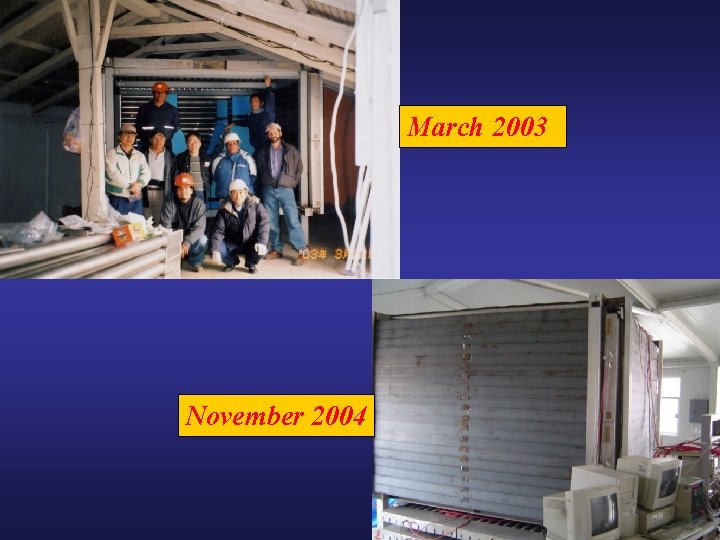
March 2003 November 2004
X-Ray Solar Flare Frequency 11 years Ago. 1987 Jul. 2004
Solar Activity 20 october – 5 november 2003 Solar Flares 2003/10/19 - 2003/11/05 Class X : 11 Class M : 46 488 484 486 SOHO Aurora at Innsbruck, Austria
Solar Position: 4 nov 2003, 19: 30 UTC X 28 Flare (record) with max at 19: 45 UTC
October-Noviember, 2003 Date Start 031019 1629 031023 0819 031023 1950 031026 0557 031026 1721 031028 0951 031029 2037 031102 1703 031103 0109 031103 0943 031104 1929 MAX 1650 0835 2004 0654 1819 1110 2049 1725 0130 0955 1950 Class Coord X 1. 1 N 08 E 58 X 5. 4 S 21 E 88 X 1. 1 S 17 E 84 X 1. 2 S 15 E 44 X 2. 1 N 02 W 38 X 17. 0 S 16 E 08 X 10. 0 S 15 W 02 X 8. 3 S 14 W 56 X 2. 7 N 10 W 83 X 3. 9 N 08 W 77 X 28. 0 S 19 W 83 ¡¡Record !!
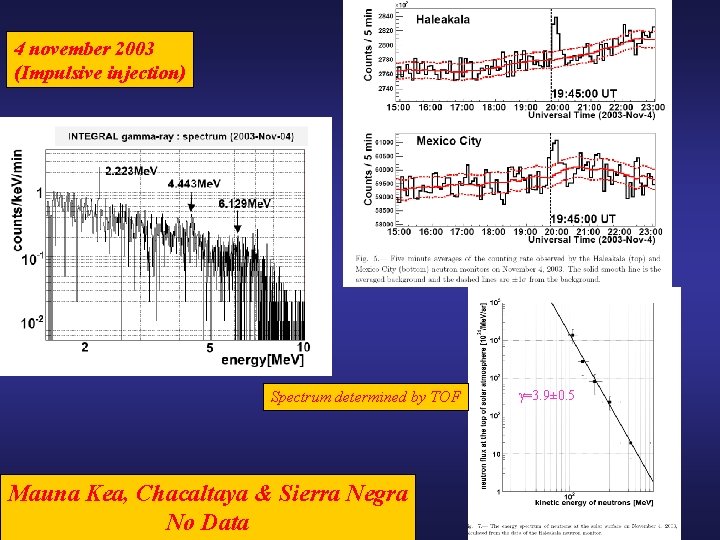
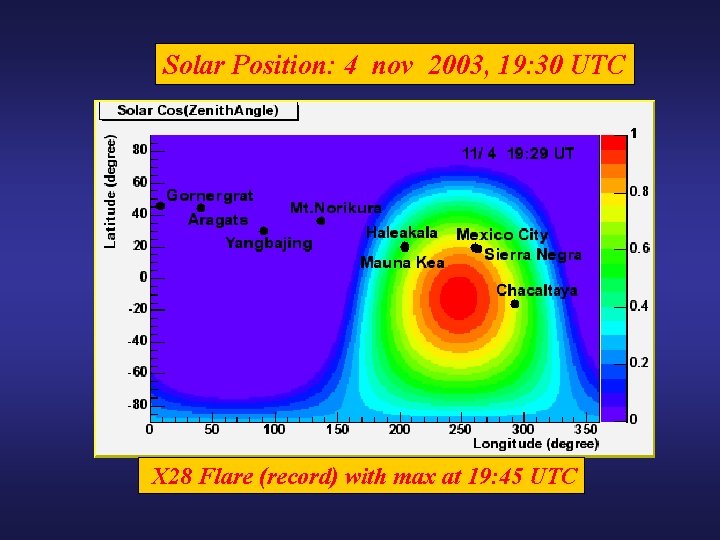
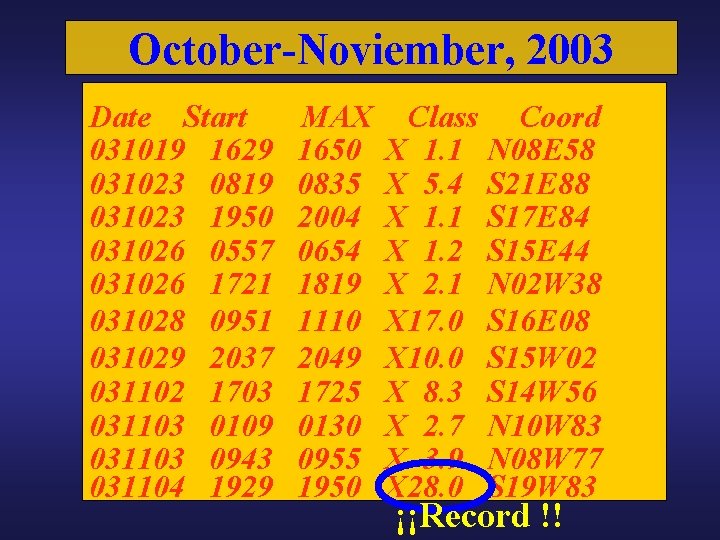
4 november 2003 (Impulsive injection) Spectrum determined by TOF Mauna Kea, Chacaltaya & Sierra Negra No Data =3. 9± 0. 5
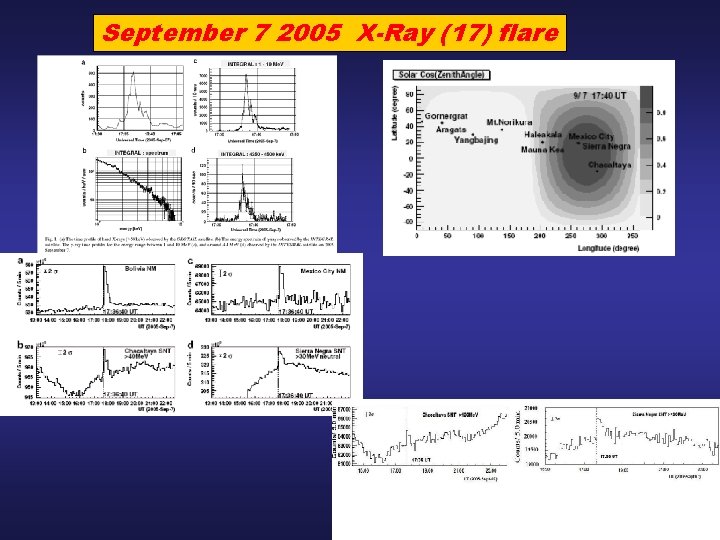
September 7 2005 X-Ray (17) flare
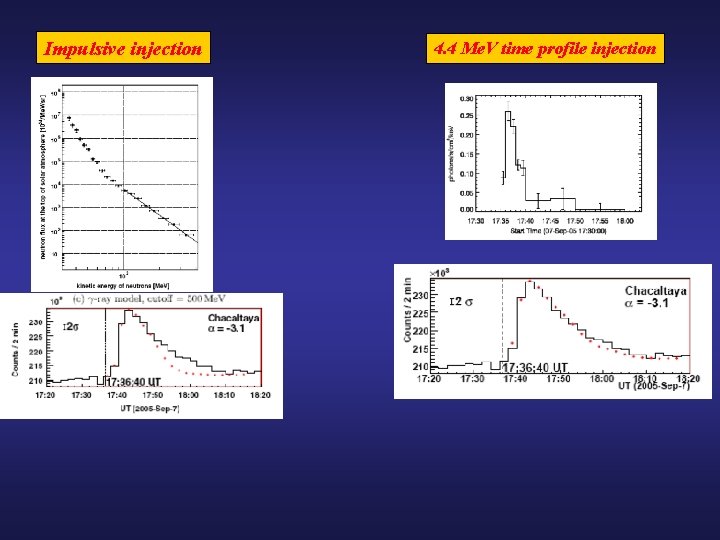
Impulsive injection 4. 4 Me. V time profile injection
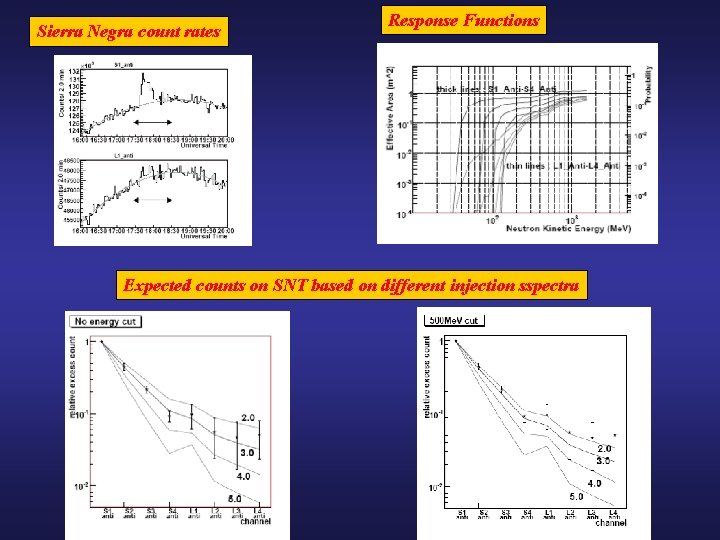
Sierra Negra count rates Response Functions Expected counts on SNT based on different injection sspectra
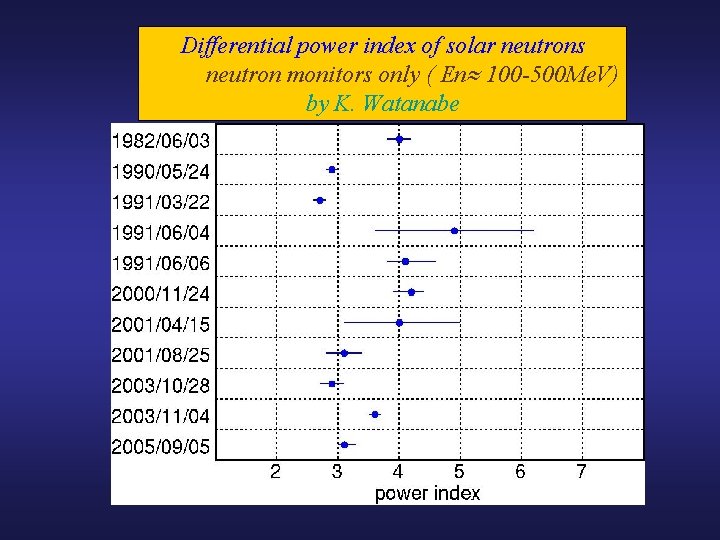
Differential power index of solar neutrons neutron monitors only ( En 100 -500 Me. V) by K. Watanabe
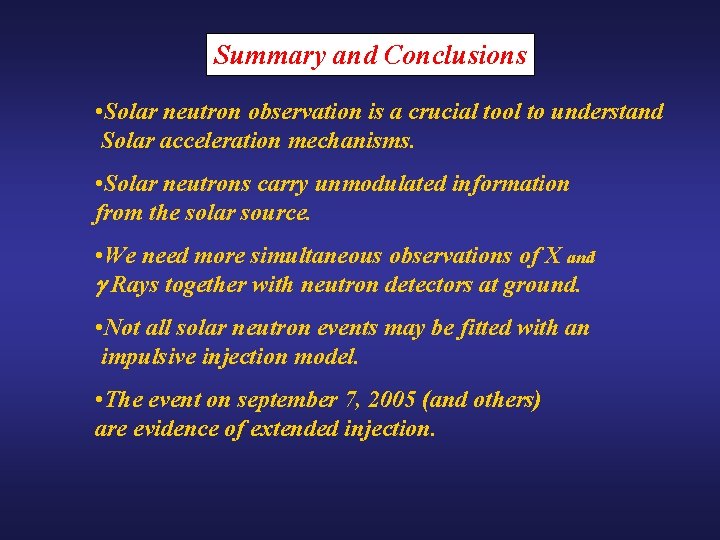
Summary and Conclusions • Solar neutron observation is a crucial tool to understand Solar acceleration mechanisms. • Solar neutrons carry unmodulated information from the solar source. • We need more simultaneous observations of X and Rays together with neutron detectors at ground. • Not all solar neutron events may be fitted with an impulsive injection model. • The event on september 7, 2005 (and others) are evidence of extended injection.
- Slides: 31