
A BIOARGO FLOAT INVESTIGATION IN THE MARQUESAS ISLAND
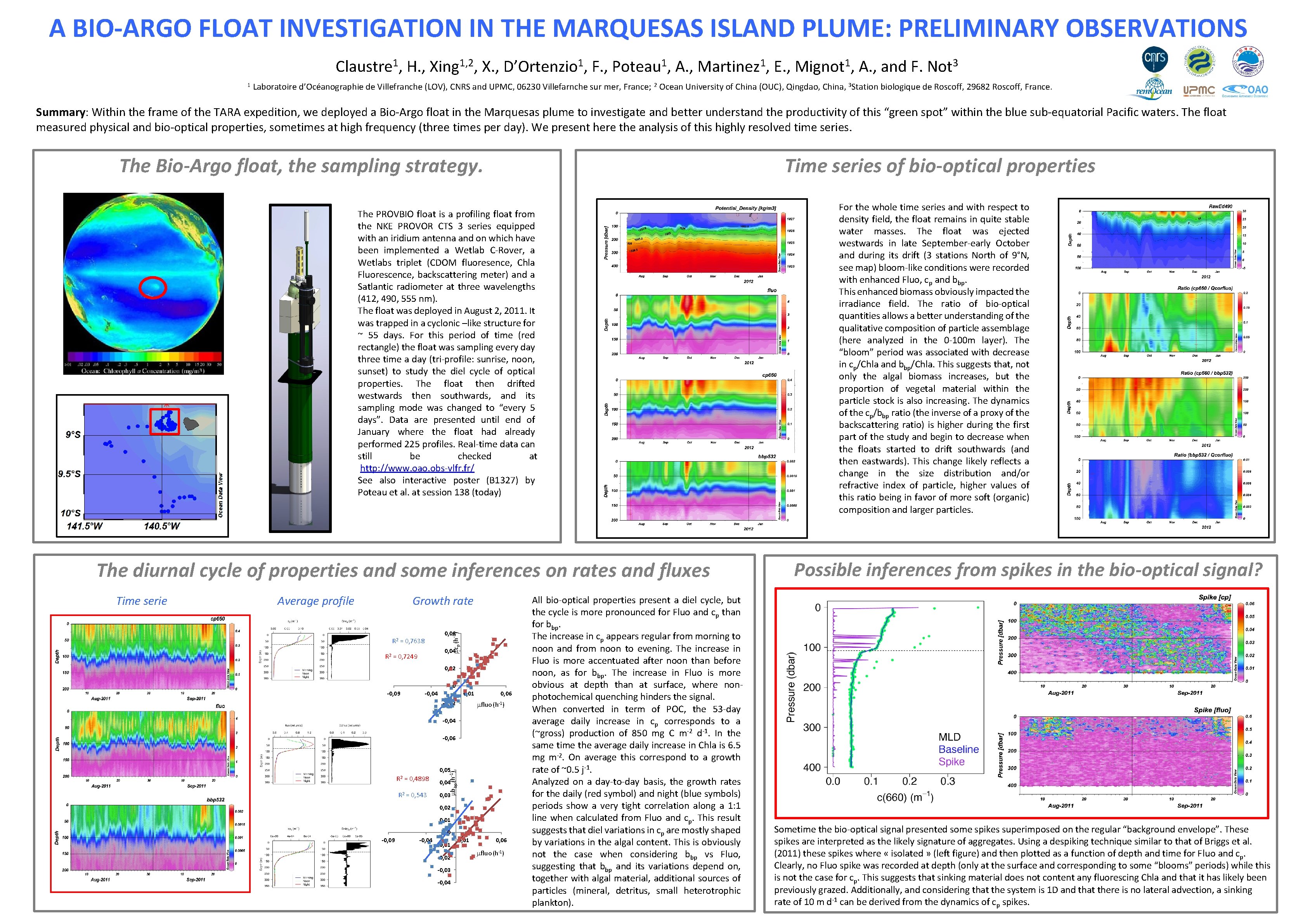
A BIO-ARGO FLOAT INVESTIGATION IN THE MARQUESAS ISLAND PLUME: PRELIMINARY OBSERVATIONS 1 Claustre , 1 H. , 1, 2 Xing , X. , 1 D’Ortenzio , F. , 1 Poteau , A. , 1 Martinez , E. , 1 Mignot , A. , and F. 3 Not Laboratoire d’Océanographie de Villefranche (LOV), CNRS and UPMC, 06230 Villefarnche sur mer, France; 2 Ocean University of China (OUC), Qingdao, China, 3 Station biologique de Roscoff, 29682 Roscoff, France. Summary: Within the frame of the TARA expedition, we deployed a Bio-Argo float in the Marquesas plume to investigate and better understand the productivity of this “green spot” within the blue sub-equatorial Pacific waters. The float measured physical and bio-optical properties, sometimes at high frequency (three times per day). We present here the analysis of this highly resolved time series. The Bio-Argo float, the sampling strategy. Time series of bio-optical properties The PROVBIO float is a profiling float from the NKE PROVOR CTS 3 series equipped with an iridium antenna and on which have been implemented a Wetlab C-Rover, a Wetlabs triplet (CDOM fluoresence, Chla Fluorescence, backscattering meter) and a Satlantic radiometer at three wavelengths (412, 490, 555 nm). The float was deployed in August 2, 2011. It was trapped in a cyclonic –like structure for ~ 55 days. For this period of time (red rectangle) the float was sampling every day three time a day (tri-profile: sunrise, noon, sunset) to study the diel cycle of optical properties. The float then drifted westwards then southwards, and its sampling mode was changed to “every 5 days”. Data are presented until end of January where the float had already performed 225 profiles. Real-time data can still be checked at http: //www. oao. obs-vlfr. fr/ See also interactive poster (B 1327) by Poteau et al. at session 138 (today) The diurnal cycle of properties and some inferences on rates and fluxes Growth rate 0, 06 mcp (h-1) Average profile R 2 = 0, 7638 R 2 0, 04 = 0, 7249 0, 02 0 -0, 09 -0, 04 0, 01 -0, 02 0, 06 mfluo (h-1) -0, 04 -0, 06 0, 05 R 2 = 0, 4898 R 2 = 0, 543 mbbp (h-1) Time serie 0, 04 0, 03 0, 02 0, 01 0 -0, 09 -0, 04 -0, 01 -0, 02 -0, 03 -0, 04 0, 01 0, 06 mfluo (h-1) All bio-optical properties present a diel cycle, but the cycle is more pronounced for Fluo and cp than for bbp. The increase in cp appears regular from morning to noon and from noon to evening. The increase in Fluo is more accentuated after noon than before noon, as for bbp. The increase in Fluo is more obvious at depth than at surface, where nonphotochemical quenching hinders the signal. When converted in term of POC, the 53 -day average daily increase in cp corresponds to a (~gross) production of 850 mg C m-2 d-1. In the same time the average daily increase in Chla is 6. 5 mg m-2. On average this correspond to a growth rate of ~0. 5 j-1. Analyzed on a day-to-day basis, the growth rates for the daily (red symbol) and night (blue symbols) periods show a very tight correlation along a 1: 1 line when calculated from Fluo and cp. This result suggests that diel variations in cp are mostly shaped by variations in the algal content. This is obviously not the case when considering bbp vs Fluo, suggesting that bbp and its variations depend on, together with algal material, additional sources of particles (mineral, detritus, small heterotrophic plankton). For the whole time series and with respect to density field, the float remains in quite stable water masses. The float was ejected westwards in late September-early October and during its drift (3 stations North of 9°N, see map) bloom-like conditions were recorded with enhanced Fluo, cp and bbp. This enhanced biomass obviously impacted the irradiance field. The ratio of bio-optical quantities allows a better understanding of the qualitative composition of particle assemblage (here analyzed in the 0 -100 m layer). The “bloom” period was associated with decrease in cp/Chla and bbp/Chla. This suggests that, not only the algal biomass increases, but the proportion of vegetal material within the particle stock is also increasing. The dynamics of the cp/bbp ratio (the inverse of a proxy of the backscattering ratio) is higher during the first part of the study and begin to decrease when the floats started to drift southwards (and then eastwards). This change likely reflects a change in the size distribution and/or refractive index of particle, higher values of this ratio being in favor of more soft (organic) composition and larger particles. Possible inferences from spikes in the bio-optical signal? Sometime the bio-optical signal presented some spikes superimposed on the regular “background envelope”. These spikes are interpreted as the likely signature of aggregates. Using a despiking technique similar to that of Briggs et al. (2011) these spikes where « isolated » (left figure) and then plotted as a function of depth and time for Fluo and cp. Clearly, no Fluo spike was recorded at depth (only at the surface and corresponding to some “blooms” periods) while this is not the case for cp. This suggests that sinking material does not content any fluorescing Chla and that it has likely been previously grazed. Additionally, and considering that the system is 1 D and that there is no lateral advection, a sinking rate of 10 m d-1 can be derived from the dynamics of cp spikes.
- Slides: 1