
A Bidirectional Matching Algorithm for Deformable Pattern Detection

A Bidirectional Matching Algorithm for Deformable Pattern Detection with Application to Handwritten Word Retrieval by K. W. Cheung, D. Y. Yeung, R. T. Chin {wiliam, dyyeung, roland}@cs. ust. hk
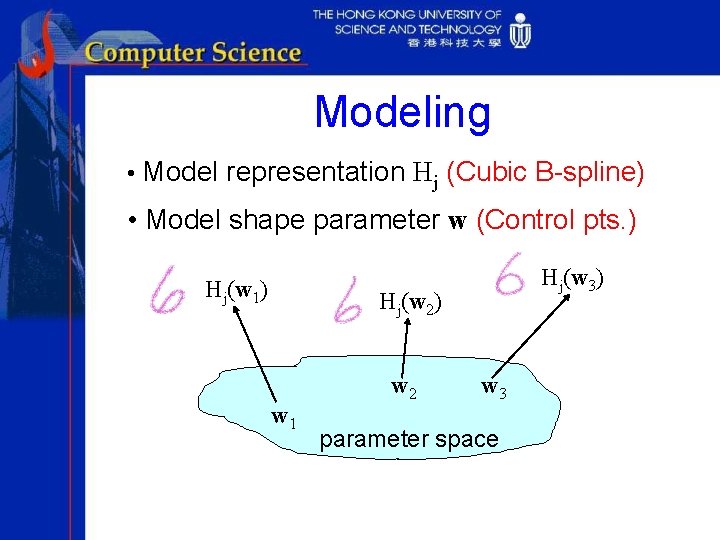
Modeling • Model representation Hj (Cubic B-spline) • Model shape parameter w (Control pts. ) Hj(w 1) Hj(w 3) Hj(w 2) w 1 w 2 w 3 parameter space
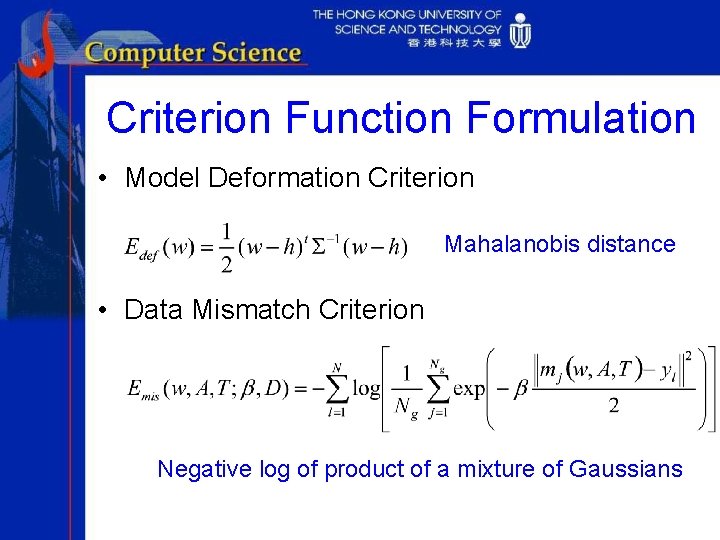
Criterion Function Formulation • Model Deformation Criterion Mahalanobis distance • Data Mismatch Criterion Negative log of product of a mixture of Gaussians
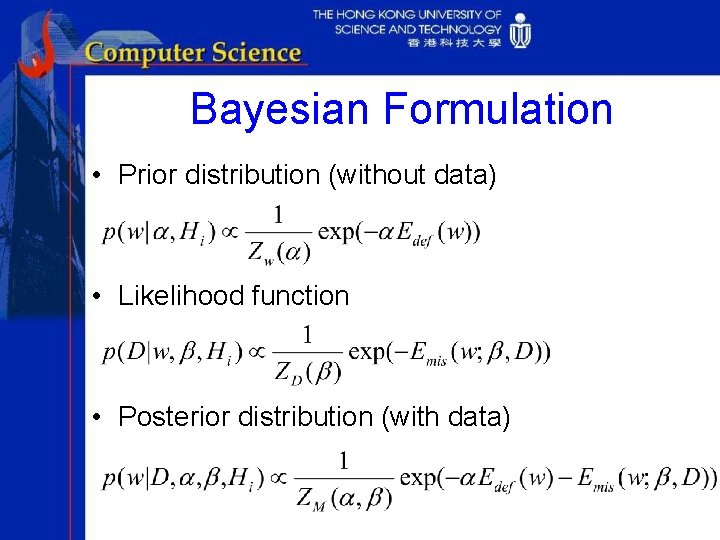
Bayesian Formulation • Prior distribution (without data) • Likelihood function • Posterior distribution (with data)
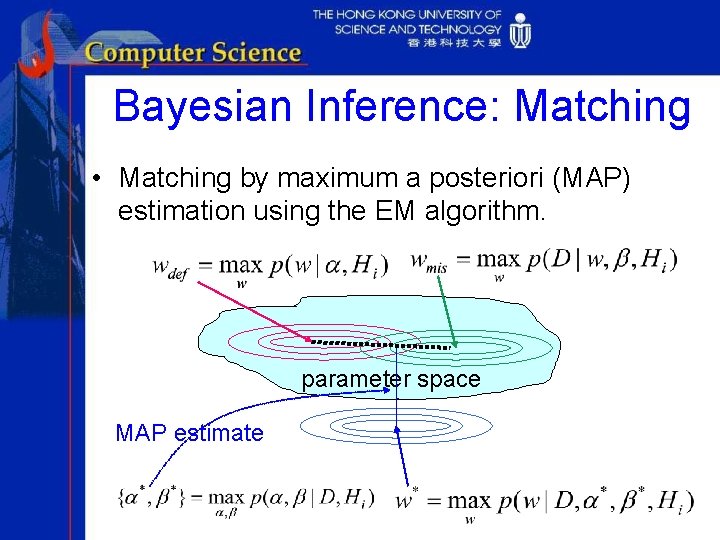
Bayesian Inference: Matching • Matching by maximum a posteriori (MAP) estimation using the EM algorithm. parameter space MAP estimate
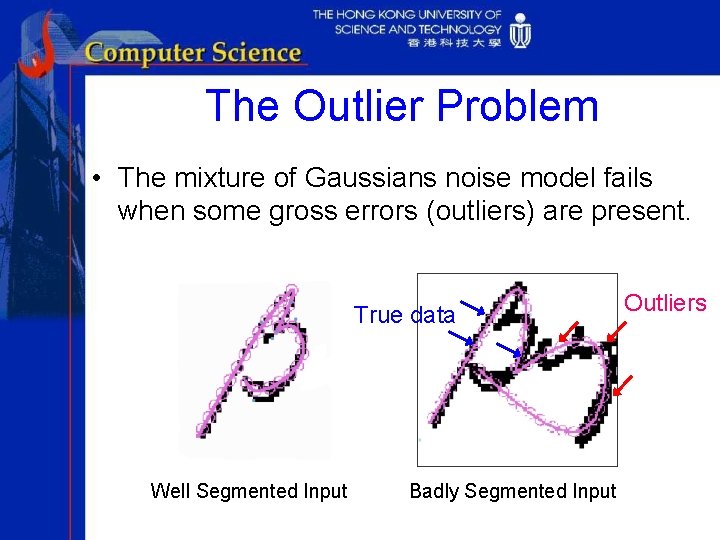
The Outlier Problem • The mixture of Gaussians noise model fails when some gross errors (outliers) are present. True data Well Segmented Input Badly Segmented Input Outliers
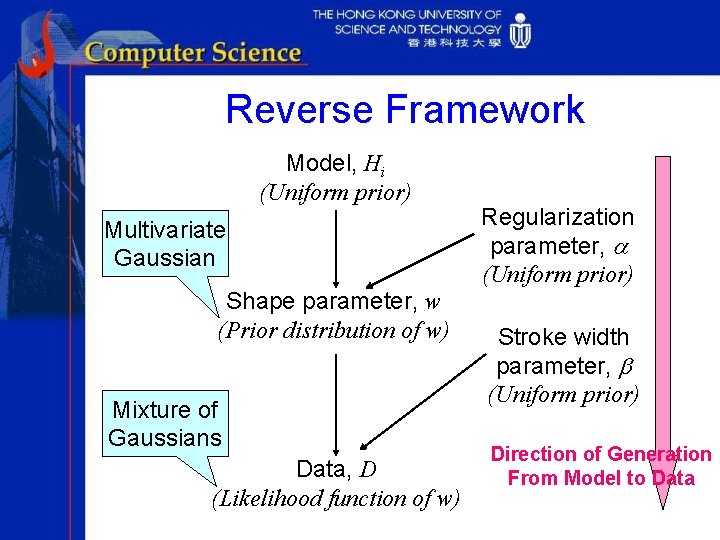
Reverse Framework Model, Hi (Uniform prior) Multivariate Gaussian Shape parameter, w (Prior distribution of w) Mixture of Gaussians Data, D (Likelihood function of w) Regularization parameter, a (Uniform prior) Stroke width parameter, b (Uniform prior) Direction of Generation From Model to Data
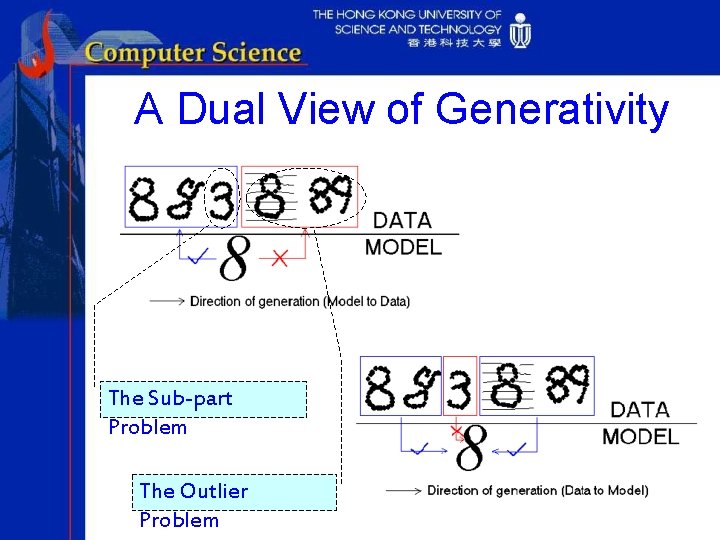
A Dual View of Generativity The Sub-part Problem The Outlier Problem
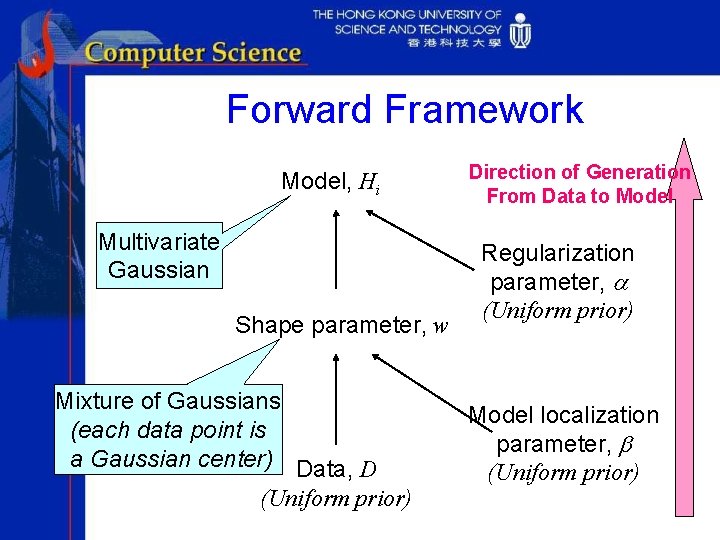
Forward Framework Model, Hi Multivariate Gaussian Shape parameter, w Mixture of Gaussians (each data point is a Gaussian center) Data, D (Uniform prior) Direction of Generation From Data to Model Regularization parameter, a (Uniform prior) Model localization parameter, b (Uniform prior)
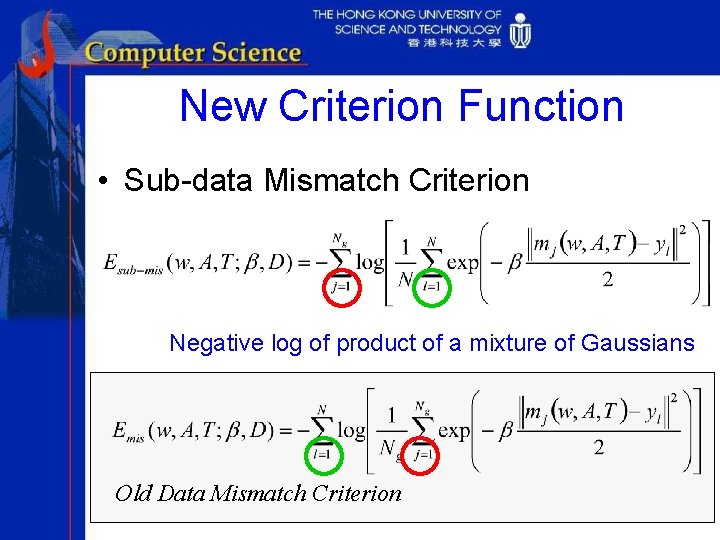
New Criterion Function • Sub-data Mismatch Criterion Negative log of product of a mixture of Gaussians Old Data Mismatch Criterion
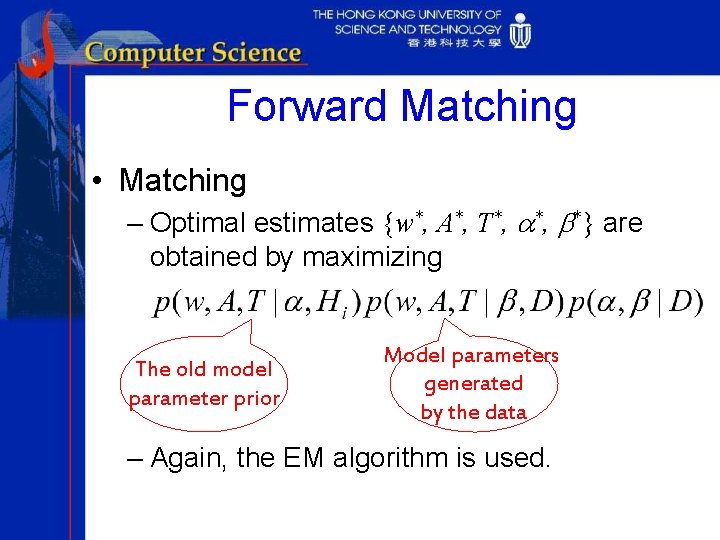
Forward Matching • Matching – Optimal estimates {w*, A*, T*, a*, b*} are obtained by maximizing The old model parameter prior Model parameters generated by the data – Again, the EM algorithm is used.
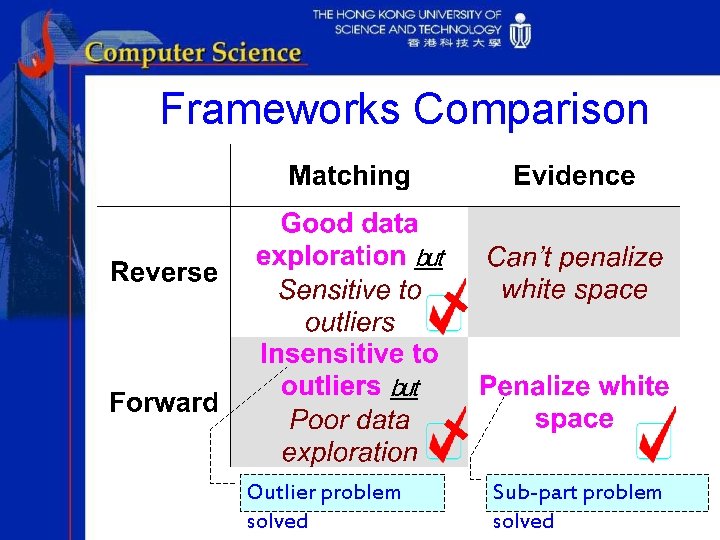
Frameworks Comparison Outlier problem solved Sub-part problem solved
Bidirectional Matching Algorithm • A matching algorithm is proposed which possesses the advantages of the two frameworks. • The underlying idea is to try to obtain a correspondence between the model and data such that the model looks like the data AND vice versa (i. e. , the data mismatch measures for the two frameworks should both be small. ).
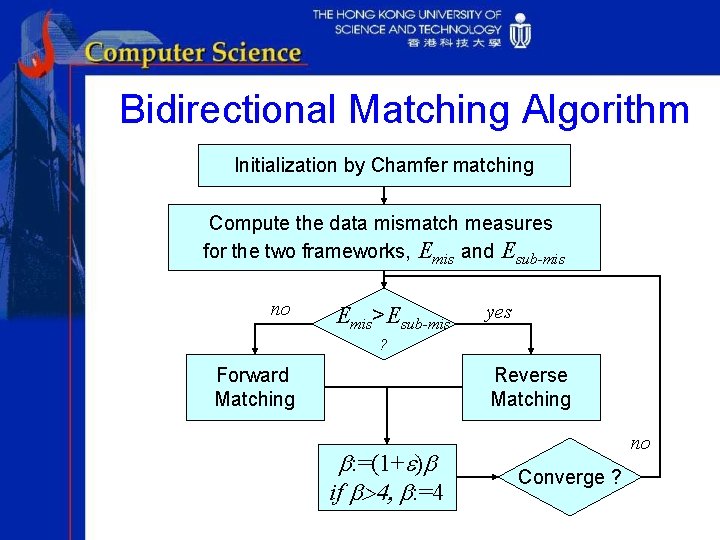
Bidirectional Matching Algorithm Initialization by Chamfer matching Compute the data mismatch measures for the two frameworks, Emis and Esub-mis no Emis>Esub-mis yes ? Forward Matching Reverse Matching b: =(1+e)b if b>4, b: =4 no Converge ?
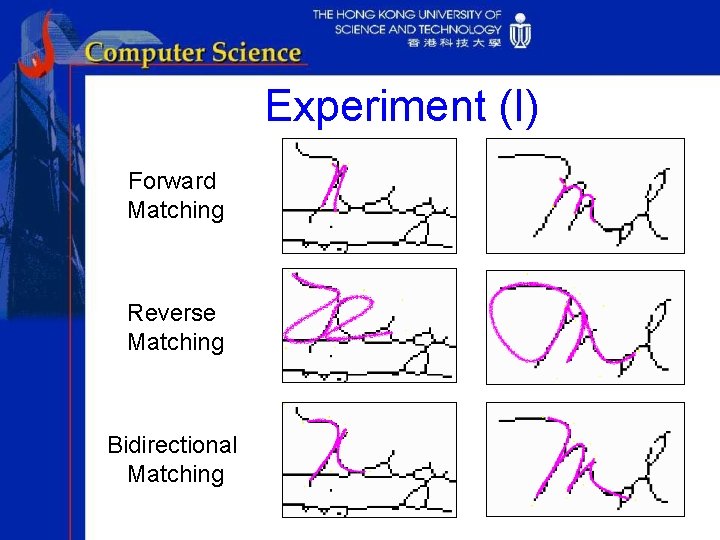
Experiment (I) Forward Matching Reverse Matching Bidirectional Matching
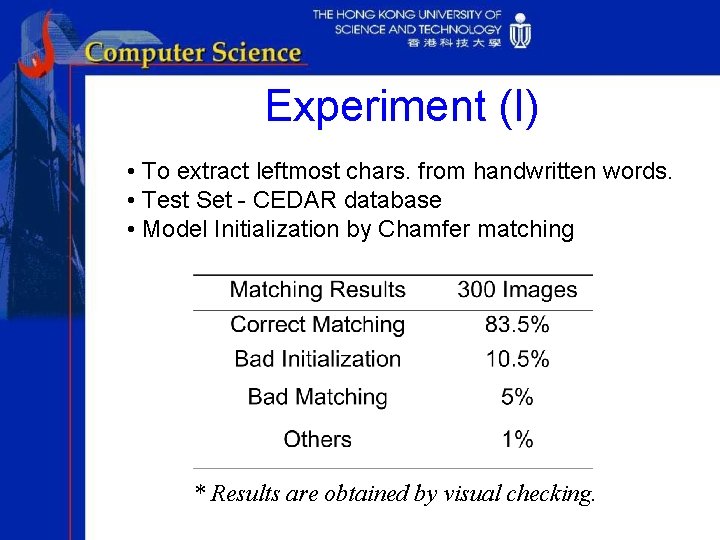
Experiment (I) • To extract leftmost chars. from handwritten words. • Test Set - CEDAR database • Model Initialization by Chamfer matching * Results are obtained by visual checking.
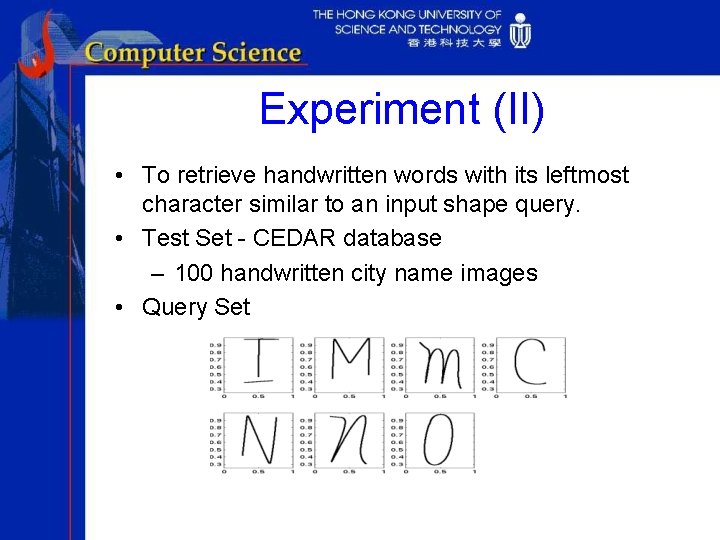
Experiment (II) • To retrieve handwritten words with its leftmost character similar to an input shape query. • Test Set - CEDAR database – 100 handwritten city name images • Query Set
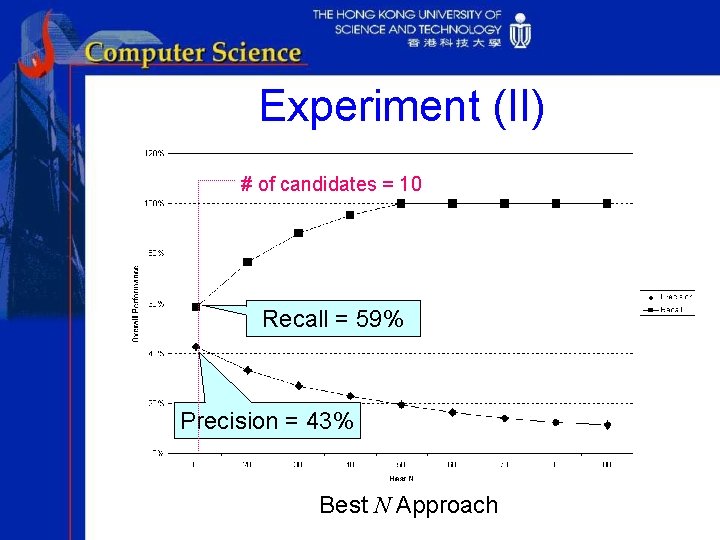
Experiment (II) # of candidates = 10 Recall = 59% Precision = 43% Best N Approach
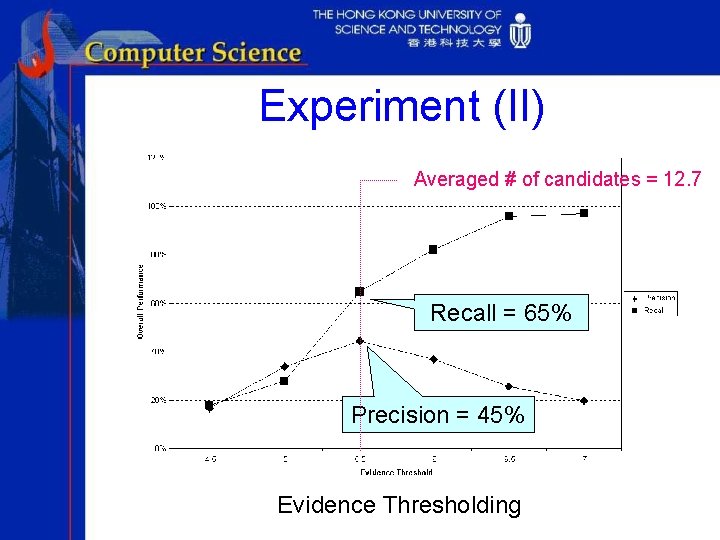
Experiment (II) Averaged # of candidates = 12. 7 Recall = 65% Precision = 45% Evidence Thresholding
- Slides: 19