
A Better Model A Model Piotr Kaminski pkaminskwho
A Better Model A Model Piotr Kaminski <pkaminsk@who. net> A Better Model
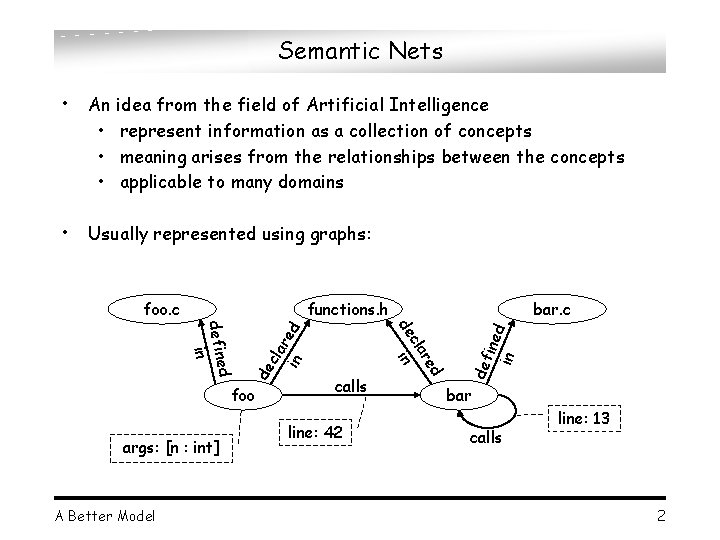
Semantic Nets • An idea from the field of Artificial Intelligence • represent information as a collection of concepts • meaning arises from the relationships between the concepts • applicable to many domains • Usually represented using graphs: calls line: 42 d re in A Better Model cla args: [n : int] de d define in foo bar. c def ine d in functions. h de cla r in ed foo. c bar calls line: 13 2
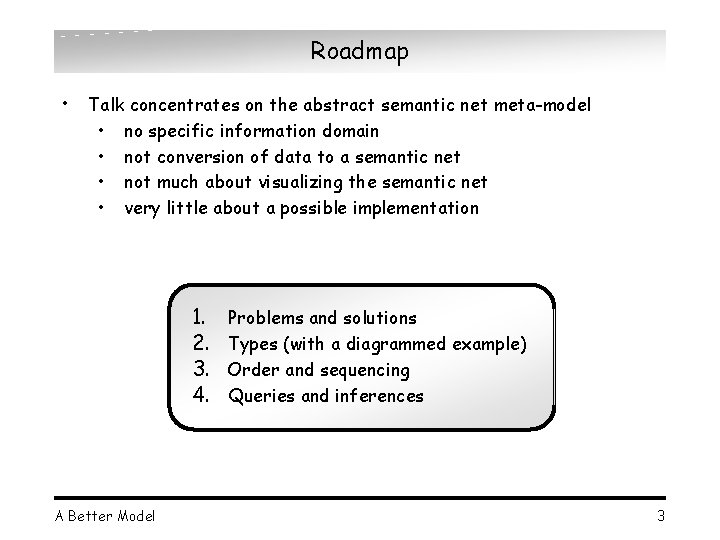
Roadmap • Talk concentrates on the abstract semantic net meta-model • • no specific information domain not conversion of data to a semantic net not much about visualizing the semantic net very little about a possible implementation 1. 2. 3. 4. A Better Model Problems and solutions Types (with a diagrammed example) Order and sequencing Queries and inferences 3
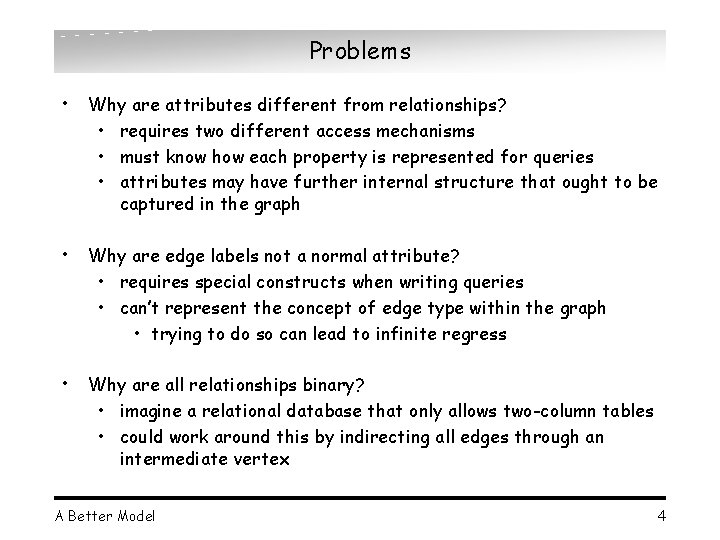
Problems • Why are attributes different from relationships? • requires two different access mechanisms • must know how each property is represented for queries • attributes may have further internal structure that ought to be captured in the graph • Why are edge labels not a normal attribute? • requires special constructs when writing queries • can’t represent the concept of edge type within the graph • trying to do so can lead to infinite regress • Why are all relationships binary? • imagine a relational database that only allows two-column tables • could work around this by indirecting all edges through an intermediate vertex A Better Model 4
Foundations • Use a hypergraph : • each edge may connect any number of vertices • same theoretical foundation as graphs • Vertices are not attributed • represent attributes by binary relationships between the subject and the value • requires special “atom” vertices to represent the actual values • Edges are collections of vertices • cardinality may be greater than 2 • each edge is also automatically a vertex (a collector or relator ) • allow edges to be members of themselves • Call vertices entities and edges relationships A Better Model 5
Types • Avoid strict typing • keep model flexible for experimentation and integration • allow optional validators that indicate any problems • Entities (including relationships) are collected into types • a type is a relationship that collects all vertices that are instances of the same concept • an entity type might be “function” or “file” • a relationship type might be “calls” or “line number” or “name” • another type is “relationship type” • note that this type is a member of itself A Better Model 6
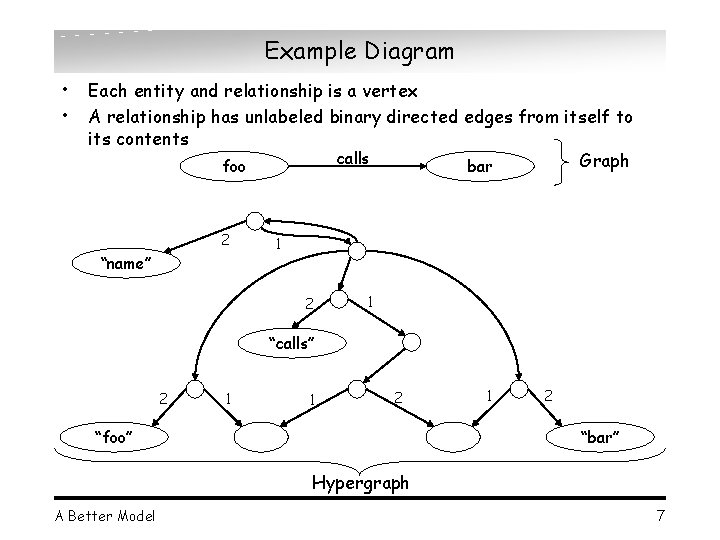
Example Diagram • Each entity and relationship is a vertex • A relationship has unlabeled binary directed edges from itself to its contents calls foo 2 “name” Graph bar 1 2 1 “calls” 2 1 1 2 “foo” 1 2 “bar” Hypergraph A Better Model 7
Don’t Panic! • It looks complex, but… • only the initial setup requires lots of extra vertices • long term, the # of vertices is O(n) relative to a plain graph • an implementation is not required to realize a vertex until it’s needed by the user • most vertices will be virtual for their entire lifespan • How to present these hypergraphs to the user? • • abstract away from the physical structure similar to usual Rigi and SHri. MP visuals n-ary edges represented by either tentacles or grouping potential issues with relationships that contain themselves A Better Model 8
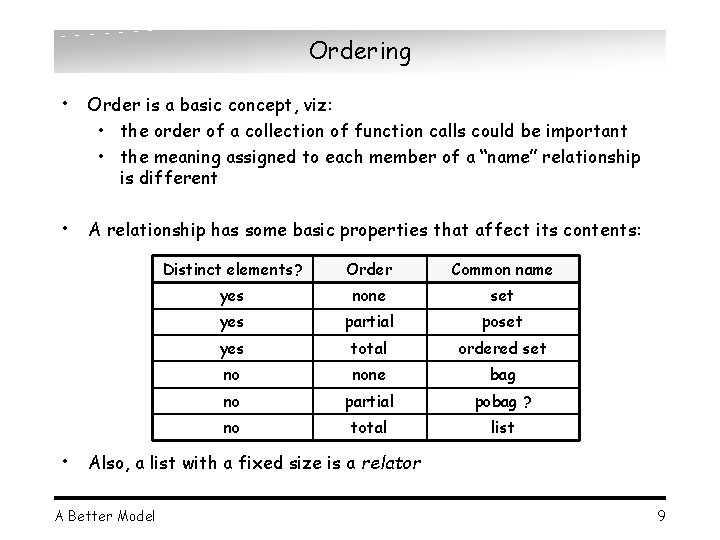
Ordering • Order is a basic concept, viz: • the order of a collection of function calls could be important • the meaning assigned to each member of a “name” relationship is different • A relationship has some basic properties that affect its contents: Distinct elements? Order Common name yes none set yes partial poset yes total ordered set no none bag no partial pobag ? no total list • Also, a list with a fixed size is a relator A Better Model 9
Sequencing • Sequence is also a basic concept, distinct from order • some infinite sets have order but no sequence (e. g. the rationals) • sequence does imply order, though • Sequencing is more than a series of binary relationships • allows access to entity at any given index • changing the sequence of a linked list is tricky • especially if only certain operations are allowed by a given relationship (e. g. exchange elements, move elements) • However, if a collection of elements is already sequenced using binary relationships, we can take advantage of it A Better Model 10
Queries • A query selects a subset of an input relationship to produce a new output relationship • the result changes dynamically along with changes in the input • the output relationship is read-only • the output relationship can be used as input for another query • How? • make a new language? rule-based? • how to describe the ordering/sequencing of the result? • what’s a useful interpretation of transitive closure in a hypergraph? A Better Model 11
Inferences • There always implicit entities and relationships in a graph that can be inferred from existing information, e. g. • aggregation: combine relationships along some hierarchy to allow for high-level overview of relationships • factoring: split relators into a bunch of binary relationships, and vice-versa • reification: make the containment relation explicit (as in the raw diagrams), etc. • any other derived semantics… • Inferred entities should be indistinguishable from original ones • can be visualized alongside the original entities • can be related to other entities, whether inferred or original • Inferences are similar to queries, but create new entities (instead of just filtering and regrouping existing ones) A Better Model 12
Virtualization • We don’t necessarily want to represent all results of an inference explicitly: • the number of inferred entities could be big (even infinite) • most of them might never be needed • often, we just want to know if an existing entity participates in some inferred relationship • Hence: • • let user specify explicitly which inferences to apply where apply inference rules lazily cache inference results destroy inferred entities if unmodified and no longer needed • All (de)virtualization is performed transparently! A Better Model 13
Conclusion • Advantages of this hypergraph meta-model: • uniform: simplified access from user code and reuse of visualization code at all meta-levels • abstract: virtualization allows complex inferences and infinite sets without destroying uniformity • complete: can represent all levels of meta-concepts within the graph itself • flexible: can be used to integrate many other models • rich: offers many opportunities for optimization • What’s next? • ironing out queries and inferences • specifying dimensions • implementing a proof of concept or two. A Better Model 14
- Slides: 14