
A Berkeley View of Big Data Ion Stoica
A Berkeley View of Big Data Ion Stoica UC Berkeley BEARS February 17, 2011
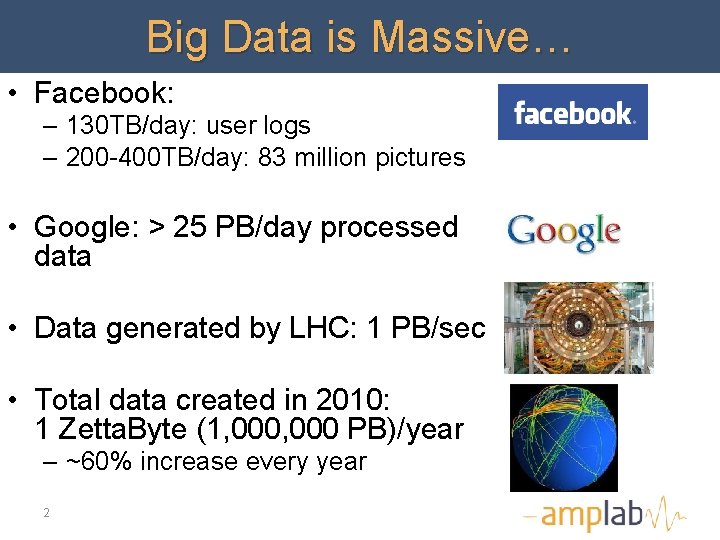
Big Data is Massive… • Facebook: – 130 TB/day: user logs – 200 -400 TB/day: 83 million pictures • Google: > 25 PB/day processed data • Data generated by LHC: 1 PB/sec • Total data created in 2010: 1. Zetta. Byte (1, 000 PB)/year – ~60% increase every year 2
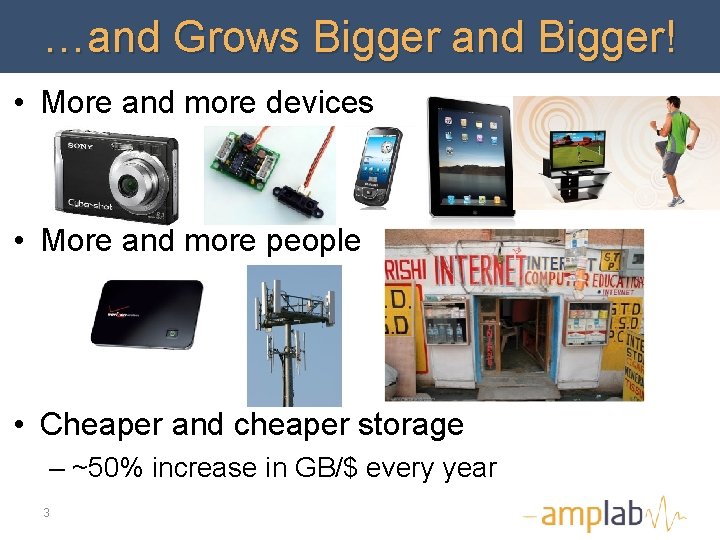
…and Grows Bigger and Bigger! • More and more devices • More and more people • Cheaper and cheaper storage – ~50% increase in GB/$ every year 3
…and Grows Bigger and Bigger! • Log everything! – Don’t always know what question you’ll need to answer • Hard to decide what to delete – Thankless decision: people know only when you are wrong! – “Climate Research Unit (CRU) scientists admit they threw away key data used in global warming calculations” • Stored data grows faster than GB/$ 4
What is Big Data? Data that is expensive to manage, and hard to extract value from • You don’t need to be big to have big data problem! – Inadequate tools to analyze data – Data management may dominate infrastructure cost 5
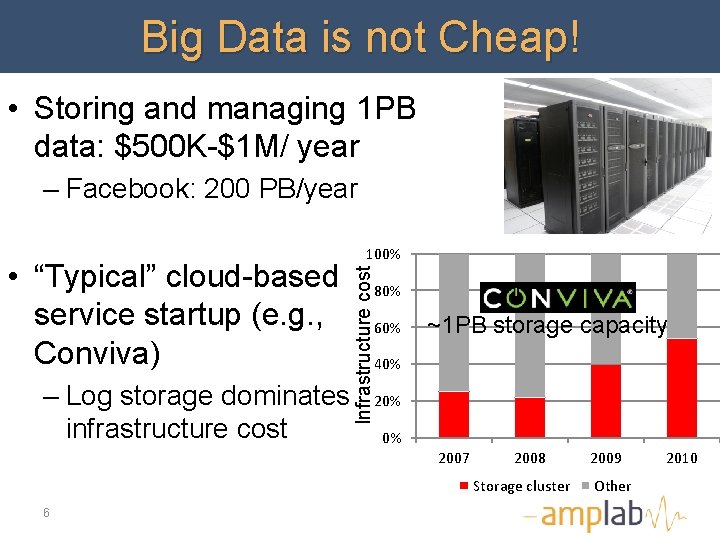
Big Data is not Cheap! • Storing and managing 1 PB data: $500 K-$1 M/ year – Facebook: 200 PB/year – Log storage dominates infrastructure cost Infrastructure cost • “Typical” cloud-based service startup (e. g. , Conviva) 100% 80% 60% ~1 PB storage capacity 40% 20% 0% 2007 2008 Storage cluster 6 2009 Other 2010
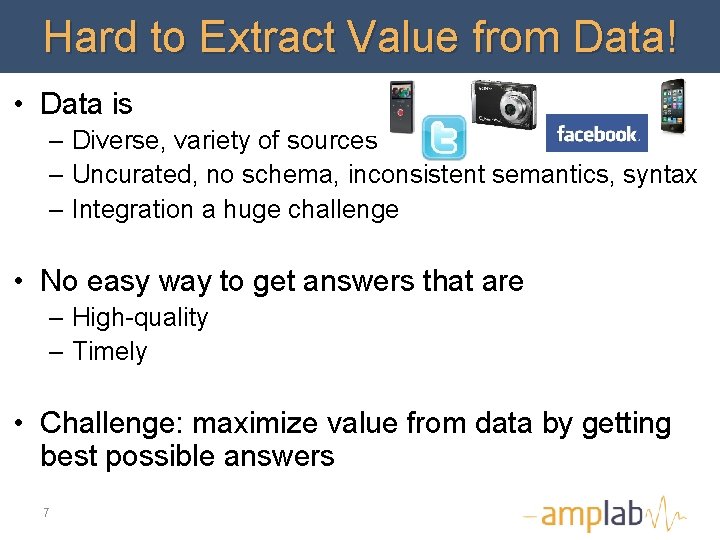
Hard to Extract Value from Data! • Data is – Diverse, variety of sources – Uncurated, no schema, inconsistent semantics, syntax – Integration a huge challenge • No easy way to get answers that are – High-quality – Timely • Challenge: maximize value from data by getting best possible answers 7
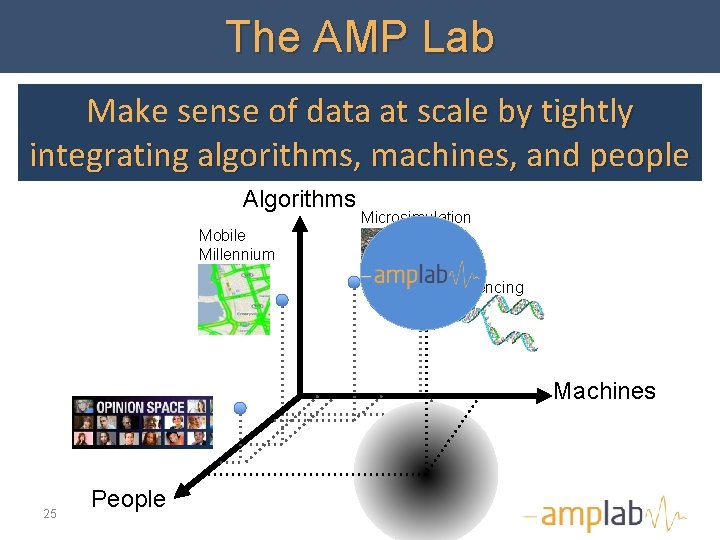
Requires Multifaceted Approach • Three dimensions to improve data analysis – Improving scale, efficiency, and quality of algorithms (Algorithms) – Scaling up datacenters (Machines) – Leverage human activity and intelligence (People) • Need to adaptively and flexibly combine all three dimensions 8
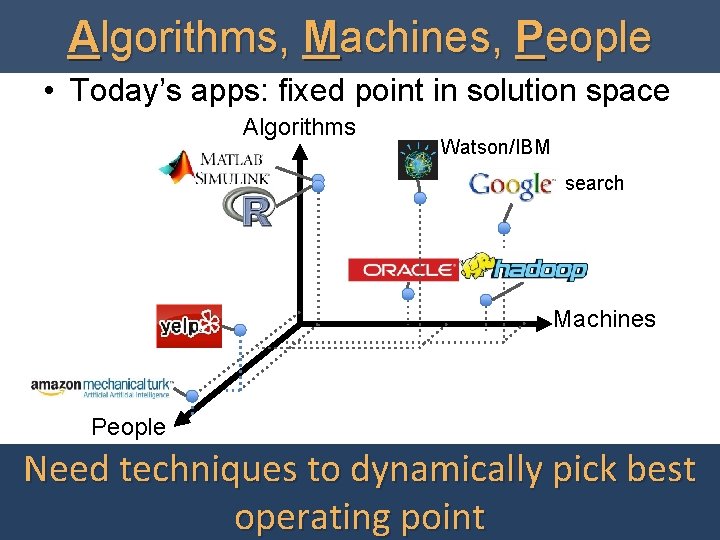
Algorithms, Machines, People • Today’s apps: fixed point in solution space Algorithms Watson/IBM search Machines People Need techniques to dynamically pick best operating point 9
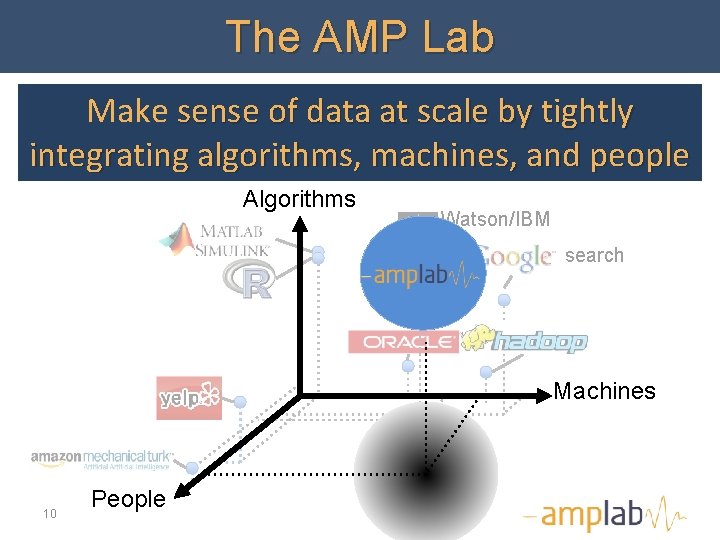
The AMP Lab Make sense of data at scale by tightly integrating algorithms, machines, and people Algorithms Watson/IBM search Machines 10 People
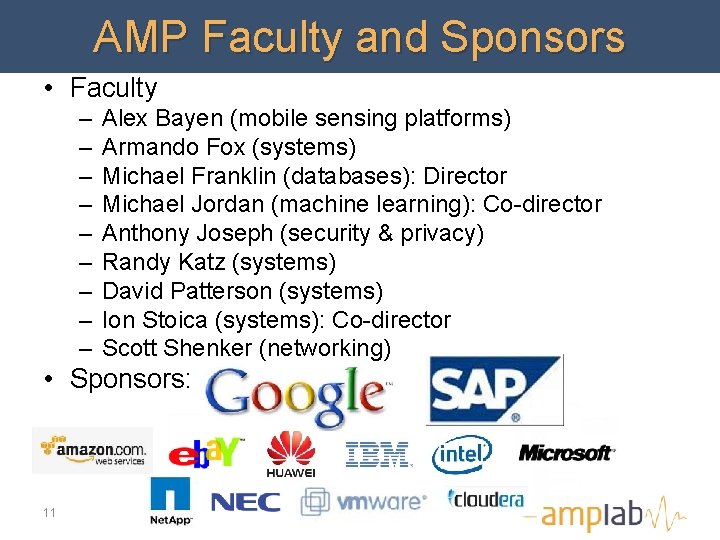
AMP Faculty and Sponsors • Faculty – – – – – Alex Bayen (mobile sensing platforms) Armando Fox (systems) Michael Franklin (databases): Director Michael Jordan (machine learning): Co-director Anthony Joseph (security & privacy) Randy Katz (systems) David Patterson (systems) Ion Stoica (systems): Co-director Scott Shenker (networking) • Sponsors: 11
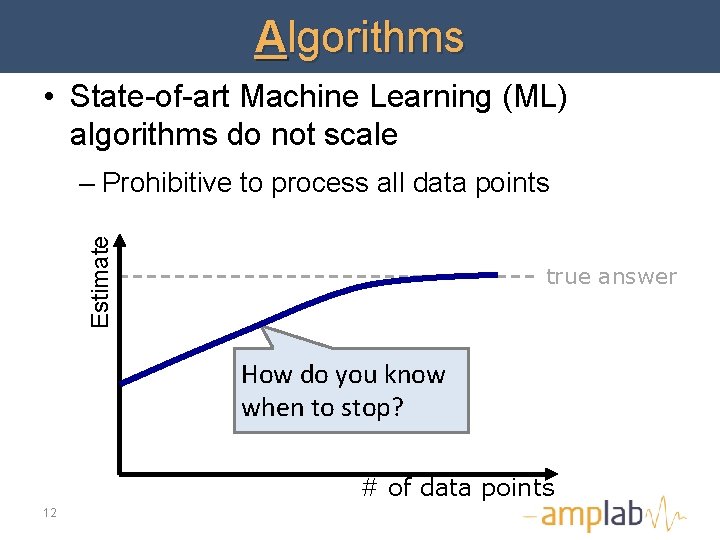
Algorithms • State-of-art Machine Learning (ML) algorithms do not scale Estimate – Prohibitive to process all data points true answer How do you know when to stop? # of data points 12
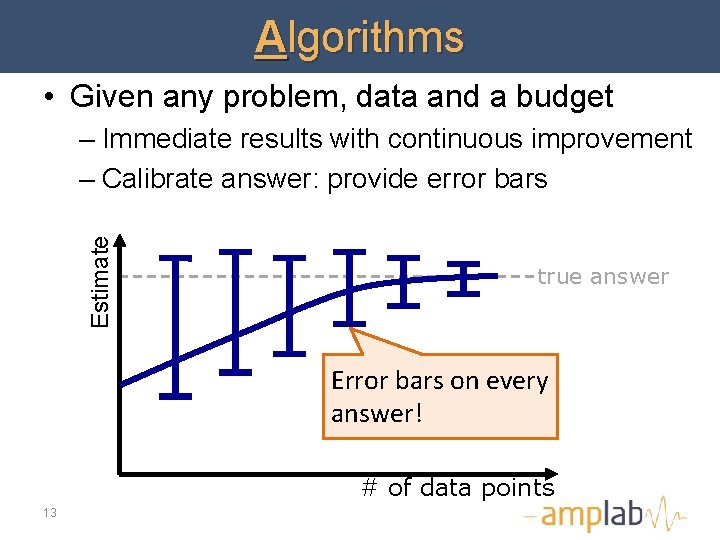
Algorithms • Given any problem, data and a budget Estimate – Immediate results with continuous improvement – Calibrate answer: provide error bars true answer Error bars on every answer! # of data points 13
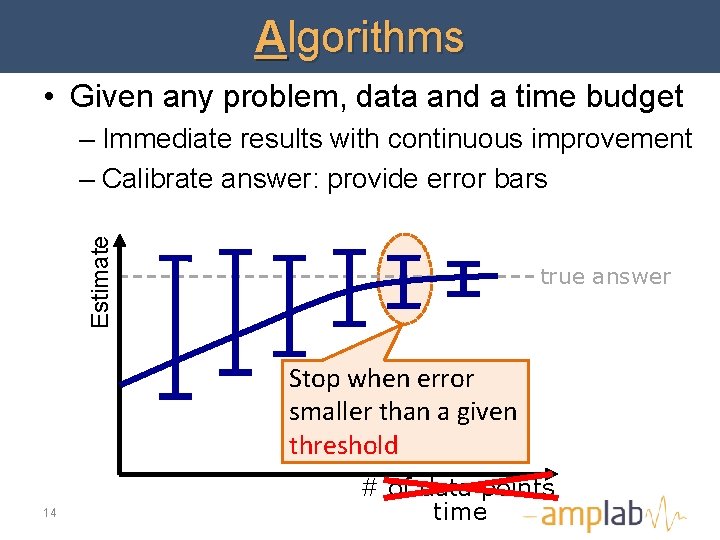
Algorithms • Given any problem, data and a time budget Estimate – Immediate results with continuous improvement – Calibrate answer: provide error bars true answer Stop when error smaller than a given threshold 14 # of data points time
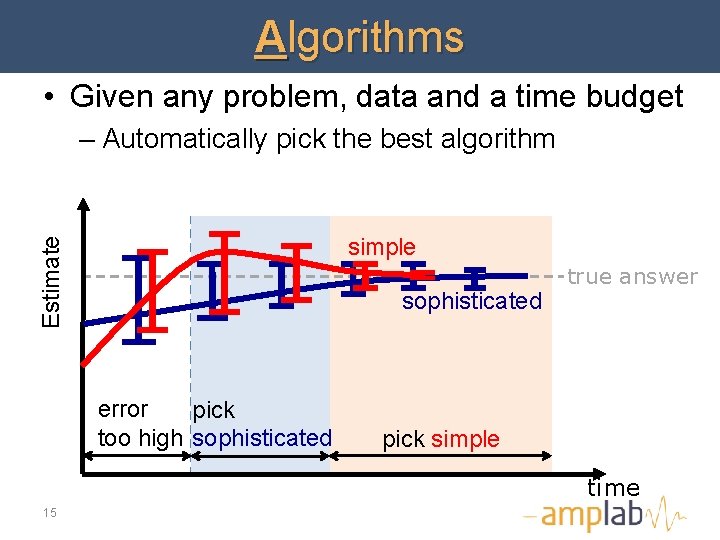
Algorithms • Given any problem, data and a time budget – Automatically pick the best algorithm Estimate simple sophisticated error pick too high sophisticated true answer pick simple time 15
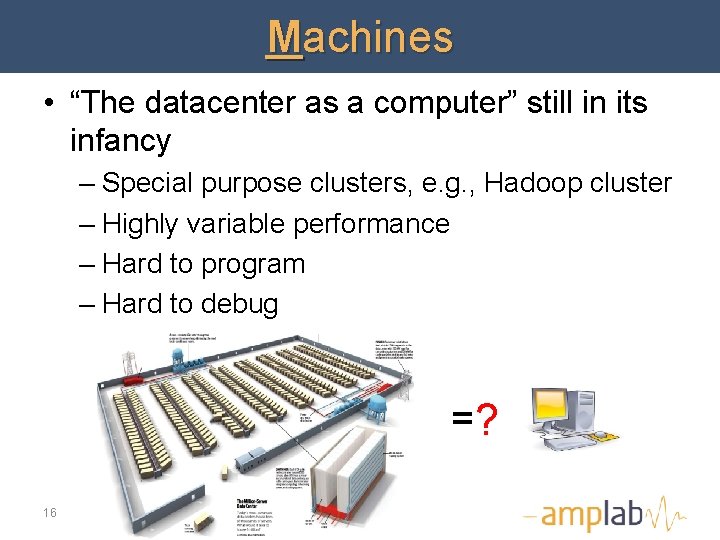
Machines • “The datacenter as a computer” still in its infancy – Special purpose clusters, e. g. , Hadoop cluster – Highly variable performance – Hard to program – Hard to debug =? 16
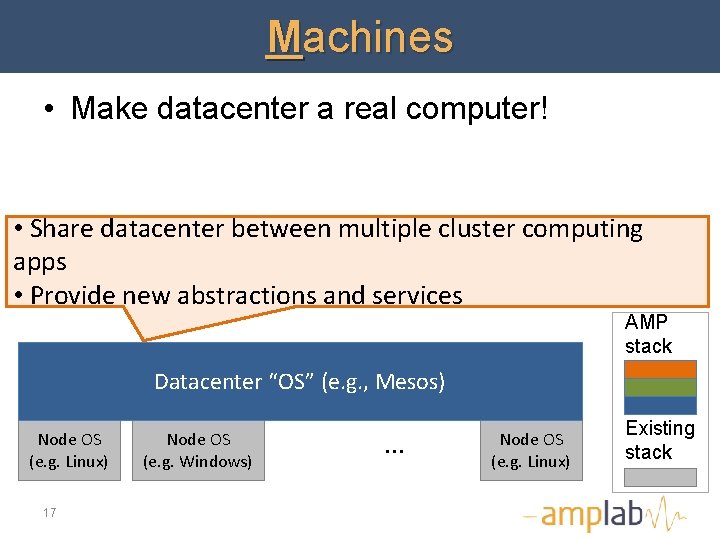
Machines • Make datacenter a real computer! • Share datacenter between multiple cluster computing apps • Provide new abstractions and services AMP stack Datacenter “OS” (e. g. , Mesos) Node OS (e. g. Linux) 17 Node OS (e. g. Windows) … Node OS (e. g. Linux) Existing stack
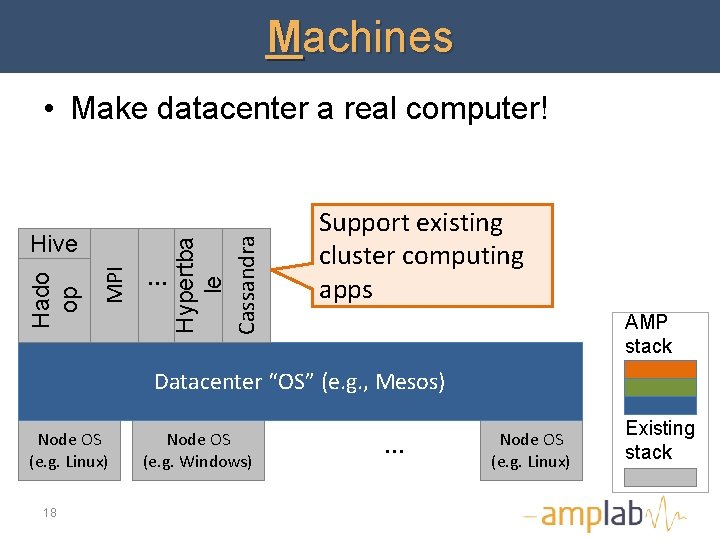
Machines MPI Hado op Hive … Hypertba le Cassandra • Make datacenter a real computer! Support existing cluster computing apps AMP stack Datacenter “OS” (e. g. , Mesos) Node OS (e. g. Linux) 18 Node OS (e. g. Windows) … Node OS (e. g. Linux) Existing stack
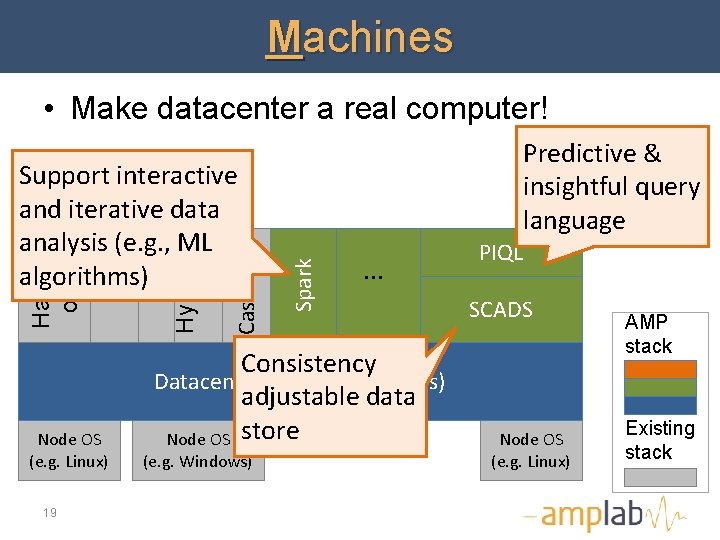
Machines • Make datacenter a real computer! Node OS (e. g. Linux) 19 Spark Hypertba le Cassandra MPI Hado op Support interactive and iterative data analysis (e. g. , ML Hive algorithms)… Predictive & insightful query language PIQL … SCADS Consistency Datacenter “OS” (e. g. , Mesos) adjustable data Node OS store (e. g. Windows) … Node OS (e. g. Linux) AMP stack Existing stack
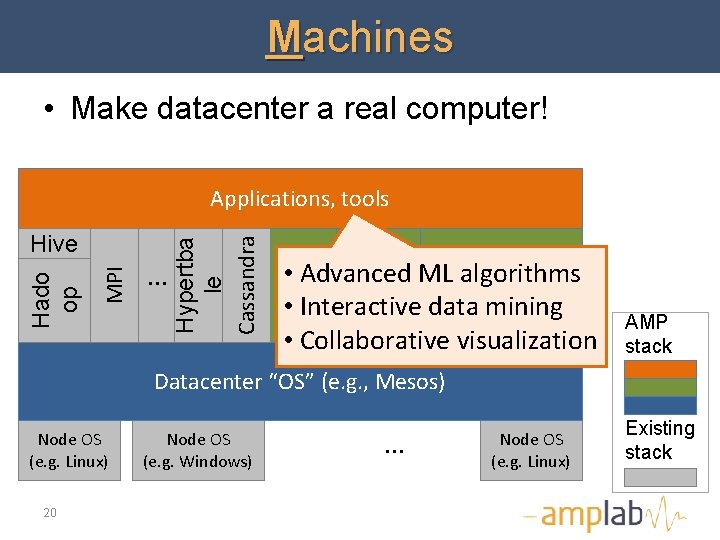
Machines • Make datacenter a real computer! … PIQL … • Advanced ML algorithms • Interactive data. SCADS mining • Collaborative visualization Spark MPI Hado op Hive Hypertba le Cassandra Applications, tools AMP stack Datacenter “OS” (e. g. , Mesos) Node OS (e. g. Linux) 20 Node OS (e. g. Windows) … Node OS (e. g. Linux) Existing stack
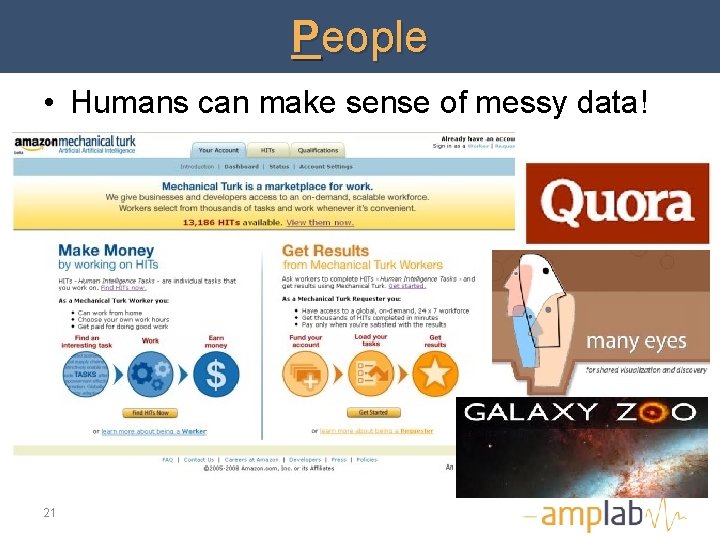
People • Humans can make sense of messy data! 21
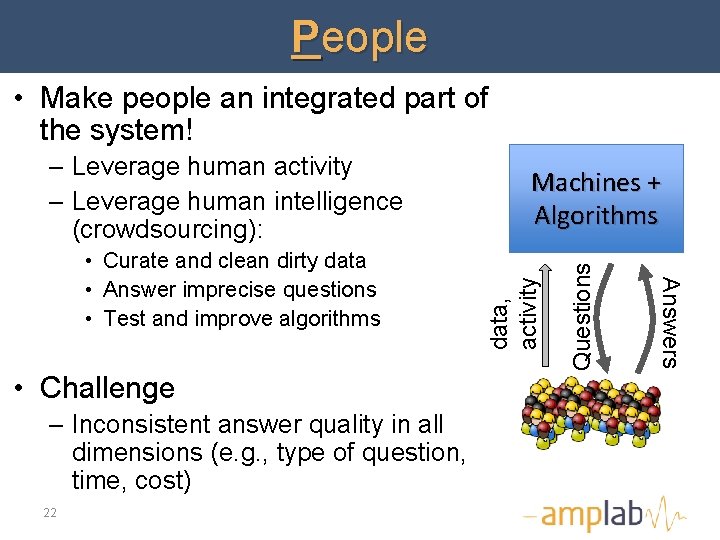
People • Make people an integrated part of the system! – Inconsistent answer quality in all dimensions (e. g. , type of question, time, cost) 22 Questions • Challenge Answers • Curate and clean dirty data • Answer imprecise questions • Test and improve algorithms Machines + Algorithms data, activity – Leverage human intelligence (crowdsourcing):
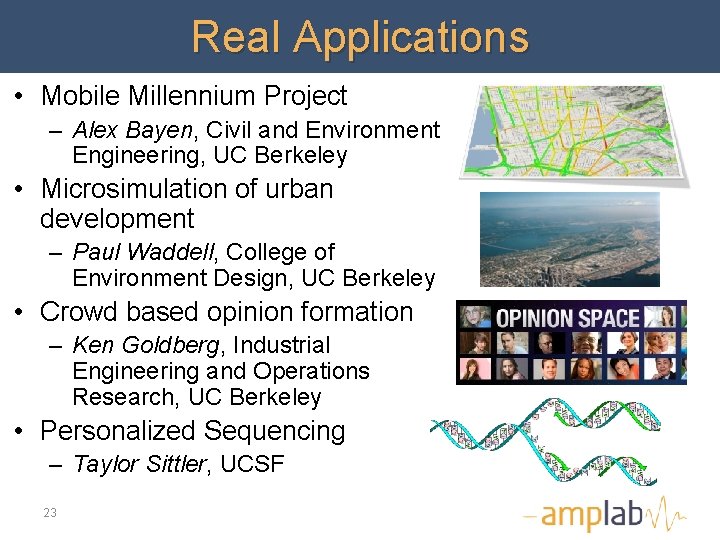
Real Applications • Mobile Millennium Project – Alex Bayen, Civil and Environment Engineering, UC Berkeley • Microsimulation of urban development – Paul Waddell, College of Environment Design, UC Berkeley • Crowd based opinion formation – Ken Goldberg, Industrial Engineering and Operations Research, UC Berkeley • Personalized Sequencing – Taylor Sittler, UCSF 23
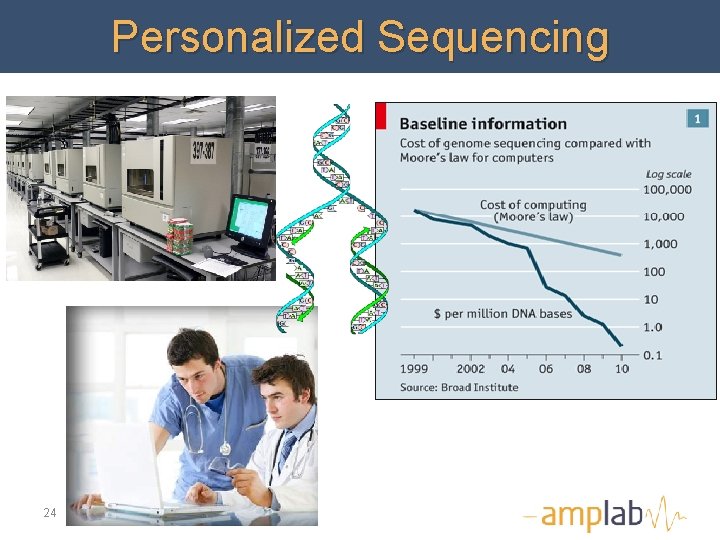
Personalized Sequencing 24
The AMP Lab Make sense of data at scale by tightly integrating algorithms, machines, and people Algorithms Microsimulation Mobile Millennium Sequencing Machines 25 People
Big Data in 2020 Almost Certainly: • Create a new generation of big data scientist • A real datacenter OS • ML becoming an engineering discipline • People deeply integrated in big data analysis pipeline If We’re Lucky: • System will know what to throw away • Generate new knowledge that an individual person cannot
Summary • Goal: Tame Big Data Problem – Get results with right quality at the right time • Approach: Holistically integrate Algorithms, Machines, and People • Huge research issues across many domains 27
- Slides: 27