
A Beginners Guide to the Balkans Balkan Peninsula
A Beginner’s Guide to the Balkans
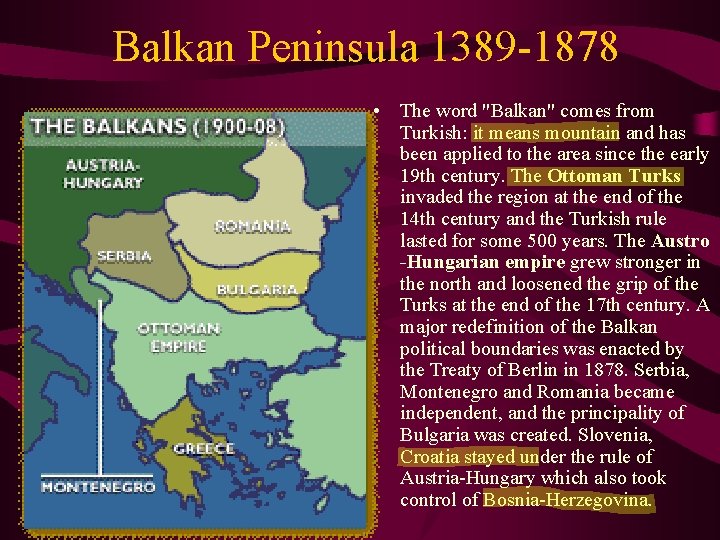
Balkan Peninsula 1389 -1878 • The word "Balkan" comes from Turkish: it means mountain and has been applied to the area since the early 19 th century. The Ottoman Turks invaded the region at the end of the 14 th century and the Turkish rule lasted for some 500 years. The Austro -Hungarian empire grew stronger in the north and loosened the grip of the Turks at the end of the 17 th century. A major redefinition of the Balkan political boundaries was enacted by the Treaty of Berlin in 1878. Serbia, Montenegro and Romania became independent, and the principality of Bulgaria was created. Slovenia, Croatia stayed under the rule of Austria-Hungary which also took control of Bosnia-Herzegovina.
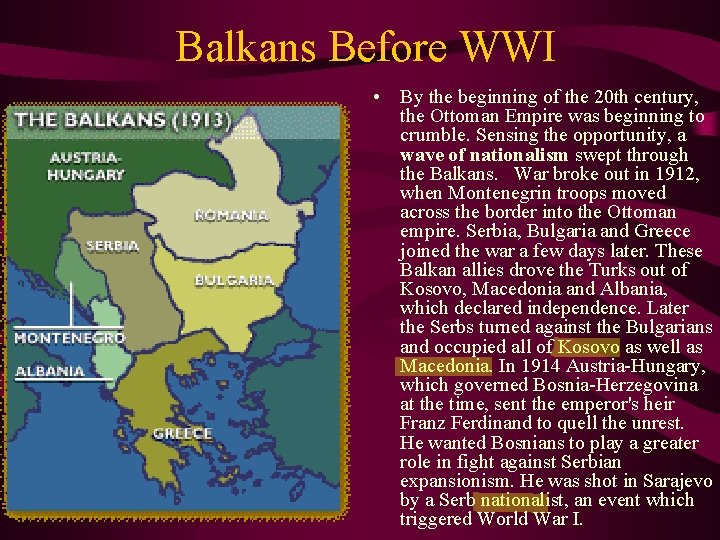
Balkans Before WWI • By the beginning of the 20 th century, the Ottoman Empire was beginning to crumble. Sensing the opportunity, a wave of nationalism swept through the Balkans. War broke out in 1912, when Montenegrin troops moved across the border into the Ottoman empire. Serbia, Bulgaria and Greece joined the war a few days later. These Balkan allies drove the Turks out of Kosovo, Macedonia and Albania, which declared independence. Later the Serbs turned against the Bulgarians and occupied all of Kosovo as well as Macedonia. In 1914 Austria-Hungary, which governed Bosnia-Herzegovina at the time, sent the emperor's heir Franz Ferdinand to quell the unrest. He wanted Bosnians to play a greater role in fight against Serbian expansionism. He was shot in Sarajevo by a Serb nationalist, an event which triggered World War I.
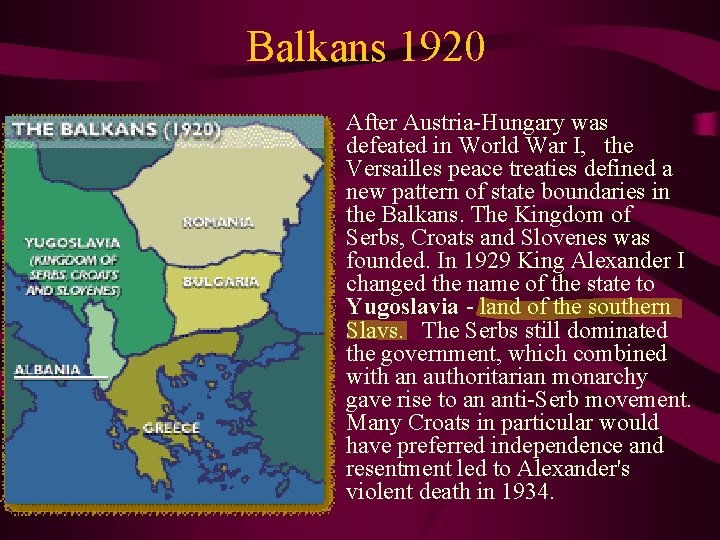
Balkans 1920 • After Austria-Hungary was defeated in World War I, the Versailles peace treaties defined a new pattern of state boundaries in the Balkans. The Kingdom of Serbs, Croats and Slovenes was founded. In 1929 King Alexander I changed the name of the state to Yugoslavia - land of the southern Slavs. The Serbs still dominated the government, which combined with an authoritarian monarchy gave rise to an anti-Serb movement. Many Croats in particular would have preferred independence and resentment led to Alexander's violent death in 1934.
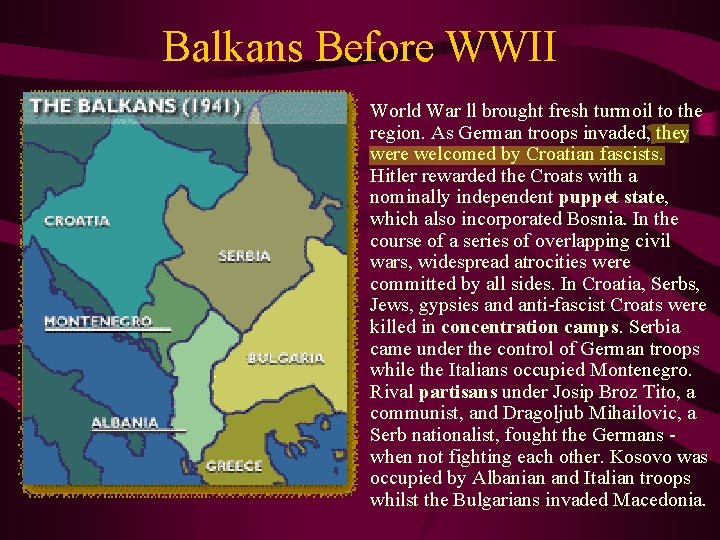
Balkans Before WWII • World War ll brought fresh turmoil to the region. As German troops invaded, they were welcomed by Croatian fascists. Hitler rewarded the Croats with a nominally independent puppet state, which also incorporated Bosnia. In the course of a series of overlapping civil wars, widespread atrocities were committed by all sides. In Croatia, Serbs, Jews, gypsies and anti-fascist Croats were killed in concentration camps. Serbia came under the control of German troops while the Italians occupied Montenegro. Rival partisans under Josip Broz Tito, a communist, and Dragoljub Mihailovic, a Serb nationalist, fought the Germans when not fighting each other. Kosovo was occupied by Albanian and Italian troops whilst the Bulgarians invaded Macedonia.
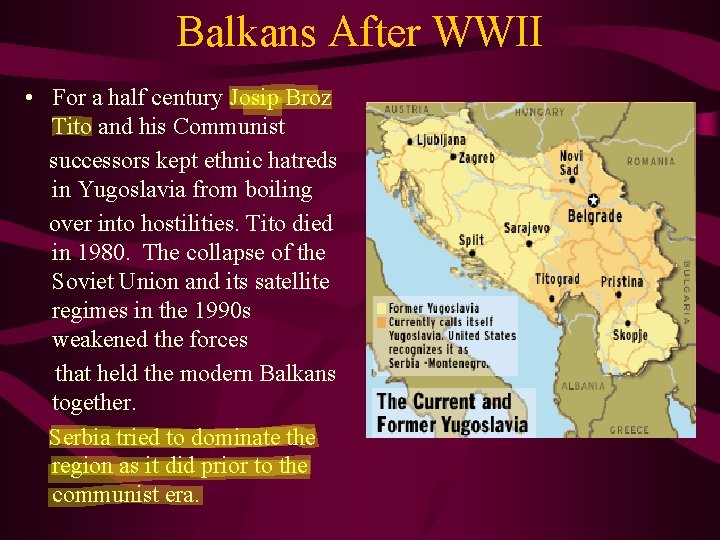
Balkans After WWII • For a half century Josip Broz Tito and his Communist successors kept ethnic hatreds in Yugoslavia from boiling over into hostilities. Tito died in 1980. The collapse of the Soviet Union and its satellite regimes in the 1990 s weakened the forces that held the modern Balkans together. Serbia tried to dominate the region as it did prior to the communist era.
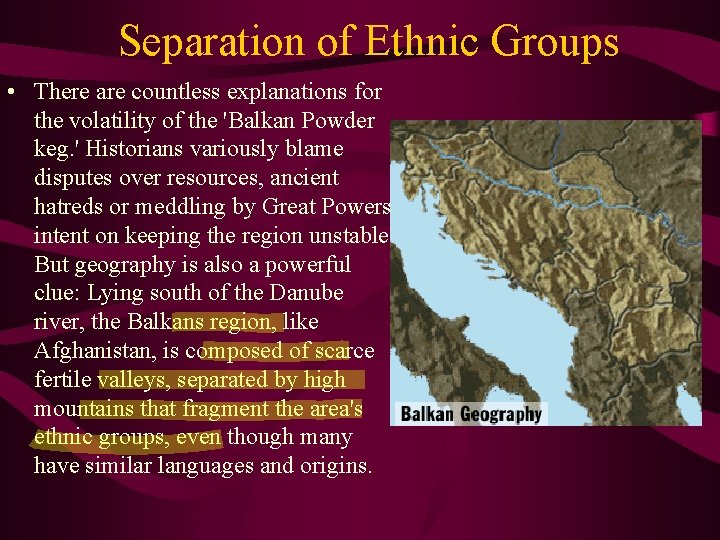
Separation of Ethnic Groups • There are countless explanations for the volatility of the 'Balkan Powder keg. ' Historians variously blame disputes over resources, ancient hatreds or meddling by Great Powers intent on keeping the region unstable. But geography is also a powerful clue: Lying south of the Danube river, the Balkans region, like Afghanistan, is composed of scarce fertile valleys, separated by high mountains that fragment the area's ethnic groups, even though many have similar languages and origins.
Balkanization • There are countries in the world where political citizenship doesn’t mean anything-it’s ethnic identity that matters. • Basques bomb spanish police stations, agitating for their own state. Blacks and whites squabble over resources in post-apartheid South Africa, and even in wealthy Canada, a French-speaking separatist movement is gaining strength in Quebec. • But it’s the Balkans that we think of when a nation splinters apart. It’s the Balkans-mainly Bosnia, Croatia, and Serbia - that took center stage for the U. S. and other major powers for much of the last decade. Balkanization - the term was coined in 1912 during similar troubles - means to break up into smaller, often hostile, nations. This terrifies the industrialized world because it can lead to skyrocketing inflation, currency crises, or increased tensions as neighbors watch nervously or take sides.
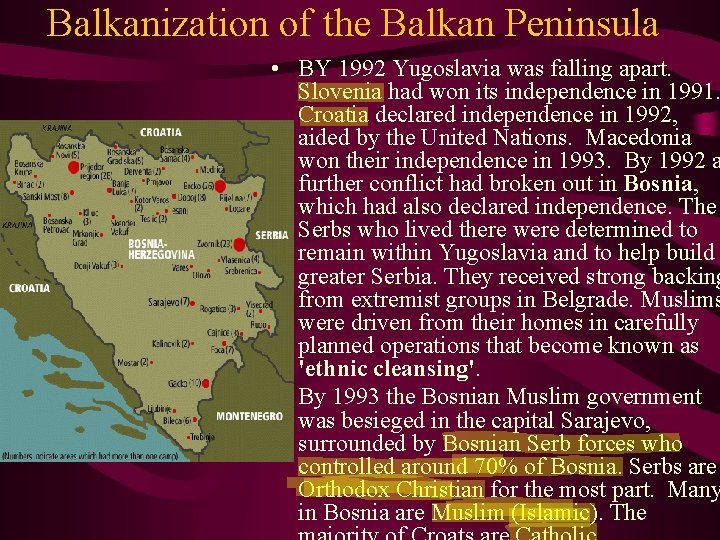
Balkanization of the Balkan Peninsula • BY 1992 Yugoslavia was falling apart. Slovenia had won its independence in 1991. Croatia declared independence in 1992, aided by the United Nations. Macedonia won their independence in 1993. By 1992 a further conflict had broken out in Bosnia, which had also declared independence. The Serbs who lived there were determined to remain within Yugoslavia and to help build greater Serbia. They received strong backing from extremist groups in Belgrade. Muslims were driven from their homes in carefully planned operations that become known as 'ethnic cleansing'. • By 1993 the Bosnian Muslim government was besieged in the capital Sarajevo, surrounded by Bosnian Serb forces who controlled around 70% of Bosnia. Serbs are Orthodox Christian for the most part. Many in Bosnia are Muslim (Islamic). The
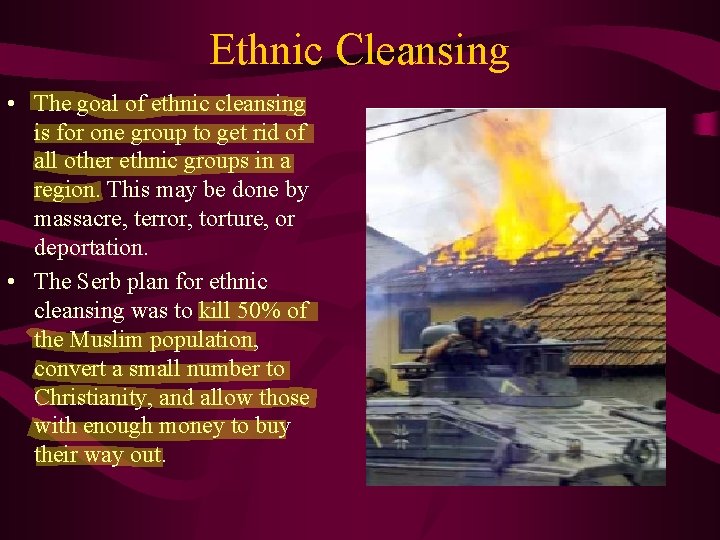
Ethnic Cleansing • The goal of ethnic cleansing is for one group to get rid of all other ethnic groups in a region. This may be done by massacre, terror, torture, or deportation. • The Serb plan for ethnic cleansing was to kill 50% of the Muslim population, convert a small number to Christianity, and allow those with enough money to buy their way out.
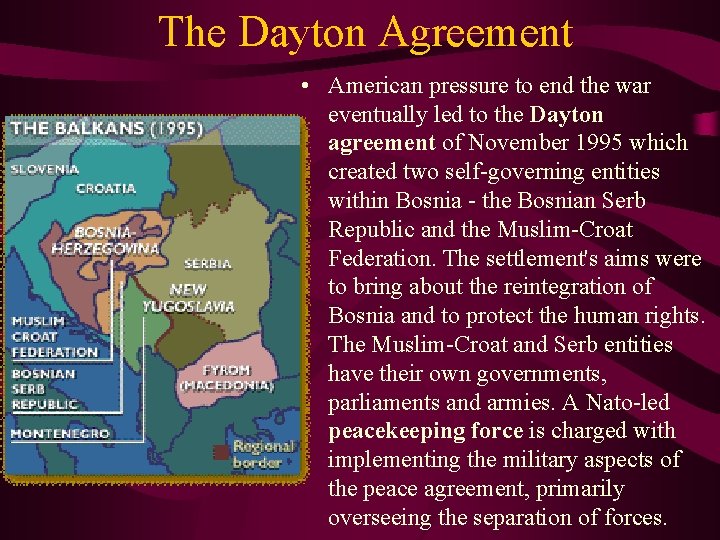
The Dayton Agreement • American pressure to end the war eventually led to the Dayton agreement of November 1995 which created two self-governing entities within Bosnia - the Bosnian Serb Republic and the Muslim-Croat Federation. The settlement's aims were to bring about the reintegration of Bosnia and to protect the human rights. The Muslim-Croat and Serb entities have their own governments, parliaments and armies. A Nato-led peacekeeping force is charged with implementing the military aspects of the peace agreement, primarily overseeing the separation of forces.
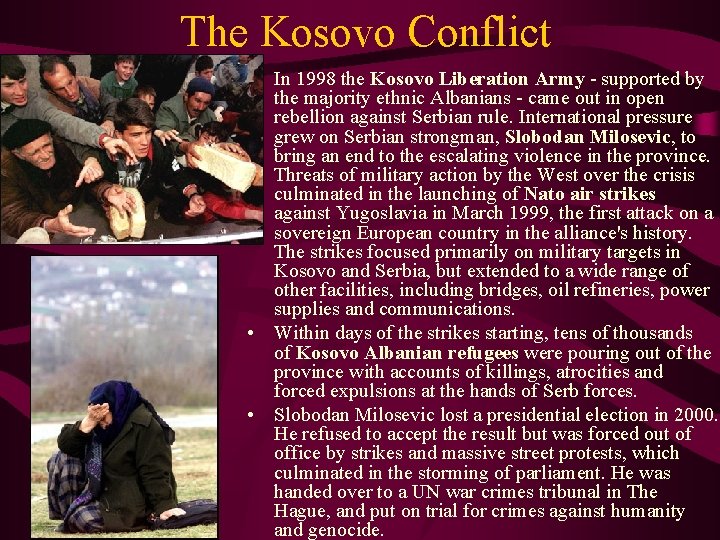
The Kosovo Conflict • In 1998 the Kosovo Liberation Army - supported by the majority ethnic Albanians - came out in open rebellion against Serbian rule. International pressure grew on Serbian strongman, Slobodan Milosevic, to bring an end to the escalating violence in the province. Threats of military action by the West over the crisis culminated in the launching of Nato air strikes against Yugoslavia in March 1999, the first attack on a sovereign European country in the alliance's history. The strikes focused primarily on military targets in Kosovo and Serbia, but extended to a wide range of other facilities, including bridges, oil refineries, power supplies and communications. • Within days of the strikes starting, tens of thousands of Kosovo Albanian refugees were pouring out of the province with accounts of killings, atrocities and forced expulsions at the hands of Serb forces. • Slobodan Milosevic lost a presidential election in 2000. He refused to accept the result but was forced out of office by strikes and massive street protests, which culminated in the storming of parliament. He was handed over to a UN war crimes tribunal in The Hague, and put on trial for crimes against humanity and genocide.
- Slides: 12