
A Beginners Guide to English Pathways Stage 1
A Beginner’s Guide to …. English Pathways Stage 1 or Stage 2 Handy hints from one school’s perspective.
How things fit and where to put them in the year? School Assessment 70% Text Analysis 30% - three or four responses for text analysis Text Production 40% - four assessments for text production External Assessment 30% One Language Study Planner
Text Analysis The texts should be chosen from at least two of the following three text types: • an extended prose, verse, or electronic text (e. g. a novel, a graphic novel, a collection of short stories, a biography, an instructional manual) • a visual or media text (e. g. a display advertisement, a web page, a film, a documentary, a training text) • a creative/aesthetic text (e. g. poetry, song lyrics, a dramatic performance).
Read and respond to three or four different texts that achieve at least two of the three purposes below • To entertain or engage a reader or listener • To persuade or communicate a point of view • To communicate observations or information • A written response should be a maximum of 800 words. An oral presentation should be a maximum of 5 minutes; a response in multimodal form should be of equivalent length.
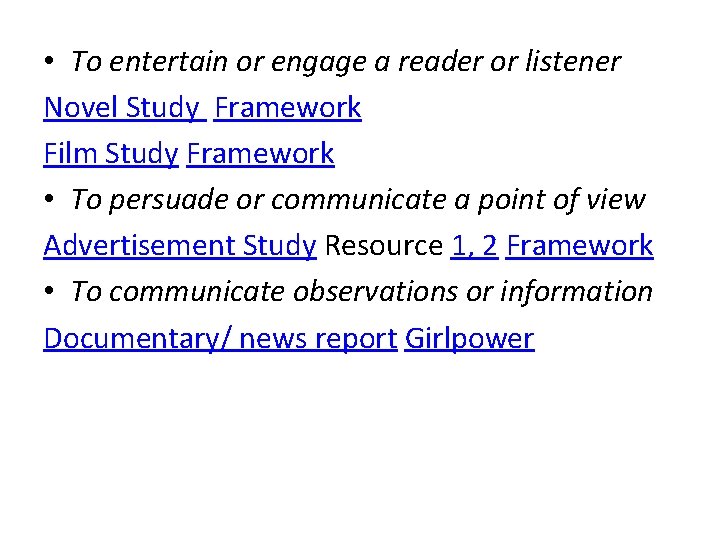
• To entertain or engage a reader or listener Novel Study Framework Film Study Framework • To persuade or communicate a point of view Advertisement Study Resource 1, 2 Framework • To communicate observations or information Documentary/ news report Girlpower
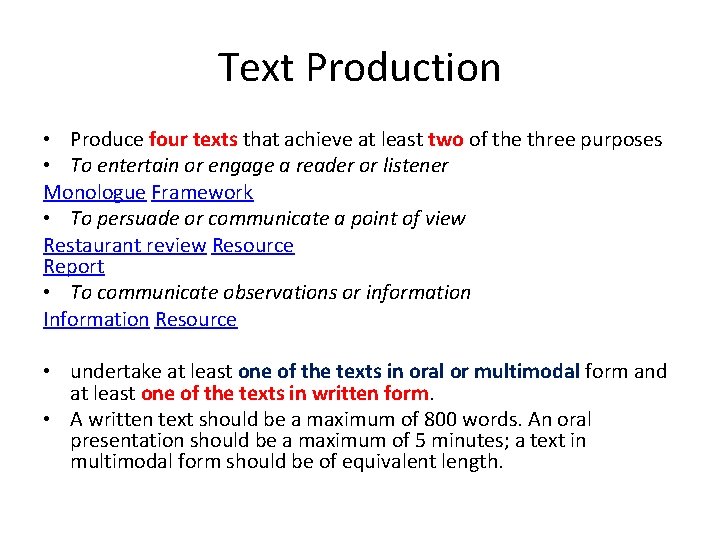
Text Production • Produce four texts that achieve at least two of the three purposes • To entertain or engage a reader or listener Monologue Framework • To persuade or communicate a point of view Restaurant review Resource Report • To communicate observations or information Information Resource • undertake at least one of the texts in oral or multimodal form and at least one of the texts in written form. • A written text should be a maximum of 800 words. An oral presentation should be a maximum of 5 minutes; a text in multimodal form should be of equivalent length.
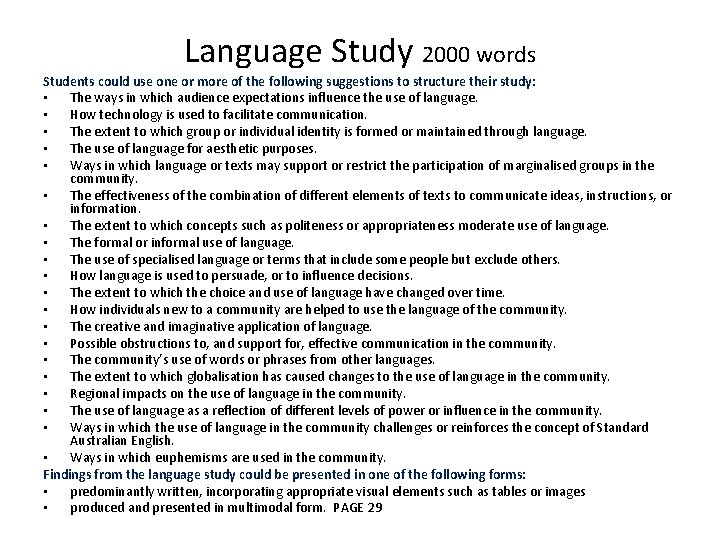
Language Study 2000 words Students could use one or more of the following suggestions to structure their study: • The ways in which audience expectations influence the use of language. • How technology is used to facilitate communication. • The extent to which group or individual identity is formed or maintained through language. • The use of language for aesthetic purposes. • Ways in which language or texts may support or restrict the participation of marginalised groups in the community. • The effectiveness of the combination of different elements of texts to communicate ideas, instructions, or information. • The extent to which concepts such as politeness or appropriateness moderate use of language. • The formal or informal use of language. • The use of specialised language or terms that include some people but exclude others. • How language is used to persuade, or to influence decisions. • The extent to which the choice and use of language have changed over time. • How individuals new to a community are helped to use the language of the community. • The creative and imaginative application of language. • Possible obstructions to, and support for, effective communication in the community. • The community’s use of words or phrases from other languages. • The extent to which globalisation has caused changes to the use of language in the community. • Regional impacts on the use of language in the community. • The use of language as a reflection of different levels of power or influence in the community. • Ways in which the use of language in the community challenges or reinforces the concept of Standard Australian English. • Ways in which euphemisms are used in the community. Findings from the language study could be presented in one of the following forms: • predominantly written, incorporating appropriate visual elements such as tables or images • produced and presented in multimodal form. PAGE 29



- Slides: 10