
A beginners guide to amateur radio satellites David
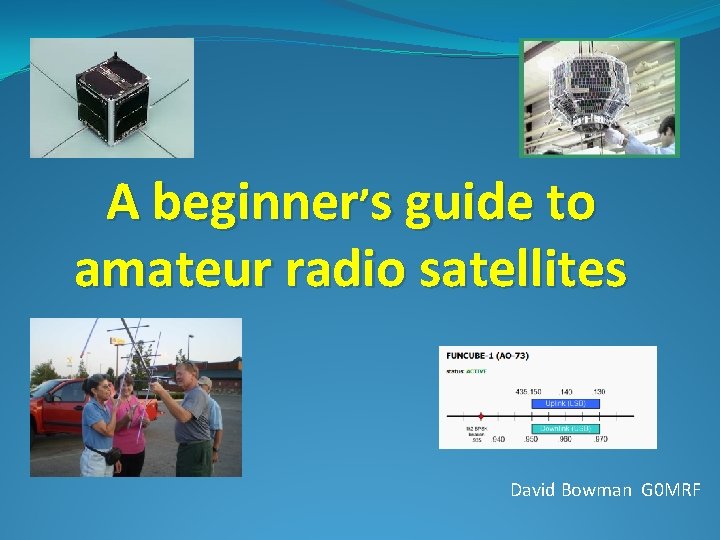
A beginner’s guide to amateur radio satellites David Bowman G 0 MRF
• Satellite types. – Transponders Repeaters and data • Orbits. Where is it and who can I talk to ? • What do I need? - Radios and antennas • Active satellites / A typical QSO / awards + challenges • Audience participation ! – AO-73 from the car park David Bowman G 0 MRF
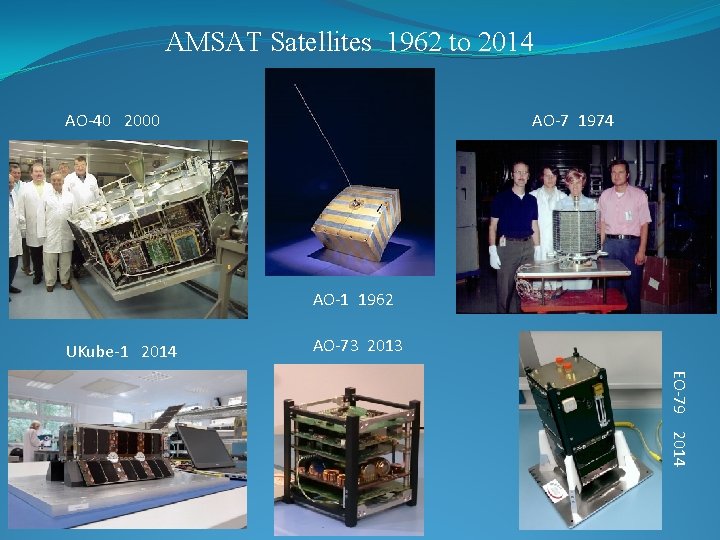
AMSAT Satellites 1962 to 2014 AO-40 2000 AO-7 1974 AO-1 1962 UKube-1 2014 AO-73 2013 EO-79 2014
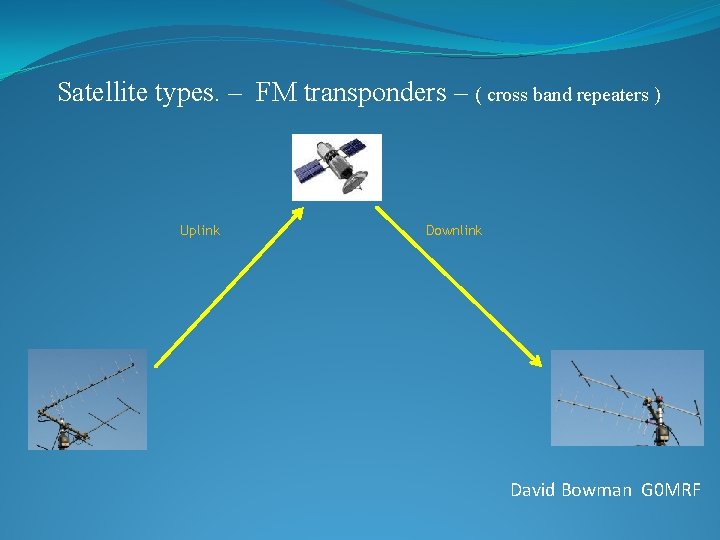
Satellite types. – FM transponders – ( cross band repeaters ) Uplink Downlink David Bowman G 0 MRF
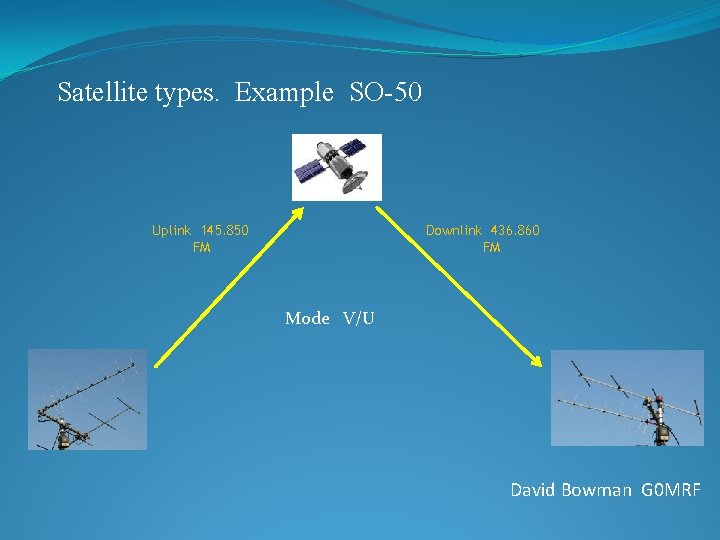
Satellite types. Example SO-50 Uplink 145. 850 FM Downlink 436. 860 FM Mode V/U David Bowman G 0 MRF
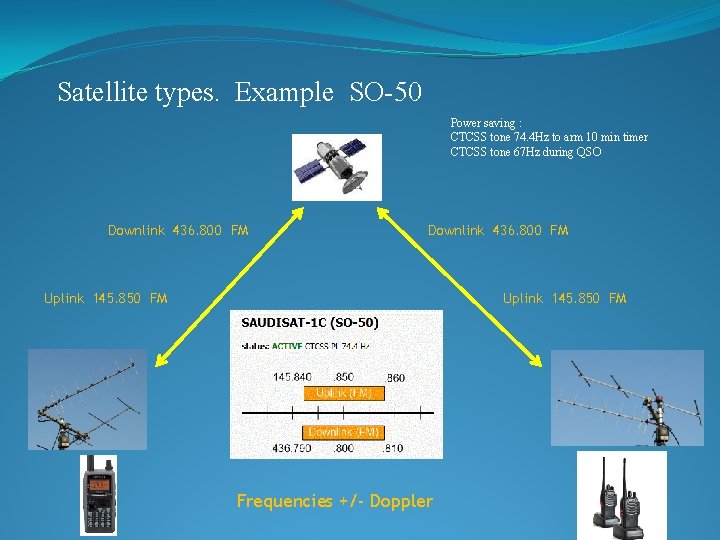
Satellite types. Example SO-50 Power saving : CTCSS tone 74. 4 Hz to arm 10 min timer CTCSS tone 67 Hz during QSO Downlink 436. 800 FM Uplink 145. 850 FM Frequencies +/- Doppler

Satellite types. – Linear Transponders • • Converts 20 k. Hz - 100 k. Hz of spectrum from one band to another Allows many QSOs at the same time Use narrow band modes CW SSB etc. Usually inverting. Convention is USB on downlink (LSB on uplink) Doppler shift: At 7. 5 km per second, Doppler can be +/- 9 k. Hz on 70 cm +/- 3 k. Hz on 2 m David Bowman G 0 MRF
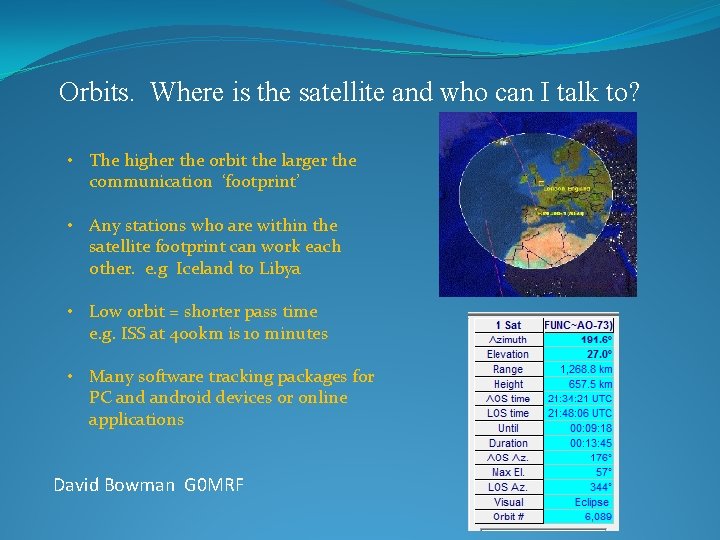
Orbits. Where is the satellite and who can I talk to? • The higher the orbit the larger the communication ‘footprint’ • Any stations who are within the satellite footprint can work each other. e. g Iceland to Libya • Low orbit = shorter pass time e. g. ISS at 400 km is 10 minutes • Many software tracking packages for PC android devices or online applications David Bowman G 0 MRF
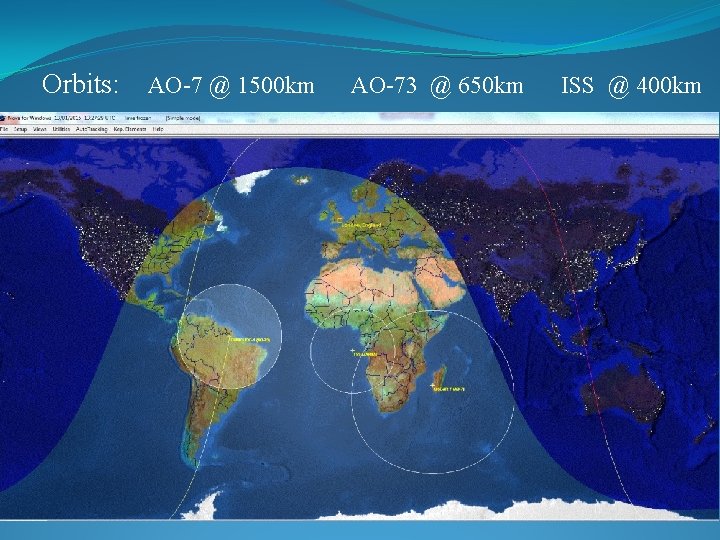
Orbits: AO-7 @ 1500 km AO-73 @ 650 km ISS @ 400 km
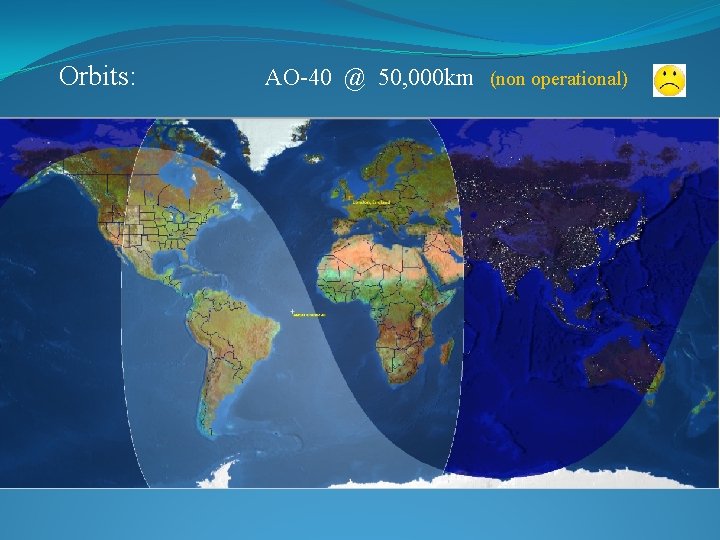
Orbits: AO-40 @ 50, 000 km (non operational)

Orbits: Tracking software Amsat. Droid. Free download for android devices. World map + sky view for pointing antennas Nova for Windows. Free version with limitations or $50 Ham Radio Deluxe. Was free, now? Includes rotator control Sat. PC 32. From AMSAT-NA tracking + computer control of doppler via radio CAT interface. Online: N 2 YO. com Uses your location and google maps for display. Or pass predictions at amsat. org
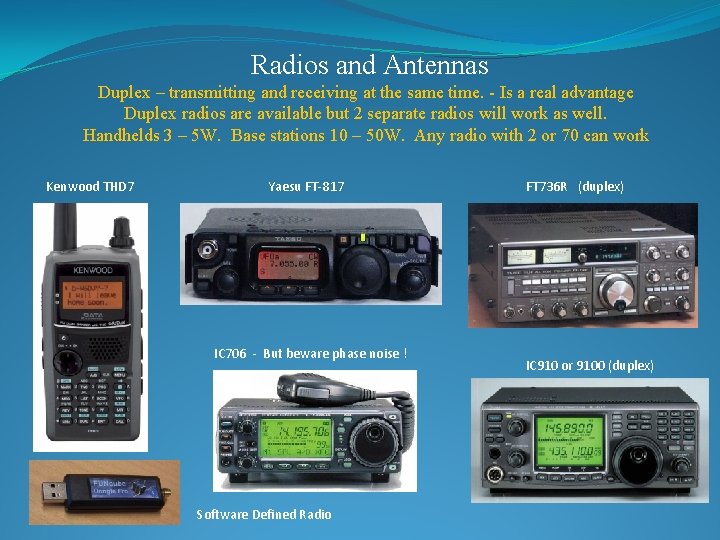
Radios and Antennas Duplex – transmitting and receiving at the same time. - Is a real advantage Duplex radios are available but 2 separate radios will work as well. Handhelds 3 – 5 W. Base stations 10 – 50 W. Any radio with 2 or 70 can work Kenwood THD 7 Yaesu FT-817 IC 706 - But beware phase noise ! Software Defined Radio FT 736 R (duplex) IC 910 or 9100 (duplex)
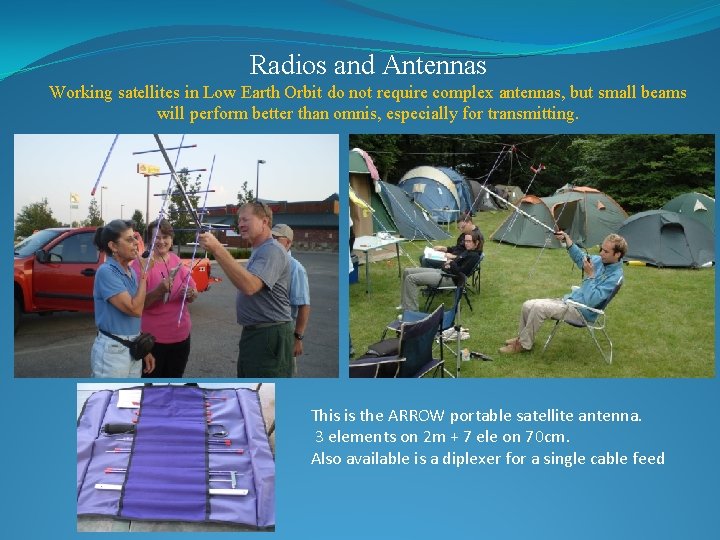
Radios and Antennas Working satellites in Low Earth Orbit do not require complex antennas, but small beams will perform better than omnis, especially for transmitting. This is the ARROW portable satellite antenna. 3 elements on 2 m + 7 ele on 70 cm. Also available is a diplexer for a single cable feed
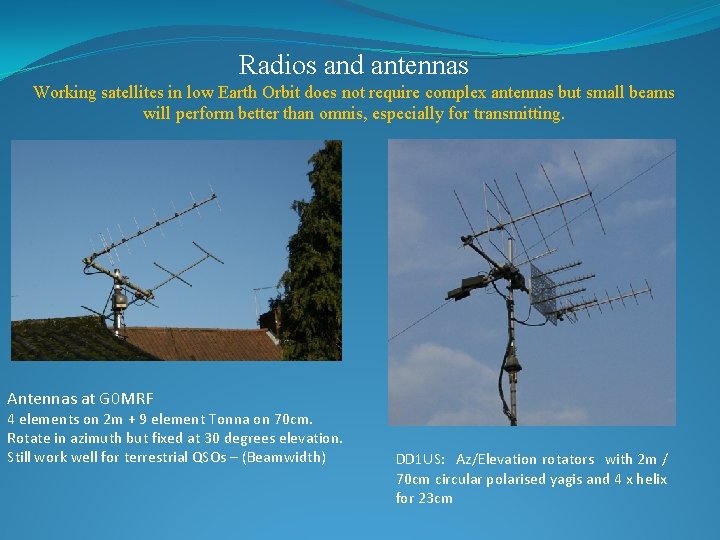
Radios and antennas Working satellites in low Earth Orbit does not require complex antennas but small beams will perform better than omnis, especially for transmitting. Antennas at G 0 MRF 4 elements on 2 m + 9 element Tonna on 70 cm. Rotate in azimuth but fixed at 30 degrees elevation. Still work well for terrestrial QSOs – (Beamwidth) DD 1 US: Az/Elevation rotators with 2 m / 70 cm circular polarised yagis and 4 x helix for 23 cm
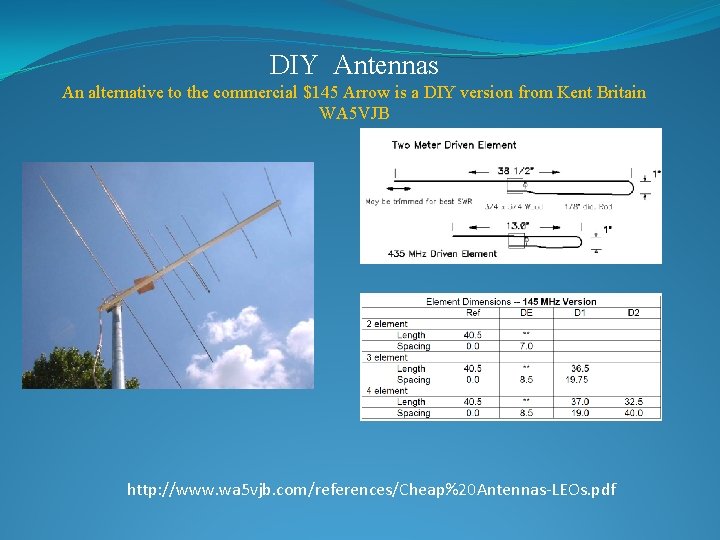
DIY Antennas An alternative to the commercial $145 Arrow is a DIY version from Kent Britain WA 5 VJB http: //www. wa 5 vjb. com/references/Cheap%20 Antennas-LEOs. pdf
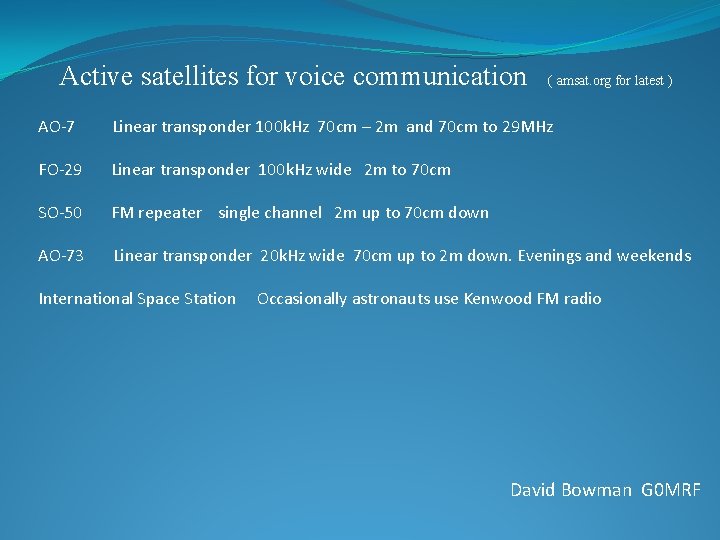
Active satellites for voice communication ( amsat. org for latest ) AO-7 Linear transponder 100 k. Hz 70 cm – 2 m and 70 cm to 29 MHz FO-29 Linear transponder 100 k. Hz wide 2 m to 70 cm SO-50 FM repeater single channel 2 m up to 70 cm down AO-73 Linear transponder 20 k. Hz wide 70 cm up to 2 m down. Evenings and weekends International Space Station Occasionally astronauts use Kenwood FM radio David Bowman G 0 MRF
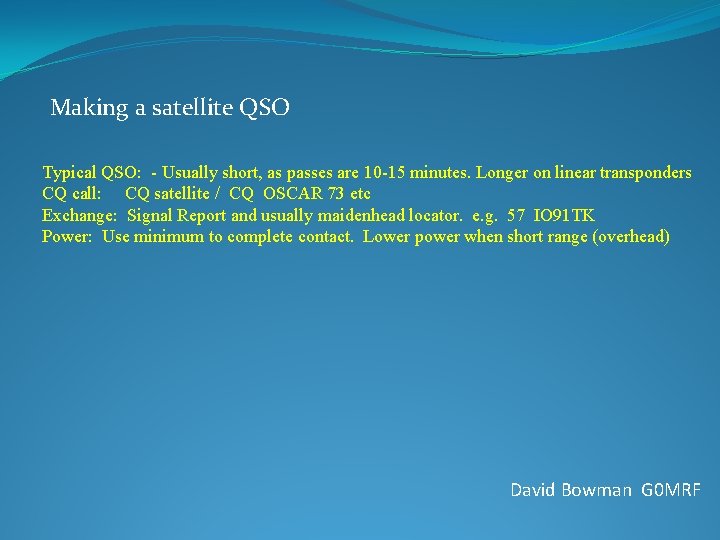
Making a satellite QSO Typical QSO: - Usually short, as passes are 10 -15 minutes. Longer on linear transponders CQ call: CQ satellite / CQ OSCAR 73 etc Exchange: Signal Report and usually maidenhead locator. e. g. 57 IO 91 TK Power: Use minimum to complete contact. Lower power when short range (overhead) David Bowman G 0 MRF
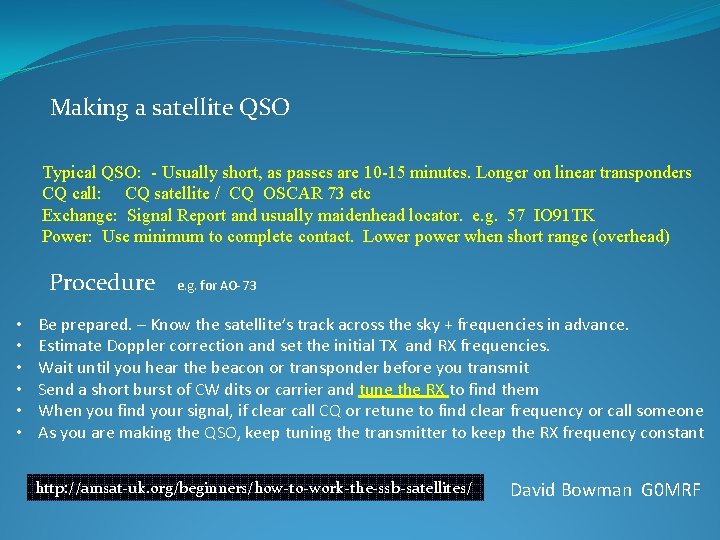
Making a satellite QSO Typical QSO: - Usually short, as passes are 10 -15 minutes. Longer on linear transponders CQ call: CQ satellite / CQ OSCAR 73 etc Exchange: Signal Report and usually maidenhead locator. e. g. 57 IO 91 TK Power: Use minimum to complete contact. Lower power when short range (overhead) Procedure • • • e. g. for AO-73 Be prepared. – Know the satellite’s track across the sky + frequencies in advance. Estimate Doppler correction and set the initial TX and RX frequencies. Wait until you hear the beacon or transponder before you transmit Send a short burst of CW dits or carrier and tune the RX to find them When you find your signal, if clear call CQ or retune to find clear frequency or call someone As you are making the QSO, keep tuning the transmitter to keep the RX frequency constant http: //amsat-uk. org/beginners/how-to-work-the-ssb-satellites/ David Bowman G 0 MRF
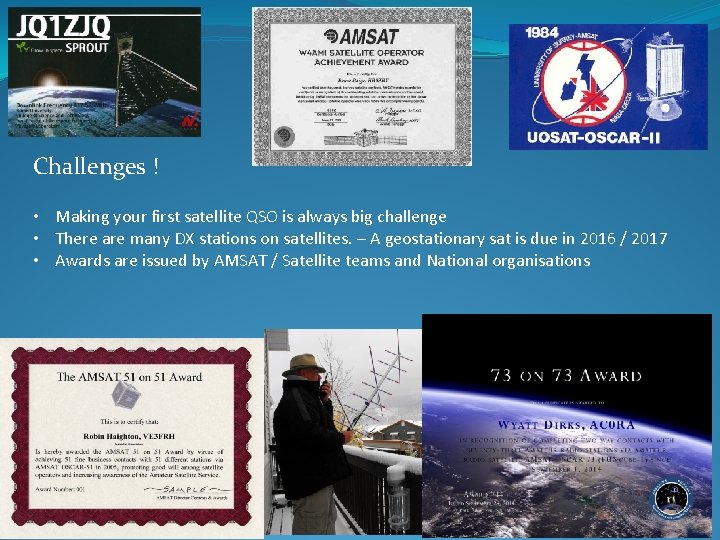
Challenges ! • Making your first satellite QSO is always big challenge • There are many DX stations on satellites. – A geostationary sat is due in 2016 / 2017 • Awards are issued by AMSAT / Satellite teams and National organisations
Thank You David Bowman G 0 MRF
- Slides: 20