
A basic modelling primer Dr Mark Cresswell 69

A basic modelling primer Dr Mark Cresswell 69 EG 6517 – Impacts & Models of Climate Change
Lecture Topics • Introduction (what is a model? ) • • Modelling philosophy The systems approach to modelling Systems analysis Climate model basics • Suggested reading • Today’s practical – Daisy World

INTRODUCTION
Introduction #1 What is a Model? • A necessarily simplified abstraction of the realworld • Comprises the known fundamental sources of causality within a natural system • Disregards factors of little or no importance • Uses assumptions • Uses parameterisations where factors are not known or hard to calculate
Introduction #2 What is a Model? • A climate model must attempt to describe the climate system in terms of basic physical, chemical and biological principles (laws) • The model becomes a series of equations expressing these laws • Equations must be solved rapidly for individual grid -points and for many time integrations
Introduction #3 What is Modelling? • A process such as weathering (by wind or rain) may be represented mathematically by the inputs (water), outputs (sediment solution) and weathering action involved. An entire system is a collection of processes (like the climate system for example) - each one defined by a set of rules at the simplest level or complex equations and physics at a higher level. The mathematical representation of the dynamics of real world systems is known as simulation modelling.
Modelling Philosophy
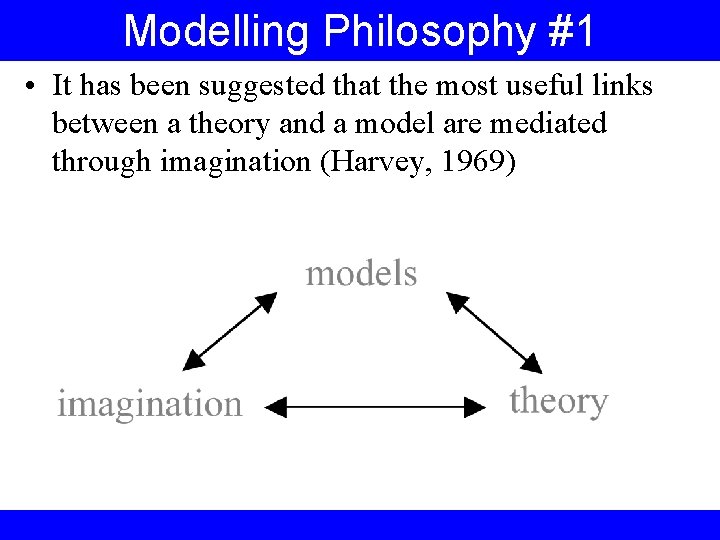
Modelling Philosophy #1 • It has been suggested that the most useful links between a theory and a model are mediated through imagination (Harvey, 1969)
Modelling Philosophy #2 There are three broad categories of model as outlined by Hardisty, 1995: • Natural analogues. The use of actual events or objects occurring in different times or different places to help examine what has, is or will happen to a particular system • Hardware or physical models. A range of materials (often natural) is used • Mathematical models. A range of deterministic or stochastic approaches based upon the solution of equations, rules and algorithms.
Modelling Philosophy #3 Example of a very basic model
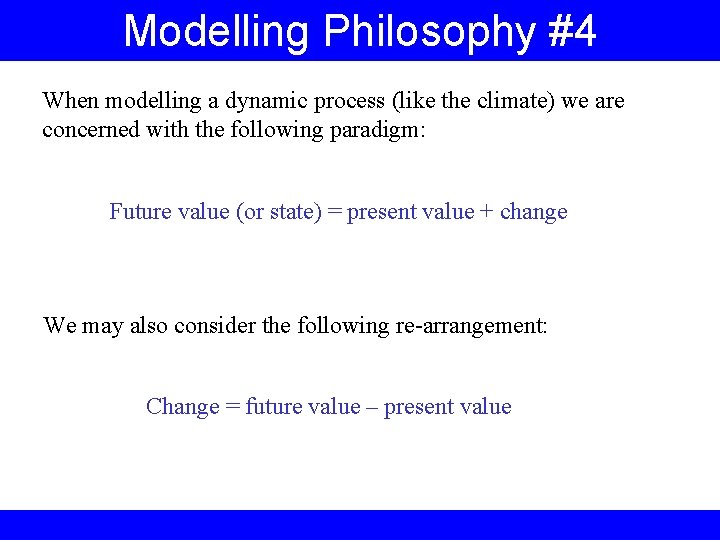
Modelling Philosophy #4 When modelling a dynamic process (like the climate) we are concerned with the following paradigm: Future value (or state) = present value + change We may also consider the following re-arrangement: Change = future value – present value
Modelling Philosophy #5 The MOST important principle of modelling
The Systems Approach
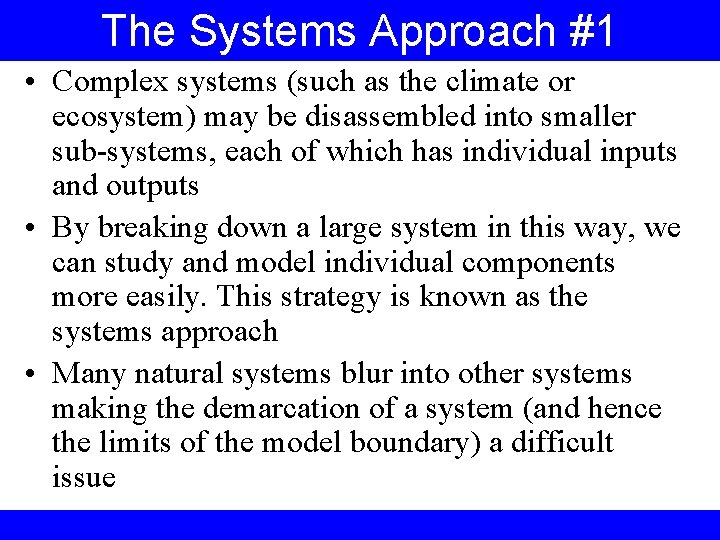
The Systems Approach #1 • Complex systems (such as the climate or ecosystem) may be disassembled into smaller sub-systems, each of which has individual inputs and outputs • By breaking down a large system in this way, we can study and model individual components more easily. This strategy is known as the systems approach • Many natural systems blur into other systems making the demarcation of a system (and hence the limits of the model boundary) a difficult issue
The Systems Approach #2 • Since the 1970 s there has been a shift (in the environmental sciences) to a dynamical systems approach after the realisation that models can evolve in time as the processes and sub-systems they represent change and evolve. • The study of the functioning and composition of systems is known as systems analysis (Hardisty et al. , 1995). Systems analysis is very closely allied to modelling as system construction is an early phase in modelling itself
Systems Analysis
Systems Analysis #1 • There are four phases • Phase 1: The lexical phase. This requires the (a) definition of the system boundaries; (b) selection of system components (more correctly referred to as state variables); and (c) estimation of the value (state) of the state variables. Huggett (1980) calls these stages system closure, entitation and quantitation respectively
Systems Analysis #2 • Phase 2: The parsing phase. This involves defining the relationships of the state variables of the system in a mathematical way. Relationships may be deterministic (a single value) or stochastic (a more probabilistic or random value). • Deterministic model solutions provide a single outcome - with no estimate of error or probability • Stochastic models provide both probabilities and estimates of skill and reliability
Systems Analysis #3 • Phase 3: The modelling phase. The first step is model construction which requires that changes in controlling and state variables are well understood. The second step is running the model. • In advanced global climate model simulations the ocean model is coupled to the atmospheric model • Less advanced (and hence less computationally intensive) climate models run atmospheric models with oceanic persistence or climatology
Systems Analysis #4 • Phase 4: The analysis phase. This is where the model is validated – when we compare the model output against actual observations. Once we are happy the model performs well, we can begin to trust its outputs • Observational data used for validation of climate models is often referred to as reanalysis • ECMWF produces ERA-15 (1979 -1993) • ERA-15 however is flawed and hence climate models have been affected as a result
Climate model basics
Climate model basics #1 • Radiation: input, output and absorption of solar radiation and the emission of infrared radiation • Dynamics: movement of energy around the globe by oceans and winds - both horizontal and vertical • Surface processes: effects of sea- and land-ice, snow, vegetation, albedo, emissivity and surfaceatmosphere energy exchanges • Chemistry: chemical composition of the atmosphere • Resolution: both in time and space
Climate model basics #2 Fundamental equations solved in GCMs • Conservation of energy (first law of thermodynamics): – Input energy = increase in internal energy + work done • Conservation of momentum (Newton’s second law of motion): – Force = Mass x Acceleration • Conservation of mass (the continuity equation) • Ideal gas law
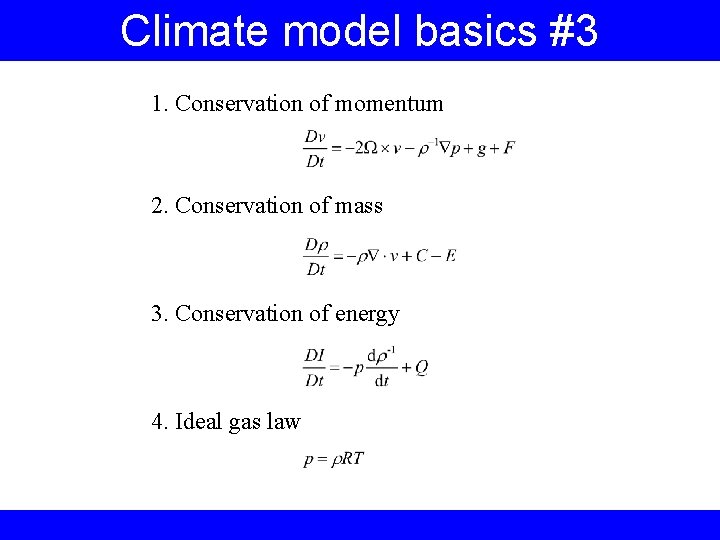
Climate model basics #3 1. Conservation of momentum 2. Conservation of mass 3. Conservation of energy 4. Ideal gas law
Suggested reading Text Books Hardisty J, Taylor DM and Metcalfe SE (1995). Computerised environmental modelling: A practical introduction using Excel. Published by John Wiley & Sons, England. Berry J and Houston K. (1995). Mathematical modelling. Published by Edward Arnold, London Giordano F, Weir M and Fox W. (1997). A first course in mathematical modeling. Published by Brooks and Cole, California. Deaton M and Winebrake J. (1999). Dynamic modelling of environmental systems. Published by Springer Verlag, New York
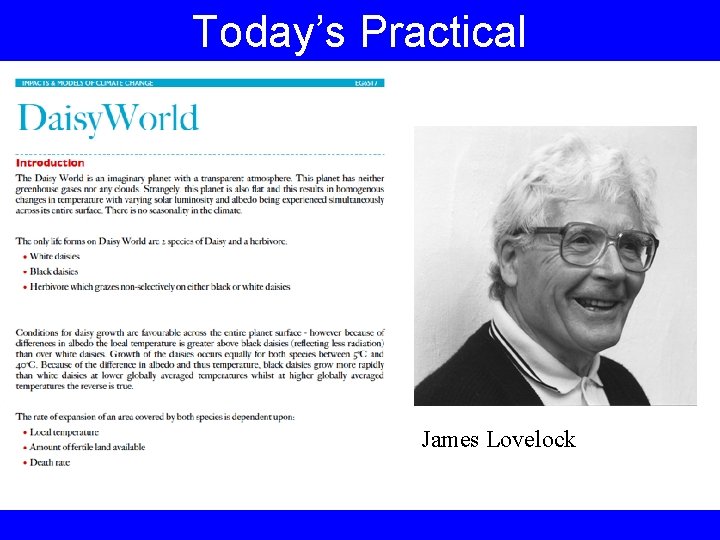
Today’s Practical James Lovelock
- Slides: 26