
A Balanced Introduction to Computer Science David Reed
A Balanced Introduction to Computer Science David Reed, Creighton University © 2005 Pearson Prentice Hall ISBN 0 -13 -046709 -X Chapter 13 Conditional Repetition 1
Conditional Repetition an if statement is known as a control statement n it is used to control the execution of other Java. Script statements n it provides for conditional execution it is useful for solving problems that involve choices p either do this or don't, based on some condition (if) p either do this or do that, based on some condition (if-else) n closely related to the concept of conditional execution is conditional repetition n many problems involve repeating some task over and over until a specific condition is met n n e. g. , rolling dice until a 7 is obtained e. g. , repeatedly prompting the user for a valid input n in Java. Script, while loops provide for conditional repetition 2
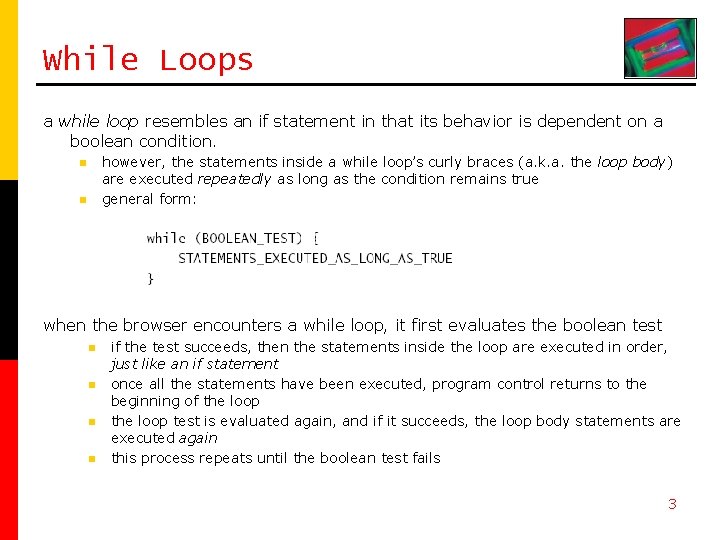
While Loops a while loop resembles an if statement in that its behavior is dependent on a boolean condition. however, the statements inside a while loop’s curly braces (a. k. a. the loop body) are executed repeatedly as long as the condition remains true general form: n n when the browser encounters a while loop, it first evaluates the boolean test n n if the test succeeds, then the statements inside the loop are executed in order, just like an if statement once all the statements have been executed, program control returns to the beginning of the loop test is evaluated again, and if it succeeds, the loop body statements are executed again this process repeats until the boolean test fails 3

While Loop Example example: roll two dice repeatedly until doubles are obtained sample output: note: even though while loops and if statements look similar, they are very different control statements n n an if statement may execute its code 1 time or not at all a while loop may execute its code an arbitrary number of times 4

While Loop Page 5
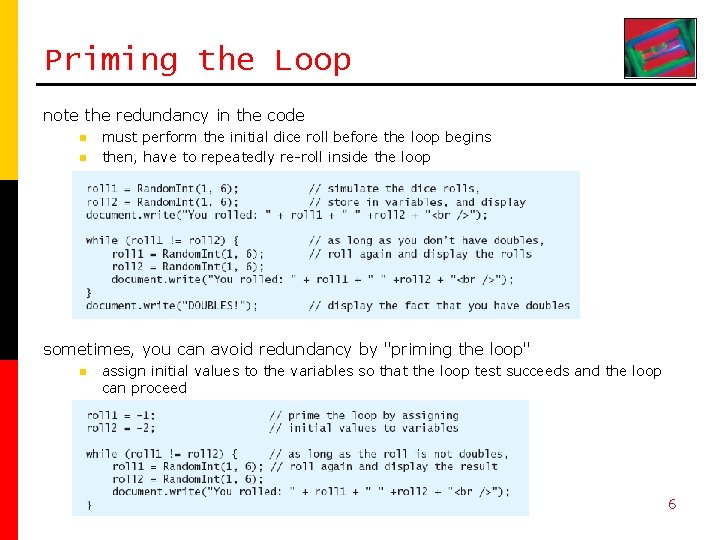
Priming the Loop note the redundancy in the code n n must perform the initial dice roll before the loop begins then, have to repeatedly re-roll inside the loop sometimes, you can avoid redundancy by "priming the loop" n assign initial values to the variables so that the loop test succeeds and the loop can proceed 6
Loop Tests note: the loop test defines the condition under which the loop continues n this is often backwards from the way we think about loops n e. g. , read input until you get a positive number (e. g. , input > 0) while (input <= 0) {. . . } n e. g. , keep rolling dice until you get doubles (i. e. , roll 1 == roll 2) while (roll 1 != roll 2) {. . . } n e. g. , keep rolling dice until you get double fours (i. e. , roll 1 == 4 && roll 2 = 4) while (roll 1 != 4 || roll 2 != 4) {. . . } De. Morgan's Law: !(X && Y) == (!X || !Y) !(X || Y) == (!X && !Y) 7
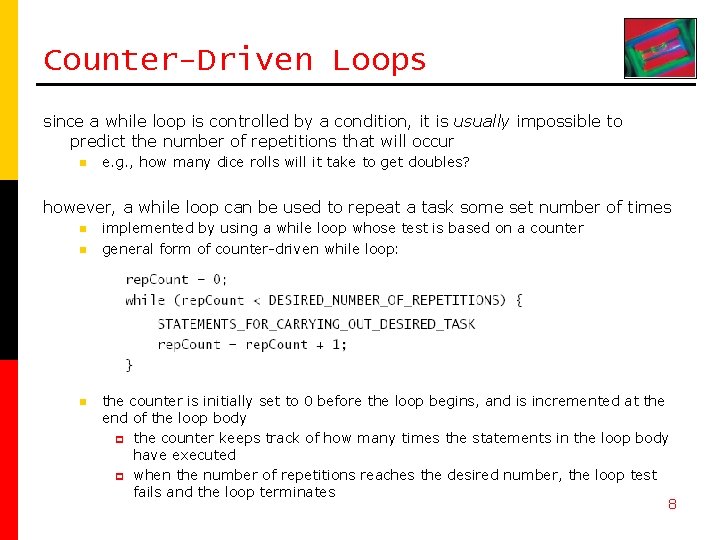
Counter-Driven Loops since a while loop is controlled by a condition, it is usually impossible to predict the number of repetitions that will occur n e. g. , how many dice rolls will it take to get doubles? however, a while loop can be used to repeat a task some set number of times n n n implemented by using a while loop whose test is based on a counter general form of counter-driven while loop: the counter is initially set to 0 before the loop begins, and is incremented at the end of the loop body p the counter keeps track of how many times the statements in the loop body have executed p when the number of repetitions reaches the desired number, the loop test fails and the loop terminates 8
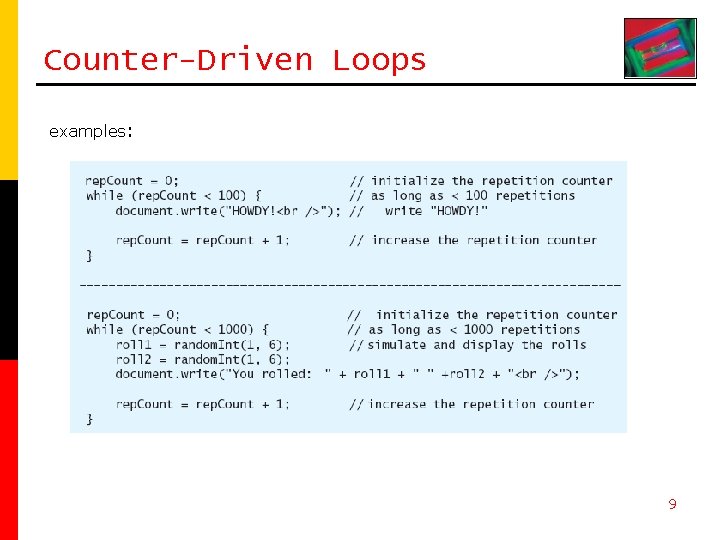
Counter-Driven Loops examples: 9
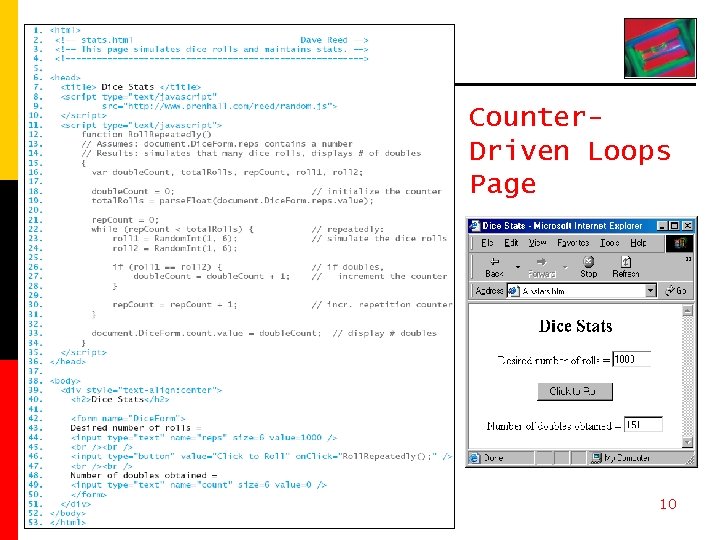
Counter. Driven Loops Page 10
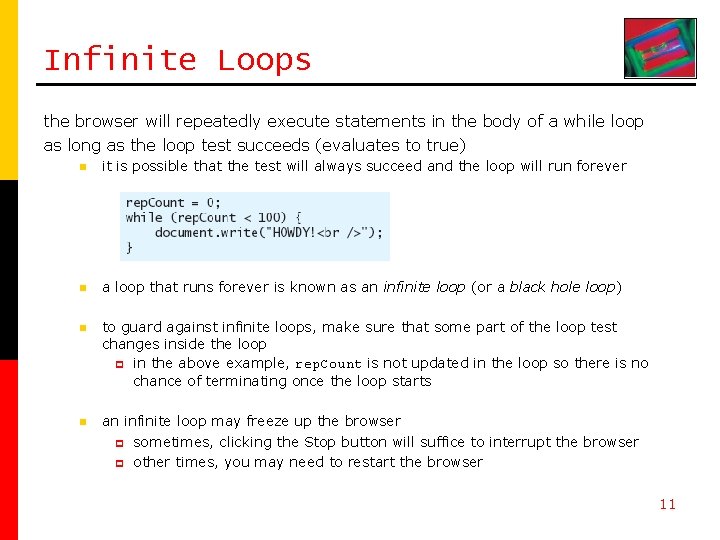
Infinite Loops the browser will repeatedly execute statements in the body of a while loop as long as the loop test succeeds (evaluates to true) n it is possible that the test will always succeed and the loop will run forever n a loop that runs forever is known as an infinite loop (or a black hole loop) n to guard against infinite loops, make sure that some part of the loop test changes inside the loop p in the above example, rep. Count is not updated in the loop so there is no chance of terminating once the loop starts n an infinite loop may freeze up the browser p sometimes, clicking the Stop button will suffice to interrupt the browser p other times, you may need to restart the browser 11
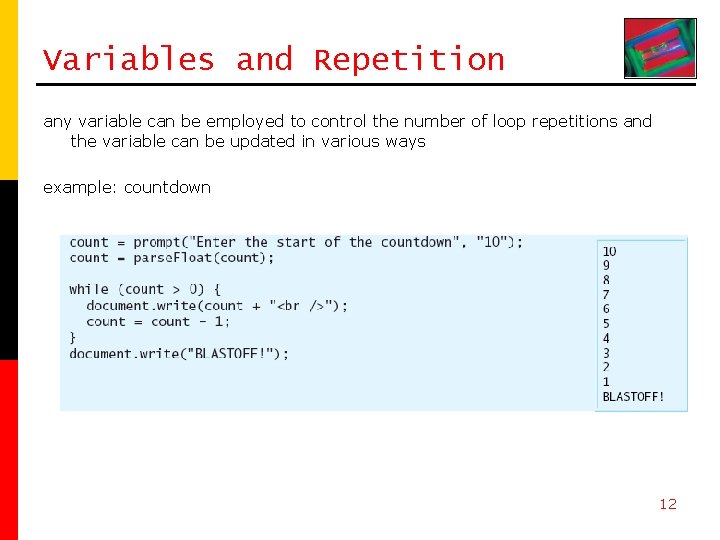
Variables and Repetition any variable can be employed to control the number of loop repetitions and the variable can be updated in various ways example: countdown 12
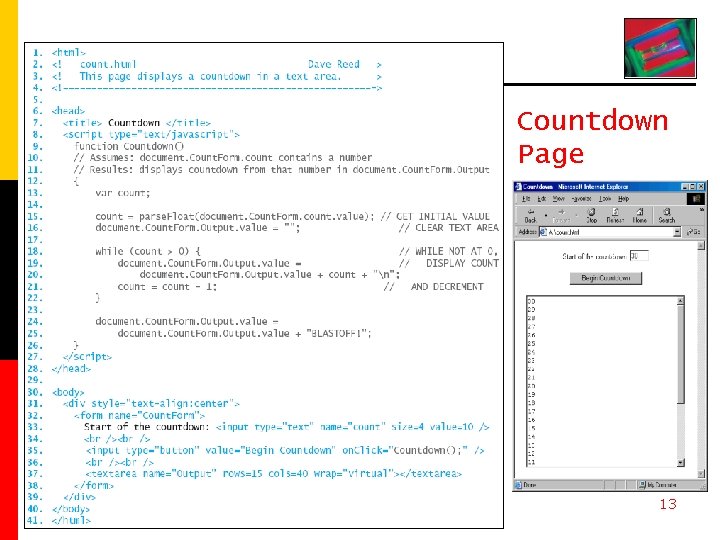
Countdown Page 13
Example: Hailstone Sequences an interesting unsolved problem in mathematics: hailstone sequence 3. start with any positive integer if the number is odd, then multiply the number by three and add one; otherwise, divide it by two repeat as many times as desired n for example: 5, 16, 8, 4, 2, 1, … 1. 2. it is conjectured that, no matter what positive integer you start with, you will always end up in the 4 -2 -1 loop n n n this has been verified for all starting number up to 1, 200, 000, 000 but, it still has not been proven to hold for ALL starting numbers we can define a Java. Script function for experimenting with this problem p the hailstone function will generate the sequence given a starting number 14
- Slides: 14