
A Balanced Introduction to Computer Science 2E David
A Balanced Introduction to Computer Science, 2/E David Reed, Creighton University © 2008 Pearson Prentice Hall ISBN 978 -0 -13 -601722 -6 Chapter 15 Java. Script Strings 1
Strings as Objects so far, your interactive Web pages have manipulated strings in simple ways n use prompt or a text box/area to input a word or phrase n store that text in a (string) variable incorporate the text in a message, possibly using + to concatenate n strings are different from numbers and Booleans in that they are objects n a software object is a unit of code that encapsulates both data and operations that can be performed on that data n a string is a software object that models words and phrases data: a sequence of characters, enclosed in quotes operations include: make upper case, make lower case, determine the number of characters, access a particular character, search for a particular character, … 2
Object-Oriented Programming objects are fundamental in the dominant approach to developing software systems: object-oriented programming (OOP) n OOP encourages programmers to design programs around software objects p the programmer identifies the real-world objects involved in a system (e. g. , for a banking program: bank account, customer, teller, …) p then designs and builds software objects to model these real-world objects n OOP is effective for managing large systems, since individual objects can be assigned to different teams and developed independently OOP also supports code reuse, since the same or similar objects can be combined in different ways to solve different kinds of problems n example: a doorbell button n n has physical components/properties: color, shape, label, … has functionality: when you press the button, the bell rings an HTML button is a software object that models a real-world button n n has physical components/properties: color, shape, label, … has functionality: when you click on the button, Java. Script code is executed 3

Properties and Methods using object-oriented terminology, n n the characteristics of an object are called properties p e. g. , a string object has a length property that identifies the number of characters in the string the operations that can be performed on the string are called methods p e. g. , the to. Lower. Case method makes a copy of the string with all uppercase letters converted to lower-case properties and methods are not new concepts n n a property is a special kind of a variable (it stores a value) a method is a special kind of function (it performs some action) what is special is that they are associated with (or "belong to") an object n e. g. , each string object will have its own variable to store its length to access an object property, specify: object name, a period, property name str 1 = "foo"; str 2 = "Hi there"; len 1 = str 1. length; len 2 = str 2. length; 4

Properties and Methods similarly, to call a method: object name, period, method call n n e. g. , str. to. Lower. Case() calls the to. Lower. Case method on str (which returns a lowercase copy of the string) e. g. , str. to. Upper. Case() calls the to. Upper. Case method on str (which returns an uppercase copy of the string) note: the to. Lower. Case and to. Upper. Case methods do not change the string object they are called on (only an assignment can do that!) n instead, they return modified copies of the string 5
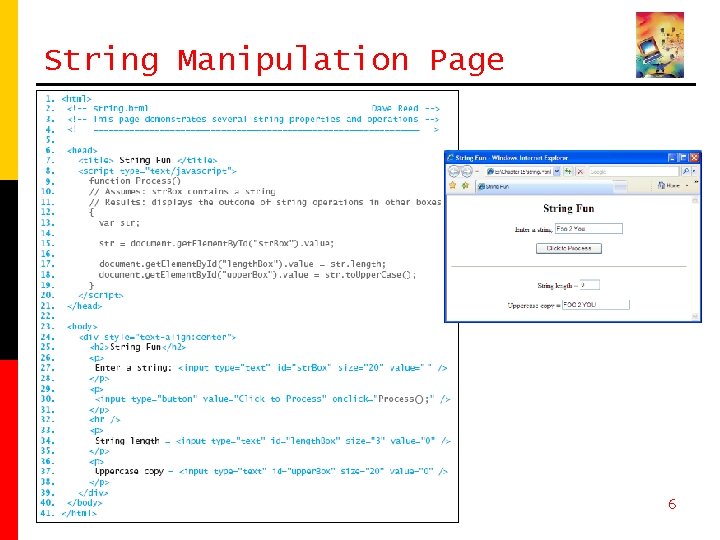
String Manipulation Page 6
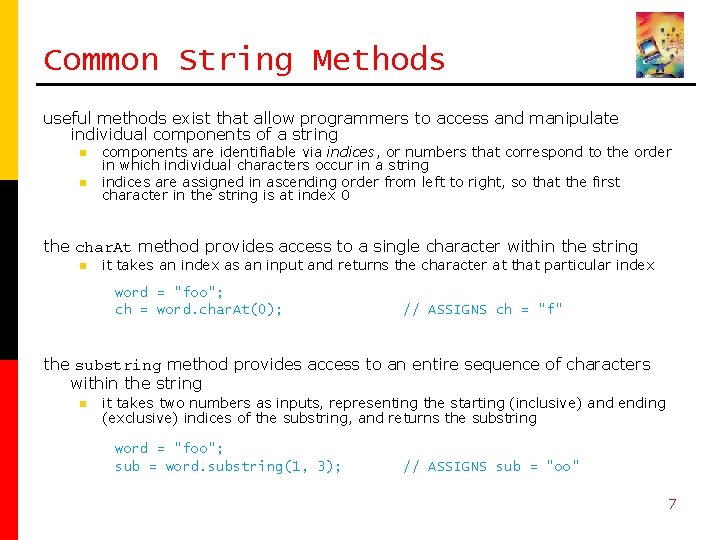
Common String Methods useful methods exist that allow programmers to access and manipulate individual components of a string n n components are identifiable via indices, or numbers that correspond to the order in which individual characters occur in a string indices are assigned in ascending order from left to right, so that the first character in the string is at index 0 the char. At method provides access to a single character within the string n it takes an index as an input and returns the character at that particular index word = "foo"; ch = word. char. At(0); // ASSIGNS ch = "f" the substring method provides access to an entire sequence of characters within the string n it takes two numbers as inputs, representing the starting (inclusive) and ending (exclusive) indices of the substring, and returns the substring word = "foo"; sub = word. substring(1, 3); // ASSIGNS sub = "oo" 7
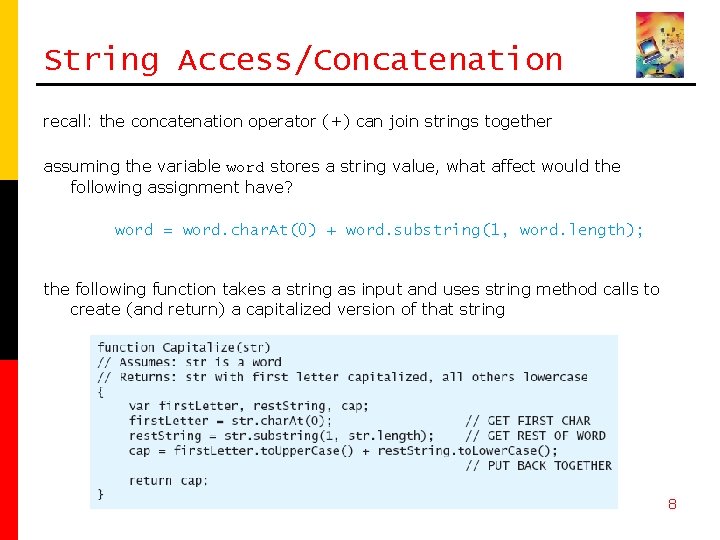
String Access/Concatenation recall: the concatenation operator (+) can join strings together assuming the variable word stores a string value, what affect would the following assignment have? word = word. char. At(0) + word. substring(1, word. length); the following function takes a string as input and uses string method calls to create (and return) a capitalized version of that string 8
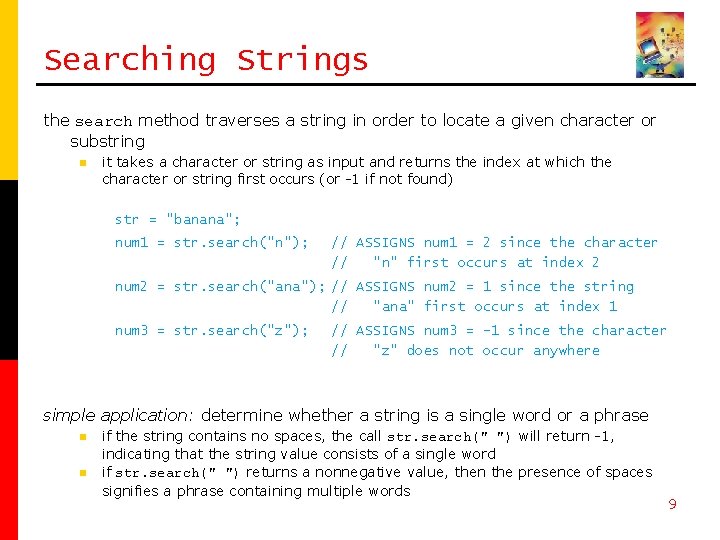
Searching Strings the search method traverses a string in order to locate a given character or substring n it takes a character or string as input and returns the index at which the character or string first occurs (or -1 if not found) str = "banana"; num 1 = str. search("n"); // ASSIGNS num 1 = 2 since the character // "n" first occurs at index 2 num 2 = str. search("ana"); // ASSIGNS num 2 = 1 since the string // "ana" first occurs at index 1 num 3 = str. search("z"); // ASSIGNS num 3 = -1 since the character // "z" does not occur anywhere simple application: determine whether a string is a single word or a phrase n n if the string contains no spaces, the call str. search(" ") will return -1, indicating that the string value consists of a single word if str. search(" ") returns a nonnegative value, then the presence of spaces signifies a phrase containing multiple words 9
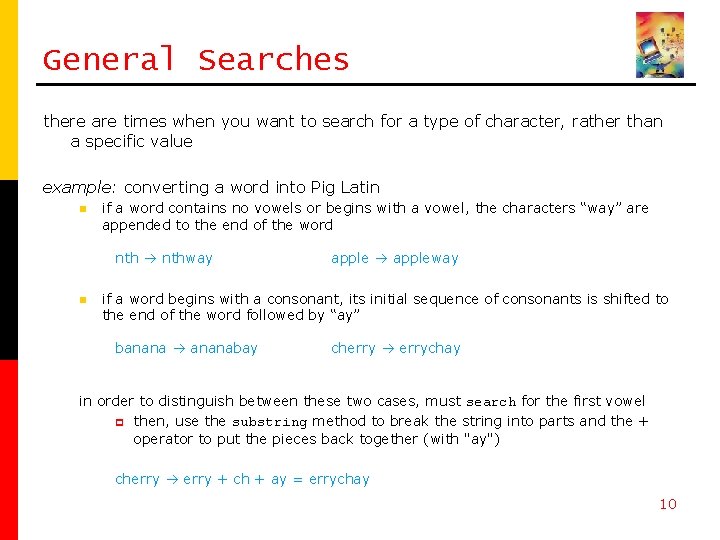
General Searches there are times when you want to search for a type of character, rather than a specific value example: converting a word into Pig Latin n if a word contains no vowels or begins with a vowel, the characters “way” are appended to the end of the word nthway n appleway if a word begins with a consonant, its initial sequence of consonants is shifted to the end of the word followed by “ay” banana ananabay cherry errychay in order to distinguish between these two cases, must search for the first vowel p then, use the substring method to break the string into parts and the + operator to put the pieces back together (with "ay") cherry + ch + ay = errychay 10
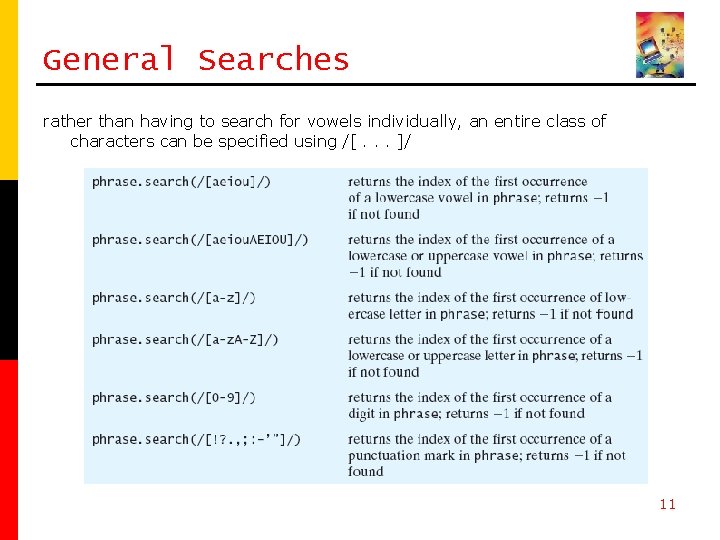
General Searches rather than having to search for vowels individually, an entire class of characters can be specified using /[. . . ]/ 11
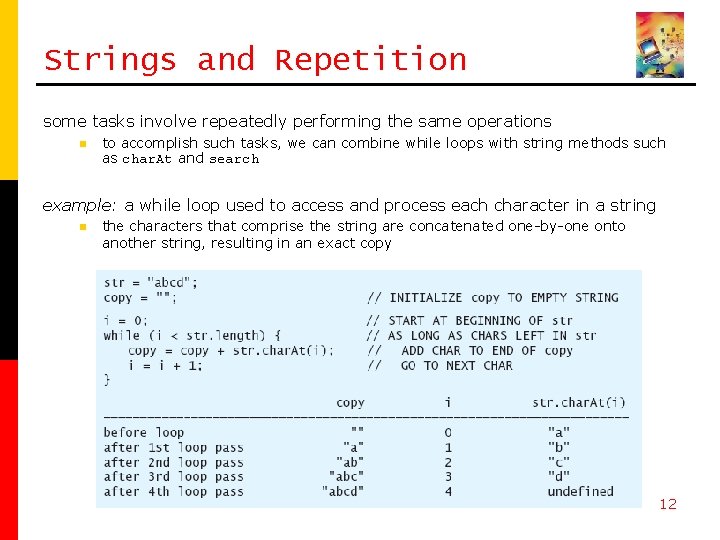
Strings and Repetition some tasks involve repeatedly performing the same operations n to accomplish such tasks, we can combine while loops with string methods such as char. At and search example: a while loop used to access and process each character in a string n the characters that comprise the string are concatenated one-by-one onto another string, resulting in an exact copy 12
- Slides: 12