
A An THE RULE Use A before words
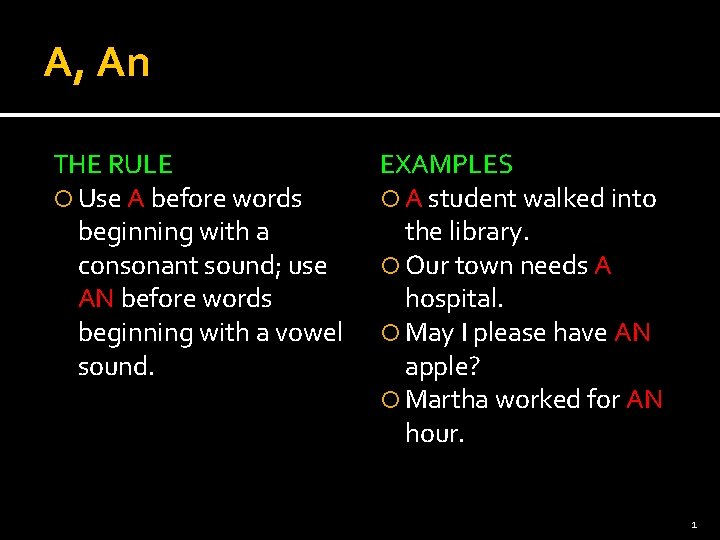
A, An THE RULE Use A before words beginning with a consonant sound; use AN before words beginning with a vowel sound. EXAMPLES A student walked into the library. Our town needs A hospital. May I please have AN apple? Martha worked for AN hour. 1
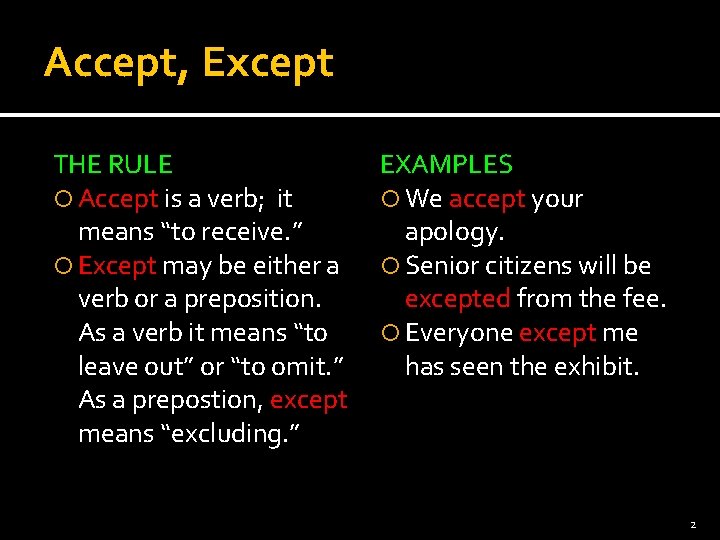
Accept, Except THE RULE Accept is a verb; it means “to receive. ” Except may be either a verb or a preposition. As a verb it means “to leave out” or “to omit. ” As a prepostion, except means “excluding. ” EXAMPLES We accept your apology. Senior citizens will be excepted from the fee. Everyone except me has seen the exhibit. 2
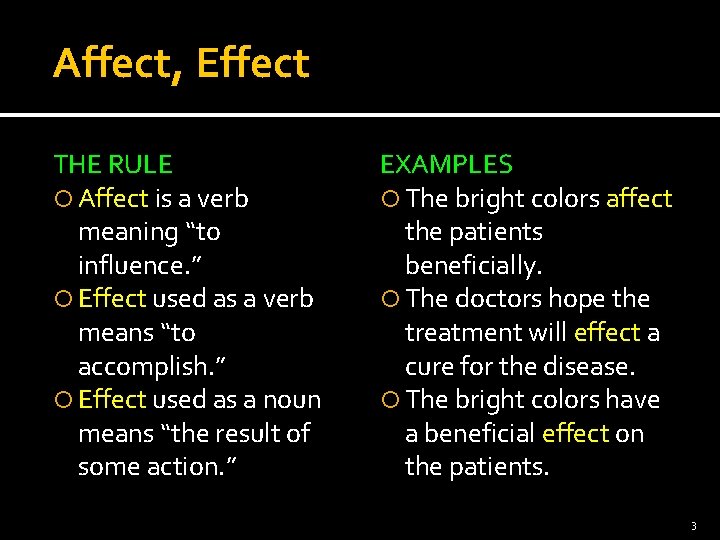
Affect, Effect THE RULE Affect is a verb meaning “to influence. ” Effect used as a verb means “to accomplish. ” Effect used as a noun means “the result of some action. ” EXAMPLES The bright colors affect the patients beneficially. The doctors hope the treatment will effect a cure for the disease. The bright colors have a beneficial effect on the patients. 3
Ain’t THE RULE Do not use this word in speaking or writing; it is considered nonstandard English. 4
and, etc. THE RULE EXAMPLE(S) Etc. is an abbreviation My younger sister of the Latin phrase et collects string, bottle cetera, meaning “and caps, stickers, etc. (not other things. ” Thus, and etc. ) and etc. means “and other things. ” Do not use and with etc. 5
anywheres, everywheres, nowheres, somewheres THE RULE Use these words without the final –s. EXAMPLES That bird is described somewhere (not somewheres) in this book. I searched everywhere (not everywheres) for a blouse to match that skirt. 6
At THE RULE Do not use at after where. EXAMPLES INCORRECT: This is where I live at. CORRECT: This is where I live. 7

beside, besides THE RULE Beside means “by the side of” someone or something; it is always a preposition. Besides as a preposition means “in addition to. ” Besides as an adverb means “moreover or further. ” EXAMPLES Sit beside me on the couch. Besides songs and dances, the show featured several comedy sketches. I have a long walk home. Besides, it’s starting to snow. 9
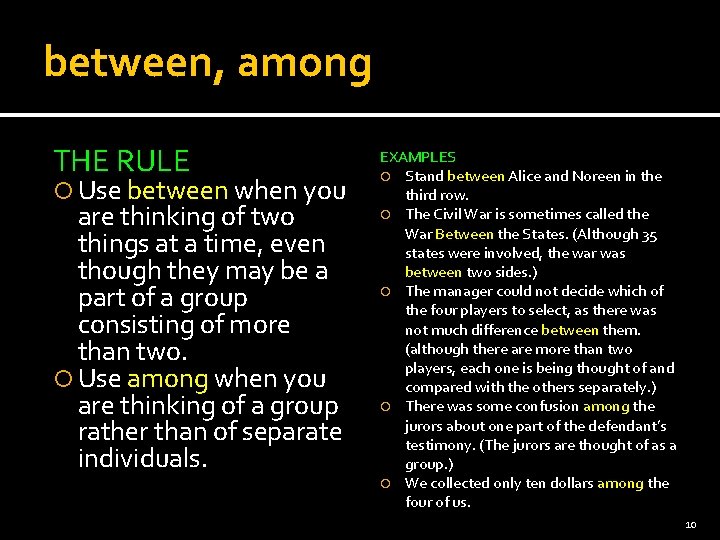
between, among THE RULE Use between when you are thinking of two things at a time, even though they may be a part of a group consisting of more than two. Use among when you are thinking of a group rather than of separate individuals. EXAMPLES Stand between Alice and Noreen in the third row. The Civil War is sometimes called the War Between the States. (Although 35 states were involved, the war was between two sides. ) The manager could not decide which of the four players to select, as there was not much difference between them. (although there are more than two players, each one is being thought of and compared with the others separately. ) There was some confusion among the jurors about one part of the defendant’s testimony. (The jurors are thought of as a group. ) We collected only ten dollars among the four of us. 10
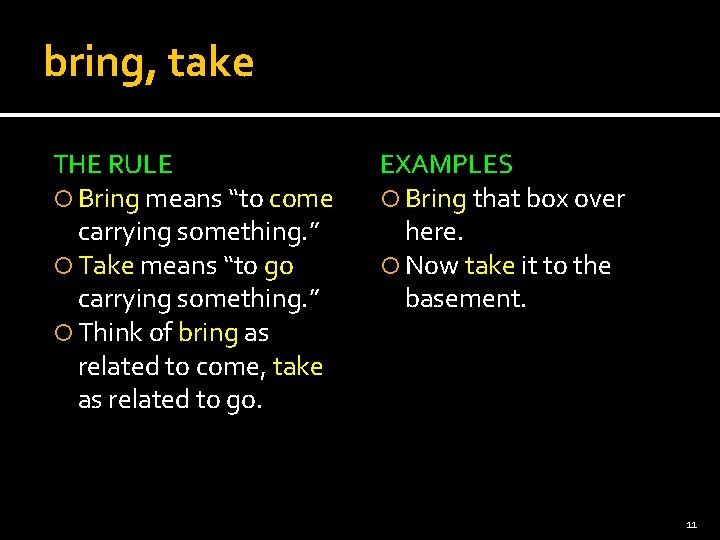
bring, take THE RULE Bring means “to come carrying something. ” Take means “to go carrying something. ” Think of bring as related to come, take as related to go. EXAMPLES Bring that box over here. Now take it to the basement. 11
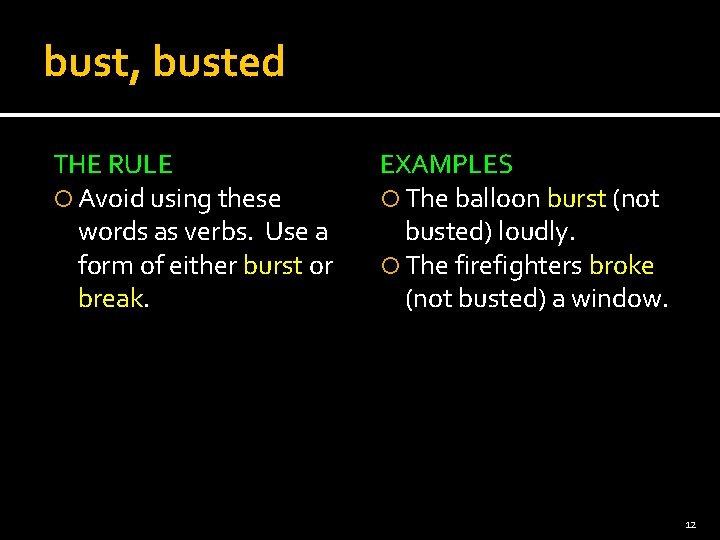
bust, busted THE RULE Avoid using these words as verbs. Use a form of either burst or break. EXAMPLES The balloon burst (not busted) loudly. The firefighters broke (not busted) a window. 12
QUIZ TOMORROW OVER GLOSSARY OF USAGE Review the Glossary of Usage Terms we have studied so far for five minutes in preparation for a practice quiz tomorrow. The quiz will consist of 20 sentences to correct. You may want to study some outside of class, too. 13
Glossary of Usage Quiz Today Take five minutes to study your notes. Quizzes will be distributed by the teacher. After completing the quiz, turn it face down on your desk and wait quietly, until everyone is done. Practice Quiz One 14
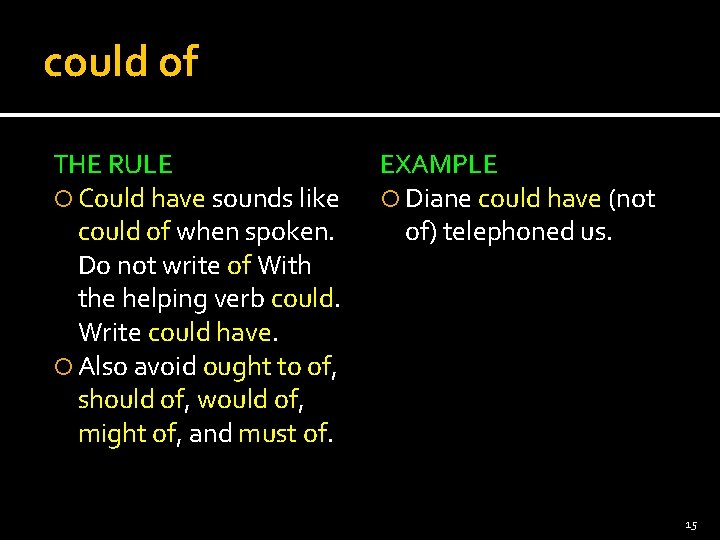
could of THE RULE Could have sounds like could of when spoken. Do not write of With the helping verb could. Write could have. Also avoid ought to of, should of, would of, might of, and must of. EXAMPLE Diane could have (not of) telephoned us. 15
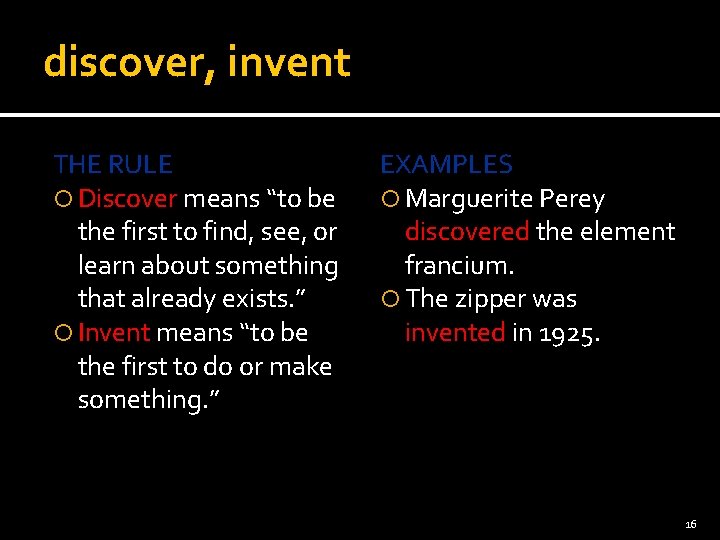
discover, invent THE RULE Discover means “to be the first to find, see, or learn about something that already exists. ” Invent means “to be the first to do or make something. ” EXAMPLES Marguerite Perey discovered the element francium. The zipper was invented in 1925. 16
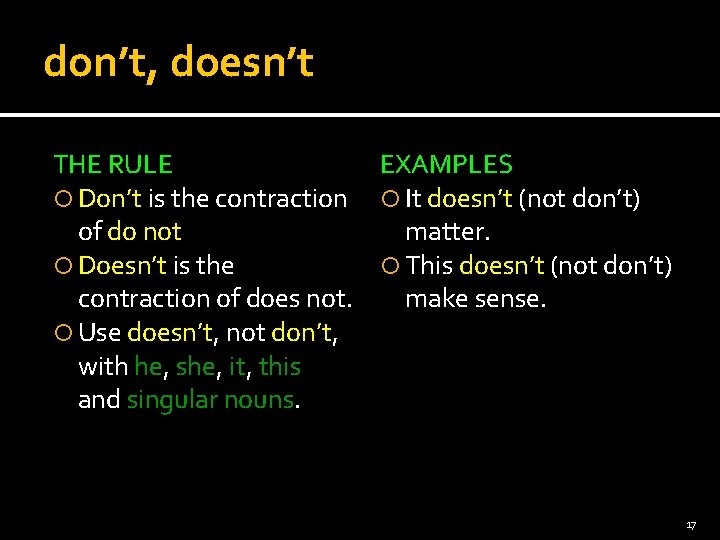
don’t, doesn’t THE RULE EXAMPLES Don’t is the contraction It doesn’t (not don’t) of do not matter. Doesn’t is the This doesn’t (not don’t) contraction of does not. make sense. Use doesn’t, not don’t, with he, she, it, this and singular nouns. 17
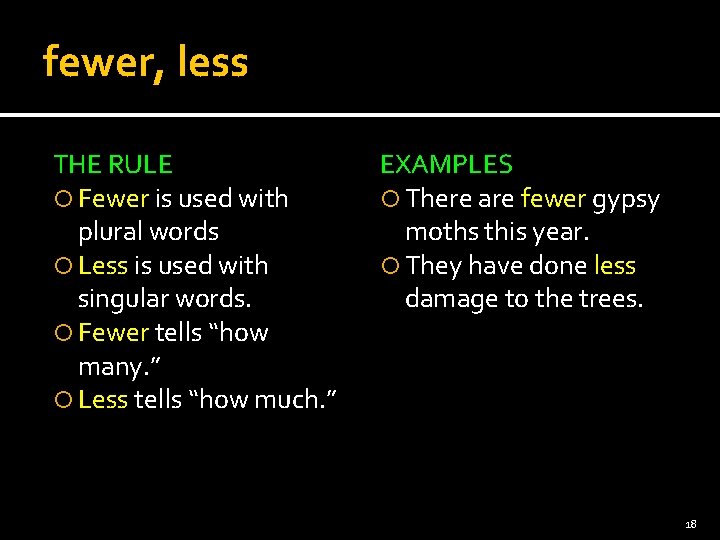
fewer, less THE RULE Fewer is used with plural words Less is used with singular words. Fewer tells “how many. ” Less tells “how much. ” EXAMPLES There are fewer gypsy moths this year. They have done less damage to the trees. 18
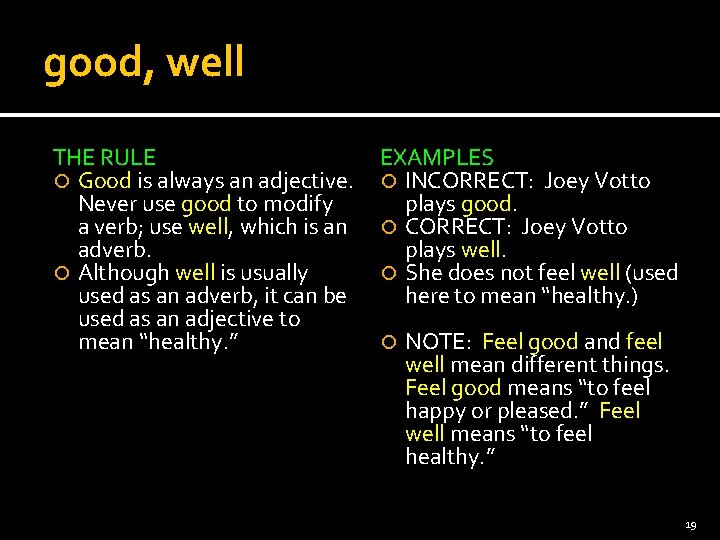
good, well THE RULE Good is always an adjective. Never use good to modify a verb; use well, which is an adverb. Although well is usually used as an adverb, it can be used as an adjective to mean “healthy. ” EXAMPLES INCORRECT: Joey Votto plays good. CORRECT: Joey Votto plays well. She does not feel well (used here to mean “healthy. ) NOTE: Feel good and feel well mean different things. Feel good means “to feel happy or pleased. ” Feel well means “to feel healthy. ” 19
QUIZ TOMORROW OVER GLOSSARY OF USAGE Review the Glossary of Usage Terms we have studied so far for five minutes in preparation for a practice quiz tomorrow. The quiz will consist of 10 sentences to correct. You may want to study some outside of class, too. 20
Glossary of Usage Quiz Today Take five minutes to study your notes. Quizzes will be distributed by the teacher. After completing the quiz, turn it face down on your desk and wait quietly, until everyone is done. Practice Quiz Two 21
Glossary of Usage Review Test coming. � Study Glossary of Usage Terms for five minutes in preparation for Review Test. � The Review Test will consist of 20 sentences that cover the most important usage problems we’ve discussed so far. � You will need to evaluate each sentence, determine if there is an error in usage, and correct if necessary. � Date of Test � This test will be for a grade in the grade book. � The value of this test is 40 points. � You probably should study outside of class to do the best you can. The purpose of this test is to assess YOUR learning. 22
Glossary of Usage Review Test coming. � Study Glossary of Usage Terms for five minutes in preparation for Review Test. � The Review Test will consist of 20 sentences that cover the most important usage problems we’ve discussed so far. � You will need to evaluate each sentence, determine if there is an error in usage, and correct if necessary. � Date of Test � This test will be for a grade in the grade book. � The value of this test is 40 points. � You probably should study outside of class to do the best you can. The purpose of this test is to assess YOUR learning. 23
Glossary of Usage Review Test coming. � Study Glossary of Usage Terms for five minutes in preparation for Review Test. � The Review Test will consist of 20 sentences that cover the most important usage problems we’ve discussed so far. � You will need to evaluate each sentence, determine if there is an error in usage, and correct if necessary. � Date of Test � This test will be for a grade in the grade book. � The value of this test is 40 points. � You probably should study outside of class to do the best you can. The purpose of this test is to assess YOUR learning. 24
Glossary of Usage Review Test TODAY! Study five minutes for Review Test. Are there any questions? Be ready to ask at the end of five minutes. Tests will be distributed by the teacher. GOOD LUCK! 25
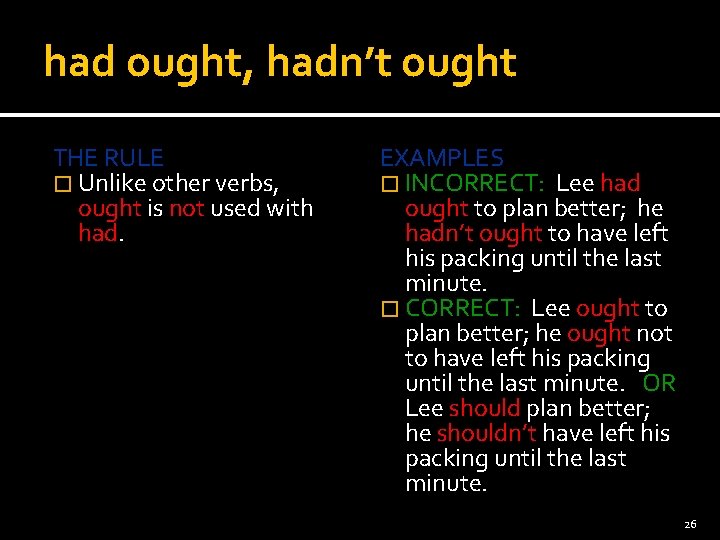
had ought, hadn’t ought THE RULE � Unlike other verbs, ought is not used with had. EXAMPLES � INCORRECT: Lee had ought to plan better; he hadn’t ought to have left his packing until the last minute. � CORRECT: Lee ought to plan better; he ought not to have left his packing until the last minute. OR Lee should plan better; he shouldn’t have left his packing until the last minute. 26
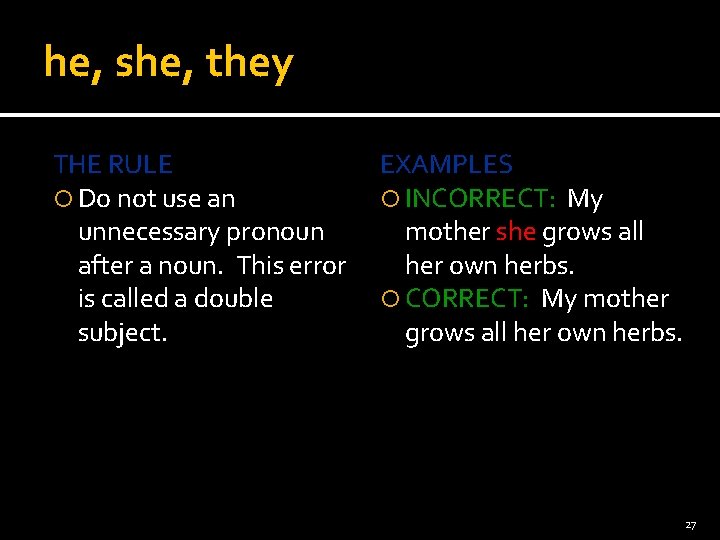
he, she, they THE RULE EXAMPLES Do not use an INCORRECT: My unnecessary pronoun mother she grows all after a noun. This error her own herbs. is called a double CORRECT: My mother subject. grows all her own herbs. 27
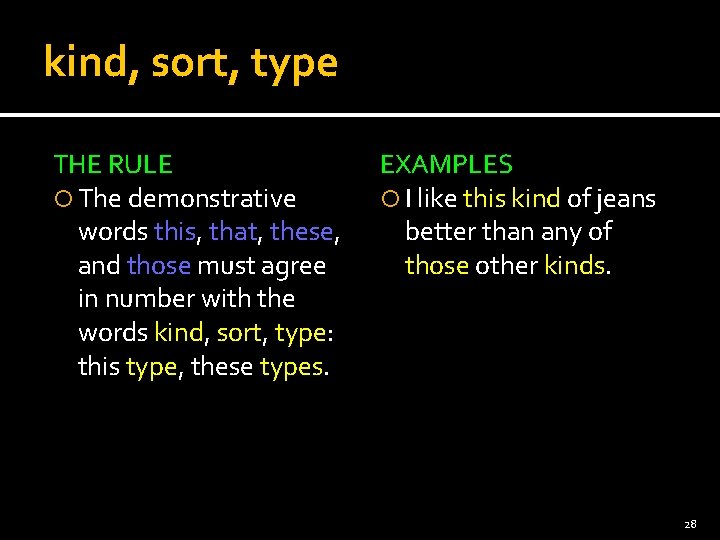
kind, sort, type THE RULE The demonstrative words this, that, these, and those must agree in number with the words kind, sort, type: this type, these types. EXAMPLES I like this kind of jeans better than any of those other kinds. 28
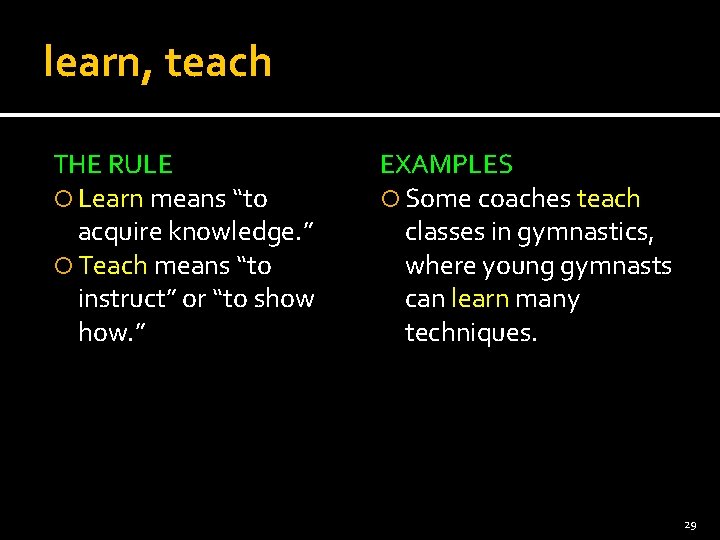
learn, teach THE RULE Learn means “to acquire knowledge. ” Teach means “to instruct” or “to show how. ” EXAMPLES Some coaches teach classes in gymnastics, where young gymnasts can learn many techniques. 29
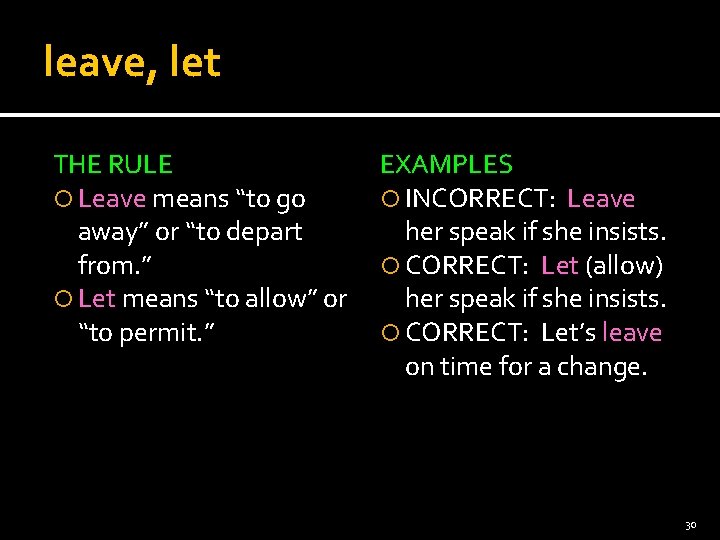
leave, let THE RULE Leave means “to go away” or “to depart from. ” Let means “to allow” or “to permit. ” EXAMPLES INCORRECT: Leave her speak if she insists. CORRECT: Let (allow) her speak if she insists. CORRECT: Let’s leave on time for a change. 30
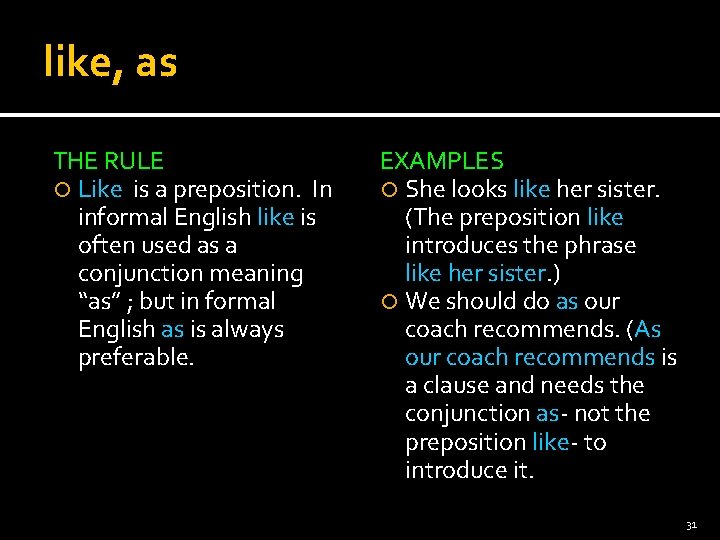
like, as THE RULE Like is a preposition. In informal English like is often used as a conjunction meaning “as” ; but in formal English as is always preferable. EXAMPLES She looks like her sister. (The preposition like introduces the phrase like her sister. ) We should do as our coach recommends. (As our coach recommends is a clause and needs the conjunction as- not the preposition like- to introduce it. 31
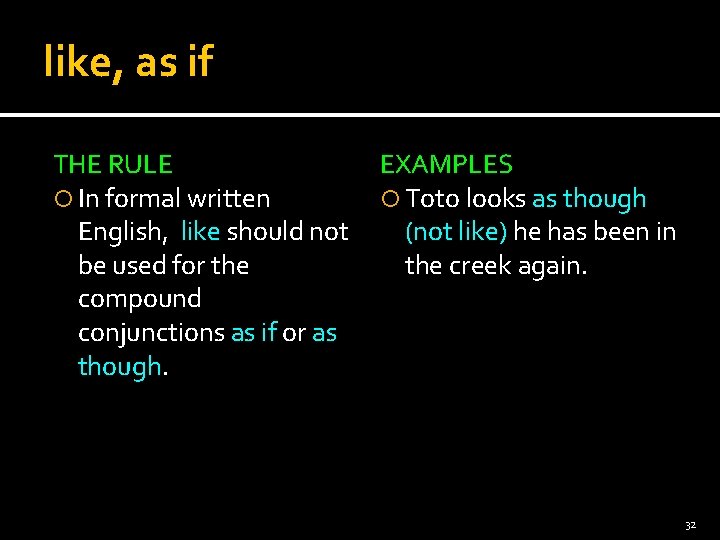
like, as if THE RULE EXAMPLES In formal written Toto looks as though English, like should not (not like) he has been in be used for the creek again. compound conjunctions as if or as though. 32
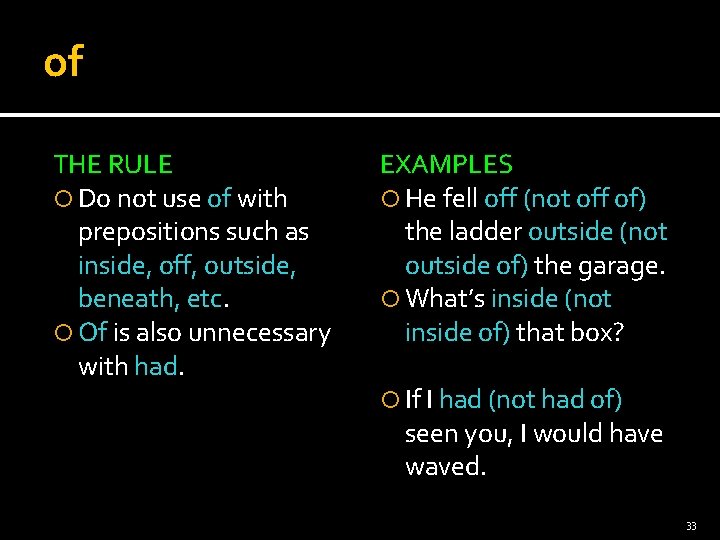
of THE RULE Do not use of with prepositions such as inside, off, outside, beneath, etc. Of is also unnecessary with had. EXAMPLES He fell off (not off of) the ladder outside (not outside of) the garage. What’s inside (not inside of) that box? If I had (not had of) seen you, I would have waved. 33
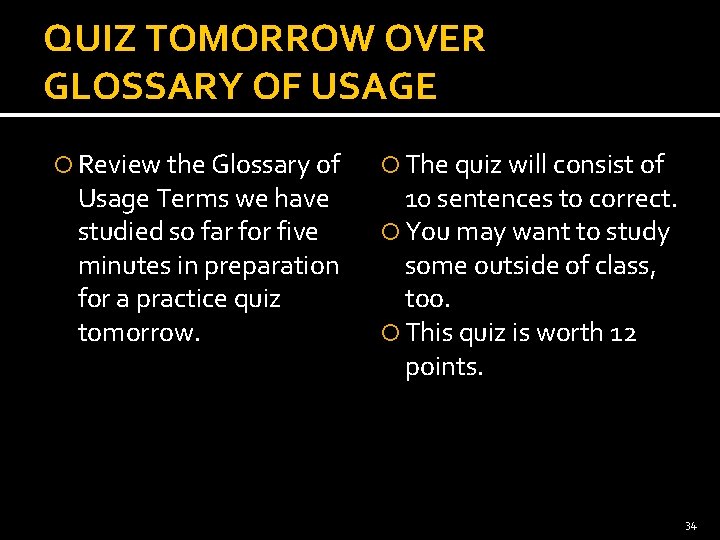
QUIZ TOMORROW OVER GLOSSARY OF USAGE Review the Glossary of Usage Terms we have studied so far for five minutes in preparation for a practice quiz tomorrow. The quiz will consist of 10 sentences to correct. You may want to study some outside of class, too. This quiz is worth 12 points. 34
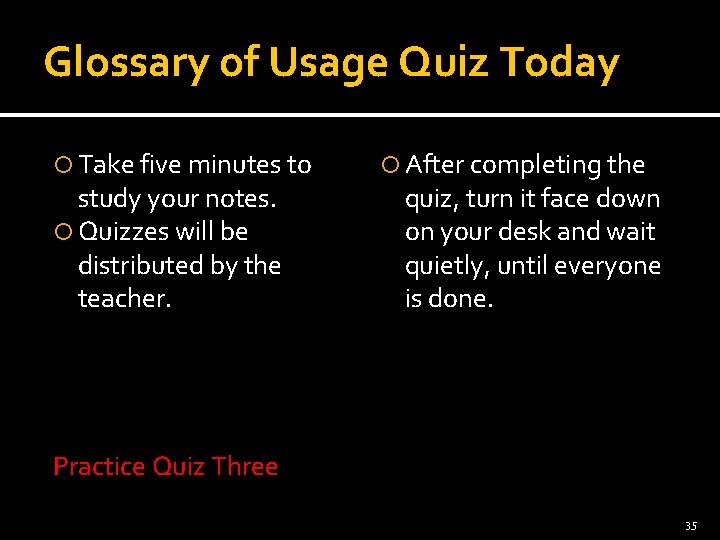
Glossary of Usage Quiz Today Take five minutes to study your notes. Quizzes will be distributed by the teacher. After completing the quiz, turn it face down on your desk and wait quietly, until everyone is done. Practice Quiz Three 35
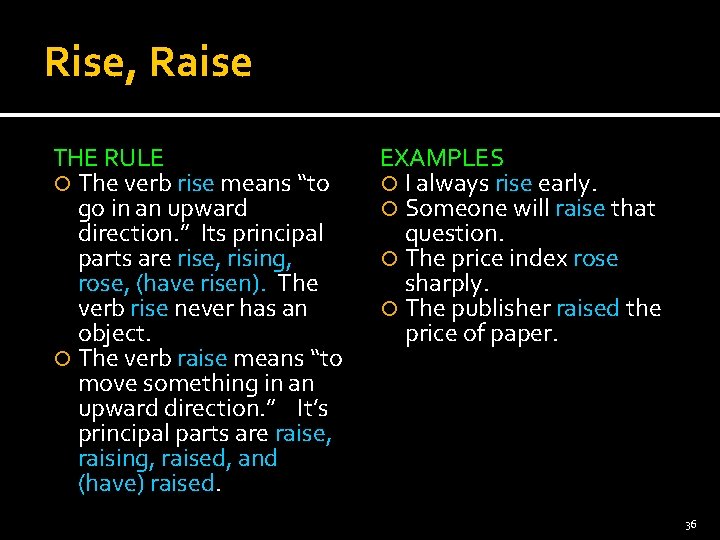
Rise, Raise THE RULE The verb rise means “to go in an upward direction. ” Its principal parts are rise, rising, rose, (have risen). The verb rise never has an object. The verb raise means “to move something in an upward direction. ” It’s principal parts are raise, raising, raised, and (have) raised. EXAMPLES I always rise early. Someone will raise that question. The price index rose sharply. The publisher raised the price of paper. 36
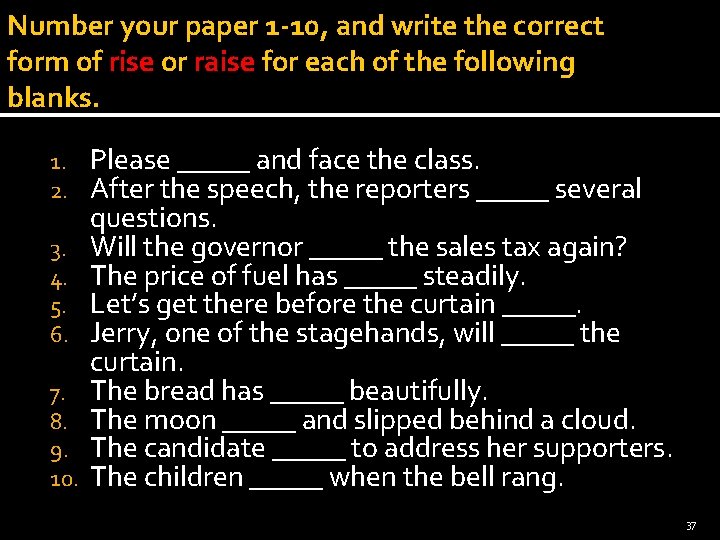
Number your paper 1 -10, and write the correct form of rise or raise for each of the following blanks. 1. 2. 3. 4. 5. 6. 7. 8. 9. 10. Please _____ and face the class. After the speech, the reporters _____ several questions. Will the governor _____ the sales tax again? The price of fuel has _____ steadily. Let’s get there before the curtain _____. Jerry, one of the stagehands, will _____ the curtain. The bread has _____ beautifully. The moon _____ and slipped behind a cloud. The candidate _____ to address her supporters. The children _____ when the bell rang. 37
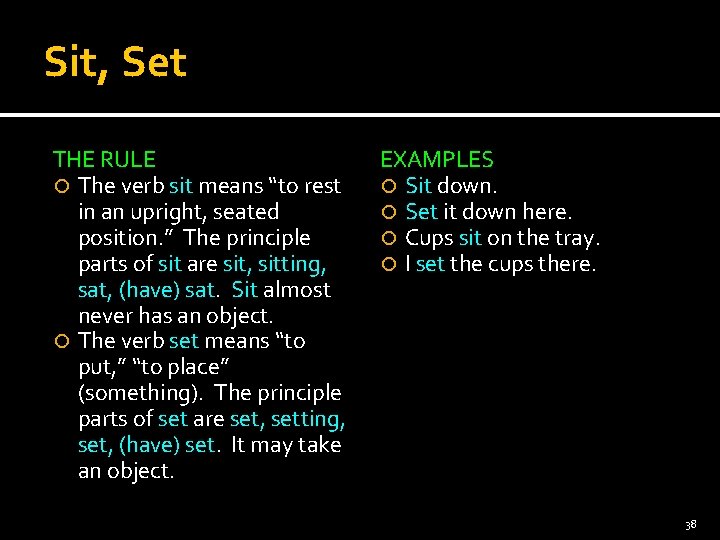
Sit, Set THE RULE The verb sit means “to rest in an upright, seated position. ” The principle parts of sit are sit, sitting, sat, (have) sat. Sit almost never has an object. The verb set means “to put, ” “to place” (something). The principle parts of set are set, setting, set, (have) set. It may take an object. EXAMPLES Sit down. Set it down here. Cups sit on the tray. I set the cups there. 38
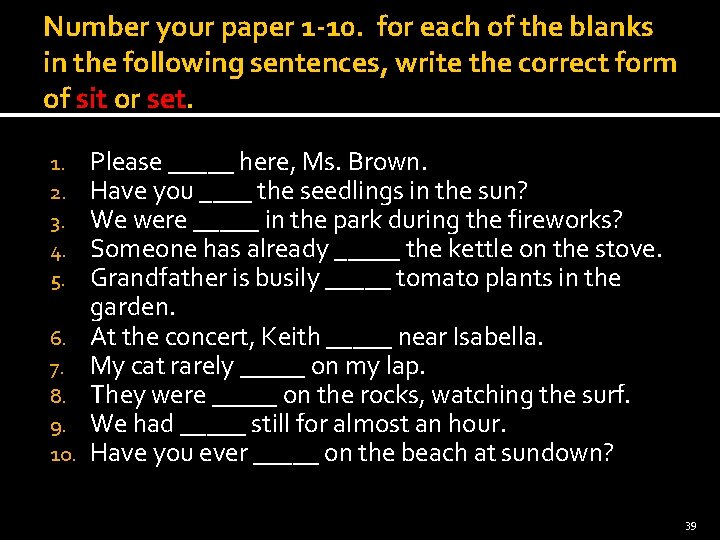
Number your paper 1 -10. for each of the blanks in the following sentences, write the correct form of sit or set. 1. 2. 3. 4. 5. 6. 7. 8. 9. 10. Please _____ here, Ms. Brown. Have you ____ the seedlings in the sun? We were _____ in the park during the fireworks? Someone has already _____ the kettle on the stove. Grandfather is busily _____ tomato plants in the garden. At the concert, Keith _____ near Isabella. My cat rarely _____ on my lap. They were _____ on the rocks, watching the surf. We had _____ still for almost an hour. Have you ever _____ on the beach at sundown? 39
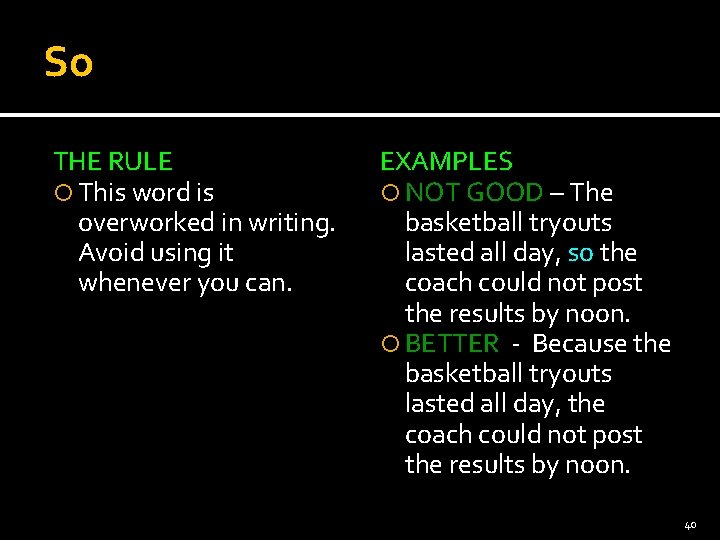
So THE RULE This word is overworked in writing. Avoid using it whenever you can. EXAMPLES NOT GOOD – The basketball tryouts lasted all day, so the coach could not post the results by noon. BETTER - Because the basketball tryouts lasted all day, the coach could not post the results by noon. 40
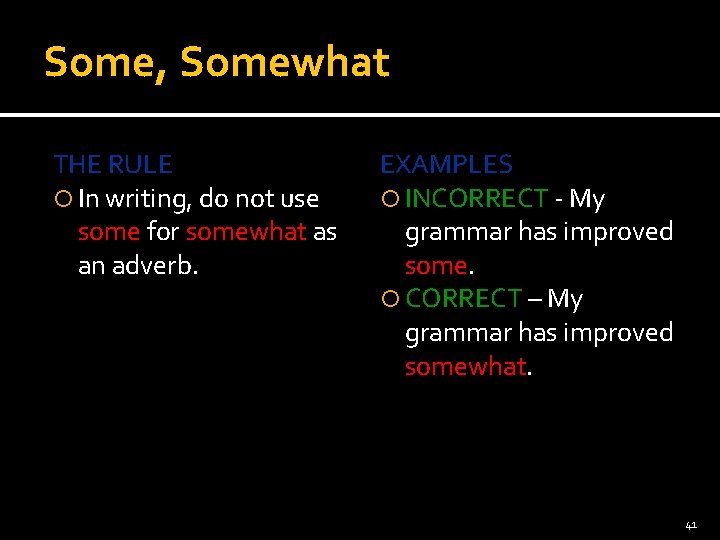
Some, Somewhat THE RULE In writing, do not use some for somewhat as an adverb. EXAMPLES INCORRECT - My grammar has improved some. CORRECT – My grammar has improved somewhat. 41

Than, Then THE RULE Do not confuse these words. Than is a conjunction, a word that joins words or groups of words. Then is an adverb a word used to modify a verb, an adjective or another adverb. EXAMPLES This box is heavier than that one. We wrapped the presents. Then we hid them in the closet. NOTE: then usually tells when – notice the similarity in spelling. 42
Them THE RULE Them should not be used as an adjective. Use these or those. EXAMPLE I like these (not them) shoes, don’t you? 43
this here, that there THE RULE The here and there are unnecessary. EXAMPLE I’m buying this (not this here) cd instead of that (not that there) one. 44
Way, Ways THE RULE Use way, NOT ways in referring to a distance. EXAMPLE We hiked a long way (not ways). 45
When, Where THE RULE Do not use when or where incorrectly in writing a definition. EXAMPLES INCORRECT – A “bomb” in football is when/ where a quarterback throws a long pass. CORRECT - A “bomb” in football is a long pass thrown by the quarterback. 46
Where THE RULE Do not use where for that. EXAMPLE I read in this magazine that (not where) Marie Ledbetter is a champion parachutist. 47
Which, That, Who THE RULE Remember that the relative pronoun who refers to people only; which refers to things only; that refers to either people or things. EXAMPLES Here is the man who will install the new carpet. (person) That is the color which we selected. (thing) It is the kind of carpet that will wear well. (thing) The dealer is a person that stands behind a product. (person) 48
Who, Whom THE RULE The words who and whom are both pronouns. To know whether to use who or whom, it is necessary to understand the difference between subjects and objects because who is used when referring to the subject of a clause and whom is used when referring to the object of a clause. The subject of the sentence is the person doing something and the object of the sentence is having something done to them. EXAMPLE I stepped on the book. ( I is the subject and the book is the object) 49
Who, Whom – Quick and Dirty Tip � Like whom, the pronoun him ends with m. � When you're trying to decide whether to use who or whom, ask yourself if the answer to the question would be he or him. � If you can answer the question being asked with him, then use whom, and it's easy to remember because they both end with m. EXAMPLES � "Who (or whom) do you love? " (The answer would be "I love him. " Him ends with an m, so you know to use whom. ) � "Who (or whom) stepped on Squiggly? " (The answer would be "He stepped on Squiggly. " There's no m, so you know to use who. 50
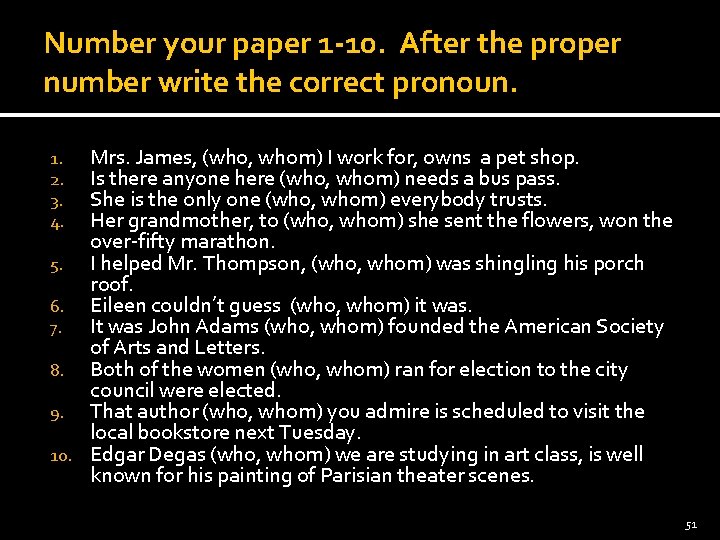
Number your paper 1 -10. After the proper number write the correct pronoun. Mrs. James, (who, whom) I work for, owns a pet shop. Is there anyone here (who, whom) needs a bus pass. She is the only one (who, whom) everybody trusts. Her grandmother, to (who, whom) she sent the flowers, won the over-fifty marathon. 5. I helped Mr. Thompson, (who, whom) was shingling his porch roof. 6. Eileen couldn’t guess (who, whom) it was. 7. It was John Adams (who, whom) founded the American Society of Arts and Letters. 8. Both of the women (who, whom) ran for election to the city council were elected. 9. That author (who, whom) you admire is scheduled to visit the local bookstore next Tuesday. 10. Edgar Degas (who, whom) we are studying in art class, is well known for his painting of Parisian theater scenes. 1. 2. 3. 4. 51
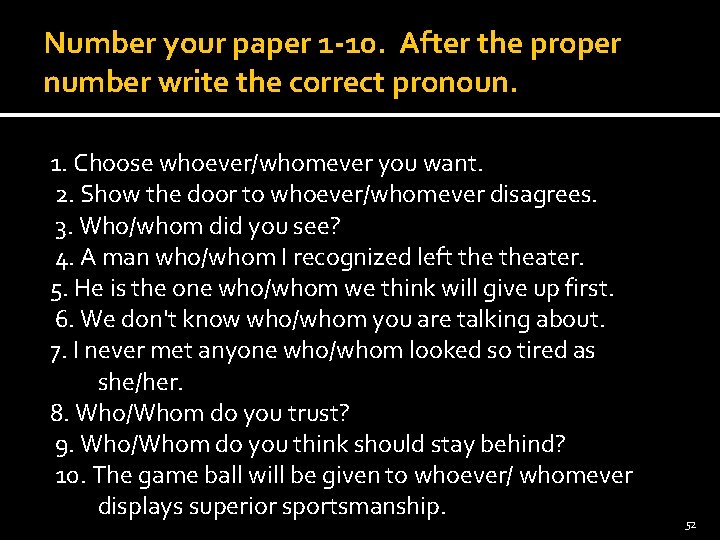
Number your paper 1 -10. After the proper number write the correct pronoun. 1. Choose whoever/whomever you want. 2. Show the door to whoever/whomever disagrees. 3. Who/whom did you see? 4. A man who/whom I recognized left theater. 5. He is the one who/whom we think will give up first. 6. We don't know who/whom you are talking about. 7. I never met anyone who/whom looked so tired as she/her. 8. Who/Whom do you trust? 9. Who/Whom do you think should stay behind? 10. The game ball will be given to whoever/ whomever displays superior sportsmanship. 52
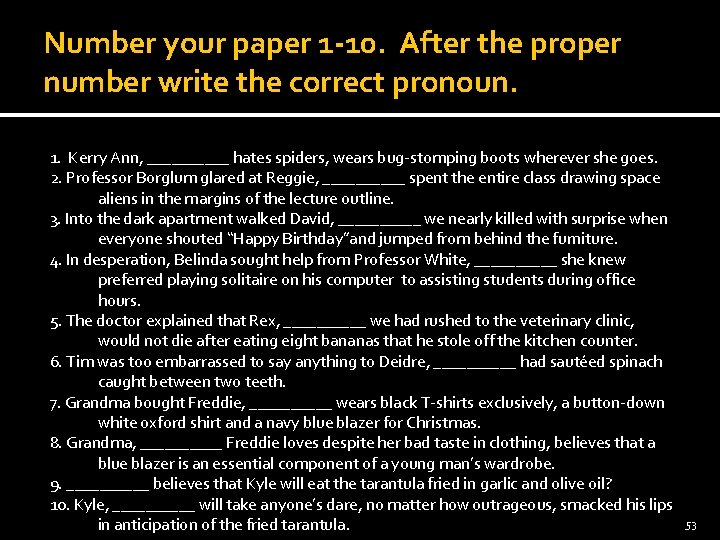
Number your paper 1 -10. After the proper number write the correct pronoun. 1. Kerry Ann, _____ hates spiders, wears bug-stomping boots wherever she goes. 2. Professor Borglum glared at Reggie, _____ spent the entire class drawing space aliens in the margins of the lecture outline. 3. Into the dark apartment walked David, _____ we nearly killed with surprise when everyone shouted “Happy Birthday”and jumped from behind the furniture. 4. In desperation, Belinda sought help from Professor White, _____ she knew preferred playing solitaire on his computer to assisting students during office hours. 5. The doctor explained that Rex, _____ we had rushed to the veterinary clinic, would not die after eating eight bananas that he stole off the kitchen counter. 6. Tim was too embarrassed to say anything to Deidre, _____ had sautéed spinach caught between two teeth. 7. Grandma bought Freddie, _____ wears black T-shirts exclusively, a button-down white oxford shirt and a navy blue blazer for Christmas. 8. Grandma, _____ Freddie loves despite her bad taste in clothing, believes that a blue blazer is an essential component of a young man’s wardrobe. 9. _____ believes that Kyle will eat the tarantula fried in garlic and olive oil? 10. Kyle, _____ will take anyone’s dare, no matter how outrageous, smacked his lips in anticipation of the fried tarantula. 53
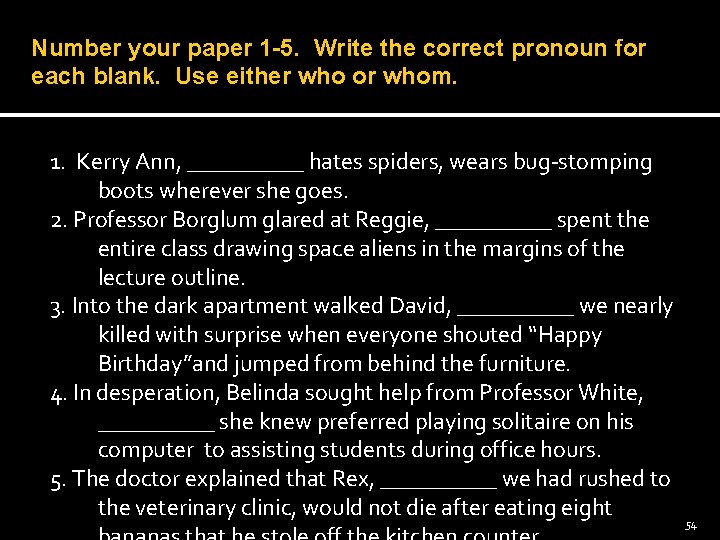
Number your paper 1 -5. Write the correct pronoun for each blank. Use either who or whom. 1. Kerry Ann, _____ hates spiders, wears bug-stomping boots wherever she goes. 2. Professor Borglum glared at Reggie, _____ spent the entire class drawing space aliens in the margins of the lecture outline. 3. Into the dark apartment walked David, _____ we nearly killed with surprise when everyone shouted “Happy Birthday”and jumped from behind the furniture. 4. In desperation, Belinda sought help from Professor White, _____ she knew preferred playing solitaire on his computer to assisting students during office hours. 5. The doctor explained that Rex, _____ we had rushed to the veterinary clinic, would not die after eating eight 54
Number your paper 1 -5. Write the correct pronoun for each blank. Use either who or whom. 1. Tim was too embarrassed to say anything to Deidre, _____ had sautéed spinach caught between two teeth. 2. Grandma bought Freddie, _____ wears black T-shirts exclusively, a button-down white oxford shirt and a navy blue blazer for Christmas. 3. Grandma, _____ Freddie loves despite her bad taste in clothing, believes that a blue blazer is an essential component of a young man’s wardrobe. 4. _____ believes that Kyle will eat the tarantula fried in garlic and olive oil? 5. Kyle, _____ will take anyone’s dare, no matter how outrageous, smacked his lips in anticipation of the fried tarantula. 55
Number your paper 1 -10. Write the entire sentence and fill in the blank with either who or whom. Underline your answer. 1. To ______ did you give the book? 2. ______ will you ask to help you with all this work? 3. I can't remember ______ told me that. 4. I can't figure out ______ I should blame for this. 5. ______ shall I say is calling? 6. To ______ should I address this question? 7. I don't care _______ takes responsibility for this accident, but somebody should. 8. Of all her athletes, ______ did Coach Carter like most? 9. Congressman Smith is the candidate ______ the voters feel is best qualified. 10. I really don't care _______ she's going out with.
Without, Unless THE RULE Do not use the preposition without in place of the conjunction unless. EXAMPLE I will not be able to sing unless (not without) my cold gets better. 57
QUIZ TOMORROW OVER GLOSSARY OF USAGE Review the Glossary of Usage Terms we have studied so far for five minutes in preparation for a practice quiz tomorrow. The quiz will consist of 20 sentences to correct. You may want to study some outside of class, too. 58
Glossary of Usage Quiz Today Take five minutes to study your notes. Quizzes will be distributed by the teacher. After completing the quiz, turn it face down on your desk and wait quietly, until everyone is done. Practice Quiz Four 59
Glossary of Usage Review Test coming. � Study Glossary of Usage Terms for five minutes in preparation for Review Test. � The Review Test will consist of 20 sentences that cover the most important usage problems we’ve discussed so far. � You will need to evaluate each sentence, determine if there is an error in usage, and correct if necessary. Date of Test – Thursday, Nov. 10, 2009 This test will be for a grade in the grade book. The value of this test is 80 points. You probably should study outside of class to do the best you can. The purpose of this test is to assess YOUR learning. 60
Glossary of Usage Review Test TODAY! Study five minutes for Review Test. Are there any questions? Be ready to ask at the end of five minutes. Tests will be distributed by the teacher. GOOD LUCK! 61
- Slides: 61