
A 77 yearold man with recurrent transient paresthesia
- Slides: 5
A 77 -year-old man with recurrent transient paresthesia Teaching Neuro. Images Neurology Resident and Fellow Section © 2018 American Academy of Neurology
Vignette A 77 -year-old man presented with recurrent transient paresthesia of the left arm for 2 weeks. The patient has no trauma history. He describes precisely the slow symptoms progression, always starting from the left hand spreading to the arm, the shoulder and sometimes to the perioral area. Several episodes occur each day but not strictly stereotyped and varied in intensity and duration. Neurological examination and standard EEG are normal. Brain CT scan is normal and CT scan angiography disclosed no vessel abnomality. Viguier et al.
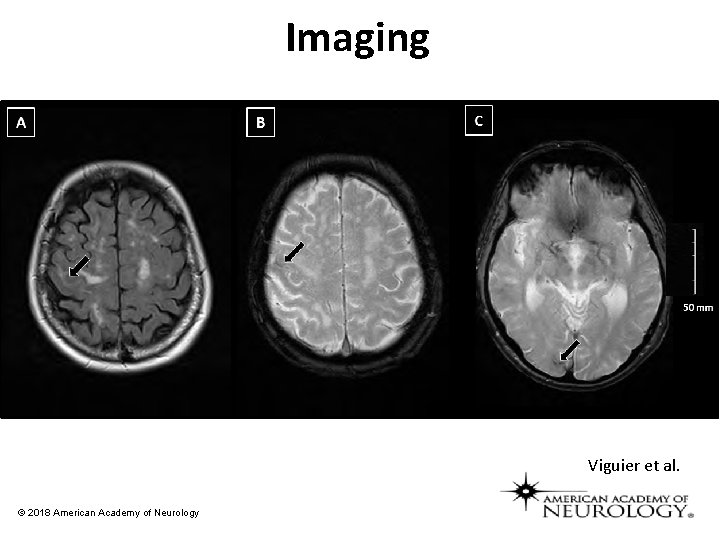
Imaging Viguier et al. © 2018 American Academy of Neurology
Video report Viguier et al. © 2018 American Academy of Neurology
Cerebral Amyloid Angiopathy-related Transient Focal Neurological Episodes also called “amyloïd spells” are a rare presentation of CCA. Numbness or tingling spreading from distal to proximal upper extremity are the more frequent presentation but weakness or aphasia may occur. Brain MRI shows convexity subarachnoid haemorrhage (c. SAH) in most cases. Although still debated, focal cortical spreading depression triggered by c. SAH may be, rather than an ischemic or an epileptic phenomena, the most plausible mechanism. Viguier et al. © 2018 American Academy of Neurology