
A 73 yearold woman with diplopia and crossed
- Slides: 6
A 73 -year-old woman with diplopia and crossed signs. Teaching Neuro. Images Neurology Resident & Fellow Section © 2020 American Academy of Neurology
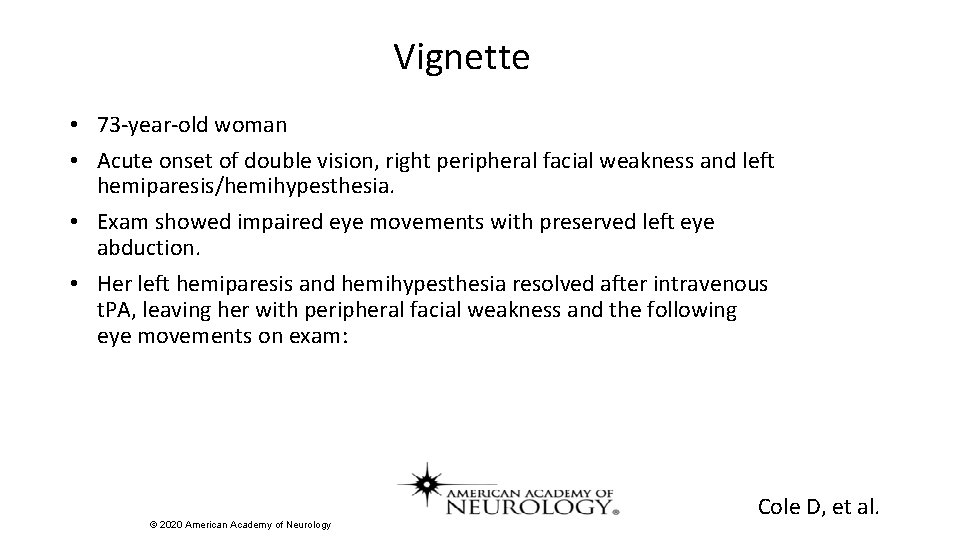
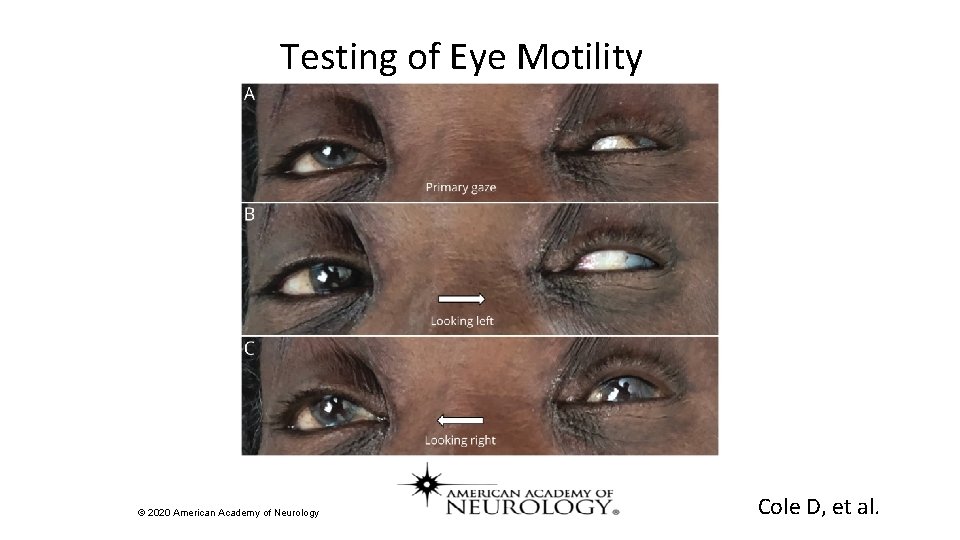
Vignette • 73 -year-old woman • Acute onset of double vision, right peripheral facial weakness and left hemiparesis/hemihypesthesia. • Exam showed impaired eye movements with preserved left eye abduction. • Her left hemiparesis and hemihypesthesia resolved after intravenous t. PA, leaving her with peripheral facial weakness and the following eye movements on exam: © 2020 American Academy of Neurology Cole D, et al.
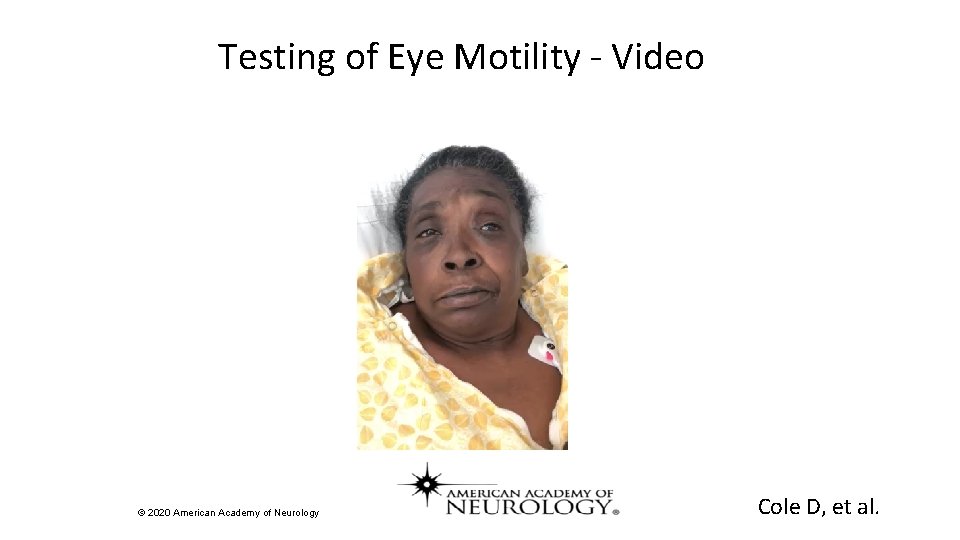
Testing of Eye Motility - Video © 2020 American Academy of Neurology Cole D, et al.
Testing of Eye Motility © 2020 American Academy of Neurology Cole D, et al.
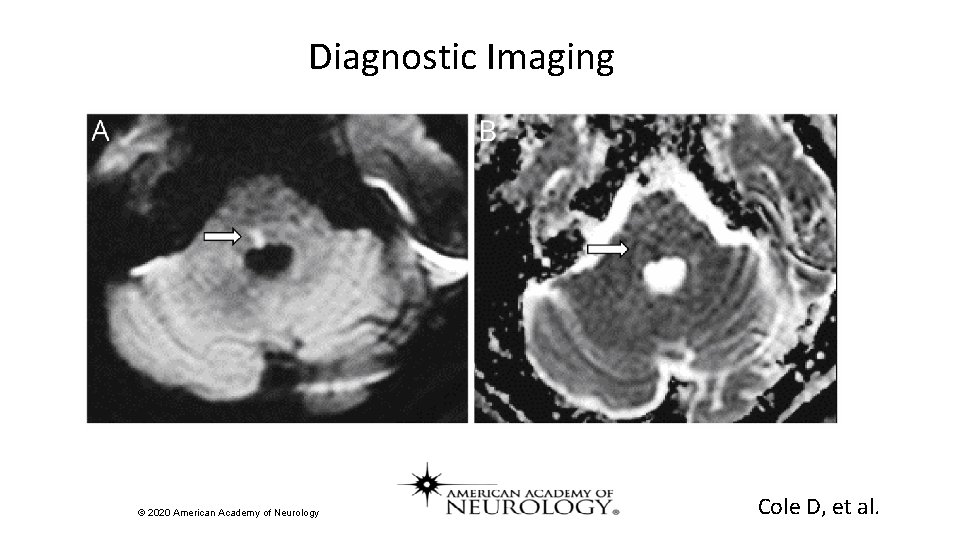
Diagnostic Imaging © 2020 American Academy of Neurology Cole D, et al.
9 to “Eight-and-a-half Syndrome” • These deficits localize to the right pontine tegmentum involving the MLF, facial nerve, abducens nucleus, medial lemniscus and corticospinal tracts. This was supported by the DWI and ADC changes on her MRI. (Figure 1) • Rosini, et al. First described these deficits as “Nine Syndrome” (7 th nerve + 1. 5 syndrome + 0. 5 hemiparesis/hypesthesia =9) 1 • After t. PA, our patient was left with an “Eight-and-a-half Syndrome” (Figures 1 &2). Infarct, hemorrhage, vasculitis and demyelination are etiologies of eight-and-a-half syndromes reported in the literature. 2 • Of note, our patient’s right eye adduction was paretic and not plegic. © 2020 American Academy of Neurology Cole D, et al.