
A 45 nm 8 Core Enterprise Xeon Processor




- Slides: 24
A 45 nm 8 -Core Enterprise Xeon® Processor ’ ISSCC 2009 Presented By: Ahmad Lashgar University Of Tehran December 2010 Original Authors: Stefan Rusu, Simon Tam, Harry Muljono, Jason Stinson, David Ayers, Jonathan Chang, Raj Varada, Matt Ratta, Sailesh Kottapalli Some slides are included from original paper only for educational purposes
Outline • Introduction – Xeon Family – Xeon in Supercomputing • Overview of Nehalem Architecture – Pipeline – Quick Path Interconnect • Nehalem based Xeon – Platforms Configurations – Clock Domains – Clock Skews
Introduction • Wikipedia -> The Xeon is a brand of multiprocessing-capable x 86 microprocessors from Intel mainly targeted at the server, workstation and embedded system markets.
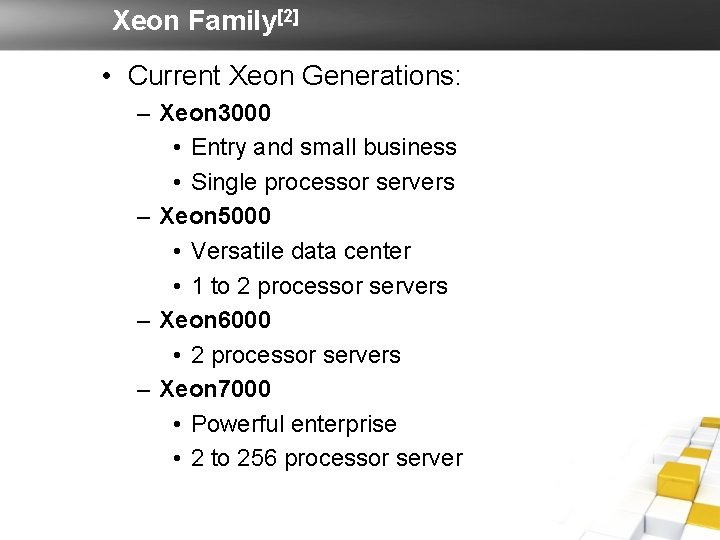
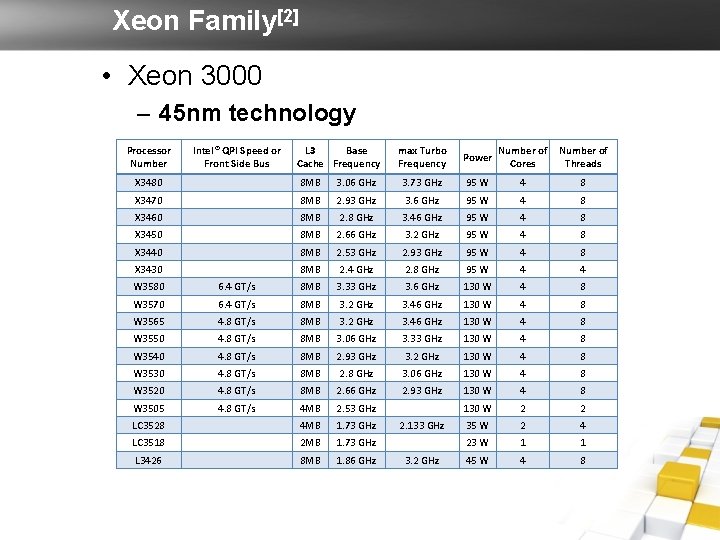
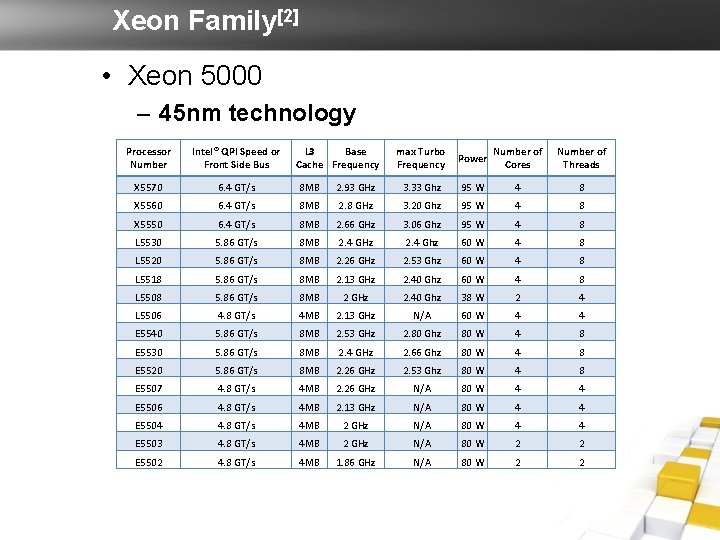
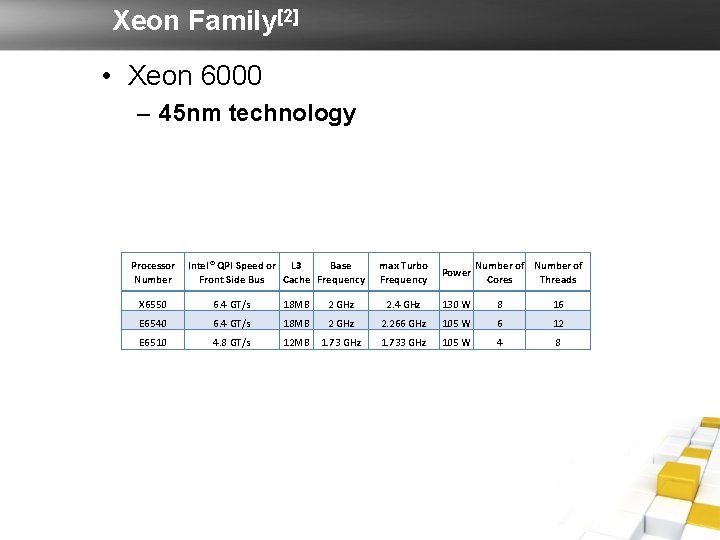
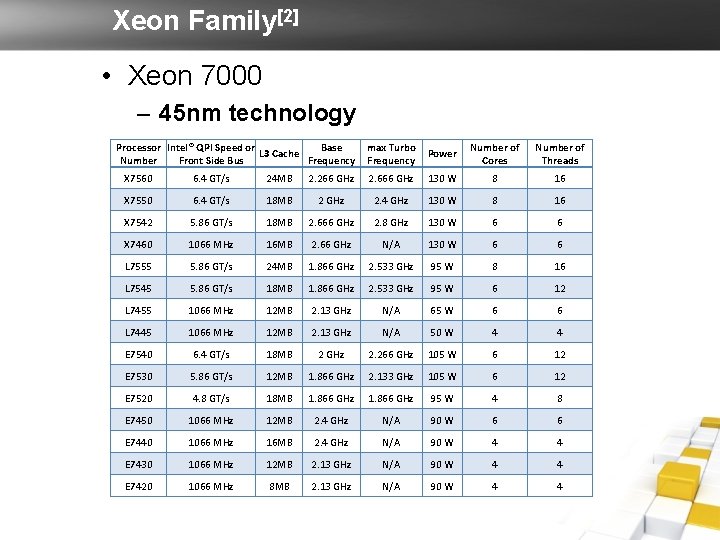
Xeon Family[2] • Current Xeon Generations: – Xeon 3000 • Entry and small business • Single processor servers – Xeon 5000 • Versatile data center • 1 to 2 processor servers – Xeon 6000 • 2 processor servers – Xeon 7000 • Powerful enterprise • 2 to 256 processor server
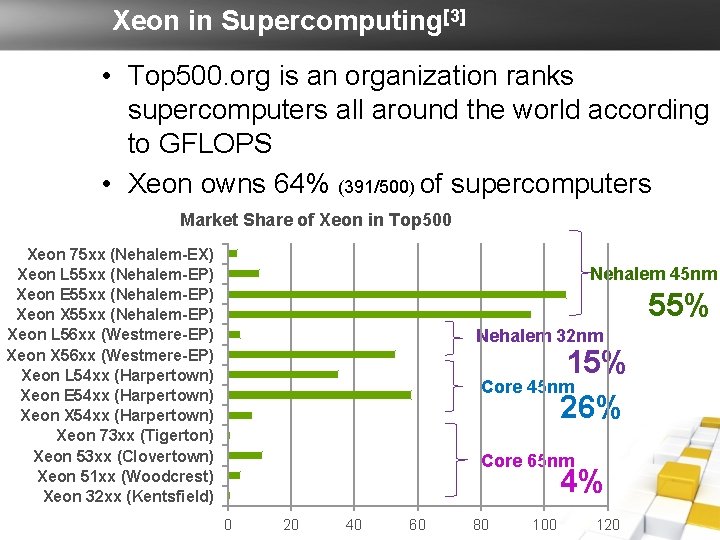
Xeon in Supercomputing[3] • Top 500. org is an organization ranks supercomputers all around the world according to GFLOPS • Xeon owns 64% (391/500) of supercomputers Market Share of Xeon in Top 500 Xeon 75 xx (Nehalem-EX) Xeon L 55 xx (Nehalem-EP) Xeon E 55 xx (Nehalem-EP) Xeon X 55 xx (Nehalem-EP) Xeon L 56 xx (Westmere-EP) Xeon X 56 xx (Westmere-EP) Xeon L 54 xx (Harpertown) Xeon E 54 xx (Harpertown) Xeon X 54 xx (Harpertown) Xeon 73 xx (Tigerton) Xeon 53 xx (Clovertown) Xeon 51 xx (Woodcrest) Xeon 32 xx (Kentsfield) Nehalem 45 nm 55% Nehalem 32 nm 15% Core 45 nm 26% Core 65 nm 4% 0 20 40 60 80 100 120
Overview of Nehalem Architecture[4] • Introduced with Intel Core i 7 • Nehalem Overall Features: – – – 2 up to 8 core Optional Hyper-threading L 1 and L 2 cache per core, shared L 3 Integrated Memory Controller Quick Path Interconnect Optional Turbo Boost Nehalem Die-Shot [5]
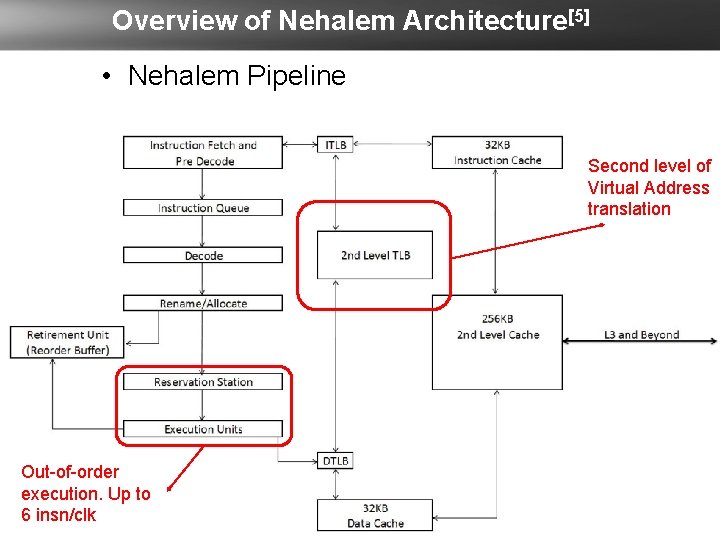
Overview of Nehalem Architecture[5] • Nehalem Pipeline Second level of Virtual Address translation Out-of-order execution. Up to 6 insn/clk
Overview of Nehalem Architecture[4] • QPI and IMC: – Motivation? • High bandwidth demand in Multiprocessor systems: Processor-IO, Processor-Processor and Processor-Memory Front Side Bus versus Quick Path Interconnect [5]
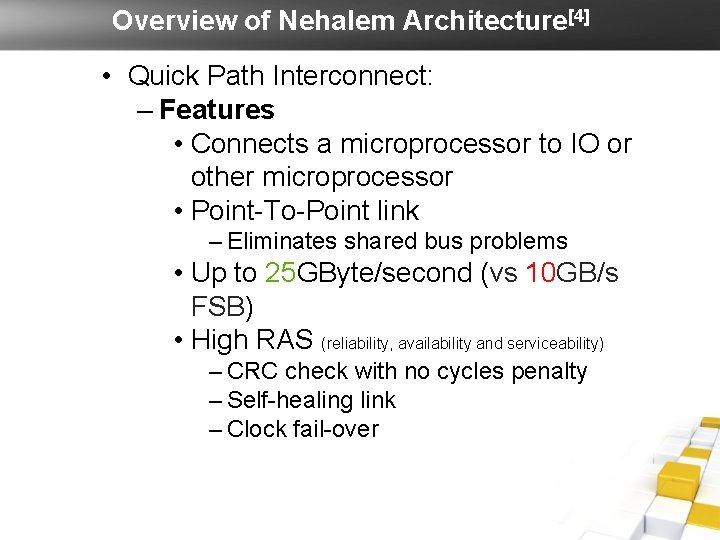
Overview of Nehalem Architecture[4] • Quick Path Interconnect: – Features • Connects a microprocessor to IO or other microprocessor • Point-To-Point link – Eliminates shared bus problems • Up to 25 GByte/second (vs 10 GB/s FSB) • High RAS (reliability, availability and serviceability) – CRC check with no cycles penalty – Self-healing link – Clock fail-over
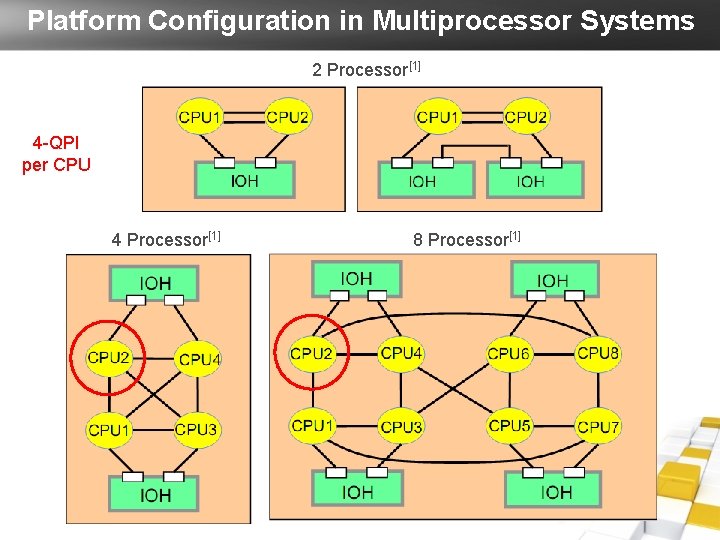
Platform Configuration in Multiprocessor Systems 2 Processor[1] 4 -QPI per CPU 4 Processor[1] 8 Processor[1]
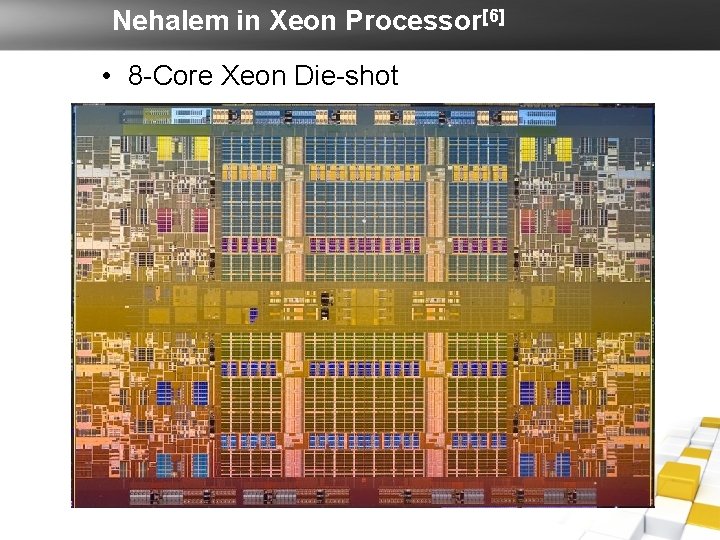
Nehalem in Xeon Processor[6] • 8 -Core Xeon Die-shot
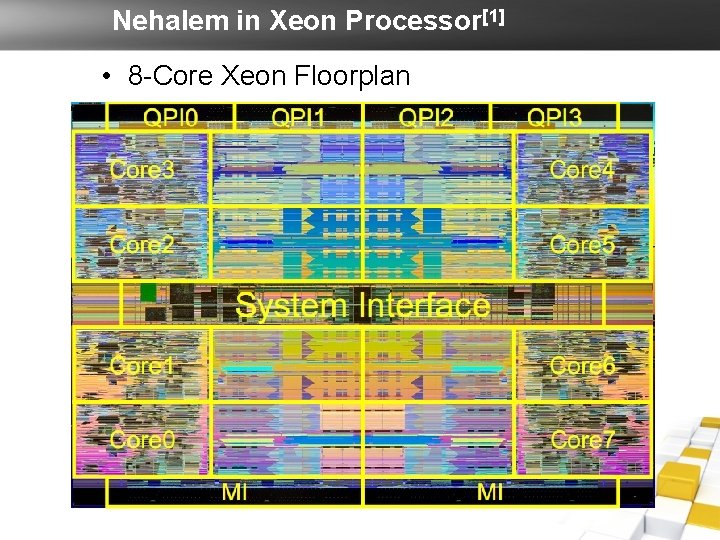
Nehalem in Xeon Processor[1] • 8 -Core Xeon Floorplan
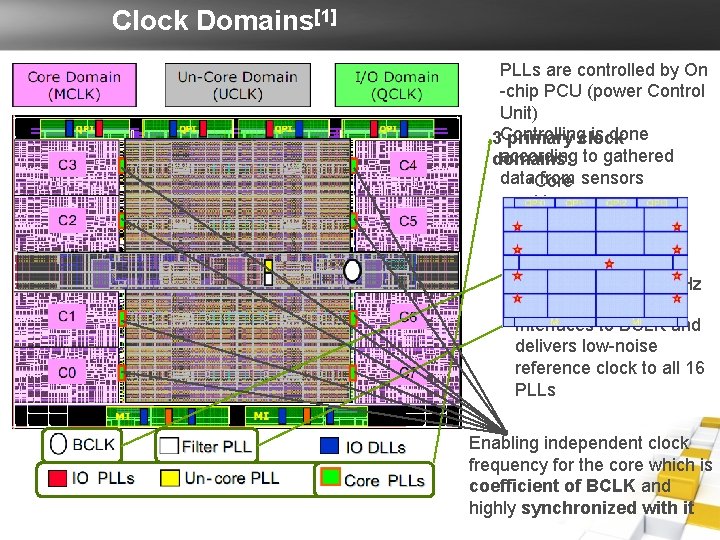
Clock Domains[1] PLLs are controlled by On -chip PCU (power Control Unit) is done 3 Controlling primary clock according to gathered domains: data • Core from sensors • Un-core • I/O System clock buffer that generates 133 MHz Interfaces to BCLK and delivers low-noise reference clock to all 16 PLLs Enabling independent clock frequency for the core which is coefficient of BCLK and highly synchronized with it
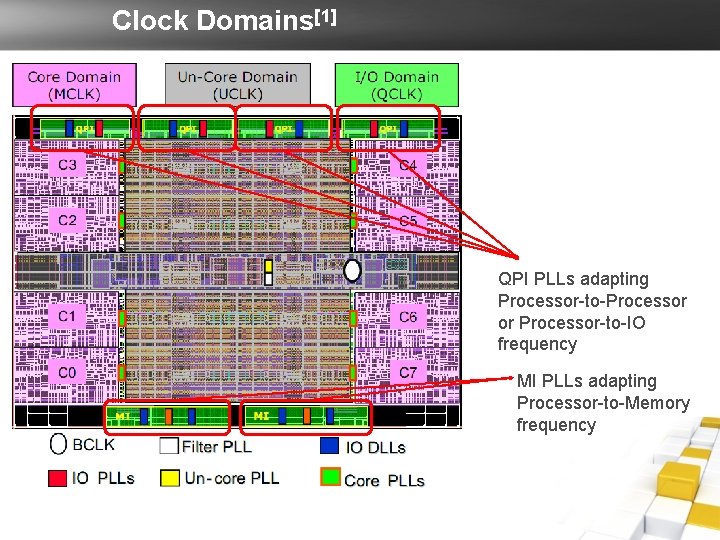
Clock Domains[1] QPI PLLs adapting Processor-to-Processor or Processor-to-IO frequency MI PLLs adapting Processor-to-Memory frequency
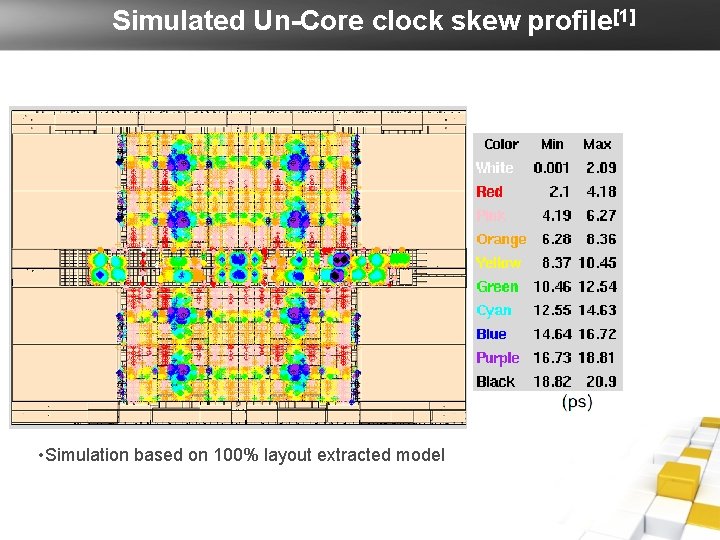
Simulated Un-Core clock skew profile[1] • Simulation based on 100% layout extracted model
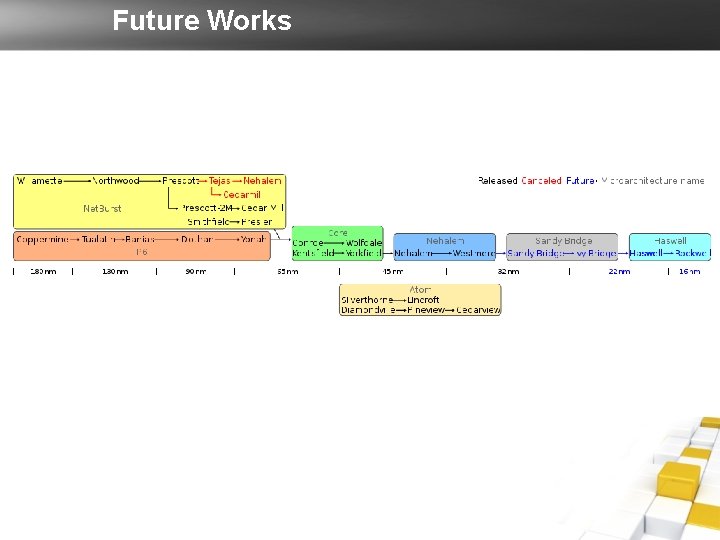
Future Works
References • [1] Stefan Rusu et al; 45 nm 8 -Core Enterprise Xeon® Processor; ISSCC 2009; page 56 -57 • [2] http: //www. intel. com/ • [3] http: //www. top 500. org/ • [4] Intel Next Generation Microarchitecture (Nehalem) White Paper • [5] http: //www. tomshardware. com/review_print. php? p 1=2041 • [6] http: //cdn. physorg. com/newman/gfx/news/hires/NHM-EXDie-Shot-1. jpg
The End • Any Question?
Overview of Nehalem Architecture[4] • Nehalem core benefits: – Larger out-of-order window – Faster Handling of branch [6] misprediction – More accurate branch prediction: • Second-level BTB – Better Hyper-threading: • Larger cache and bandwidth L 3 Cache QPI
Intel Codenames • Intel has historically named integrated circuit (IC) development projects after geographical names of towns, rivers or mountains near the location of the Intel facility responsible for the IC. • Codenames usually mapping to many marketing names • Latest architecture of Intel microprocessors named Nehalem (Nomenclature: The Nehalem River in Oregon, or possibly the town of Nehalem in Tillamook County, Oregon)
Xeon Family[2] • Xeon 3000 – 45 nm technology Processor Number Intel® QPI Speed or Front Side Bus L 3 Base Cache Frequency max Turbo Frequency Power Number of Cores Number of Threads X 3480 8 MB 3. 06 GHz 3. 73 GHz 95 W 4 8 X 3470 8 MB 2. 93 GHz 3. 6 GHz 95 W 4 8 X 3460 8 MB 2. 8 GHz 3. 46 GHz 95 W 4 8 X 3450 8 MB 2. 66 GHz 3. 2 GHz 95 W 4 8 X 3440 8 MB 2. 53 GHz 2. 93 GHz 95 W 4 8 X 3430 8 MB 2. 4 GHz 2. 8 GHz 95 W 4 4 W 3580 6. 4 GT/s 8 MB 3. 33 GHz 3. 6 GHz 130 W 4 8 W 3570 6. 4 GT/s 8 MB 3. 2 GHz 3. 46 GHz 130 W 4 8 W 3565 4. 8 GT/s 8 MB 3. 2 GHz 3. 46 GHz 130 W 4 8 W 3550 4. 8 GT/s 8 MB 3. 06 GHz 3. 33 GHz 130 W 4 8 W 3540 4. 8 GT/s 8 MB 2. 93 GHz 3. 2 GHz 130 W 4 8 W 3530 4. 8 GT/s 8 MB 2. 8 GHz 3. 06 GHz 130 W 4 8 W 3520 4. 8 GT/s 8 MB 2. 66 GHz 2. 93 GHz 130 W 4 8 W 3505 4. 8 GT/s 4 MB 2. 53 GHz 130 W 2 2 LC 3528 4 MB 1. 73 GHz 35 W 2 4 LC 3518 2 MB 1. 73 GHz 23 W 1 1 L 3426 8 MB 1. 86 GHz 45 W 4 8 2. 133 GHz 3. 2 GHz
Xeon Family[2] • Xeon 5000 – 45 nm technology Processor Number Intel® QPI Speed or Front Side Bus L 3 Base Cache Frequency max Turbo Frequency Power Number of Cores Number of Threads X 5570 6. 4 GT/s 8 MB 2. 93 GHz 3. 33 Ghz 95 W 4 8 X 5560 6. 4 GT/s 8 MB 2. 8 GHz 3. 20 Ghz 95 W 4 8 X 5550 6. 4 GT/s 8 MB 2. 66 GHz 3. 06 Ghz 95 W 4 8 L 5530 5. 86 GT/s 8 MB 2. 4 GHz 2. 4 Ghz 60 W 4 8 L 5520 5. 86 GT/s 8 MB 2. 26 GHz 2. 53 Ghz 60 W 4 8 L 5518 5. 86 GT/s 8 MB 2. 13 GHz 2. 40 Ghz 60 W 4 8 L 5508 5. 86 GT/s 8 MB 2 GHz 2. 40 Ghz 38 W 2 4 L 5506 4. 8 GT/s 4 MB 2. 13 GHz N/A 60 W 4 4 E 5540 5. 86 GT/s 8 MB 2. 53 GHz 2. 80 Ghz 80 W 4 8 E 5530 5. 86 GT/s 8 MB 2. 4 GHz 2. 66 Ghz 80 W 4 8 E 5520 5. 86 GT/s 8 MB 2. 26 GHz 2. 53 Ghz 80 W 4 8 E 5507 4. 8 GT/s 4 MB 2. 26 GHz N/A 80 W 4 4 E 5506 4. 8 GT/s 4 MB 2. 13 GHz N/A 80 W 4 4 E 5504 4. 8 GT/s 4 MB 2 GHz N/A 80 W 4 4 E 5503 4. 8 GT/s 4 MB 2 GHz N/A 80 W 2 2 E 5502 4. 8 GT/s 4 MB 1. 86 GHz N/A 80 W 2 2
Xeon Family[2] • Xeon 6000 – 45 nm technology Processor Number Intel® QPI Speed or L 3 Base Front Side Bus Cache Frequency max Turbo Frequency Power Number of Cores Threads X 6550 6. 4 GT/s 18 MB 2 GHz 2. 4 GHz 130 W 8 16 E 6540 6. 4 GT/s 18 MB 2 GHz 2. 266 GHz 105 W 6 12 E 6510 4. 8 GT/s 12 MB 1. 73 GHz 1. 733 GHz 105 W 4 8
Xeon Family[2] • Xeon 7000 – 45 nm technology Processor Intel® QPI Speed or Base L 3 Cache Number Front Side Bus Frequency max Turbo Frequency Power Number of Cores Number of Threads X 7560 6. 4 GT/s 24 MB 2. 266 GHz 2. 666 GHz 130 W 8 16 X 7550 6. 4 GT/s 18 MB 2 GHz 2. 4 GHz 130 W 8 16 X 7542 5. 86 GT/s 18 MB 2. 666 GHz 2. 8 GHz 130 W 6 6 X 7460 1066 MHz 16 MB 2. 66 GHz N/A 130 W 6 6 L 7555 5. 86 GT/s 24 MB 1. 866 GHz 2. 533 GHz 95 W 8 16 L 7545 5. 86 GT/s 18 MB 1. 866 GHz 2. 533 GHz 95 W 6 12 L 7455 1066 MHz 12 MB 2. 13 GHz N/A 65 W 6 6 L 7445 1066 MHz 12 MB 2. 13 GHz N/A 50 W 4 4 E 7540 6. 4 GT/s 18 MB 2 GHz 2. 266 GHz 105 W 6 12 E 7530 5. 86 GT/s 12 MB 1. 866 GHz 2. 133 GHz 105 W 6 12 E 7520 4. 8 GT/s 18 MB 1. 866 GHz 95 W 4 8 E 7450 1066 MHz 12 MB 2. 4 GHz N/A 90 W 6 6 E 7440 1066 MHz 16 MB 2. 4 GHz N/A 90 W 4 4 E 7430 1066 MHz 12 MB 2. 13 GHz N/A 90 W 4 4 E 7420 1066 MHz 8 MB 2. 13 GHz N/A 90 W 4 4