
A 4 Innate and Learned Behaviour Innate Behaviour
A 4: Innate and Learned Behaviour
Innate Behaviour �Develops independently of the environmental context; it’s in the genes and is inherited! �(Nature – not nurture) �A behaviour that occurs in all members of a species including young and inexperienced animals. �Genes controlling innate behaviour are naturally selected.
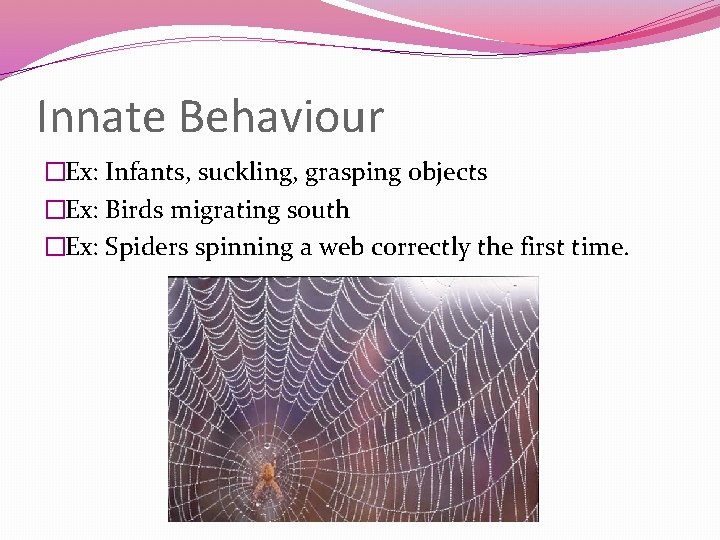
Innate Behaviour �Ex: Infants, suckling, grasping objects �Ex: Birds migrating south �Ex: Spiders spinning a web correctly the first time.
Taxes and Kinesis �(movement) responses to stimuli �Taxes and Kinesis are examples of innate behaviour �TAXES: directional response to stimuli �KINESIS: nondirectional response to stimuli
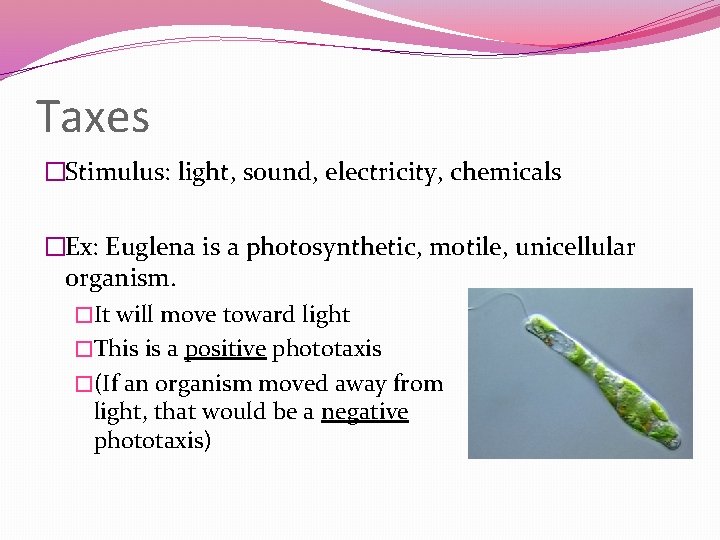
Taxes �Stimulus: light, sound, electricity, chemicals �Ex: Euglena is a photosynthetic, motile, unicellular organism. �It will move toward light �This is a positive phototaxis �(If an organism moved away from light, that would be a negative phototaxis)
Types of Taxis �Chemotaxis: response to chemicals in the environment �I. e. : p. H levels, drugs, food, pesticides… �Phototaxis: response to light �Gravitaxis: response to gravity �Rheotaxis: response to water current �Thigmotaxis: a response to touch
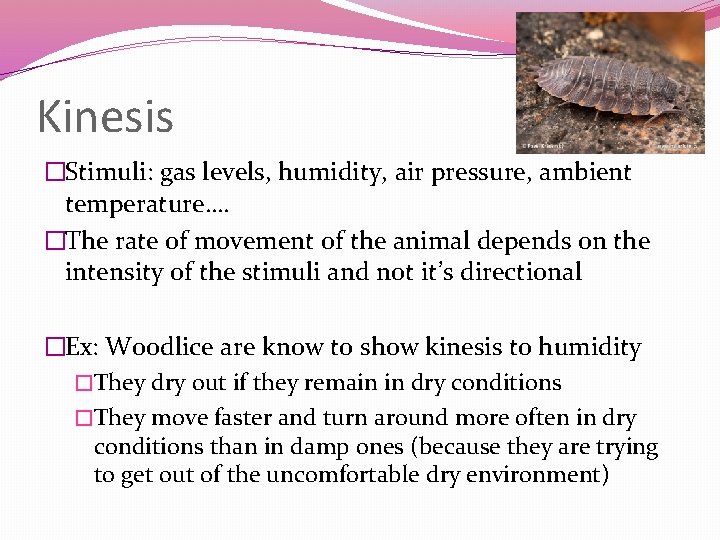
Kinesis �Stimuli: gas levels, humidity, air pressure, ambient temperature…. �The rate of movement of the animal depends on the intensity of the stimuli and not it’s directional �Ex: Woodlice are know to show kinesis to humidity �They dry out if they remain in dry conditions �They move faster and turn around more often in dry conditions than in damp ones (because they are trying to get out of the uncomfortable dry environment)
Learned Behaviour �Is the result of an experience �It is not inherited, and not controlled by genes. �Not the result of natural selection. �It’s nurture, not nature. �Develops by response to an environmental stimulus
Learned Behaviour �Offspring learn behaviour patterns from their parents and other individuals in their environment. �Ex: humans and language �An animal will repeat a particular behaviour if it is rewarded by it. �Learned behaviours also depend on genes (humans can’t talk without the presence of specific language genes) �Learned behaviours develop because of the result of the experience and innate behaviours develop independent of it.
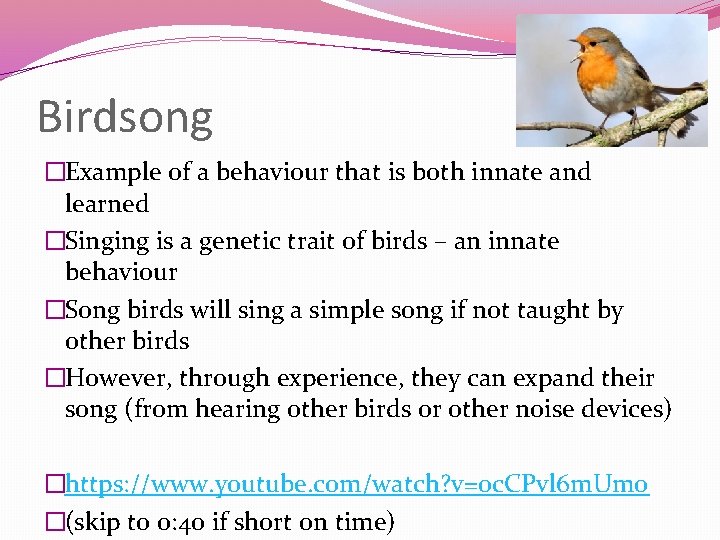
Birdsong �Example of a behaviour that is both innate and learned �Singing is a genetic trait of birds – an innate behaviour �Song birds will sing a simple song if not taught by other birds �However, through experience, they can expand their song (from hearing other birds or other noise devices) �https: //www. youtube. com/watch? v=oc. CPvl 6 m. Umo �(skip to 0: 40 if short on time)
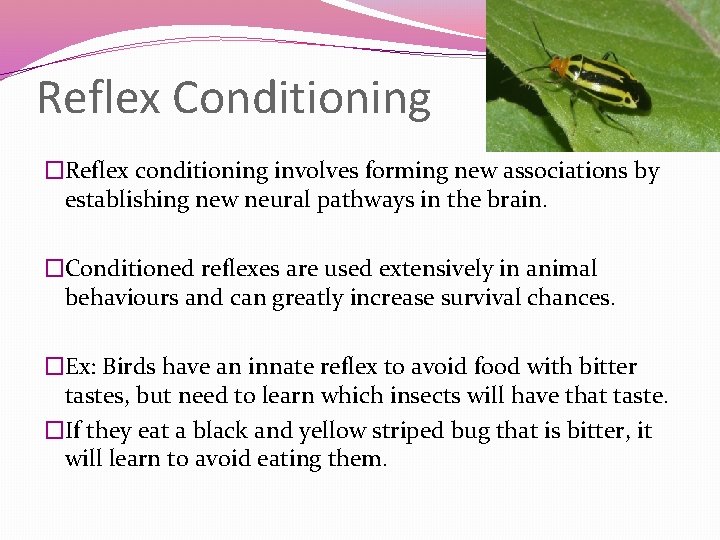
Reflex Conditioning �Reflex conditioning involves forming new associations by establishing new neural pathways in the brain. �Conditioned reflexes are used extensively in animal behaviours and can greatly increase survival chances. �Ex: Birds have an innate reflex to avoid food with bitter tastes, but need to learn which insects will have that taste. �If they eat a black and yellow striped bug that is bitter, it will learn to avoid eating them.
Pavlov’s Dog � 1920’s: psychologist Ivan Pavlov conducted experiments on conditioned behaviours. �Premise: �Animals salivate when they smell or taste or see food. �Question: �Can a behaviour such as salivation be conditioned?
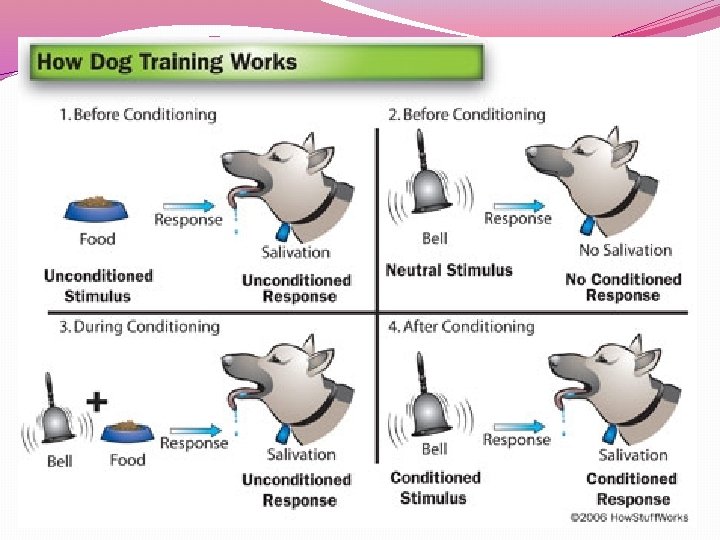
Pavlov’s Experiments �When a dog smells or tastes or sees food, it will automatically salivate. �The food is an unconditioned stimuli. �In his experiment, Pavlov would ring a bell every time he’d feed his dogs. �The dogs would become conditioned to associate the sound of the ringing with food.
Pavlov’s Experiment �As a result, after continuing this pattern, the dogs would salivate every time they heard a bell ring – even when food was not provided – because they anticipated food. �Hence, they were conditioned to salivate. �Office clip: �https: //vimeo. com/35754924
Operant Conditioning �Operant conditioning is a form of learning which consists of trial and error experiences. �Reflex conditioning is initiated by the environment imposing a stimulus on the animal. �Operant conditioning is initiated by an animal spontaneously testing out a behaviour pattern and finding out what its consequences are. �The behaviour is reinforced or inhibited based on the consequence.
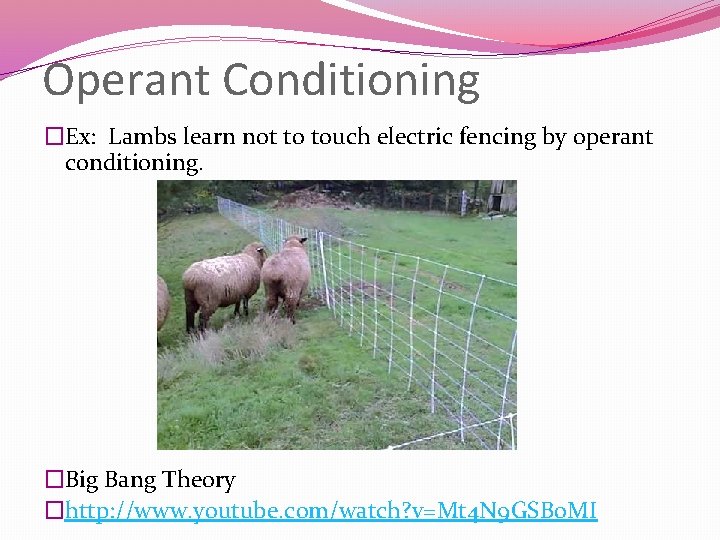
Operant Conditioning �Ex: Lambs learn not to touch electric fencing by operant conditioning. �Big Bang Theory �http: //www. youtube. com/watch? v=Mt 4 N 9 GSBo. MI
Imprinting �Imprinting is learning occurring at a particular life stage and is independent of the consequences of behaviour. �Famous example of imprinting comes from scientist Konrad Lorenz who in the 1930 s experimented with greylag geese and their goslings.
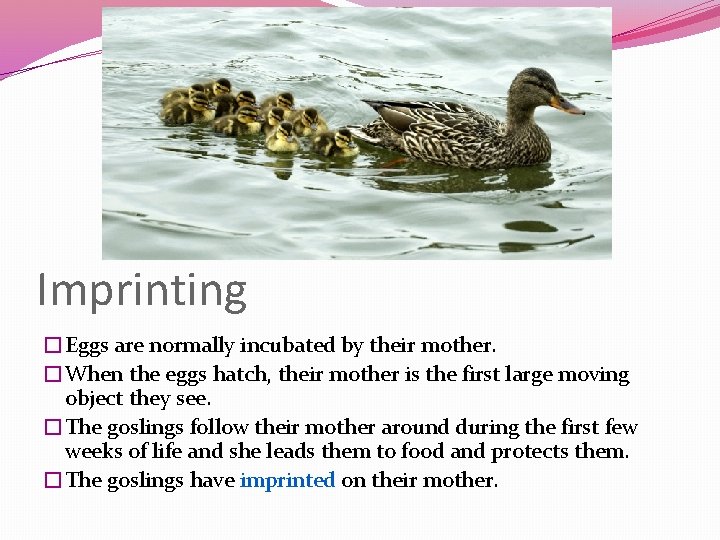
Imprinting �Eggs are normally incubated by their mother. �When the eggs hatch, their mother is the first large moving object they see. �The goslings follow their mother around during the first few weeks of life and she leads them to food and protects them. �The goslings have imprinted on their mother.
Imprinting �Lorenz showed that when young geese are hatched in an incubator, their mother isn’t the first large moving object they see. �So they attach themselves to another large, moving object. �This could be another bird, another animal, or even a human �The attachment is “imprinting”.
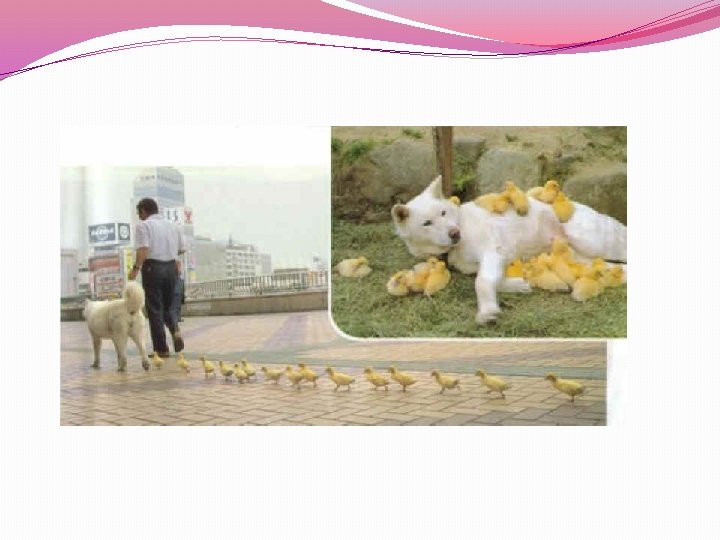
Imprinting �For the greylag geese, imprinting occurs 13 -16 hours after hatching. �Note: Imprinting is independent of the consequences of the behaviour. �Animals remain imprinted on something even if it does not increase their chance of survival. �https: //www. youtube. com/watch? v=ihh 1 x. BXwt_0
Learning �Learning is the acquisition of skill or knowledge. �The behaviour of animals changes during a lifetime. �Some behaviour patterns are lost (palmar grasp reflex of infants) and many more a learned. �Learning is a higher order function of the brain and humans have a greater capacity to learn than any other species. �The degree of learning is dependent on their longevity, their neural capacity, their experiences, and their social interactions.
Research Methods in Animal Behaviour �Laboratory experiments and field investigations have helped in the understanding of different types of behaviour and learning. �With laboratory experiments, variables can be controlled more effectively and innate behaviours in particular can be investigated well. �However, animals often do not behave normally when removed from their environment, especially with learned behaviours.
Invertebrate Behaviour Experiment �In 2 weeks, in small groups, we will be observing and analyzing the behaviour of invertebrates in response to a stimulus. �You will be observing either a taxis (a directional response to a stimulus) or a kinesis (a change in the rate of movement) �The organisms you will be working with….
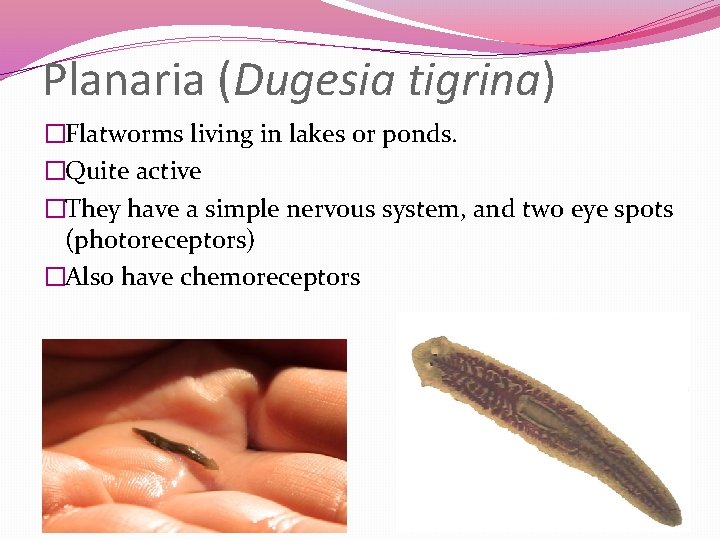
Planaria (Dugesia tigrina) �Flatworms living in lakes or ponds. �Quite active �They have a simple nervous system, and two eye spots (photoreceptors) �Also have chemoreceptors
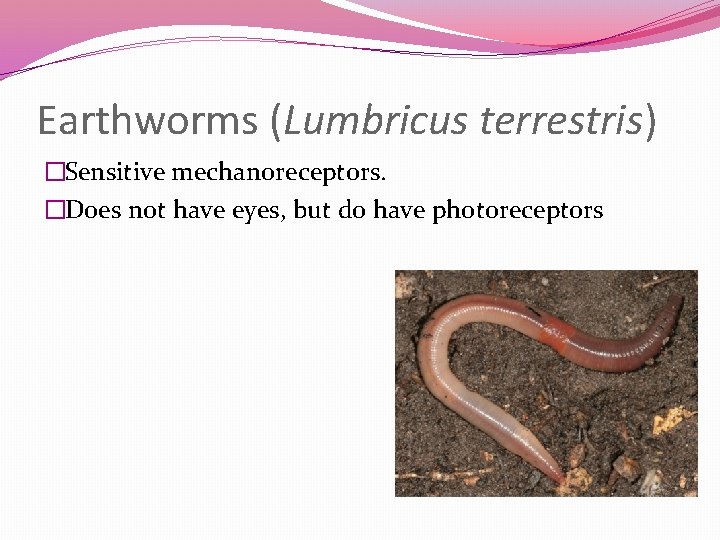
Earthworms (Lumbricus terrestris) �Sensitive mechanoreceptors. �Does not have eyes, but do have photoreceptors
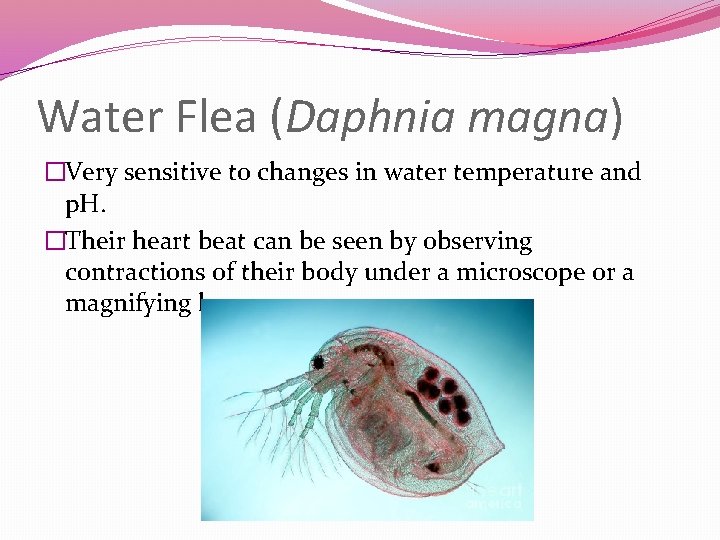
Water Flea (Daphnia magna) �Very sensitive to changes in water temperature and p. H. �Their heart beat can be seen by observing contractions of their body under a microscope or a magnifying lens.
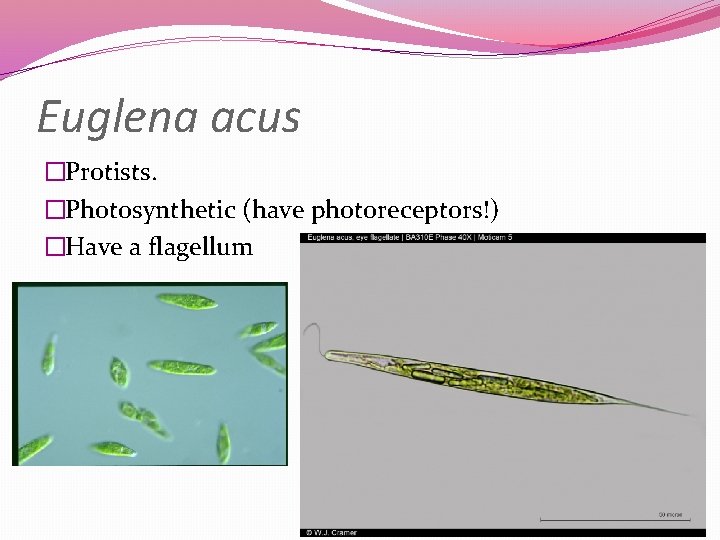
Euglena acus �Protists. �Photosynthetic (have photoreceptors!) �Have a flagellum
- Slides: 29