
A 3 5Phosphodiester bonds Phosphodiester bonds join the
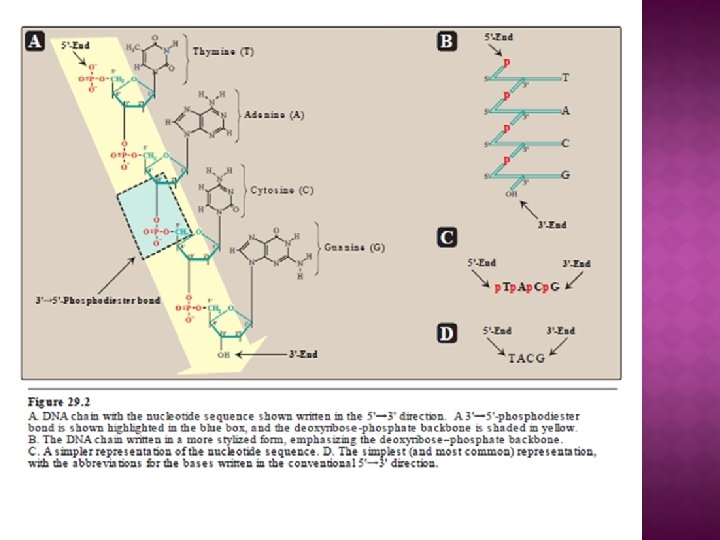
A. 3'→ 5'-Phosphodiester bonds • Phosphodiester bonds join the 3'-hydroxyl group of the deoxypentose of one nucleotide to the 5'-hydroxyl group of the deoxypentose of an adjacent nucleotide through a phosphoryl group (Figure 16). • The resulting long, unbranched chain has polarity, with both a 5'-end (the end with the free phosphate) and a 3'-end (the end with the free hydroxyl) that is not attached to other nucleotides. The bases located along the resulting deoxyribose –phosphate backbone are, by convention, always written in sequence from the 5'-end of the shown in Figure 16 D (5'-TACG-3') is read “thymine, adenine, cytosine, and guanine. ” Phosphodiester linkages between nucleotides can be hydrolyzed enzymatically by a family of nucleases: deoxyribonucleases for DNA and ribonucleases for RNA, or cleaved hydrolytically by chemicals. [Note: Only RNA is cleaved by alkali. ]
B. Double helix • In the double he lix, the two chains are coiled around a common axis called the helical axis. The chains are paired in an antiparallel manner (that is, the 5'-end of one strand is paired with the 3'-end of the other strand) as shown in Figure 17. In the DNA helix, the hydrophilic deoxyribose–phosphate backbone of e ach chain is on the outs ide of the molecule, whereas the hydrophobic bases are s tacked inside. The overall structure resembles a twisted ladder.
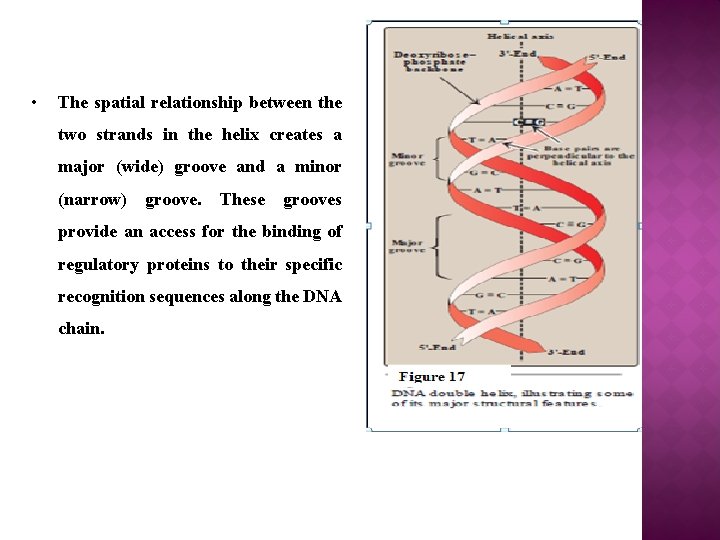
• The spatial relationship between the two strands in the helix creates a major (wide) groove and a minor (narrow) groove. These grooves provide an access for the binding of regulatory proteins to their specific recognition sequences along the DNA chain.
- Slides: 5