
A 28 0 g Sample of nitrogen gas
- Slides: 8
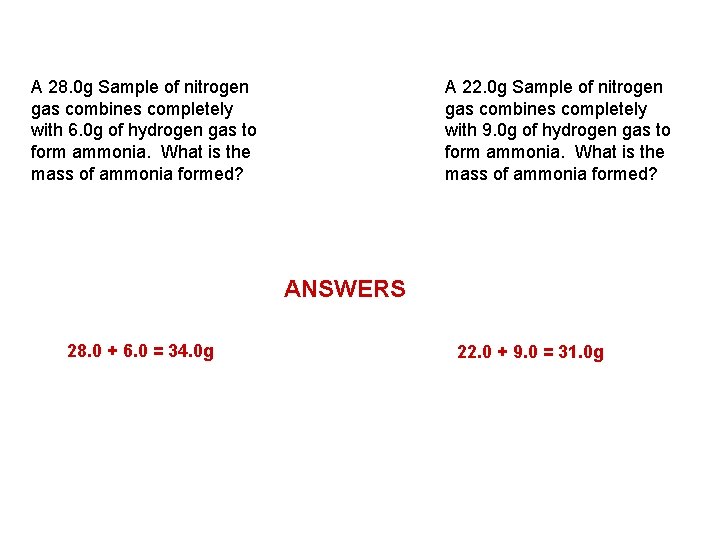
A 28. 0 g Sample of nitrogen gas combines completely with 6. 0 g of hydrogen gas to form ammonia. What is the mass of ammonia formed? A 22. 0 g Sample of nitrogen gas combines completely with 9. 0 g of hydrogen gas to form ammonia. What is the mass of ammonia formed? ANSWERS 28. 0 + 6. 0 = 34. 0 g 22. 0 + 9. 0 = 31. 0 g
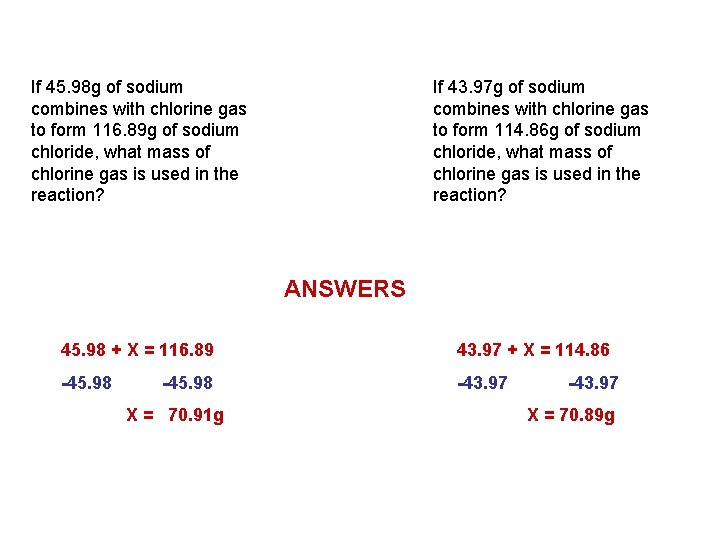
If 45. 98 g of sodium combines with chlorine gas to form 116. 89 g of sodium chloride, what mass of chlorine gas is used in the reaction? If 43. 97 g of sodium combines with chlorine gas to form 114. 86 g of sodium chloride, what mass of chlorine gas is used in the reaction? ANSWERS 45. 98 + X = 116. 89 43. 97 + X = 114. 86 -45. 98 -43. 97 -45. 98 X = 70. 91 g -43. 97 X = 70. 89 g
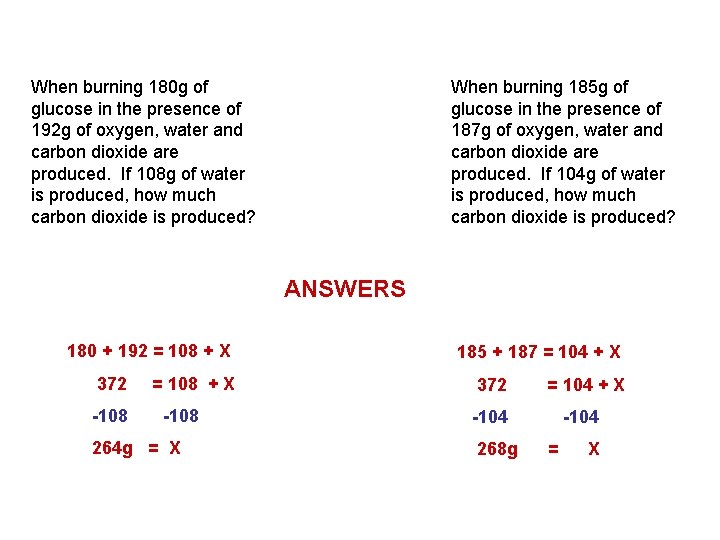
When burning 180 g of glucose in the presence of 192 g of oxygen, water and carbon dioxide are produced. If 108 g of water is produced, how much carbon dioxide is produced? When burning 185 g of glucose in the presence of 187 g of oxygen, water and carbon dioxide are produced. If 104 g of water is produced, how much carbon dioxide is produced? ANSWERS 180 + 192 = 108 + X 372 -108 = 108 + X -108 264 g = X 185 + 187 = 104 + X 372 = 104 + X -104 268 g = X
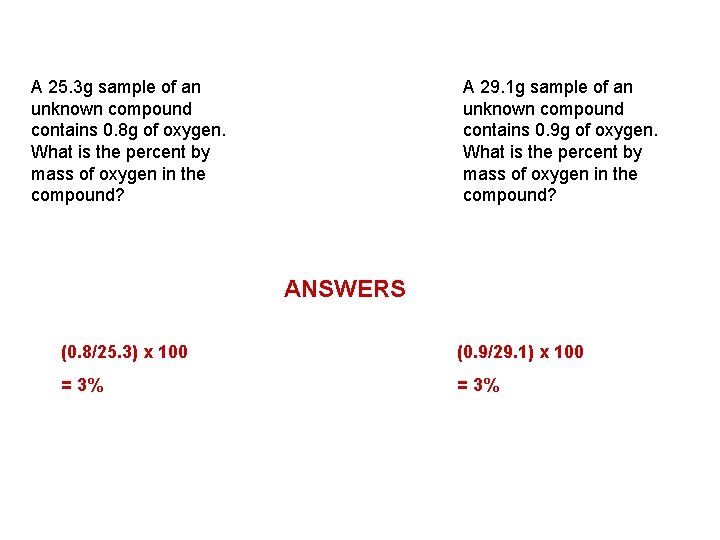
A 25. 3 g sample of an unknown compound contains 0. 8 g of oxygen. What is the percent by mass of oxygen in the compound? A 29. 1 g sample of an unknown compound contains 0. 9 g of oxygen. What is the percent by mass of oxygen in the compound? ANSWERS (0. 8/25. 3) x 100 (0. 9/29. 1) x 100 = 3%
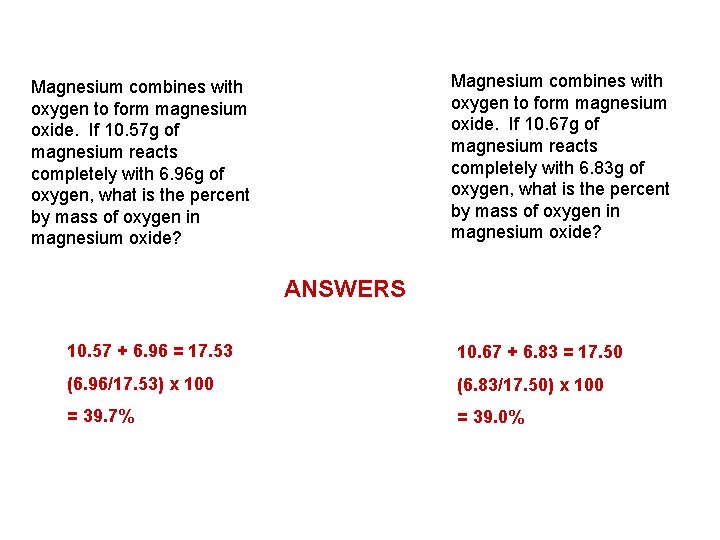
Magnesium combines with oxygen to form magnesium oxide. If 10. 67 g of magnesium reacts completely with 6. 83 g of oxygen, what is the percent by mass of oxygen in magnesium oxide? Magnesium combines with oxygen to form magnesium oxide. If 10. 57 g of magnesium reacts completely with 6. 96 g of oxygen, what is the percent by mass of oxygen in magnesium oxide? ANSWERS 10. 57 + 6. 96 = 17. 53 10. 67 + 6. 83 = 17. 50 (6. 96/17. 53) x 100 (6. 83/17. 50) x 100 = 39. 7% = 39. 0%
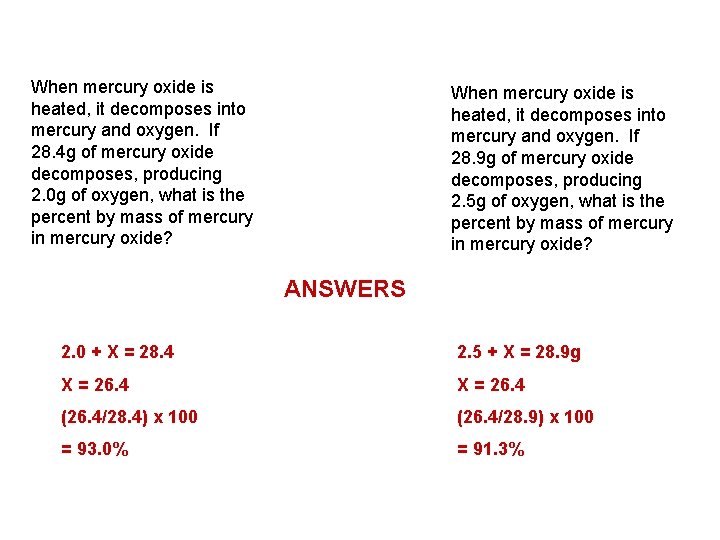
When mercury oxide is heated, it decomposes into mercury and oxygen. If 28. 4 g of mercury oxide decomposes, producing 2. 0 g of oxygen, what is the percent by mass of mercury in mercury oxide? When mercury oxide is heated, it decomposes into mercury and oxygen. If 28. 9 g of mercury oxide decomposes, producing 2. 5 g of oxygen, what is the percent by mass of mercury in mercury oxide? ANSWERS 2. 0 + X = 28. 4 2. 5 + X = 28. 9 g X = 26. 4 (26. 4/28. 4) x 100 (26. 4/28. 9) x 100 = 93. 0% = 91. 3%
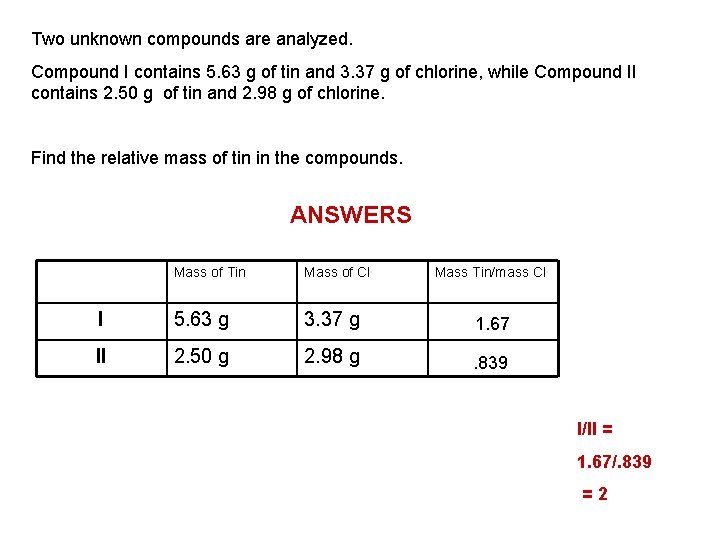
Two unknown compounds are analyzed. Compound I contains 5. 63 g of tin and 3. 37 g of chlorine, while Compound II contains 2. 50 g of tin and 2. 98 g of chlorine. Find the relative mass of tin in the compounds. ANSWERS Mass of Tin Mass of Cl Mass Tin/mass Cl I 5. 63 g 3. 37 g 1. 67 II 2. 50 g 2. 98 g . 839 I/II = 1. 67/. 839 =2
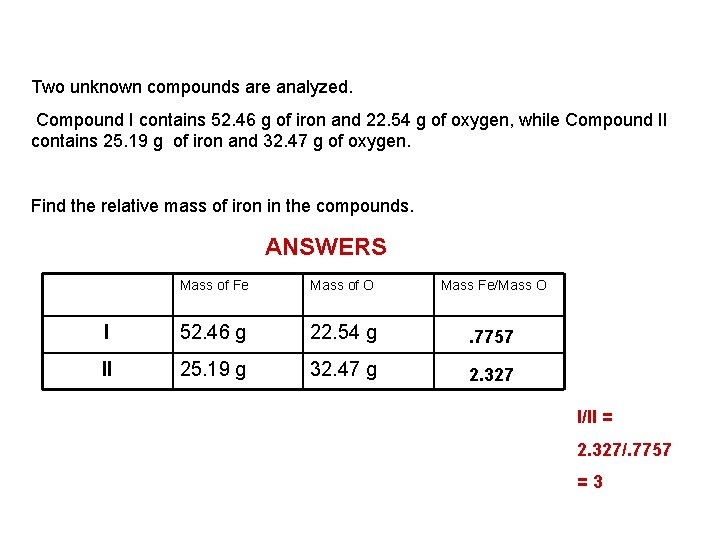
Two unknown compounds are analyzed. Compound I contains 52. 46 g of iron and 22. 54 g of oxygen, while Compound II contains 25. 19 g of iron and 32. 47 g of oxygen. Find the relative mass of iron in the compounds. ANSWERS Mass of Fe Mass of O Mass Fe/Mass O I 52. 46 g 22. 54 g . 7757 II 25. 19 g 32. 47 g 2. 327 I/II = 2. 327/. 7757 =3