
A 2 Revision 2 Based on previous questions

A 2 Revision - 2 Based on previous questions, and • potential answers to those questions • ©Subject Support 2013
Revision topics – chosen by your teachers OBLA - Lactate threshold � Impulse � Characteristics of World Games � Injury and recovery � Deviance & drug taking � Social facilitation - Zajonc's model and Baron's distraction conflict theory � Motor unit recruitment - Spatial summation � ATP-PC energy systems � ©Subject Support 2013

Lactate threshold – Typical question Elite performers follow structured training programmes to develop exceptional levels of fitness. Outline the relationship between ‘VO 2 max’ and ‘lactate threshold’. (3 marks) Gymnastic events can last up to 90 seconds. Explain how the majority of energy is provided for these events. (7 marks) ©Subject Support 2013
Lactate Threshold/OBLA �During intense exercise of short duration �Glycogen is used as energy source �Too much pyruvate produced by glycolysis - excess is converted tolactate �Can only last 30 secs - 2 mins ©Subject Support 2013 4
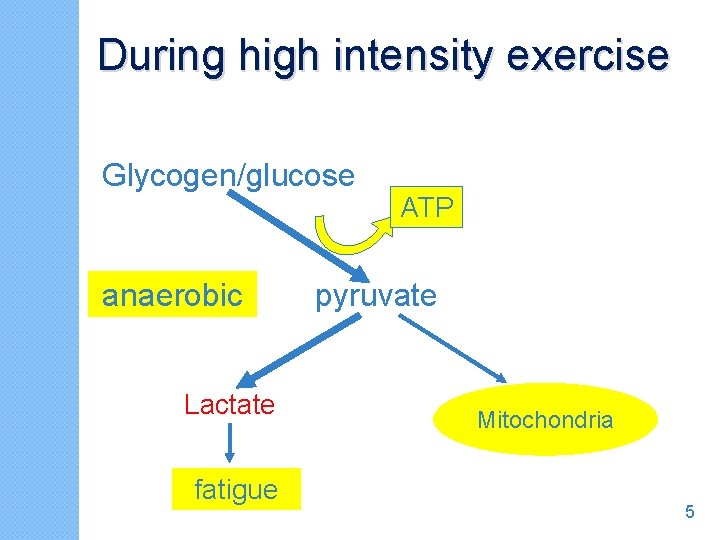
During high intensity exercise Glycogen/glucose anaerobic Lactate fatigue ATP pyruvate Mitochondria 5
Lactate threshold �When in lactate starts to increase blood �Also known as OBLA �Percentage of VO 2 oxygen �Occurs because of lack of in max mitochondria at start of exercise = oxygen deficit - and during high intensity exercise -anaerobic ©Subject Support 2013 6
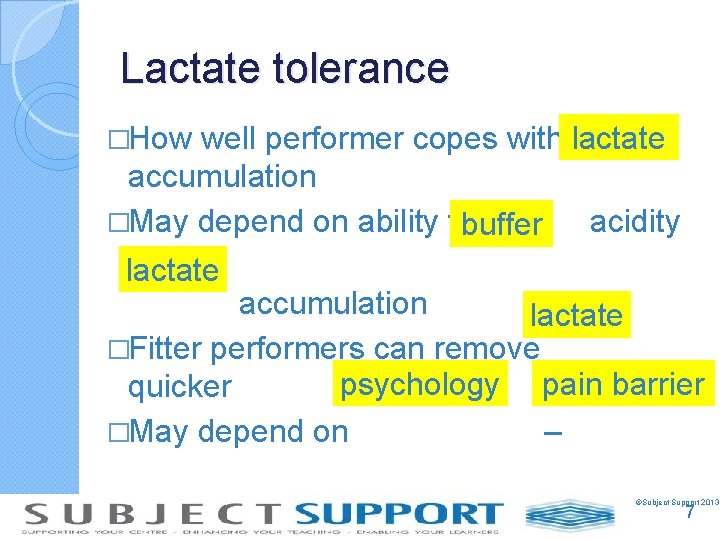
Lactate tolerance well performer copes with lactate accumulation �May depend on ability to buffer acidity of lactate accumulation lactate �Fitter performers can remove psychology pain barrier quicker �May depend on – �How ©Subject Support 2013 7
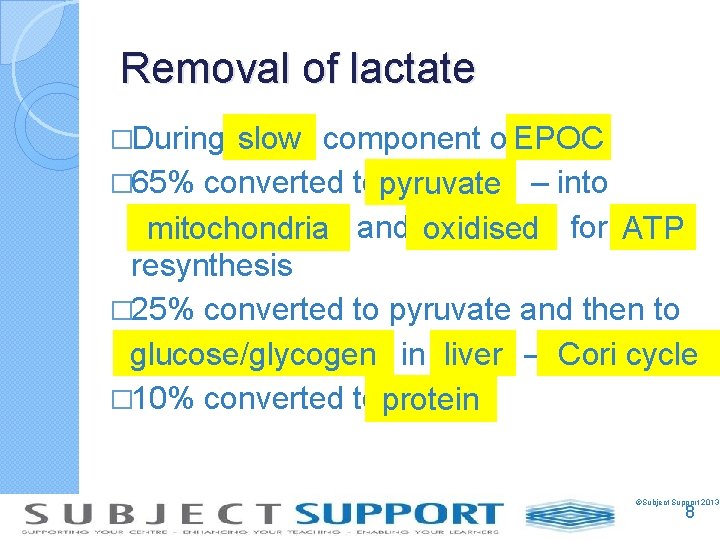
Removal of lactate slow component of. EPOC � 65% converted topyruvate – into mitochondria and oxidised for ATP resynthesis � 25% converted to pyruvate and then to glucose/glycogen in liver – Cori cycle � 10% converted to protein �During ©Subject Support 2013 8
Impulse – Typical question The acceleration that a performer receives when sprinting or high jumping is related to impulse. What do you understand by the term impulse, and how does the athlete use impulse during their sprint or take-off? (3 marks) ©Subject Support 2013
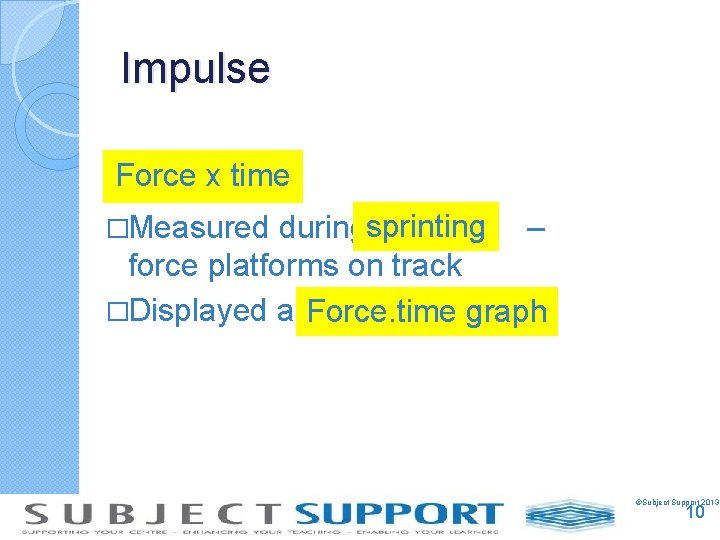
Impulse Force � x time duringsprinting – force platforms on track �Displayed as. Force. time graph �Measured ©Subject Support 2013 10
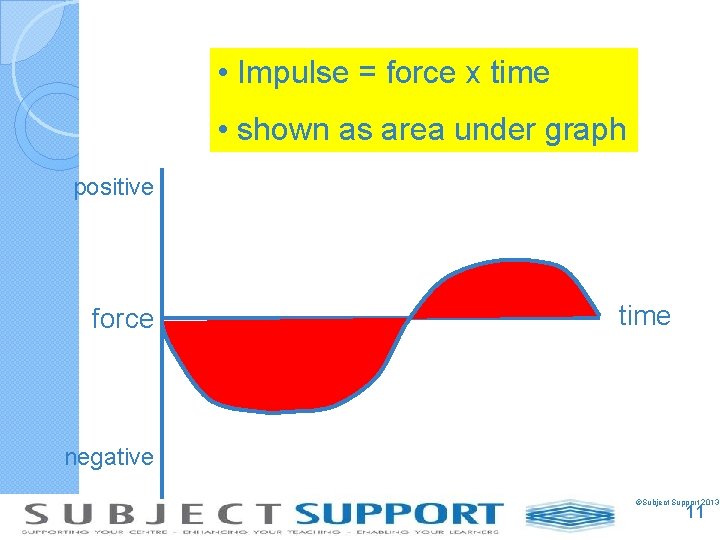
• Impulse = force x time • shown as area under graph positive force time negative ©Subject Support 2013 11
Impulse �Impulse is mainly concerned with single events – a footfall �Involves only horizontal forces �Two parts to a footfall • Landing – negative horizontal forces Push-off - positive horizontal forces ©Subject Support 2013 12
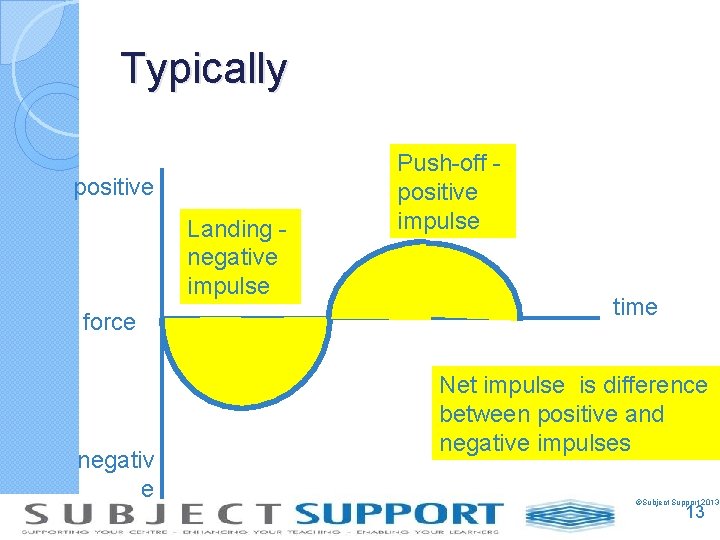
Typically positive Landing negative impulse force negativ e Push-off positive impulse time Net impulse is difference between positive and negative impulses ©Subject Support 2013 13
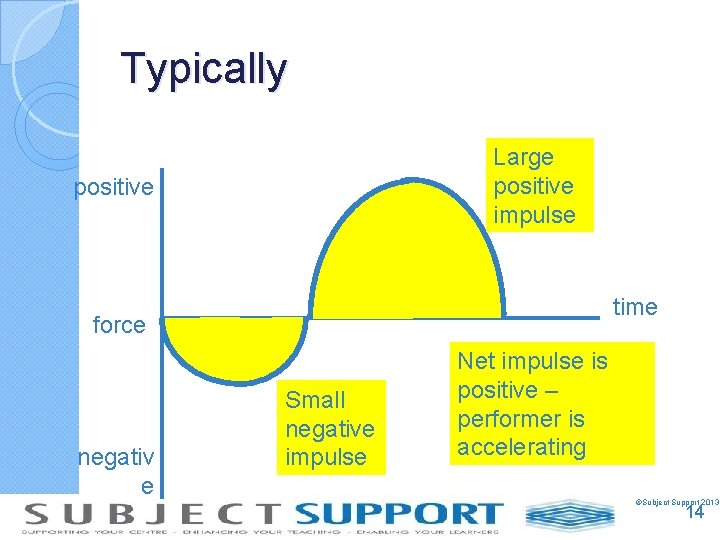
Typically Large positive impulse positive time force negativ e Small negative impulse Net impulse is positive – performer is accelerating ©Subject Support 2013 14
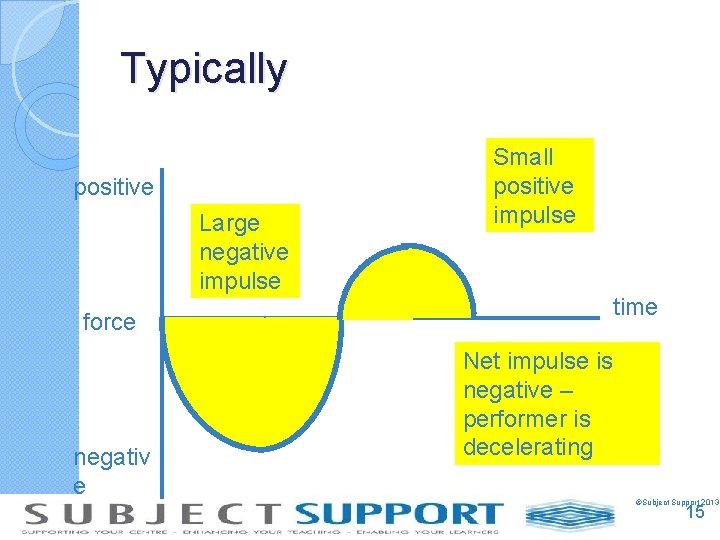
Typically positive Large negative impulse force negativ e Small positive impulse time Net impulse is negative – performer is decelerating ©Subject Support 2013 15

World games – Typical question 'World Class Events' is part of UK Sport's development programme, which aims to attract major sporting championships to the UK. Discuss the suggestion that hosting major championships will benefit the individual performer and the sport. (5 marks) ©Subject Support 2013

Characteristics of World games �Elite performers �Pre-qualifying �‘ Shop window ’ for city/country �Commercialised �Large spectator/TV appeal �Requires major infrastructure – transport, accommodation, facilities ©Subject Support 2013
Effects of World games - performers �Highly motivated to be/test themselves against the best �Make most of abilities – reach potential � Extrinsic rewards � Self-satisfaction / pride �High expectations �Role models ©Subject Support 2013
Effects of World games - performers � Long-term goal �Great sacrifices selfdiscipline/motivation �Short career �No guarantee of success ©Subject Support 2013

Effects of World games Country Cultural impact – seen as successful, part of national character �Social impact –unite country �Economic impact – financial success – tourism / regeneration / infrastructure failure �Can have negative impact � ©Subject Support 2013
Effect of World Games Government support –bidding, planning �May be used to demonstrate political success –Beijing �Successful bid seen as achievement on world-wide scale- London �Provide ©Subject Support 2013

Why seek excellence? Individual Society • Challenge • National pride • Employment • Reduces crime • Self-esteem • Big money • Healthy – increase mass participation • Role models ©Subject Support 2013

Not all good news sport for exclusive minority – requires substantialfunding and resources �Elite �Loss of morality – sportsmanship – increased deviancy �Physical and psychological damage from training and specialisation over ©Subject Support 2013
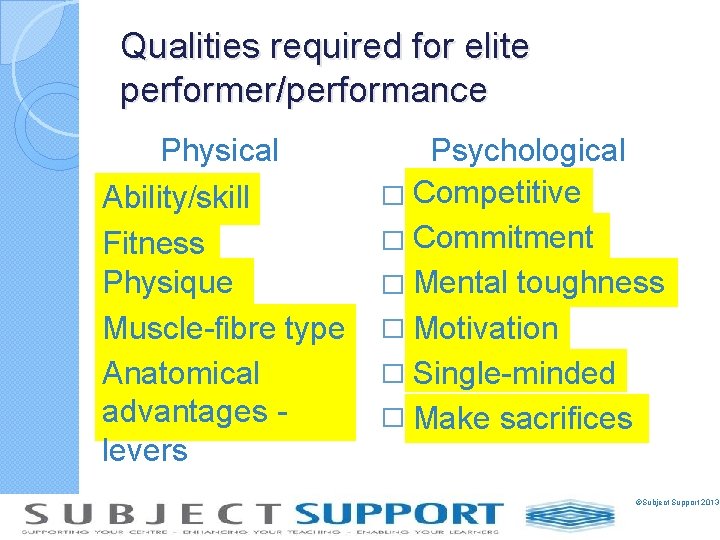
Qualities required for elite performer/performance Physical � Ability/skill � Fitness Physique � � Muscle-fibre type � Anatomical advantages levers Psychological � Competitive � Commitment � Mental toughness � Motivation � Single-minded � Make sacrifices ©Subject Support 2013
Injury and recovery – Typical question How can a performer reduce the effects of ‘delayed on of muscle soreness’ (DOMS)? (3 marks) How may hyperbaric chambers aid injury rehabilitation? (3 marks) ©Subject Support 2013
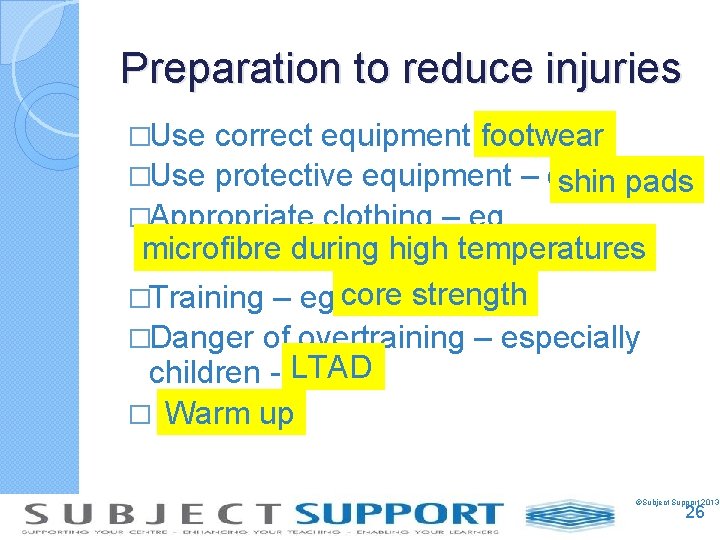
Preparation to reduce injuries �Use correct equipment – eg footwear �Use protective equipment – eg shin pads �Appropriate clothing – eg microfibre during high temperatures �Training – eg core strength �Danger of overtraining – especially children - LTAD � Warm up ©Subject Support 2013 26
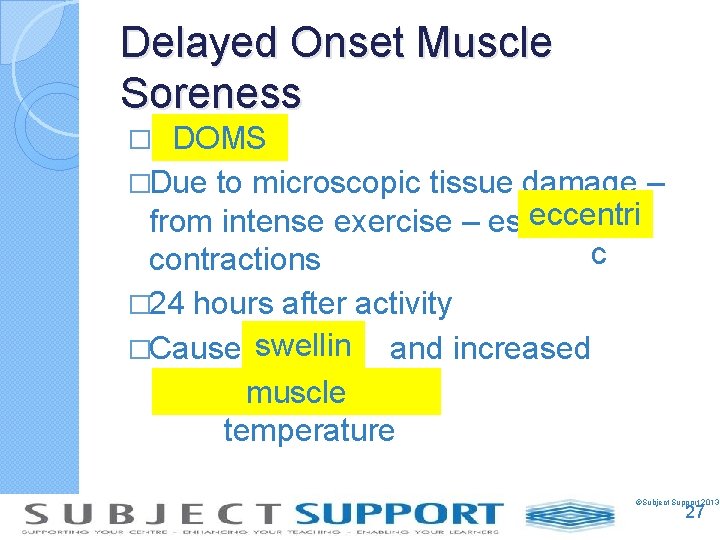
Delayed Onset Muscle Soreness DOMS �Due to microscopic tissue damage – eccentri from intense exercise – especially c contractions � 24 hours after activity �Causesswellin and increased g muscle temperature � ©Subject Support 2013 27
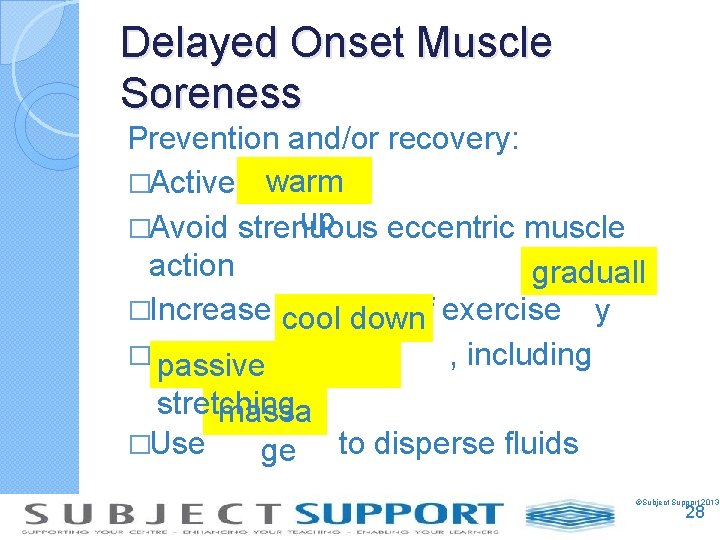
Delayed Onset Muscle Soreness Prevention and/or recovery: �Active warm up �Avoid strenuous eccentric muscle action graduall �Increase intensity of exercise y cool down �An active , including passive stretching massa �Use ge to disperse fluids ©Subject Support 2013 28
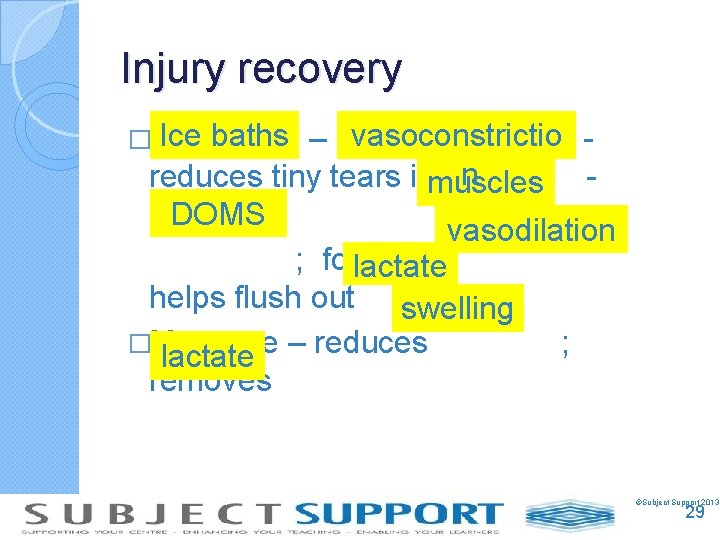
Injury recovery � Ice baths – vasoconstrictio n reduces tiny tears inmuscles DOMS prevents vasodilation ; following lactate helps flush out swelling �Massage – reduces ; lactate removes ©Subject Support 2013 29
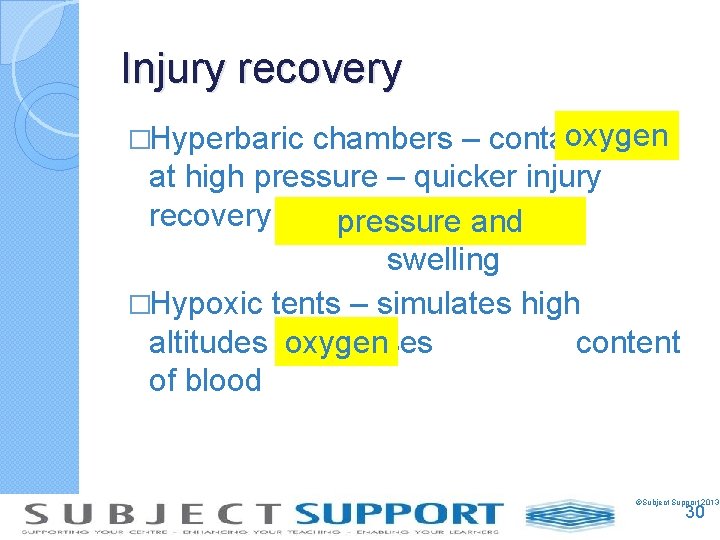
Injury recovery oxygen chambers – contain at high pressure – quicker injury recovery - reduces pressure and swelling �Hypoxic tents – simulates high altitudes -oxygen increases content of blood �Hyperbaric ©Subject Support 2013 30
Deviancy – Typical Question Some sports have experienced violence, both on and off the field of play, involving both players and spectators. How does the law and sports legislation help to ensure that performers are protected during sporting contests? (3 marks) Explain the advantages and the disadvantages of all sports, in all countries, testing for performance enhancing drugs. (4 marks) ©Subject Support 2013
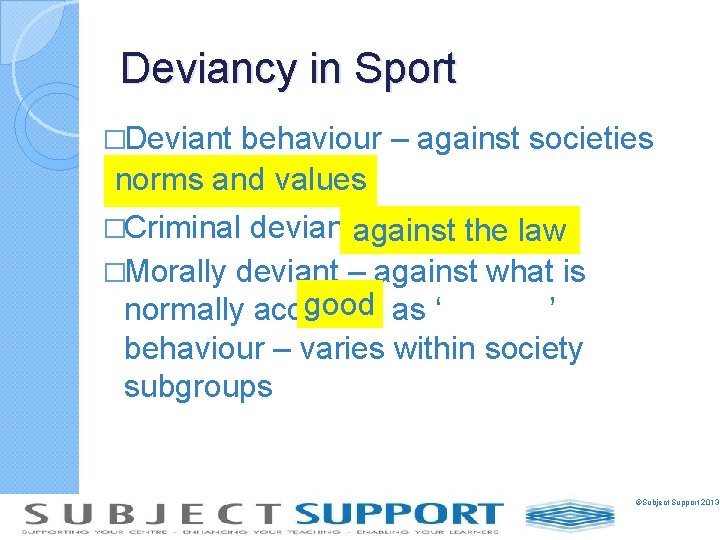
Deviancy in Sport �Deviant behaviour – against societies norms and values �Criminal deviantagainst – the law �Morally deviant – against what is good as ‘ normally accepted ’ behaviour – varies within society subgroups ©Subject Support 2013
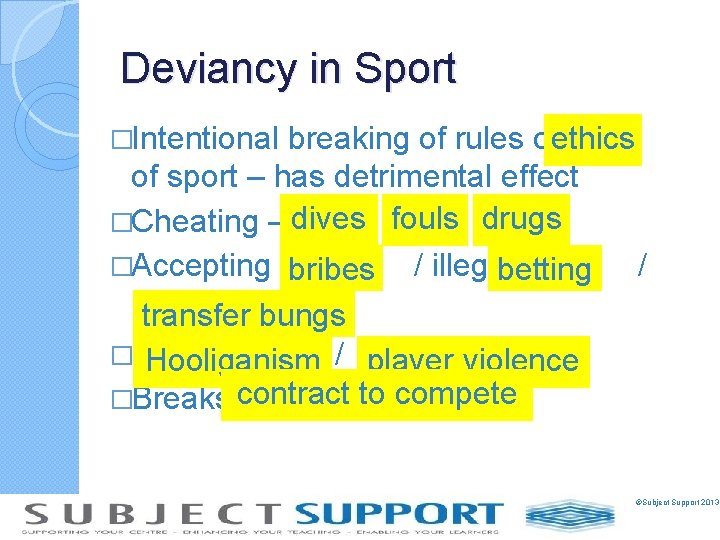
Deviancy in Sport breaking of rules orethics of sport – has detrimental effect �Cheating – dives fouls drugs �Accepting bribes / illegal betting / �Intentional transfer bungs � Hooliganism / player violence �Breaks contract to compete ©Subject Support 2013
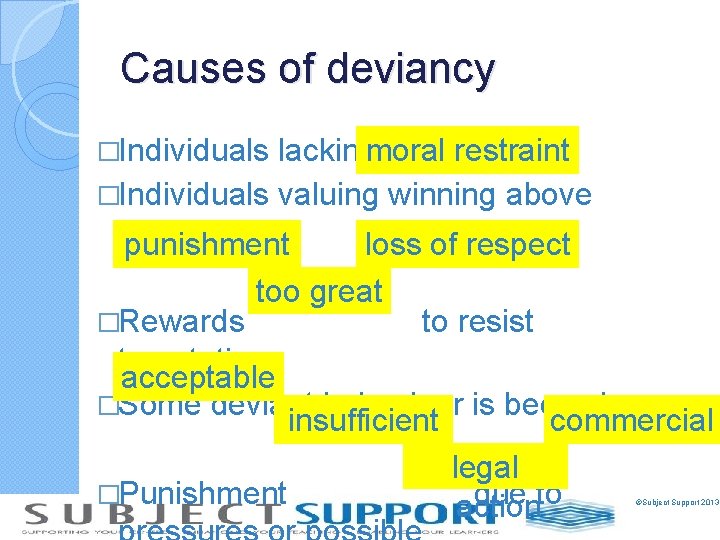
Causes of deviancy �Individuals lackingmoral restraint �Individuals valuing winning above possible punishment loss of respect or too great �Rewards to resist temptation acceptable �Some deviant behaviour is becoming commercial insufficient �Punishment legal due to action ©Subject Support 2013
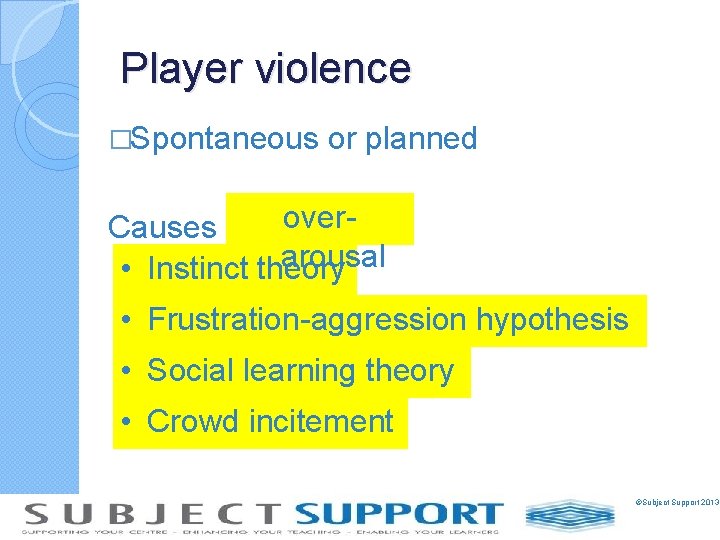
Player violence �Spontaneous or planned Causes - overarousal • Instinct theory • Frustration-aggression hypothesis • Social learning theory • Crowd incitement ©Subject Support 2013
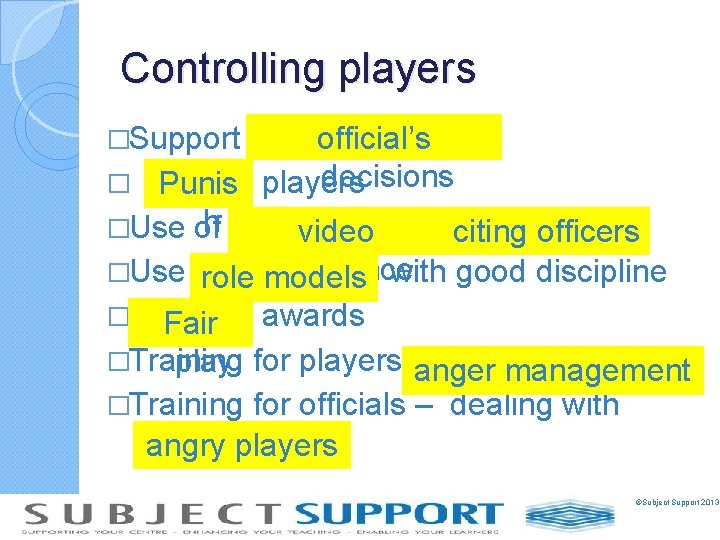
Controlling players official’s decisions � Punis players h �Use of / video citing officers evidence �Use role models with good discipline � Fair awards �Training play for players –anger management �Training for officials – dealing with angry players �Support ©Subject Support 2013
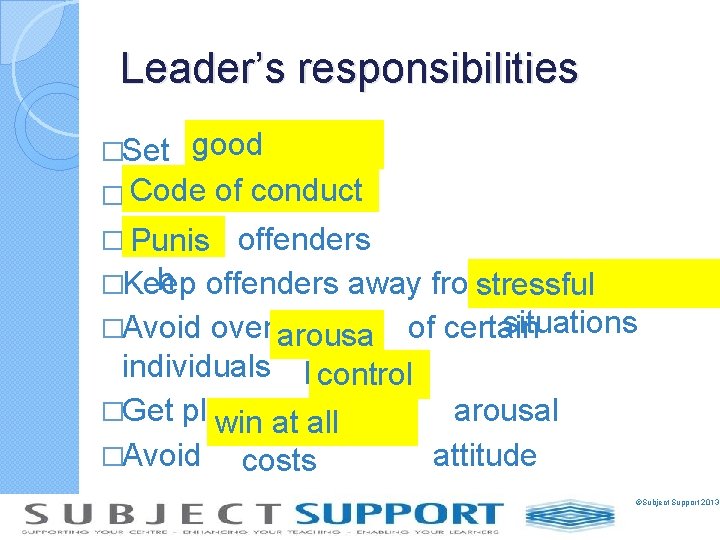
Leader’s responsibilities good example conduct � Code of �Set offenders h offenders away from �Keep stressful situations �Avoid over-arousa of certain individuals l control �Get players arousal win attoall �Avoid attitude costs � Punis ©Subject Support 2013
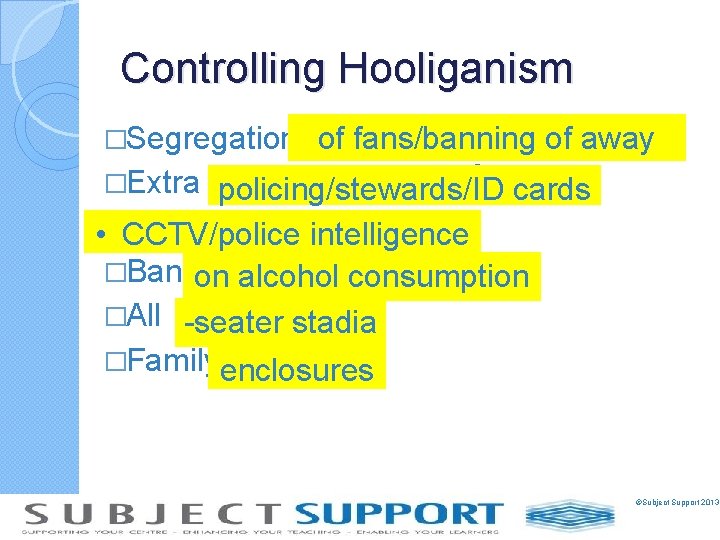
Controlling Hooliganism of fans/banning of away fans �Extra policing/stewards/ID cards �Segregation • CCTV/police intelligence �Ban on alcohol consumption �All -seater stadia �Familyenclosures ©Subject Support 2013
Drugs - Typical question ‘Elite sport performers should be allowed to use performance enhancing drugs just like any other training aid. ’ Discuss this statement (5 marks) ©Subject Support 2013
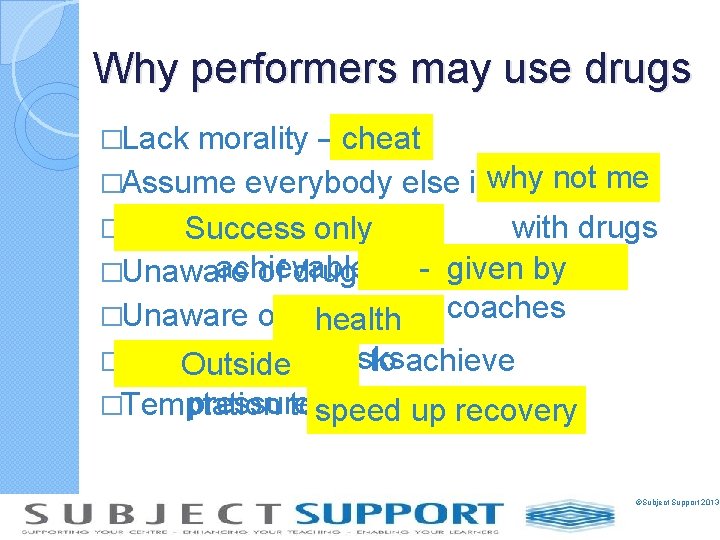
Why performers may use drugs morality – cheat �Assume everybody else iswhy – not me � with drugs Success only achievable �Unaware of drugs - given by coaches �Unaware of health � to achieve Outside risks pressure �Temptation tospeed up recovery �Lack ©Subject Support 2013
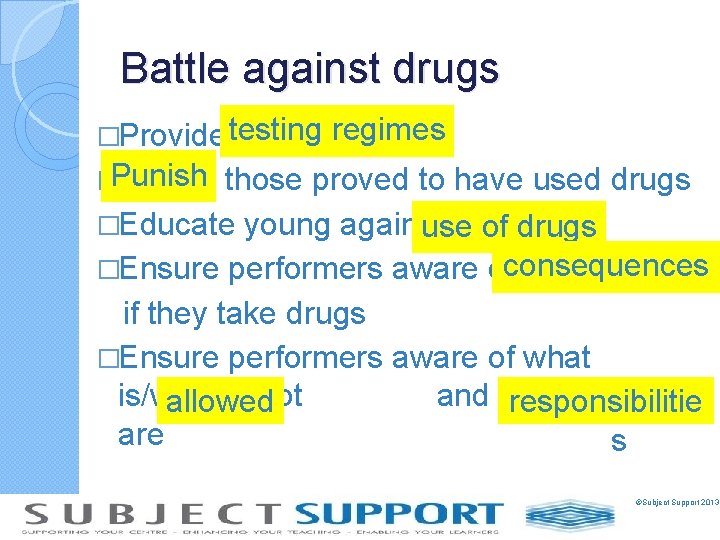
Battle against drugs �Provide testing regimes �Punish those proved to have used drugs �Educate young against use of drugs �Ensure performers aware ofconsequences if they take drugs �Ensure performers aware of what is/what is not and what their allowed responsibilitie are s ©Subject Support 2013
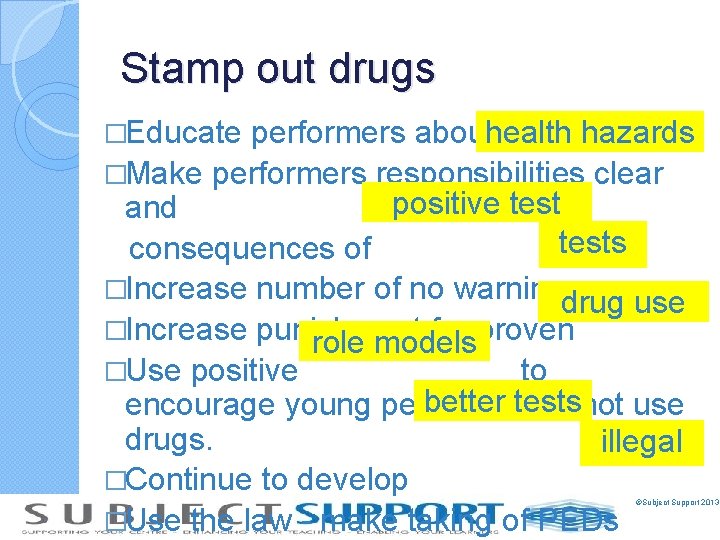
Stamp out drugs performers abouthealth hazards �Make performers responsibilities clear positive test and tests consequences of �Increase number of no warning drug use �Increase punishment for proven role models �Use positive to better tests encourage young performers to not use drugs. illegal �Continue to develop �Use the law - make taking of PEDs �Educate ©Subject Support 2013
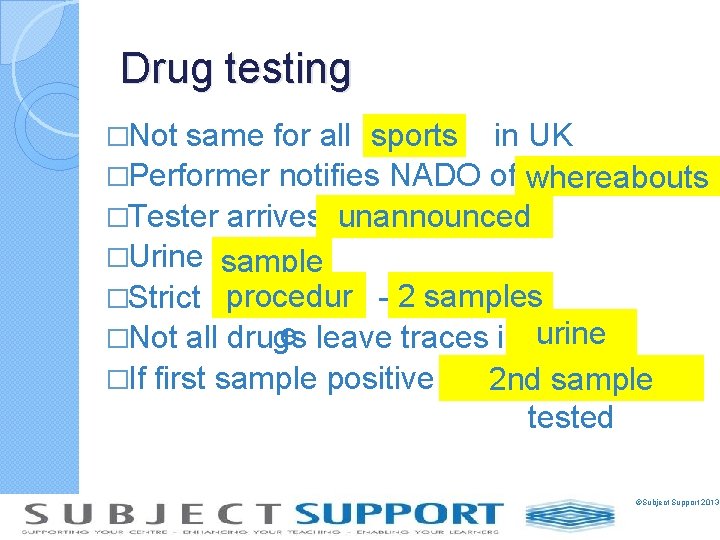
Drug testing same for all sports in UK �Performer notifies NADO of whereabouts �Tester arrives unannounced �Urine sample �Strict procedur - 2 samples e leave traces in urine �Not all drugs �If first sample positive – 2 nd sample tested �Not ©Subject Support 2013
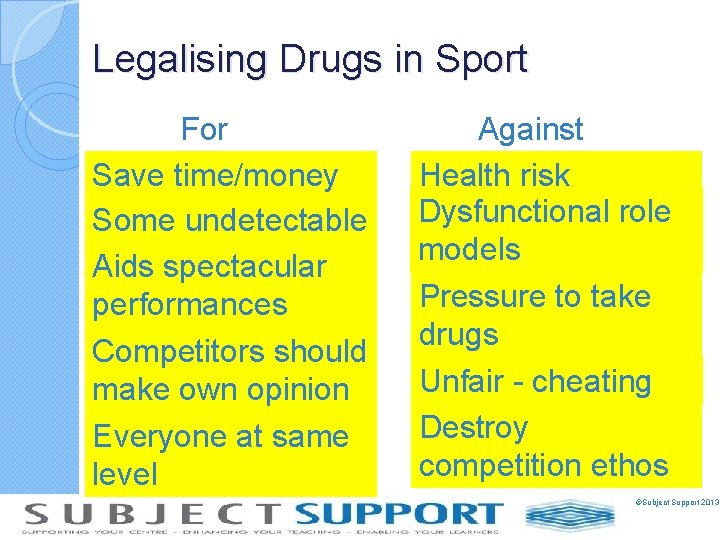
Legalising Drugs in Sport For Save time/money Some undetectable Aids spectacular performances Competitors should make own opinion Everyone at same level Against Health risk Dysfunctional role models Pressure to take drugs Unfair - cheating Destroy competition ethos ©Subject Support 2013

Social facilitation – Typical question Explain the concept of ‘social facilitation’ and how it can affect performance. (7 marks) ©Subject Support 2013
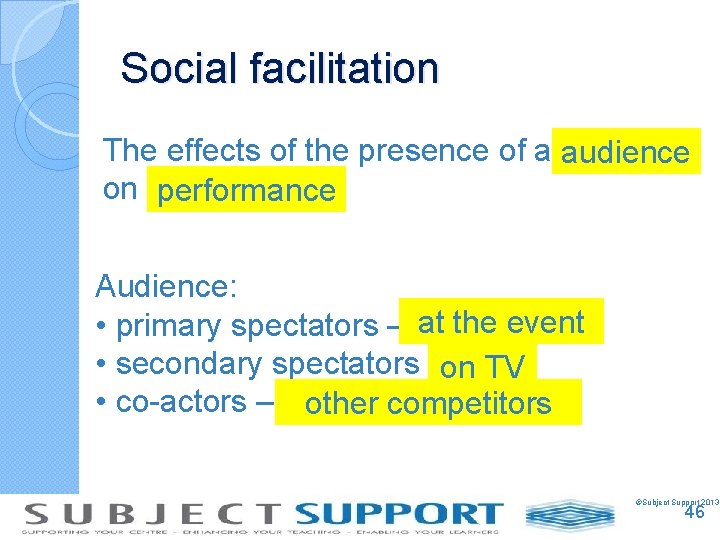
Social facilitation The effects of the presence of anaudience on performance Audience: • primary spectators – at the event • secondary spectators –on TV • co-actors – other competitors ©Subject Support 2013 46
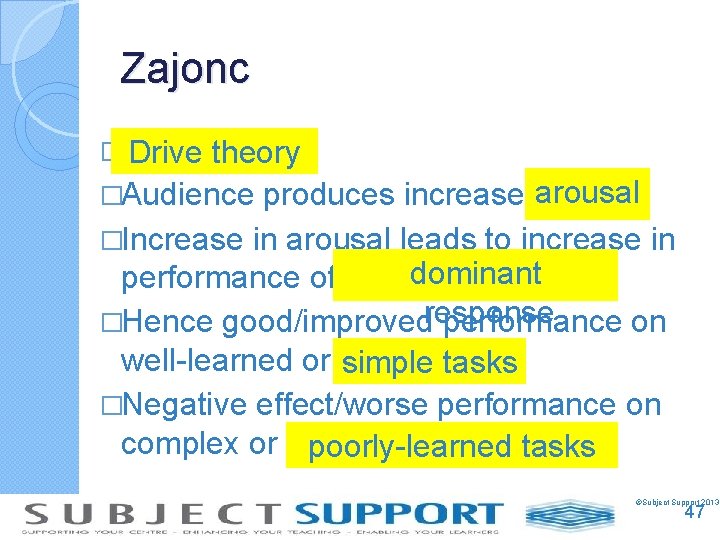
Zajonc � Drive theory arousal �Audience produces increase in �Increase in arousal leads to increase in dominant performance of �Hence good/improvedresponse performance on well-learned or simple tasks �Negative effect/worse performance on complex or poorly-learned tasks ©Subject Support 2013 47
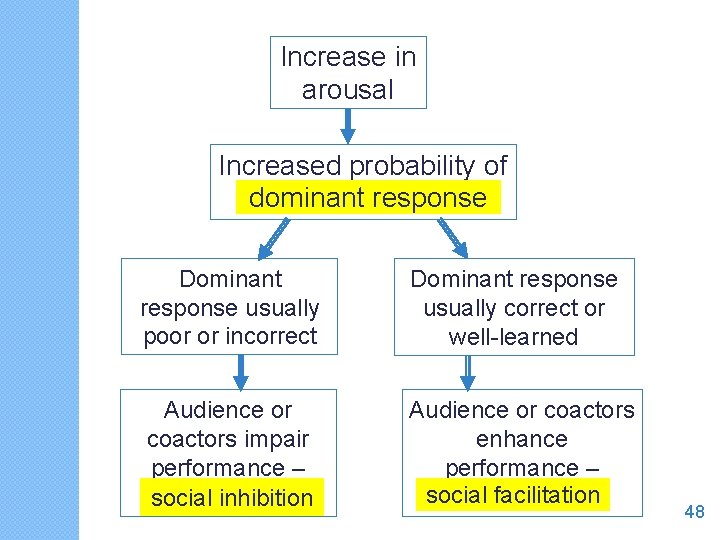
Increase in arousal Increased probability of dominant response Dominant response usually poor or incorrect Dominant response usually correct or well-learned Audience or coactors impair performance – social inhibition Audience or coactors enhance performance – social facilitation 48
Cotterell �Different audiences can have different effects evaluation apprehension �Called �Evaluative audience - increases effect of arousal ©Subject Support 2013 49
Baron’s Distraction-conflict theory �Audience takes upinformation processing capacity �Sufficient capacity for simple skills, but in complex attention tasks, audience affects arousal and increases and hence performance affects distraction arousal �Any limits processing 50 �capacity and increases ©Subject Support 2013
Implications of social facilitation �Learn new skill inisolation �Train/practice withothers �Learn to minimise effects of distractors –relaxation, self-talk, imagery, etc ©Subject Support 2013 51

Spatial summation – Typical question All gymnastic events require controlled powerful movements. How can a performer vary the strength of muscular contractions to ensure that a skill is completed correctly? (4 marks) ©Subject Support 2013
Motor Units �Muscle = bundles of muscle fibres �Group of muscle fibres + motor = unit neurone �Either fast or slow -twitch units �Different sizes of motor units: larger unit more units used - more force/strength FT unit ©Subject Support 2013 53
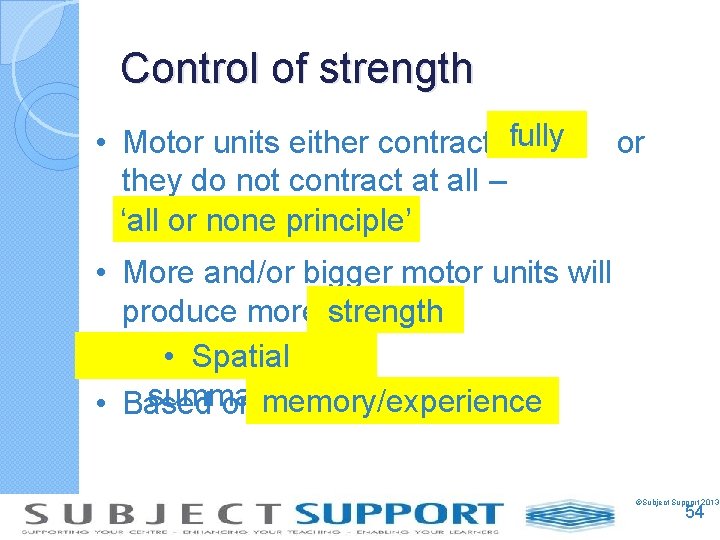
Control of strength • Motor units either contract fully they do not contract at all – ‘all or none principle’ or • More and/or bigger motor units will produce more strength • Spatial summation • Based on memory/experience ©Subject Support 2013 54

ATP-PC system – Typical question During the winter season, many elite athletes compete indoors. Sprinters compete over 60 -metres. Explain how the majority of energy is produced during a 60 -metre sprint. (4 marks) ©Subject Support 2013
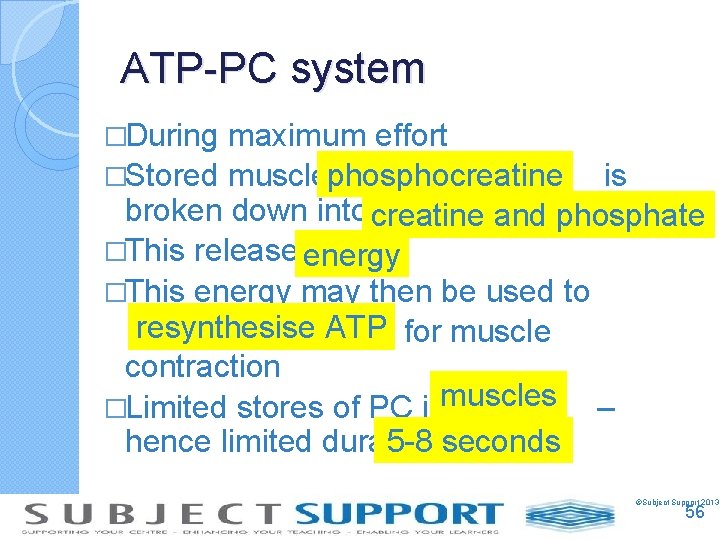
ATP-PC system �During maximum effort �Stored musclephosphocreatine is broken down into creatine and phosphate �This releasesenergy �This energy may then be used to resynthesise ATP for muscle contraction �Limited stores of PC inmuscles – 5 -8 seconds hence limited duration – ©Subject Support 2013 56
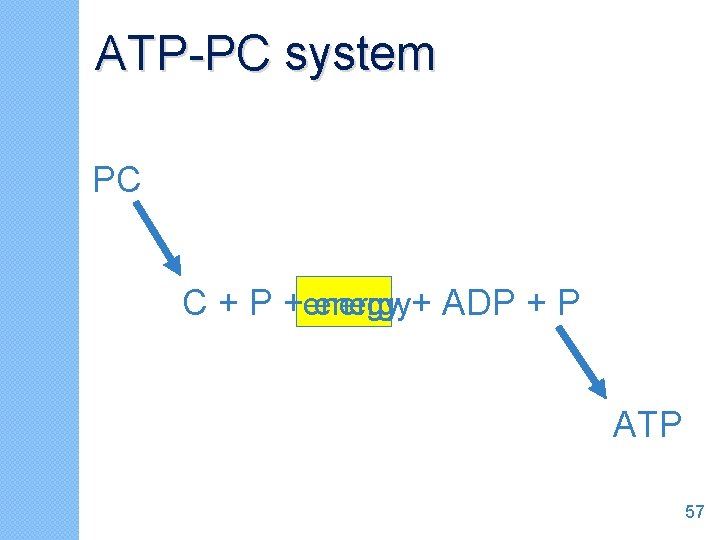
ATP-PC system PC C + P +energy+ ADP + P ATP 57
- Slides: 57