
A 2 partial wave analysis A Anisovich V
- Slides: 33
A 2: partial wave analysis A. Anisovich, V. Nikonov, A. Sarantsev, Bonn and Gatchina E. Klempt, U. Thoma , Bonn Bommerholz, 2006 Nov 27 Topics: A 2 and TR-16 A 2 results p induced N*
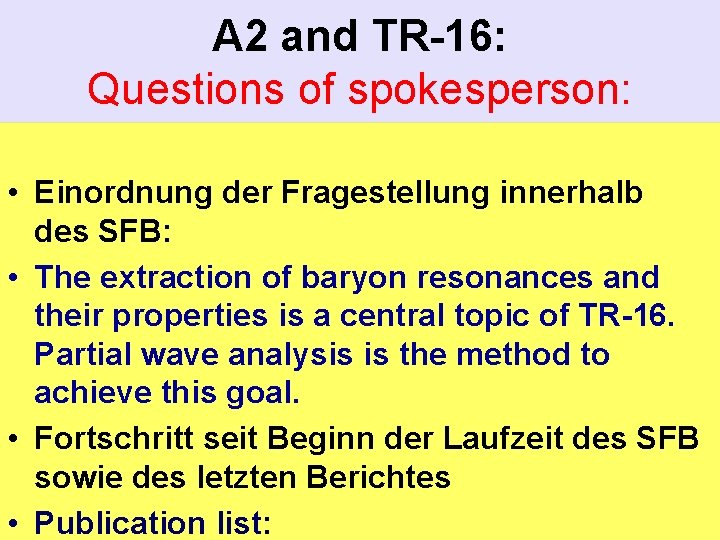
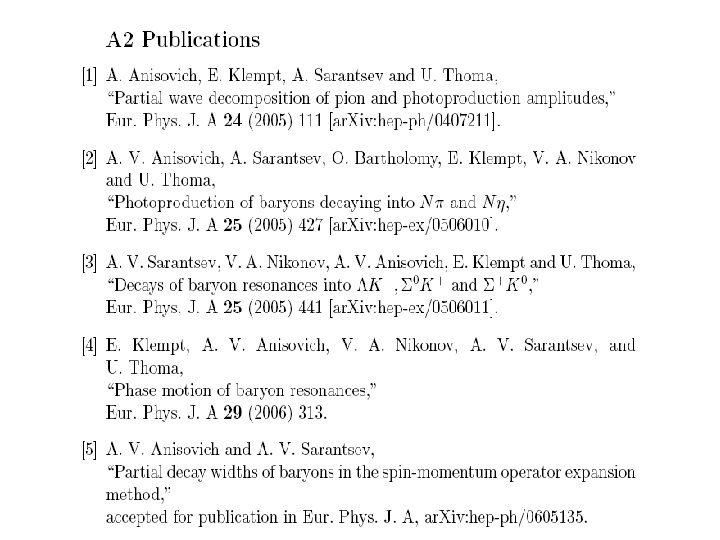
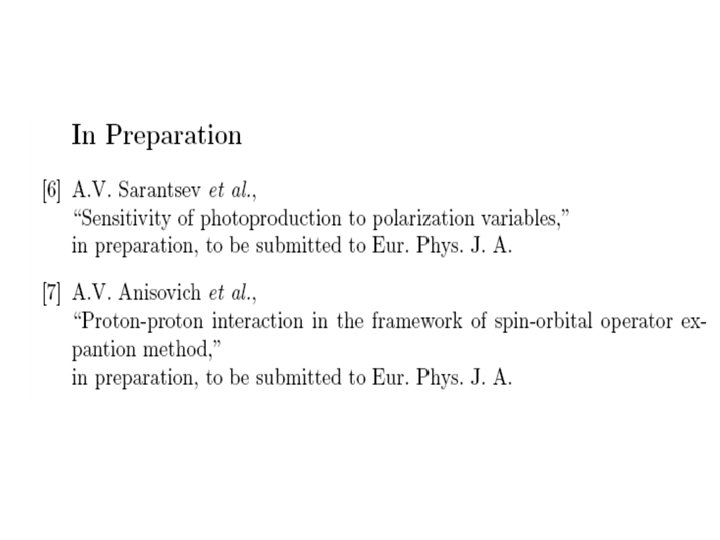
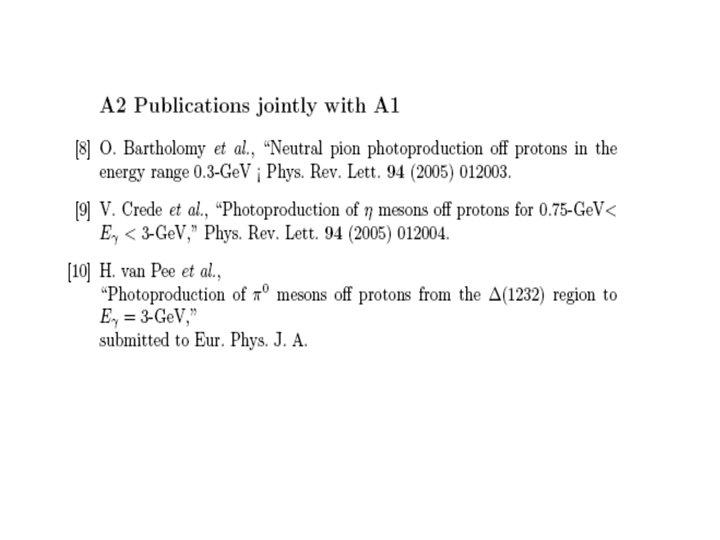
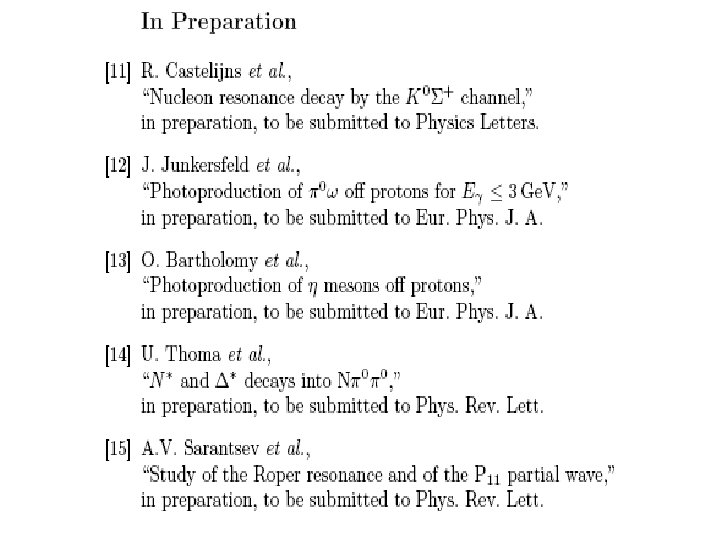
A 2 and TR-16: Questions of spokesperson: • Einordnung der Fragestellung innerhalb des SFB: • The extraction of baryon resonances and their properties is a central topic of TR-16. Partial wave analysis is the method to achieve this goal. • Fortschritt seit Beginn der Laufzeit des SFB sowie des letzten Berichtes • Publication list:
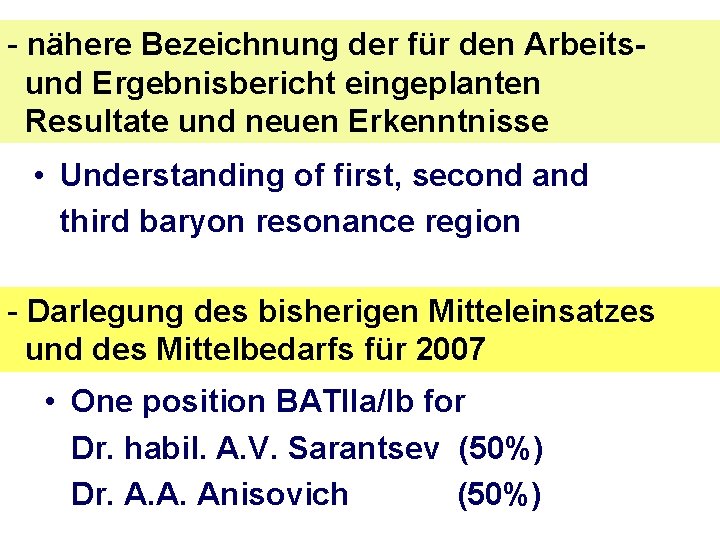
- nähere Bezeichnung der für den Arbeits- und Ergebnisbericht eingeplanten Resultate und neuen Erkenntnisse • Understanding of first, second and third baryon resonance region - Darlegung des bisherigen Mitteleinsatzes und des Mittelbedarfs für 2007 • One position BATIIa/Ib for Dr. habil. A. V. Sarantsev (50%) Dr. A. A. Anisovich (50%)
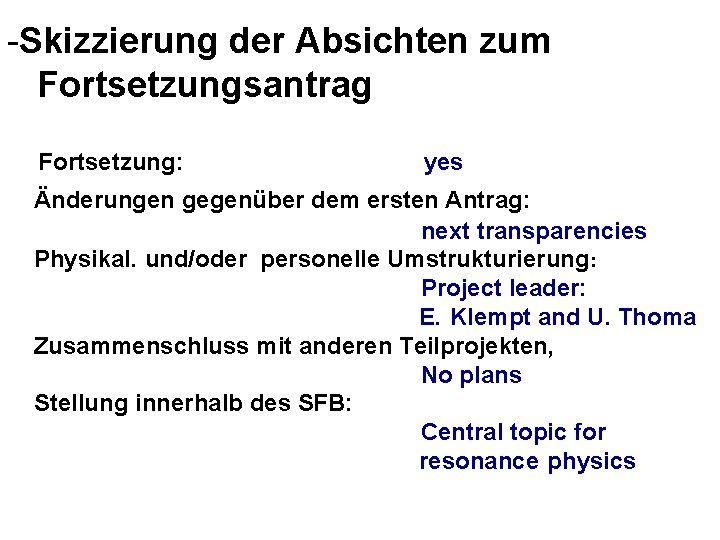
-Skizzierung der Absichten zum Fortsetzungsantrag Fortsetzung: yes Änderungen gegenüber dem ersten Antrag: next transparencies Physikal. und/oder personelle Umstrukturierung: Project leader: E. Klempt and U. Thoma Zusammenschluss mit anderen Teilprojekten, No plans Stellung innerhalb des SFB: Central topic for resonance physics
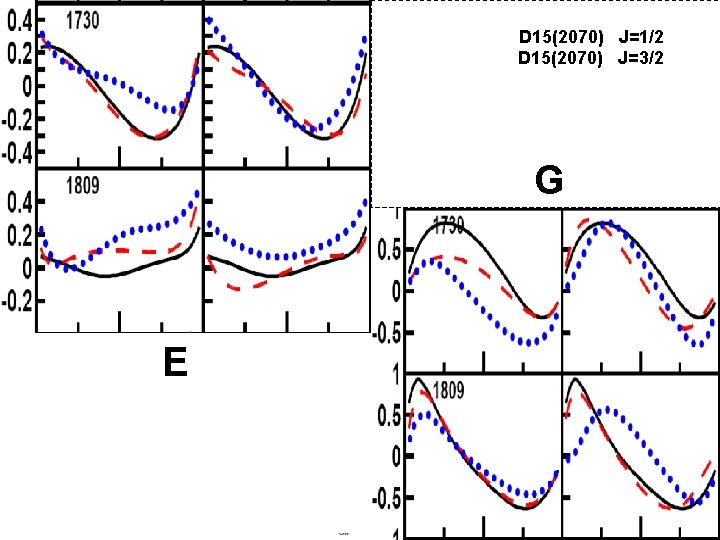
What did we promiss and achieve ? D 15(2070) J=1/2 D 15(2070) J=3/2 G E Graal, Jlab
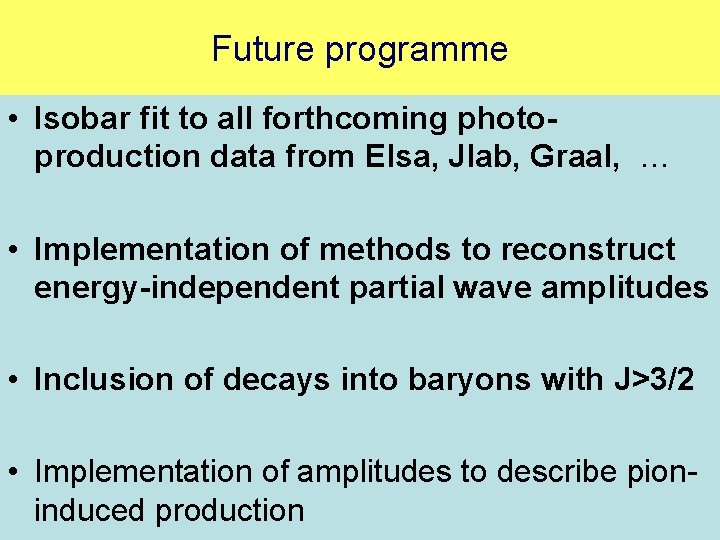
Future programme • Isobar fit to all forthcoming photoproduction data from Elsa, Jlab, Graal, … • Implementation of methods to reconstruct energy-independent partial wave amplitudes • Inclusion of decays into baryons with J>3/2 • Implementation of amplitudes to describe pioninduced production
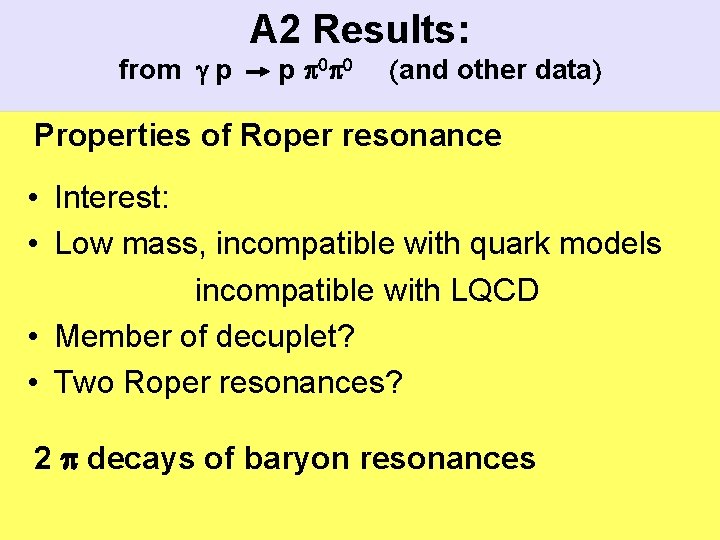
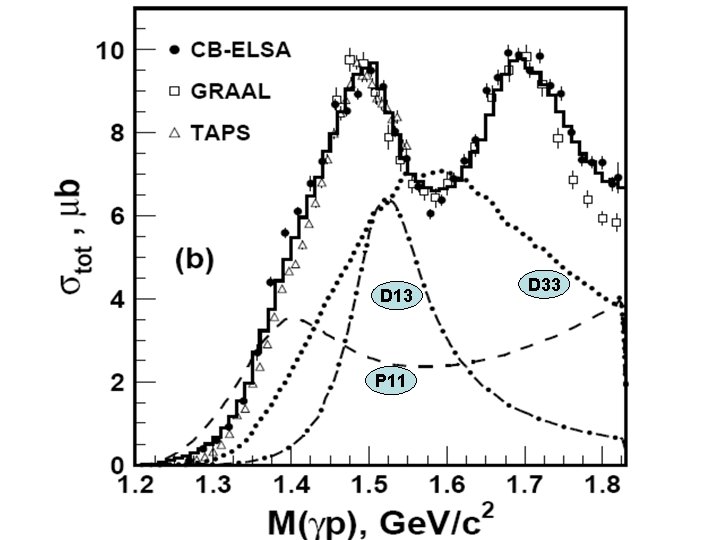
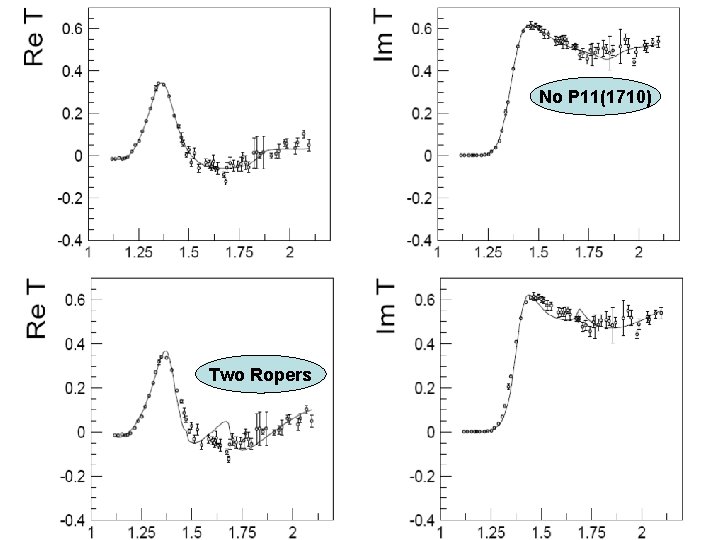
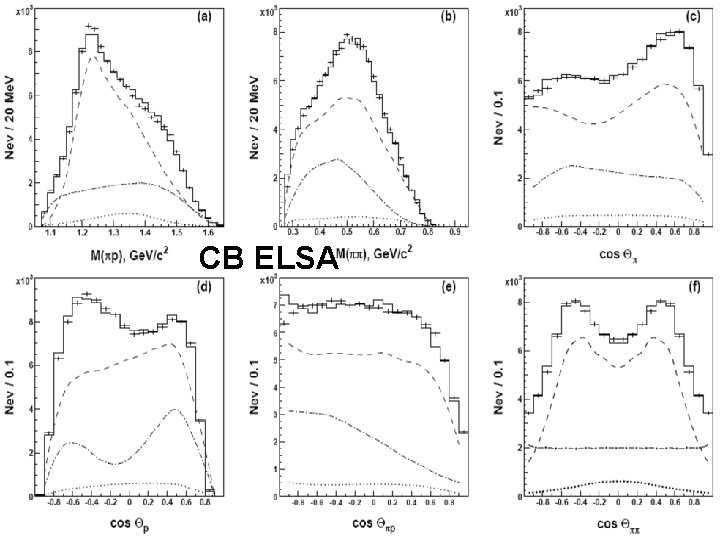
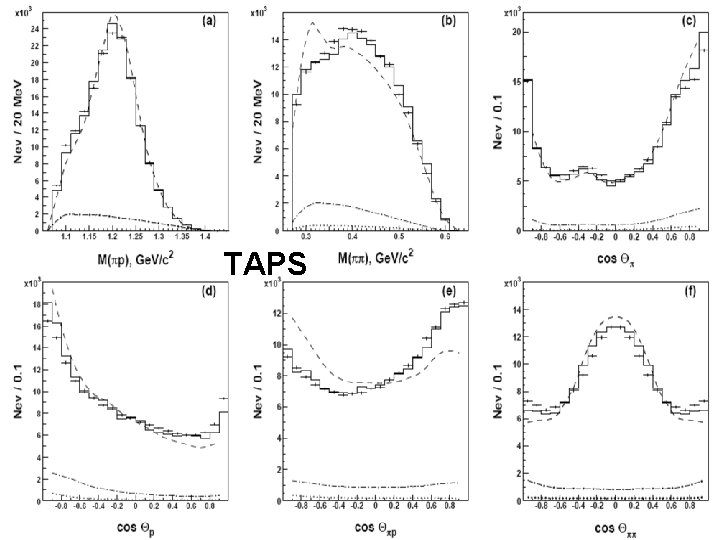
A 2 Results: from g p p p 0 p 0 (and other data) Properties of Roper resonance • Interest: • Low mass, incompatible with quark models incompatible with LQCD • Member of decuplet? • Two Roper resonances? 2 p decays of baryon resonances
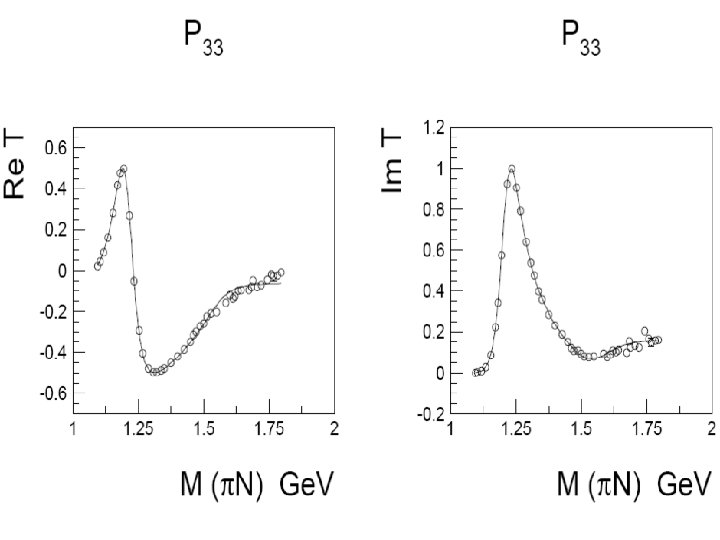
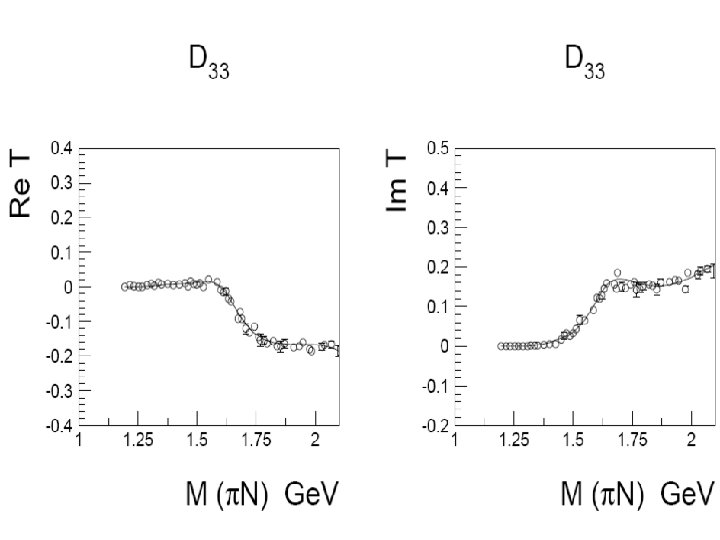
D 13 P 11 D 33
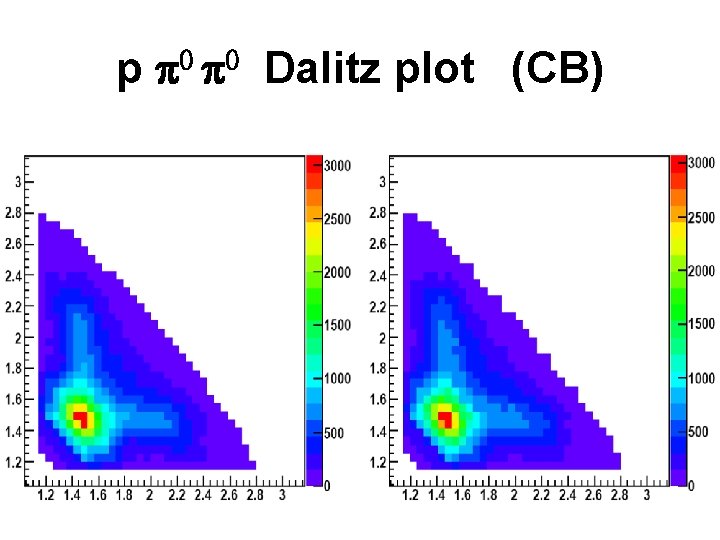
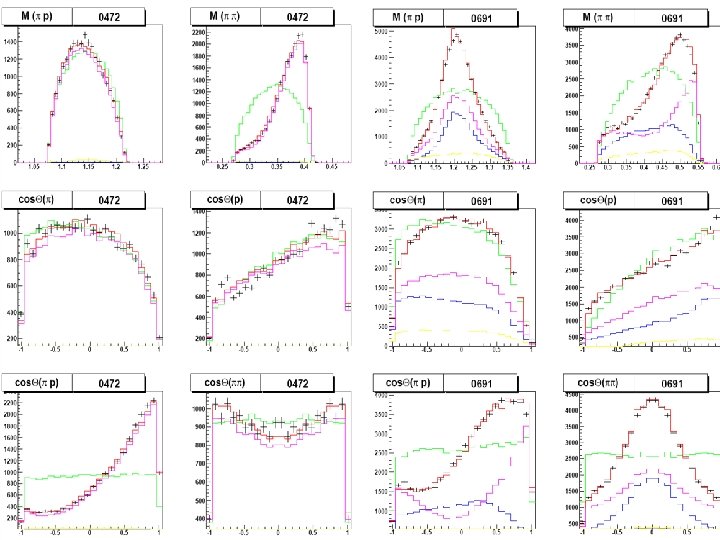
p p 0 Dalitz plot (CB)
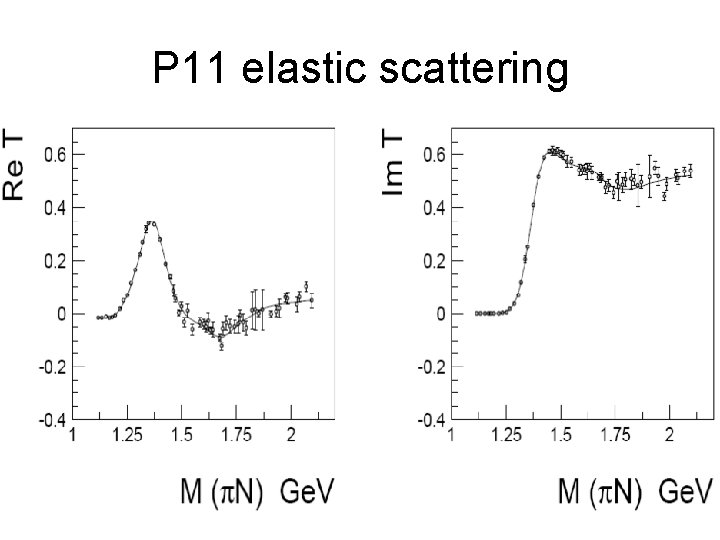
P 11 elastic scattering
No P 11(1710) Two Ropers
CB ELSA
TAPS
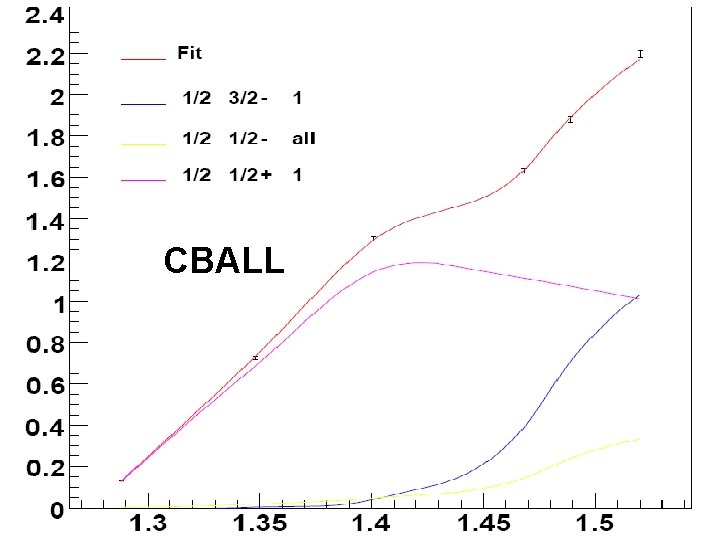
CBALL
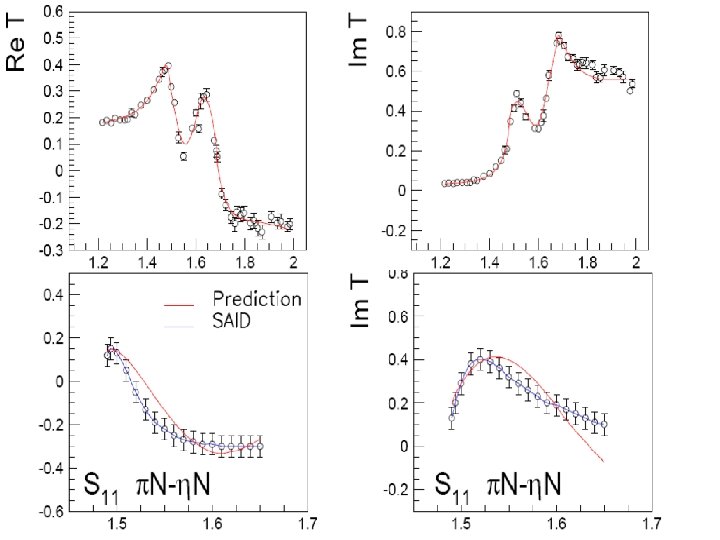
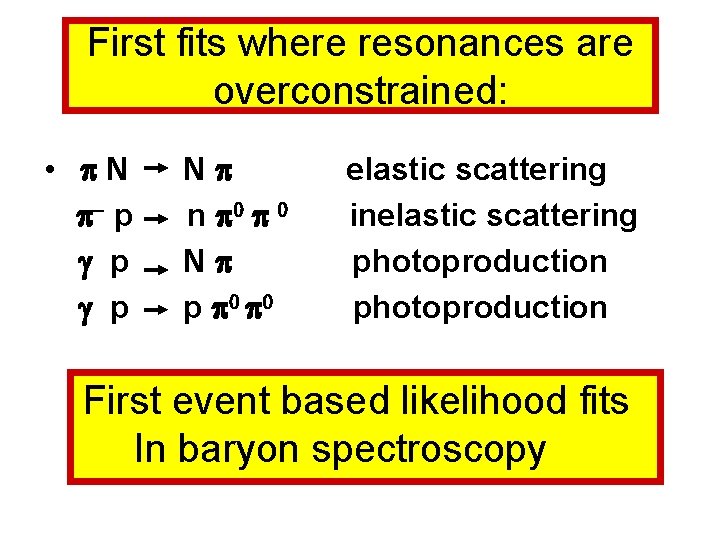
First fits where resonances are overconstrained: • p N N p elastic scattering p- p n p 0 inelastic scattering g p N p photoproduction g p p p 0 photoproduction First event based likelihood fits In baryon spectroscopy
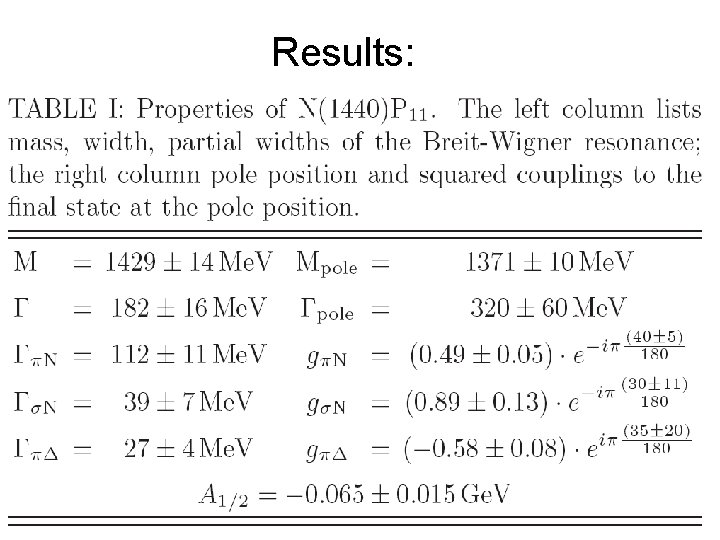
Results:
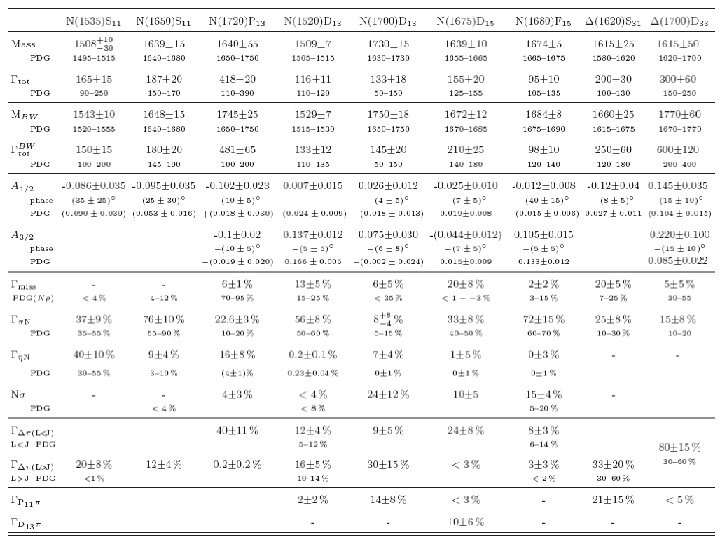
Table of results
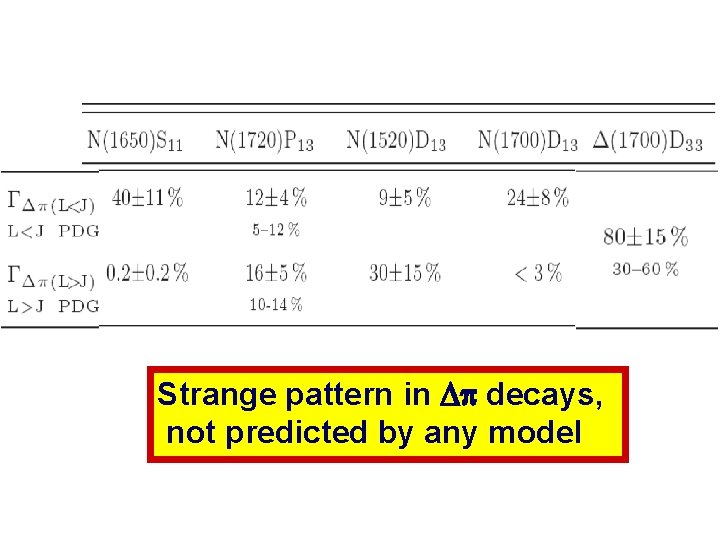
Strange pattern in Dp decays, not predicted by any model
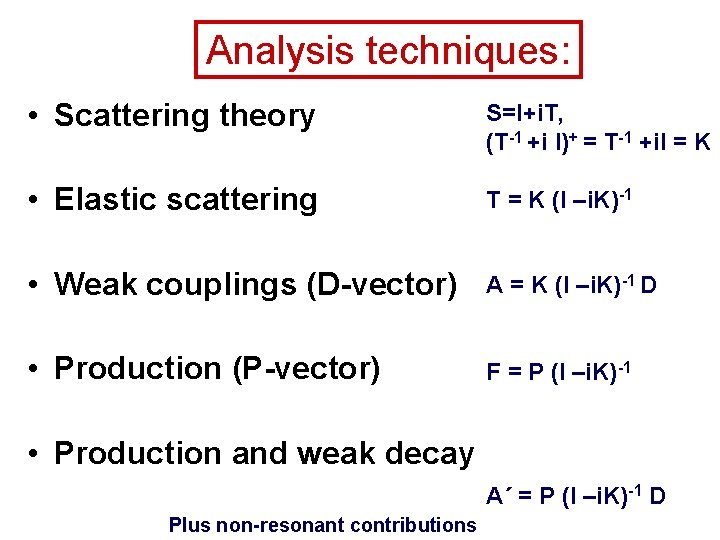
Analysis techniques: • Scattering theory S=I+i. T, (T-1 +i I)+ = T-1 +i. I = K • Elastic scattering T = K (I –i. K)-1 • Weak couplings (D-vector) A = K (I –i. K)-1 D • Production (P-vector) F = P (I –i. K)-1 • Production and weak decay A´ = P (I –i. K)-1 D Plus non-resonant contributions
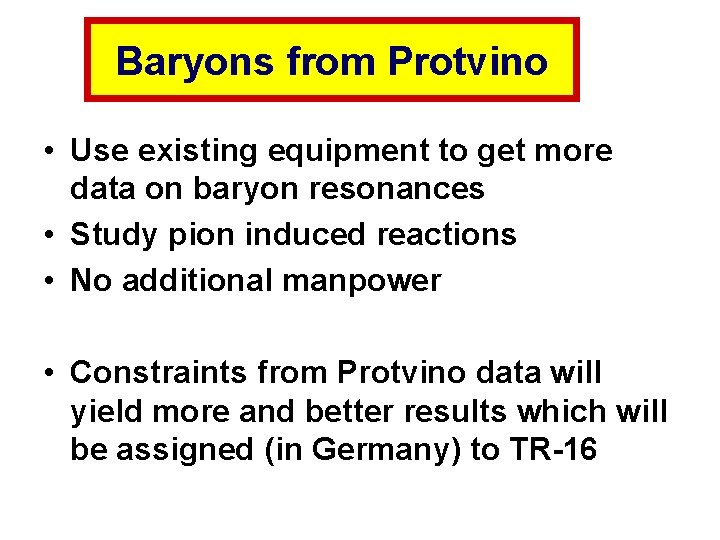
Baryons from Protvino • Use existing equipment to get more data on baryon resonances • Study pion induced reactions • No additional manpower • Constraints from Protvino data will yield more and better results which will be assigned (in Germany) to TR-16
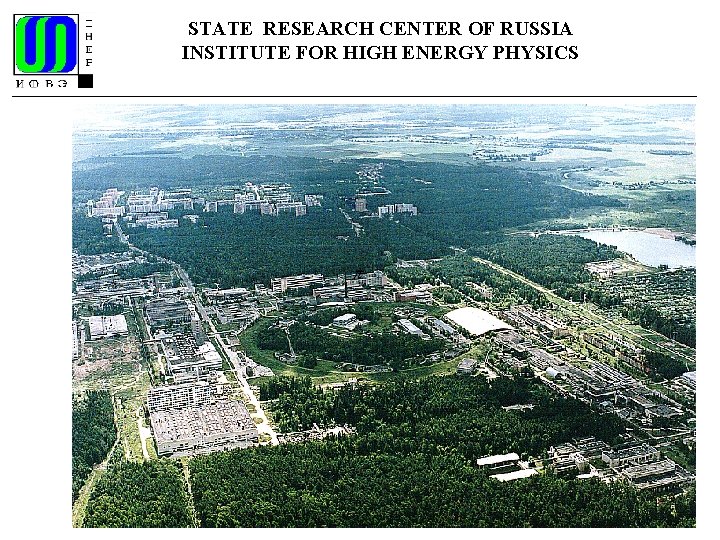
STATE RESEARCH CENTER OF RUSSIA INSTITUTE FOR HIGH ENERGY PHYSICS
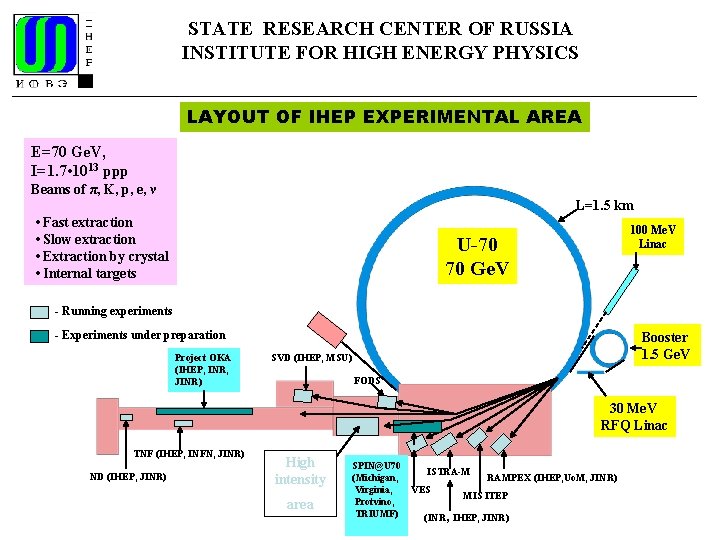
STATE RESEARCH CENTER OF RUSSIA INSTITUTE FOR HIGH ENERGY PHYSICS LAYOUT OF IHEP EXPERIMENTAL AREA E=70 Ge. V, I=1. 7 • 1013 ppp Beams of π, K, p, e, ν L=1. 5 km • Fast extraction • Slow extraction • Extraction by crystal • Internal targets 100 Me. V Linac U-70 70 Ge. V - Running experiments - Experiments under preparation Project OKA (IHEP, INR, JINR) Booster 1. 5 Ge. V SVD (IHEP, MSU) FODS 30 Me. V RFQ Linac TNF (IHEP, INFN, JINR) ND (IHEP, JINR) High intensity area SPIN@U 70 ISTRA-M (Michigan, RAMPEX (IHEP, Uo. M, JINR) Virginia, VES MIS ITEP Protvino, TRIUMF) (INR, IHEP, JINR)
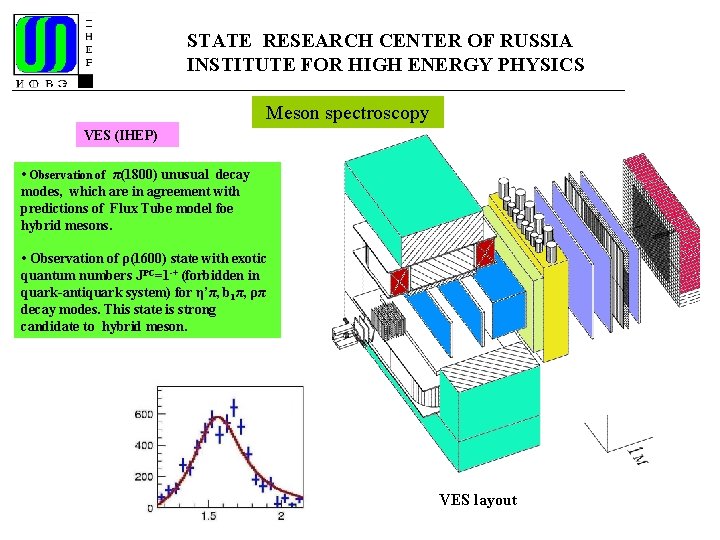
STATE RESEARCH CENTER OF RUSSIA INSTITUTE FOR HIGH ENERGY PHYSICS Meson spectroscopy VES (IHEP) • Observation of π(1800) unusual decay modes, which are in agreement with predictions of Flux Tube model foe hybrid mesons. • Observation of ρ(1600) state with exotic quantum numbers JPC=1 -+ (forbidden in quark-antiquark system) for η’π, b 1π, ρπ decay modes. This state is strong candidate to hybrid meson. VES layout
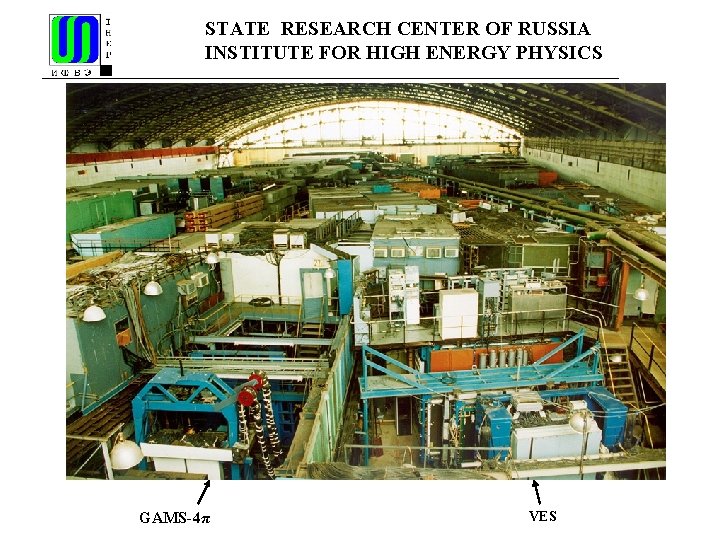
STATE RESEARCH CENTER OF RUSSIA INSTITUTE FOR HIGH ENERGY PHYSICS GAMS-4π VES
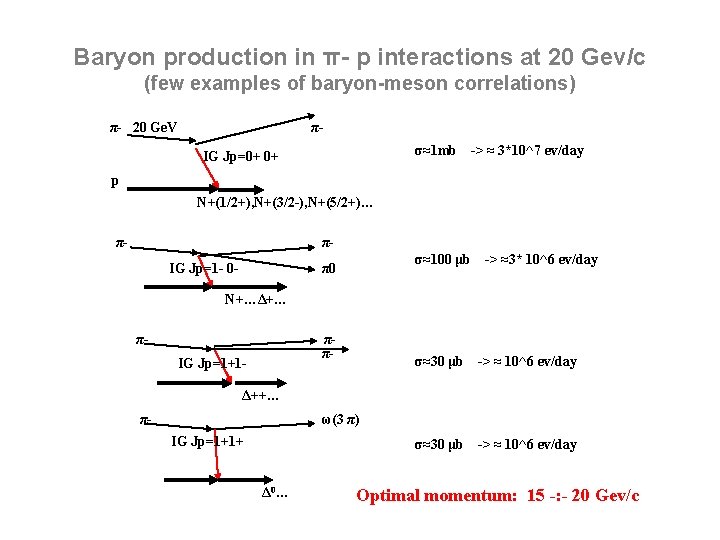
Baryon production in π- p interactions at 20 Gev/c (few examples of baryon-meson correlations) π- 20 Ge. V πσ≈1 mb IG Jp=0+ 0+ -> ≈ 3*10^7 ev/day p N+(1/2+), N+(3/2 -), N+(5/2+)… π- πIG Jp=1 - 0 - σ≈100 μb π0 -> ≈3* 10^6 ev/day N+…Δ+… π- ππ- IG Jp=1+1 - σ≈30 μb -> ≈ 10^6 ev/day Δ++… π- ω(3 π) IG Jp=1+1+ Δ 0… Optimal momentum: 15 -: - 20 Gev/c