
A 2 Approximation Algorithm for Sorting Signed Permutations


![Reversals • Reversal rev(i, j): – Cut black edges [R(ai), L(ai+1)], [R(aj), L(aj+1)]. –](https://slidetodoc.com/presentation_image_h2/96f895135d0ae494097f8cea55ed9dc8/image-17.jpg "Reversals • Reversal rev(i, j): – Cut black edges [R(ai), L(ai+1)], [R(aj), L(aj+1)]. –")
![Transpositions • Transposition tp(i, j, k) : – Cut [R(ai), L(ai+1)], [R(aj), L(aj+1)], [R(ak),](https://slidetodoc.com/presentation_image_h2/96f895135d0ae494097f8cea55ed9dc8/image-18.jpg "Transpositions • Transposition tp(i, j, k) : – Cut [R(ai), L(ai+1)], [R(aj), L(aj+1)], [R(ak),")
![Right transreversals • Right transreversal right-tp(i, j, k) : – Cut [R(ai), L(ai+1)], [R(aj),](https://slidetodoc.com/presentation_image_h2/96f895135d0ae494097f8cea55ed9dc8/image-19.jpg "Right transreversals • Right transreversal right-tp(i, j, k) : – Cut [R(ai), L(ai+1)], [R(aj),")
![Left transreversals • Left transreversal left-tp(i, j, k) : – Cut [R(ai), L(ai+1)], [R(aj),](https://slidetodoc.com/presentation_image_h2/96f895135d0ae494097f8cea55ed9dc8/image-20.jpg "Left transreversals • Left transreversal left-tp(i, j, k) : – Cut [R(ai), L(ai+1)], [R(aj),")
![Block-interchanges • block-interchange bi(i, j, k, l): – Cut [R(ai), L(ai+1)], [R(aj), L(aj+1)], [R(ak),](https://slidetodoc.com/presentation_image_h2/96f895135d0ae494097f8cea55ed9dc8/image-21.jpg "Block-interchanges • block-interchange bi(i, j, k, l): – Cut [R(ai), L(ai+1)], [R(aj), L(aj+1)], [R(ak),")
![L-bridges • Models proper reversals. • Black edges [a, b], [c, d] in cycle](https://slidetodoc.com/presentation_image_h2/96f895135d0ae494097f8cea55ed9dc8/image-27.jpg "L-bridges • Models proper reversals. • Black edges [a, b], [c, d] in cycle")
![T-bridges • A black edge e=[u, v] is twisted if the two gray edges](https://slidetodoc.com/presentation_image_h2/96f895135d0ae494097f8cea55ed9dc8/image-28.jpg "T-bridges • A black edge e=[u, v] is twisted if the two gray edges")
- Slides: 45
A 2 -Approximation Algorithm for Sorting Signed Permutations by Reversals, Transpositions, Trans. Reversals, and Block-Interchanges Fan. Chang Hao, Melvin Zhang, and Hon Wai Leong Review for TCBB Ron Zeira 5. 8. 15
Outline • Introduction – Motivation – Genome rearrangement model – Breakpoint graph • Bridge structures • Algorithm • Discussion and summary
Genome rearrangements
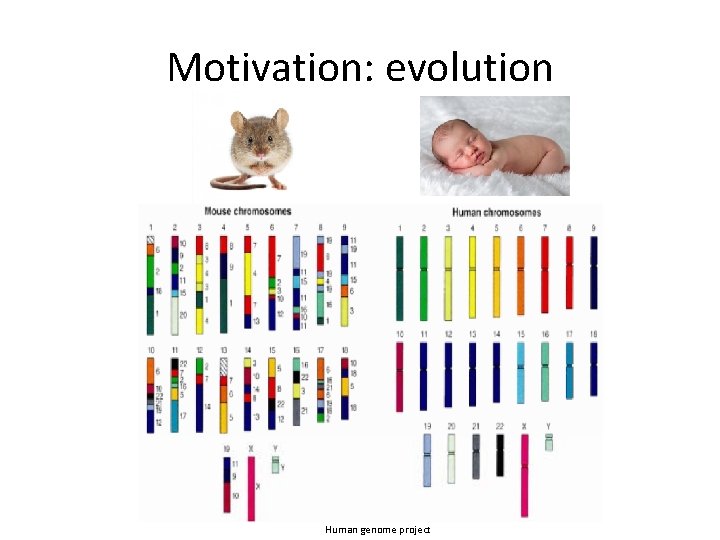
Motivation: evolution Human genome project
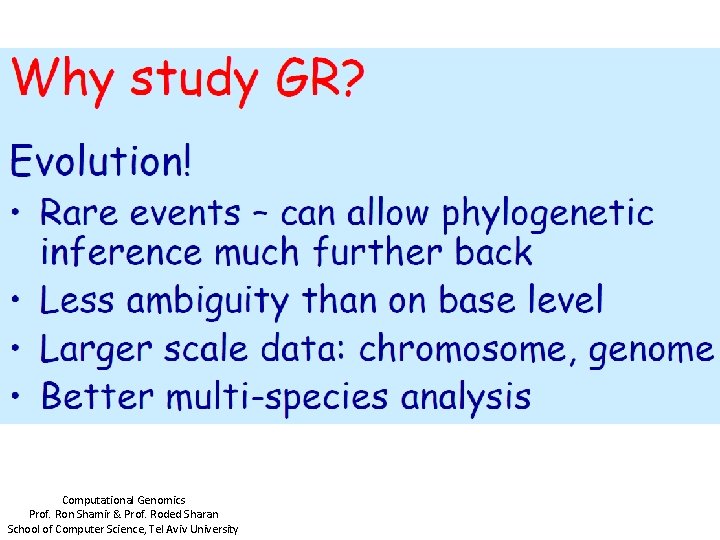
Computational Genomics Prof. Ron Shamir & Prof. Roded Sharan School of Computer Science, Tel Aviv University
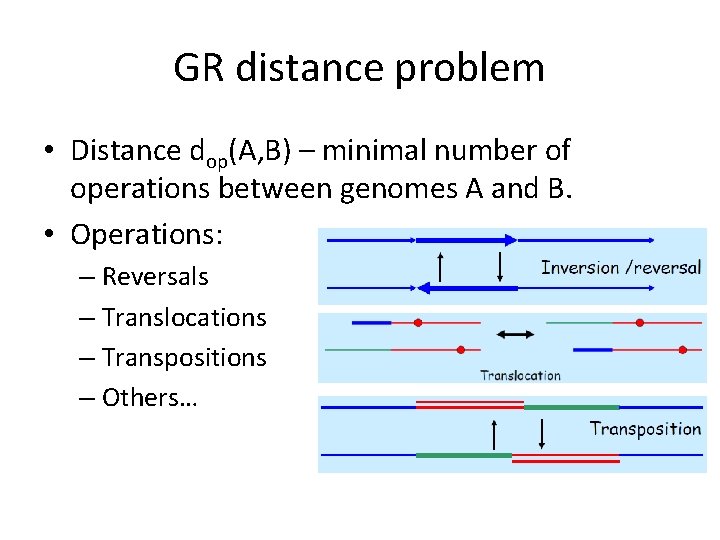
GR distance problem • Distance dop(A, B) – minimal number of operations between genomes A and B. • Operations: – Reversals – Translocations – Transpositions – Others…
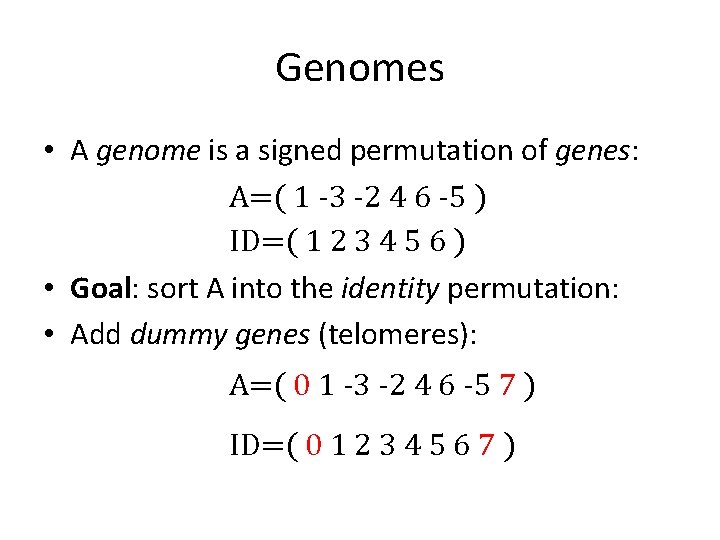
Genomes • A genome is a signed permutation of genes: A=( 1 -3 -2 4 6 -5 ) ID=( 1 2 3 4 5 6 ) • Goal: sort A into the identity permutation: • Add dummy genes (telomeres): A=( 0 1 -3 -2 4 6 -5 7 ) ID=( 0 1 2 3 4 5 6 7 )
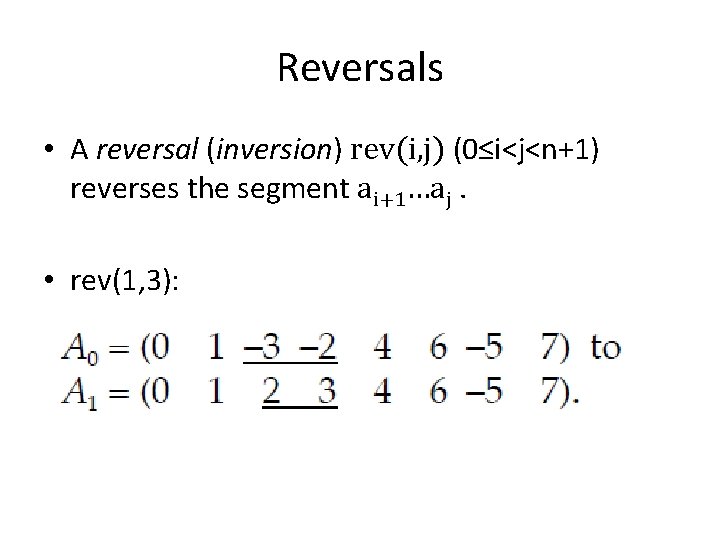
Reversals • A reversal (inversion) rev(i, j) (0≤i<j<n+1) reverses the segment ai+1…aj. • rev(1, 3):
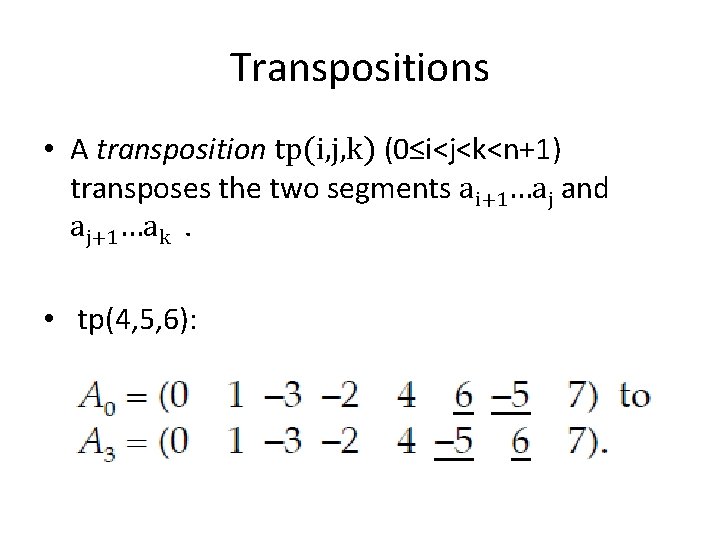
Transpositions • A transposition tp(i, j, k) (0≤i<j<k<n+1) transposes the two segments ai+1…aj and aj+1…ak. • tp(4, 5, 6):
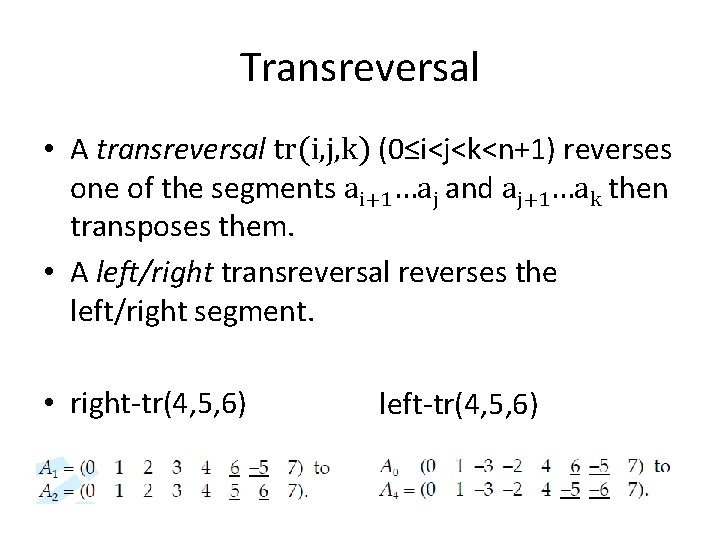
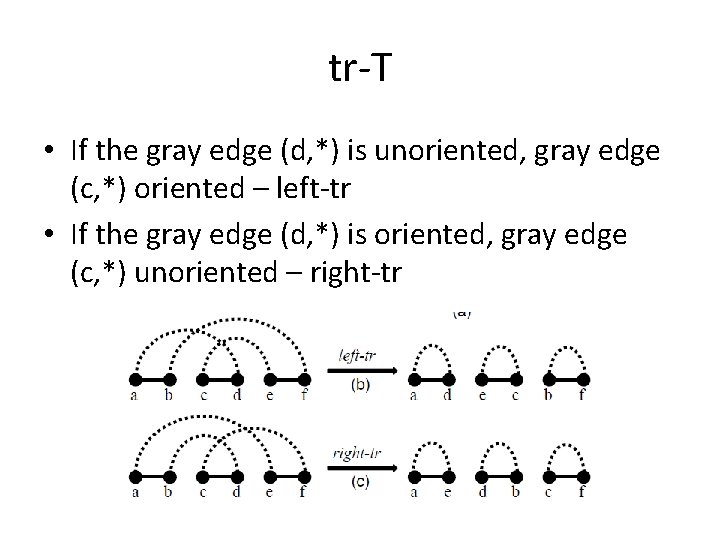
Transreversal • A transreversal tr(i, j, k) (0≤i<j<k<n+1) reverses one of the segments ai+1…aj and aj+1…ak then transposes them. • A left/right transreversal reverses the left/right segment. • right-tr(4, 5, 6) left-tr(4, 5, 6)
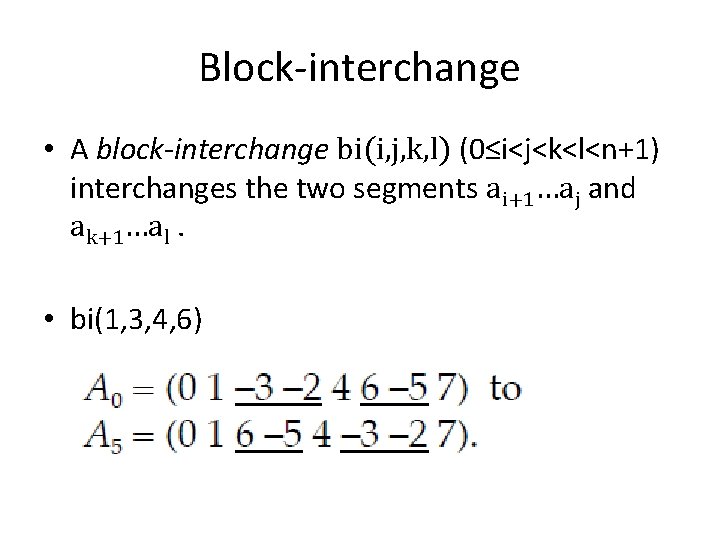
Block-interchange • A block-interchange bi(i, j, k, l) (0≤i<j<k<l<n+1) interchanges the two segments ai+1…aj and ak+1…al. • bi(1, 3, 4, 6)
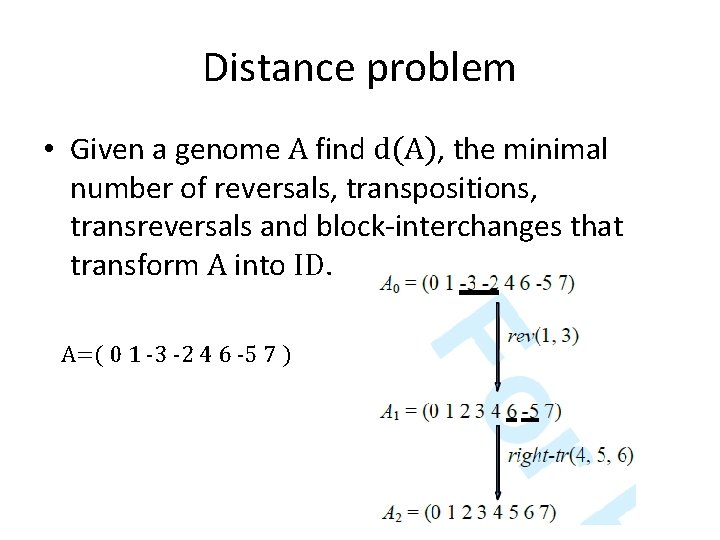
Distance problem • Given a genome A find d(A), the minimal number of reversals, transpositions, transreversals and block-interchanges that transform A into ID. A=( 0 1 -3 -2 4 6 -5 7 )
Previous results • Hannenhalli and Pevzner (95) – reversal distance is polynomial. • Transposition distance is NP-hard. Several 1. 5 approximations. • He and Chen – 2 -approximation for sorting by reversals and block-interchanges. • Hartman and Sharan – 1. 5 -approximation for sorting by transpositions and transreversals.
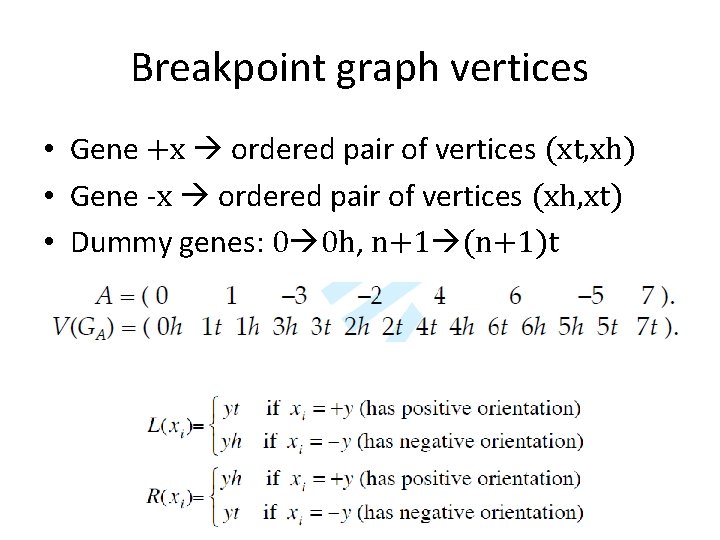
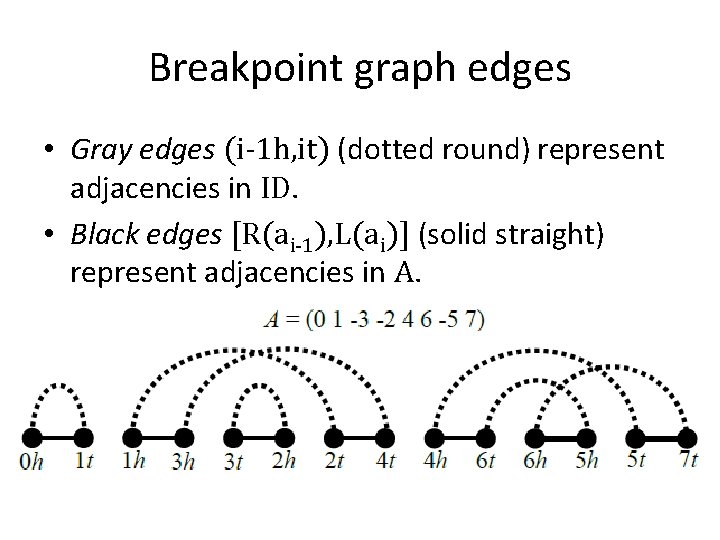
Breakpoint graph vertices • Gene +x ordered pair of vertices (xt, xh) • Gene -x ordered pair of vertices (xh, xt) • Dummy genes: 0 0 h, n+1 (n+1)t
Breakpoint graph edges • Gray edges (i-1 h, it) (dotted round) represent adjacencies in ID. • Black edges [R(ai-1), L(ai)] (solid straight) represent adjacencies in A.
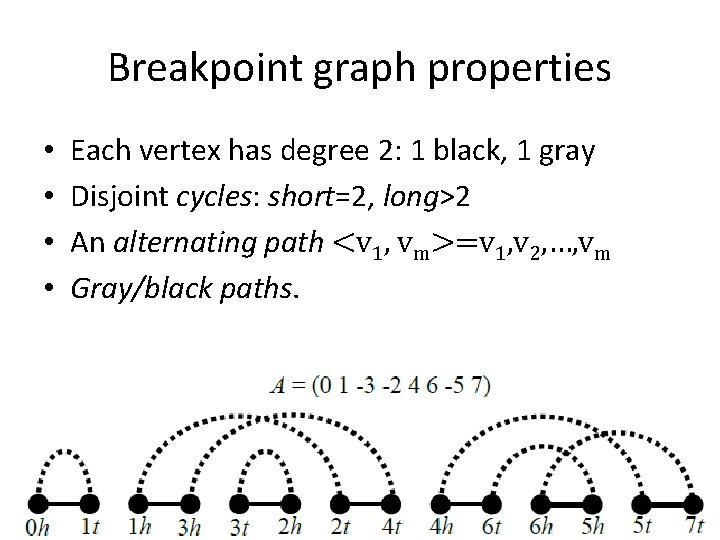
Breakpoint graph properties • • Each vertex has degree 2: 1 black, 1 gray Disjoint cycles: short=2, long>2 An alternating path <v 1, vm>=v 1, v 2, …, vm Gray/black paths.
Reversals • Reversal rev(i, j): – Cut black edges [R(ai), L(ai+1)], [R(aj), L(aj+1)]. – Add black edges [R(ai), R(aj)], [L(ai), L(aj+1)].
Transpositions • Transposition tp(i, j, k) : – Cut [R(ai), L(ai+1)], [R(aj), L(aj+1)], [R(ak), L(ak+1)] – Add [R(ai), L(aj+1)], [R(ak), L(ai+1)], [R(aj), L(ak+1)]
Right transreversals • Right transreversal right-tp(i, j, k) : – Cut [R(ai), L(ai+1)], [R(aj), L(aj+1)], [R(ak), L(ak+1)] – Add [R(ai), R(a. K)], [L(aj+1), L(ai+1)], [R(aj), L(ak+1)]
Left transreversals • Left transreversal left-tp(i, j, k) : – Cut [R(ai), L(ai+1)], [R(aj), L(aj+1)], [R(ak), L(ak+1)] – Add [R(ai), L(aj+1)], [L(ak), R(aj)], [L(ai+1), L(ak+1)]
Block-interchanges • block-interchange bi(i, j, k, l): – Cut [R(ai), L(ai+1)], [R(aj), L(aj+1)], [R(ak), L(ak+1)], [R(al), L(al+1)] – Add[R(ai), L(ak+1)], [R(al), L(aj+1)], [R(ak), L(ai+1)], [R(aj), L(al+1)]
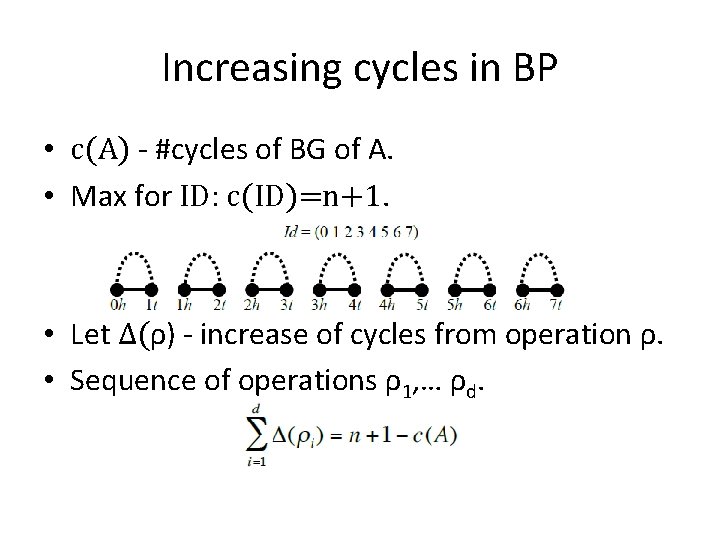
Increasing cycles in BP • c(A) - #cycles of BG of A. • Max for ID: c(ID)=n+1. • Let Δ(ρ) - increase of cycles from operation ρ. • Sequence of operations ρ1, … ρd.
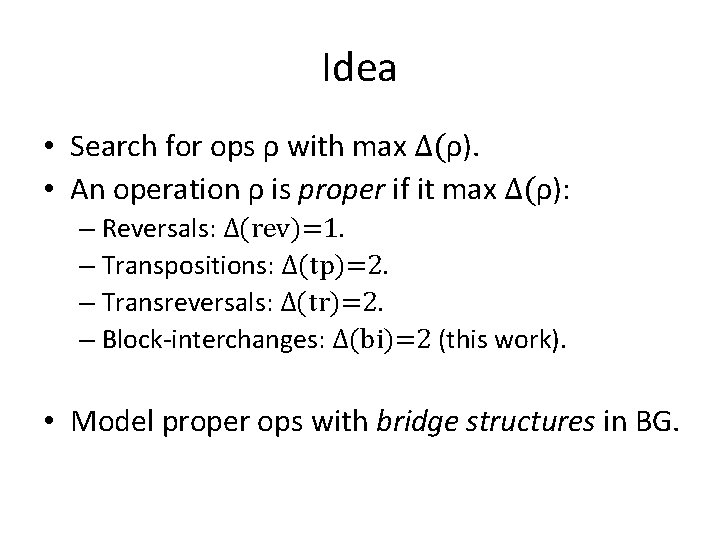
Idea • Search for ops ρ with max Δ(ρ). • An operation ρ is proper if it max Δ(ρ): – Reversals: Δ(rev)=1. – Transpositions: Δ(tp)=2. – Transreversals: Δ(tr)=2. – Block-interchanges: Δ(bi)=2 (this work). • Model proper ops with bridge structures in BG.
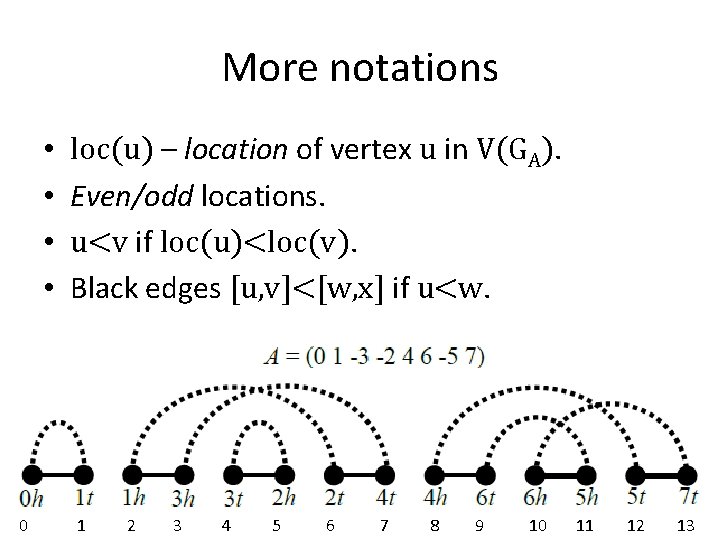
More notations • • 0 loc(u) – location of vertex u in V(GA). Even/odd locations. u<v if loc(u)<loc(v). Black edges [u, v]<[w, x] if u<w. 1 2 3 4 5 6 7 8 9 10 11 12 13
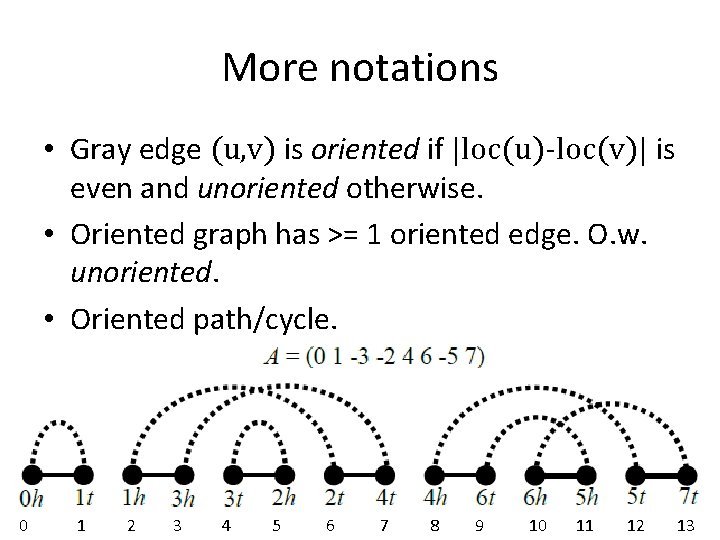
More notations • Gray edge (u, v) is oriented if |loc(u)-loc(v)| is even and unoriented otherwise. • Oriented graph has >= 1 oriented edge. O. w. unoriented. • Oriented path/cycle. 0 1 2 3 4 5 6 7 8 9 10 11 12 13
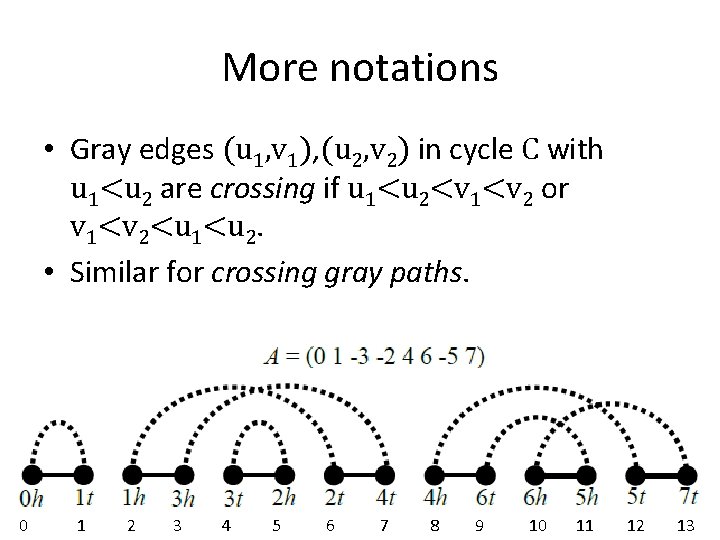
More notations • Gray edges (u 1, v 1), (u 2, v 2) in cycle C with u 1<u 2 are crossing if u 1<u 2<v 1<v 2 or v 1<v 2<u 1<u 2. • Similar for crossing gray paths. 0 1 2 3 4 5 6 7 8 9 10 11 12 13
L-bridges • Models proper reversals. • Black edges [a, b], [c, d] in cycle C, the gray edges (a, c), (b, d) are oriented and crossing. • Reversing b…c increases cycles by 1. • Generalizes to gray paths.
T-bridges • A black edge e=[u, v] is twisted if the two gray edges (u, *), (v, *) are crossing. • T-bridge models proper tps and trs with Δ=2. • Black edges e 1=[a, b], e 2=[c, d], e 3=[e, f] in cycle C s. t. e 1< e 2< e 3 and e 2 is twisted.
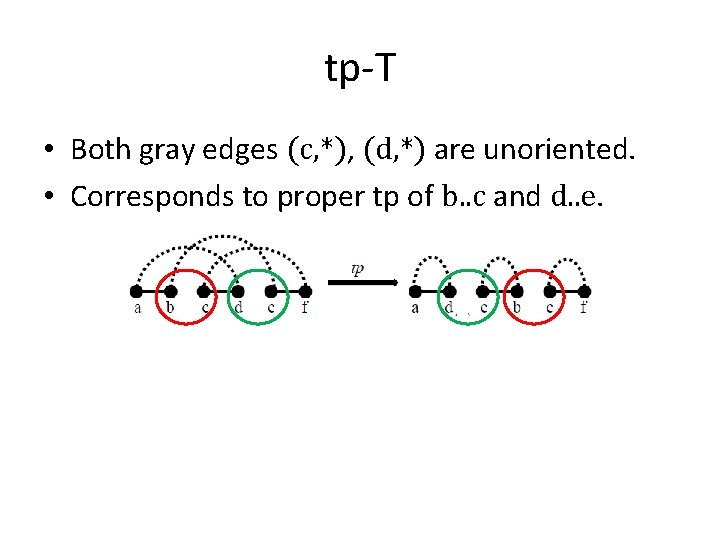
tp-T • Both gray edges (c, *), (d, *) are unoriented. • Corresponds to proper tp of b. . c and d. . e.
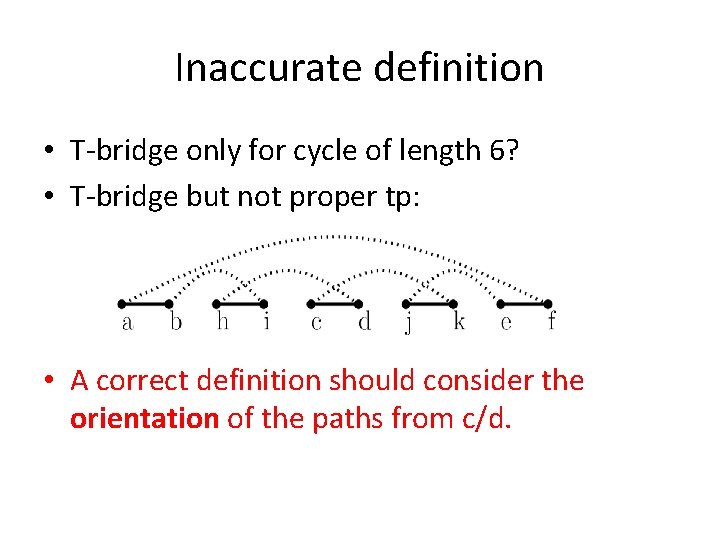
Inaccurate definition • T-bridge only for cycle of length 6? • T-bridge but not proper tp: • A correct definition should consider the orientation of the paths from c/d.
tr-T • If the gray edge (d, *) is unoriented, gray edge (c, *) oriented – left-tr • If the gray edge (d, *) is oriented, gray edge (c, *) unoriented – right-tr
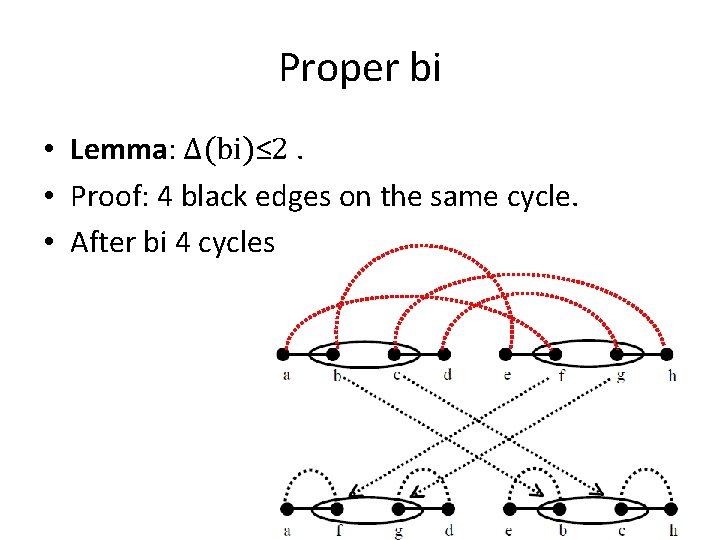
Proper bi • Lemma: Δ(bi)≤ 2. • Proof: 4 black edges on the same cycle. • After bi 4 cycles
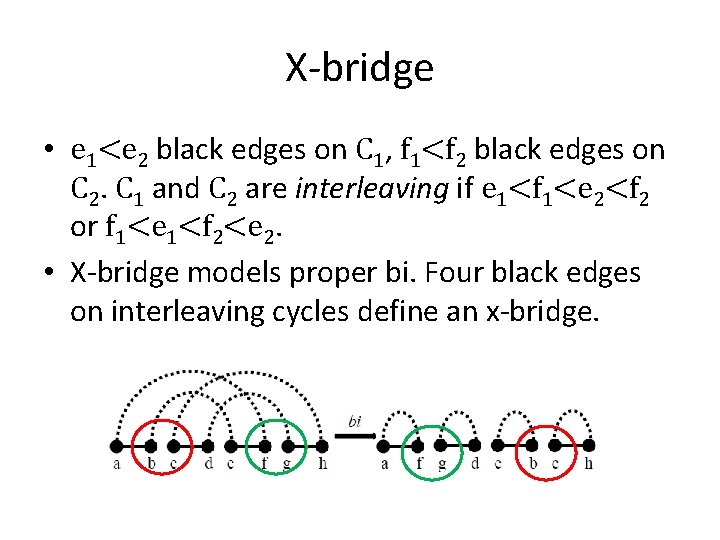
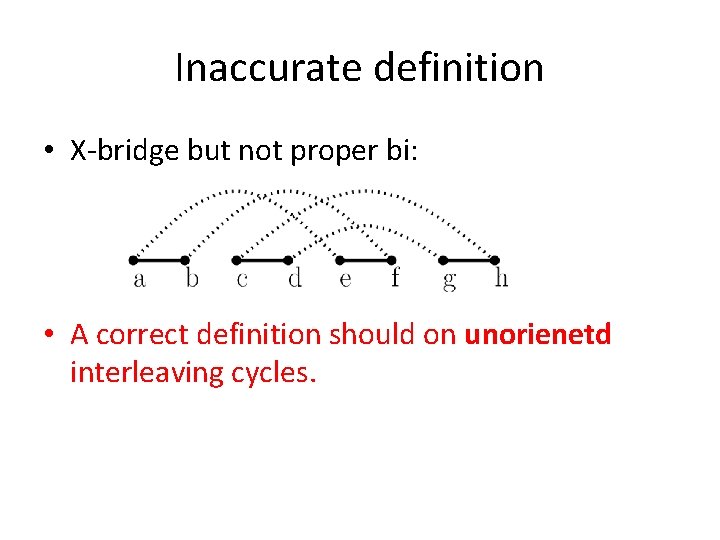
X-bridge • e 1<e 2 black edges on C 1, f 1<f 2 black edges on C 2. C 1 and C 2 are interleaving if e 1<f 1<e 2<f 2 or f 1<e 1<f 2<e 2. • X-bridge models proper bi. Four black edges on interleaving cycles define an x-bridge.
Inaccurate definition • X-bridge but not proper bi: • A correct definition should on unorienetd interleaving cycles.
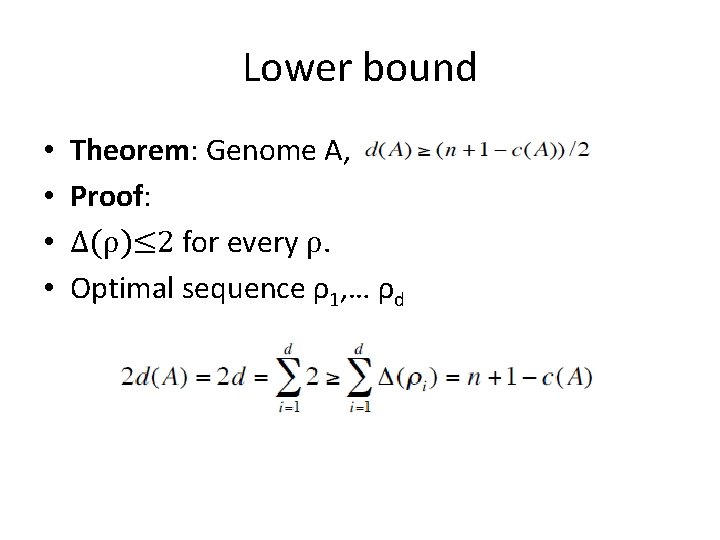
Lower bound • • Theorem: Genome A, Proof: Δ(ρ)≤ 2 for every ρ. Optimal sequence ρ1, … ρd
Upper bound • Show that we can always find either an L-, T- or X-bridge in every BG. • Classify BG: 1. Oriented graph has L-bridge. 2. Unoriented with crossing paths has T-bridge. 3. Unoriented without crossing paths has xbridge.
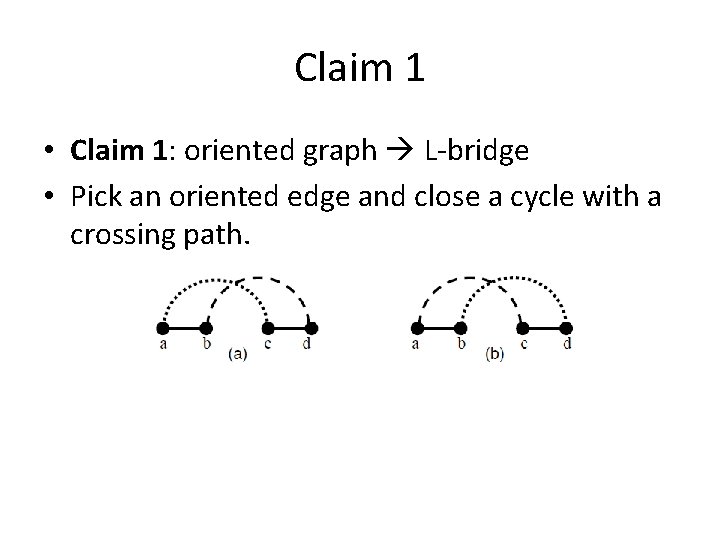
Claim 1 • Claim 1: oriented graph L-bridge • Pick an oriented edge and close a cycle with a crossing path.
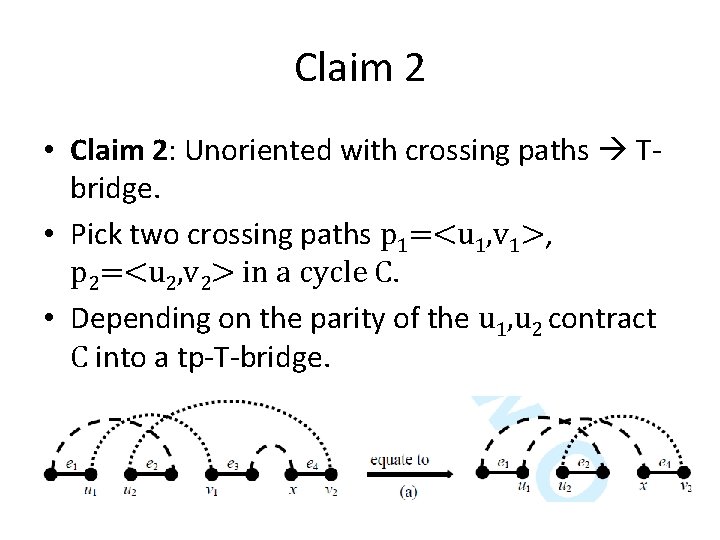
Claim 2 • Claim 2: Unoriented with crossing paths Tbridge. • Pick two crossing paths p 1=<u 1, v 1>, p 2=<u 2, v 2> in a cycle C. • Depending on the parity of the u 1, u 2 contract C into a tp-T-bridge.
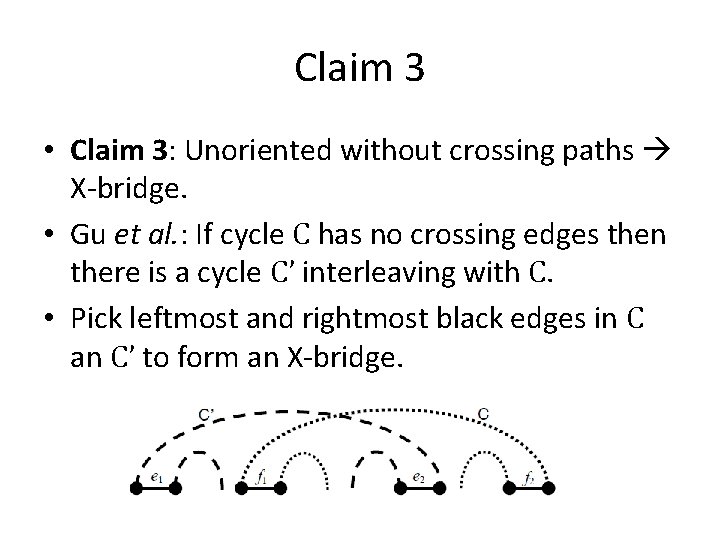
Claim 3 • Claim 3: Unoriented without crossing paths X-bridge. • Gu et al. : If cycle C has no crossing edges then there is a cycle C’ interleaving with C. • Pick leftmost and rightmost black edges in C an C’ to form an X-bridge.
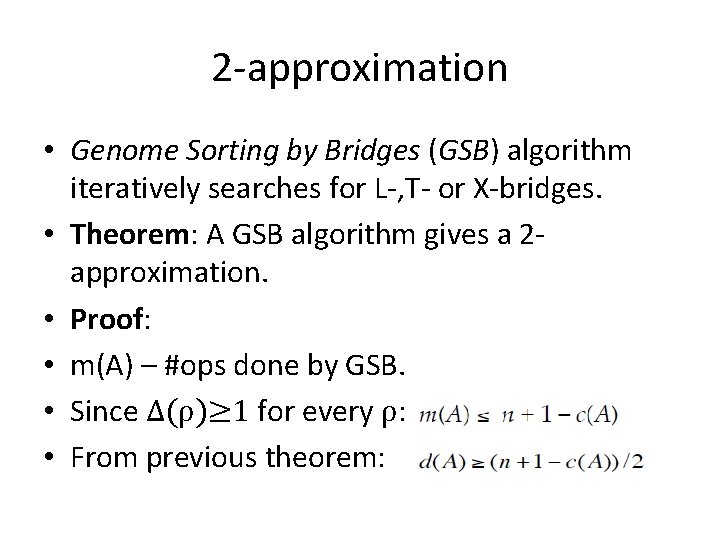
2 -approximation • Genome Sorting by Bridges (GSB) algorithm iteratively searches for L-, T- or X-bridges. • Theorem: A GSB algorithm gives a 2 approximation. • Proof: • m(A) – #ops done by GSB. • Since Δ(ρ)≥ 1 for every ρ: • From previous theorem:
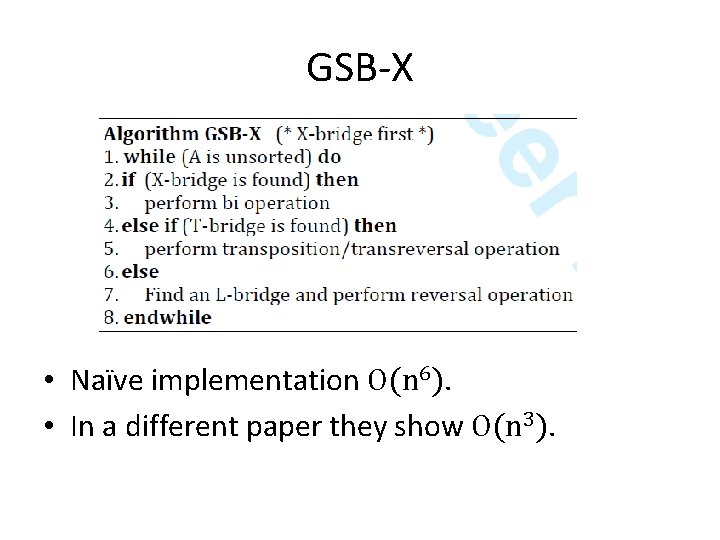
GSB-X • Naïve implementation O(n 6). • In a different paper they show O(n 3).
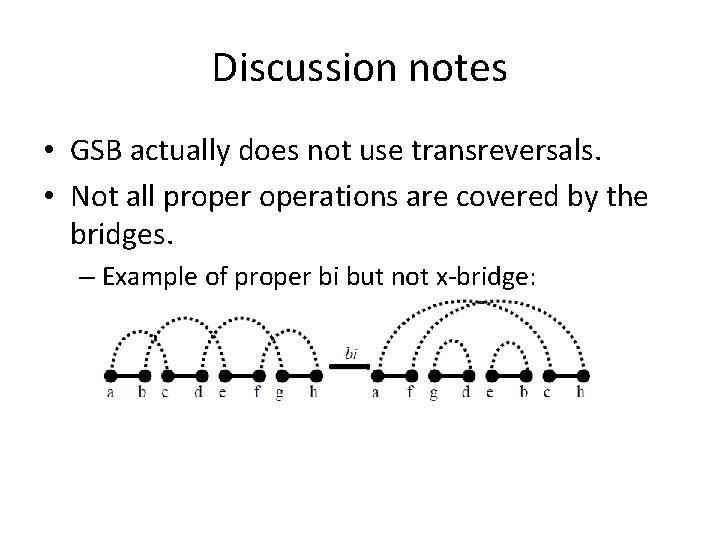
Discussion notes • GSB actually does not use transreversals. • Not all properations are covered by the bridges. – Example of proper bi but not x-bridge:
Future directions • • Analyze running time. Better approximation. Different weights. Multiple gene copies.
Pros • Nice result. • Extensive rearrangement model. • Paper is mostly self contained.
Cons • • Inaccurate bridge definitions. Many minor comments. A lot of grammar mistakes. Innovation is debatable.