
Uncertainty in Measurements l Two kinds of numbers
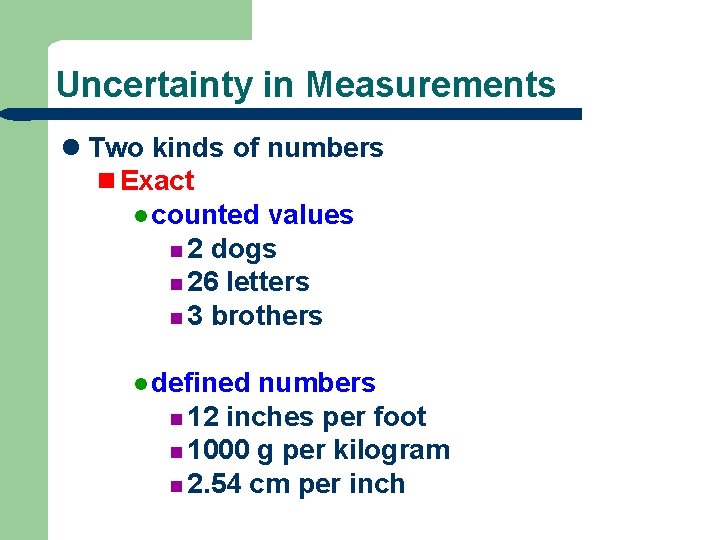
Uncertainty in Measurements l Two kinds of numbers n Exact l counted values n 2 dogs n 26 letters n 3 brothers l defined numbers n 12 inches per foot n 1000 g per kilogram n 2. 54 cm per inch

Uncertainty in Measurements l Two kinds of numbers: n Inexact Numbers l Numbers obtained by measurements l Some degree of uncertainty in the number n Equipment limitations n Human “error” l Examples: n Length n Mass n Density
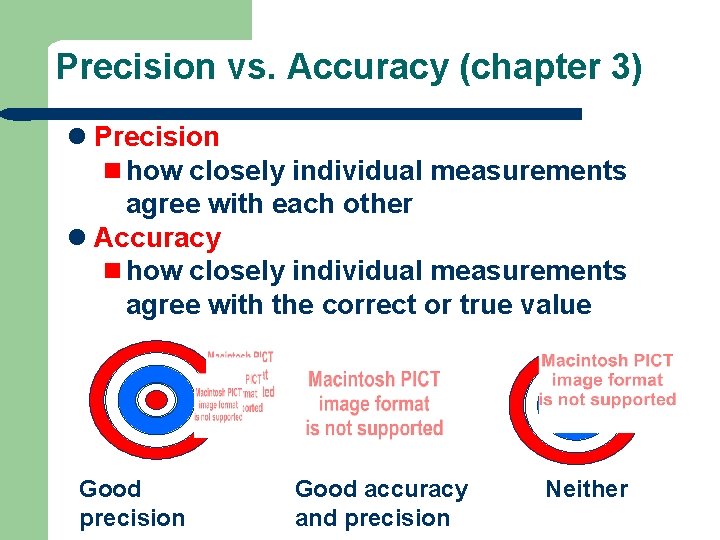
Precision vs. Accuracy (chapter 3) l Precision n how closely individual measurements agree with each other l Accuracy n how closely individual measurements agree with the correct or true value Good precision Good accuracy and precision Neither
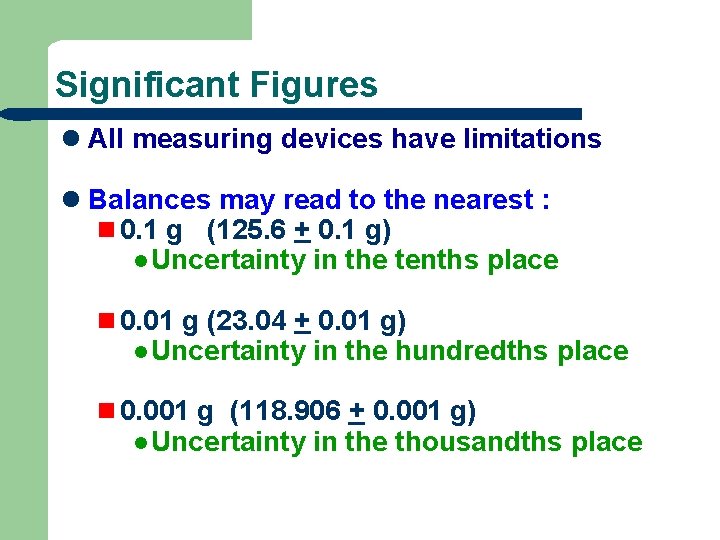
Significant Figures l All measuring devices have limitations l Balances may read to the nearest : n 0. 1 g (125. 6 + 0. 1 g) l Uncertainty in the tenths place n 0. 01 g (23. 04 + 0. 01 g) l Uncertainty in the hundredths place n 0. 001 g (118. 906 + 0. 001 g) l Uncertainty in the thousandths place
Significant Figures l Scientists drop the + notation and assume that an uncertainty of at least 1 unit exists in the final digit. l All digits, including the final one, are called significant figures.
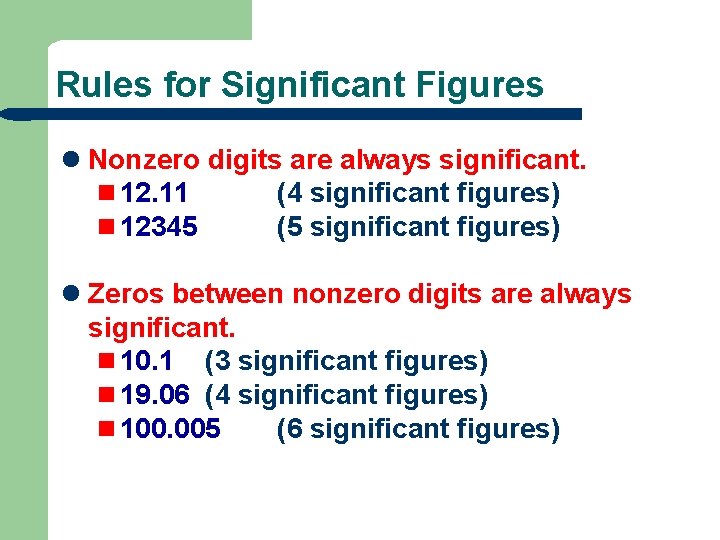
Rules for Significant Figures l Nonzero digits are always significant. n 12. 11 (4 significant figures) n 12345 (5 significant figures) l Zeros between nonzero digits are always significant. n 10. 1 (3 significant figures) n 19. 06 (4 significant figures) n 100. 005 (6 significant figures)
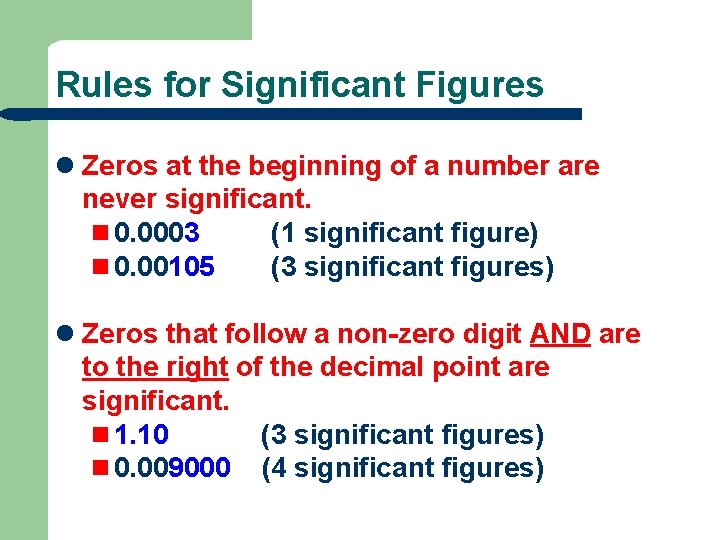
Rules for Significant Figures l Zeros at the beginning of a number are never significant. n 0. 0003 (1 significant figure) n 0. 00105 (3 significant figures) l Zeros that follow a non-zero digit AND are to the right of the decimal point are significant. n 1. 10 (3 significant figures) n 0. 009000 (4 significant figures)
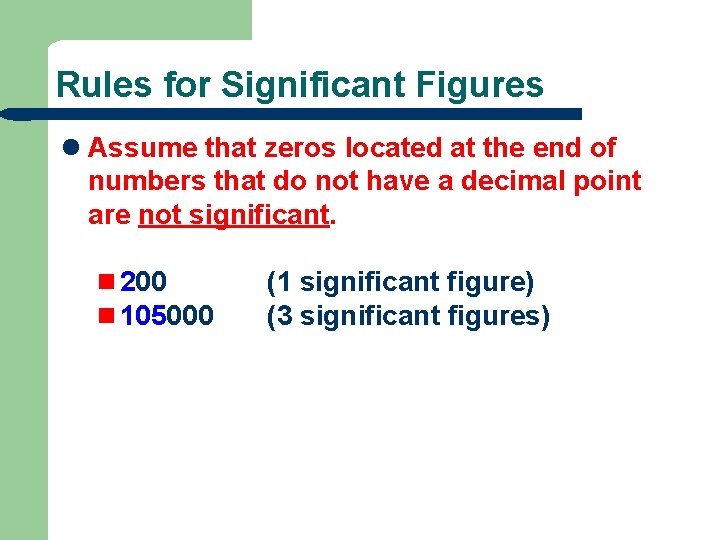
Rules for Significant Figures l Assume that zeros located at the end of numbers that do not have a decimal point are not significant. n 200 n 105000 (1 significant figure) (3 significant figures)
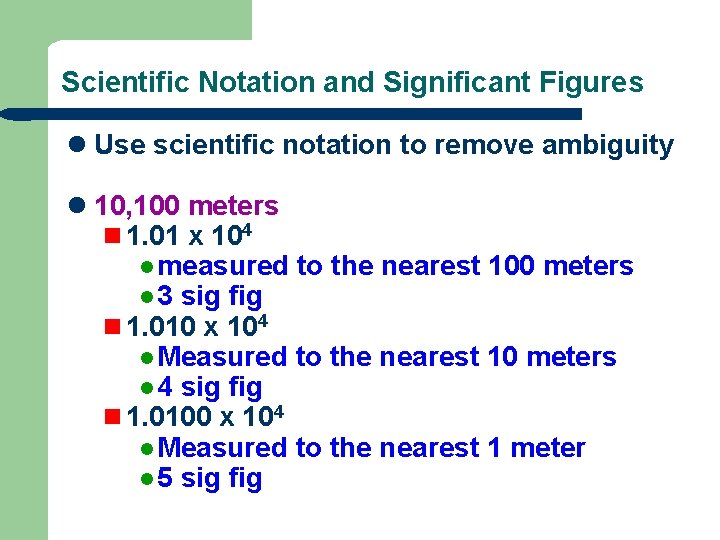
Scientific Notation and Significant Figures l Use scientific notation to remove ambiguity l 10, 100 meters n 1. 01 x 104 l measured to the nearest 100 meters l 3 sig fig n 1. 010 x 104 l Measured to the nearest 10 meters l 4 sig fig n 1. 0100 x 104 l Measured to the nearest 1 meter l 5 sig fig
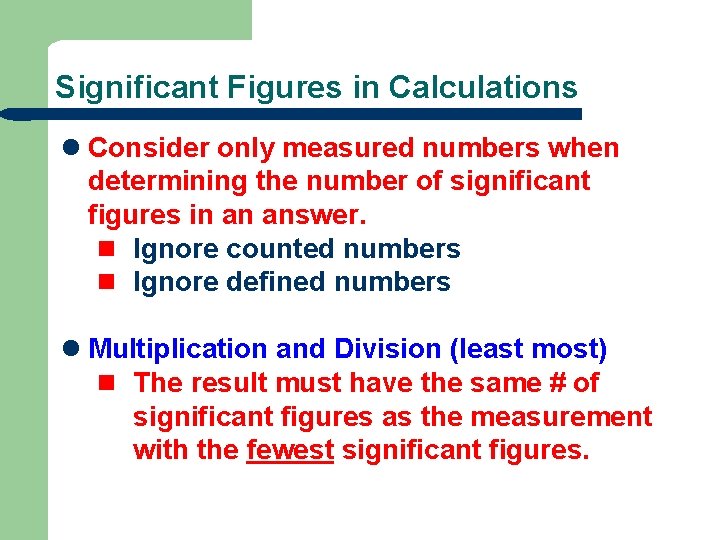
Significant Figures in Calculations l Consider only measured numbers when determining the number of significant figures in an answer. n Ignore counted numbers n Ignore defined numbers l Multiplication and Division (least most) n The result must have the same # of significant figures as the measurement with the fewest significant figures.
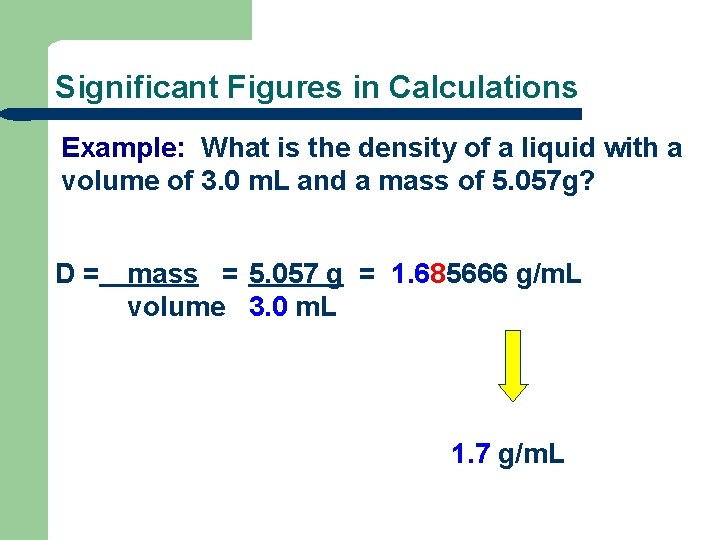
Significant Figures in Calculations Example: What is the density of a liquid with a volume of 3. 0 m. L and a mass of 5. 057 g? D = mass = 5. 057 g = 1. 685666 g/m. L volume 3. 0 m. L 1. 7 g/m. L
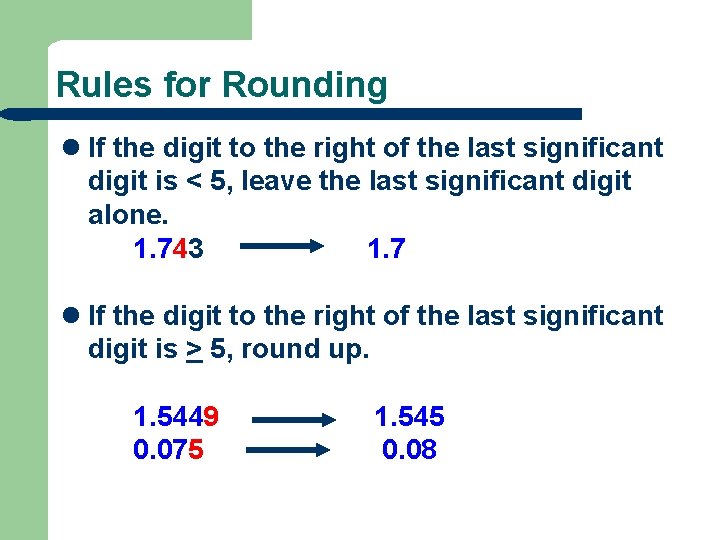
Rules for Rounding l If the digit to the right of the last significant digit is < 5, leave the last significant digit alone. 1. 743 1. 7 l If the digit to the right of the last significant digit is > 5, round up. 1. 5449 0. 075 1. 545 0. 08
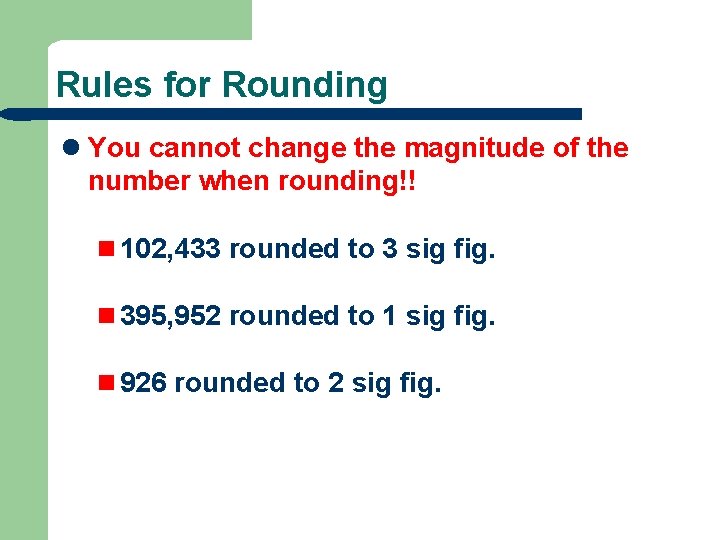
Rules for Rounding l You cannot change the magnitude of the number when rounding!! n 102, 433 rounded to 3 sig fig. n 395, 952 rounded to 1 sig fig. n 926 rounded to 2 sig fig.
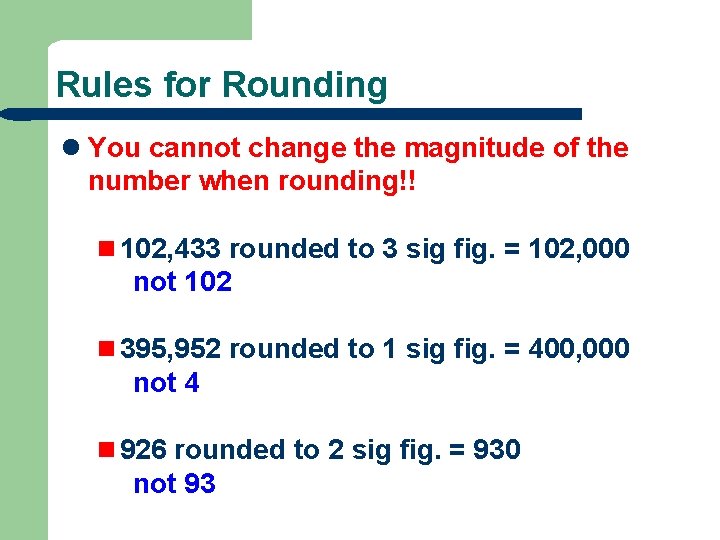
Rules for Rounding l You cannot change the magnitude of the number when rounding!! n 102, 433 rounded to 3 sig fig. = 102, 000 not 102 n 395, 952 rounded to 1 sig fig. = 400, 000 not 4 n 926 rounded to 2 sig fig. = 930 not 93
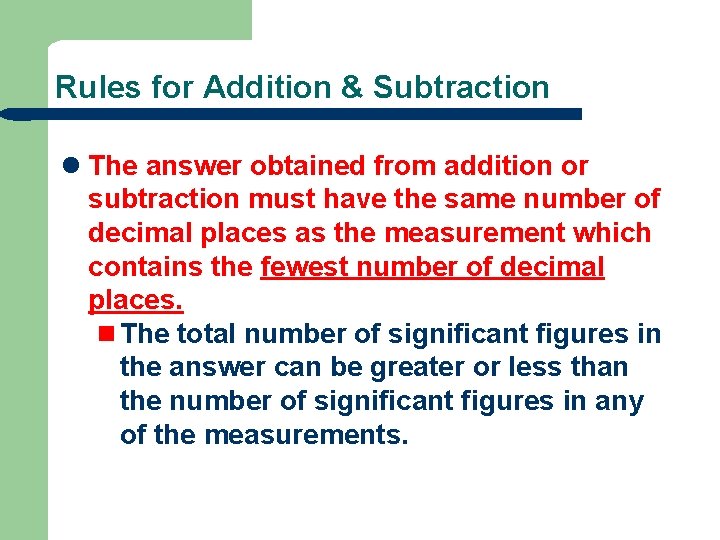
Rules for Addition & Subtraction l The answer obtained from addition or subtraction must have the same number of decimal places as the measurement which contains the fewest number of decimal places. n The total number of significant figures in the answer can be greater or less than the number of significant figures in any of the measurements.
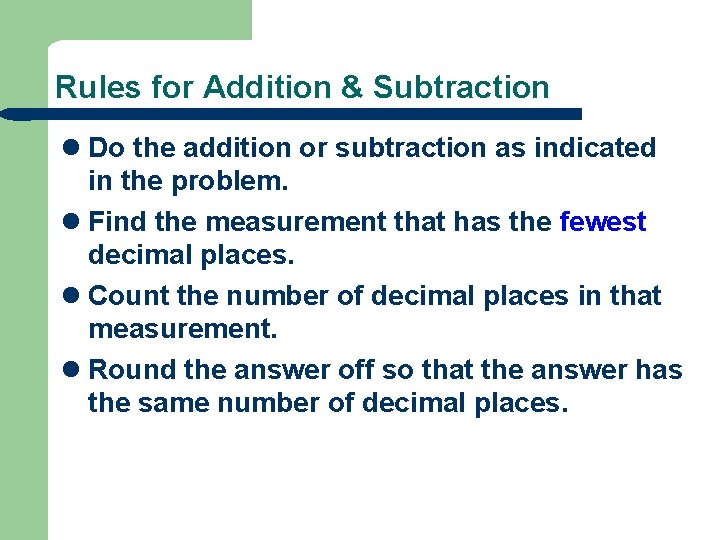
Rules for Addition & Subtraction l Do the addition or subtraction as indicated in the problem. l Find the measurement that has the fewest decimal places. l Count the number of decimal places in that measurement. l Round the answer off so that the answer has the same number of decimal places.
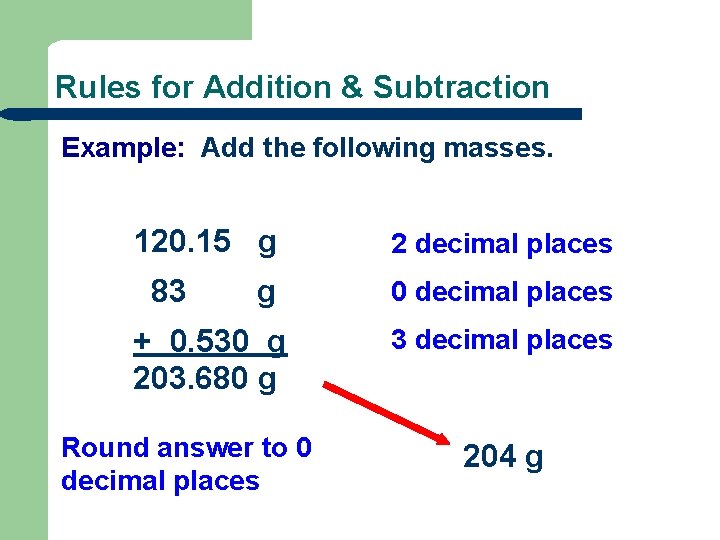
Rules for Addition & Subtraction Example: Add the following masses. 120. 15 g 83 g + 0. 530 g 203. 680 g Round answer to 0 decimal places 2 decimal places 0 decimal places 3 decimal places 204 g
Unit Analysis l Unit Analysis n A systematic method for solving problems in which units are carried thru the entire problem l units are multiplied together, divided into each other, or cancelled n Helps communicate your thinking n Helps ensure that solutions have the proper units n Uses conversion factors
Conversion Factors l Conversion Factor n a fraction whose numerator and denominator are the same quantity expressed in different units n used to change from one unit to another
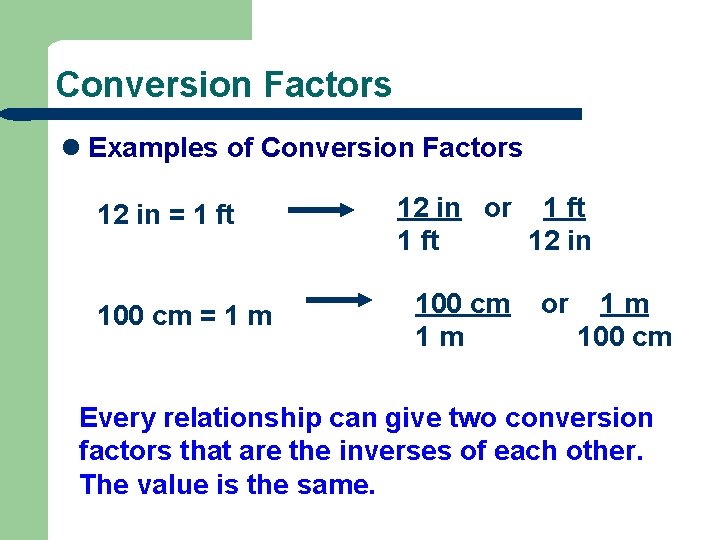
Conversion Factors l Examples of Conversion Factors 12 in = 1 ft 100 cm = 1 m 12 in or 1 ft 12 in 100 cm 1 m or 1 m 100 cm Every relationship can give two conversion factors that are the inverses of each other. The value is the same.
Unit Analysis - One Conversion Factor Example: A lab bench is 175 inches long. What is its length in feet?
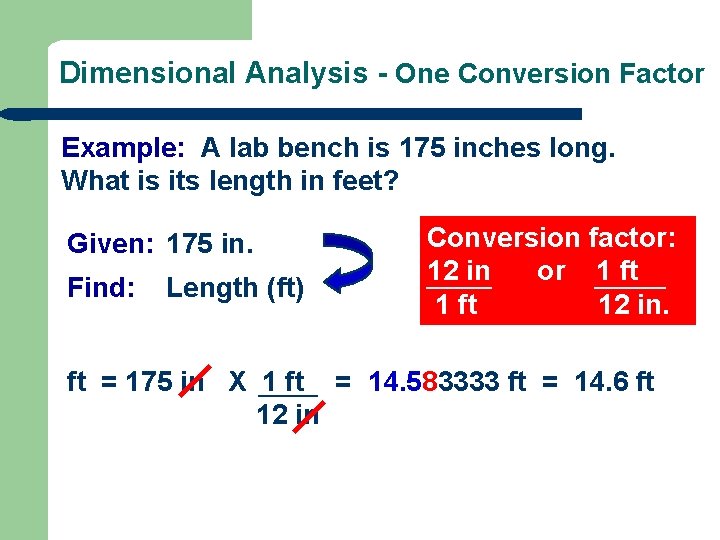
Dimensional Analysis - One Conversion Factor Example: A lab bench is 175 inches long. What is its length in feet? Given: 175 in. Find: Length (ft) Conversion factor: 12 in or 1 ft 12 in. ft = 175 in X 1 ft = 14. 583333 ft = 14. 6 ft 12 in
Dimensional Analysis - One Conversion Factor Example: A marble rolled 50. 0 mm. How many meters did it roll?
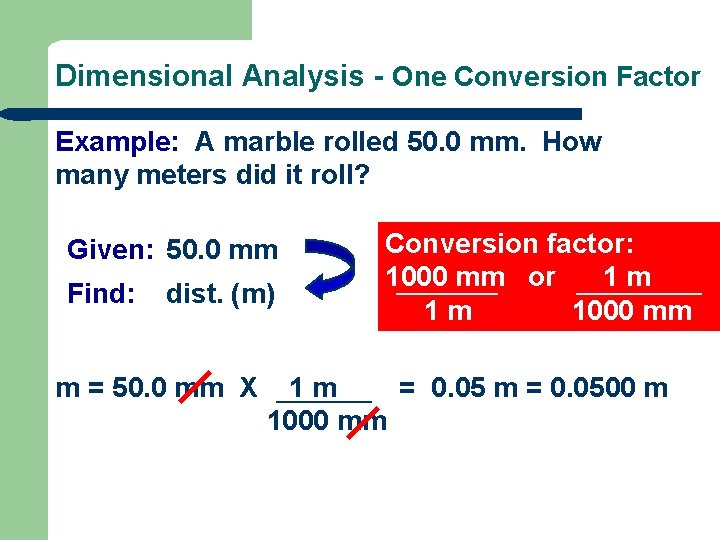
Dimensional Analysis - One Conversion Factor Example: A marble rolled 50. 0 mm. How many meters did it roll? Given: 50. 0 mm Find: dist. (m) m = 50. 0 mm X Conversion factor: 1000 mm or 1 m 1 m 1000 mm 1 m = 0. 0500 m 1000 mm
Dimensional Analysis - One Conversion Factor Example: In Germany, a salesman I was with drove at 185 km/hr. What was our speed in mi/hr?
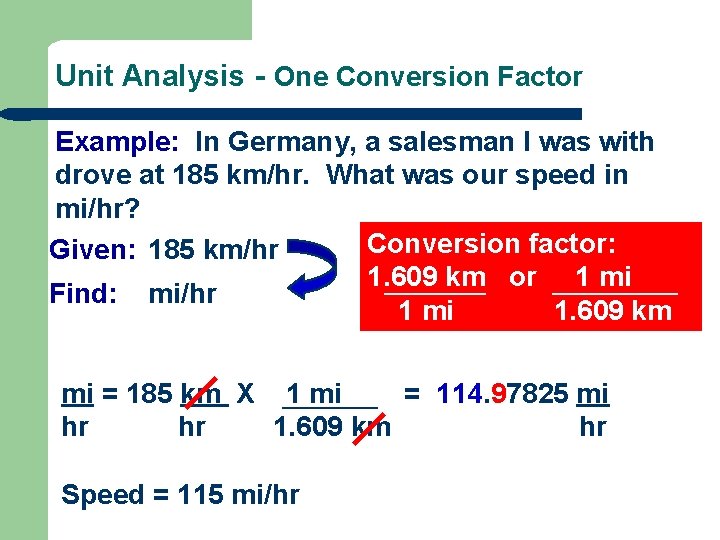
Unit Analysis - One Conversion Factor Example: In Germany, a salesman I was with drove at 185 km/hr. What was our speed in mi/hr? Conversion factor: Given: 185 km/hr 1. 609 km or 1 mi Find: mi/hr 1 mi 1. 609 km mi = 185 km X 1 mi = 114. 97825 mi hr hr 1. 609 km hr Speed = 115 mi/hr
Homework l p. 58 - 5, 6 l P. 60 - 9, 10 l P 62 - 13, 14
- Slides: 27