
The HighResolution Solar Reference Spectrum between 250 and
The High-Resolution Solar Reference Spectrum between 250 and 550 nm and its Application to Measurements with the Ozone Monitoring Instrument Marcel Dobber et al. Solar Phys (2008) 249: 281– 291, DOI 10. 1007/s 11207 -008 -9187 -7 1 December 2016 GSICS/CEOS web meeting on Reference Solar Spectrum 1
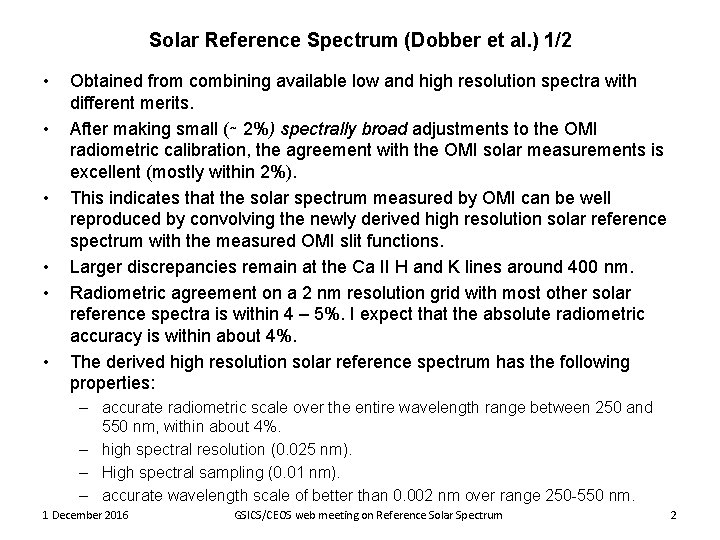
Solar Reference Spectrum (Dobber et al. ) 1/2 • • • Obtained from combining available low and high resolution spectra with different merits. After making small (∼ 2%) spectrally broad adjustments to the OMI radiometric calibration, the agreement with the OMI solar measurements is excellent (mostly within 2%). This indicates that the solar spectrum measured by OMI can be well reproduced by convolving the newly derived high resolution solar reference spectrum with the measured OMI slit functions. Larger discrepancies remain at the Ca II H and K lines around 400 nm. Radiometric agreement on a 2 nm resolution grid with most other solar reference spectra is within 4 – 5%. I expect that the absolute radiometric accuracy is within about 4%. The derived high resolution solar reference spectrum has the following properties: – accurate radiometric scale over the entire wavelength range between 250 and 550 nm, within about 4%. – high spectral resolution (0. 025 nm). – High spectral sampling (0. 01 nm). – accurate wavelength scale of better than 0. 002 nm over range 250 -550 nm. 1 December 2016 GSICS/CEOS web meeting on Reference Solar Spectrum 2
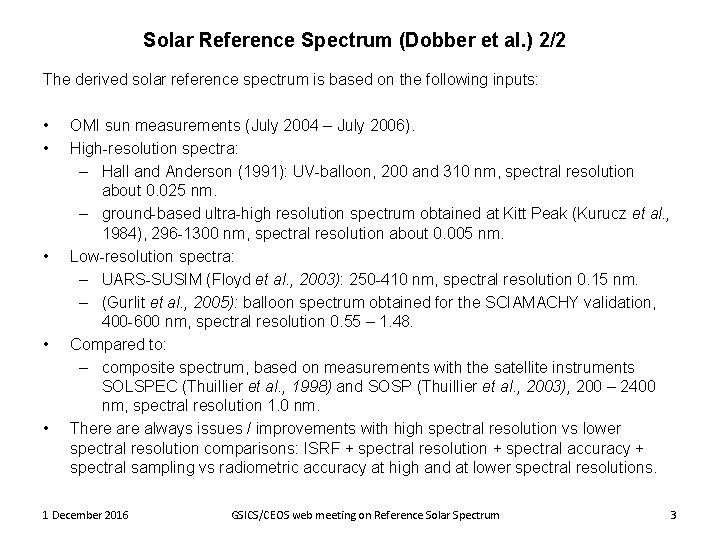
Solar Reference Spectrum (Dobber et al. ) 2/2 The derived solar reference spectrum is based on the following inputs: • • • OMI sun measurements (July 2004 – July 2006). High-resolution spectra: – Hall and Anderson (1991): UV-balloon, 200 and 310 nm, spectral resolution about 0. 025 nm. – ground-based ultra-high resolution spectrum obtained at Kitt Peak (Kurucz et al. , 1984), 296 -1300 nm, spectral resolution about 0. 005 nm. Low-resolution spectra: – UARS-SUSIM (Floyd et al. , 2003): 250 -410 nm, spectral resolution 0. 15 nm. – (Gurlit et al. , 2005): balloon spectrum obtained for the SCIAMACHY validation, 400 -600 nm, spectral resolution 0. 55 – 1. 48. Compared to: – composite spectrum, based on measurements with the satellite instruments SOLSPEC (Thuillier et al. , 1998) and SOSP (Thuillier et al. , 2003), 200 – 2400 nm, spectral resolution 1. 0 nm. There always issues / improvements with high spectral resolution vs lower spectral resolution comparisons: ISRF + spectral resolution + spectral accuracy + spectral sampling vs radiometric accuracy at high and at lower spectral resolutions. 1 December 2016 GSICS/CEOS web meeting on Reference Solar Spectrum 3
- Slides: 3