
Implementation of the Common Core State Standards WRITING


- Slides: 23
Implementation of the Common Core State Standards WRITING
The CCSS 3 Text Types Argument Informational/Explanatory Writing Narrative
Arguments are used for many purposes—to change the reader’s point of view, to bring about some action on the reader’s part, or to ask the reader to accept the writer’s explanation or evaluation of a concept, issue, or problem. An argument is a reasoned, logical way of demonstrating that the writer’s position, belief, or conclusion is valid. In grades K– 5, the term “opinion” is used to refer to this developing form of argument.
Are we preparing our students for the future? English and education professor Gerald Graff (2003) writes that “argument literacy” is fundamental to being educated. The university is largely an “argument culture, ” Graff contends; therefore, K– 12 schools should “teach the conflicts” so that students are adept at understanding and engaging in argument (both oral and written) when they enter college. He claims that because argument is not standard in most school curricula, only 20 percent of those who enter college are prepared in this respect.
Are our students prepared for college? A 2009 ACT national curriculum survey of postsecondary instructors of composition, freshman English, and survey of American literature courses (ACT, Inc. , 2009) found that “write to argue or persuade readers” was virtually tied with “write to convey information” as the most important type of writing needed by incoming college students.
Argument and Persuasion: What’s the difference? Persuasive Strategies: appeal to the credibility, character, or authority of the writer (or speaker) establish that they are knowledgeable and trustworthy, audiences are more likely to believe what they say appeal to the audience’s self-interest, sense of identity, or emotions, any of which can sway an audience. A logical argument, on the other hand… convinces the audience because of the perceived merit and reasonableness of the claims and proofs The CCSS place special emphasis on writing logical arguments as a particularly important form of college- and career-ready writing.
Examples of Argument: ELA make claims about the worth or meaning of a literary work or works defend interpretations or judgments with evidence from the text(s) they are writing about
Examples of Argument: History/Social Studies analyze evidence from multiple primary and secondary sources to advance a claim that is best supported by the evidence argue for a historically or empirically situated interpretation
Examples of Argument: Science make claims in the form of statements or conclusions that answer questions or address problems marshal evidence and draw on their understanding of scientific concepts to argue in support of their claims
Examples of Argument in Younger Grades develop a variety of methods to extend and elaborate by… providing examples offering reasons for their assertions explaining cause and effect These kinds of expository structures are steps on the road to argument.
Informational/Explanatory Writing Informational/explanatory writing conveys information accurately. This kind of writing serves one or more closely related purposes: to increase readers’ knowledge of a subject, to help readers better understand a procedure or process, or to provide readers with an enhanced comprehension of a concept.
Informational/Explanatory Writing Informational/explanatory writing addresses matters such as… Types Example: What are the different types of poetry? Components Example: What are the parts of a motor? Size, Function, or Behavior Example: How big is the United States? What is an X-ray used for? How do penguins find food? How things work Example: How does the legislative branch of government function? Why things happen Example: Why do some authors blend genres?
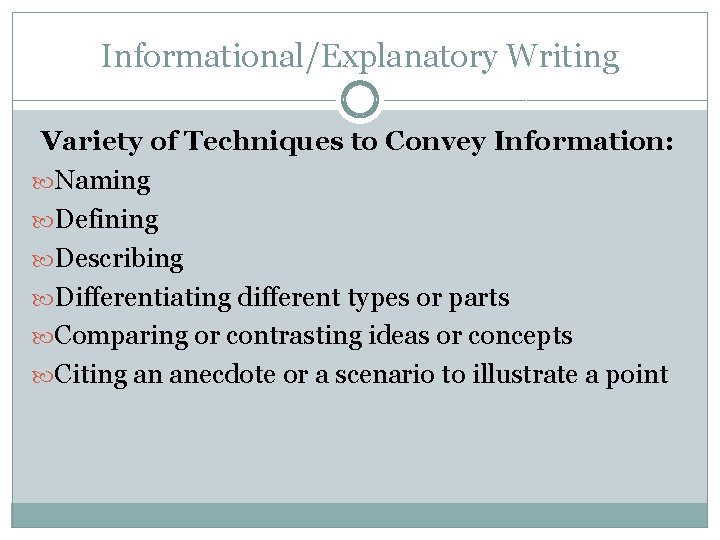
Informational/Explanatory Writing Variety of Techniques to Convey Information: Naming Defining Describing Differentiating different types or parts Comparing or contrasting ideas or concepts Citing an anecdote or a scenario to illustrate a point
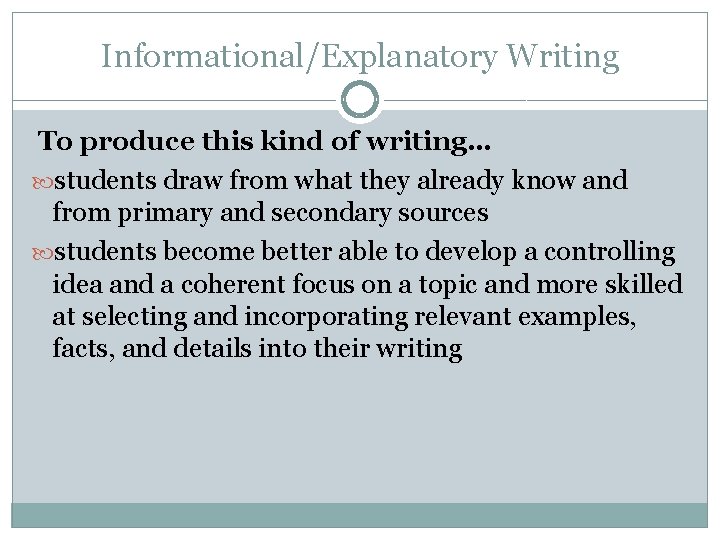
Informational/Explanatory Writing To produce this kind of writing… students draw from what they already know and from primary and secondary sources students become better able to develop a controlling idea and a coherent focus on a topic and more skilled at selecting and incorporating relevant examples, facts, and details into their writing
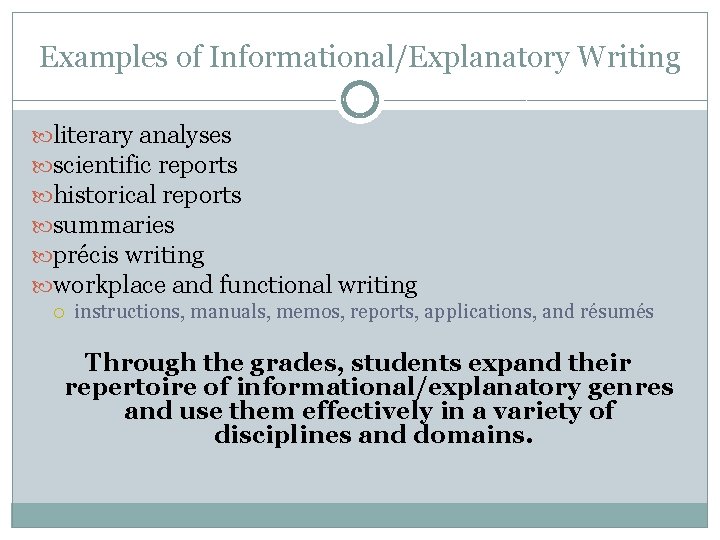
Examples of Informational/Explanatory Writing literary analyses scientific reports historical reports summaries précis writing workplace and functional writing instructions, manuals, memos, reports, applications, and résumés Through the grades, students expand their repertoire of informational/explanatory genres and use them effectively in a variety of disciplines and domains.
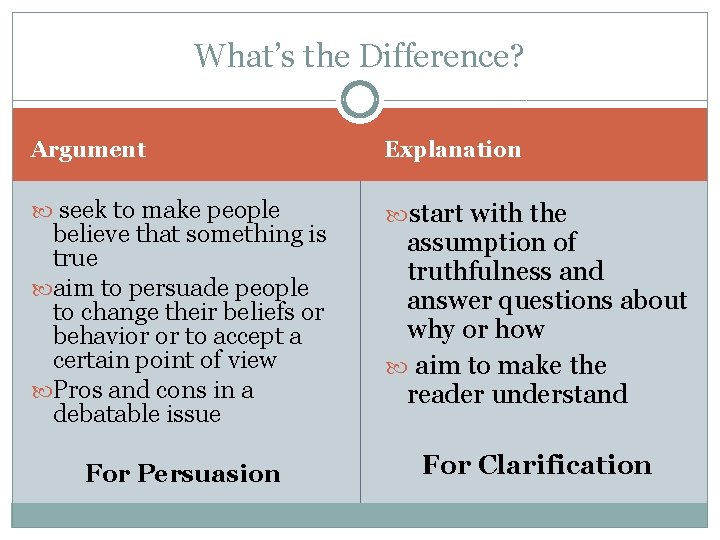
What’s the Difference? Argument Explanation seek to make people start with the believe that something is true aim to persuade people to change their beliefs or behavior or to accept a certain point of view Pros and cons in a debatable issue For Persuasion assumption of truthfulness and answer questions about why or how aim to make the reader understand For Clarification
Narrative conveys experience, either real or imaginary, and uses time as its deep structure can be used for many purposes, such as. . to inform to instruct to persuade to entertain
Examples of Narrative in ELA Creative fictional stories Memoirs Anecdotes Autobiographies Over time, they learn to provide visual details of scenes, objects, or people; to depict specific actions (for example, movements, gestures
Examples of Narrative in ELA Over time, they learn to… provide visual details of scenes, objects, or people; to depict specific actions (for example, movements, gestures, postures, and expressions) to use dialogue and interior monologue that provide insight into the narrator’s and characters’ personalities and motives to manipulate pace to highlight the significance of events and create tension and suspense
Examples of Narrative in History, Social Studies, and Science History/Social Studies write narrative accounts about individuals construct event models of what happened, selecting from their sources only the most relevant information Science: narrative descriptions of the step-by-step procedures they follow in their investigations so that others can replicate their procedures and (perhaps) reach the same results expand their repertoire and control of different narrative strategies
Text that Blends the Types Skilled writers many times use a blend of these three text types to accomplish their purposes. Examples: The Longitude Prize, included in Appendix B, embeds narrative elements within a largely expository structure. Effective student writing can also cross the boundaries of type, as does the grade 12 student sample “Fact vs. Fiction and All the Grey Space In Between” found in Appendix C.
A Closer Look… Let’s take a closer look at samples texts in Appendix C.
Coming Back Together with Discussion What do you think of the text samples? Any discussion…