
940701 56 slides http academicstaff kmu ac iraliasadipour









- Slides: 56
940701. . . 56 slides http: \academicstaff. kmu. ac. iraliasadipour 1
940701. . . 56 slides http: \academicstaff. kmu. ac. iraliasadipour 2
The End!!!!!!! 940701. . . 56 slides http: \academicstaff. kmu. ac. iraliasadipour 3
Chemical Kinetics (Mark=2) 940701. . . 56 slides http: \academicstaff. kmu. ac. iraliasadipour 5
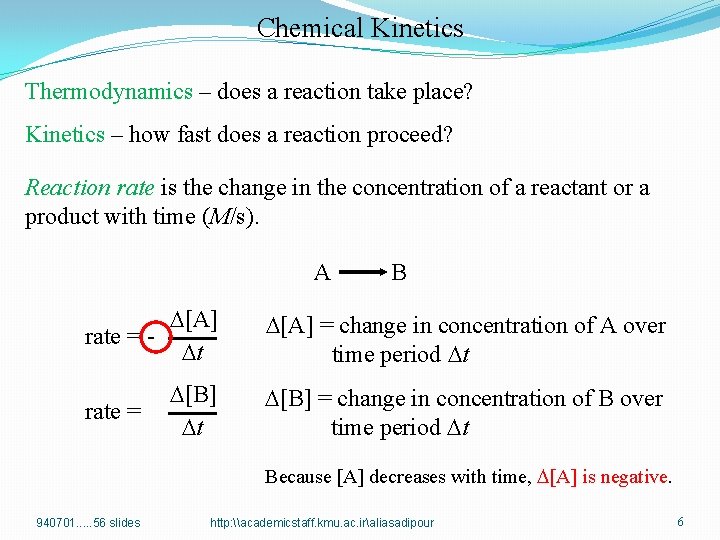
Chemical Kinetics Thermodynamics – does a reaction take place? Kinetics – how fast does a reaction proceed? Reaction rate is the change in the concentration of a reactant or a product with time (M/s). A B D[A] rate = Dt D[A] = change in concentration of A over time period Dt D[B] = change in concentration of B over time period Dt rate = Because [A] decreases with time, D[A] is negative. 940701. . . 56 slides http: \academicstaff. kmu. ac. iraliasadipour 6
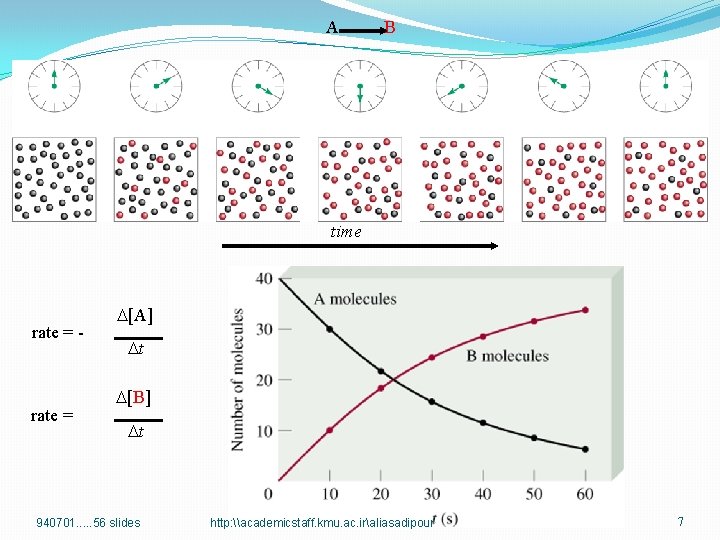
A B time rate = - rate = D[A] Dt D[B] Dt 940701. . . 56 slides http: \academicstaff. kmu. ac. iraliasadipour 7
Reaction Rates �Reaction rate = change in concentration of a reactant or product with time. �Three “types” of rates �initial rate �average rate �instantaneous rate 940701. . . 56 slides http: \academicstaff. kmu. ac. iraliasadipour 8
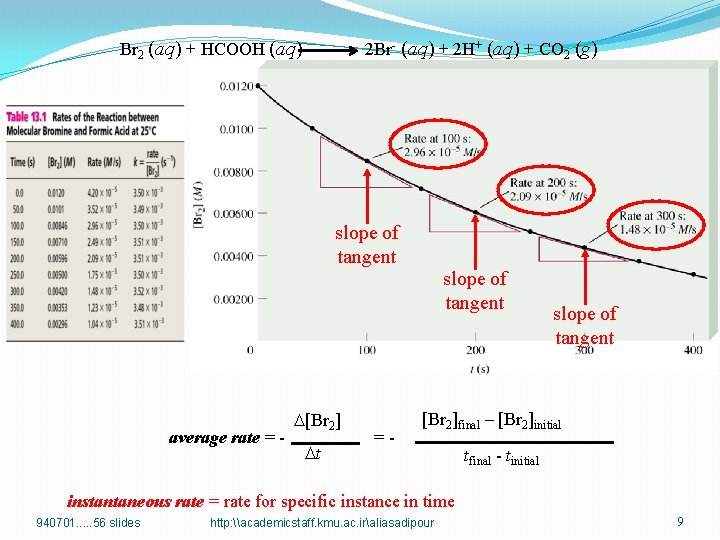
Br 2 (aq) + HCOOH (aq) 2 Br- (aq) + 2 H+ (aq) + CO 2 (g) slope of tangent average rate = - D[Br 2] Dt =- slope of tangent [Br 2]final – [Br 2]initial tfinal - tinitial instantaneous rate = rate for specific instance in time 940701. . . 56 slides http: \academicstaff. kmu. ac. iraliasadipour 9
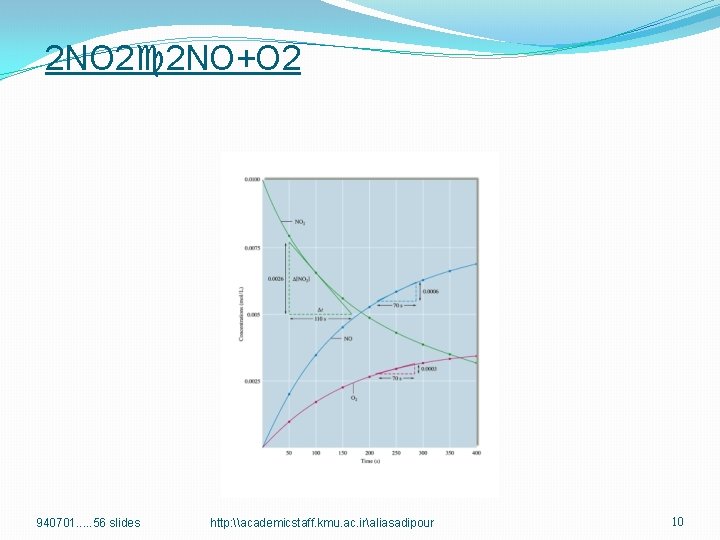
2 NO 2 2 NO+O 2 940701. . . 56 slides http: \academicstaff. kmu. ac. iraliasadipour 10
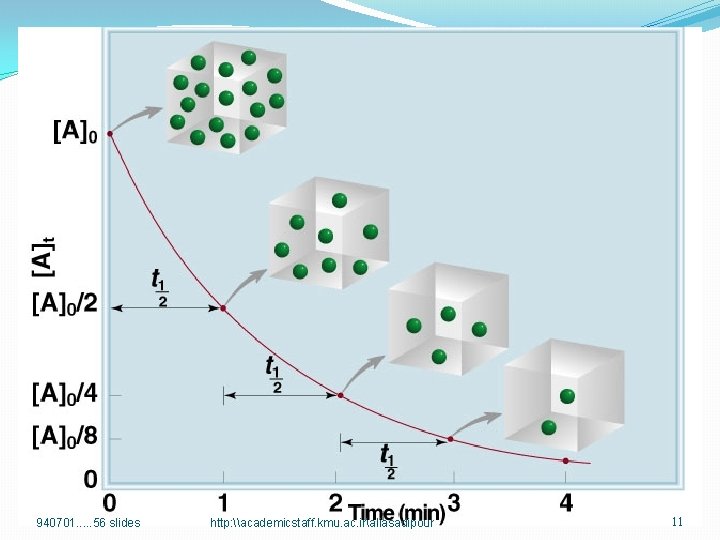
940701. . . 56 slides http: \academicstaff. kmu. ac. iraliasadipour 11
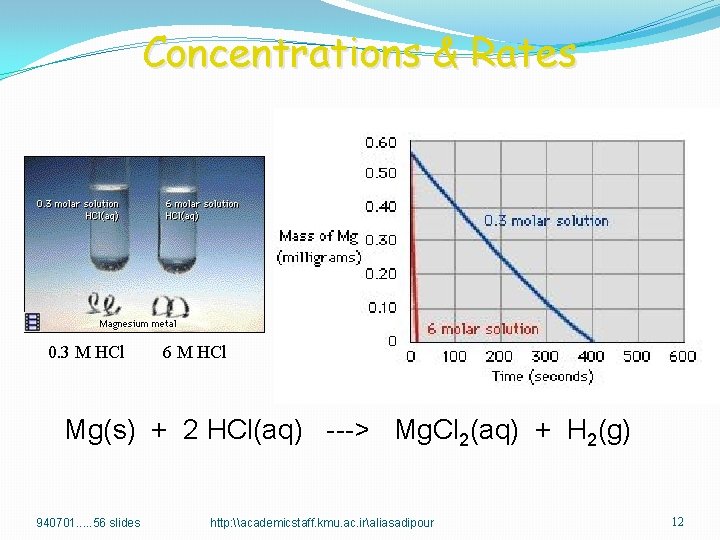
Concentrations & Rates 0. 3 M HCl 6 M HCl Mg(s) + 2 HCl(aq) ---> Mg. Cl 2(aq) + H 2(g) 940701. . . 56 slides http: \academicstaff. kmu. ac. iraliasadipour 12
940701. . . 56 slides http: \academicstaff. kmu. ac. iraliasadipour 13
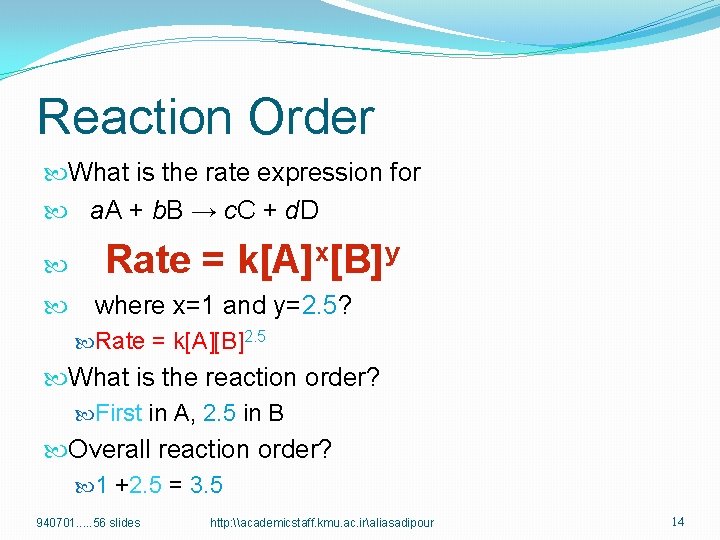
Reaction Order What is the rate expression for a. A + b. B → c. C + d. D Rate = k[A]x[B]y where x=1 and y=2. 5? Rate = k[A][B]2. 5 What is the reaction order? First in A, 2. 5 in B Overall reaction order? 1 +2. 5 = 3. 5 940701. . . 56 slides http: \academicstaff. kmu. ac. iraliasadipour 14
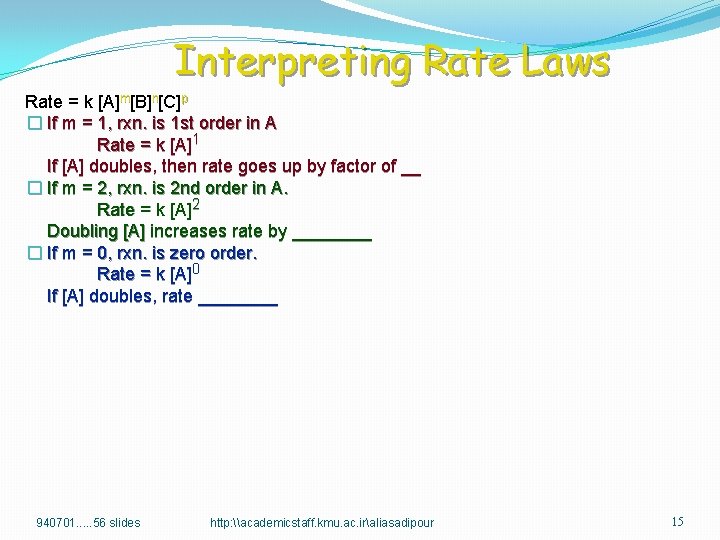
Interpreting Rate Laws Rate = k [A]m[B]n[C]p � If m = 1, rxn. is 1 st order in A Rate = k [A]1 If [A] doubles, then rate goes up by factor of __ � If m = 2, rxn. is 2 nd order in A. Rate = k [A]2 Doubling [A] increases rate by ____ � If m = 0, rxn. is zero order. Rate = k [A]0 If [A] doubles, rate ____ 940701. . . 56 slides http: \academicstaff. kmu. ac. iraliasadipour 15
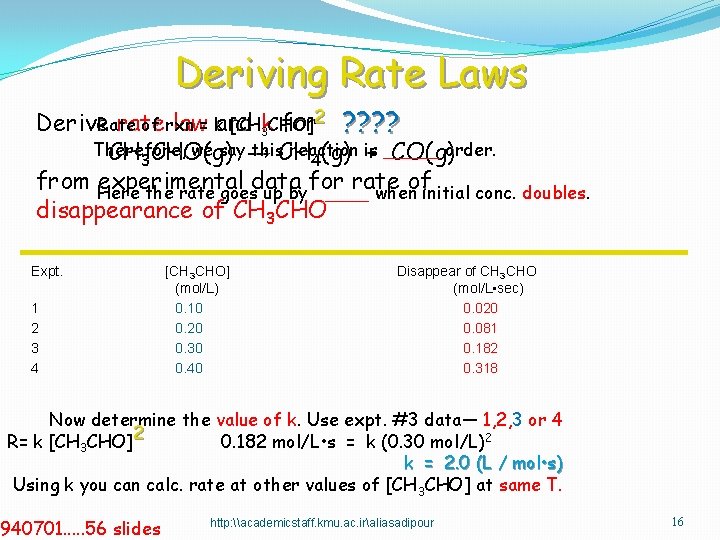
Deriving Rate Laws Derive rate law= kand for 2 ? ? Rate of rxn [CH 3 k. CHO] Therefore, we say → this. CH reaction is _____ order. CH 3 CHO(g) 4(g) + CO(g) from Here experimental data for rate of the rate goes up by _____ when initial conc. doubles. disappearance of CH 3 CHO Expt. 1 2 3 4 [CH 3 CHO] (mol/L) 0. 10 0. 20 0. 30 0. 40 Disappear of CH 3 CHO (mol/L • sec) 0. 020 0. 081 0. 182 0. 318 Now determine the value of k. Use expt. #3 data— 1, 2, 3 or 4 R= k [CH 3 CHO]2 0. 182 mol/L • s = k (0. 30 mol/L)2 k = 2. 0 (L / mol • s) Using k you can calc. rate at other values of [CH 3 CHO] at same T. 940701. . . 56 slides http: \academicstaff. kmu. ac. iraliasadipour 16
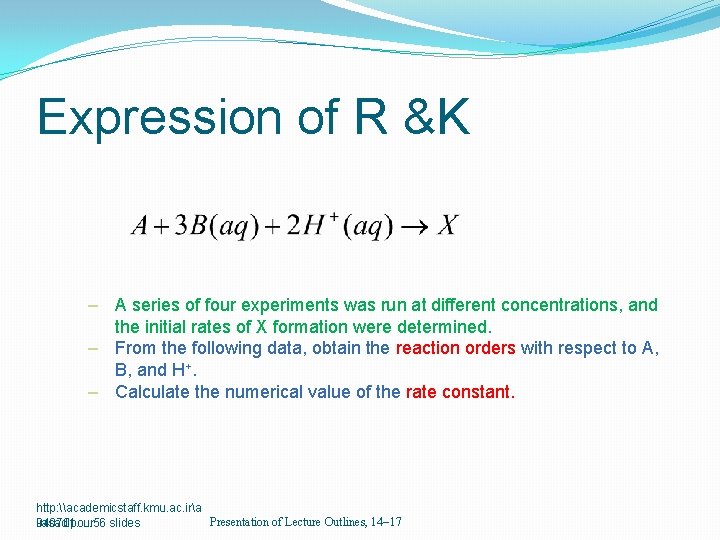
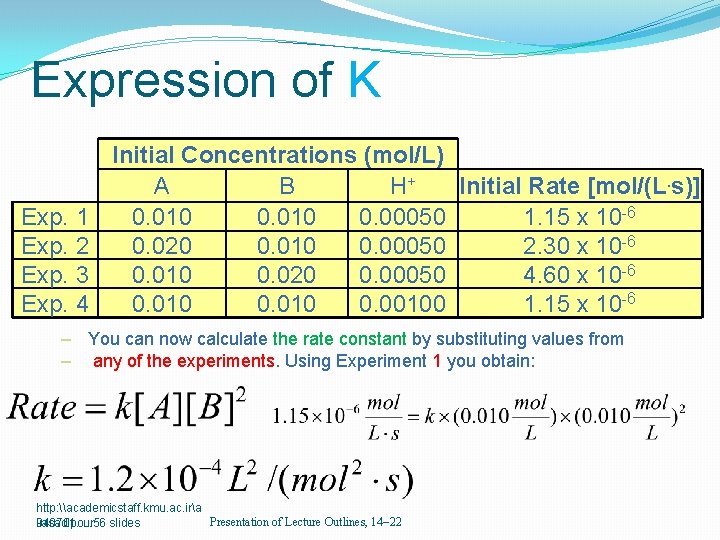
Expression of R &K – A series of four experiments was run at different concentrations, and the initial rates of X formation were determined. – From the following data, obtain the reaction orders with respect to A, B, and H+. – Calculate the numerical value of the rate constant. http: \academicstaff. kmu. ac. ira Presentation of Lecture Outlines, 14– 17 940701. . . 56 slides liasadipour
Expression of R Exp. 1 Exp. 2 Exp. 3 Exp. 4 Initial Concentrations (mol/L) A B H+ Initial Rate [mol/(L. s)] 0. 010 0. 00050 1. 15 x 10 -6 0. 020 0. 010 0. 00050 2. 30 x 10 -6 0. 010 0. 020 0. 00050 2. 30 x 10 -6 0. 010 0. 00100 1. 15 x 10 -6 – Comparing Experiment 1 and Experiment 2, you see that when the – A concentration doubles (with other concentrations constant), – the rate doubles. – This implies a first-order dependence with respect to A. http: \academicstaff. kmu. ac. ira Presentation of Lecture Outlines, 14– 18 940701. . . 56 slides liasadipour
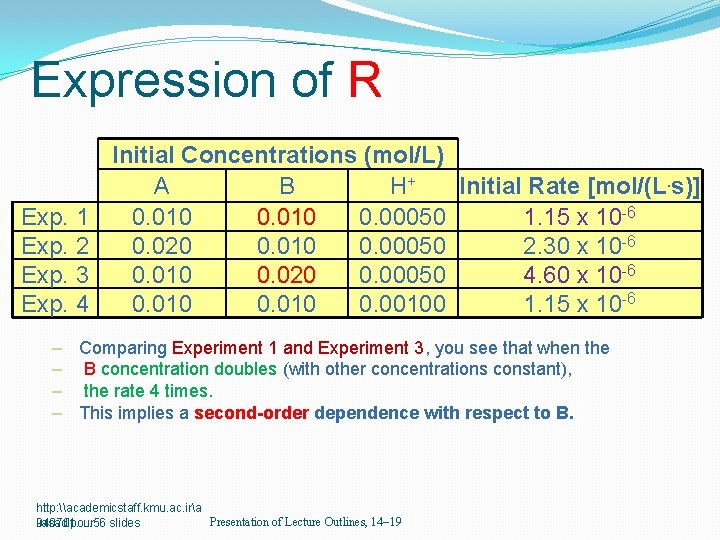
Expression of R Exp. 1 Exp. 2 Exp. 3 Exp. 4 Initial Concentrations (mol/L) A B H+ Initial Rate [mol/(L. s)] 0. 010 0. 00050 1. 15 x 10 -6 0. 020 0. 010 0. 00050 2. 30 x 10 -6 0. 010 0. 020 0. 00050 4. 60 x 10 -6 0. 010 0. 00100 1. 15 x 10 -6 – Comparing Experiment 1 and Experiment 3, you see that when the – B concentration doubles (with other concentrations constant), – the rate 4 times. – This implies a second-order dependence with respect to B. http: \academicstaff. kmu. ac. ira Presentation of Lecture Outlines, 14– 19 940701. . . 56 slides liasadipour
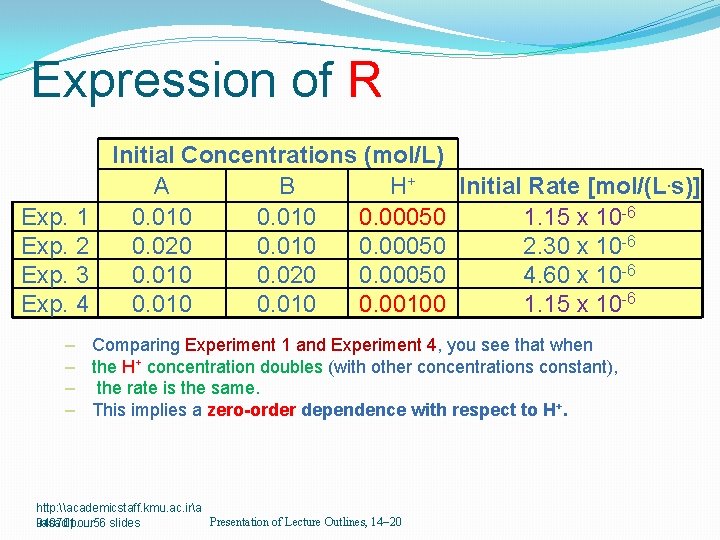
Expression of R Exp. 1 Exp. 2 Exp. 3 Exp. 4 Initial Concentrations (mol/L) A B H+ Initial Rate [mol/(L. s)] 0. 010 0. 00050 1. 15 x 10 -6 0. 020 0. 010 0. 00050 2. 30 x 10 -6 0. 010 0. 020 0. 00050 4. 60 x 10 -6 0. 010 0. 00100 1. 15 x 10 -6 – Comparing Experiment 1 and Experiment 4, you see that when – the H+ concentration doubles (with other concentrations constant), – the rate is the same. – This implies a zero-order dependence with respect to H+. http: \academicstaff. kmu. ac. ira Presentation of Lecture Outlines, 14– 20 940701. . . 56 slides liasadipour
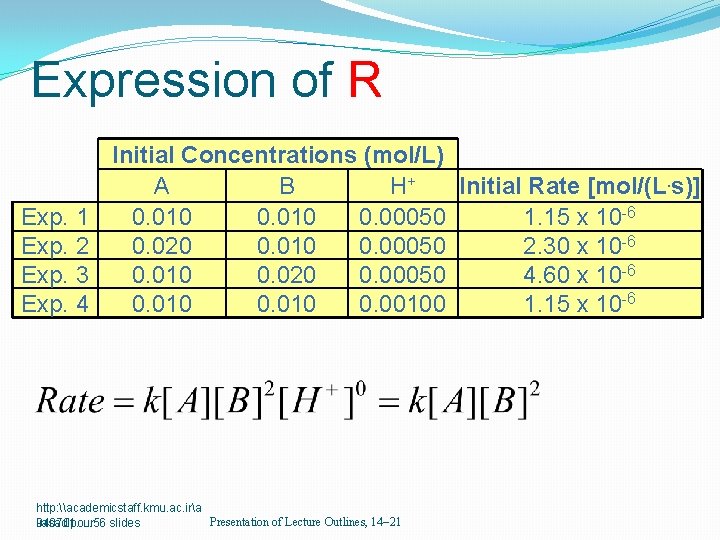
Expression of R Exp. 1 Exp. 2 Exp. 3 Exp. 4 Initial Concentrations (mol/L) A B H+ Initial Rate [mol/(L. s)] 0. 010 0. 00050 1. 15 x 10 -6 0. 020 0. 010 0. 00050 2. 30 x 10 -6 0. 010 0. 020 0. 00050 4. 60 x 10 -6 0. 010 0. 00100 1. 15 x 10 -6 http: \academicstaff. kmu. ac. ira Presentation of Lecture Outlines, 14– 21 940701. . . 56 slides liasadipour
Expression of K Exp. 1 Exp. 2 Exp. 3 Exp. 4 Initial Concentrations (mol/L) A B H+ Initial Rate [mol/(L. s)] 0. 010 0. 00050 1. 15 x 10 -6 0. 020 0. 010 0. 00050 2. 30 x 10 -6 0. 010 0. 020 0. 00050 4. 60 x 10 -6 0. 010 0. 00100 1. 15 x 10 -6 – You can now calculate the rate constant by substituting values from – any of the experiments. Using Experiment 1 you obtain: http: \academicstaff. kmu. ac. ira Presentation of Lecture Outlines, 14– 22 940701. . . 56 slides liasadipour
940701. . . 56 slides http: \academicstaff. kmu. ac. iraliasadipour 23
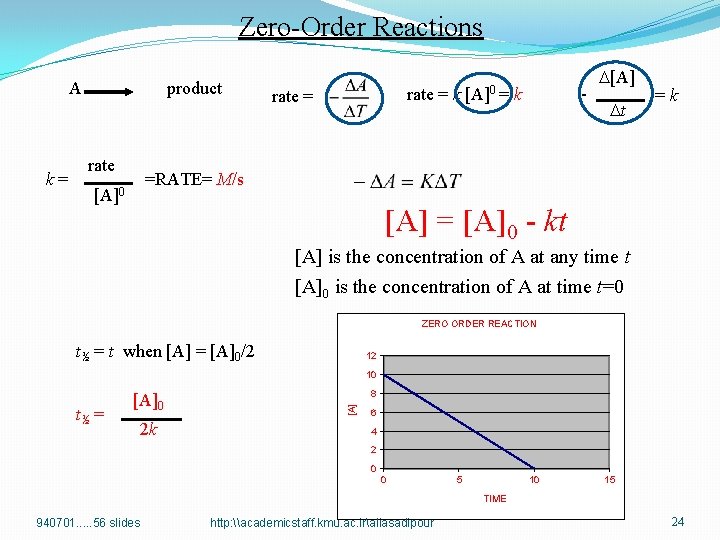
Zero-Order Reactions A k= product rate = k rate = [A]0 = - k D[A] Dt =k =RATE= M/s [A]0 [A] = [A]0 - kt [A] is the concentration of A at any time t [A]0 is the concentration of A at time t=0 ZERO ORDER REACTION t½ = t when [A] = [A]0/2 12 10 2 k 8 [A] t½ = [A]0 6 4 2 0 0 5 10 15 TIME 940701. . . 56 slides http: \academicstaff. kmu. ac. iraliasadipour 24
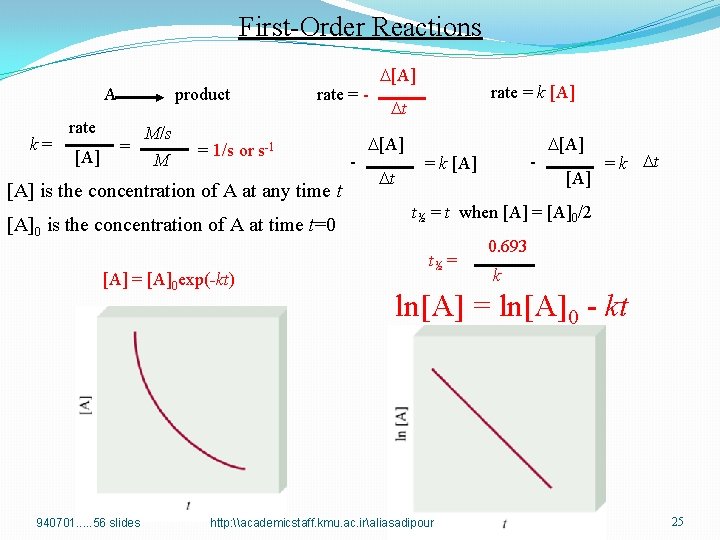
First-Order Reactions A k= rate [A] product = M/s M rate = - = 1/s or s-1 [A] is the concentration of A at any time t [A]0 is the concentration of A at time t=0 [A] = [A]0 exp(-kt) 940701. . . 56 slides - D[A] rate = k [A] Dt D[A] Dt - = k [A] D[A] = k Dt t½ = t when [A] = [A]0/2 t½ = 0. 693 k ln[A] = ln[A]0 - kt http: \academicstaff. kmu. ac. iraliasadipour 25
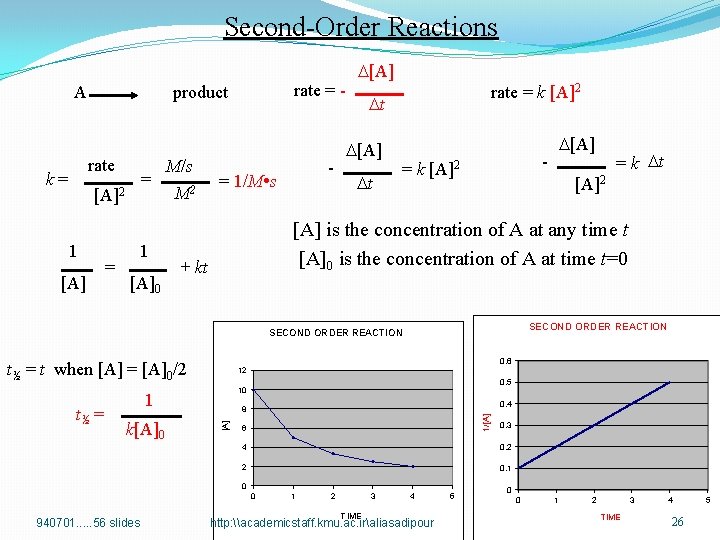
Second-Order Reactions A rate k= rate = - product M/s = M 2 [A]2 1 [A] = 1 [A]0 - = 1/M • s D[A] rate = k [A]2 Dt D[A] Dt - = k [A]2 [A] is the concentration of A at any time t [A]0 is the concentration of A at time t=0 + kt SECOND ORDER REACTION 0. 6 t½ = t when [A] = [A]0/2 12 0. 5 10 1 0. 4 1/[A] 8 [A] k[A]0 6 0. 3 4 0. 2 2 0. 1 0 0 940701. . . 56 slides = k Dt [A]2 SECOND ORDER REACTION t½ = D[A] 1 2 3 TIME 4 http: \academicstaff. kmu. ac. iraliasadipour 5 0 0 1 2 3 TIME 4 5 13. 3 26
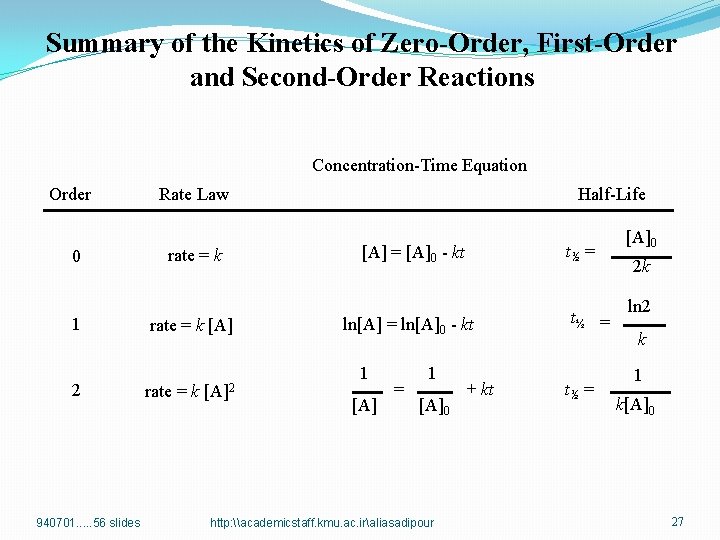
Summary of the Kinetics of Zero-Order, First-Order and Second-Order Reactions Concentration-Time Equation Order 0 Rate Law rate = k 1 rate = k [A] 2 [A]2 940701. . . 56 slides rate = k Half-Life t½ = [A]0 - kt ln[A] = ln[A]0 - kt 1 [A] = 1 [A]0 http: \academicstaff. kmu. ac. iraliasadipour + kt t½ = [A]0 2 k ln 2 k 1 k[A]0 27
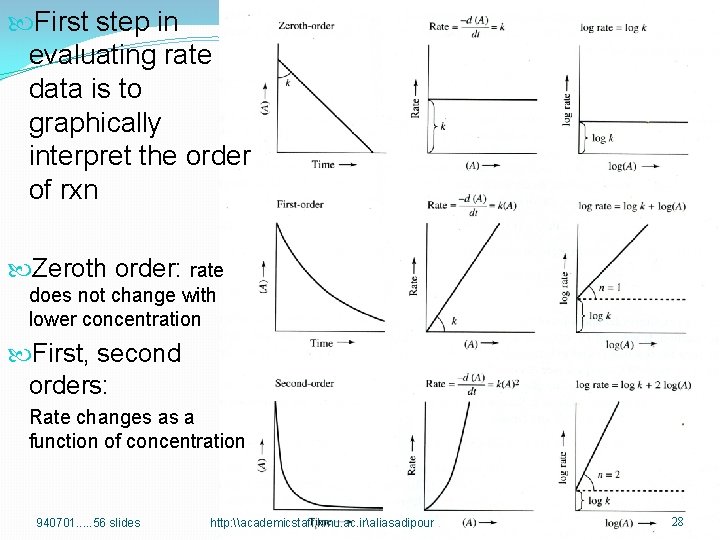
First step in evaluating rate data is to graphically interpret the order of rxn Zeroth order: rate does not change with lower concentration First, second orders: Rate changes as a function of concentration 940701. . . 56 slides http: \academicstaff. kmu. ac. iraliasadipour 28
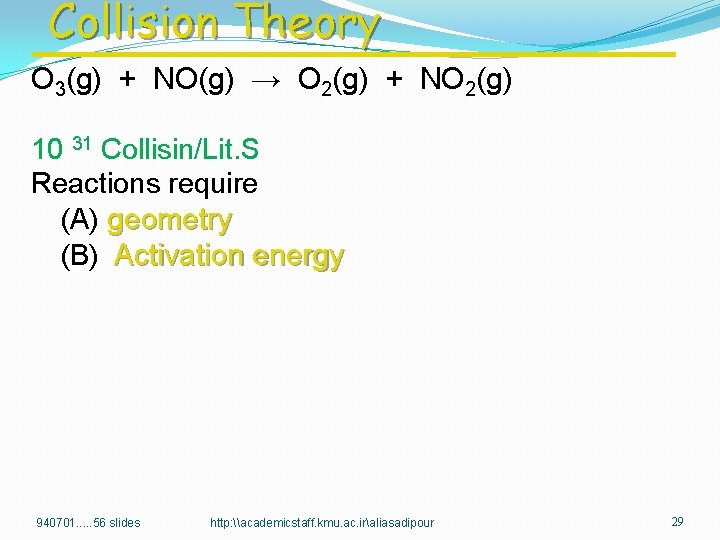
Collision Theory O 3(g) + NO(g) → O 2(g) + NO 2(g) 10 31 Collisin/Lit. S Reactions require (A) geometry (B) Activation energy 940701. . . 56 slides http: \academicstaff. kmu. ac. iraliasadipour 29
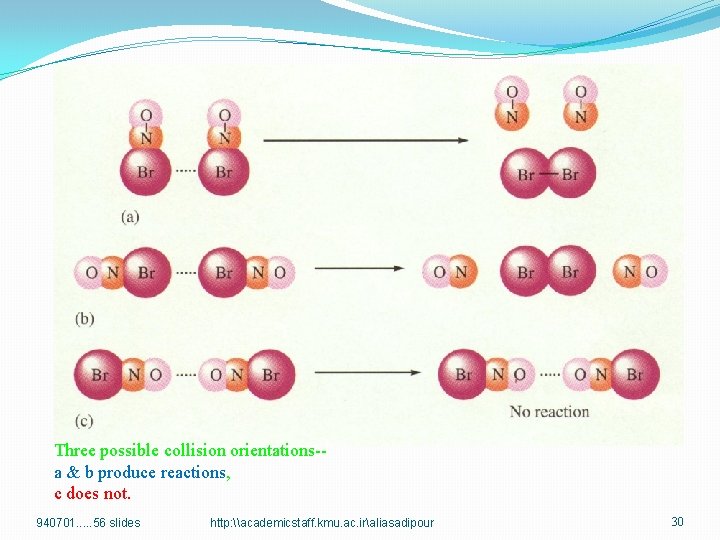
Three possible collision orientations-a & b produce reactions, c does not. 940701. . . 56 slides http: \academicstaff. kmu. ac. iraliasadipour 30
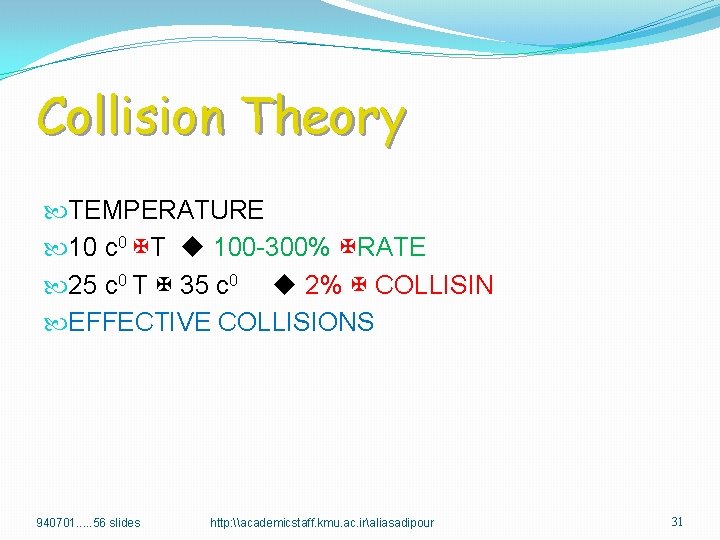
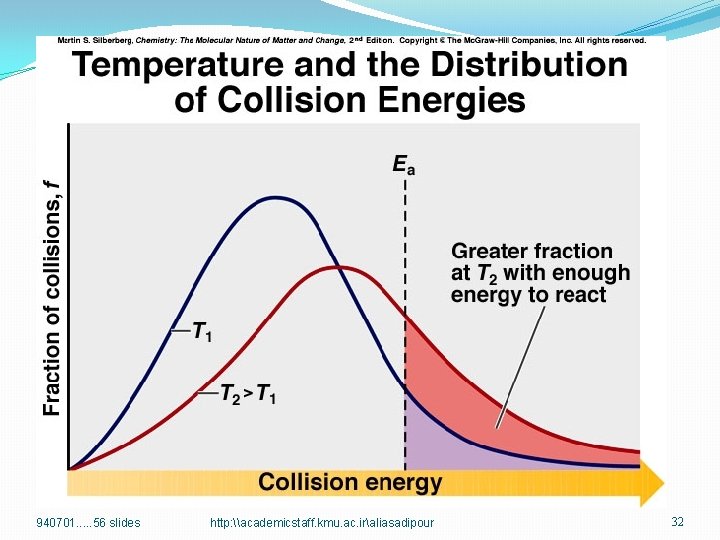
Collision Theory TEMPERATURE 10 c 0 T 100 -300% RATE 25 c 0 T 35 c 0 2% COLLISIN EFFECTIVE COLLISIONS 940701. . . 56 slides http: \academicstaff. kmu. ac. iraliasadipour 31
940701. . . 56 slides http: \academicstaff. kmu. ac. iraliasadipour 32
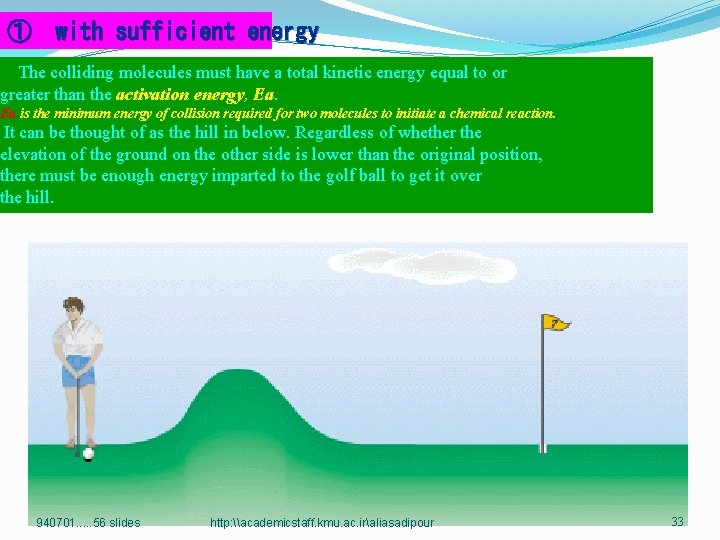
① with sufficient energy The colliding molecules must have a total kinetic energy equal to or greater than the activation energy, Ea. Ea is the minimum energy of collision required for two molecules to initiate a chemical reaction. It can be thought of as the hill in below. Regardless of whether the elevation of the ground on the other side is lower than the original position, there must be enough energy imparted to the golf ball to get it over the hill. 940701. . . 56 slides http: \academicstaff. kmu. ac. iraliasadipour 33
940701. . . 56 slides http: \academicstaff. kmu. ac. iraliasadipour 34
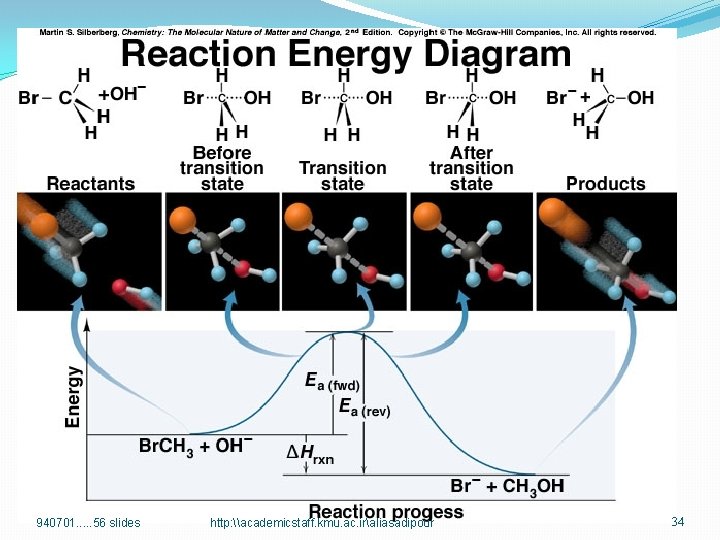
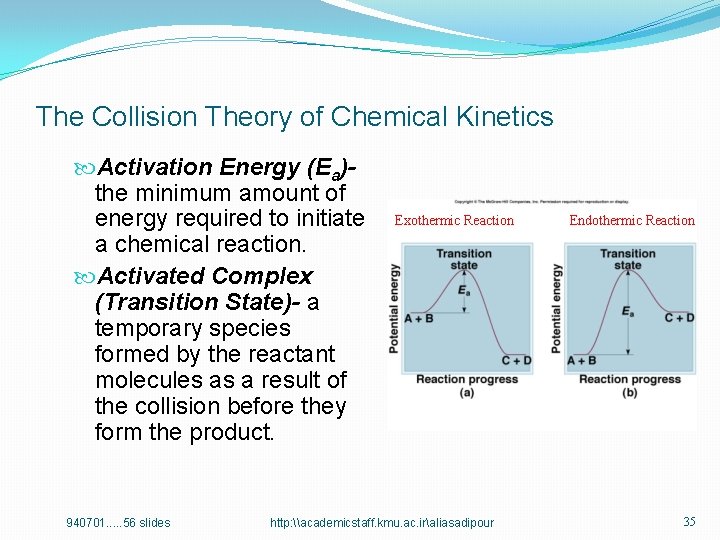
The Collision Theory of Chemical Kinetics Activation Energy (Ea)the minimum amount of energy required to initiate a chemical reaction. Activated Complex (Transition State)- a temporary species formed by the reactant molecules as a result of the collision before they form the product. 940701. . . 56 slides Exothermic Reaction http: \academicstaff. kmu. ac. iraliasadipour Endothermic Reaction 35
940701. . . 56 slides http: \academicstaff. kmu. ac. iraliasadipour 36
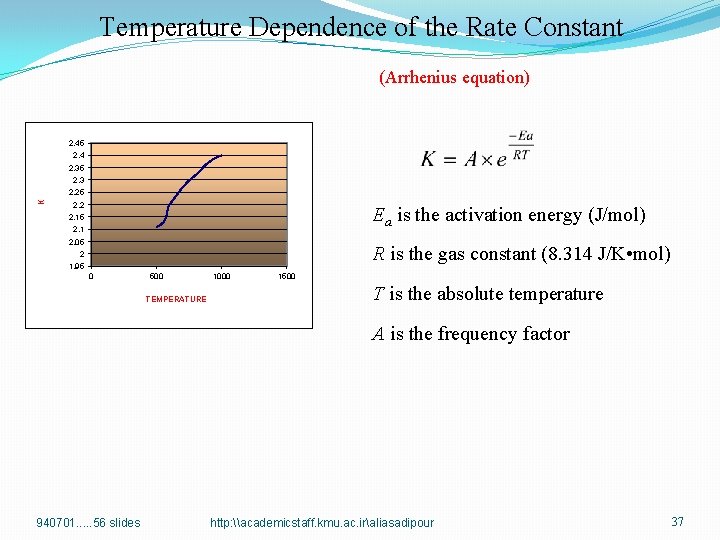
Temperature Dependence of the Rate Constant (Arrhenius equation) 2. 45 2. 4 2. 35 2. 3 K 2. 25 2. 2 Ea is the activation energy (J/mol) 2. 15 2. 1 2. 05 R is the gas constant (8. 314 J/K • mol) 2 1. 95 0 500 TEMPERATURE 1000 1500 T is the absolute temperature A is the frequency factor 940701. . . 56 slides http: \academicstaff. kmu. ac. iraliasadipour 37
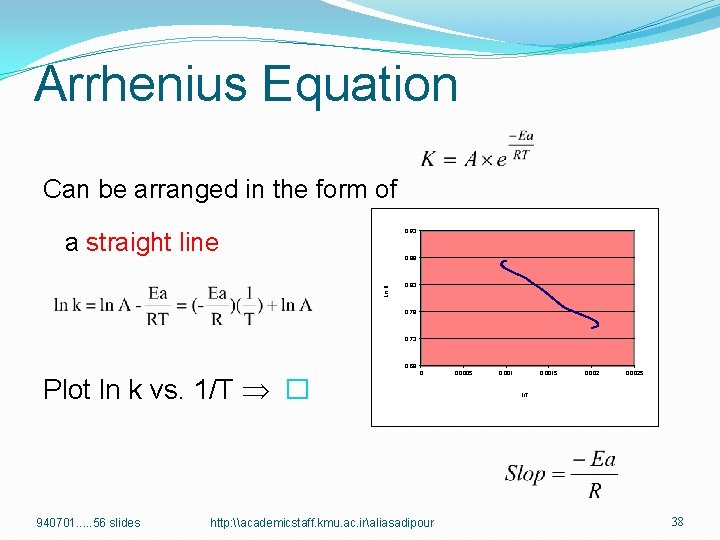
Arrhenius Equation Can be arranged in the form of a straight line 0. 93 Ln K 0. 88 0. 83 0. 78 0. 73 0. 68 Plot ln k vs. 1/T � 940701. . . 56 slides 0 http: \academicstaff. kmu. ac. iraliasadipour 0. 0005 0. 0015 0. 0025 1/T 38
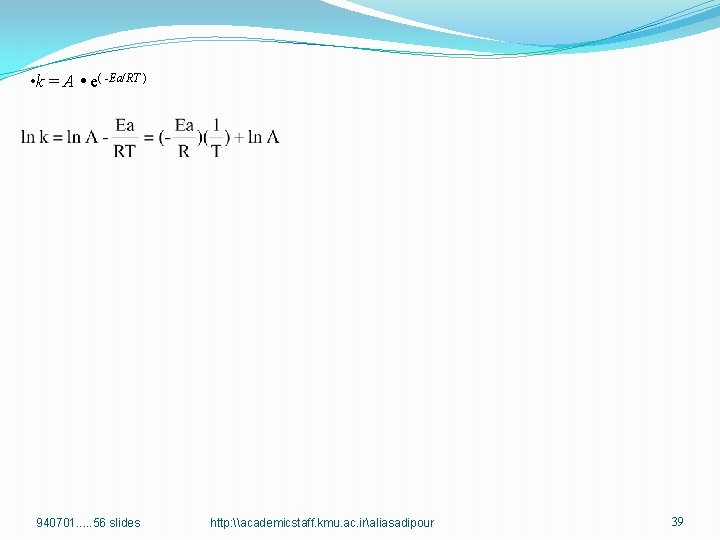
• k = A • e( -Ea/RT ) 940701. . . 56 slides http: \academicstaff. kmu. ac. iraliasadipour 39
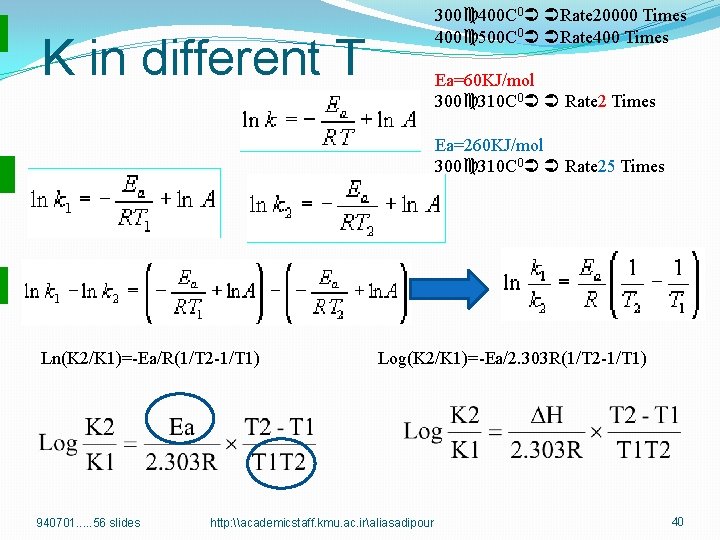
300 400 C 0 Rate 20000 Times 400 500 C 0 Rate 400 Times K in different T Ea=60 KJ/mol 300 310 C 0 Rate 2 Times Ea=260 KJ/mol 300 310 C 0 Rate 25 Times Ln(K 2/K 1)=-Ea/R(1/T 2 -1/T 1) 940701. . . 56 slides Log(K 2/K 1)=-Ea/2. 303 R(1/T 2 -1/T 1) http: \academicstaff. kmu. ac. iraliasadipour 40
940701. . . 56 slides http: \academicstaff. kmu. ac. iraliasadipour 41
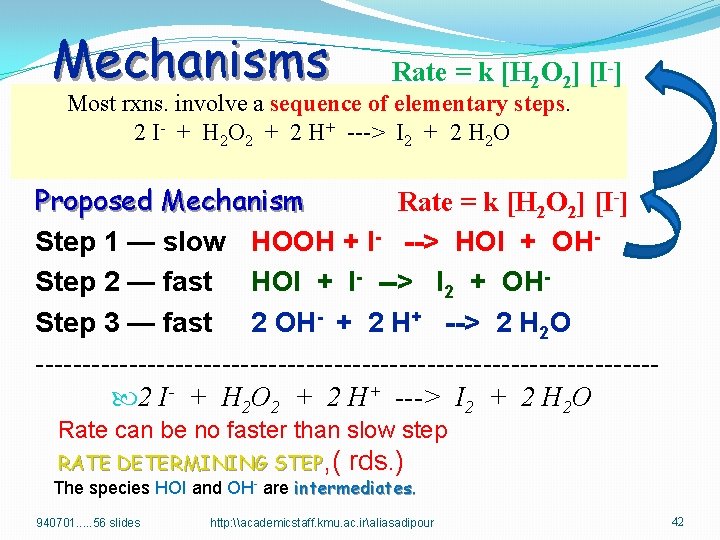
Mechanisms Rate = k [H 2 O 2] [I-] Most rxns. involve a sequence of elementary steps. 2 I- + H 2 O 2 + 2 H+ ---> I 2 + 2 H 2 O Proposed Mechanism Rate = k [H 2 O 2] [I-] Step 1 — slow HOOH + I- --> HOI + OHStep 2 — fast HOI + I- --> I 2 + OHStep 3 — fast 2 OH- + 2 H+ --> 2 H 2 O --------------------------------- 2 I- + H 2 O 2 + 2 H+ ---> I 2 + 2 H 2 O Rate can be no faster than slow step RATE DETERMINING STEP, ( rds. ) The species HOI and OH- are intermediates. 940701. . . 56 slides http: \academicstaff. kmu. ac. iraliasadipour 42
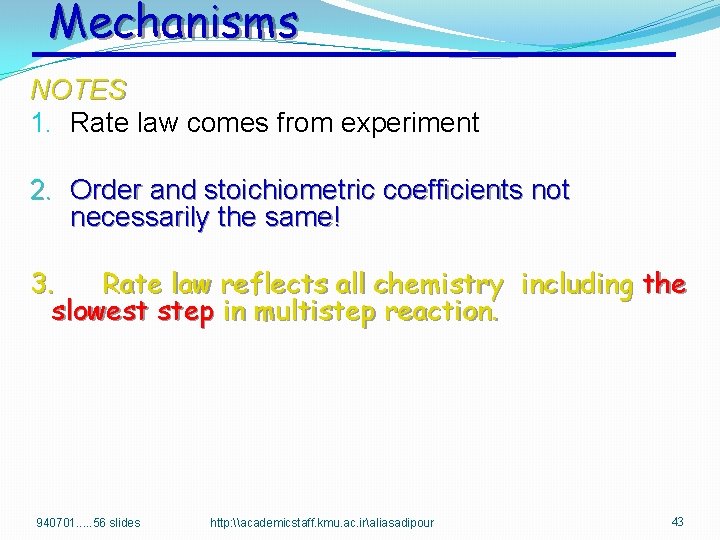
Mechanisms NOTES 1. Rate law comes from experiment 2. Order and stoichiometric coefficients not necessarily the same! 3. Rate law reflects all chemistry including the slowest step in multistep reaction. 940701. . . 56 slides http: \academicstaff. kmu. ac. iraliasadipour 43
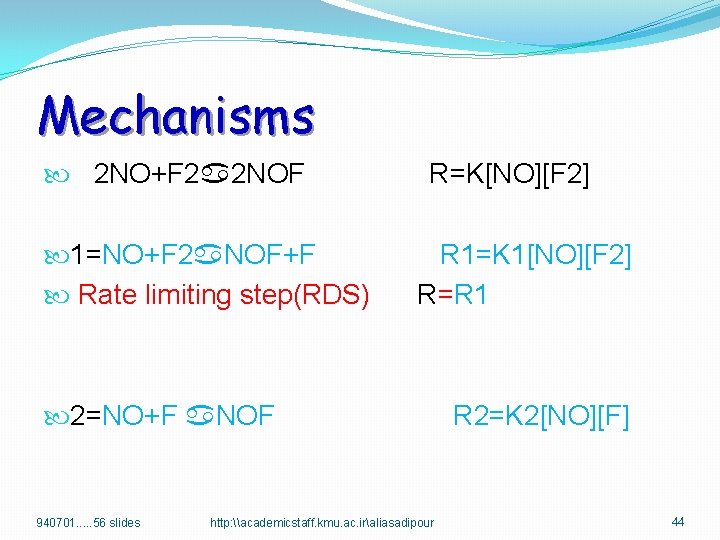
Mechanisms 2 NO+F 2 2 NOF 1=NO+F 2 NOF+F Rate limiting step(RDS) R=K[NO][F 2] R 1=K 1[NO][F 2] R=R 1 2=NO+F NOF 940701. . . 56 slides http: \academicstaff. kmu. ac. iraliasadipour R 2=K 2[NO][F] 44
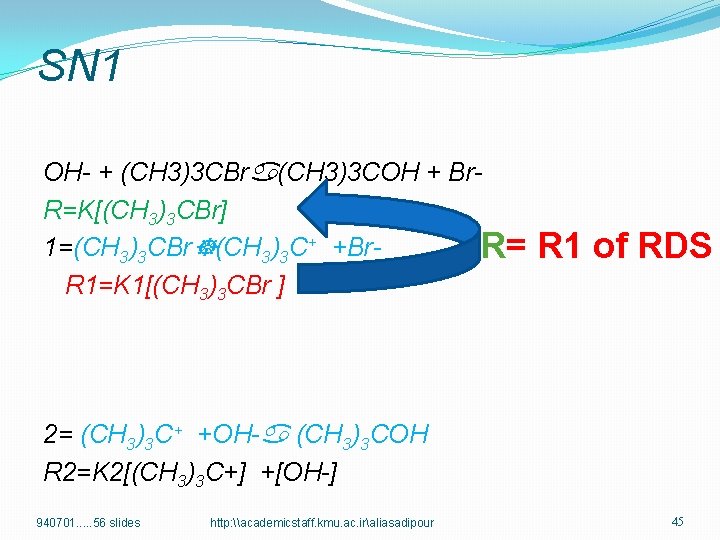
SN 1 OH- + (CH 3)3 CBr (CH 3)3 COH + Br. R=K[(CH 3)3 CBr] 1=(CH 3)3 CBr (CH 3)3 C+ +Br. R= R 1=K 1[(CH 3)3 CBr ] R 1 of RDS 2= (CH 3)3 C+ +OH- (CH 3)3 COH R 2=K 2[(CH 3)3 C+] +[OH-] 940701. . . 56 slides http: \academicstaff. kmu. ac. iraliasadipour 45
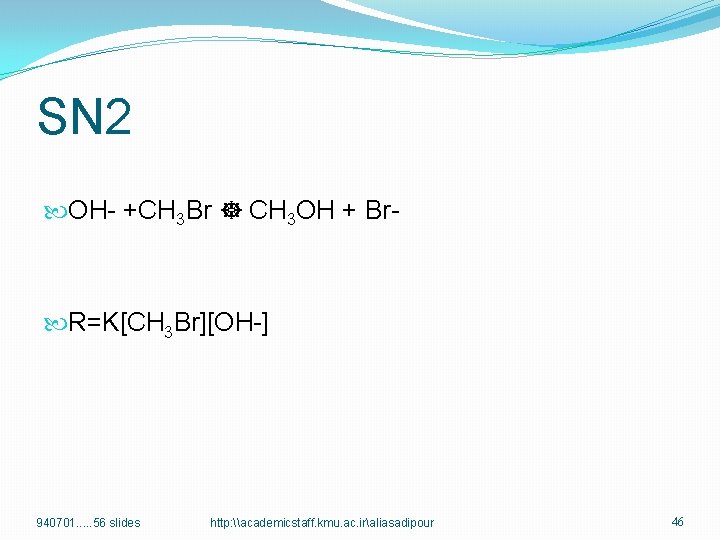
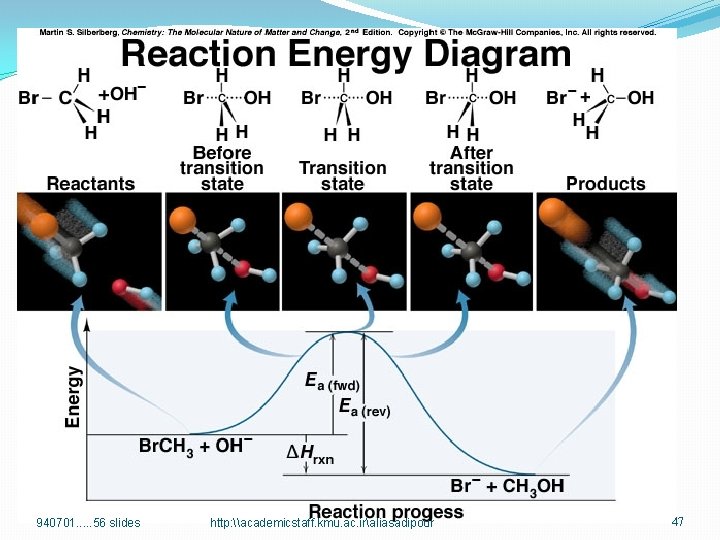
SN 2 OH- +CH 3 Br CH 3 OH + Br- R=K[CH 3 Br][OH-] 940701. . . 56 slides http: \academicstaff. kmu. ac. iraliasadipour 46
940701. . . 56 slides http: \academicstaff. kmu. ac. iraliasadipour 47
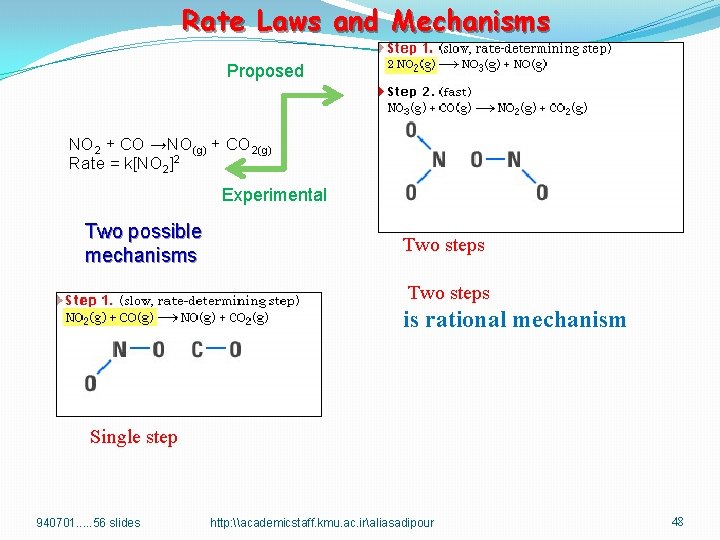
Rate Laws and Mechanisms Proposed NO 2 + CO →NO(g) + CO 2(g) Rate = k[NO 2]2 Experimental Two possible mechanisms Two steps is rational mechanism Single step 940701. . . 56 slides http: \academicstaff. kmu. ac. iraliasadipour 48
940701. . . 56 slides http: \academicstaff. kmu. ac. iraliasadipour 49
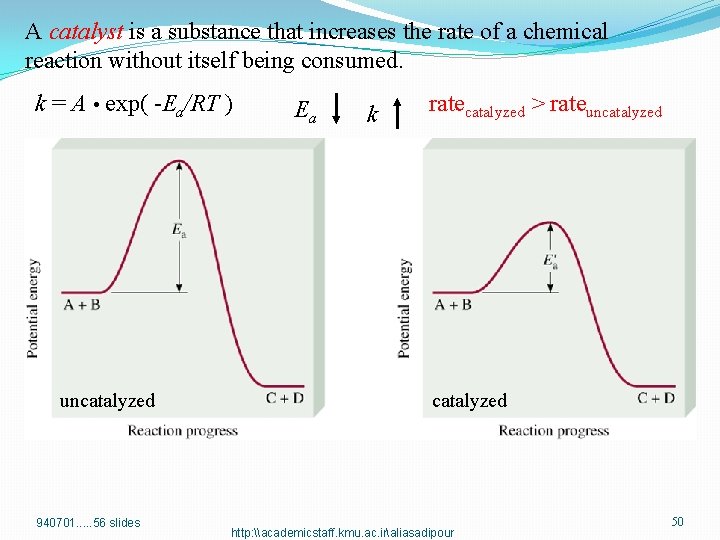
A catalyst is a substance that increases the rate of a chemical reaction without itself being consumed. k = A • exp( -Ea/RT ) uncatalyzed 940701. . . 56 slides Ea k ratecatalyzed > rateuncatalyzed http: \academicstaff. kmu. ac. iraliasadipour 50
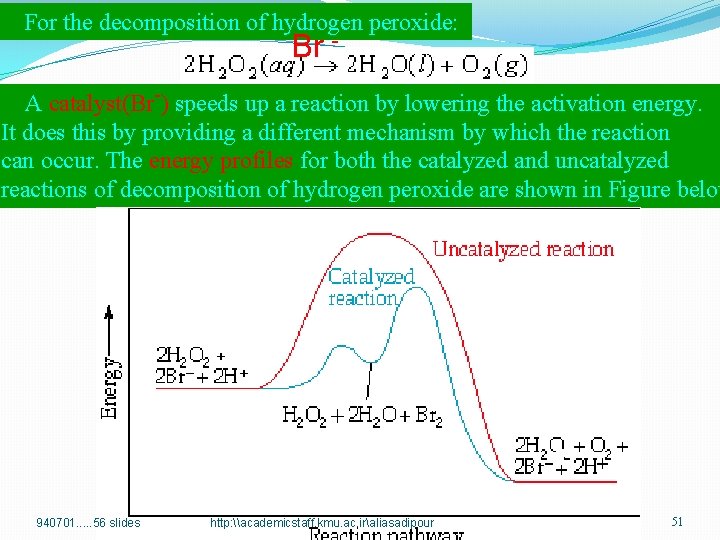
For the decomposition of hydrogen peroxide: Br - A catalyst(Br-) speeds up a reaction by lowering the activation energy. It does this by providing a different mechanism by which the reaction can occur. The energy profiles for both the catalyzed and uncatalyzed reactions of decomposition of hydrogen peroxide are shown in Figure below 940701. . . 56 slides http: \academicstaff. kmu. ac. iraliasadipour 51
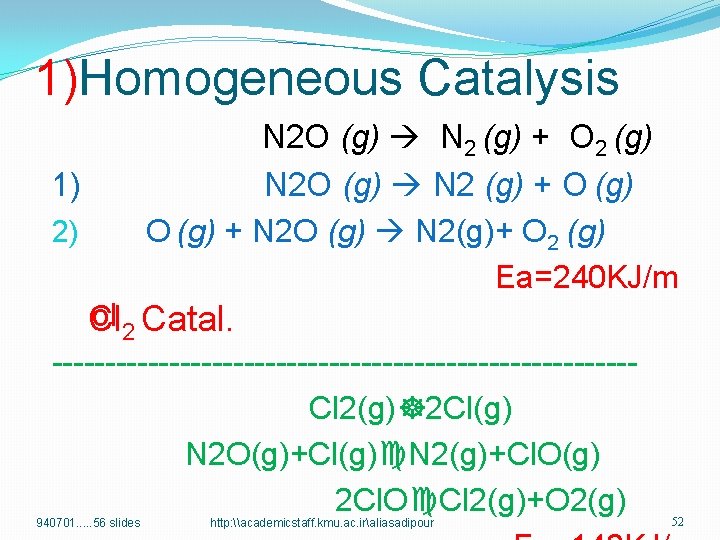
1)Homogeneous Catalysis N 2 O (g) N 2 (g) + O 2 (g) N 2 O (g) N 2 (g) + O (g) + N 2 O (g) N 2(g)+ O 2 (g) Ea=240 KJ/m 1) 2) ol 2 Catal. Cl ---------------------------Cl 2(g) 2 Cl(g) N 2 O(g)+Cl(g) N 2(g)+Cl. O(g) 2 Cl. O Cl 2(g)+O 2(g) 940701. . . 56 slides http: \academicstaff. kmu. ac. iraliasadipour 52
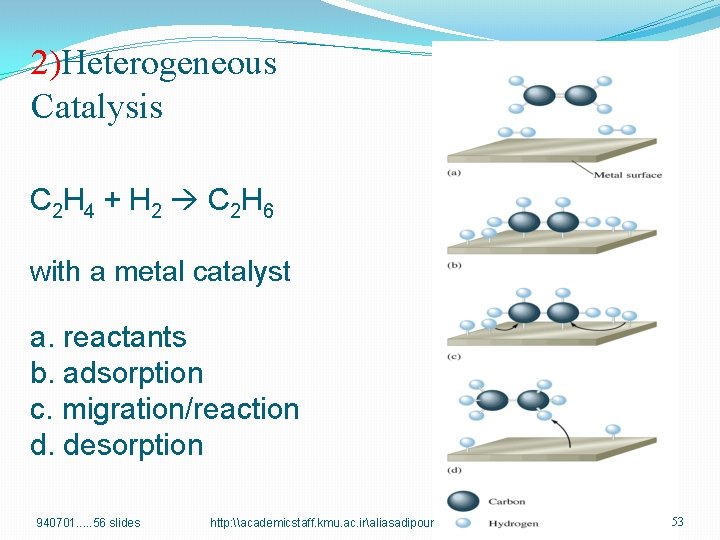
2)Heterogeneous Catalysis C 2 H 4 + H 2 C 2 H 6 with a metal catalyst a. reactants b. adsorption c. migration/reaction d. desorption 940701. . . 56 slides http: \academicstaff. kmu. ac. iraliasadipour 53
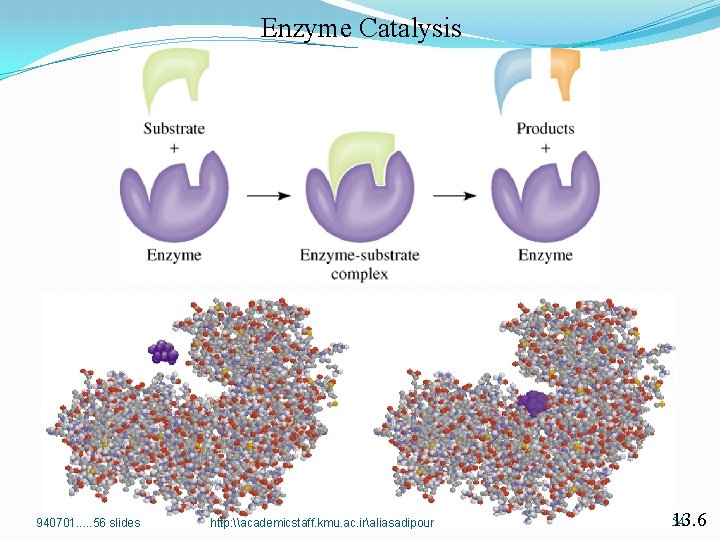
Enzyme Catalysis 940701. . . 56 slides http: \academicstaff. kmu. ac. iraliasadipour 13. 6 54
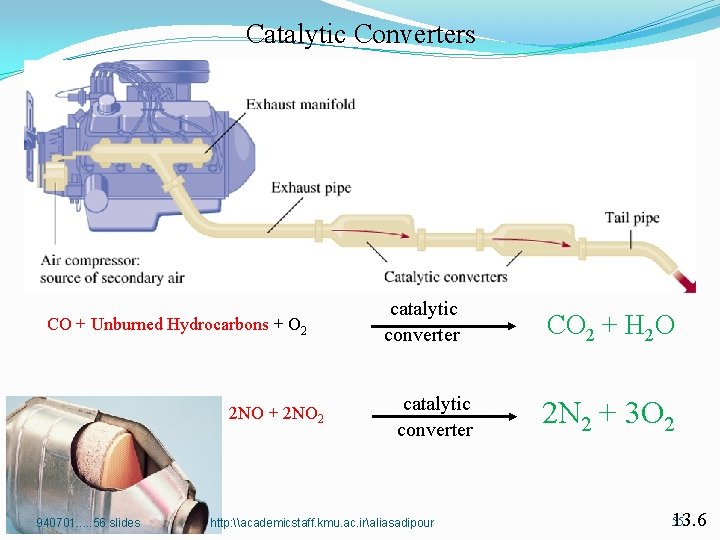
Catalytic Converters CO + Unburned Hydrocarbons + O 2 2 NO + 2 NO 2 940701. . . 56 slides catalytic converter http: \academicstaff. kmu. ac. iraliasadipour CO 2 + H 2 O 2 N 2 + 3 O 2 13. 6 55
The End!!!!!!! 940701. . . 56 slides http: \academicstaff. kmu. ac. iraliasadipour 56