
91610 BR Who described the state of nature
9/16/10 BR- Who described the state of nature as “. . continual fear, and danger of violent death; and the life of man, solitary, poor, nasty, brutish, and short. ” Today: Social Contract – A Way Out of the State of Nature -Folders, Forms -MIKVA -Gradebook. If you want your login info gimmee a lil’ piece of paper -“A’ Essay!
Binder Check Tomorrow What am I looking for? - Syllabus - Mr. Mac’s Class Guidelines - Student Bill of Rights - 9/8: Exit Slip (about respect) - 9/9: Exit Slip (about Robert and Amelia) - 9/10: BR and Exit Slip (3 Things You Want to Learn. . ) - 9/14 : BR, Government notes, Government forms paper - 9/15 : BR, State of Nature Notes, - 9/16: (today) BR, Exit Slip
Homework Check Imagine you are living in a Hobbes’ state of nature and Rousseau’s state of nature. Describe for me what your life is like Write a descriptive paragraph for each. -ORDraw a picture (at least half a sheet of paper for each) that shows life in a state of nature.
What Was There Before There Was Law State of Nature Hobbes’ State of Nature Rousseau’s State of Nature Sovereignty Social Contract Impact Questions Summary Statement -
Vocabulary Journal #1 • State of nature, Hobbesian state of nature, Rousseau’s state of nature, social contract, sovereignty
State of Nature • A philosophical idea that describes humanities social state before there were laws.
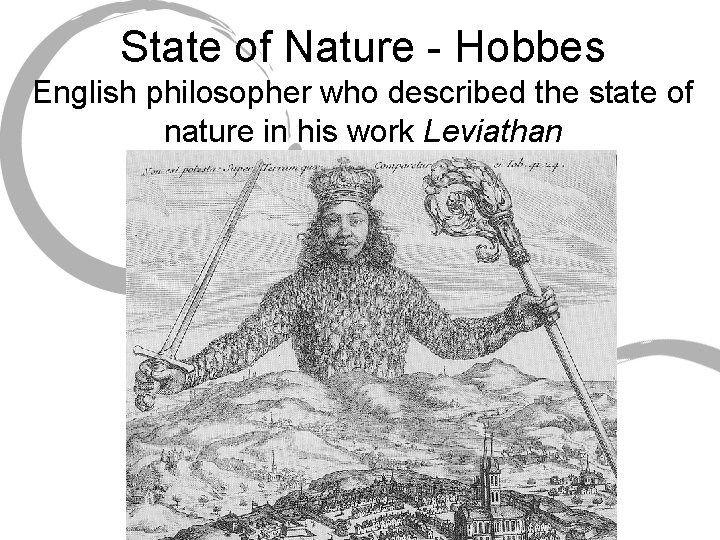
State of Nature - Hobbes English philosopher who described the state of nature in his work Leviathan
State of Nature - Hobbes English philosopher who described the state of nature in his work Leviathan • Without a figure of awe, a state of nature exists. State of nature is a state of war against all. bellum omnium contra omnes • “No society; and which is worst of all, continual fear, and danger of violent death; and the life of man, solitary, poor, nasty, brutish, and short. ” • Everyone works against everyone all the time might makes right. • Only way out is - social contract, a powerful sovereign (ruler) to give awe.
State of Nature - Rousseau French political Philosopher – Discourse on Inequality
State of Nature - Rousseau French political Philosopher • Humans began like animals and were neither bad or good. “Noble Savages” • The earliest solitary humans possessed a basic drive for self preservation and a natural disposition to compassion or pity - we were nice. • As they lived together they developed attachments such as family and clan. • Property is acquired and labor must be divided, thus governments must be formed • Sovereignty comes from the people
Sovereignty • The power and authority to make laws
Social Contract • The only way out of the state of nature • You agree to give up certain freedoms in order to have certain safety. • A deal to turn over sovereignty to someone else in order to do other things
Impact • Both philosophies inspired a type of rule of law (government) Hobbes: ? Rousseau: ?
Exit Slip (videos) 1. In the 1 st video what doe the author say are the only real forms of government and why? 2. In the second video, why is it called a “cycle of freedom? ”
- Slides: 14