
9 The Healthy Human Body 1 Describe body
9 The Healthy Human Body 1. Describe body systems and define key anatomical terms Define the following terms: homeostasis the condition in which all of the body’s systems are working at their best. metabolism physical and chemical processes by which substances are produced or broken down into energy or products for use by the body. organs structural units in the human body that perform specific functions.
9 The Healthy Human Body 1. Describe body systems and define key anatomical terms Define the following terms: tissues groups of cells that perform similar tasks. cells basic structural units of the body that divide, develop, and die, renewing tissues and organs.

9 The Healthy Human Body 1. Describe body systems and define key anatomical terms REMEMBER: Signs are what the NA actually sees, hears, feels, or smells. Symptoms are not directly seen by the NA, but reported by the resident.
9 The Healthy Human Body 1. Describe body systems and define key anatomical terms It is important for NAs to know these anatomical terms of location: • Anterior or ventral (front of the body or body part) • Posterior or dorsal (back of the body or body part) • Superior (toward the head) • Inferior (away from the head) • Medial (toward the midline of the body) • Lateral (to the side away from the midline of the body) • Proximal (closer to the torso) • Distal (farther away from the torso)
9 The Healthy Human Body 2. Describe the integumentary system Define the following terms: integument a natural protective covering. dilate to widen. constrict to narrow.
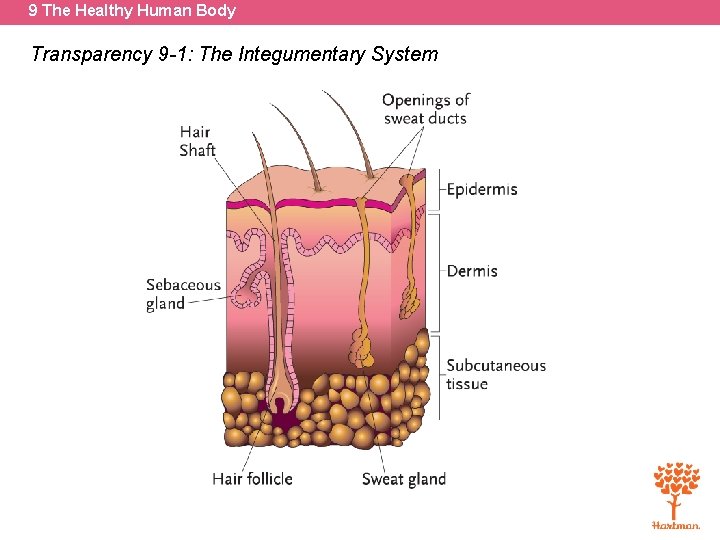
9 The Healthy Human Body Transparency 9 -1: The Integumentary System
9 The Healthy Human Body 2. Describe the integumentary system NAs should know these important points about the integumentary system: • Body’s largest organ and system • Natural protective covering • Prevents excessive loss of water and injury to internal organs • Skin made of tissue and glands • Skin is a sense organ. • Regulates body temperature
9 The Healthy Human Body 2. Describe the integumentary system The following are normal changes of aging in the integumentary system: • Thinner, drier, more fragile skin • Less elastic skin • Thinning fatty tissue can cause person to feel colder • Thinner, gray hair • Wrinkles and brown spots • Nails harder and more brittle • Dry, itchy skin due to lack of oil from sebaceous glands
9 The Healthy Human Body 2. Describe the integumentary system Think about this question: The orange box on p. 129 of the text describes some ways NAs can assist residents experiencing normal changes of aging to the integumentary system. In what other ways might NAs help?
9 The Healthy Human Body 2. Describe the integumentary system NAs should report these signs and symptoms related to the integumentary system: • Pale, white, reddened, or purple areas • Blisters or bruises • Complaints of tingling, warmth, or burning • Dry or flaking skin • Itching or scratching • Rashes or discoloration • Swelling • Cuts, boils, sores, wounds, abrasions
9 The Healthy Human Body 2. Describe the integumentary system Signs and symptoms related to the integumentary system (cont’d): • Fluid or blood draining from skin • Broken skin • Changes in moistness/dryness • Changes in wound or ulcer • Redness or broken skin between toes or around toenails • Scalp or hair changes • Skin that appears different from normal • In darker complexions, look for change in the feel of the tissue or appearance of the skin (e. g. , “orange peel” look)
9 The Healthy Human Body 3. Describe the musculoskeletal system Define the following terms: bones rigid connective tissues that make up the skeleton, protect organs, and allow the body to move. joint the place at which two bones meet. muscles groups of tissues that provide movement of body parts, protection of organs, and creation of body heat.
9 The Healthy Human Body 3. Describe the musculoskeletal system Define the following terms: atrophy the wasting away, decreasing in size, and weakening of muscles from lack of use. contracture the permanent and often painful shortening of a muscle, usually due to lack of activity.
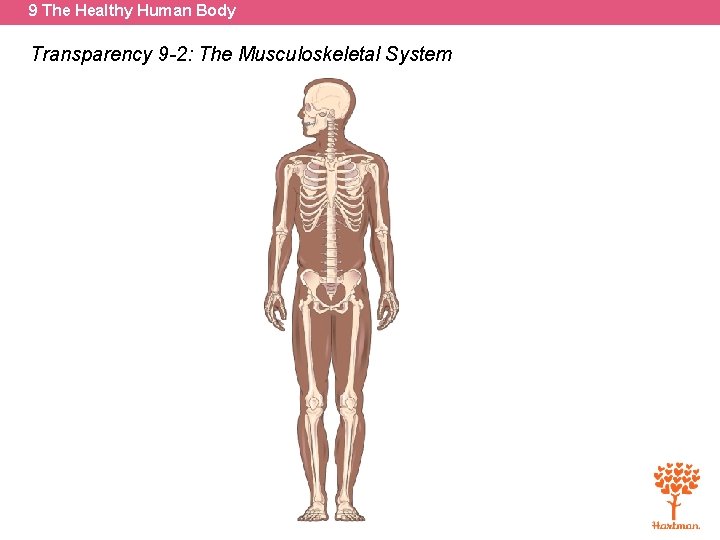
9 The Healthy Human Body Transparency 9 -2: The Musculoskeletal System
9 The Healthy Human Body 3. Describe the musculoskeletal system NAs should know these important points about the musculoskeletal system: • Human body has 206 bones. • Two bones meet at joint (for movement). Joints make movement possible in either all directions or in one direction only. • Muscles provide movement and produce body heat. • Physical activity/exercise increases circulation, increasing blood flow to organs and tissues. • Inactivity can cause depression, pneumonia, constipation, UTIs, loss of self-esteem, and blood clots. • Muscles develop atrophy or contractures from inactivity. • ROM exercises help prevent atrophy or contractures.
9 The Healthy Human Body 3. Describe the musculoskeletal system The following are normal changes of aging in the musculoskeletal system: • Muscles weaken and lose tone. • Body movement slows. • Bones lose density and become more brittle. • Joints can stiffen/become painful. • Height is gradually lost.
9 The Healthy Human Body 3. Describe the musculoskeletal system Think about this question: The orange box on pp. 130 -31 of the text describes some ways NAs can assist residents experiencing normal changes of aging to the musculoskeletal system. In what other ways might NAs help?
9 The Healthy Human Body 3. Describe the musculoskeletal system NAs should report these signs and symptoms related to the musuloskeletal system: • Changes in movement and activity • Changes in ability to do ROMs • Pain during movement • New or increased swelling of joints • White, shiny, red, or warm areas over joints • Bruising • Aches and pains reported by resident
9 The Healthy Human Body 4. Describe the nervous system Define the following terms: central nervous system (CNS) part of the nervous system that is composed of the brain and spinal cord. peripheral nervous system (PNS) part of the nervous system made up of the nerves that extend throughout the body.
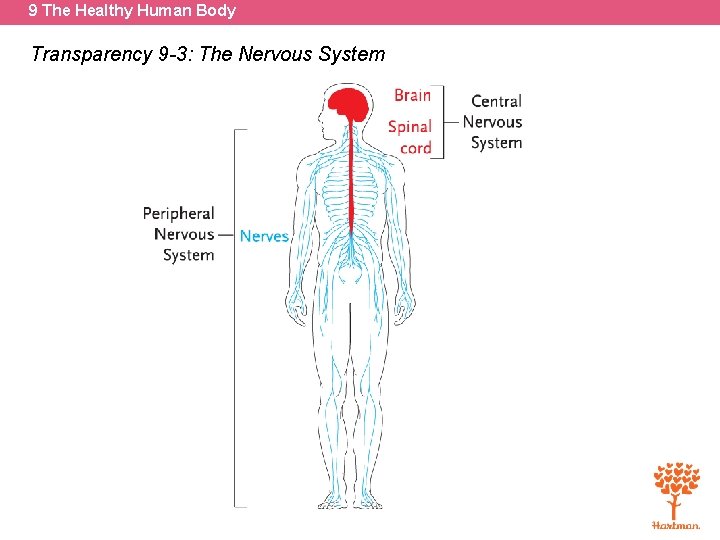
9 The Healthy Human Body Transparency 9 -3: The Nervous System
9 The Healthy Human Body 4. Describe the nervous system NAs should know these important points about the nervous system: • Control and message center of body • Controls and coordinates all body functions • Senses information from outside the body • Two main parts: central nervous system (brain) and peripheral nervous system (nerves)
9 The Healthy Human Body 4. Describe the nervous system The following are normal changes of aging in the nervous system: • Slower responses and reflexes • Decrease in sensitivity of nerve endings in skin • Some memory loss, more often with short-term memory
9 The Healthy Human Body 4. Describe the nervous system Think about this question: The orange box on pp. 132 -33 of the text describes some ways NAs can assist residents experiencing normal changes of aging to the nervous system. In what other ways might NAs help?
9 The Healthy Human Body 4. Describe the nervous system NAs should report these signs and symptoms related to the nervous system: • Fatigue or pain with movement • Shaking or trembling • Inability to move one side of body • Difficulty speaking or slurring of speech • Numbness or tingling • Disturbance or change in vision or hearing
9 The Healthy Human Body 4. Describe the nervous system Signs and symptoms related to the nervous system (cont’d): • Dizziness or loss of balance • Changes in eating or fluid intake • Difficulty swallowing • Bowel or bladder changes • Depression or mood changes • Memory loss or confusion • Violent behavior • Unusual or unexplained change in behavior • Decreased ability to perform ADLs
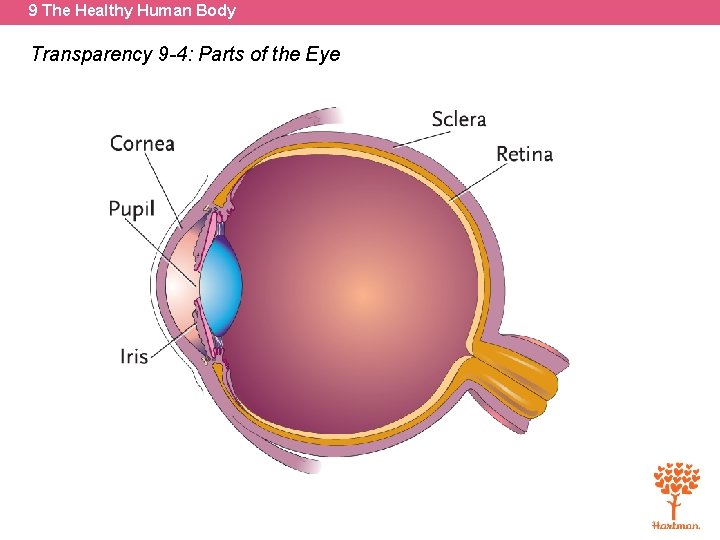
9 The Healthy Human Body Transparency 9 -4: Parts of the Eye
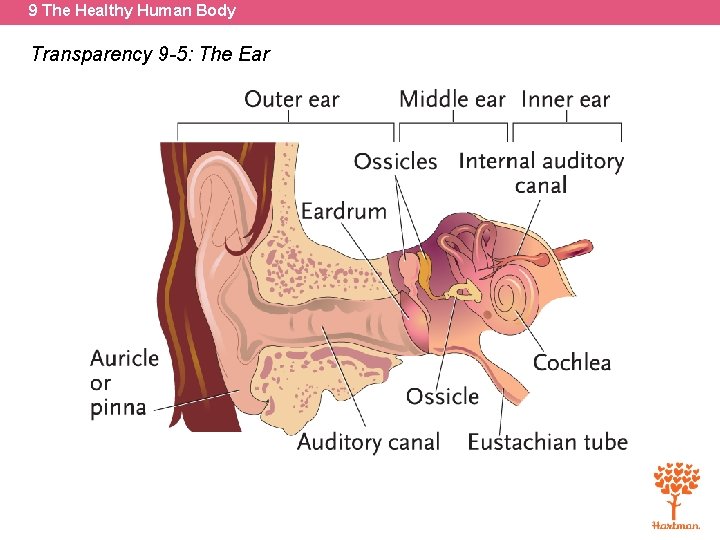
9 The Healthy Human Body Transparency 9 -5: The Ear
9 The Healthy Human Body 4. Describe the nervous system Think about this question: What are the other sense organs in the human body?
9 The Healthy Human Body 4. Describe the nervous system The following are normal changes of aging to a person’s senses: • Reduced vision and hearing (sense of balance may be affected) • Decreased senses of taste, touch, and smell • Decreased sensitivity to heat and cold
9 The Healthy Human Body 4. Describe the nervous system Think about this question: The orange box on pp. 134 of the text describes some ways NAs can assist residents experiencing normal changes of aging to their senses. In what other ways might NAs help?
9 The Healthy Human Body 4. Describe the nervous system NAs should report these signs and symptoms related to the sense organs: • Changes in vision or hearing • Signs of infection • Dizziness • Complaints of pain in eyes or ears
9 The Healthy Human Body 5. Describe the circulatory system Define the following terms: systole phase where the heart is at work, contracting and pushing blood out of the left ventricle. diastole phase when the heart relaxes or rests.
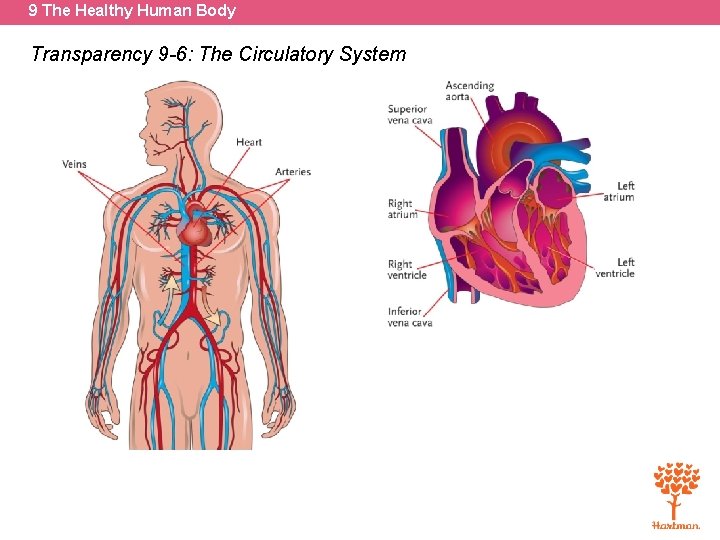
9 The Healthy Human Body Transparency 9 -6: The Circulatory System
9 The Healthy Human Body 5. Describe the circulatory system NAs should know these important points about the circulatory system: • Made up of heart, blood vessels, and blood • Blood carries food, oxygen, and essential substances to cells. • Heart has four chambers (two atria/upper chambers and two ventricles/lower chambers). • Heart functions in two phases: resting phase—diastole (chambers fill with blood) and contracting phase—systole (ventricles pump blood).
9 The Healthy Human Body 5. Describe the circulatory system Important points about the circulatory system (cont’d): • Major functions are to: • Supply food, oxygen, and hormones to cells • Produce and supply antibodies • Remove waste products from cells • Control body temperature
9 The Healthy Human Body 5. Describe the circulatory system The following are normal changes of aging in the circulatory system: • Heart pumps less efficiently • Decreased blood flow • Narrowed blood vessels
9 The Healthy Human Body 5. Describe the circulatory system Think about this question: The orange box on p. 136 of the text describes some ways NAs can assist residents experiencing normal changes of aging to the circulatory system. In what other ways might NAs help?
9 The Healthy Human Body 5. Describe the circulatory system NAs should report these signs and symptoms related to the circulatory system: • Changes in pulse rate • Weakness or fatigue • Loss of ability to perform ADLs • Swelling of hands and feet • Pale or blue hands, feet, or lips • Chest pain • Weight gain • Shortness of breath, changes in breathing patterns, inability to catch breath • Severe headache • Inactivity, which can lead to circulatory problems
9 The Healthy Human Body 6. Describe the respiratory system Define the following terms: respiration the process of breathing air into the lungs and exhaling air out of the lungs. inspiration breathing in. expiration exhaling air out of the lungs. sputum thick mucus coughed up from the lungs.
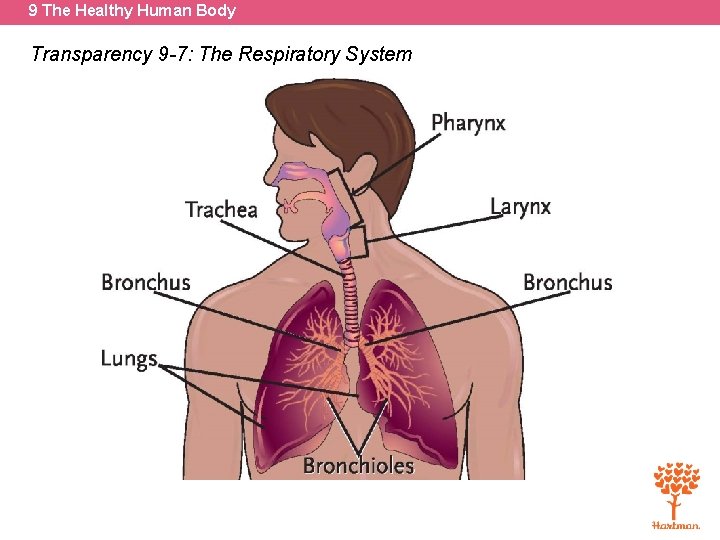
9 The Healthy Human Body Transparency 9 -7: The Respiratory System
9 The Healthy Human Body 6. Describe the respiratory system NAs should know these important points about the respiratory system: • Inspiration is breathing in and expiration is breathing out by the lungs. • Functions are • To bring oxygen into body • To eliminate carbon dioxide produced by the body
9 The Healthy Human Body 6. Describe the respiratory system The following are normal changes of aging in the respiratory system: • Loss of lung strength • Decreased lung capacity • Decreased oxygen in the blood • Weakened voice
9 The Healthy Human Body 6. Describe the respiratory system Think about this question: The orange box on p. 137 of the text describes some ways NAs can assist residents experiencing normal changes of aging to the respiratory system. In what other ways might NAs help?
9 The Healthy Human Body 6. Describe the respiratory system NAs should report these signs and symptoms related to the respiratory system: • Changes in respiratory rate • Shallow breathing or breathing through pursed lips • Coughing or wheezing • Nasal congestion or discharge • Sore throat, difficulty swallowing, swollen tonsils • Need to sit after mild exertion • Pale, bluish, or gray lips or extremities • Pain in chest • Discolored sputum (yellow, green, gray, or bloody)
9 The Healthy Human Body 7. Describe the urinary system Define the following terms: urinary incontinence the inability to control the bladder, which leads to an involuntary loss of urine.
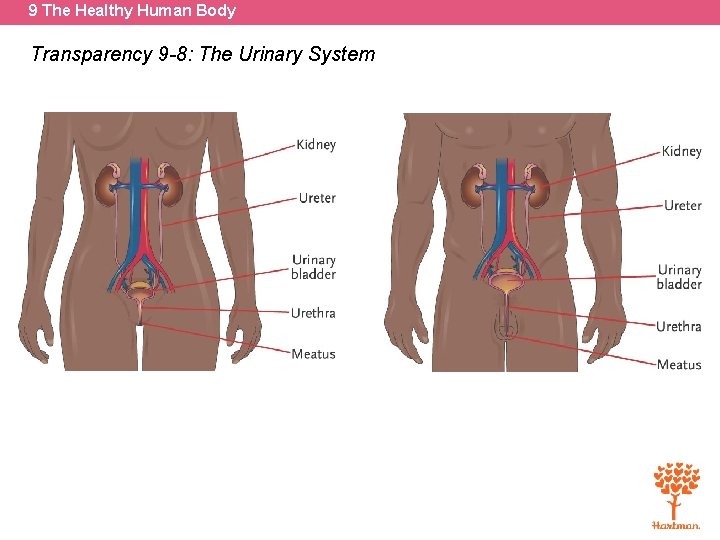
9 The Healthy Human Body Transparency 9 -8: The Urinary System
9 The Healthy Human Body 7. Describe the urinary system NAs should know these important points about the urinary system: • Functions are: • To eliminate wastes • To maintain water balance
9 The Healthy Human Body 7. Describe the urinary system The following are normal changes of aging in the urinary system: • Reduced ability of kidneys to filter blood • Weakened bladder muscle tone • Bladder holds less urine causing more frequent urination • Bladder may not empty completely, causing more susceptibility to infection
9 The Healthy Human Body 7. Describe the urinary system Think about this question: The orange box on p. 138 of the text describes some ways NAs can assist residents experiencing normal changes of aging to the urinary system. In what other ways might NAs help?
9 The Healthy Human Body 7. Describe the urinary system NAs should report these signs and symptoms related to the urinary system: • Weight loss or gain • Swelling in extremities • Painful urination or burning during urination • Changes in urine (cloudy, odor, color) • Change in frequency or amount of urine • Swelling in abdominal/bladder area • Complaints that bladder feels full or painful • Urinary incontinence • Pain in kidney or back/flank • Inadequate fluid intake
9 The Healthy Human Body 8. Describe the gastrointestinal system Define the following terms: digestion the process of preparing food physically and chemically so that it can be absorbed into the cells. elimination the process of expelling solid wastes (made up of the waste products of food) that are not absorbed into the cells. fecal incontinence the inability to control the bowels, leading to an involuntary passage of stool.
9 The Healthy Human Body Transparency 9 -9: The Gastrointestinal System
9 The Healthy Human Body 8. Describe the gastrointestinal system NAs should know these important points about the gastrointestinal system: • Digestion prepares food for absorption into cells. • Elimination is expelling solid wastes.
9 The Healthy Human Body 8. Describe the gastrointestinal system The following are normal changes of aging in the gastrointestinal system: • Decreased saliva production affects chewing/swallowing. • Dulled sense of taste may result in poor appetite. • Absorption of vitamins/minerals decreases. • Digestion takes longer, is less efficient. • Body waste moves more slowly through intestines; constipation is more frequent.
9 The Healthy Human Body 8. Describe the gastrointestinal system Think about this question: The orange box on p. 140 of the text describes some ways NAs can assist residents experiencing normal changes of aging to the gastrointestinal system. In what other ways might NAs help?
9 The Healthy Human Body 8. Describe the gastrointestinal system NAs should report these signs and symptoms related to the gastrointestinal system: • Difficulty swallowing or chewing • Fecal incontinence • Weight gain or loss • Loss of appetite • Abdominal pain or cramping • Diarrhea • Nausea and vomiting (especially coffee grounds type)
9 The Healthy Human Body 8. Describe the gastrointestinal system Signs and symptoms related to the gastrointestinal system (cont’d): • Constipation • Flatulence • Hiccups, belching • Bloody, black, or hard stools • Heartburn • Poor nutritional intake
9 The Healthy Human Body 9. Describe the endocrine system Define the following terms: glands organs that produce and secrete chemicals called hormones chemical substances created by the body that control numerous body functions.
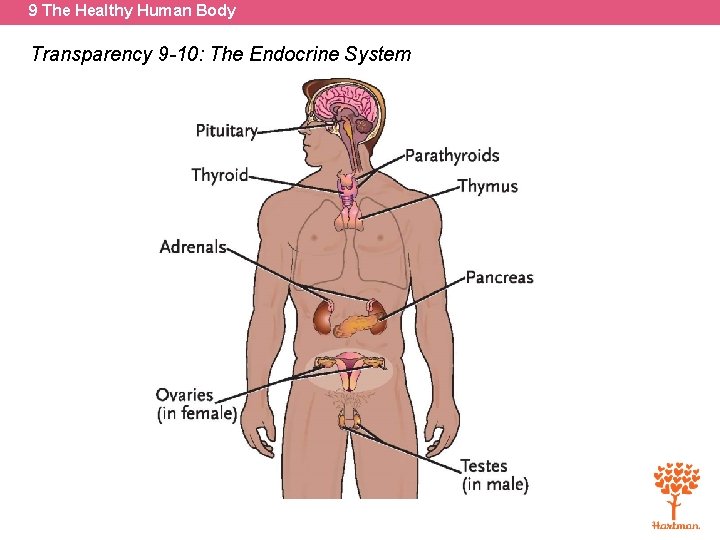
9 The Healthy Human Body Transparency 9 -10: The Endocrine System
9 The Healthy Human Body 9. Describe the endocrine system NAs should know these important points about the endocrine system: • Glands secrete hormones, which are chemical substances that control numerous body functions • Hormones are carried by the blood to organs in order to achieve the following: • Maintain homeostasis • Influence growth and development • Regulate blood sugar levels • Regulate calcium levels in bones • Regulate body’s ability to reproduce • Determine how fast cells burn food for energy
9 The Healthy Human Body 9. Describe the endocrine system The following are normal changes of aging in the endocrine system: • Decrease in levels of hormones, such as estrogen and progesterone • Less production of insulin • Less able to handle stress
9 The Healthy Human Body 9. Describe the endocrine system Think about this question: The orange box on p. 141 of the text describes some ways NAs can assist residents experiencing normal changes of aging to the endocrine system. In what other ways might NAs help?
9 The Healthy Human Body 9. Describe the endocrine system NAs should report these signs and symptoms related to the endocrine system: • Headache • Weakness • Blurred vision • Dizziness • Irritability • Sweating • Change in “normal” behavior • Confusion • Change in mobility • Change in sensation
9 The Healthy Human Body 9. Describe the endocrine system Signs and symptoms related to the endocrine system (cont’d): • Numbness or tingling in arms or legs • Weight gain/loss • Loss of appetite/increase in appetite • Increased thirst • Frequent urination • Hunger • Dry skin • Skin breakdown • Sweet or fruity breath • Sluggishness or fatigue • Hyperactivity
9 The Healthy Human Body 10. Describe the reproductive system Define the following terms: reproduce to create new human life. gonads sex glands.
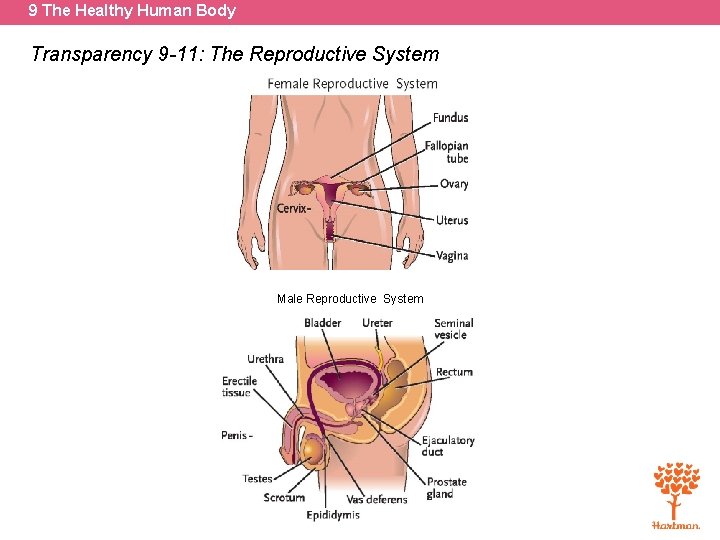
9 The Healthy Human Body Transparency 9 -11: The Reproductive System Male Reproductive System
9 The Healthy Human Body 10. Describe the reproductive system NAs should know these important points about the reproductive system: • Reproductive organs and hormones are different in males (testes, scrotum, testosterone) and females (ovaries, fallopian tubes, estrogen). • Reproductive system allows humans to reproduce.
9 The Healthy Human Body 10. Describe the reproductive system The following are normal changes of aging in the integumentary system: • Male: • Decrease in sperm production • Enlargement of the prostate gland • Female: • Menstruation ends • Decrease in estrogen leads to loss of calcium, causing brittle bones • Drying and thinning of vaginal walls
9 The Healthy Human Body 10. Describe the reproductive system Think about this question: The orange box on p. 143 of the text describes some ways NAs can assist residents experiencing normal changes of aging to the reproductive system. In what other ways might NAs help?
9 The Healthy Human Body 10. Describe the reproductive system NAs should report these signs and symptoms related to the reproductive system: • Discomfort or difficulty with urination • Discharge from penis or vagina • Swelling of genitals • Blood in urine or stool • Breast changes, lumps, or discharge • Sores on genitals • Reports of impotence • Reports of painful intercourse
9 The Healthy Human Body 10. Describe the reproductive system REMEMBER: Residents have the right to sexual freedom and expression. They have the right to privacy and to meet their sexual needs.
9 The Healthy Human Body 11. Describe the immune and lymphatic systems Define the following terms: nonspecific immunity a type of immunity that protects the body from disease in general. specific immunity a type of immunity that protects against a particular disease that is invading the body at a given time. lymph a clear yellowish fluid that carries disease-fighting cells called lymphocytes.
9 The Healthy Human Body 11. Describe the immune and lymphatic systems NAs should know these important points about the immune system: • Nonspecific immunity protects the body from disease in general. • Specific immunity protects the body against a particular disease invading the body at a given time.
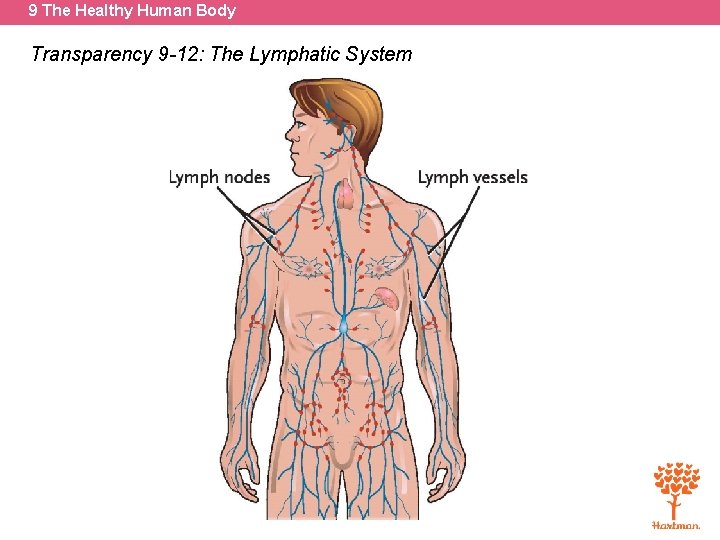
9 The Healthy Human Body Transparency 9 -12: The Lymphatic System
9 The Healthy Human Body 11. Describe the immune and lymphatic systems NAs should know these important points about the lymphatic system: • Functions of system are to remove excess fluids and waste products and to help the immune system fight infections. • It is closely related to the circulatory system because lymph fluid, after being purified in the lymph nodes, flows into the bloodstream. • It has no pump, but is circulated by muscle activity, massage, and breathing.
9 The Healthy Human Body 11. Describe the immune and lymphatic systems The following are normal changes of aging in the immune and lymphatic systems: • Increased risk of infections due to weaker immune system • Takes long to recover from an illness • Decreased number and size of lymph nodes • Decreased response to vaccines
9 The Healthy Human Body 11. Describe the immune and lymphatic systems Think about this question: The orange box on p. 145 of the text describes some ways NAs can assist residents experiencing normal changes of aging to the immune system. In what other ways might NAs help?
9 The Healthy Human Body 11. Describe the immune and lymphatic systems NAs should report these signs and symptoms related to the immune and lymphatic systems: • Recurrent infections • Swelling of lymph nodes • Increased fatigue
9 The Healthy Human Body Exam Multiple Choice. Choose the correct answer. 1. Which anatomical term means toward the midline of the body? (A) Lateral (B) Proximal (C) Medial (D) Posterior 2. Which anatomical term means the front of the body? (A) Anterior (B) Inferior (C) Superior (D) Posterior
9 The Healthy Human Body Exam 1. Homeostasis is (A) Abnormal changes in the body systems (B) The condition in which all of the body systems are working their best (C) The building block of the body (D) A group of cells that perform a similar task 2. Which of the following statements is true of the skin? (A) It feels heat, cold, pain, touch, and pressure. (B) It becomes more elastic as a person ages. (C) It is the chemical substance that is created by the body and controls body functions. (D) The epidermis is the inner layer of the skin.
9 The Healthy Human Body Exam 1. One way a nursing assistant can help with normal changes of aging related to the integumentary system is to (A) Withhold fluids so a resident will not go to the bathroom often (B) Clip toenails frequently (C) Keep sheets wrinkle-free (D) Rub lotion into red or irritated spots on the resident’s skin 2. Which of the following is true of muscles? (A) They provide movement of body parts. (B) Two muscles meet at a joint. (C) They produce toxins. (D) They prevent contractures from occurring.
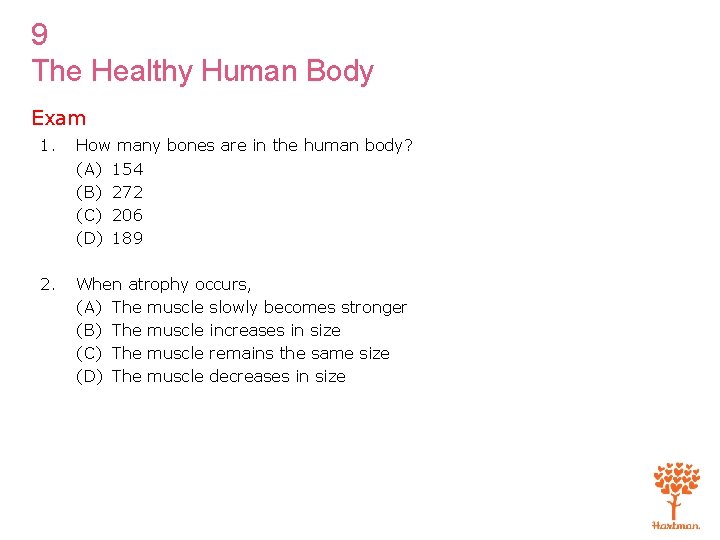
9 The Healthy Human Body Exam 1. How many bones are in the human body? (A) 154 (B) 272 (C) 206 (D) 189 2. When atrophy occurs, (A) The muscle slowly becomes stronger (B) The muscle increases in size (C) The muscle remains the same size (D) The muscle decreases in size
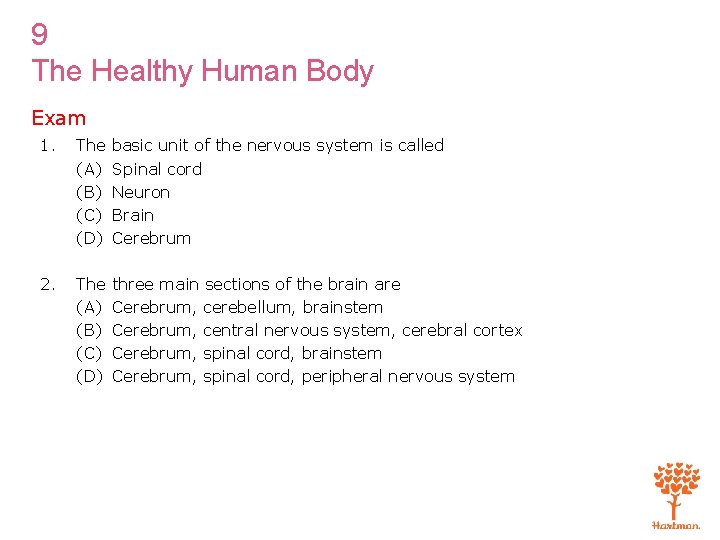
9 The Healthy Human Body Exam 1. The (A) (B) (C) (D) basic unit of the nervous system is called Spinal cord Neuron Brain Cerebrum 2. The (A) (B) (C) (D) three main sections of the brain are Cerebrum, cerebellum, brainstem Cerebrum, central nervous system, cerebral cortex Cerebrum, spinal cord, brainstem Cerebrum, spinal cord, peripheral nervous system
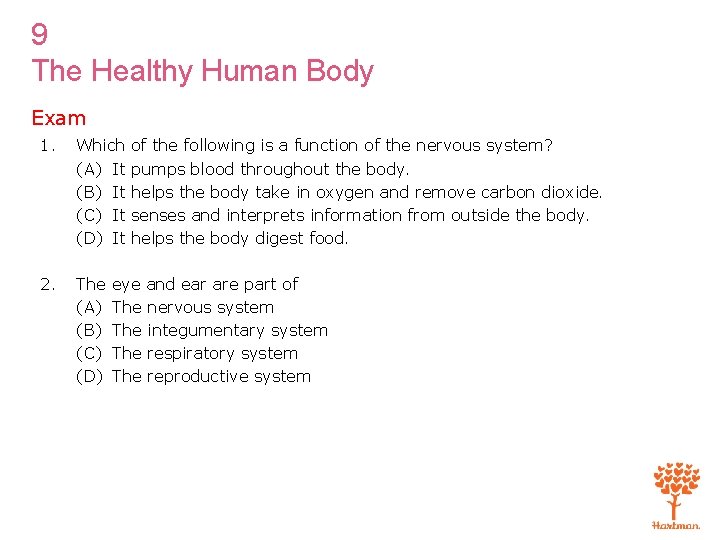
9 The Healthy Human Body Exam 1. Which (A) It (B) It (C) It (D) It 2. The (A) (B) (C) (D) of the following is a function of the nervous system? pumps blood throughout the body. helps the body take in oxygen and remove carbon dioxide. senses and interprets information from outside the body. helps the body digest food. eye and ear are part of The nervous system The integumentary system The respiratory system The reproductive system
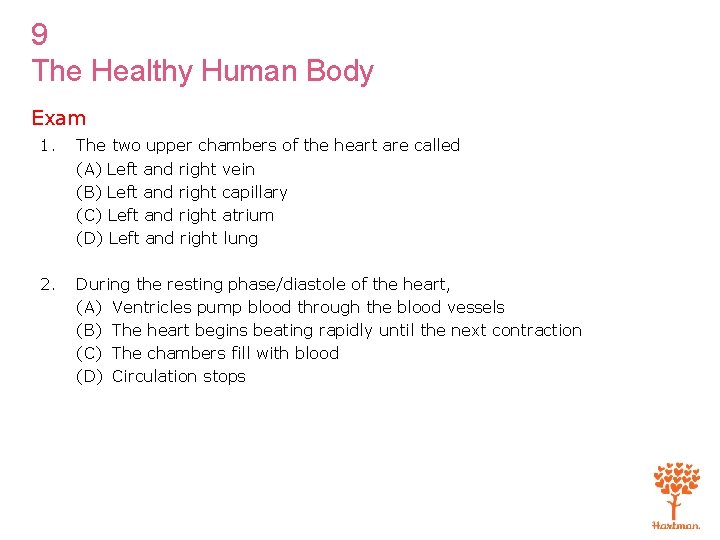
9 The Healthy Human Body Exam 1. The two upper chambers of the heart are called (A) Left and right vein (B) Left and right capillary (C) Left and right atrium (D) Left and right lung 2. During the resting phase/diastole of the heart, (A) Ventricles pump blood through the blood vessels (B) The heart begins beating rapidly until the next contraction (C) The chambers fill with blood (D) Circulation stops
9 The Healthy Human Body Exam 1. Which (A) It (B) It (C) It (D) It 2. Respiration consists of (A) Intake and output (B) Inspiration and expiration (C) Systole and diastole (D) Dilation and contraction of the following is a function of the circulatory system? senses and interprets information from the environment. supplies food, oxygen, and hormones to cells. controls and coordinates all body functions. allows humans to reproduce.
9 The Healthy Human Body Exam 1. The (A) (B) (C) (D) 2. What is one way nursing assistants can assist residents with normal changes of aging related to the urinary system? (A) NAs should offer frequent trips to the bathroom. (B) NAs should withhold fluids to prevent incontinence. (C) NAs should keep residents from using the toilet too often. (D) NAs should make sure every resident wears incontinence briefs. respiratory system is made up of Kidneys, ureters, urethra Brain, spinal cord, nerves Trachea, bronchi, lungs Atria, ventricles, aorta
9 The Healthy Human Body Exam 1. Why are females more likely to have urinary tract infections than males? (A) Due to the different location of the meatus (B) Due to having a shorter urethra (C) Due to not filtering blood properly in the kidneys (D) Due to incontinence 2. Which of the following is involved in digestion? (A) Pituitary gland (B) Oxytocin (C) Kidney (D) Saliva
9 The Healthy Human Body Exam 1. What is peristalsis? (A) An enzyme that regulates the body’s conversion of glucose/sugar (B) The muscular pouch located in the abdominal cavity (C) Involuntary contractions that help move food into the stomach (D) The chopping and grinding of food by the teeth 2. What is the “master gland” in the body? (A) Pituitary gland (B) Adrenal gland (C) Sex gland (D) Parathyroid gland
9 The Healthy Human Body Exam 1. Which gland secretes insulin? (A) Gonads (B) Thyroid (C) Pancreas (D) Parathyroid 2. What is the male hormone needed for reproductive organs to function properly? (A) Estrogen (B) Progesterone (C) Oxytocin (D) Testosterone
9 The Healthy Human Body Exam 1. A normal change of aging for the female reproductive system is (A) The continuation of menstruation (B) An increase in moisture of the vaginal walls (C) A weakening of the voice (D) A loss of calcium 2. The (A) (B) (C) (D) yellowish fluid that carries disease-fighting cells is called Sperm Lymph Urine Blood
9 The Healthy Human Body Exam 1. How does the immune system protect the body from disease? (A) Through nonspecific and specific immunity (B) Through hormones (C) Through digestion and elimination (D) Through inspiration and expiration
9 The Healthy Human Body CHAPTER 9 PRACTICE 1. Homeostasis is (A) Abnormal changes in the body systems (B) The condition in which all of the body systems are working their best (C) The building block of the body (D) A group of cells that perform a similar task 2. How many bones are in the human body? (A) 154 (B) 272 (C) 206 (D) 189 3. Which of the following is a function of the circulatory system? (A) It senses and interprets information from the environment. (B) It supplies food, oxygen, and hormones to cells. (C) It controls and coordinates all body functions. (D) It allows humans to reproduce. 4. What is peristalsis? (A) An enzyme that regulates the body’s conversion of glucose/sugar (B) The muscular pouch located in the abdominal cavity (C) Involuntary contractions that help move food into the stomach (D) The chopping and grinding of food by the teeth 5. How does the immune system protect the body from disease? (A) Through nonspecific and specific immunity (B) Through hormones (C) Through digestion and elimination (D)Through inspiration and expiration
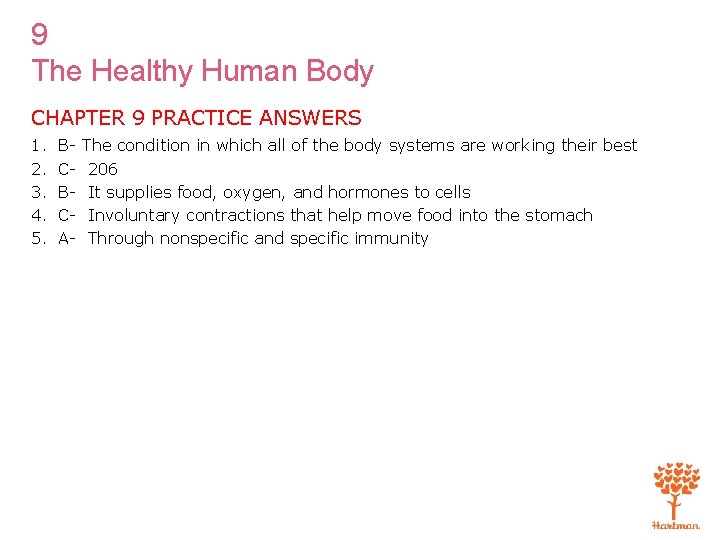
9 The Healthy Human Body CHAPTER 9 PRACTICE ANSWERS 1. 2. 3. 4. 5. BCBCA- The condition in which all of the body systems are working their best 206 It supplies food, oxygen, and hormones to cells Involuntary contractions that help move food into the stomach Through nonspecific and specific immunity
- Slides: 94