
9 The Discrete vs The Continuous Finite Arithmetic


- Slides: 33
9. The Discrete vs The Continuous Finite Arithmetic More practice with iteration and conditionals.
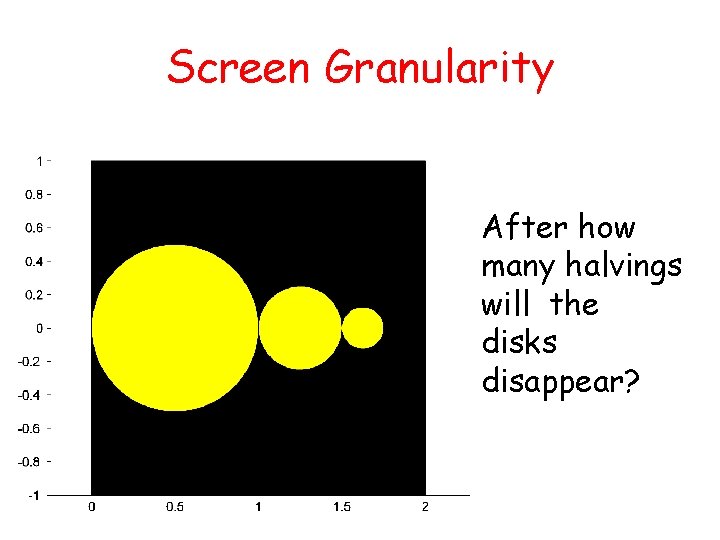
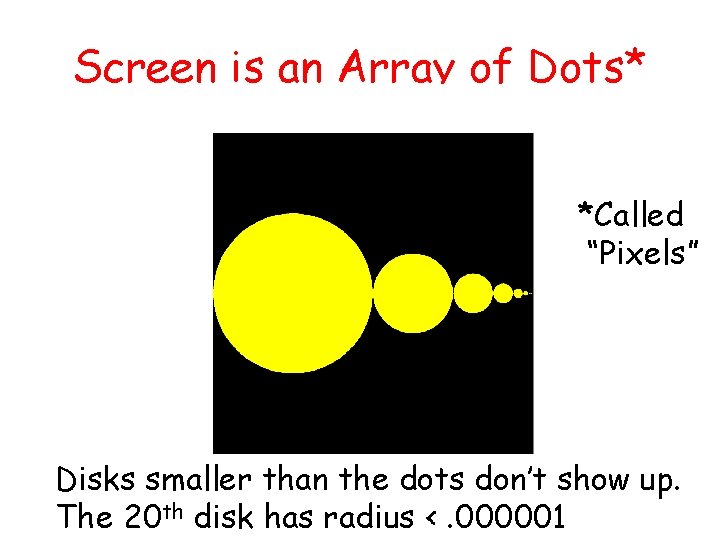
Screen Granularity After how many halvings will the disks disappear?
Xeno’s Paradox • A wall is two feet away. • Take steps that repeatedly halve the remaining distance. • You never reach the wall because the distance traveled after n steps = 1 + ½ + ¼ + … + 1/2 n = 2 – 1/2 n
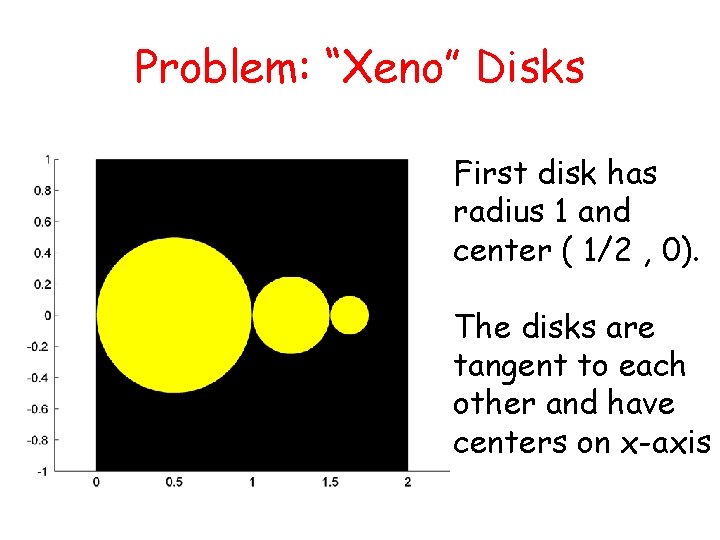
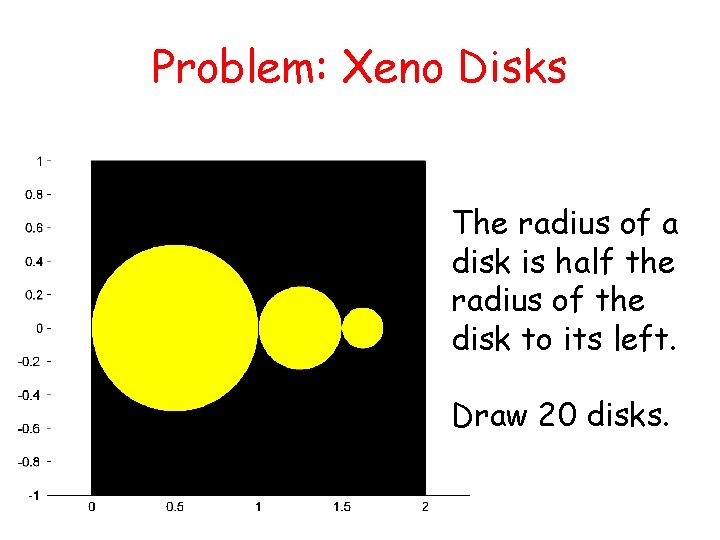
Problem: “Xeno” Disks x First disk has radius 1 and center ( 1/2 , 0). The disks are tangent to each other and have centers on x-axis
Problem: Xeno Disks x The radius of a disk is half the radius of the disk to its left. Draw 20 disks.
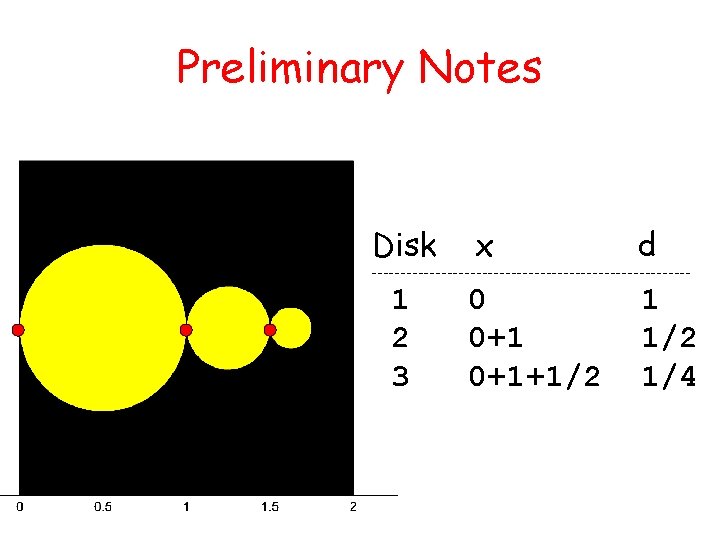
Variable Definitions x: the x-value of the left tangent point for a given circle. d : the diameter of a given circle
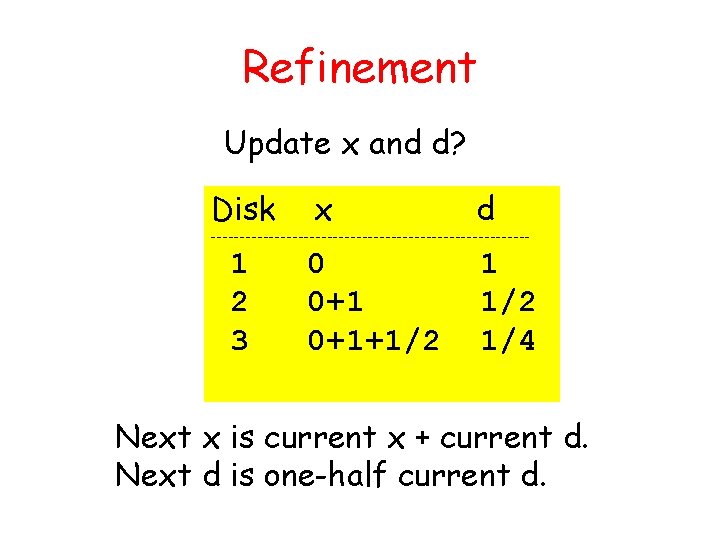
Preliminary Notes Disk x d 0 0+1+1/2 1/4 ---------------------------- 1 2 3
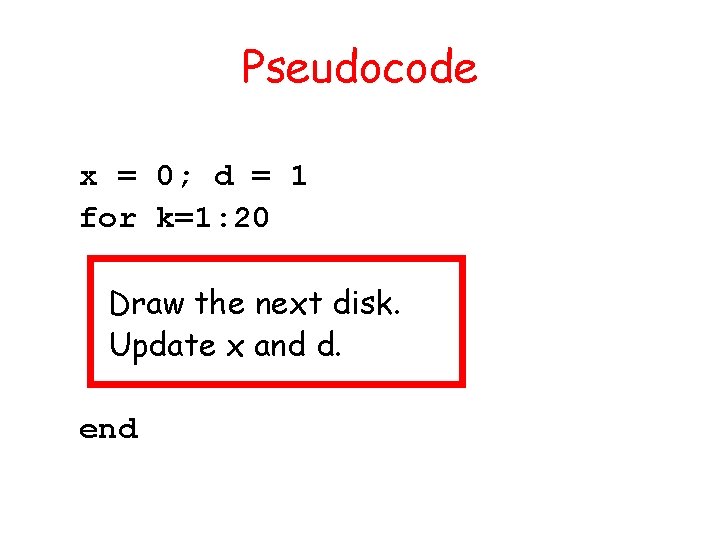
Pseudocode x = 0; d = 1 for k=1: 20 Draw the next disk. Update x and d. end
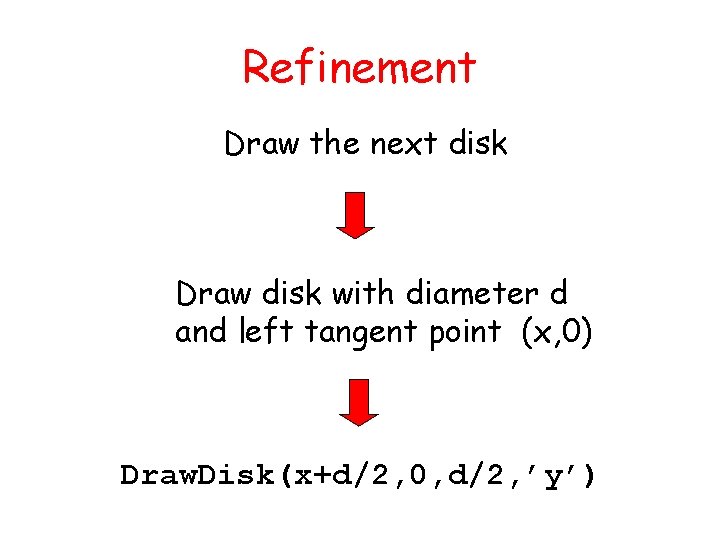
Refinement Draw the next disk Draw disk with diameter d and left tangent point (x, 0) Draw. Disk(x+d/2, 0, d/2, ’y’)
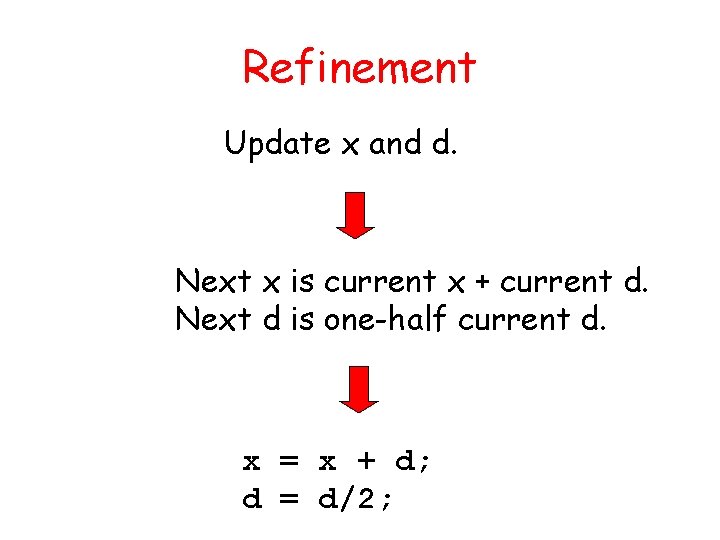
Refinement Update x and d? Disk x d 0 0+1+1/2 1/4 ---------------------------- 1 2 3 Next x is current x + current d. Next d is one-half current d.
Refinement Update x and d. Next x is current x + current d. Next d is one-half current d. x = x + d; d = d/2;
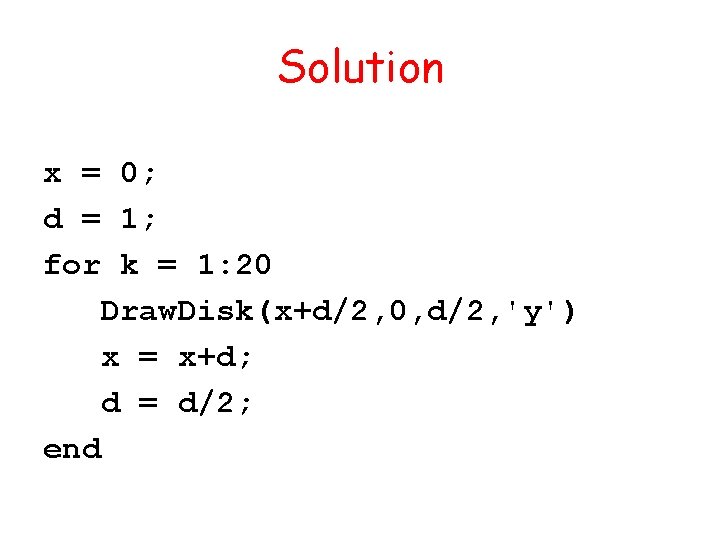
Solution x = 0; d = 1; for k = 1: 20 Draw. Disk(x+d/2, 0, d/2, 'y') x = x+d; d = d/2; end
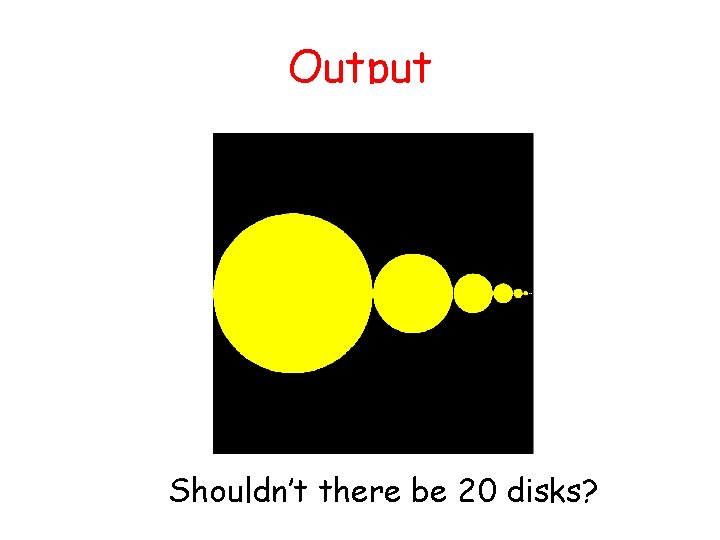
Output Shouldn’t there be 20 disks?
Screen is an Array of Dots* *Called “Pixels” Disks smaller than the dots don’t show up. The 20 th disk has radius <. 000001
Finiteness It shows up all over the place in computing.
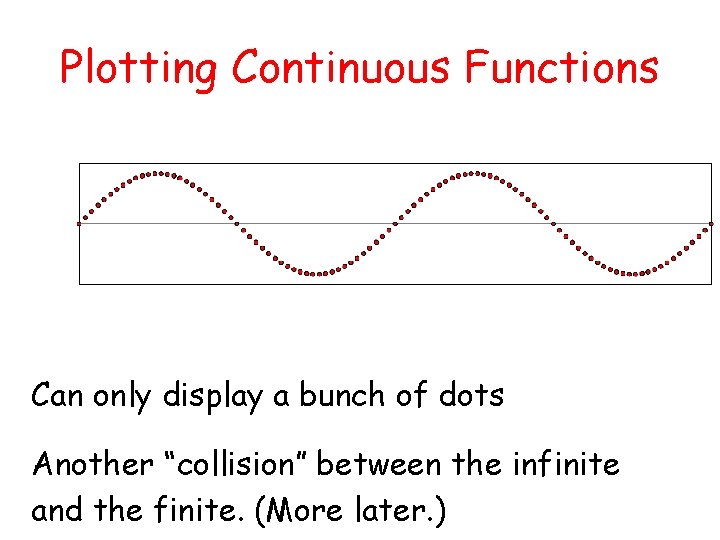
Plotting Continuous Functions Can only display a bunch of dots Another “collision” between the infinite and the finite. (More later. )
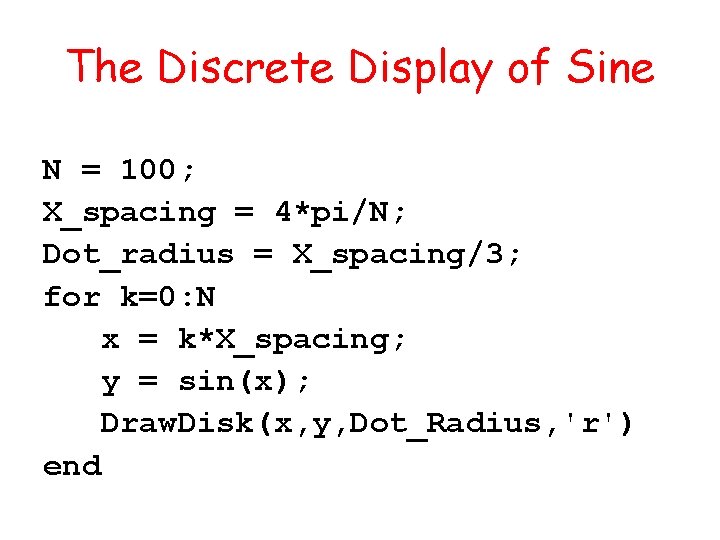
The Discrete Display of Sine N = 100; X_spacing = 4*pi/N; Dot_radius = X_spacing/3; for k=0: N x = k*X_spacing; y = sin(x); Draw. Disk(x, y, Dot_Radius, 'r') end
The Moral To produce realistic plots/renderings you must appreciate screen granularity.
Similar Finite “Behavior” with Computer Arithmetic Memory Hardware is finite. Computer cannot store never-ending decimals like pi, sqrt(2), 1/3.
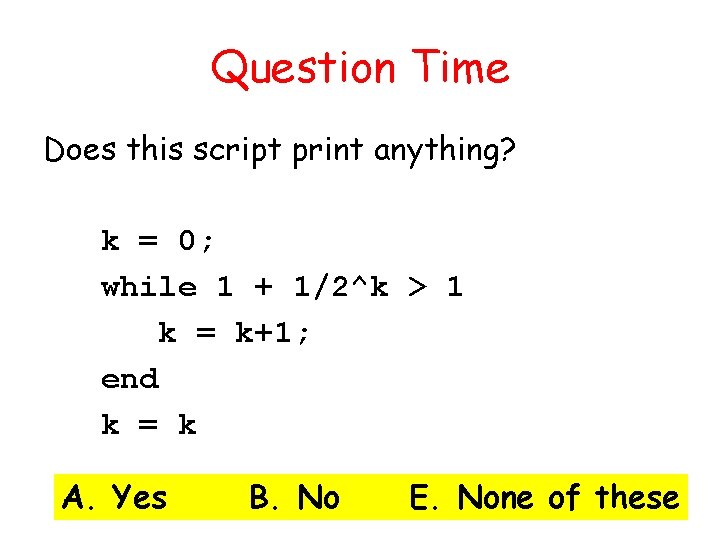
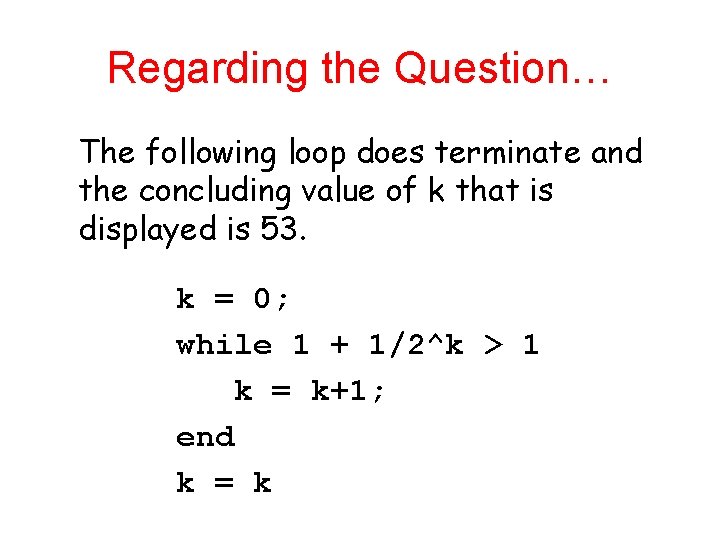
Question Time Does this script print anything? k = 0; while 1 + 1/2^k > 1 k = k+1; end k = k A. Yes B. No E. None of these
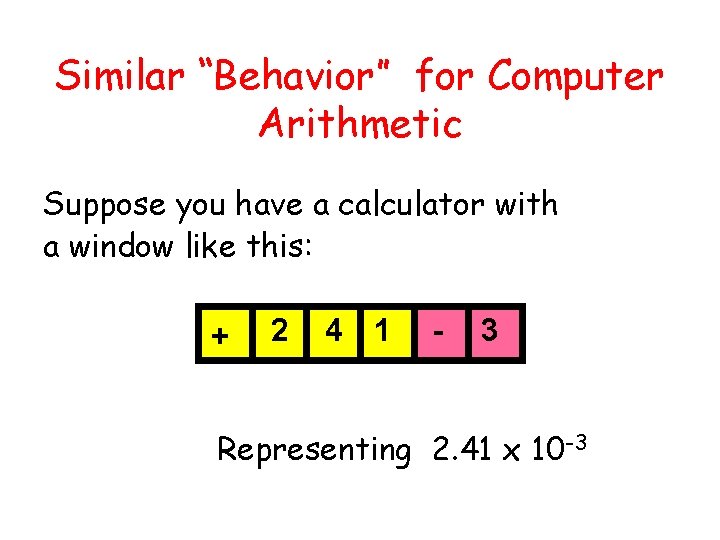
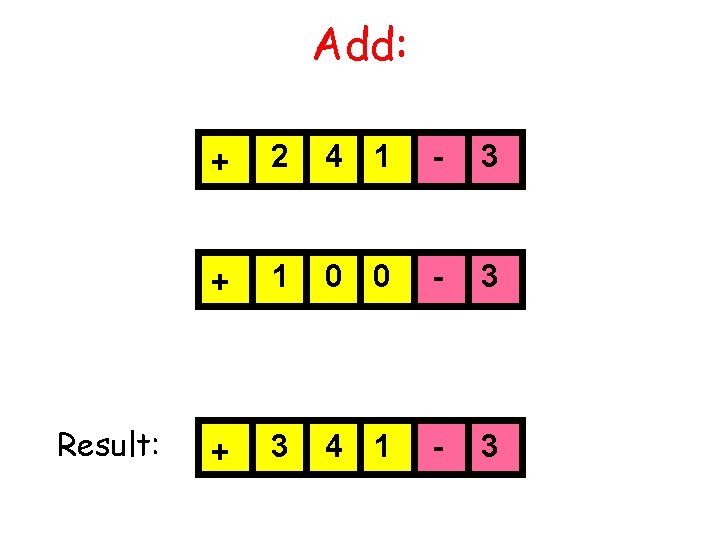
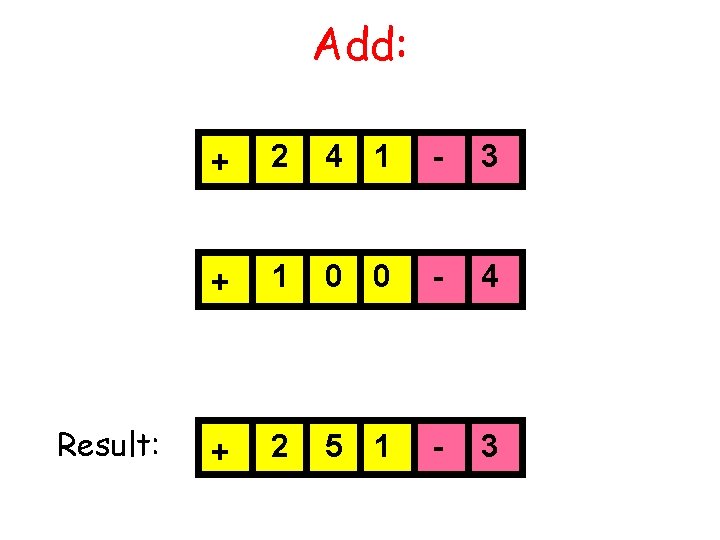
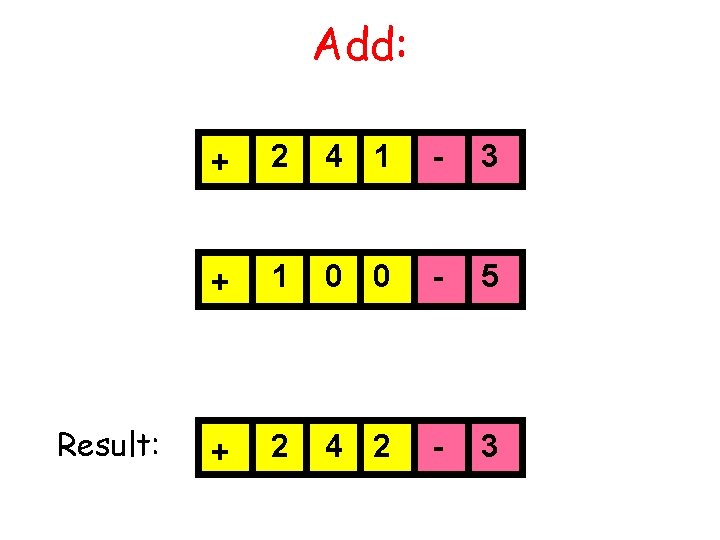
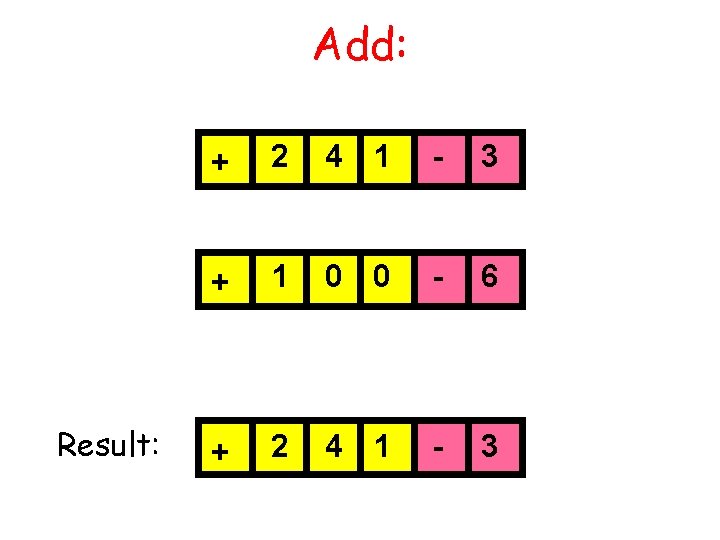
Similar “Behavior” for Computer Arithmetic Suppose you have a calculator with a window like this: + 2 4 1 - 3 Representing 2. 41 x 10 -3
Add: Result: + 2 4 1 - 3 + 1 0 0 - 3 + 3 4 1 - 3
Add: Result: + 2 4 1 - 3 + 1 0 0 - 4 + 2 5 1 - 3
Add: Result: + 2 4 1 - 3 + 1 0 0 - 5 + 2 4 2 - 3
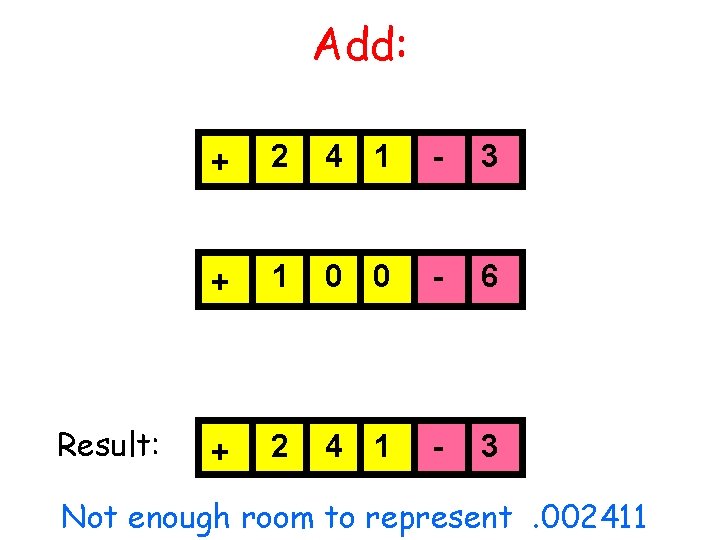
Add: Result: + 2 4 1 - 3 + 1 0 0 - 6 + 2 4 1 - 3
Add: Result: + 2 4 1 - 3 + 1 0 0 - 6 + 2 4 1 - 3 Not enough room to represent. 002411
Regarding the Question… The following loop does terminate and the concluding value of k that is displayed is 53. k = 0; while 1 + 1/2^k > 1 k = k+1; end k = k
The Moral To produce reliable numerical results you must appreciate floating point arithmetic.
The 1991 Patriot Missile Disaster Elementary misperceptions about the finiteness of computer arithmetic. 30+ died.
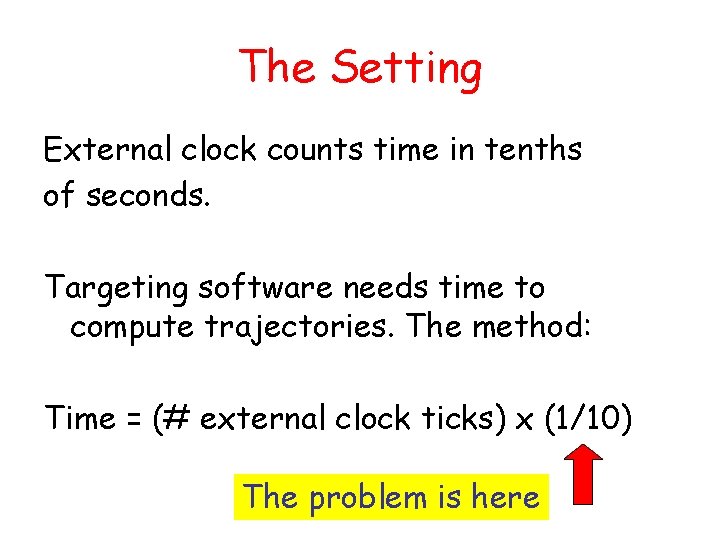
The Setting External clock counts time in tenths of seconds. Targeting software needs time to compute trajectories. The method: Time = (# external clock ticks) x (1/10) The problem is here
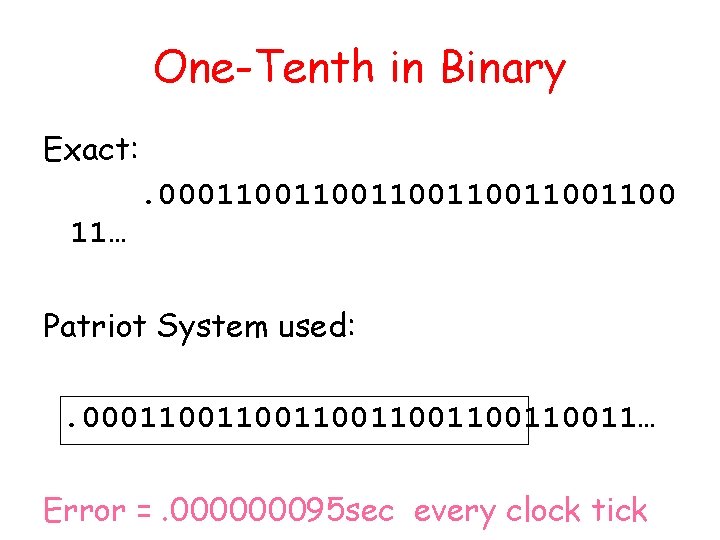
One-Tenth in Binary Exact: . 000110011001100 11… Patriot System used: . 00011001100110011… Error =. 000000095 sec every clock tick
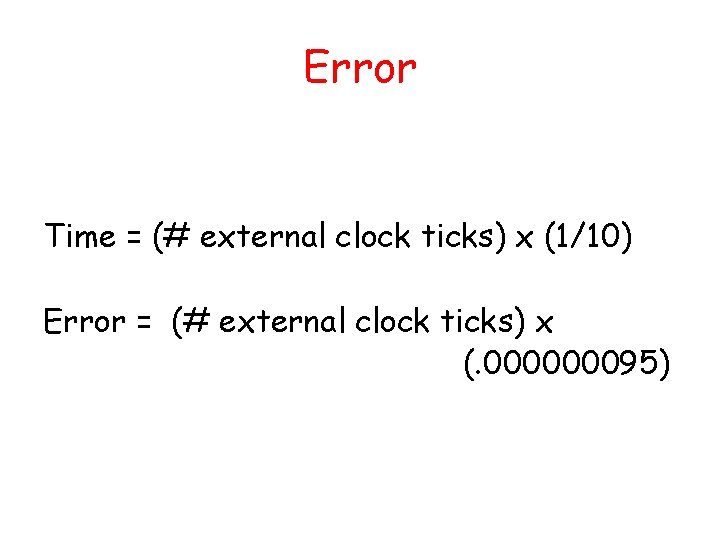
Error Time = (# external clock ticks) x (1/10) Error = (# external clock ticks) x (. 000000095)
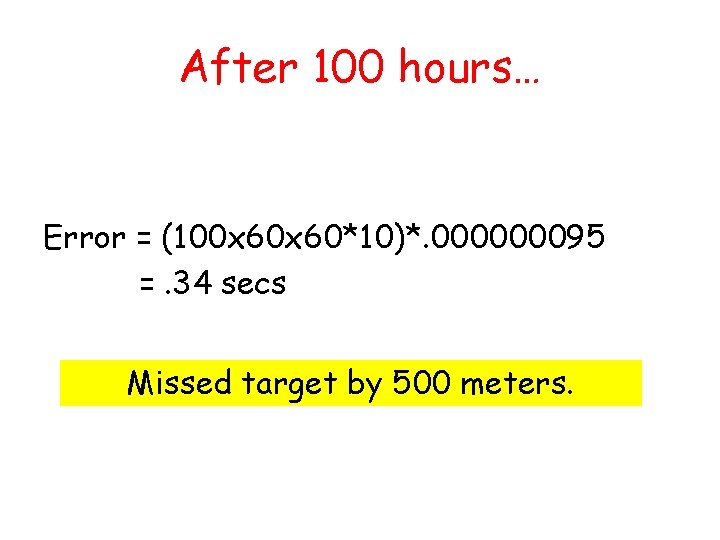
After 100 hours… Error = (100 x 60*10)*. 000000095 =. 34 secs Missed target by 500 meters.