
9 th CWRF ESRF Grenoble 20 th 24
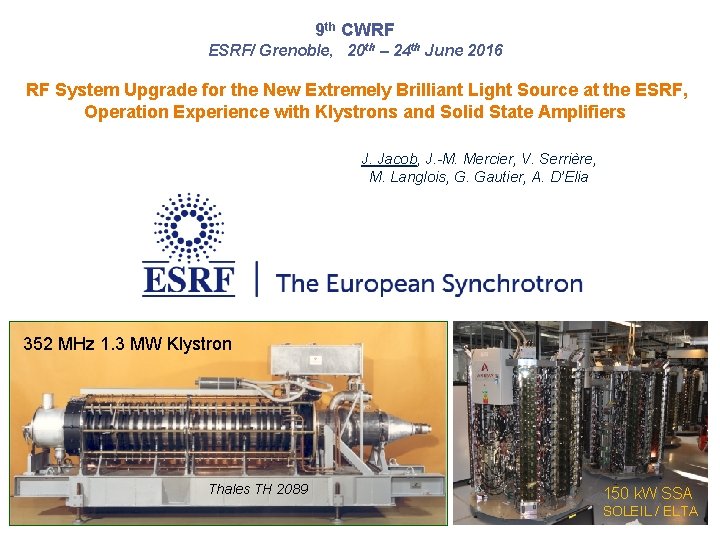
9 th CWRF ESRF/ Grenoble, 20 th – 24 th June 2016 RF System Upgrade for the New Extremely Brilliant Light Source at the ESRF, Operation Experience with Klystrons and Solid State Amplifiers J. Jacob, J. -M. Mercier, V. Serrière, M. Langlois, G. Gautier, A. D’Elia 352 MHz 1. 3 MW Klystron Thales TH 2089 150 k. W SSA SOLEIL / ELTA
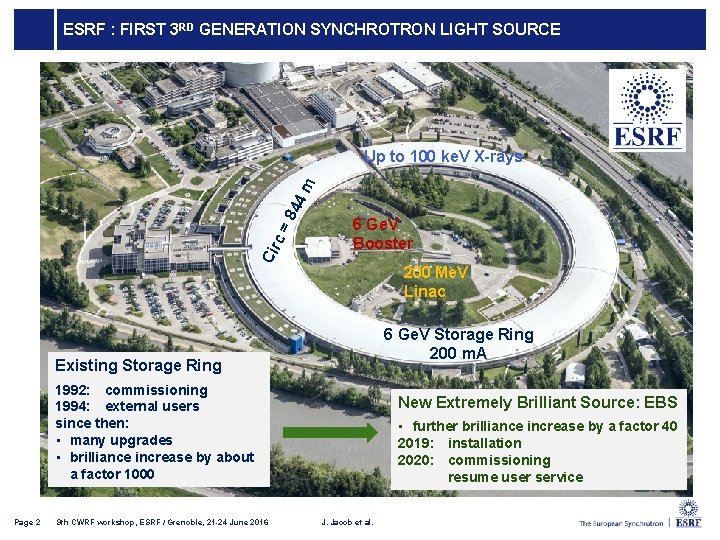
ESRF : FIRST 3 RD GENERATION SYNCHROTRON LIGHT SOURCE Cir c= 84 4 m Up to 100 ke. V X-rays 6 Ge. V Booster 200 Me. V Linac 6 Ge. V Storage Ring 200 m. A Existing Storage Ring 1992: commissioning 1994: external users since then: • many upgrades • brilliance increase by about a factor 1000 Page 2 9 th CWRF workshop, ESRF / Grenoble, 21 -24 June 2016 New Extremely Brilliant Source: EBS • further brilliance increase by a factor 40 2019: installation 2020: commissioning resume user service J. Jacob et al.
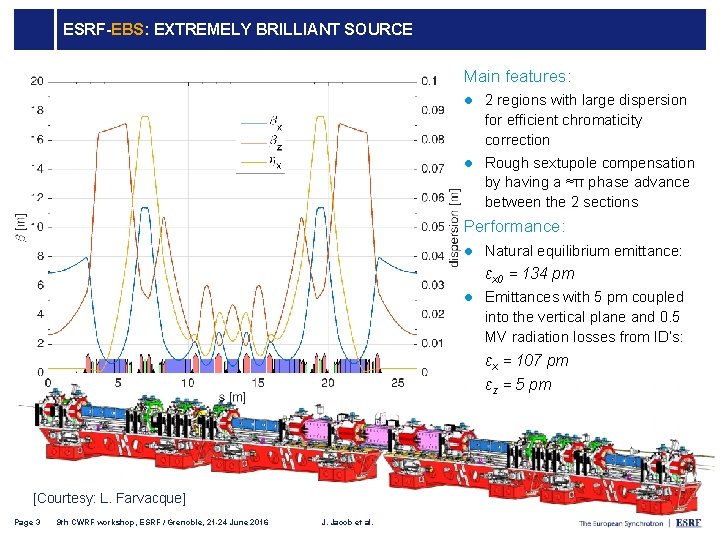
ESRF-EBS: EXTREMELY BRILLIANT SOURCE Main features: l 2 regions with large dispersion for efficient chromaticity correction l Rough sextupole compensation by having a ≈π phase advance between the 2 sections Performance: l Natural equilibrium emittance: εx 0 = 134 pm l Emittances with 5 pm coupled into the vertical plane and 0. 5 MV radiation losses from ID’s: εx = 107 pm εz = 5 pm [Courtesy: L. Farvacque] Page 3 9 th CWRF workshop, ESRF / Grenoble, 21 -24 June 2016 J. Jacob et al.
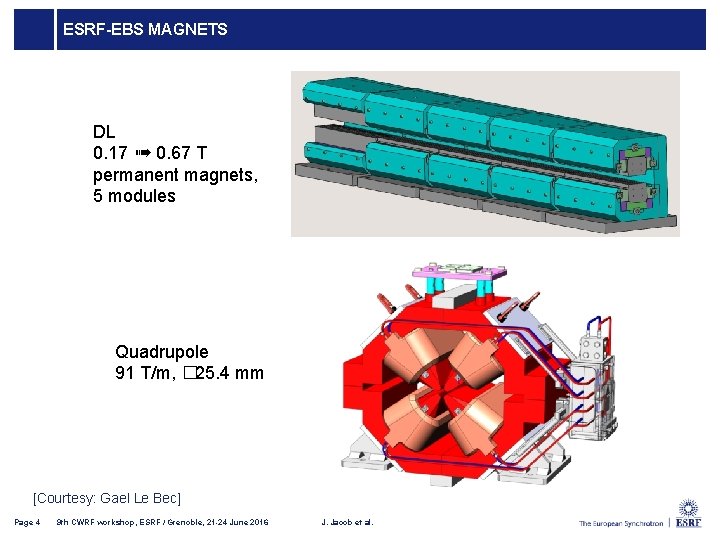
ESRF-EBS MAGNETS DL 0. 17 ➠ 0. 67 T permanent magnets, 5 modules Quadrupole 91 T/m, � 25. 4 mm [Courtesy: Gael Le Bec] Page 4 9 th CWRF workshop, ESRF / Grenoble, 21 -24 June 2016 J. Jacob et al.
![ESRF-EBS MAGNETS DQ 0. 55 T, 37 T/m [Courtesy: Gael Le Bec] Page 5](http://slidetodoc.com/presentation_image_h2/96f7f54015e7abb669605f071bedab7f/image-5.jpg "ESRF-EBS MAGNETS DQ 0. 55 T, 37 T/m [Courtesy: Gael Le Bec] Page 5")
ESRF-EBS MAGNETS DQ 0. 55 T, 37 T/m [Courtesy: Gael Le Bec] Page 5 9 th CWRF workshop, ESRF / Grenoble, 21 -24 June 2016 J. Jacob et al.
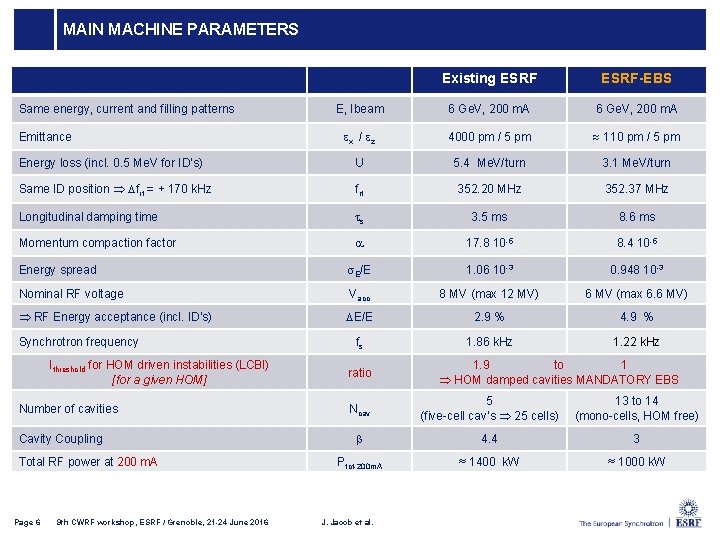
MAIN MACHINE PARAMETERS Existing ESRF-EBS E, Ibeam 6 Ge. V, 200 m. A x / z 4000 pm / 5 pm 110 pm / 5 pm Energy loss (incl. 0. 5 Me. V for ID’s) U 5. 4 Me. V/turn 3. 1 Me. V/turn Same ID position Dfrf = + 170 k. Hz frf 352. 20 MHz 352. 37 MHz Longitudinal damping time ts 3. 5 ms 8. 6 ms Momentum compaction factor a 17. 8 10 -5 8. 4 10 -5 Energy spread s. E/E 1. 06 10 -3 0. 948 10 -3 Nominal RF voltage Vacc 8 MV (max 12 MV) 6 MV (max 6. 6 MV) RF Energy acceptance (incl. ID’s) DE/E 2. 9 % 4. 9 % fs 1. 86 k. Hz 1. 22 k. Hz Same energy, current and filling patterns Emittance Synchrotron frequency Ithreshold for HOM driven instabilities (LCBI) [for a given HOM] Number of cavities Cavity Coupling Total RF power at 200 m. A Page 6 9 th CWRF workshop, ESRF / Grenoble, 21 -24 June 2016 ratio 1. 9 to 1 HOM damped cavities MANDATORY EBS Ncav 5 (five-cell cav’s 25 cells) 13 to 14 (mono-cells, HOM free) b 4. 4 3 Ptot-200 m. A ≈ 1400 k. W ≈ 1000 k. W J. Jacob et al.

RF DESIGN ELEMENTS FOR ESRF-EBS Total energy loss including ID radiation: 3. 1 Me. V/turn Maximum RF Voltage: 6. 6 MV RF transmission losses: 15 % F including RF losses, spurious mismatches Stored current with operational margin: 220 m. A RF frequency: 352. 371 MHz 15 HOM damped cavities: 3 prototypes validated for 0. 6 MV / 150 k. W 12 cavities in fabrication ES RF 5 -cell cavities: strong HOM ! Page 7 9 th CWRF workshop, ESRF / Grenoble, 21 -24 June 2016 J. Jacob et al. HOM damped mono-cell cavities developed at ESRF, based on BESSY/ALBA design vi si t
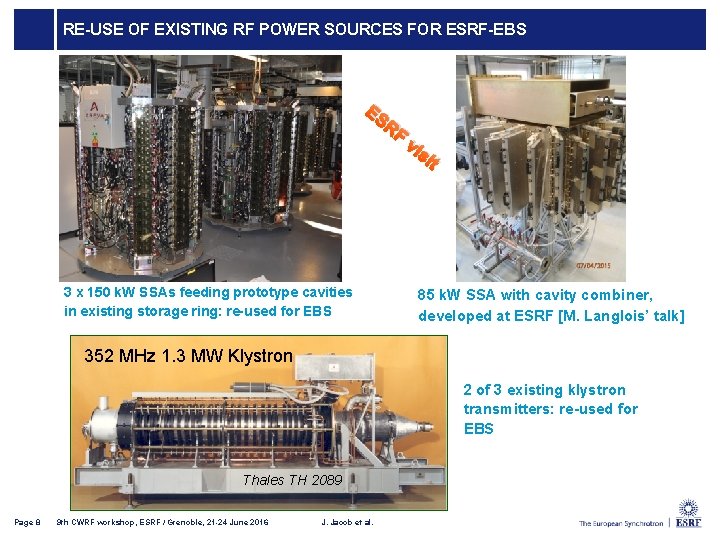
RE-USE OF EXISTING RF POWER SOURCES FOR ESRF-EBS ES RF 3 x 150 k. W SSAs feeding prototype cavities in existing storage ring: re-used for EBS vi si t 85 k. W SSA with cavity combiner, developed at ESRF [M. Langlois’ talk] 352 MHz 1. 3 MW Klystron 2 of 3 existing klystron transmitters: re-used for EBS Thales TH 2089 Page 8 9 th CWRF workshop, ESRF / Grenoble, 21 -24 June 2016 J. Jacob et al.
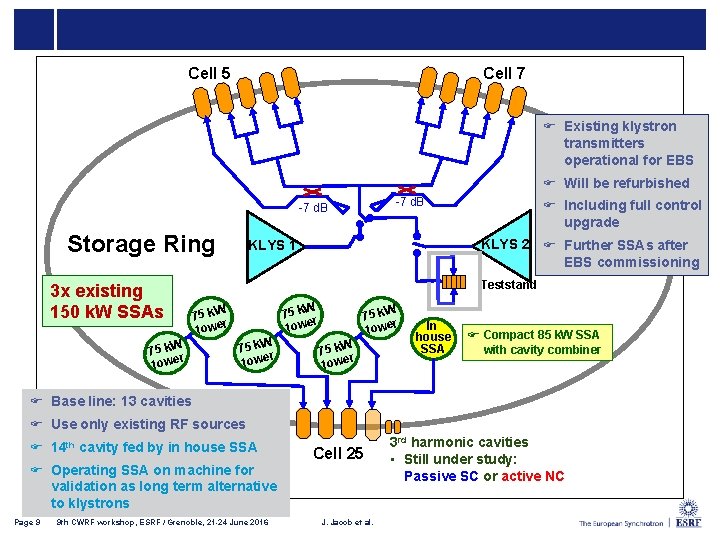
Cell 5 Cell 7 F Existing klystron transmitters operational for EBS F Will be refurbished -7 d. B Storage Ring 3 x existing 150 k. W SSAs 75 k. W r towe F Including full control upgrade KLYS 2 F Further SSAs after EBS commissioning KLYS 1 Teststand 75 k. W r towe In house SSA F Compact 85 k. W SSA with cavity combiner F Base line: 13 cavities F Use only existing RF sources F 14 th cavity fed by in house SSA F Operating SSA on machine for validation as long term alternative to klystrons Page 9 9 th CWRF workshop, ESRF / Grenoble, 21 -24 June 2016 Cell 25 J. Jacob et al. 3 rd harmonic cavities • Still under study: Passive SC or active NC
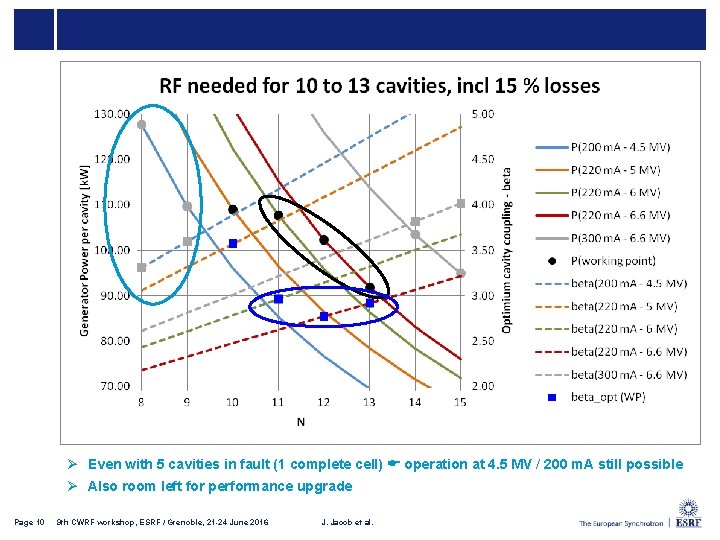
Ø Even with 5 cavities in fault (1 complete cell) operation at 4. 5 MV / 200 m. A still possible Ø Also room left for performance upgrade Page 10 9 th CWRF workshop, ESRF / Grenoble, 21 -24 June 2016 J. Jacob et al.
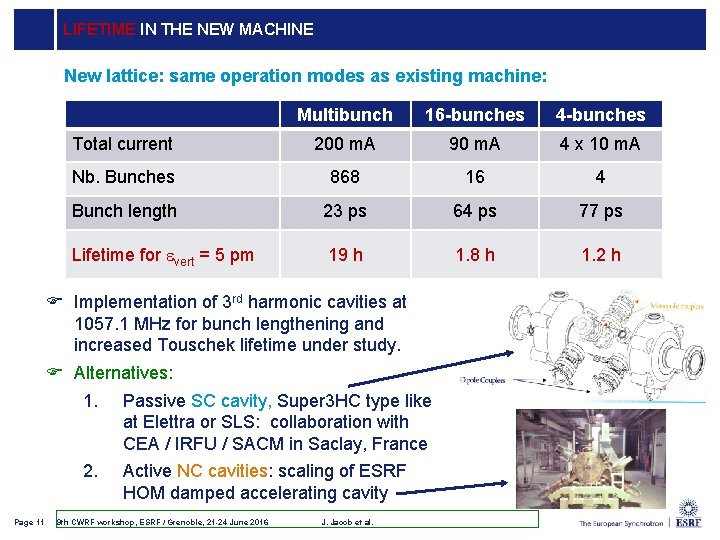
LIFETIME IN THE NEW MACHINE New lattice: same operation modes as existing machine: Multibunch 16 -bunches 4 -bunches Total current 200 m. A 90 m. A 4 x 10 m. A Nb. Bunches 868 16 4 Bunch length 23 ps 64 ps 77 ps Lifetime for vert = 5 pm 19 h 1. 8 h 1. 2 h F Implementation of 3 rd harmonic cavities at 1057. 1 MHz for bunch lengthening and increased Touschek lifetime under study. F Alternatives: 1. Passive SC cavity, Super 3 HC type like at Elettra or SLS: collaboration with CEA / IRFU / SACM in Saclay, France 2. Active NC cavities: scaling of ESRF HOM damped accelerating cavity Page 11 9 th CWRF workshop, ESRF / Grenoble, 21 -24 June 2016 J. Jacob et al.
![OPERATION OF PASSIVE SC HARMONIC CAVITY Z / [W] detuning Df fs R+ 3](http://slidetodoc.com/presentation_image_h2/96f7f54015e7abb669605f071bedab7f/image-12.jpg "OPERATION OF PASSIVE SC HARMONIC CAVITY Z / [W] detuning Df fs R+ 3")
OPERATION OF PASSIVE SC HARMONIC CAVITY Z / [W] detuning Df fs R+ 3 frf f - 3 fres [k. Hz] -> Ø Strong detuning Df of Super 3 HC like cavity: • Zcav ≈ j. X, with X >> R, X ≠ f(QL) • Df such that: 2 Ibeam X = Vharm • Df ≈ 3. 5 k. Hz for Ibeam = 70 m. A Ø Smaller Ibeam larger X smaller Df larger R+ Bunch lengthening: => Problem of AC Robinson instability for I beam < 70 m. A ! Vharm = 1. 7 MV for Vacc = 6 MV (off resonance, Fharm follows rigid bunch motion at f s≠ 0) Page 12 9 th CWRF workshop, ESRF / Grenoble, 21 -24 June 2016 J. Jacob et al.
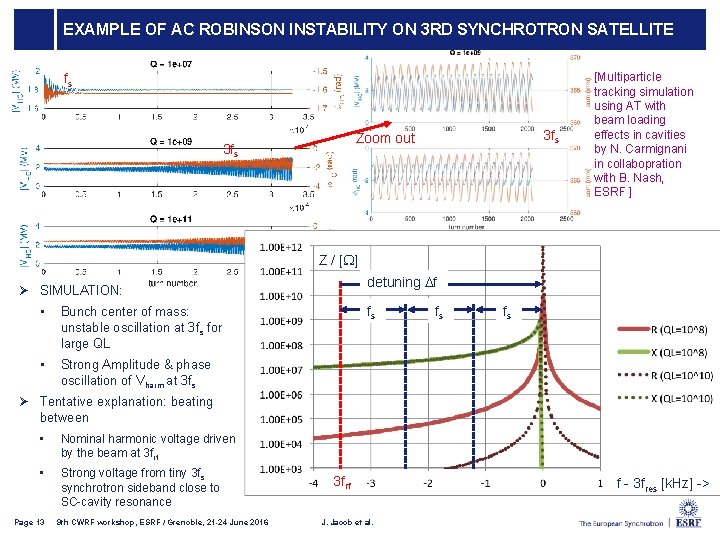
EXAMPLE OF AC ROBINSON INSTABILITY ON 3 RD SYNCHROTRON SATELLITE fs 3 fs Zoom out 3 fs [Multiparticle tracking simulation using AT with beam loading effects in cavities by N. Carmignani in collabopration with B. Nash, ESRF ] Z / [W] detuning Df Ø SIMULATION: • Bunch center of mass: unstable oscillation at 3 fs for large QL • Strong Amplitude & phase oscillation of Vharm at 3 fs fs Ø Tentative explanation: beating between • Nominal harmonic voltage driven by the beam at 3 frf • Strong voltage from tiny 3 fs synchrotron sideband close to SC-cavity resonance Page 13 9 th CWRF workshop, ESRF / Grenoble, 21 -24 June 2016 3 frf J. Jacob et al. f - 3 fres [k. Hz] ->
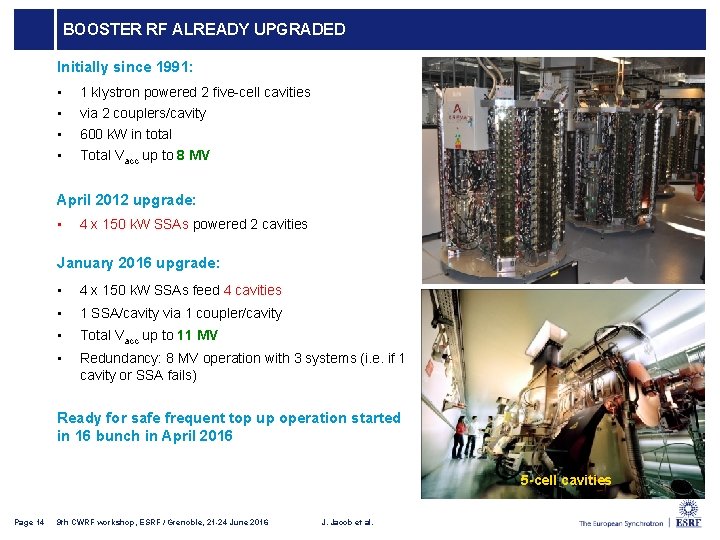
BOOSTER RF ALREADY UPGRADED Initially since 1991: • • 1 klystron powered 2 five-cell cavities via 2 couplers/cavity 600 k. W in total Total Vacc up to 8 MV April 2012 upgrade: • 4 x 150 k. W SSAs powered 2 cavities January 2016 upgrade: • 4 x 150 k. W SSAs feed 4 cavities • 1 SSA/cavity via 1 coupler/cavity • Total Vacc up to 11 MV • Redundancy: 8 MV operation with 3 systems (i. e. if 1 cavity or SSA fails) Ready for safe frequent top up operation started in 16 bunch in April 2016 5 -cell cavities Page 14 9 th CWRF workshop, ESRF / Grenoble, 21 -24 June 2016 J. Jacob et al.
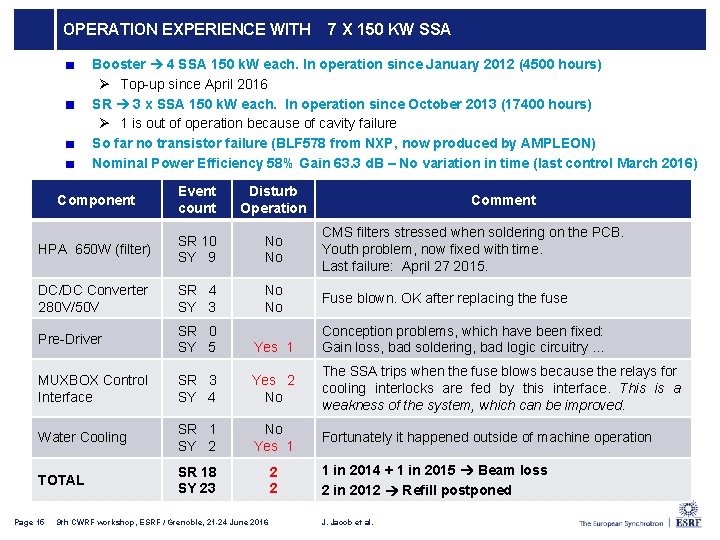
OPERATION EXPERIENCE WITH 7 X 150 KW SSA Booster 4 SSA 150 k. W each. In operation since January 2012 (4500 hours) Ø Top-up since April 2016 SR 3 x SSA 150 k. W each. In operation since October 2013 (17400 hours) Ø 1 is out of operation because of cavity failure So far no transistor failure (BLF 578 from NXP, now produced by AMPLEON) Nominal Power Efficiency 58% Gain 63. 3 d. B – No variation in time (last control March 2016) Component Event count Disturb Operation HPA 650 W (filter) SR 10 SY 9 No No CMS filters stressed when soldering on the PCB. Youth problem, now fixed with time. Last failure: April 27 2015. DC/DC Converter 280 V/50 V SR 4 SY 3 No No Fuse blown. OK after replacing the fuse Pre-Driver SR 0 SY 5 Yes 1 MUXBOX Control Interface SR 3 SY 4 Yes 2 No The SSA trips when the fuse blows because the relays for cooling interlocks are fed by this interface. This is a weakness of the system, which can be improved. Water Cooling SR 1 SY 2 No Yes 1 Fortunately it happened outside of machine operation TOTAL SR 18 SY 23 2 2 Page 15 9 th CWRF workshop, ESRF / Grenoble, 21 -24 June 2016 Comment Conception problems, which have been fixed: Gain loss, bad soldering, bad logic circuitry … 1 in 2014 + 1 in 2015 Beam loss 2 in 2012 Refill postponed J. Jacob et al.
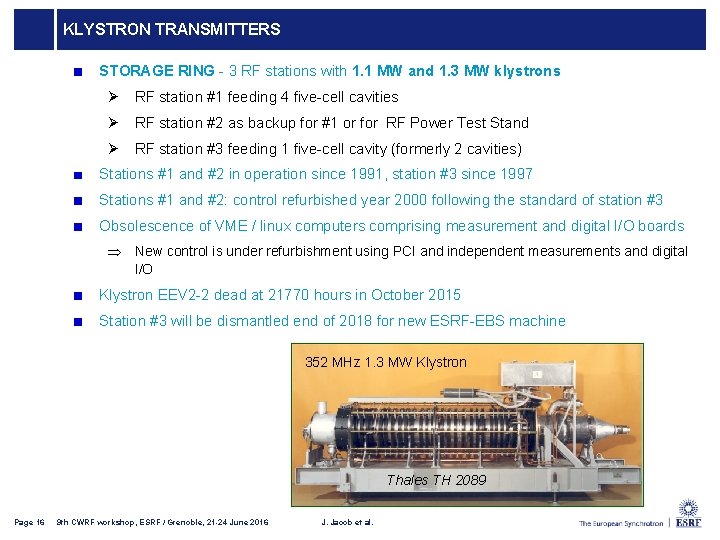
KLYSTRON TRANSMITTERS STORAGE RING - 3 RF stations with 1. 1 MW and 1. 3 MW klystrons Ø RF station #1 feeding 4 five-cell cavities Ø RF station #2 as backup for #1 or for RF Power Test Stand Ø RF station #3 feeding 1 five-cell cavity (formerly 2 cavities) Stations #1 and #2 in operation since 1991, station #3 since 1997 Stations #1 and #2: control refurbished year 2000 following the standard of station #3 Obsolescence of VME / linux computers comprising measurement and digital I/O boards New control is under refurbishment using PCI and independent measurements and digital I/O Klystron EEV 2 -2 dead at 21770 hours in October 2015 Station #3 will be dismantled end of 2018 for new ESRF-EBS machine 352 MHz 1. 3 MW Klystron Thales TH 2089 Page 16 9 th CWRF workshop, ESRF / Grenoble, 21 -24 June 2016 J. Jacob et al.
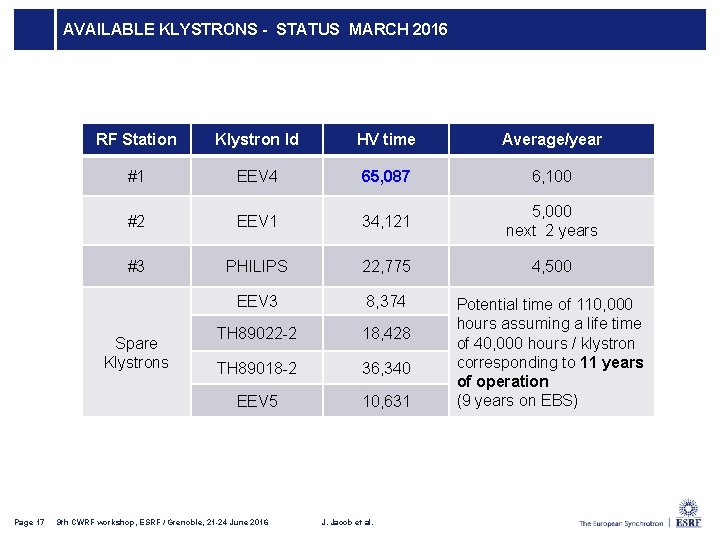
AVAILABLE KLYSTRONS - STATUS MARCH 2016 RF Station Klystron Id HV time Average/year #1 EEV 4 65, 087 6, 100 #2 EEV 1 34, 121 5, 000 next 2 years #3 PHILIPS 22, 775 4, 500 EEV 3 8, 374 TH 89022 -2 18, 428 TH 89018 -2 36, 340 EEV 5 10, 631 Potential time of 110, 000 hours assuming a life time of 40, 000 hours / klystron corresponding to 11 years of operation (9 years on EBS) Spare Klystrons Page 17 9 th CWRF workshop, ESRF / Grenoble, 21 -24 June 2016 J. Jacob et al.
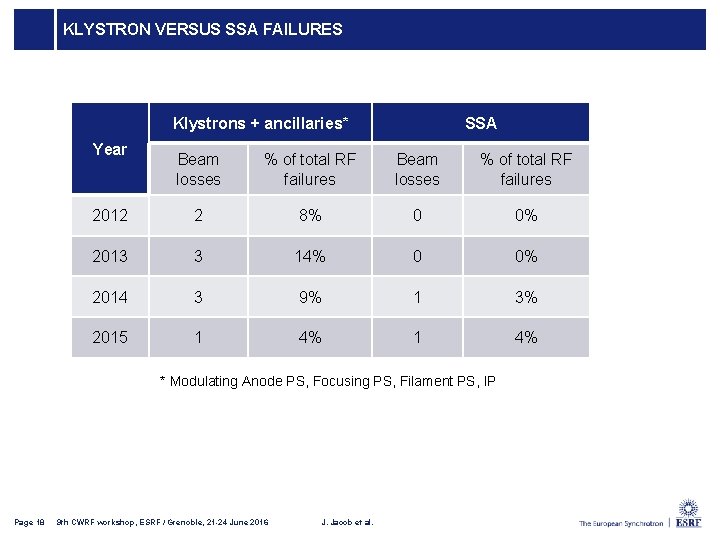
KLYSTRON VERSUS SSA FAILURES Klystrons + ancillaries* Year SSA Beam losses % of total RF failures 2012 2 8% 0 0% 2013 3 14% 0 0% 2014 3 9% 1 3% 2015 1 4% * Modulating Anode PS, Focusing PS, Filament PS, IP Page 18 9 th CWRF workshop, ESRF / Grenoble, 21 -24 June 2016 J. Jacob et al.
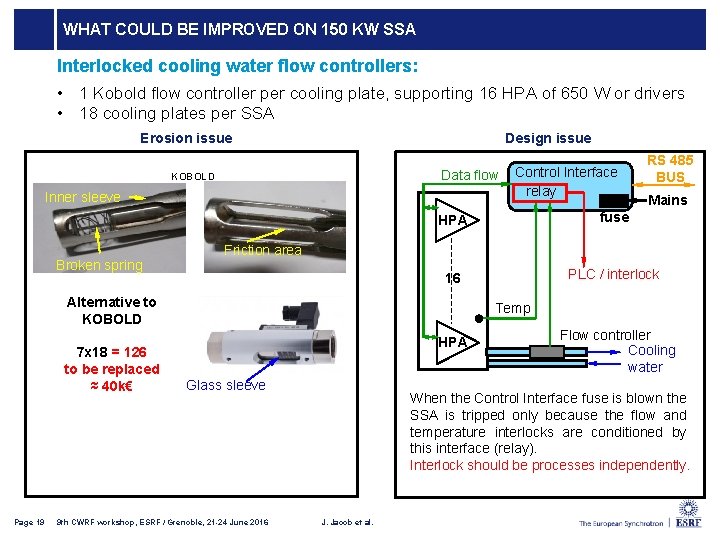
WHAT COULD BE IMPROVED ON 150 KW SSA Interlocked cooling water flow controllers: • 1 Kobold flow controller per cooling plate, supporting 16 HPA of 650 W or drivers • 18 cooling plates per SSA Erosion issue Design issue Data flow KOBOLD Inner sleeve Broken spring Page 19 RS 485 BUS Mains HPA fuse 16 PLC / interlock Friction area Alternative to KOBOLD 7 x 18 = 126 to be replaced ≈ 40 k€ Control Interface relay Temp HPA Glass sleeve 9 th CWRF workshop, ESRF / Grenoble, 21 -24 June 2016 Flow controller Cooling water When the Control Interface fuse is blown the SSA is tripped only because the flow and temperature interlocks are conditioned by this interface (relay). Interlock should be processes independently. J. Jacob et al.
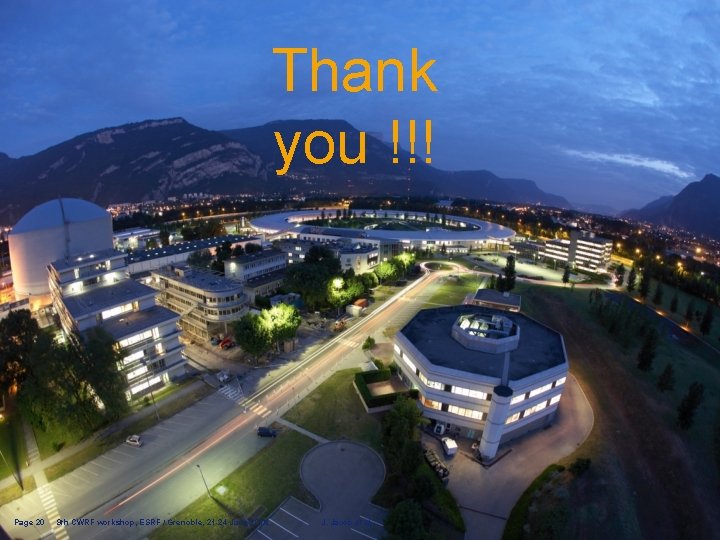
Thank you !!! Page 20 9 th CWRF workshop, ESRF / Grenoble, 21 -24 June 2016 J. Jacob et al.
- Slides: 20