
9 Scheduling Proportional Share Operating System Three Easy
- Slides: 12
9: Scheduling: Proportional Share Operating System: Three Easy Pieces Youjip Won 1
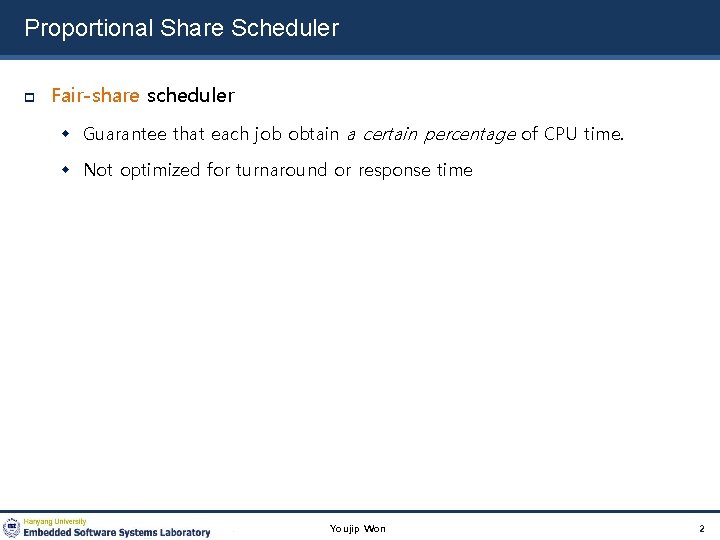
Proportional Share Scheduler Fair-share scheduler Guarantee that each job obtain a certain percentage of CPU time. Not optimized for turnaround or response time Youjip Won 2
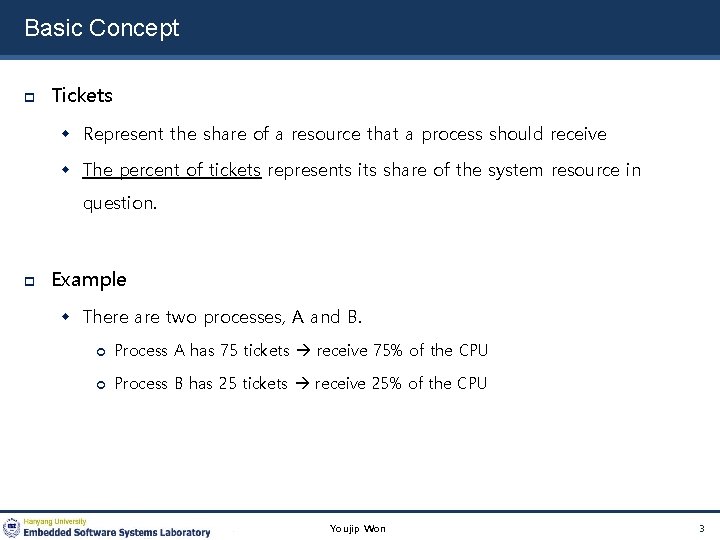
Basic Concept Tickets Represent the share of a resource that a process should receive The percent of tickets represents its share of the system resource in question. Example There are two processes, A and B. Process A has 75 tickets receive 75% of the CPU Process B has 25 tickets receive 25% of the CPU Youjip Won 3
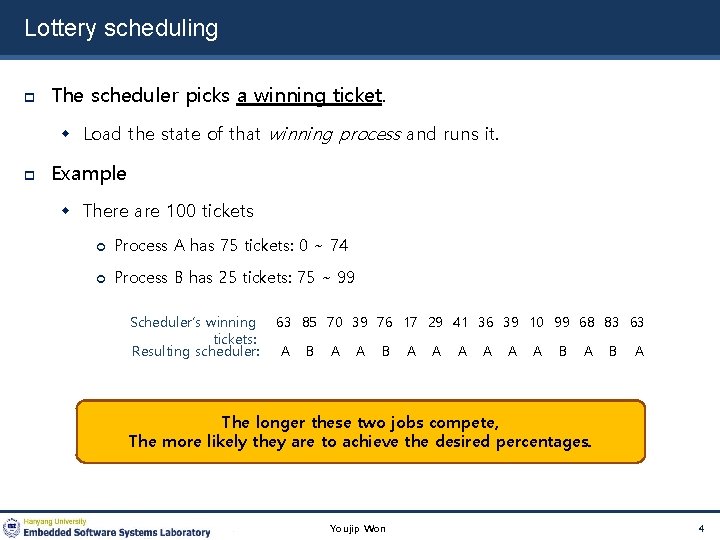
Lottery scheduling The scheduler picks a winning ticket. Load the state of that winning process and runs it. Example There are 100 tickets Process A has 75 tickets: 0 ~ 74 Process B has 25 tickets: 75 ~ 99 Scheduler’s winning tickets: Resulting scheduler: 63 85 70 39 76 17 29 41 36 39 10 99 68 83 63 A B A A A A B A The longer these two jobs compete, The more likely they are to achieve the desired percentages. Youjip Won 4
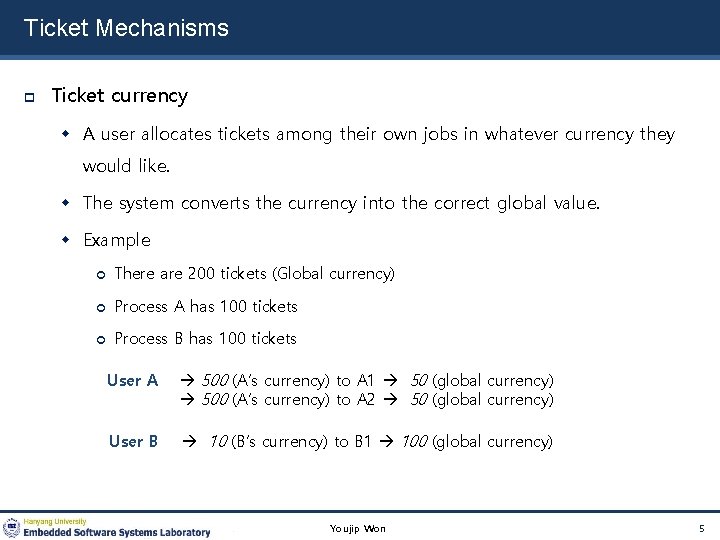
Ticket Mechanisms Ticket currency A user allocates tickets among their own jobs in whatever currency they would like. The system converts the currency into the correct global value. Example There are 200 tickets (Global currency) Process A has 100 tickets Process B has 100 tickets User A 500 (A’s currency) to A 1 50 (global currency) 500 (A’s currency) to A 2 50 (global currency) User B 10 (B’s currency) to B 1 100 (global currency) Youjip Won 5
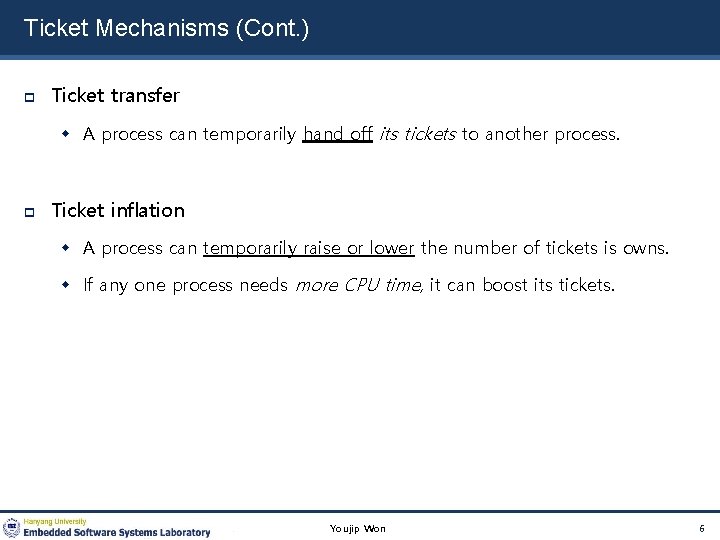
Ticket Mechanisms (Cont. ) Ticket transfer A process can temporarily hand off its tickets to another process. Ticket inflation A process can temporarily raise or lower the number of tickets is owns. If any one process needs more CPU time, it can boost its tickets. Youjip Won 6
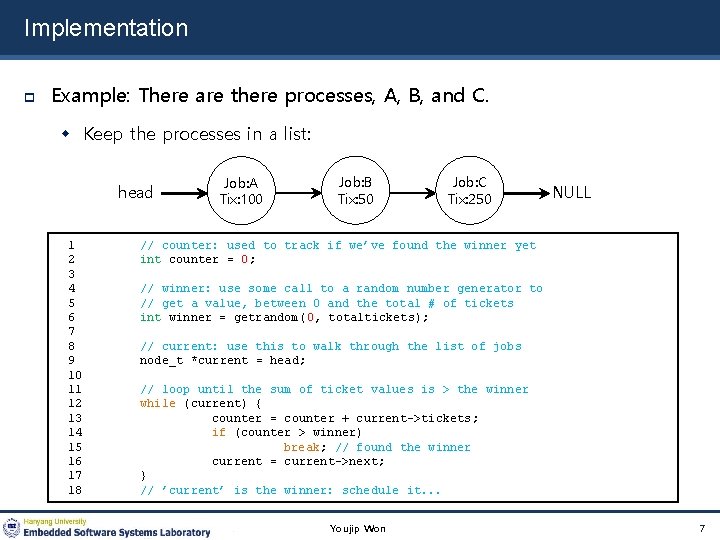
Implementation Example: There are there processes, A, B, and C. Keep the processes in a list: head 1 2 3 4 5 6 7 8 9 10 11 12 13 14 15 16 17 18 Job: A Tix: 100 Job: B Tix: 50 Job: C Tix: 250 NULL // counter: used to track if we’ve found the winner yet int counter = 0; // winner: use some call to a random number generator to // get a value, between 0 and the total # of tickets int winner = getrandom(0, totaltickets); // current: use this to walk through the list of jobs node_t *current = head; // loop until the sum of ticket values is > the winner while (current) { counter = counter + current->tickets; if (counter > winner) break; // found the winner current = current->next; } // ’current’ is the winner: schedule it. . . Youjip Won 7
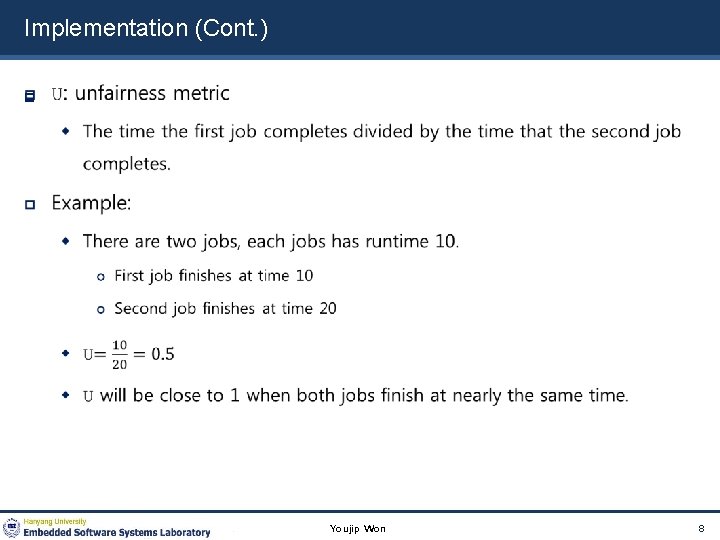
Implementation (Cont. ) Youjip Won 8
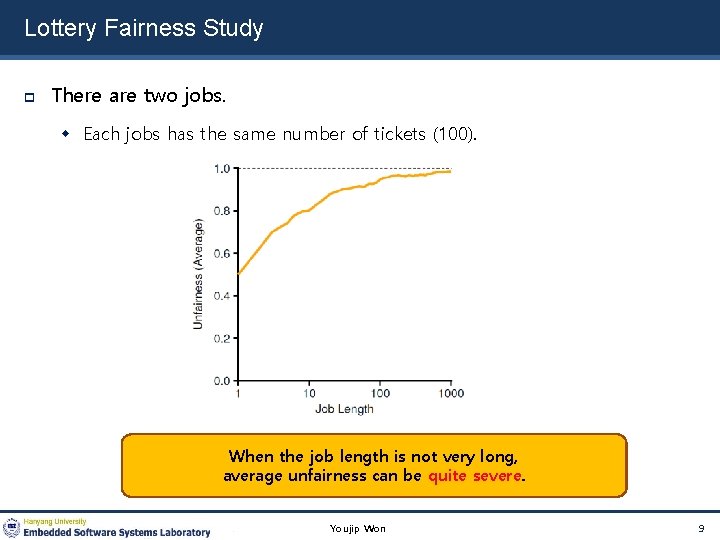
Lottery Fairness Study There are two jobs. Each jobs has the same number of tickets (100). When the job length is not very long, average unfairness can be quite severe. Youjip Won 9
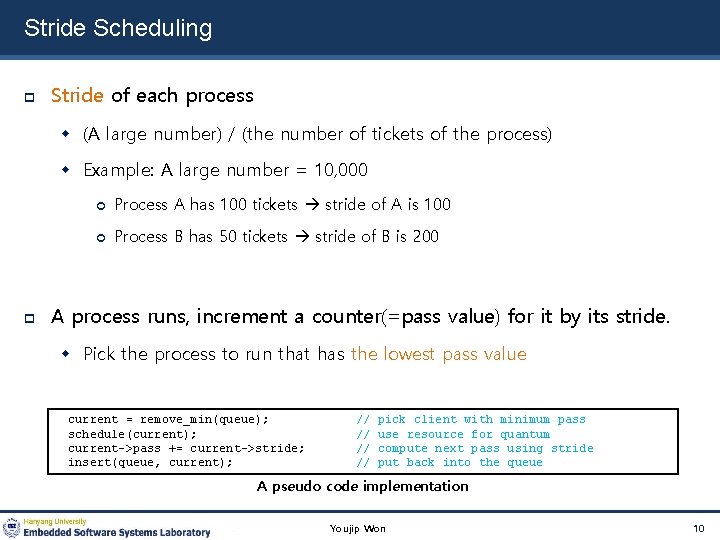
Stride Scheduling Stride of each process (A large number) / (the number of tickets of the process) Example: A large number = 10, 000 Process A has 100 tickets stride of A is 100 Process B has 50 tickets stride of B is 200 A process runs, increment a counter(=pass value) for it by its stride. Pick the process to run that has the lowest pass value current = remove_min(queue); schedule(current); current->pass += current->stride; insert(queue, current); // // pick client with minimum pass use resource for quantum compute next pass using stride put back into the queue A pseudo code implementation Youjip Won 10
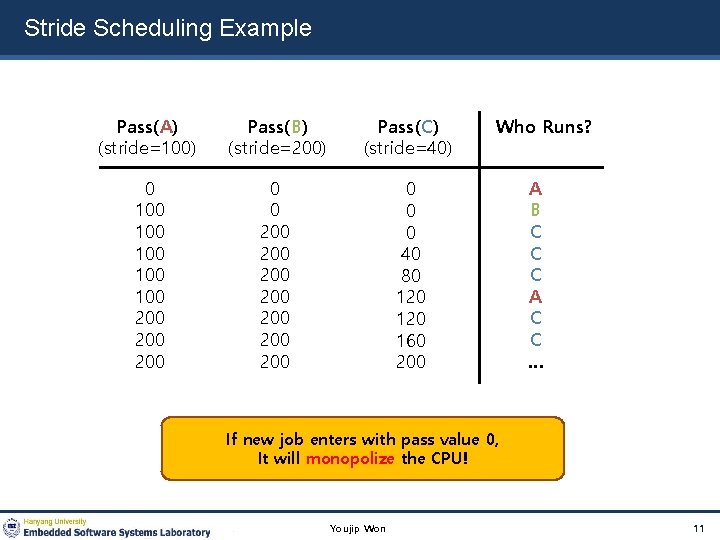
Stride Scheduling Example Pass(A) (stride=100) Pass(B) (stride=200) Pass(C) (stride=40) 0 100 100 100 200 200 0 0 200 200 0 40 80 120 160 200 Who Runs? A B C C C A C C … If new job enters with pass value 0, It will monopolize the CPU! Youjip Won 11
Disclaimer: This lecture slide set was initially developed for Operating System course in Computer Science Dept. at Hanyang University. This lecture slide set is for OSTEP book written by Remzi and Andrea at University of Wisconsin. Youjip Won 12