
9 RoleBased Access Control RBAC Role Classification Algorithm
9. Role-Based Access Control (RBAC) Role Classification Algorithm Prof. Bharat Bhargava Center for Education and Research in Information Assurance and Security (CERIAS) and Department of Computer Sciences Purdue University http: //www. cs. purdue. edu/people/bb bb@cs. purdue. edu Collaborators in the RAID Lab (http: //raidlab. cs. purdue. edu): Ms. E. Terzi (former Graduate Student) Dr. Yuhui Zhong (former Ph. D. Student) Prof. Sanjay Madria (U. Missouri-Rolla) This research is supported by CERIAS and NSF grants from IIS and ANIR. 1 --- 9/29/2020 7: 17: 25 PM
RBAC Role Classification Algorithm - Outline 1) Introduction 2) Algorithm 2. 1) Algorithm Preliminaries 2. 2) Algorithm - Training Phase 2. 3) Algorithm - Classification Phase 2. 4) Classification Algorithm Pseudocode 3) Experiments 3. 1) Experiment 1: Classification Accuracy 3. 2) Experiment 2: Detection and Diagnosis 3. 3) Experiment Summary 2 --- 9/29/2020 7: 17: 27 PM
![1) Introduction [E. Terzi, Y. Zhong, B. Bhargava et al. , 2002] n Goals](http://slidetodoc.com/presentation_image/8f3e9a2b89b2f0d8bd56da00edf695ee/image-3.jpg "1) Introduction [E. Terzi, Y. Zhong, B. Bhargava et al. , 2002] n Goals")
1) Introduction [E. Terzi, Y. Zhong, B. Bhargava et al. , 2002] n Goals for RBAC Role Classification Algorithm n n n Detect intruders (malicious users) that enter the system Build user role profiles using a supervised clustering algorithm Incorporate the method in RBAC Server Architecture § RBAC = Role Based Access Control n Context n n Role server architecture that dynamically assigns roles to users based on trust and credential information Role classification algorithm phases n Training phase § Build clusters that correspond to the role profiles based on the previously selected training set of normal audit log records n Classification phase § Process on the run users audit records and specify whether they behave according to the profile of the role they are holding 3 --- 9/29/2020 7: 17: 30 PM
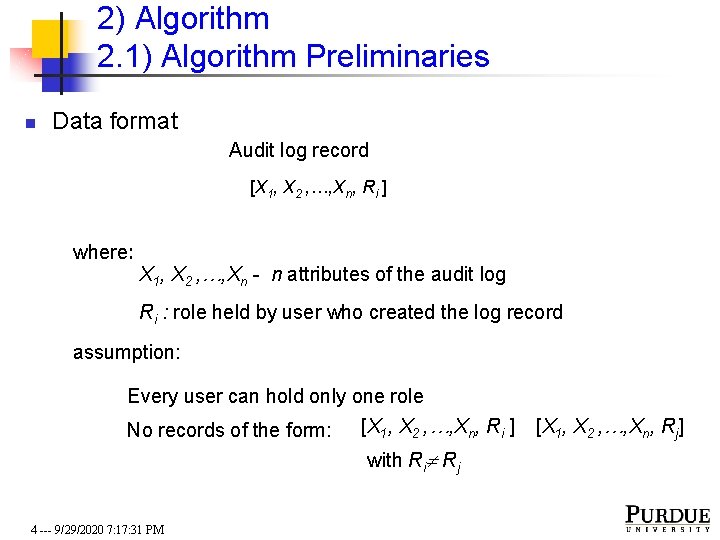
2) Algorithm 2. 1) Algorithm Preliminaries n Data format Audit log record [X 1, X 2 , …, Xn, Ri ] where: X 1, X 2 , …, Xn - n attributes of the audit log Ri : role held by user who created the log record assumption: Every user can hold only one role No records of the form: [X 1, X 2 , …, Xn, Ri ] with Ri Rj 4 --- 9/29/2020 7: 17: 31 PM [X 1, X 2 , …, Xn, Rj]
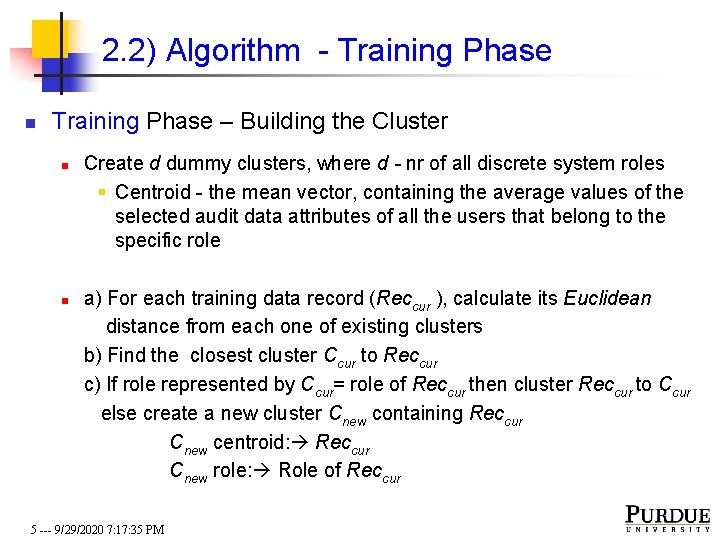
2. 2) Algorithm - Training Phase n Training Phase – Building the Cluster n n Create d dummy clusters, where d - nr of all discrete system roles § Centroid - the mean vector, containing the average values of the selected audit data attributes of all the users that belong to the specific role a) For each training data record (Reccur ), calculate its Euclidean distance from each one of existing clusters b) Find the closest cluster Ccur to Reccur c) If role represented by Ccur= role of Reccur then cluster Reccur to Ccur else create a new cluster Cnew containing Reccur Cnew centroid: Reccur Cnew role: Role of Reccur 5 --- 9/29/2020 7: 17: 35 PM
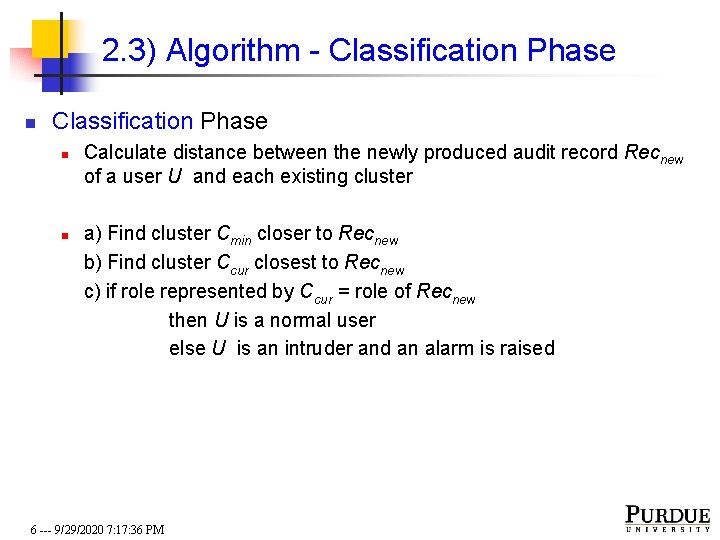
2. 3) Algorithm - Classification Phase n n Calculate distance between the newly produced audit record Recnew of a user U and each existing cluster a) Find cluster Cmin closer to Recnew b) Find cluster Ccur closest to Recnew c) if role represented by Ccur = role of Recnew then U is a normal user else U is an intruder and an alarm is raised 6 --- 9/29/2020 7: 17: 36 PM
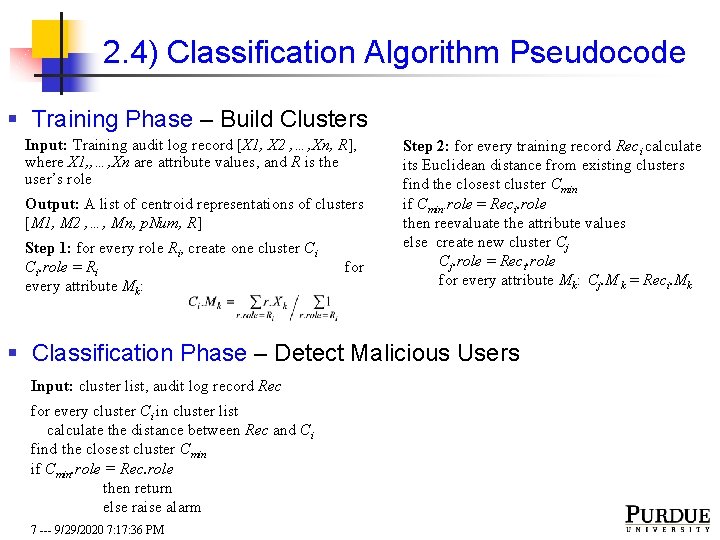
2. 4) Classification Algorithm Pseudocode § Training Phase – Build Clusters Input: Training audit log record [X 1, X 2 , …, Xn, R], where X 1, , …, Xn are attribute values, and R is the user’s role Output: A list of centroid representations of clusters [M 1, M 2 , …, Mn, p. Num, R] Step 1: for every role Ri, create one cluster Ci Ci. role = Ri every attribute Mk: for Step 2: for every training record Reci calculate its Euclidean distance from existing clusters find the closest cluster Cmin if Cmin. role = Reci. role then reevaluate the attribute values else create new cluster Cj Cj. role = Reci. role for every attribute Mk: Cj. M k = Reci. Mk § Classification Phase – Detect Malicious Users Input: cluster list, audit log record Rec for every cluster Ci in cluster list calculate the distance between Rec and Ci find the closest cluster Cmin if Cmin. role = Rec. role then return else raise alarm 7 --- 9/29/2020 7: 17: 36 PM
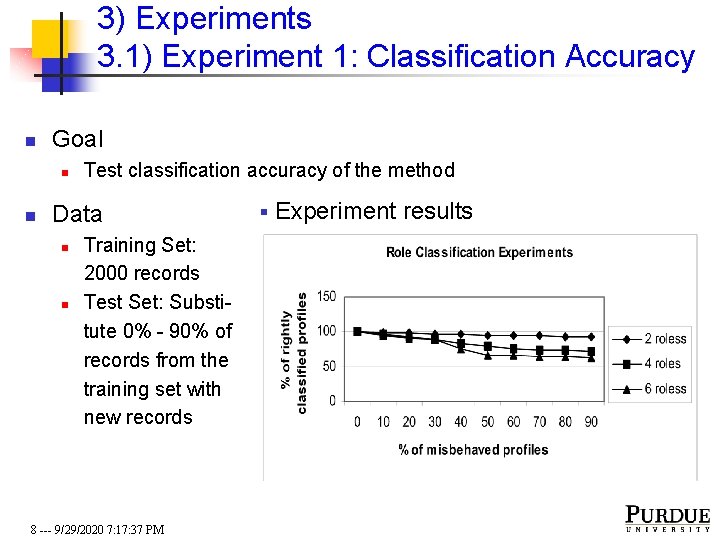
3) Experiments 3. 1) Experiment 1: Classification Accuracy n Goal n n Test classification accuracy of the method Data n n Training Set: 2000 records Test Set: Substitute 0% - 90% of records from the training set with new records 8 --- 9/29/2020 7: 17: 37 PM § Experiment results
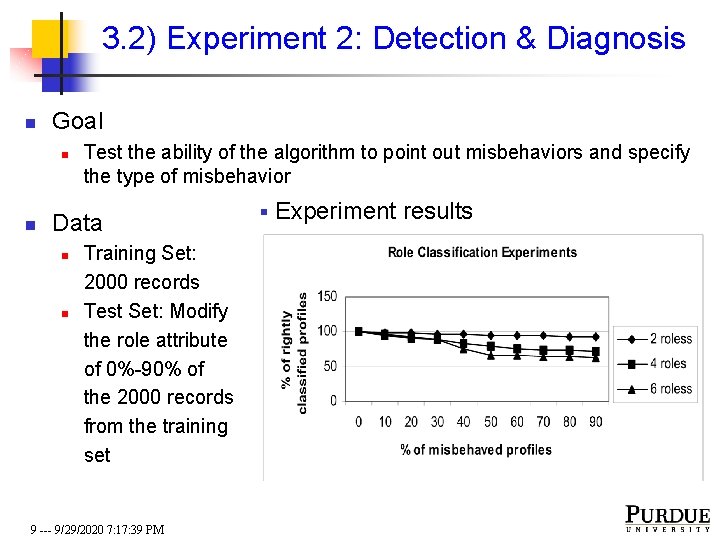
3. 2) Experiment 2: Detection & Diagnosis n Goal n n Test the ability of the algorithm to point out misbehaviors and specify the type of misbehavior Data n n Training Set: 2000 records Test Set: Modify the role attribute of 0%-90% of the 2000 records from the training set 9 --- 9/29/2020 7: 17: 39 PM § Experiment results
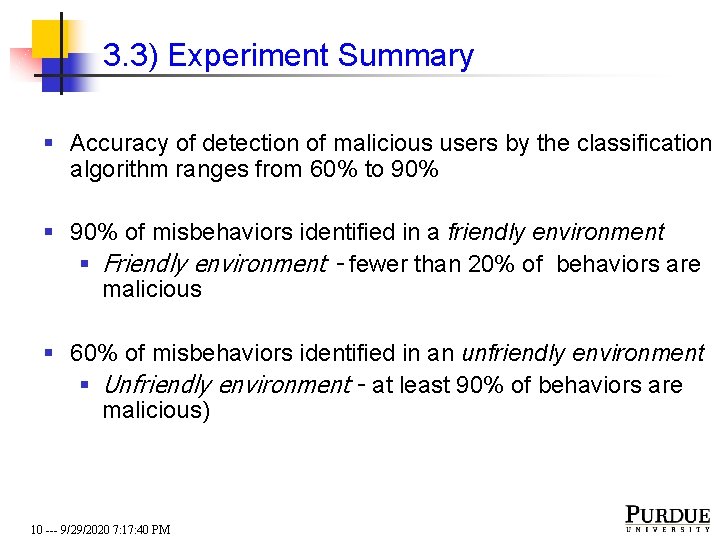
3. 3) Experiment Summary § Accuracy of detection of malicious users by the classification algorithm ranges from 60% to 90% § 90% of misbehaviors identified in a friendly environment § Friendly environment - fewer than 20% of behaviors are malicious § 60% of misbehaviors identified in an unfriendly environment § Unfriendly environment - at least 90% of behaviors are malicious) 10 --- 9/29/2020 7: 17: 40 PM
Our Research at Purdue § Web Site: http/www. cs. purdue. edu/homes/bb § Over one million dollars in current support from: NSF, Cisco, Motorola, DARPA § Selected Publications § B. Bhargava and Y. Zhong, "Authorization Based on Evidence and Trust", in Proc. of Data Warehouse and Knowledge Management Conference (Da. Wa. K), Sept. 2002. § E. Terzi, Y. Zhong, B. Bhargava, Pankaj, and S. Madria, "An Algorithm for Building User-Role Profiles in a Trust Environment", in Proc. of Da. Wa. K, Sept. 2002. § A. Bhargava and M. Zoltowski, “Sensors and Wireless Communication for Medical Care, ” in Proc. of 6 th Intl. Workshop on Mobility in Databases and Distributed Systems (MDDS), Prague, Czechia, Sept. 2003. § B. Bhargava, Y. Zhong, and Y. Lu, "Fraud Formalization and Detection", in Proc. of Da. Wa. K, Prague, Czech Republic, Sept. 2003. 11 --- 9/29/2020 7: 17: 41 PM

THE END 12 --- 9/29/2020 7: 17: 42 PM
- Slides: 12