
9 Part II Chapter 9 Topological Path Planning
- Slides: 30
9 Part II Chapter 9: Topological Path Planning Introduction to AI Robotics (MIT Press), copyright Robin Murphy 2000 Chapter 9: Topological Path Planning 1
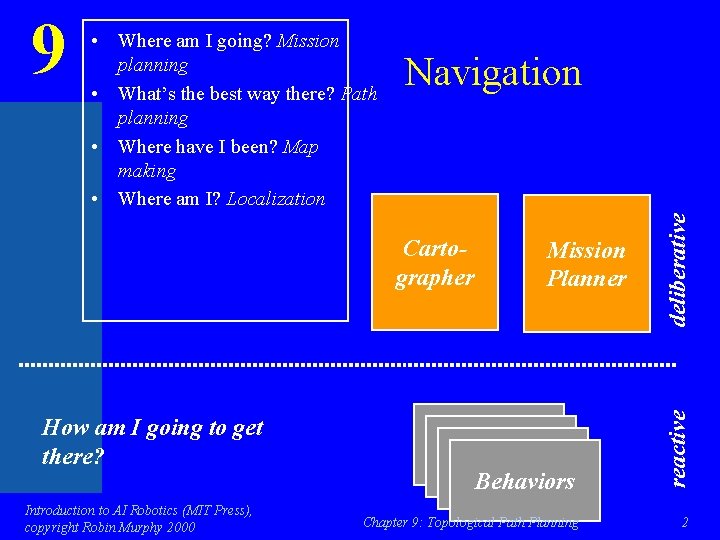
Cartographer How am I going to get there? Introduction to AI Robotics (MIT Press), copyright Robin Murphy 2000 Mission Planner Behaviors Chapter 9: Topological Path Planning deliberative Navigation reactive 9 • Where am I going? Mission planning • What’s the best way there? Path planning • Where have I been? Map making • Where am I? Localization 2
9 Spatial Memory • What’s the Best Way There? depends on the representation of the world • A robot’s world representation and how it is maintained over time is its spatial memory – – Attention Reasoning Path planning Information collection • Two forms – Route (or qualitative) – Layout (or metric) • Layout leads to Route, but not the other way Introduction to AI Robotics (MIT Press), copyright Robin Murphy 2000 Chapter 9: Topological Path Planning 3
9 Route, or Qualitative Navigation • Two categories • Relational – spatial memory is a relational graph, also known as a topological map – use graph theory to plan paths • Associative – spatial memory is a series of remembered viewpoints, where each viewpoint is labeled with a location – good for retracing steps
9 Topological Maps Use Landmarks • A landmark is one or more perceptually distinctive features of interest on an object or locale of interest • Natural landmark: configuration of existing features that wasn’t put in the environment to aid with the robot’s navigation (ex. gas station on the corner) • Artificial landmark: set of features added to the environment to support navigation (ex. highway sign) • Roboticists avoid artificial landmarks! Introduction to AI Robotics (MIT Press), copyright Robin Murphy 2000 Chapter 9: Topological Path Planning 5
9 Desirable Characteristics of Landmarks • Recognizable (can see it when you need to) – Passive – Perceivable over the entire range of where the robot might need to view it – Distinctive features should be globally unique, or at least locally unique • Perceivable for the task (can extract what you need from it) – ex. can extract relative orientation and depth – ex. unambiguously points the way • Be perceivable from many different viewpoints Introduction to AI Robotics (MIT Press), copyright Robin Murphy 2000 Chapter 9: Topological Path Planning 6
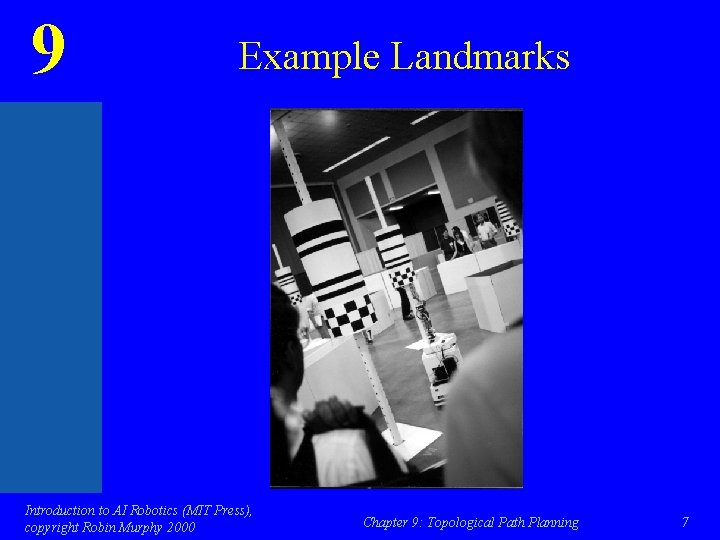
9 Example Landmarks Introduction to AI Robotics (MIT Press), copyright Robin Murphy 2000 Chapter 9: Topological Path Planning 7
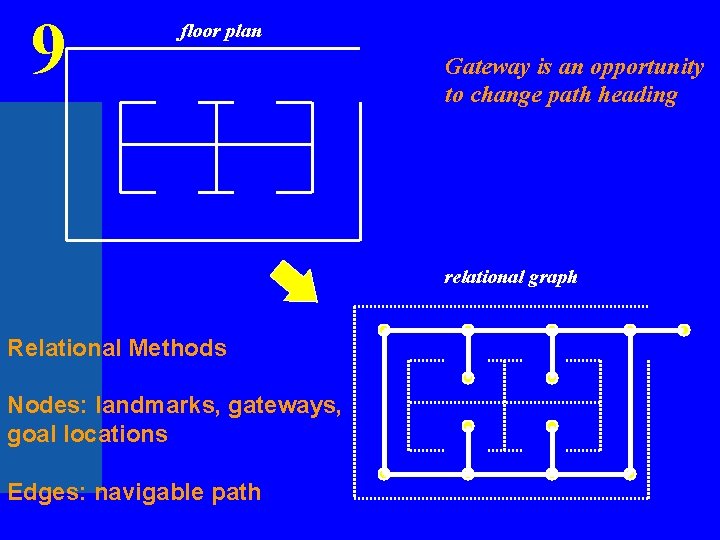
9 floor plan Gateway is an opportunity to change path heading relational graph Relational Methods Nodes: landmarks, gateways, goal locations Edges: navigable path
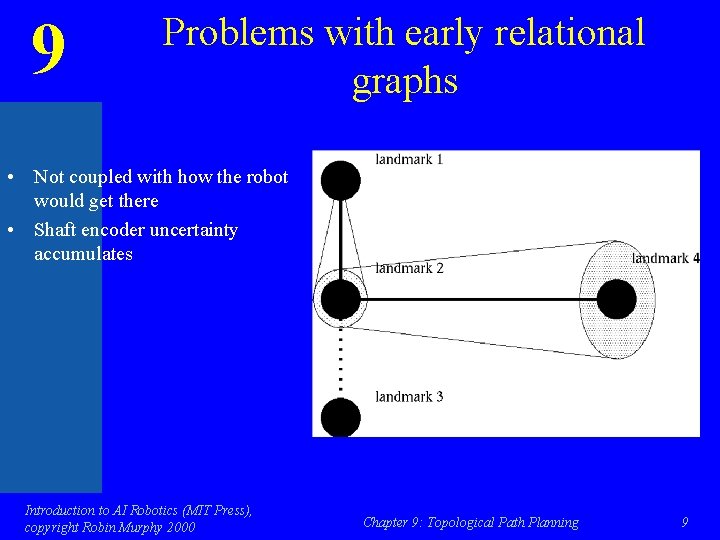
9 Problems with early relational graphs • Not coupled with how the robot would get there • Shaft encoder uncertainty accumulates Introduction to AI Robotics (MIT Press), copyright Robin Murphy 2000 Chapter 9: Topological Path Planning 9
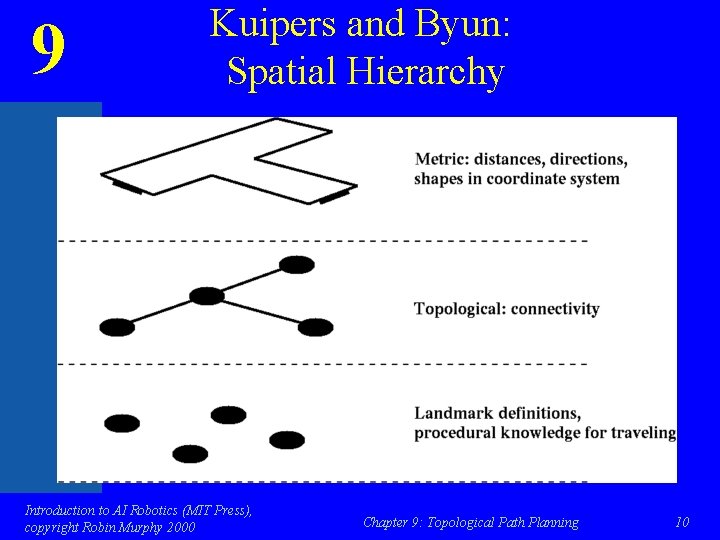
9 Kuipers and Byun: Spatial Hierarchy Introduction to AI Robotics (MIT Press), copyright Robin Murphy 2000 Chapter 9: Topological Path Planning 10
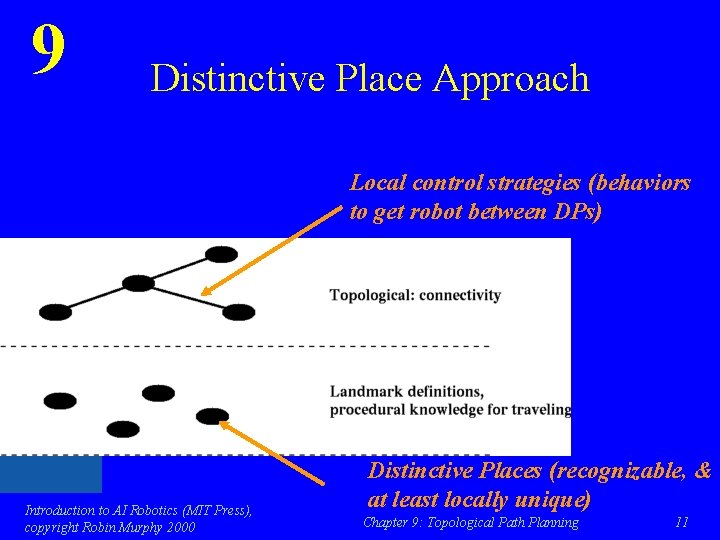
9 Distinctive Place Approach Local control strategies (behaviors to get robot between DPs) Introduction to AI Robotics (MIT Press), copyright Robin Murphy 2000 Distinctive Places (recognizable, & at least locally unique) Chapter 9: Topological Path Planning 11
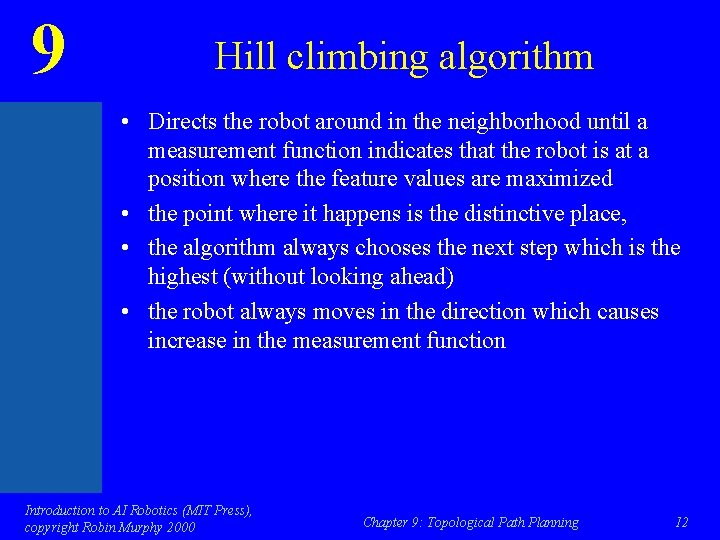
9 Hill climbing algorithm • Directs the robot around in the neighborhood until a measurement function indicates that the robot is at a position where the feature values are maximized • the point where it happens is the distinctive place, • the algorithm always chooses the next step which is the highest (without looking ahead) • the robot always moves in the direction which causes increase in the measurement function Introduction to AI Robotics (MIT Press), copyright Robin Murphy 2000 Chapter 9: Topological Path Planning 12
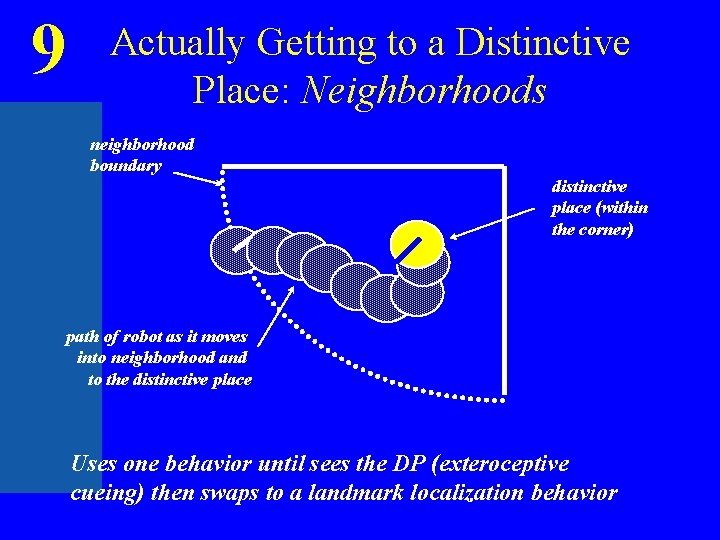
9 Actually Getting to a Distinctive Place: Neighborhoods neighborhood boundary distinctive place (within the corner) path of robot as it moves into neighborhood and to the distinctive place Uses one behavior until sees the DP (exteroceptive cueing) then swaps to a landmark localization behavior
9 Advantages and disadvantages • Distinctive place concept eliminates any navigational errors at each node • supports discovery of new landmarks as the robot explores an unknown environment • distinctive places may be hard to find • problems with perception • learning local control strategy is hard • problems with indistinguishable locations Introduction to AI Robotics (MIT Press), copyright Robin Murphy 2000 Chapter 9: Topological Path Planning 14
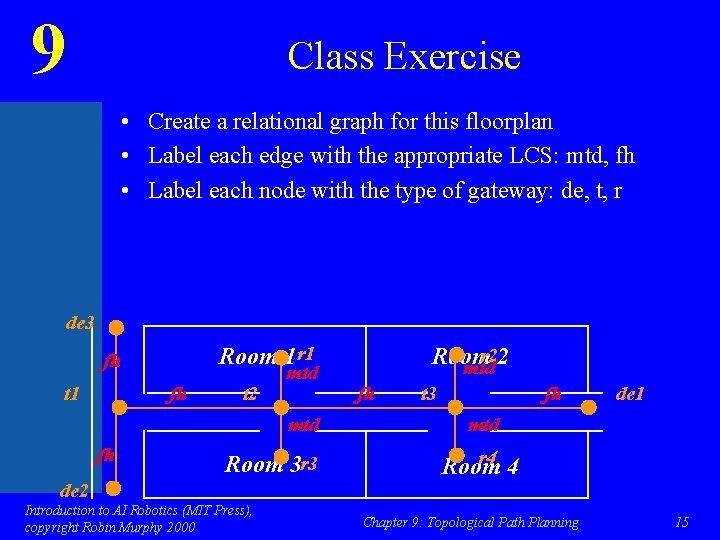
9 Class Exercise • Create a relational graph for this floorplan • Label each edge with the appropriate LCS: mtd, fh • Label each node with the type of gateway: de, t, r de 3 Room 1 r 1 fh t 2 mtd fh Room 3 r 3 r 2 Room mtd 2 fh t 3 fh de 1 mtd r 4 Room 4 de 2 Introduction to AI Robotics (MIT Press), copyright Robin Murphy 2000 Chapter 9: Topological Path Planning 15
9 Associative Methods • Create a behavior which converts sensor observations into the direction to go to reach a particular landmark • that landmark has to have two attributes 1. Perceptual stability - close views of a landmark are similar 2. Perceptual distinguishibility - far away views are different Introduction to AI Robotics (MIT Press), copyright Robin Murphy 2000 Chapter 9: Topological Path Planning 16
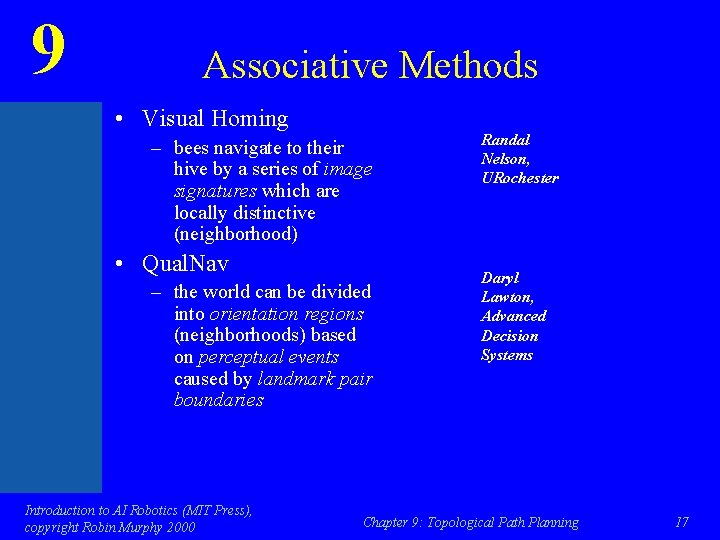
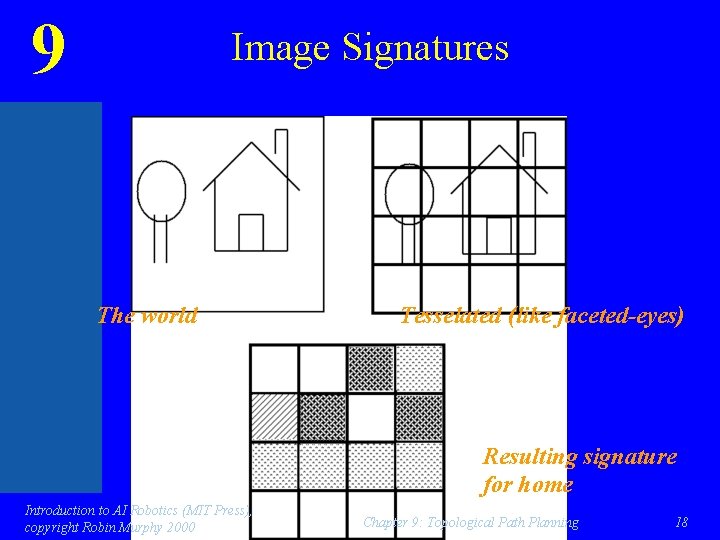
9 Associative Methods • Visual Homing – bees navigate to their hive by a series of image signatures which are locally distinctive (neighborhood) • Qual. Nav – the world can be divided into orientation regions (neighborhoods) based on perceptual events caused by landmark pair boundaries Introduction to AI Robotics (MIT Press), copyright Robin Murphy 2000 Randal Nelson, URochester Daryl Lawton, Advanced Decision Systems Chapter 9: Topological Path Planning 17
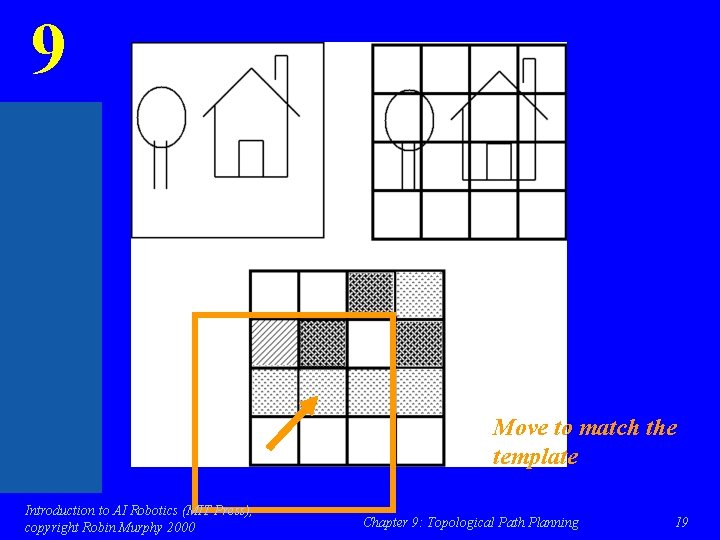
9 Image Signatures The world Tesselated (like faceted-eyes) Resulting signature for home Introduction to AI Robotics (MIT Press), copyright Robin Murphy 2000 Chapter 9: Topological Path Planning 18
9 Move to match the template Introduction to AI Robotics (MIT Press), copyright Robin Murphy 2000 Chapter 9: Topological Path Planning 19
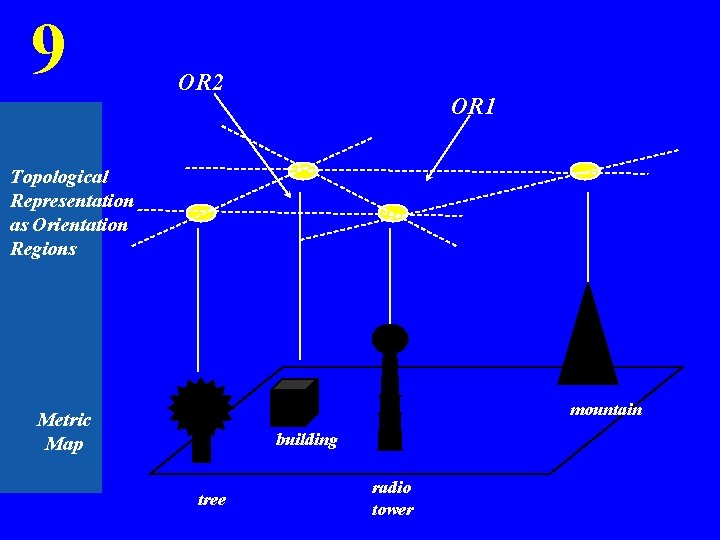
9 OR 2 OR 1 Topological Representation as Orientation Regions mountain Metric Map building tree radio tower
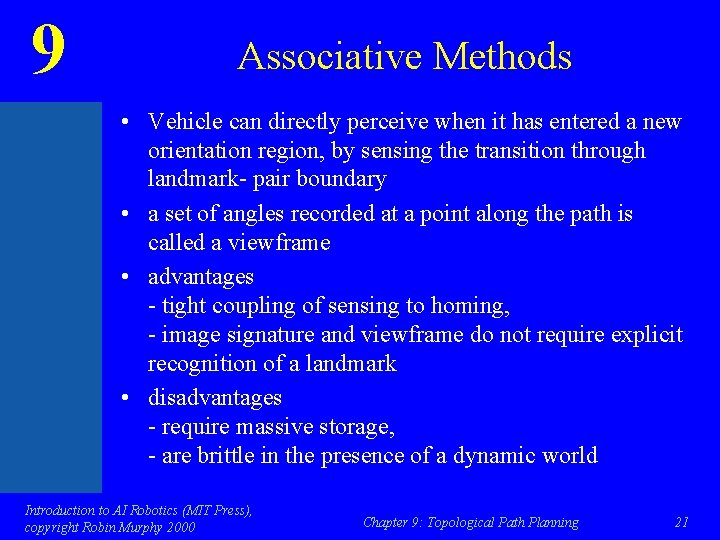
9 Associative Methods • Vehicle can directly perceive when it has entered a new orientation region, by sensing the transition through landmark- pair boundary • a set of angles recorded at a point along the path is called a viewframe • advantages - tight coupling of sensing to homing, - image signature and viewframe do not require explicit recognition of a landmark • disadvantages - require massive storage, - are brittle in the presence of a dynamic world Introduction to AI Robotics (MIT Press), copyright Robin Murphy 2000 Chapter 9: Topological Path Planning 21
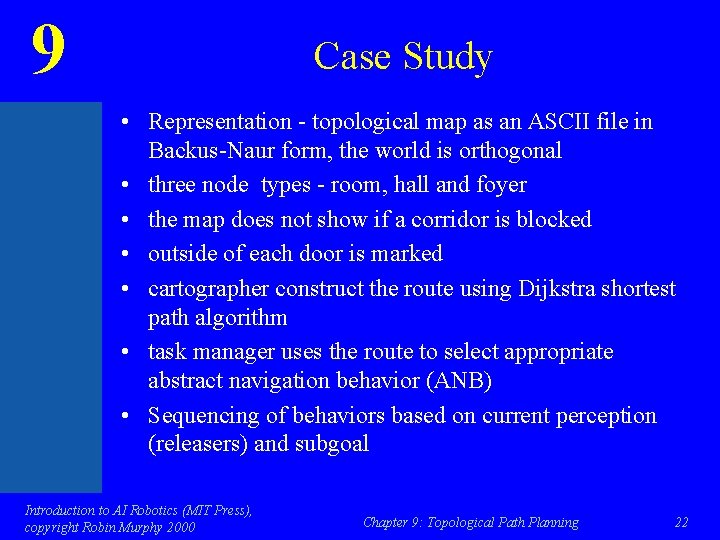
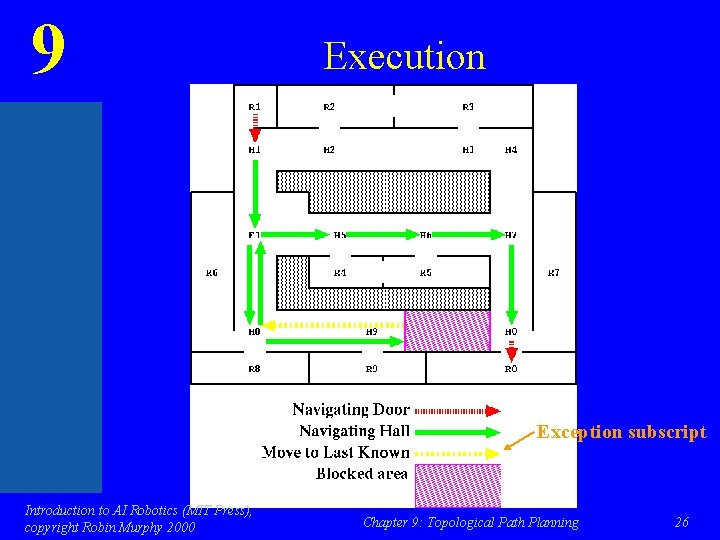
9 Case Study • Representation - topological map as an ASCII file in Backus-Naur form, the world is orthogonal • three node types - room, hall and foyer • the map does not show if a corridor is blocked • outside of each door is marked • cartographer construct the route using Dijkstra shortest path algorithm • task manager uses the route to select appropriate abstract navigation behavior (ANB) • Sequencing of behaviors based on current perception (releasers) and subgoal Introduction to AI Robotics (MIT Press), copyright Robin Murphy 2000 Chapter 9: Topological Path Planning 22
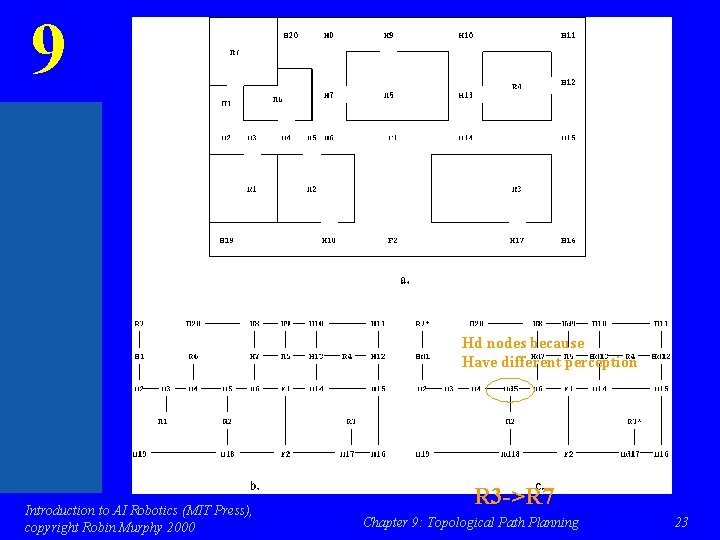
9 Hd nodes because Have different perception Introduction to AI Robotics (MIT Press), copyright Robin Murphy 2000 R 3 ->R 7 Chapter 9: Topological Path Planning 23
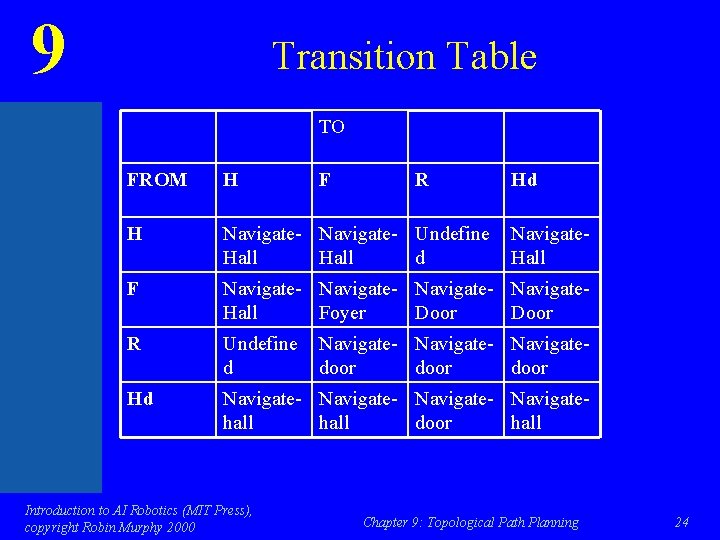
9 Transition Table TO FROM H H Navigate- Undefine Hall d F Navigate- Navigate. Hall Foyer Door R Undefine d Hd Navigate- Navigatehall door hall Introduction to AI Robotics (MIT Press), copyright Robin Murphy 2000 F R Hd Navigate. Hall Navigate- Navigatedoor Chapter 9: Topological Path Planning 24
9 Task manager • Not all combinations of nodes are permitted • table not necessarily symmetric • ANB uses information from the database entries corresponding to nodes as parameters for instantiating the script to the current waypoint pair, • in case of a blocked path TM terminates the currently active ANB, directs the robot to the last known node and request from the cartographer a new path from this node to the destination Introduction to AI Robotics (MIT Press), copyright Robin Murphy 2000 Chapter 9: Topological Path Planning 25
9 Execution Exception subscript Introduction to AI Robotics (MIT Press), copyright Robin Murphy 2000 Chapter 9: Topological Path Planning 26
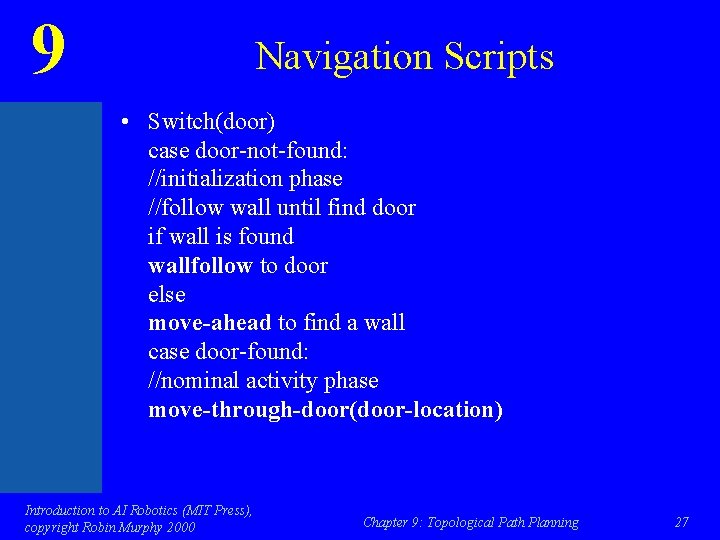
9 Navigation Scripts • Switch(door) case door-not-found: //initialization phase //follow wall until find door if wall is found wallfollow to door else move-ahead to find a wall case door-found: //nominal activity phase move-through-door(door-location) Introduction to AI Robotics (MIT Press), copyright Robin Murphy 2000 Chapter 9: Topological Path Planning 27
9 Summary • Route, qualitative, and topological navigation all refer to navigating by detecting and responding to landmarks. • Landmarks may be natural or artificial; roboticists prefer natural but may have to use artificial to compensate for robot sensors • There are two type of qualitative navigation: relational and associative Introduction to AI Robotics (MIT Press), copyright Robin Murphy 2000 Chapter 9: Topological Path Planning 28
9 Summary (cont. ) • Relational methods use graphs (good for planning) and landmarks – The best known relational method is distinctive places – Distinctive places are often gateways – Local control strategies are behaviors • Associative methods remember places as image signature or a viewframe extracted from a signature – can’t really plan a path, just retrace it – direct stimulus-response coupling by matching signature to current perception Introduction to AI Robotics (MIT Press), copyright Robin Murphy 2000 Chapter 9: Topological Path Planning 29
9 What you should be able to do • Define the difference between natural and artificial landmarks; give one example of each • Given a description of an indoor office environment and a set of behaviors, build a relational graph representation labeling the distinctive places and local control strategies for gateways • Describe in one or two sentences: gateway, image signature, visual homing, viewframe, orientation region • Given a figure showing landmarks, create a topological map showing landmarks, landmark pair boundaries, and orientation regions Introduction to AI Robotics (MIT Press), copyright Robin Murphy 2000 Chapter 9: Topological Path Planning 30