
9 Multi Carrier Modulation and OFDM Transmission of


- Slides: 36
9. Multi Carrier Modulation and OFDM
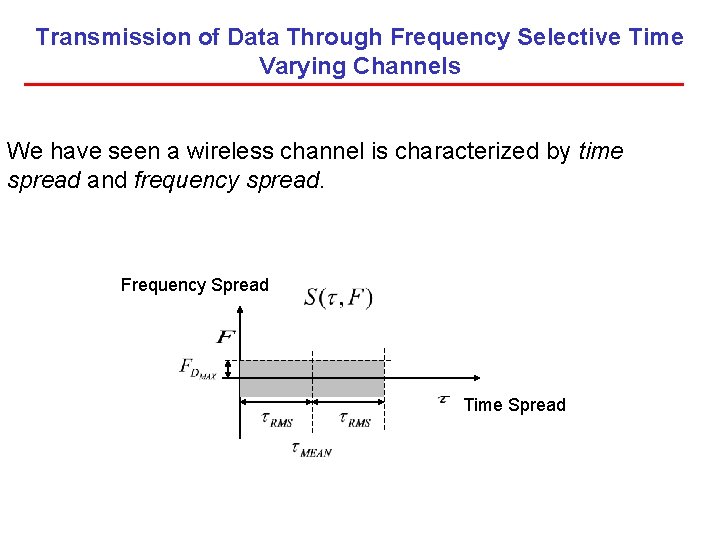
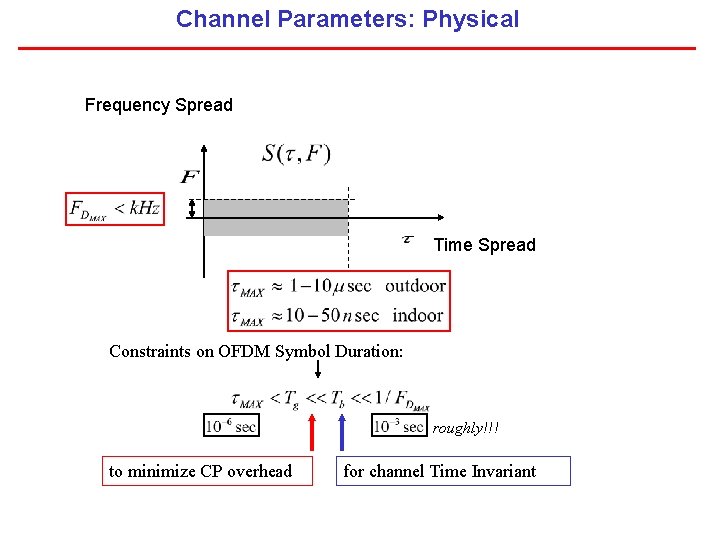
Transmission of Data Through Frequency Selective Time Varying Channels We have seen a wireless channel is characterized by time spread and frequency spread. Frequency Spread Time Spread
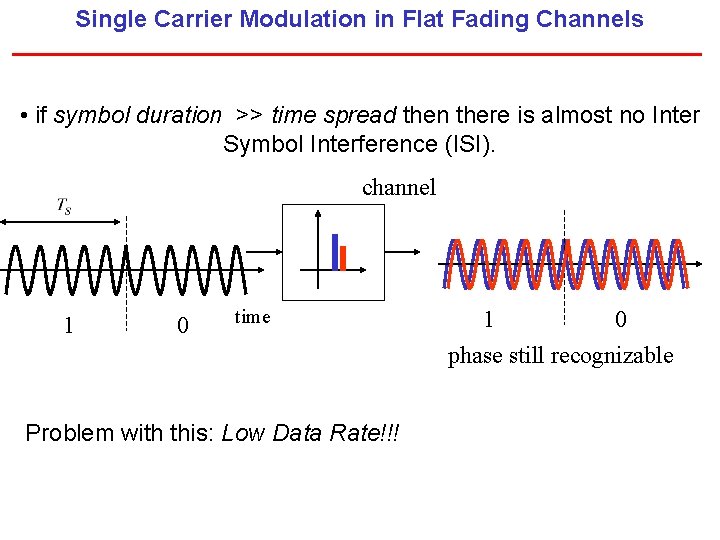
Single Carrier Modulation in Flat Fading Channels • if symbol duration >> time spread then there is almost no Inter Symbol Interference (ISI). channel 1 0 time Problem with this: Low Data Rate!!! 1 0 phase still recognizable
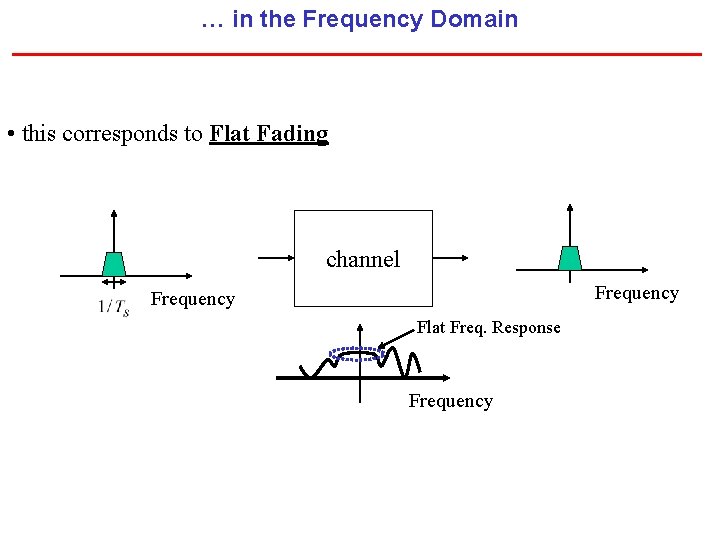
… in the Frequency Domain • this corresponds to Flat Fading channel Frequency Flat Freq. Response Frequency
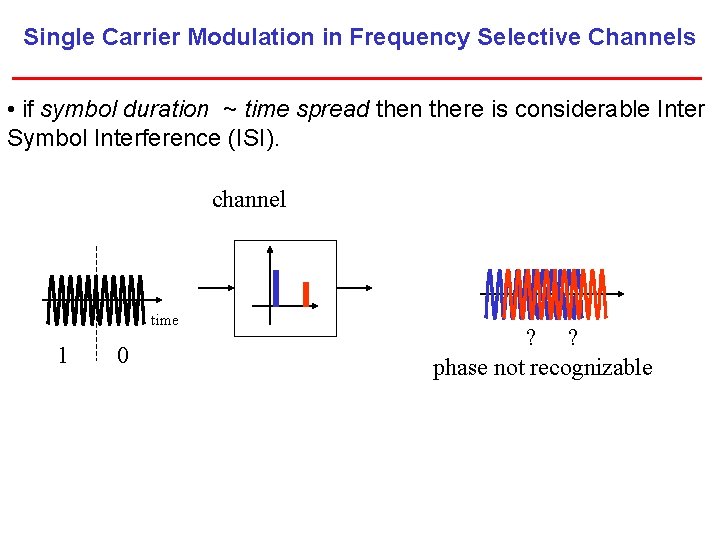
Single Carrier Modulation in Frequency Selective Channels • if symbol duration ~ time spread then there is considerable Inter Symbol Interference (ISI). channel time 1 0 ? ? phase not recognizable
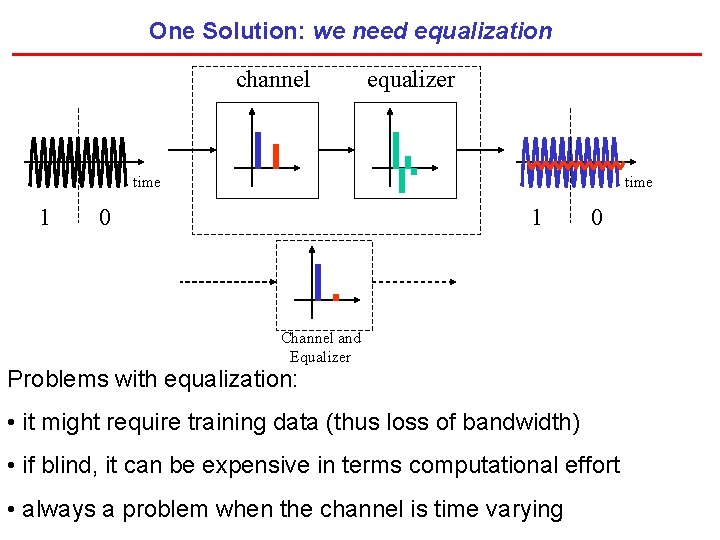
One Solution: we need equalization channel equalizer time 1 time 0 1 0 Channel and Equalizer Problems with equalization: • it might require training data (thus loss of bandwidth) • if blind, it can be expensive in terms computational effort • always a problem when the channel is time varying
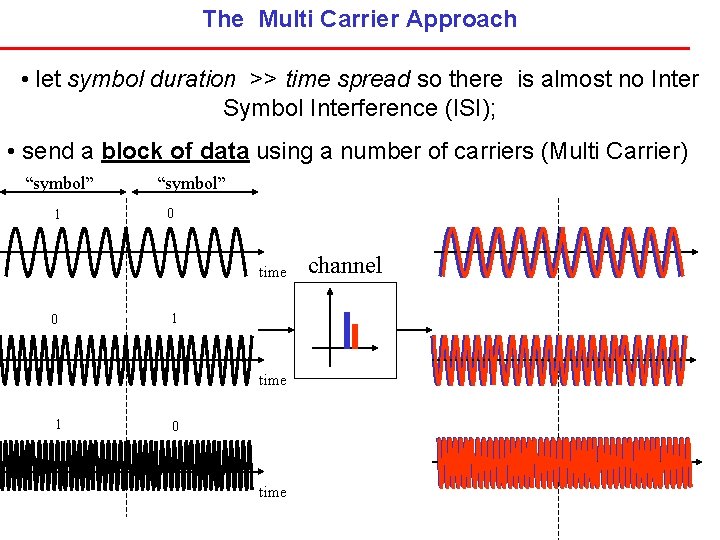
The Multi Carrier Approach • let symbol duration >> time spread so there is almost no Inter Symbol Interference (ISI); • send a block of data using a number of carriers (Multi Carrier) “symbol” 1 “symbol” 0 time 0 1 time 1 0 time channel
Compare Single Carrier and Multi Carrier Modulation SC Frequency 1 1 One symbol 0 1 1 Flat Fading Channel: Easy Demod channel MC 0 1 1 1 Frequency subcarriers 0 1 1 1 Block of symbols Frequency Each subcarrier sees a Flat Fading Channel: Easy Demod
Structure of Multi Carrier Modulation In MC modulation each “MC symbol” is defined on a time interval and it contains a block of data OFDM Symbol data data guard interval with data interval MAX channel time spread
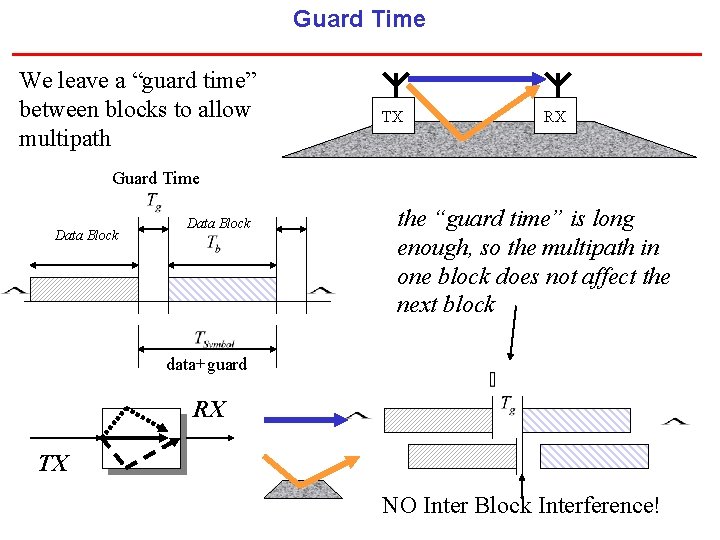
Guard Time We leave a “guard time” between blocks to allow multipath TX RX Guard Time Data Block the “guard time” is long enough, so the multipath in one block does not affect the next block data+guard RX TX NO Inter Block Interference!
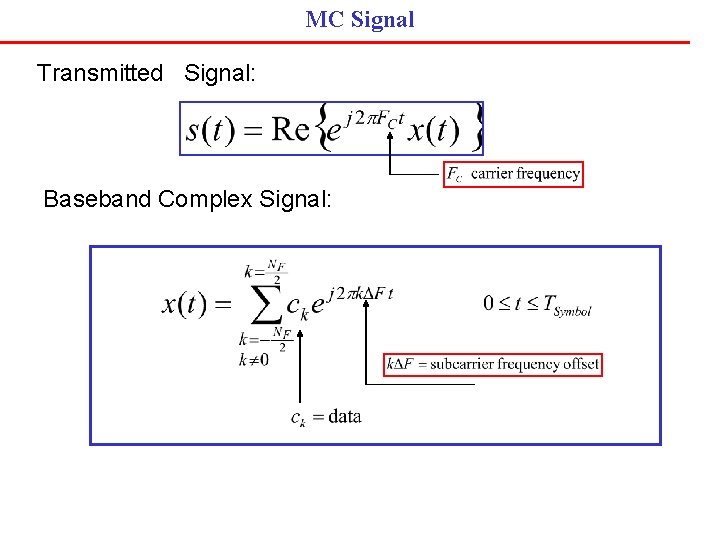
MC Signal Transmitted Signal: Baseband Complex Signal:
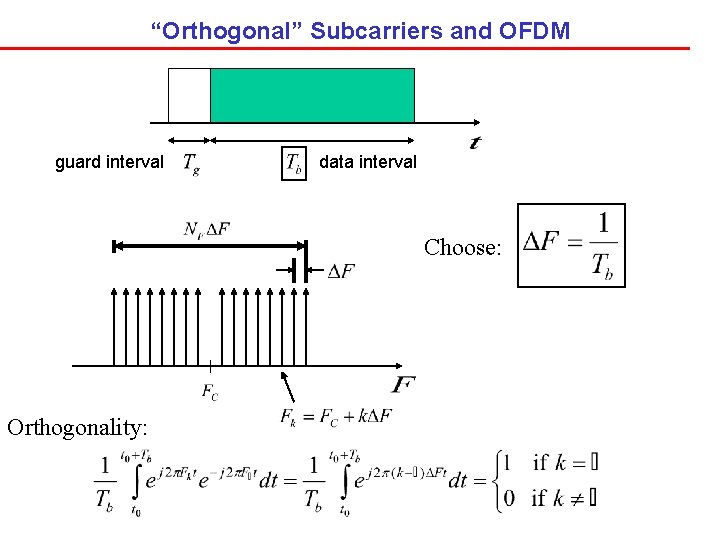
“Orthogonal” Subcarriers and OFDM guard interval data interval Choose: Orthogonality:
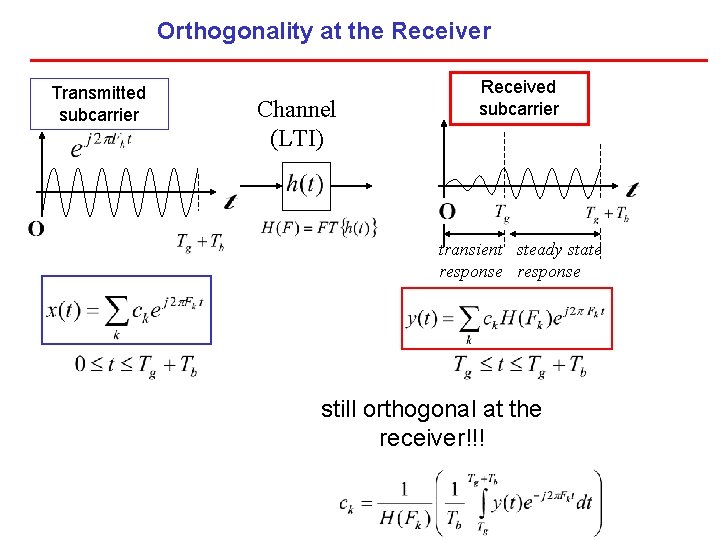
Orthogonality at the Receiver Transmitted subcarrier Channel (LTI) Received subcarrier transient steady state response still orthogonal at the receiver!!!
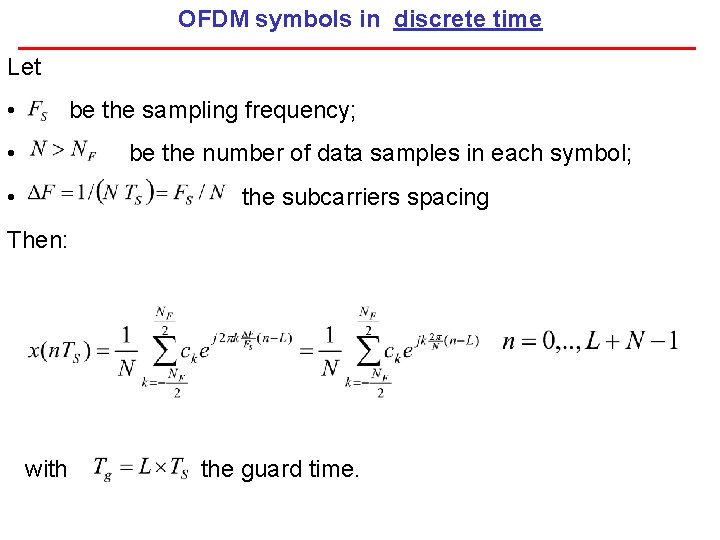
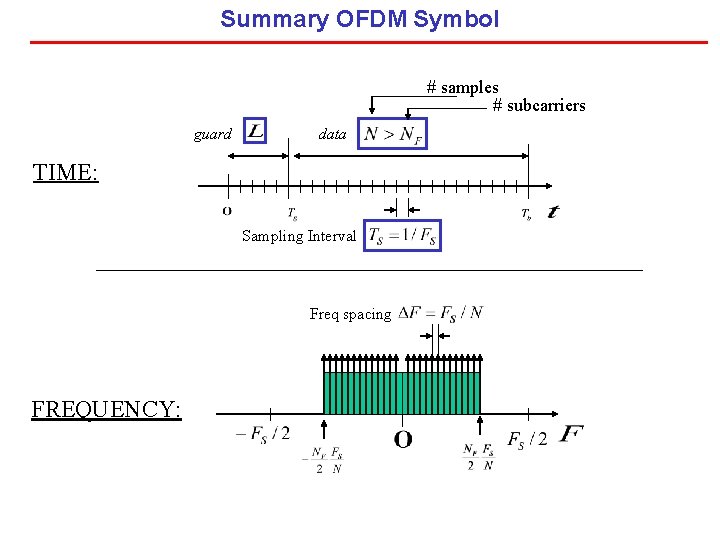
OFDM symbols in discrete time Let • be the sampling frequency; • be the number of data samples in each symbol; • the subcarriers spacing Then: with the guard time.
Summary OFDM Symbol # samples # subcarriers guard data TIME: Sampling Interval Freq spacing FREQUENCY:
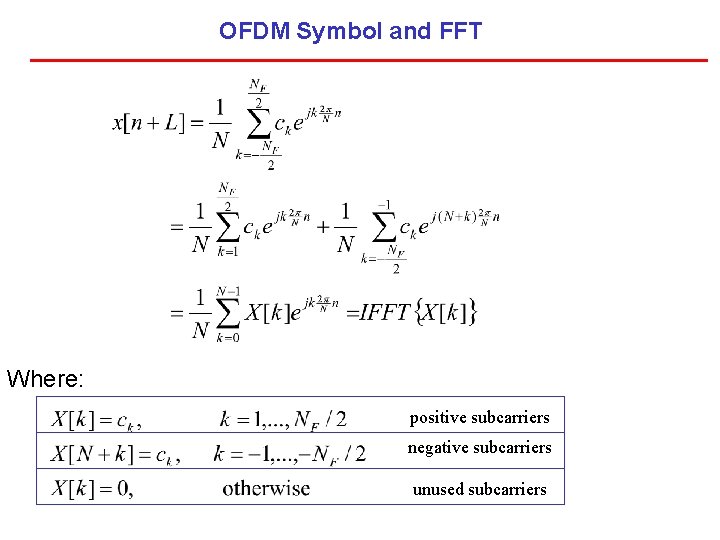
OFDM Symbol and FFT Where: positive subcarriers negative subcarriers unused subcarriers
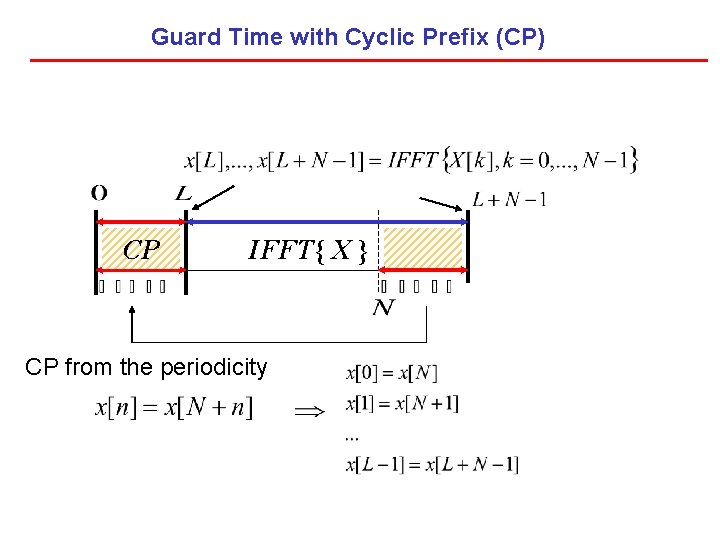
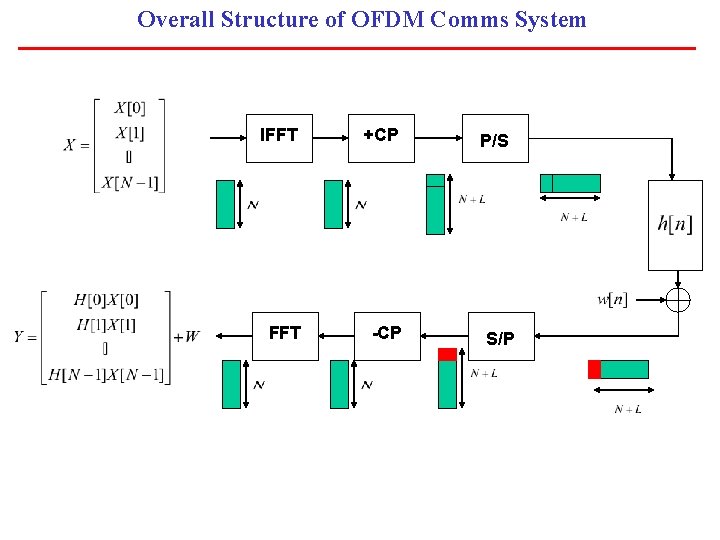
Guard Time with Cyclic Prefix (CP) CP IFFT{ X } CP from the periodicity
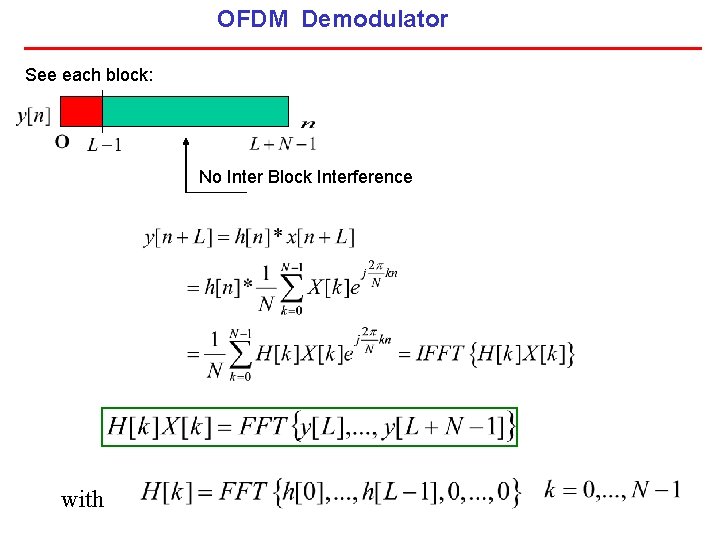
OFDM Demodulator See each block: No Inter Block Interference with
Overall Structure of OFDM Comms System IFFT +CP FFT -CP P/S S/P
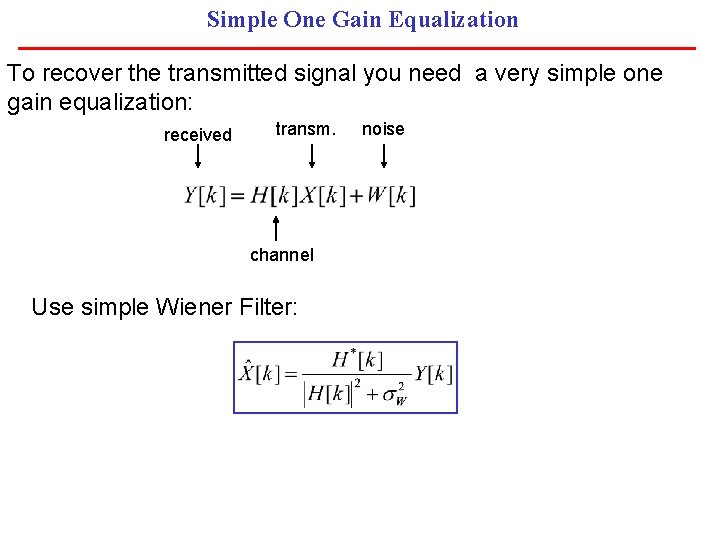
Simple One Gain Equalization To recover the transmitted signal you need a very simple one gain equalization: received transm. channel Use simple Wiener Filter: noise
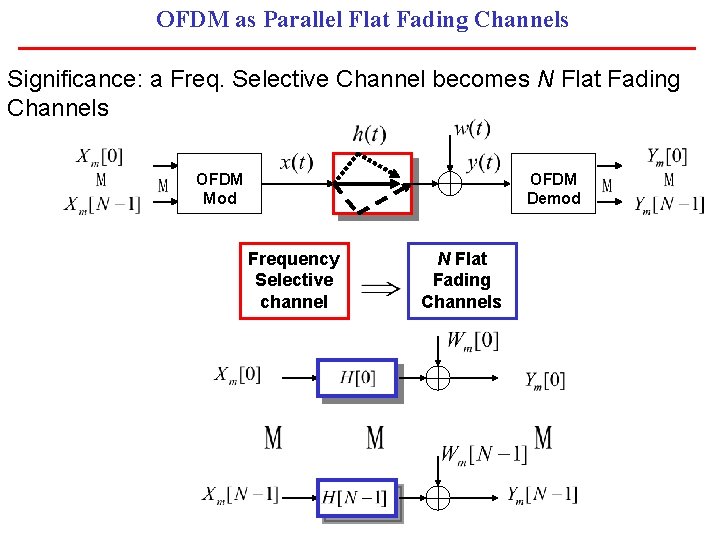
OFDM as Parallel Flat Fading Channels Significance: a Freq. Selective Channel becomes N Flat Fading Channels OFDM Mod OFDM Demod Frequency Selective channel N Flat Fading Channels
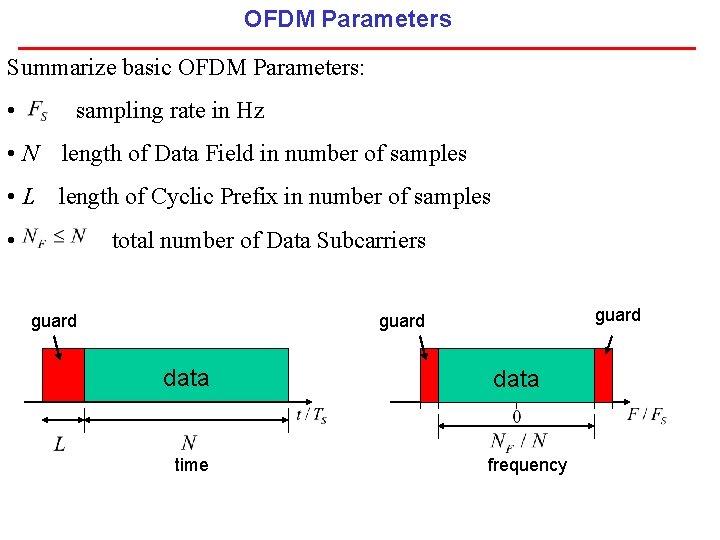
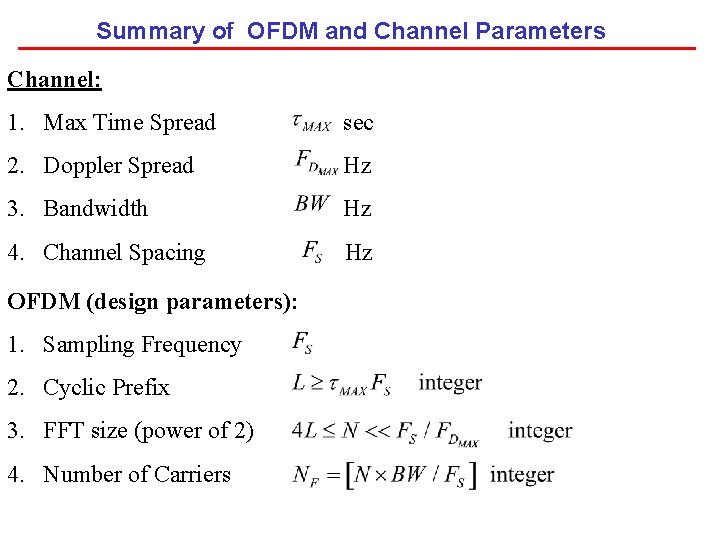
OFDM Parameters Summarize basic OFDM Parameters: • sampling rate in Hz • N length of Data Field in number of samples • L length of Cyclic Prefix in number of samples • total number of Data Subcarriers guard data time data frequency
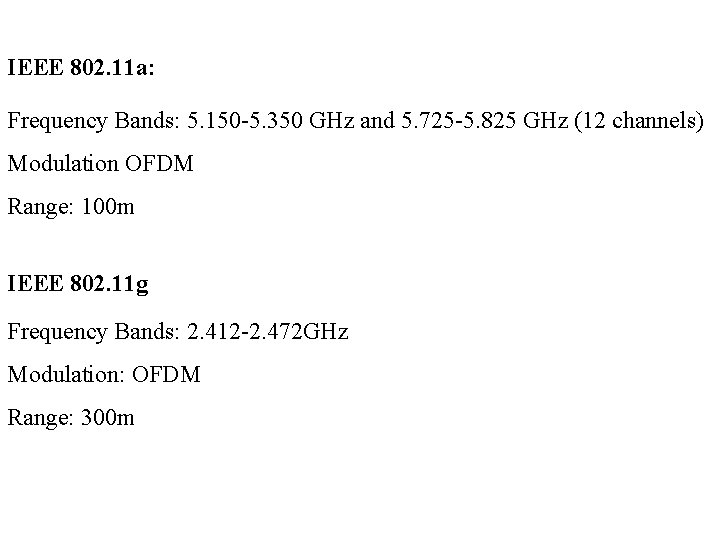
IEEE 802. 11 a: Frequency Bands: 5. 150 -5. 350 GHz and 5. 725 -5. 825 GHz (12 channels) Modulation OFDM Range: 100 m IEEE 802. 11 g Frequency Bands: 2. 412 -2. 472 GHz Modulation: OFDM Range: 300 m
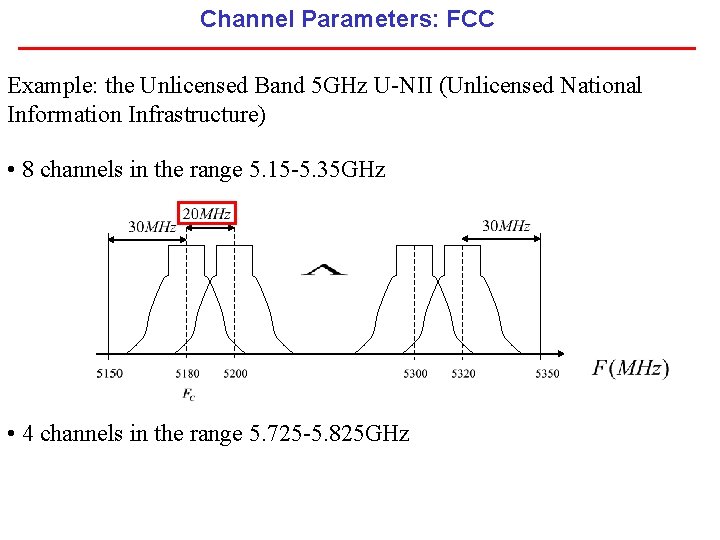
Channel Parameters: FCC Example: the Unlicensed Band 5 GHz U-NII (Unlicensed National Information Infrastructure) • 8 channels in the range 5. 15 -5. 35 GHz • 4 channels in the range 5. 725 -5. 825 GHz
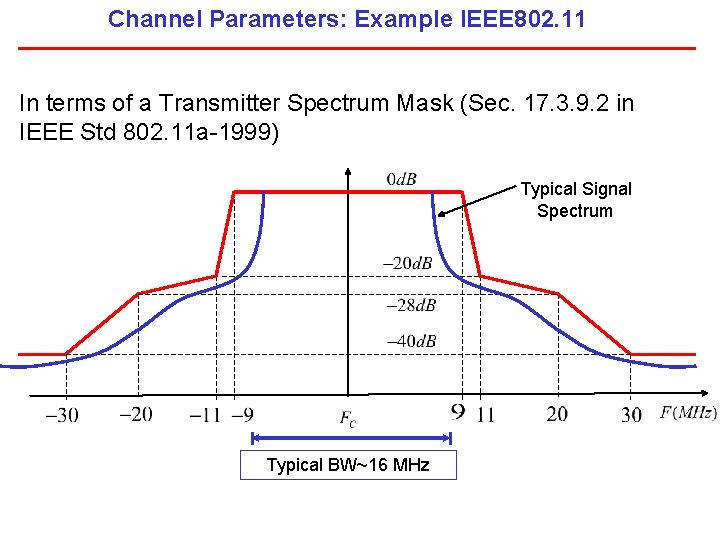
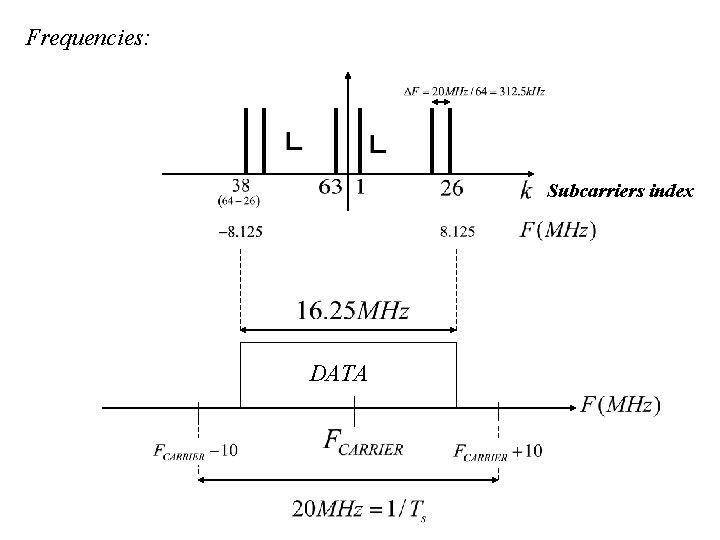
Channel Parameters: Example IEEE 802. 11 In terms of a Transmitter Spectrum Mask (Sec. 17. 3. 9. 2 in IEEE Std 802. 11 a-1999) Typical Signal Spectrum Typical BW~16 MHz
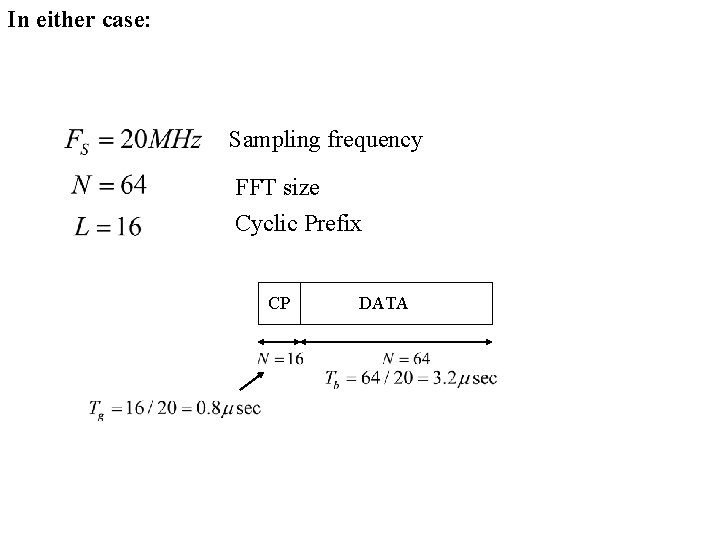
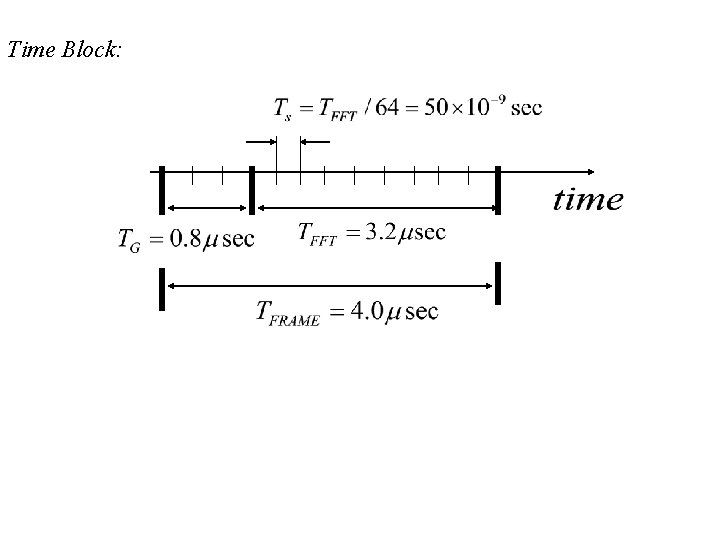
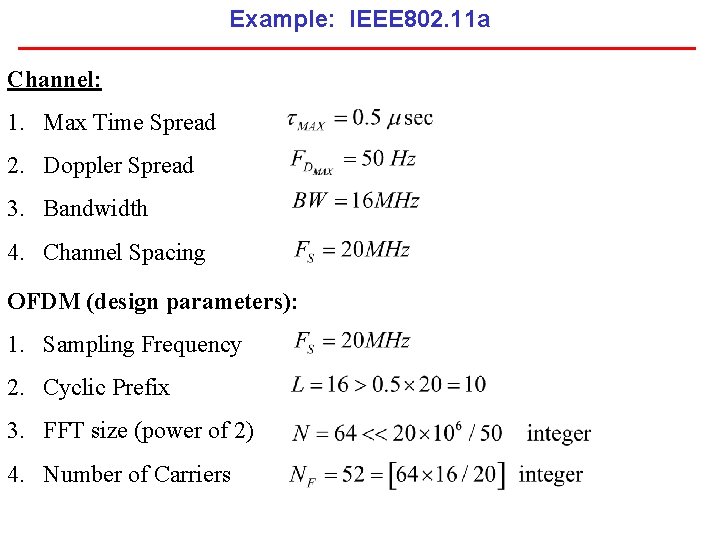
In either case: Sampling frequency FFT size Cyclic Prefix CP DATA
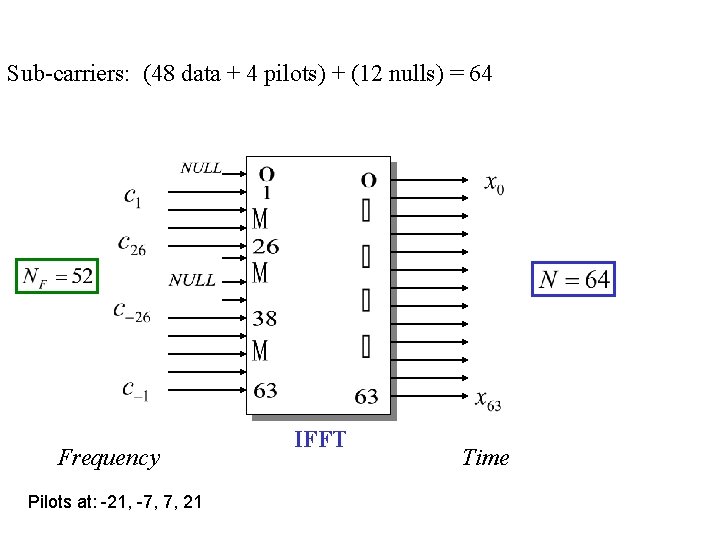
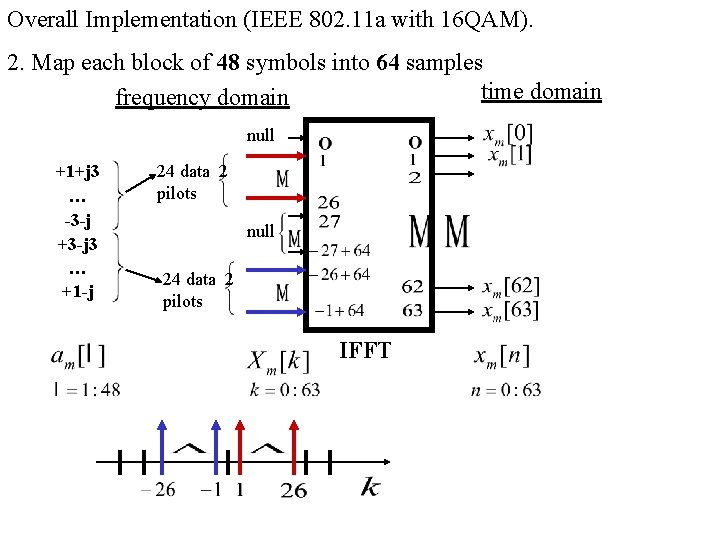
Sub-carriers: (48 data + 4 pilots) + (12 nulls) = 64 Frequency Pilots at: -21, -7, 7, 21 IFFT Time
Frequencies: Subcarriers index DATA
Time Block:
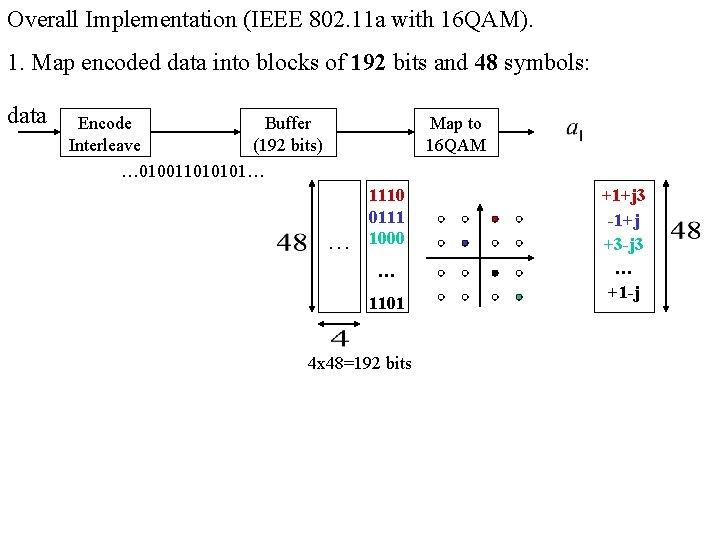
Overall Implementation (IEEE 802. 11 a with 16 QAM). 1. Map encoded data into blocks of 192 bits and 48 symbols: data Encode Buffer Interleave (192 bits) … 010011010101… Map to 16 QAM … 1110 0111 1000 … 1101 4 x 48=192 bits +1+j 3 -1+j +3 -j 3 … +1 -j
Overall Implementation (IEEE 802. 11 a with 16 QAM). 2. Map each block of 48 symbols into 64 samples time domain frequency domain null +1+j 3 … -3 -j +3 -j 3 … +1 -j 24 data 2 pilots null 24 data 2 pilots IFFT
Channel Parameters: Physical Frequency Spread Time Spread Constraints on OFDM Symbol Duration: roughly!!! to minimize CP overhead for channel Time Invariant
Summary of OFDM and Channel Parameters Channel: 1. Max Time Spread sec 2. Doppler Spread Hz 3. Bandwidth Hz 4. Channel Spacing Hz OFDM (design parameters): 1. Sampling Frequency 2. Cyclic Prefix 3. FFT size (power of 2) 4. Number of Carriers
Example: IEEE 802. 11 a Channel: 1. Max Time Spread 2. Doppler Spread 3. Bandwidth 4. Channel Spacing OFDM (design parameters): 1. Sampling Frequency 2. Cyclic Prefix 3. FFT size (power of 2) 4. Number of Carriers
Applications: various Area Networks According to the applications, we define three “Area Networks”: • Personal Area Network (PAN), for communications within a few meters. This is the typical Bluetooth or Zigbee application between personal devices such as your cell phone, desktop, earpiece and so on; • Local Area Network (LAN), for communications up 300 meters. Access points at the airport, coffee shops, wireless networking at home. Typical standard is IEEE 802. 11 (Wi. Fi) or Hyper. Lan in Europe. It is implemented by access points, but it does not support mobility; • Wide Area Network (WAN), for cellular communications, implemented by towers. Mobility is fully supported, so you can move from one cell to the next without interruption. Currently it is implemented by Spread Spectrum Technology via CDMA, CDMA-2000, TD-SCDMA, EDGE and so on. The current technology, 3 G, supports voice and data on separate networks. For (not so) future developments, 4 G technology will be supporting both data and voice on the same network and the standard IEEE 802. 16 (Wi. Max) seems to be very likely
More Applications 1. WLAN (Wireless Local Area Network) standards and Wi. Fi. In particular: • IEEE 802. 11 a in Europe and North America • Hiper. LAN /2 (High Performance LAN type 2) in Europe and North America • MMAC (Mobile Multimedia Access Communication) in Japan 2. WMAN (Wireless Metropolitan Network) and Wi. Max • IEEE 802. 16 3. Digital Broadcasting • Digital Audio and Video Broadcasting (DAB, DVB) in Europe 4. Ultra Wide Band (UWB) Modulation • a very large bandwidth for a very short time. 5. Proposed for IEEE 802. 20 (to come) for high mobility communications (cars, trains …)