
9 Decision Making CONSUMER BEHAVIOR 12 e Michael
9 Decision Making CONSUMER BEHAVIOR, 12 e Michael R. Solomon Copyright © 2017 Pearson Education, Inc. 9 -1
Chapter Objectives 1. The three categories of consumer decision-making are cognitive, habitual, and affective. 2. A cognitive purchase decision is the outcome of a series of stages that results in the selection of one product over competing options. Copyright © 2017 Pearson Education, Inc. 9 -2
Chapter Objectives (Cont. ) 3. The way information about a product choice is framed can prime a decision even when the consumer is unaware of this influence. 4. We often fall back on well-learned “rulesof-thumb” to make decisions. 5. Marketers often need to understand consumers’ behavior rather than a consumer’s behavior. Copyright © 2017 Pearson Education, Inc. 9 -3
Chapter Objectives (Cont. ) 6. The decision-making process differs when people choose what to buy on behalf of an organization rather than for personal use. 7. Members of a family unit play different roles and have different amounts of influence when the family makes purchase decisions. Copyright © 2017 Pearson Education, Inc. 9 -4
Learning Objective 1 The three categories of consumer decision-making are cognitive, habitual, and affective. Copyright © 2017 Pearson Education, Inc. 9 -5
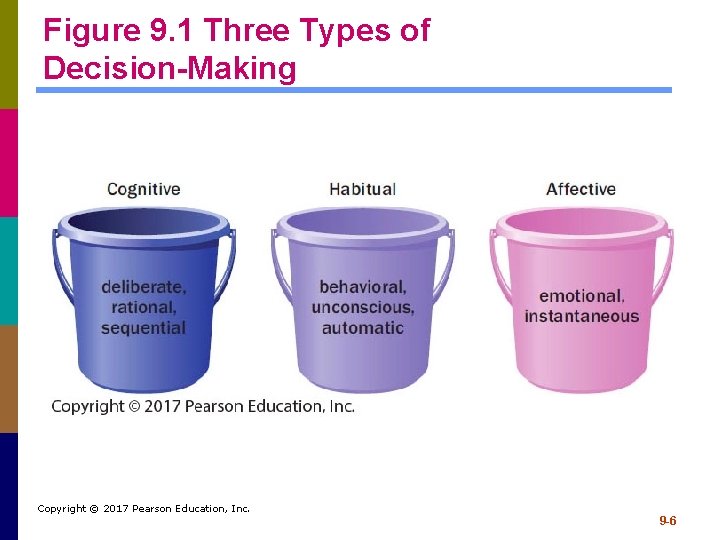
Figure 9. 1 Three Types of Decision-Making Copyright © 2017 Pearson Education, Inc. 9 -6
Problem? • Consumer hyperchoice • Constructive processing • Mental budget Copyright © 2017 Pearson Education, Inc. 9 -7
Self-Regulation • • • Implementation intentions Counteractive construal Feedback loop Morning Morality Effect Executive control center Copyright © 2017 Pearson Education, Inc. 9 -8
For Reflection • Provide an example when the feedback loop was used on you. Copyright © 2017 Pearson Education, Inc. 9 -9
Learning Objective 2 A cognitive purchase decision is the outcome of a series of stages that results in the selection of one product over competing options. Copyright © 2017 Pearson Education, Inc. 9 -10
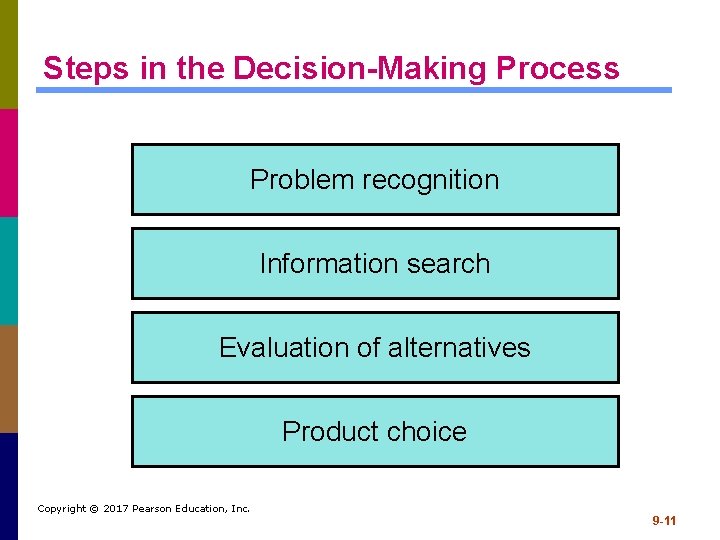
Steps in the Decision-Making Process Problem recognition Information search Evaluation of alternatives Product choice Copyright © 2017 Pearson Education, Inc. 9 -11
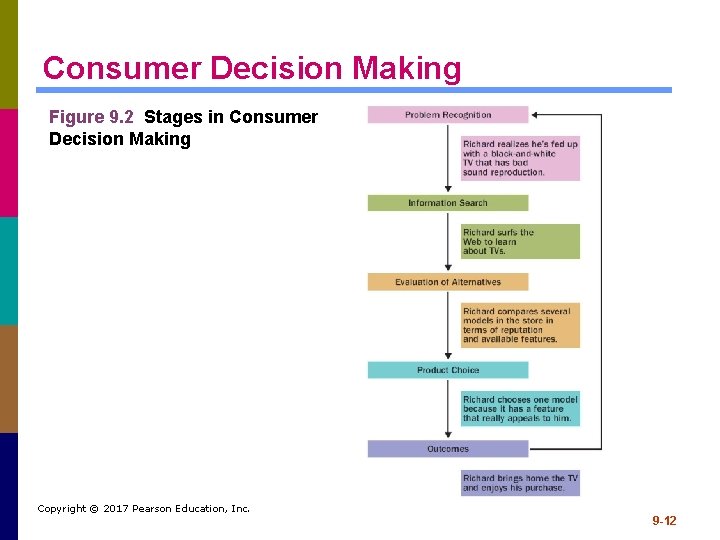
Consumer Decision Making Figure 9. 2 Stages in Consumer Decision Making Copyright © 2017 Pearson Education, Inc. 9 -12
Stage 1: Problem Recognition • Occurs when consumer sees difference between current state and ideal state • Need recognition: actual state declines • Opportunity recognition: ideal state moves upward Copyright © 2017 Pearson Education, Inc. 9 -13
Stage 2: Information Search The process by which we survey the environment for appropriate data to make a reasonable decision. • Prepurchase or ongoing search • Internal or external search • Online search and cybermediaries Copyright © 2017 Pearson Education, Inc. 9 -14
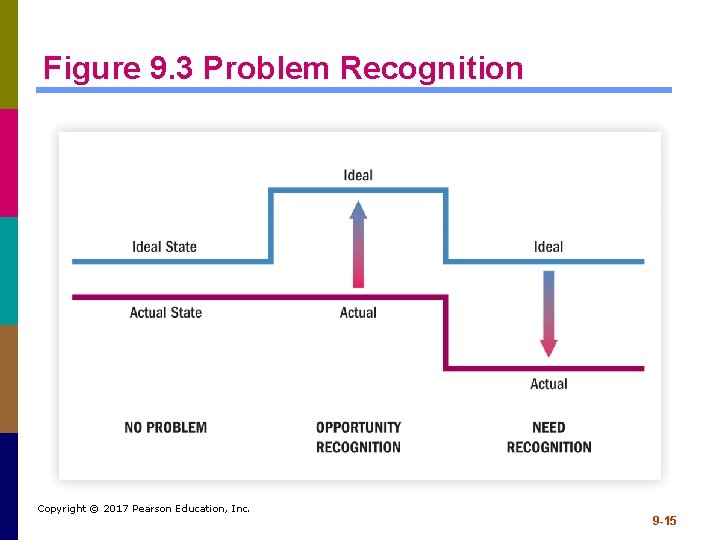
Figure 9. 3 Problem Recognition Copyright © 2017 Pearson Education, Inc. 9 -15
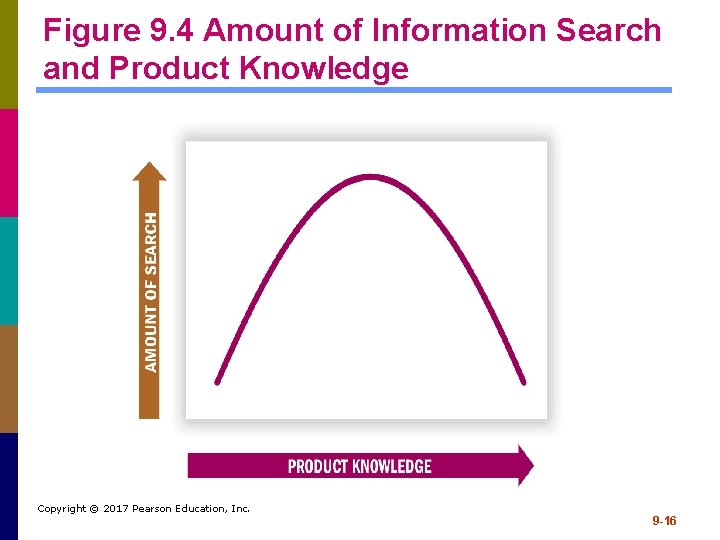
Figure 9. 4 Amount of Information Search and Product Knowledge Copyright © 2017 Pearson Education, Inc. 9 -16
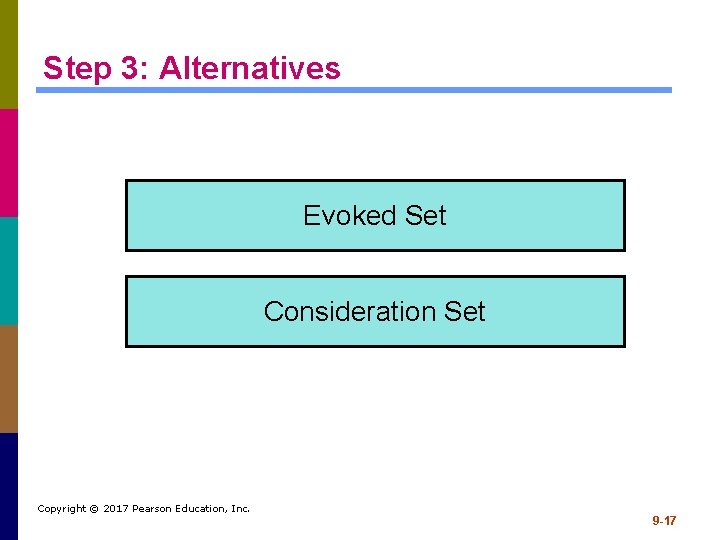
Step 3: Alternatives Evoked Set Consideration Set Copyright © 2017 Pearson Education, Inc. 9 -17
For Reflection • Is it a problem that consumers have too many choices? Would it be better to have less choices? How does it affect consumer decision-making? Copyright © 2017 Pearson Education, Inc. 9 -18
Learning Objective 3 The way information about a product choice is framed can prime a decision even when the consumer is unaware of this influence. Copyright © 2017 Pearson Education, Inc. 9 -19
Product Choice Step 4: Product choice • Feature creep Step 5: Postpurchase evaluation • Neuromarketing Copyright © 2017 Pearson Education, Inc. 9 -20
Online Decision Making • • Cybermediary Intelligent agents Search engine optimization • Long tail Copyright © 2017 Pearson Education, Inc. 9 -21
Strategic Implementation of Product Categories • • Position a product Identify competitors Create an exemplar product Locate products in a store Copyright © 2017 Pearson Education, Inc. 9 -22
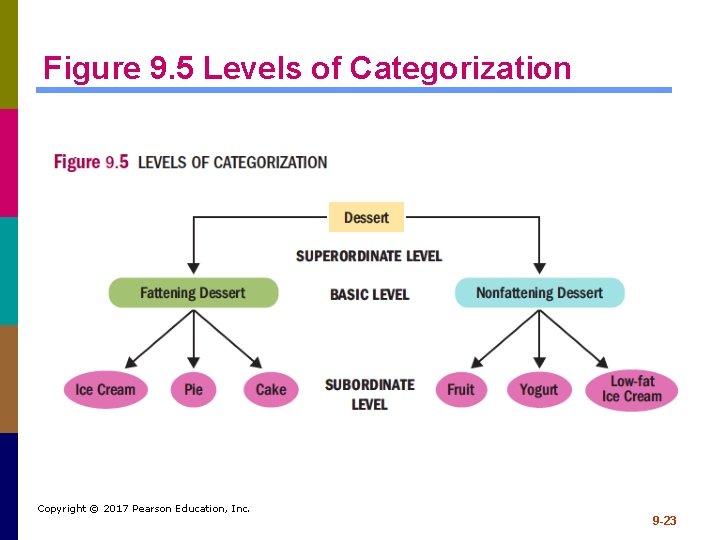
Figure 9. 5 Levels of Categorization Copyright © 2017 Pearson Education, Inc. 9 -23
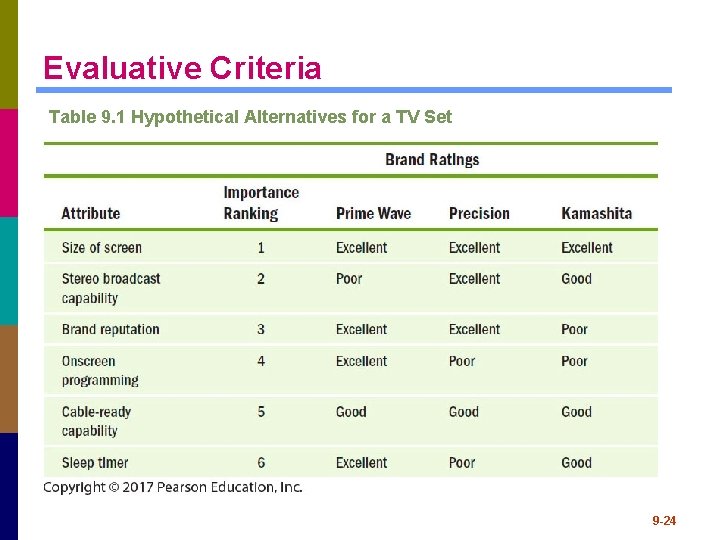
Evaluative Criteria Table 9. 1 Hypothetical Alternatives for a TV Set 9 -24
Compensatory Rule • Simple additive rule leads to the option with the largest number of positive attributes • Weighted additive rule allows consumer to take in to account the relative importance by weighting. Copyright © 2017 Pearson Education, Inc. 9 -25
Noncompensatory Decision Rules • Lexicographic rule: consumers select the brand that is the best on the most important attribute • Elimination-by-aspects rule: must have a specific feature to be chosen • Conjunctive rule: entails processing by brand Copyright © 2017 Pearson Education, Inc. 9 -26
For Reflection • Think of some of the common country of origin effects (e. g. , watches, wine). Which ones affect your consumer choices? What could brands from other countries do to compete such effects? Copyright © 2017 Pearson Education, Inc. 9 -27
Learning Objective 4 We often rely on rules-of-thumb to make routine decisions. Copyright © 2017 Pearson Education, Inc. 9 -28
Biases in Decision-Making Process • Mental accounting: framing a problem in terms of gains/losses influences our decisions • Sunk-cost fallacy: We are reluctant to waste something we have paid for • Loss aversion: We emphasize losses more than gains • Prospect theory: risk differs when we face gains versus losses Copyright © 2017 Pearson Education, Inc. 9 -29
Heuristics Covariation Country of Origin Familiar Brand Names Higher Prices Copyright © 2017 Pearson Education, Inc. 9 -30
For Reflection • When have you made a high involvement decision on the basis of affect? • Were you in a maximizing mode or satisficing mode? Copyright © 2017 Pearson Education, Inc. 9 -31
Learning Objective 5 Marketers often need to understand consumers’ behavior rather than a consumer’s behavior. Copyright © 2017 Pearson Education, Inc. 9 -32
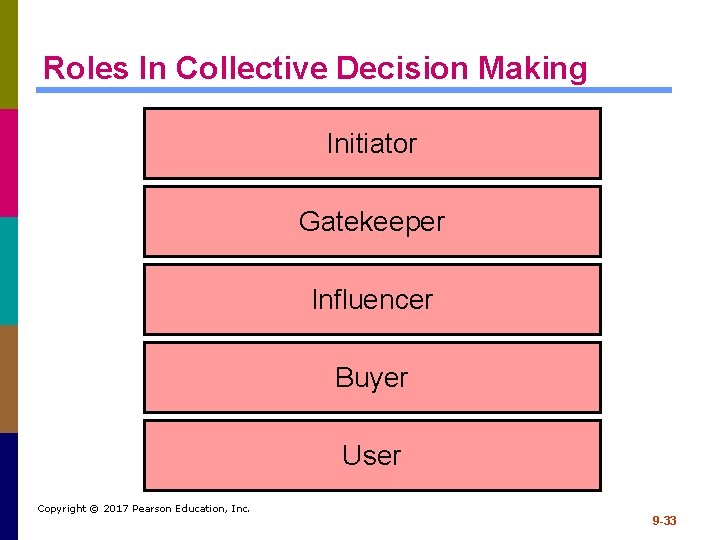
Roles In Collective Decision Making Initiator Gatekeeper Influencer Buyer User Copyright © 2017 Pearson Education, Inc. 9 -33
Learning Objective 6 The decision-making process differs when people choose what to buy on behalf of an organization rather than for personal use. Copyright © 2017 Pearson Education, Inc. 9 -34
Organizational Decision Making • Organizational buyers: purchase goods and services on behalf of companies for use in the process of manufacturing, distribution, or resale. • Business-to-business (B 2 B) marketers: specialize in meeting needs of organizations such as corporations, government agencies, hospitals, and retailers. Copyright © 2017 Pearson Education, Inc. 9 -35
Compared to Consumer Decision Making, Organizational Decision Making… • Involves many people • Requires precise, technical specifications • Is based on past experience and careful • • • weighing of alternatives May require risky decisions Involves substantial dollar volume Places more emphasis on personal selling Copyright © 2017 Pearson Education, Inc. 9 -36
What Influences Organizational Buyers? The buyclass theory of purchasing divides organizational buying decisions into 3 types: • Level of information required • Seriousness of decision • Familiarity with purchase Copyright © 2017 Pearson Education, Inc. 9 -37
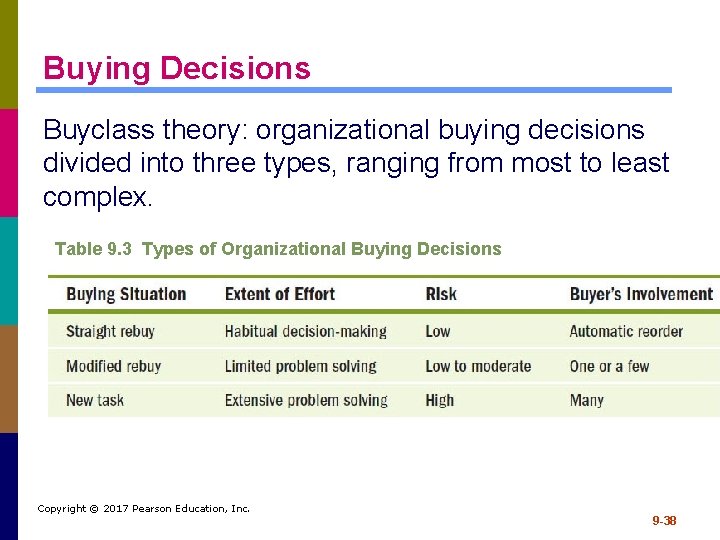
Buying Decisions Buyclass theory: organizational buying decisions divided into three types, ranging from most to least complex. Table 9. 3 Types of Organizational Buying Decisions Copyright © 2017 Pearson Education, Inc. 9 -38
B 2 B e-commerce • Prediction market • Crowdsourcing • Wisdom of crowds Copyright © 2017 Pearson Education, Inc. 9 -39
For Reflection • Assume that you are a sales representative for a large company that markets laptop computers. • List all the people that may be involved in making the decision to purchase from you. • Try to match all the people to their possible decision roles as outlined on the previous slide. Copyright © 2017 Pearson Education, Inc. 9 -40
Learning Objective 7 Members of a family unit play different roles and have different amounts of influence when the family makes purchase decisions. Copyright © 2017 Pearson Education, Inc. 9 -41
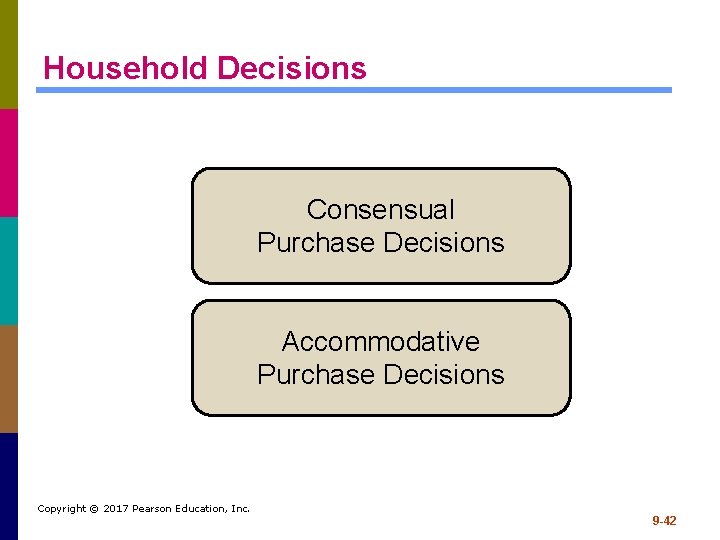
Household Decisions Consensual Purchase Decisions Accommodative Purchase Decisions Copyright © 2017 Pearson Education, Inc. 9 -42
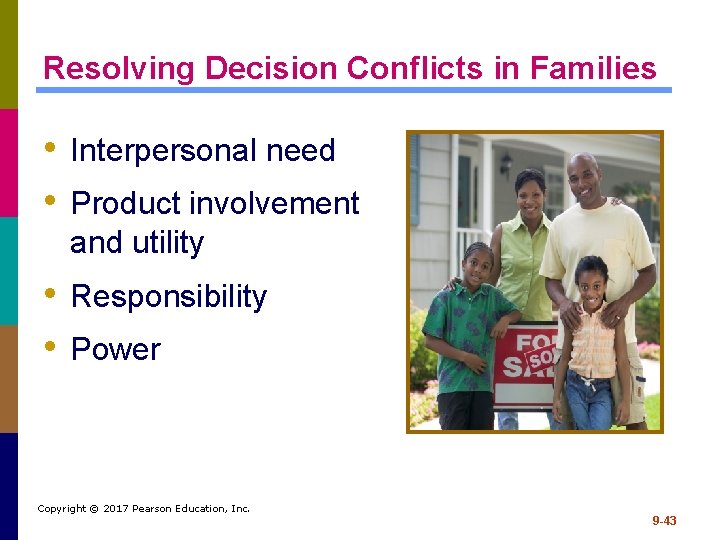
Resolving Decision Conflicts in Families • Interpersonal need • Product involvement and utility • Responsibility • Power Copyright © 2017 Pearson Education, Inc. 9 -43
Who Makes Key Decisions in the Family? • Autonomic decision: one family member chooses a product • Syncretic decision: involve both partners Used for cars, vacations, homes, appliances, furniture, home electronics, interior design, phone service o As education increases, so does syncretic decision making o Copyright © 2017 Pearson Education, Inc. 9 -44
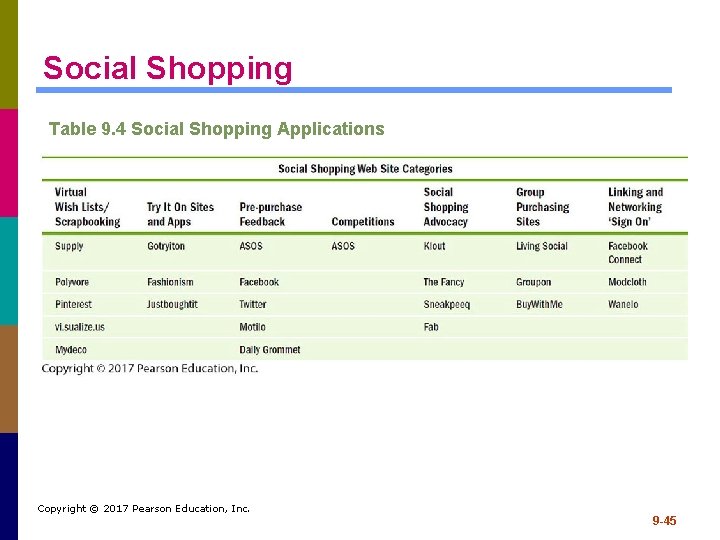
Social Shopping Table 9. 4 Social Shopping Applications Copyright © 2017 Pearson Education, Inc. 9 -45
For Reflection • What exposure have you had to family decisions made in your own family? Can you see the patterns discussed in the chapter in those decisions? Give an example. Copyright © 2017 Pearson Education, Inc. 9 -46
For Review 1. The three categories of consumer decision-making are cognitive, habitual, and affective. 2. A cognitive purchase decision is the outcome of a series of stages that results in the selection of one product over competing options. Copyright © 2017 Pearson Education, Inc. 9 -47
For Review 3. The way information about a product choice is framed can prime a decision even when the consumer is unaware of this influence. 4. We often fall back on well-learned “rulesof-thumb” to make decisions. 5. Marketers often need to understand consumers’ behavior rather than a consumer’s behavior. Copyright © 2017 Pearson Education, Inc. 9 -48
For Review 6. The decision-making process differs when people choose what to but on behalf of an organization rather than for personal use. 7. Members of a family unit play different roles and have different amounts of influence when the family makes purchase decisions. Copyright © 2017 Pearson Education, Inc. 9 -49

Copyright © 2017 Pearson Education, Inc. 2 -50
- Slides: 50