
9 Chapter 9 Specialized Leisure Service Areas Objectives
9 Chapter 9 Specialized Leisure- Service Areas

Objectives • Provide an overview of services of each of the five categories of service including: – Primary clientele – Defining characteristics – Sample organizations through which services are provided
Introduction • Five categories of specialized service – Therapeutic recreation – Armed forces recreation – Employee services and recreation programs – Campus recreation – Private membership recreation

Recreation Therapy • “… a treatment service designed to restore, remediate and rehabilitate a person’s level of functioning and independence in life activities, to promote health and wellness as well as reduce or eliminate the activity limitations and restrictions to participation in life situations caused by an illness or disabling condition. ” Source: American Therapeutic Recreation Association (ATRA). “What is TR? ” (July 2009). Hattiesburg, MS: Author. Available at http: //www. atra-online. com/displaycommon. cfm? an=12.
Therapeutic Recreation • “…engaging people in planned recreation and related experiences in order to improve functioning, health and well-being, and quality of life, while focusing on the whole person and the needed changes in the optimal living environment. ” Source: Robin Kunstler and Frances Stavola Daly, “Therapeutic Recreation. ” In Human Kinetics (Eds. ), Introduction to Recreation and Leisure (177− 196). (Champaign, IL: Human Kinetics, 2006).
Therapeutic Recreation (cont’d) • Early development of therapeutic recreation (TR) – Hospitals, rehabilitation centers, special schools – World War I and World War II sparked rehabilitation for veterans and the value of TR
Therapeutic Recreation (cont’d) • Clinical TR Settings – Acute care, outpatient care, psychiatric care, and rehabilitation hospitals • Community TR Settings – Municipal parks and recreation – Inclusion

Therapeutic Recreation (cont’d) • Two models of practice – Leisure Ability Model § Based on the idea that everyone should experience leisure regardless of their abilities and disabilities. § Three components: functional interventions, leisure education, and recreation participation
Therapeutic Recreation (cont’d) • Two models of practice – Health Protection–Health Promotion Model § Treating and rehabilitating a client after an illness or disability § Maintaining and enhancing good health. § Three components: prescriptive activity, recreation, and leisure

Therapeutic Recreation (cont’d) • Two models of practice – Health Protection–Health Promotion Model § APIE o Assessment o Planning o Implementation o Evaluation
Therapeutic Recreation (cont’d) • Unique aspects of TR – Technology and assistive devices – Cooperative network of agencies § Special recreation associations – Inclusion § Involvement and full acceptance of people with disabilities in a wide range of community settings
Therapeutic Recreation (cont’d) • Unique aspects of TR – Certified TR specialist – Expansion of sport and outdoor recreation in TR
Armed Forces Recreation • Provide a well-rounded morale, welfare, and recreational program for the physical, social, and mental wellbeing of its personnel • MWR: Morale, Welfare & Recreation

Armed Forces Recreation (cont’d) • Unique elements of MWR – Military community is quite transient and ever changing. – Military communities often in unstable communities including remote locations, combat zones, and less than desirable geographic locations.

Armed Forces Recreation (cont’d) • Unique elements of MWR – Exclusive in whom it serves § Active duty and dependents § Reserve and dependents § Retired military personnel and their dependents § Civilian employees § Surviving spouses of military personnel who died in active duty

Armed Forces Recreation (cont’d) • Program elements – Sports – Fitness programs – Outdoor recreation – Family recreation – Community relations – Resorts
Armed Forces Recreation (cont’d) • Fiscal support of armed forces recreation – Appropriated funding § Funding approved by Congress – Nonappropriated funding § Funds generated on base – Base closures and budget cuts have encouraged a more businesslike approach.
Employee Services and Recreation Programs • Provide recreation for employees within a company. • Goals of employee recreation – Improve employer-employee relations. – Directly promote employee fitness and efficiency. § Emphasis on reducing healthcare costs
Employee Services and Recreation Programs (cont’d) • Recruitment-retention appeal – Reduction of job turnover – Higher employee morale • Company image and community role – Internal and external image

Employee Services and Recreation Programs (cont’d) • Program activities and services – Wellness programs and fitness centers § Health screenings § Exercise programs § Education/awareness/intervention § Health skill building – Administrative arrangements § Provision of facilities and personnel § Making facilities and programs available to community
Employee Services and Recreation Programs (cont’d) • Scheduling flexibility: off-shift programming – Create convenient opportunities for employees. • Innovation and entrepreneurship – Enable employee programs to become less dependent upon company financial support. – Ensure that funds allocated yield a benefit.
Campus Recreation • Organized programs and leisure services provided by university and colleges for their students, faculty, and staff.
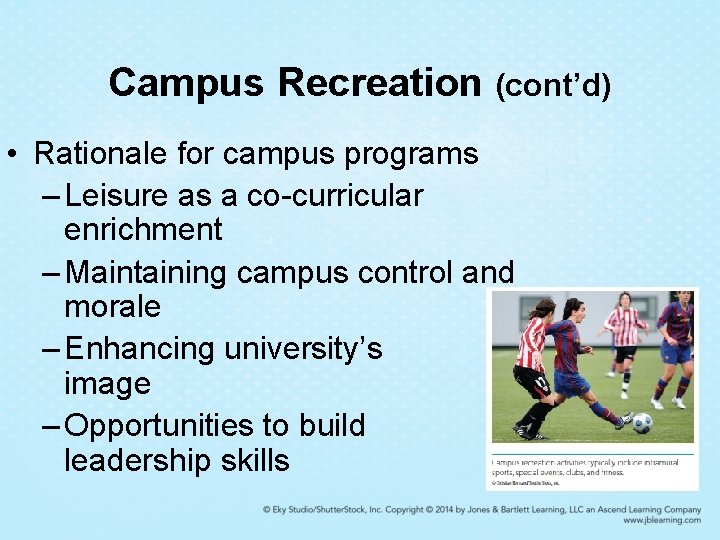
Campus Recreation (cont’d) • Rationale for campus programs – Leisure as a co-curricular enrichment – Maintaining campus control and morale – Enhancing university’s image – Opportunities to build leadership skills
Campus Recreation (cont’d) • Range of campus recreation experiences – Recreational sports – Outdoor recreation – Special events: entertainment and cultural programs – Services for students with disabilities – Community service projects
Campus Recreation (cont’d) • Overview of campus recreation – Offers practical experience. – Provides meaningful and creative opportunities. – Linked to other levels of educational experience.
Private-Membership Recreation Organizations • Restricted use of facilities or programs to individual members and their families and guests. • Organizations offer facilities, instruction, or other services for activities such as skiing, tennis, golf, boating, and hunting or fishing. • Social exclusivity.

Private-Membership Recreation Organizations (cont’d) • Ownership of clubs – Nonprofit “equity clubs, ” owned and operated by members § Destination club/vacation homes – Commercially owned, for-profit clubs § Golf clubs, country clubs
Private-Membership Recreation Organizations (cont’d) • Residence-connected clubs – Real estate trends offering leisure within developments – Apartments, condos, single-family homes – Provide complete communities within one building or area

Private-Membership Recreation Organizations (cont’d) • Vacation homes – Timeshare apartments and condos – Appeal to “jet set” ideal – Exclusive communities • Retirement communities – “Leisure villages” – Providing leisure as well as housing
Comparisons Among Special-Focus Organizations • Therapeutic recreation deals with people with disabilities. • Armed forces recreation is worldwide, but made up of smaller efforts. • Employee recreation designed to improve morale and quality of life. • Campus recreation currently seen as an integral element to higher education. • Private-membership organizations are heavily influenced by socioeconomic factors.
- Slides: 30