
9 BLOOD TRANSFUSION BONE MARROW TRANSPLANTATION Prof Sherif
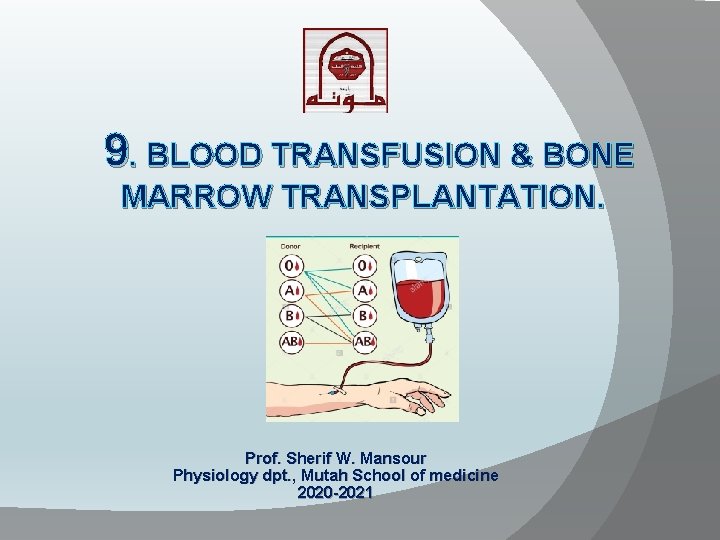
9. BLOOD TRANSFUSION & BONE MARROW TRANSPLANTATION. Prof. Sherif W. Mansour Physiology dpt. , Mutah School of medicine 2020 -2021
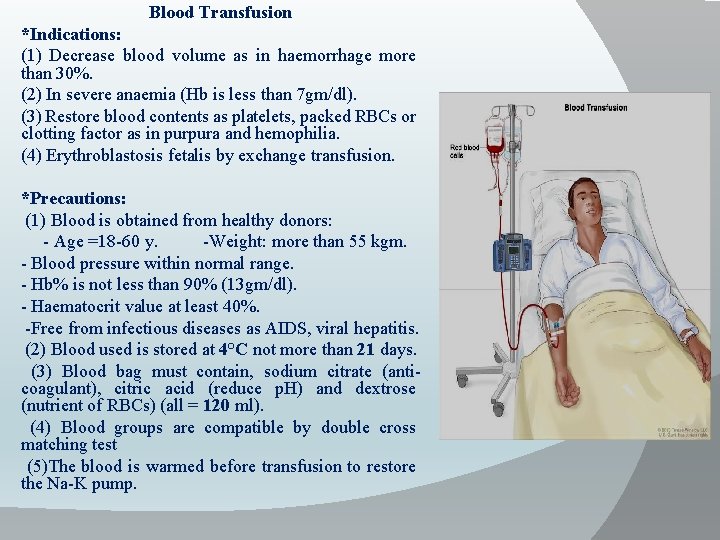
Blood Transfusion *Indications: (1) Decrease blood volume as in haemorrhage more than 30%. (2) In severe anaemia (Hb is less than 7 gm/dl). (3) Restore blood contents as platelets, packed RBCs or clotting factor as in purpura and hemophilia. (4) Erythroblastosis fetalis by exchange transfusion. *Precautions: (1) Blood is obtained from healthy donors: - Age =18 -60 y. -Weight: more than 55 kgm. - Blood pressure within normal range. - Hb% is not less than 90% (13 gm/dl). - Haematocrit value at least 40%. -Free from infectious diseases as AIDS, viral hepatitis. (2) Blood used is stored at 4°C not more than 21 days. (3) Blood bag must contain, sodium citrate (anticoagulant), citric acid (reduce p. H) and dextrose (nutrient of RBCs) (all = 120 ml). (4) Blood groups are compatible by double cross matching test (5)The blood is warmed before transfusion to restore the Na-K pump.
Complications of blood transfusion: (A) Incompatibility: leads to 1. RBCs (received from the donor) are agglutinated in clumps and block small blood vessels → ischaemic pain in chest and back. If the amount of the blood is less than 350 ml, death not occur. 2. The agglutinated RBCs hemolyse and hemoglobin is liberated in plasma and: • Converted to bilirubin → post-transfusion jaundice due to increase the indirect bilirubin. • Pass through the kidney and precipitate as acid hematin in the renal tubules blocking it � renal failure and anuria (no urine) this may cause death from uremia. • ↑ Viscosity and colloidal osmotic pressure →↑ heart work and may cause heart failure. 3. Hemolysed RBCs may produce toxic substances → V. C of renal vessels → renal failure. Or may release histamine with severe vasodilatation and drop in blood pressure. (B) Other complications : 1. Transmission of diseases as AIDS & hepatitis B, C. 2. Bacterial contamination and increase body temperature. 3. Over loading by excessive transfusion → heart failure. 4. Hyperkalemia → arrhythmia (so warming blood activate Na+ - K+ pump and restore K+ intracellular). 5. Hypocalcemia → tetany. This occur if large volume of citrated blood is transfused especially to patient with liver or kidney failure as the healthy liver oxidizes citrate to bicarbonate causing alkalosis preventing its combination to calcium. To avoid this effect calcium gluconate is injected with the blood. 6. Allergic reactions due to sensitization of tissue antigens present in WBCs and platelets.
Changes occur in stored blood: 1 - Increase K+ ions in plasma (Na-K pump inhibited by cold). 2 - Decrease dextrose and changed to lactic acid. 3 - Decrease Platelets number (short life span) 4 - RBCs swell and become spherical and more hemolysed. 5 - Decrease the plasma concentration of factors VII, VIII & IX. 6 - Decrease 2, 3 DPG → more Hb affinity to O 2 → less O 2 supply to the patient → hypoxia.

Bone Marrow Transplantation Bone Marrow is the soft spongy tissue that fills the cores of larger bones. It serves an active function in the body by producing all three types of blood cells, as well as lymphocytes, which support the immune system. Bone Marrow transplant is a procedure used to treat patients with life-threatening blood, immune or genetic disorders. This includes leukaemia and bone marrow cancers. A bone Marrow transplant replaces the unhealthy blood forming cells with healthy ones. Healthy bone marrow stem cells are harvested from matching bone marrow donors. Stem cells are immature cells in the bone marrow that give rise to all your blood cells.
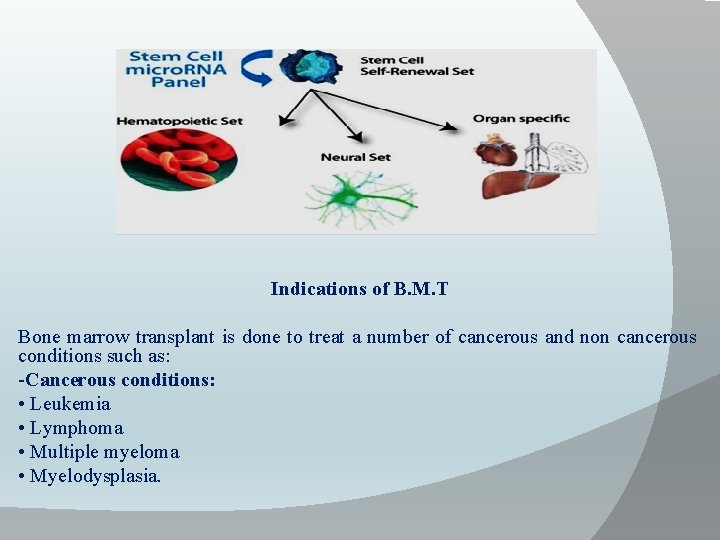
Indications of B. M. T Bone marrow transplant is done to treat a number of cancerous and non cancerous conditions such as: -Cancerous conditions: • Leukemia • Lymphoma • Multiple myeloma • Myelodysplasia.
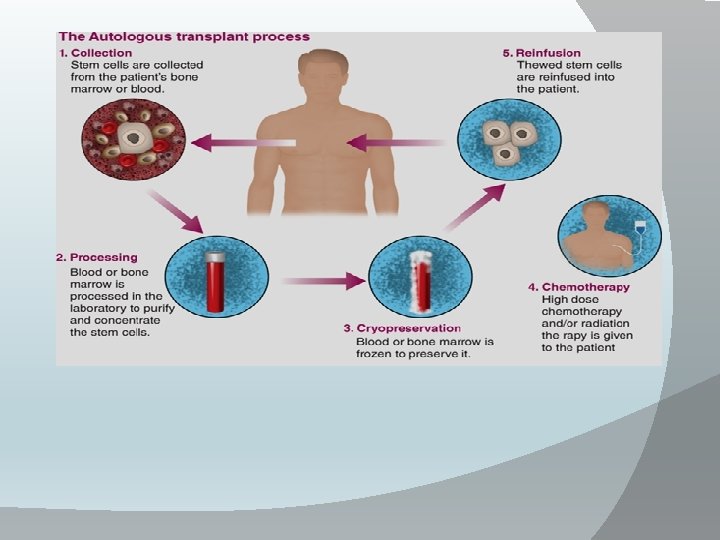
-Non cancerous conditions: • Aplastic anemia • Hemoglobinopathies • Immunodeficiency disorders and conditions affecting blood present from birth There are two main types of bone marrow transplantation: Autologous Allogeneic 1 -Autologous Bone Marrow Transplant: -In autologous transplants, the transplanted stem cells come from the body of the child having the transplant. The doctors remove the stem cells from the child, store them, and then put these cells back after destroying the cancer or diseased cells with conditioning. -If your child is having an autologous transplant, you do not need a donor; the child acts as his or her own donor. However, your child will have to undergo either bone marrow harvesting or stem cell mobilization in order to gather the stem cells. The advantage of using the child’s own stem cells is that he or she will not face the complication of graft-versus-host disease (when donated white blood cells attack the child’s healthy cells). -However, with an auto-logous transplant the child does not have the same graftversus-tumor benefits (when the donated white blood cells attack the child’s diseased cells). -As a result, there is a higher relapse rate with autologous transplants, and this type is not suitable for some diseases or patients.
2 -Allogeneic Bone Marrow Transplant For some diseases, the transplanted stem cells come from another person, called a donor. Donor transplants are called allogeneic transplants. Why use another person’s stem cells? Often the child’s own blood cells are simply too diseased to be given back to them. In other cases, the donated stem cells are far more aggressive in killing the patient’s diseased cells (the graft-versus-tumor effect described above). For these reasons, in certain serious conditions, allogeneic transplants can boost the chances of a child’s long-term recovery. However, allogeneic transplants can be riskier than autologous transplants because the cells of the donor and the recipient mix, which can lead to graft-versus-host disease. Finding a donor who is related to your child—a brother or sister, for example—can reduce some of this risk. So can using stem cells from an unrelated donor whose cells closely match your child’s.
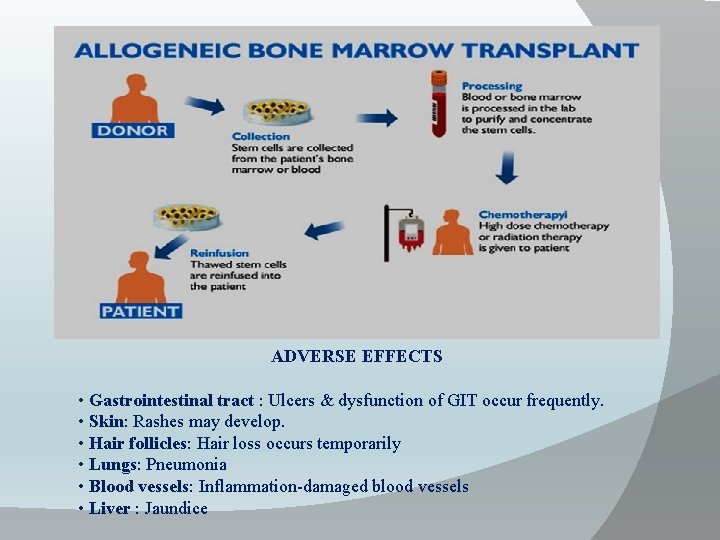
ADVERSE EFFECTS • Gastrointestinal tract : Ulcers & dysfunction of GIT occur frequently. • Skin: Rashes may develop. • Hair follicles: Hair loss occurs temporarily • Lungs: Pneumonia • Blood vessels: Inflammation-damaged blood vessels • Liver : Jaundice

Thank You
- Slides: 11