
9 5 OxymercurationDemercuration Because rearrangements often produce a
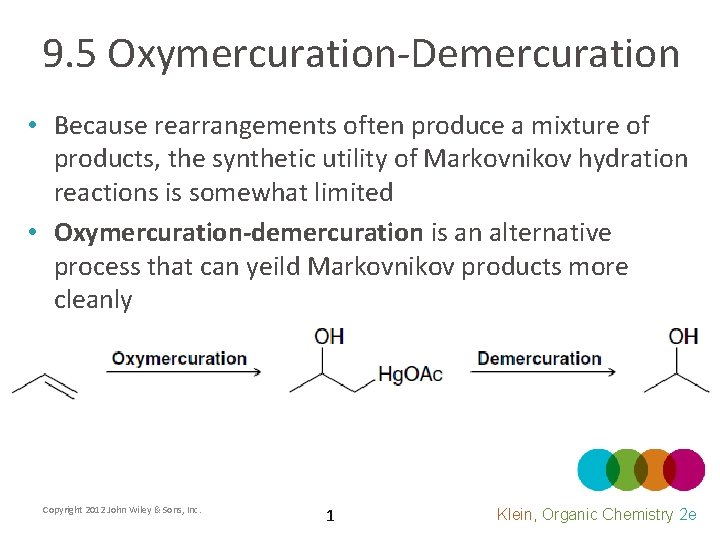
9. 5 Oxymercuration-Demercuration • Because rearrangements often produce a mixture of products, the synthetic utility of Markovnikov hydration reactions is somewhat limited • Oxymercuration-demercuration is an alternative process that can yeild Markovnikov products more cleanly Copyright 2012 John Wiley & Sons, Inc. 1 Klein, Organic Chemistry 2 e
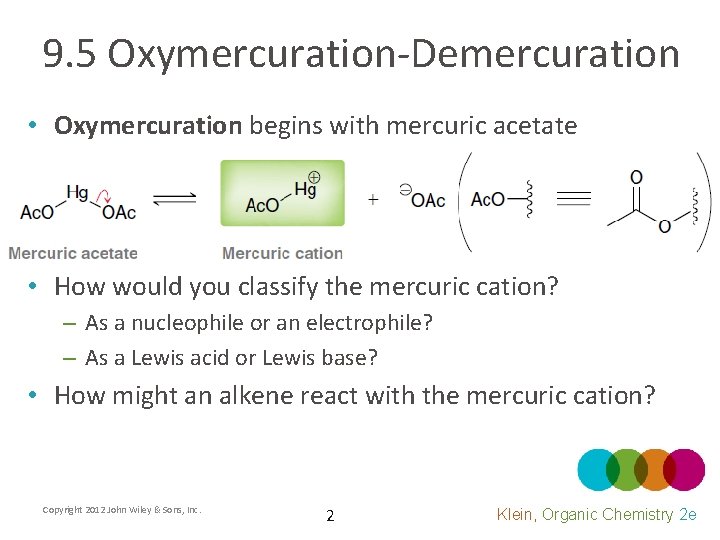
9. 5 Oxymercuration-Demercuration • Oxymercuration begins with mercuric acetate • How would you classify the mercuric cation? – As a nucleophile or an electrophile? – As a Lewis acid or Lewis base? • How might an alkene react with the mercuric cation? Copyright 2012 John Wiley & Sons, Inc. 2 Klein, Organic Chemistry 2 e
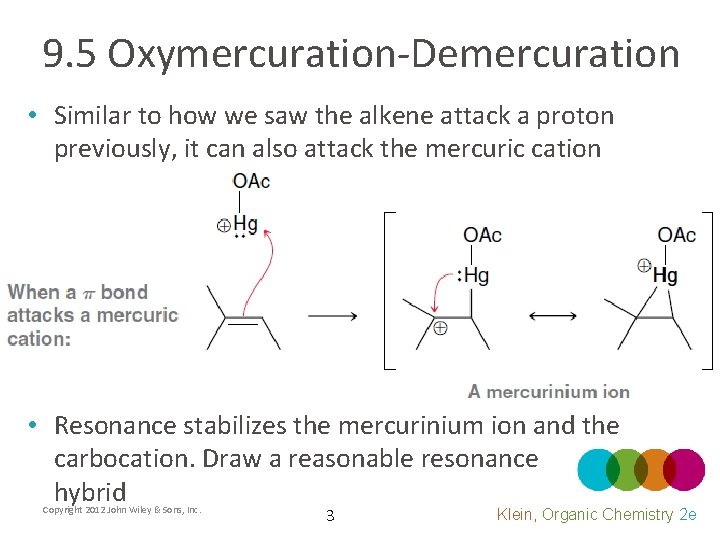
9. 5 Oxymercuration-Demercuration • Similar to how we saw the alkene attack a proton previously, it can also attack the mercuric cation • Resonance stabilizes the mercurinium ion and the carbocation. Draw a reasonable resonance hybrid Copyright 2012 John Wiley & Sons, Inc. 3 Klein, Organic Chemistry 2 e
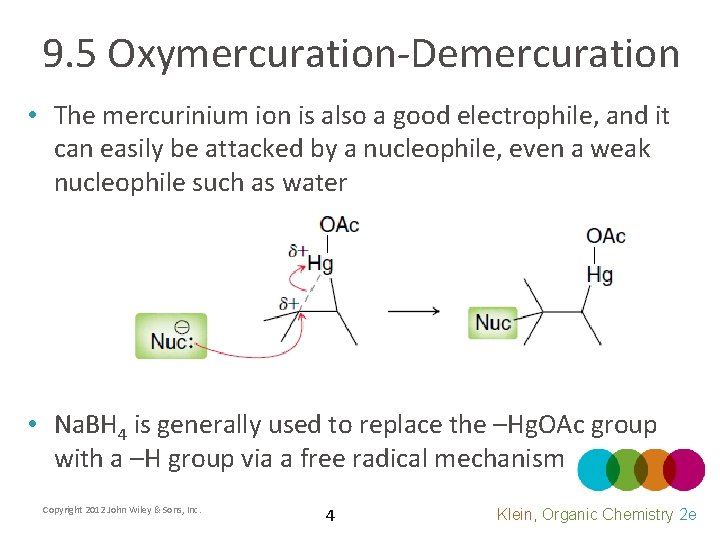
9. 5 Oxymercuration-Demercuration • The mercurinium ion is also a good electrophile, and it can easily be attacked by a nucleophile, even a weak nucleophile such as water • Na. BH 4 is generally used to replace the –Hg. OAc group with a –H group via a free radical mechanism Copyright 2012 John Wiley & Sons, Inc. 4 Klein, Organic Chemistry 2 e
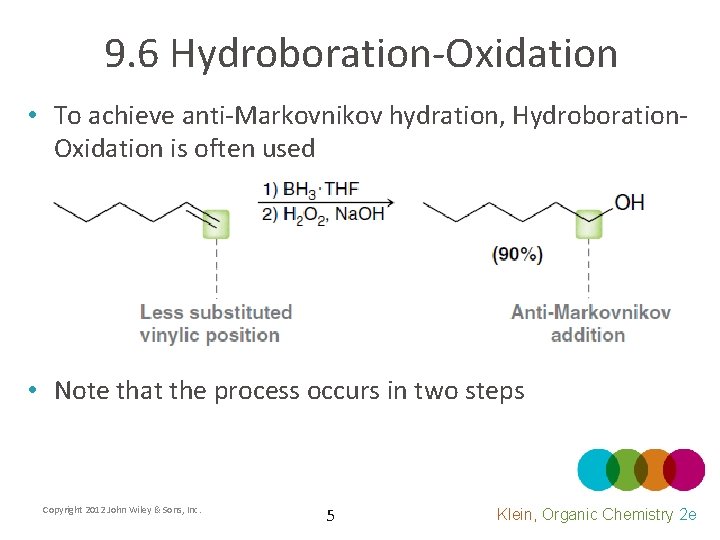
9. 6 Hydroboration-Oxidation • To achieve anti-Markovnikov hydration, Hydroboration. Oxidation is often used • Note that the process occurs in two steps Copyright 2012 John Wiley & Sons, Inc. 5 Klein, Organic Chemistry 2 e
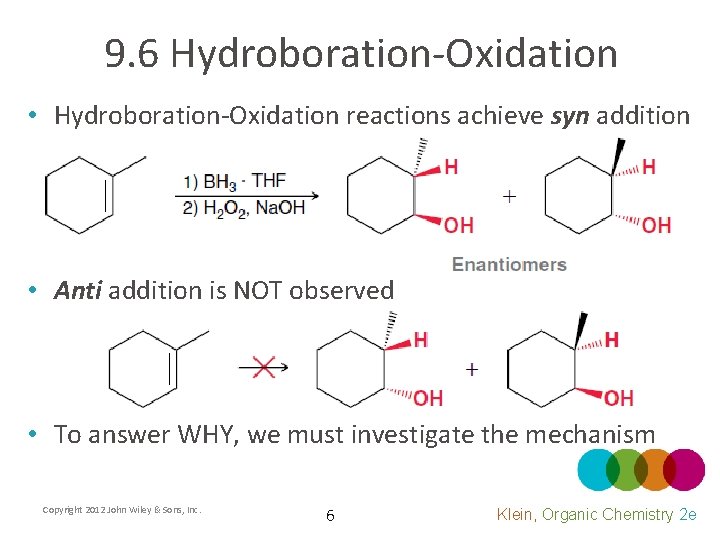
9. 6 Hydroboration-Oxidation • Hydroboration-Oxidation reactions achieve syn addition • Anti addition is NOT observed • To answer WHY, we must investigate the mechanism Copyright 2012 John Wiley & Sons, Inc. 6 Klein, Organic Chemistry 2 e
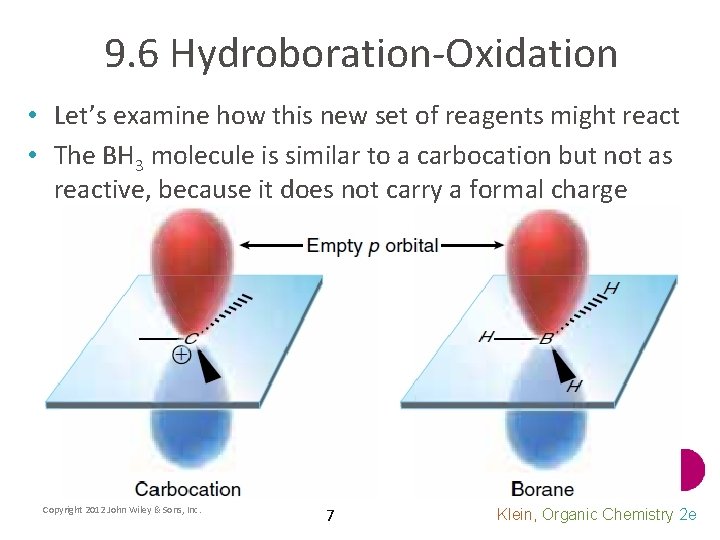
9. 6 Hydroboration-Oxidation • Let’s examine how this new set of reagents might react • The BH 3 molecule is similar to a carbocation but not as reactive, because it does not carry a formal charge Copyright 2012 John Wiley & Sons, Inc. 7 Klein, Organic Chemistry 2 e
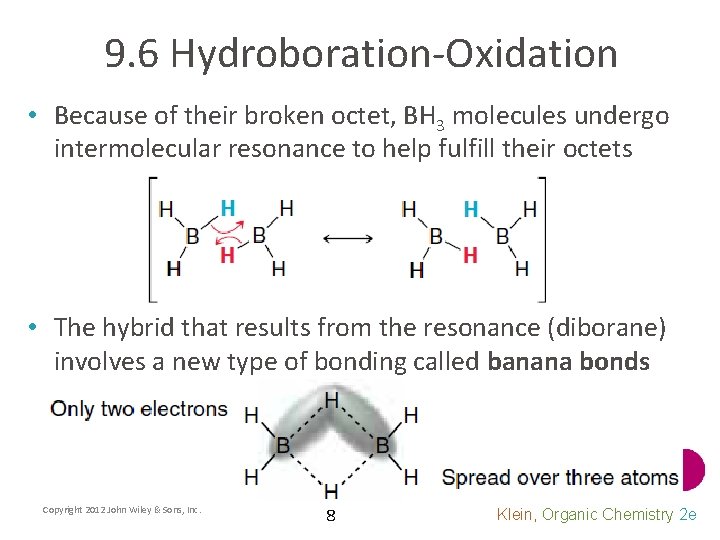
9. 6 Hydroboration-Oxidation • Because of their broken octet, BH 3 molecules undergo intermolecular resonance to help fulfill their octets • The hybrid that results from the resonance (diborane) involves a new type of bonding called banana bonds Copyright 2012 John Wiley & Sons, Inc. 8 Klein, Organic Chemistry 2 e
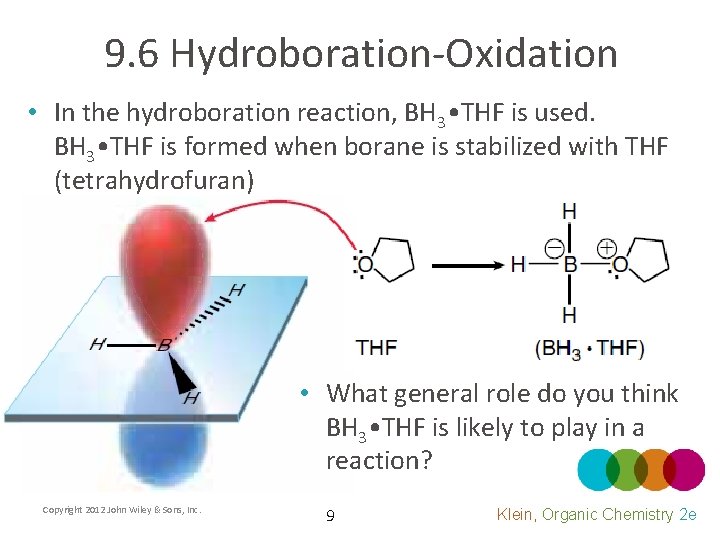
9. 6 Hydroboration-Oxidation • In the hydroboration reaction, BH 3 • THF is used. BH 3 • THF is formed when borane is stabilized with THF (tetrahydrofuran) • What general role do you think BH 3 • THF is likely to play in a reaction? Copyright 2012 John Wiley & Sons, Inc. 9 Klein, Organic Chemistry 2 e
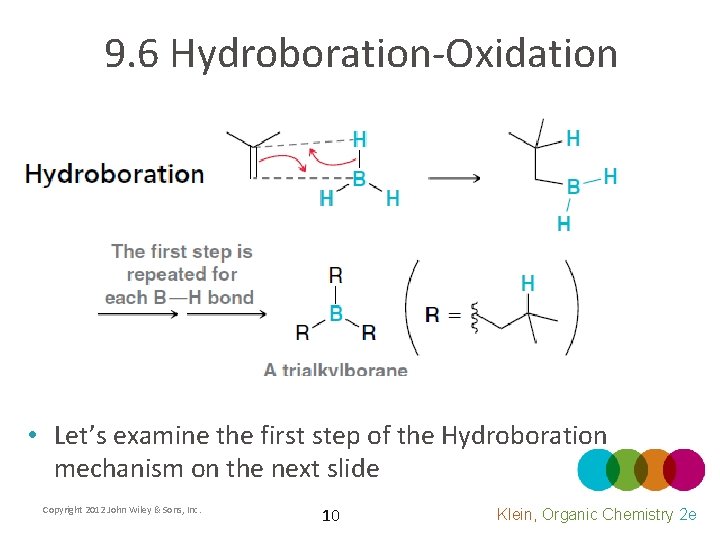
9. 6 Hydroboration-Oxidation • Let’s examine the first step of the Hydroboration mechanism on the next slide Copyright 2012 John Wiley & Sons, Inc. 10 Klein, Organic Chemistry 2 e
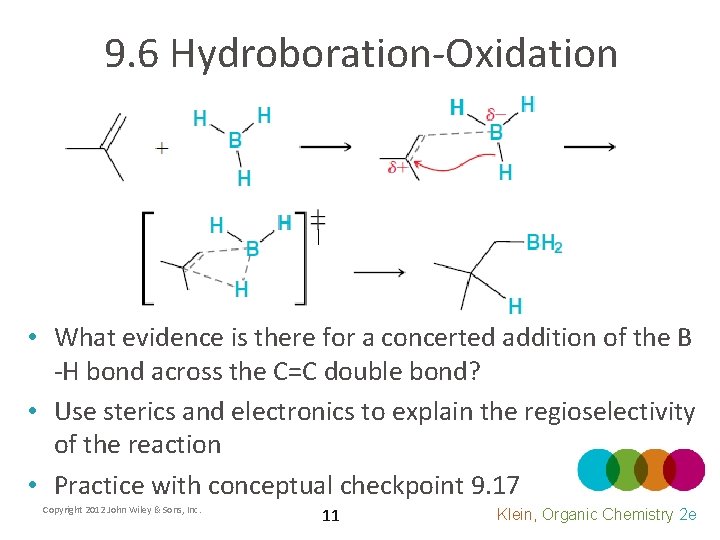
9. 6 Hydroboration-Oxidation • What evidence is there for a concerted addition of the B -H bond across the C=C double bond? • Use sterics and electronics to explain the regioselectivity of the reaction • Practice with conceptual checkpoint 9. 17 Copyright 2012 John Wiley & Sons, Inc. 11 Klein, Organic Chemistry 2 e
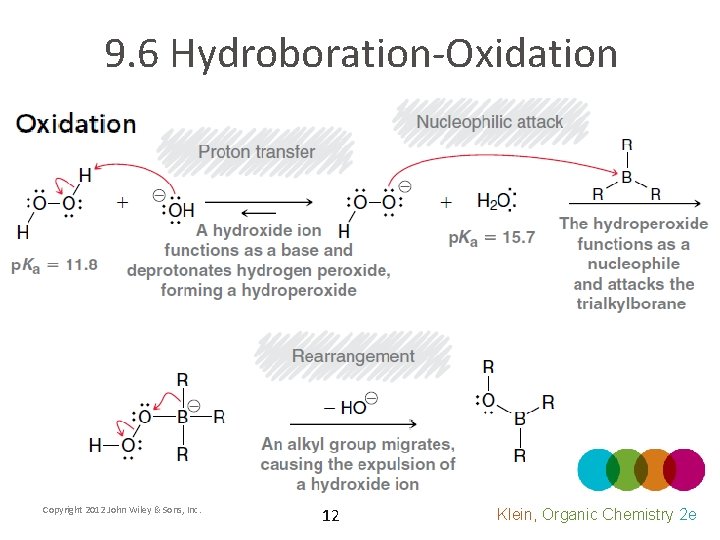
9. 6 Hydroboration-Oxidation Copyright 2012 John Wiley & Sons, Inc. 12 Klein, Organic Chemistry 2 e
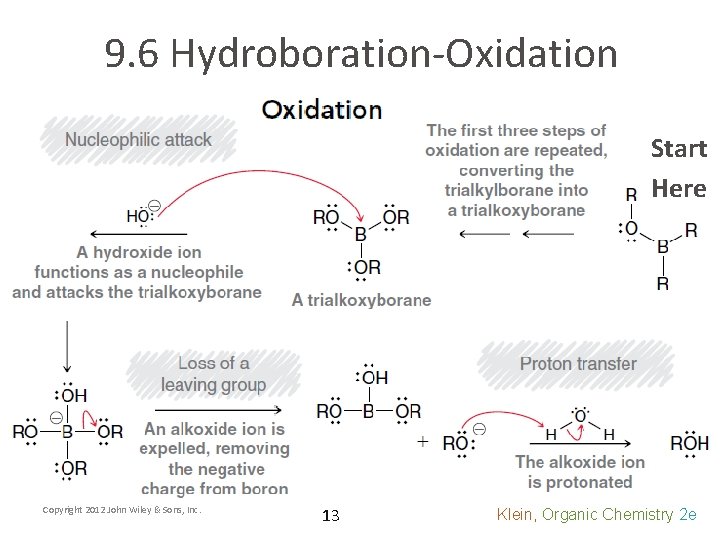
9. 6 Hydroboration-Oxidation Start Here Copyright 2012 John Wiley & Sons, Inc. 13 Klein, Organic Chemistry 2 e
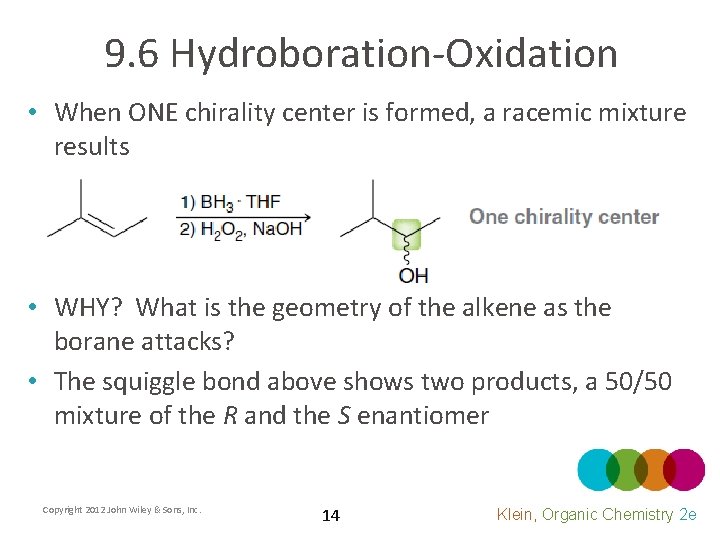
9. 6 Hydroboration-Oxidation • When ONE chirality center is formed, a racemic mixture results • WHY? What is the geometry of the alkene as the borane attacks? • The squiggle bond above shows two products, a 50/50 mixture of the R and the S enantiomer Copyright 2012 John Wiley & Sons, Inc. 14 Klein, Organic Chemistry 2 e
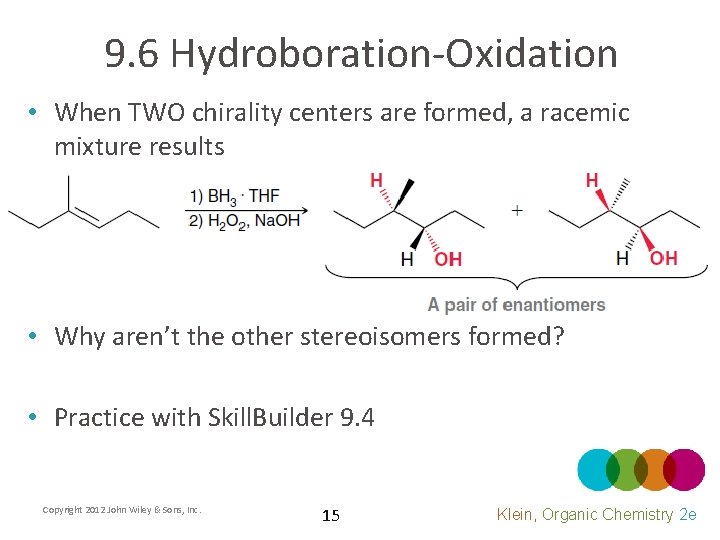
9. 6 Hydroboration-Oxidation • When TWO chirality centers are formed, a racemic mixture results • Why aren’t the other stereoisomers formed? • Practice with Skill. Builder 9. 4 Copyright 2012 John Wiley & Sons, Inc. 15 Klein, Organic Chemistry 2 e
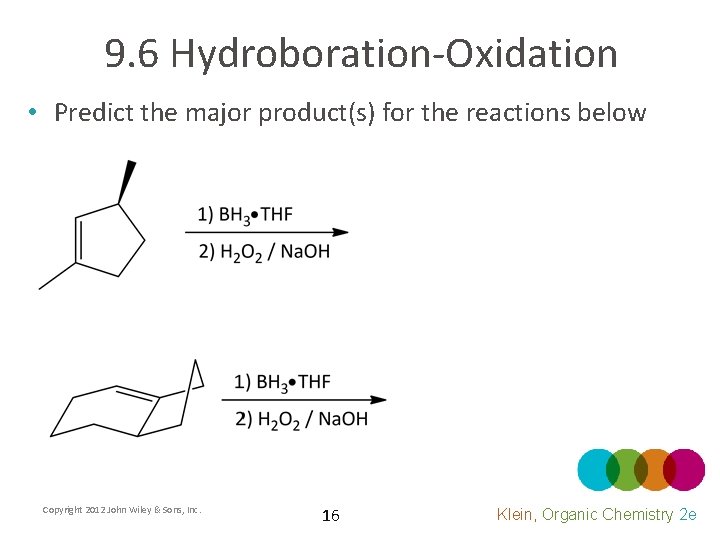
9. 6 Hydroboration-Oxidation • Predict the major product(s) for the reactions below Copyright 2012 John Wiley & Sons, Inc. 16 Klein, Organic Chemistry 2 e
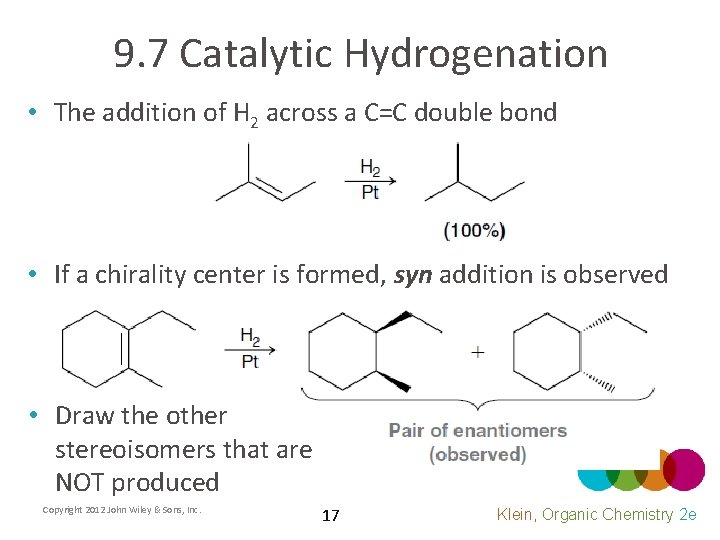
9. 7 Catalytic Hydrogenation • The addition of H 2 across a C=C double bond • If a chirality center is formed, syn addition is observed • Draw the other stereoisomers that are NOT produced Copyright 2012 John Wiley & Sons, Inc. 17 Klein, Organic Chemistry 2 e
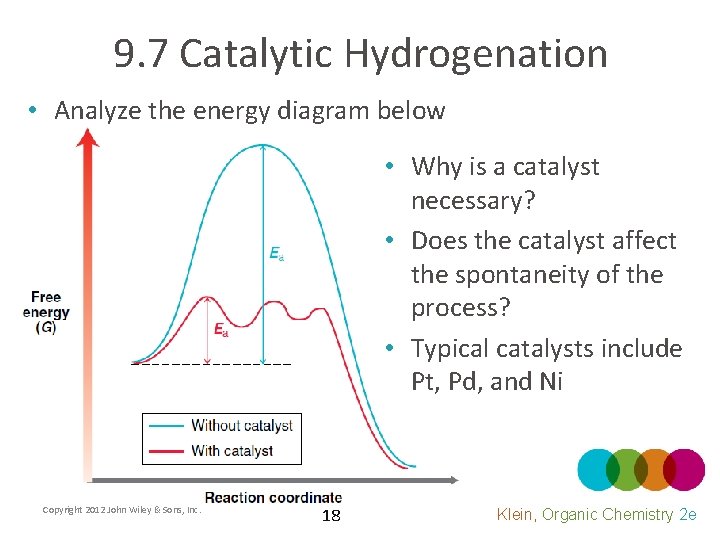
9. 7 Catalytic Hydrogenation • Analyze the energy diagram below • Why is a catalyst necessary? • Does the catalyst affect the spontaneity of the process? • Typical catalysts include Pt, Pd, and Ni Copyright 2012 John Wiley & Sons, Inc. 18 Klein, Organic Chemistry 2 e
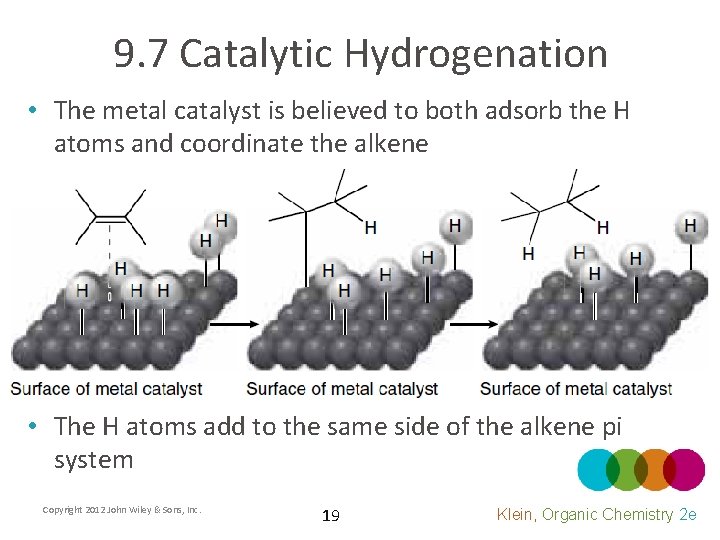
9. 7 Catalytic Hydrogenation • The metal catalyst is believed to both adsorb the H atoms and coordinate the alkene • The H atoms add to the same side of the alkene pi system Copyright 2012 John Wiley & Sons, Inc. 19 Klein, Organic Chemistry 2 e
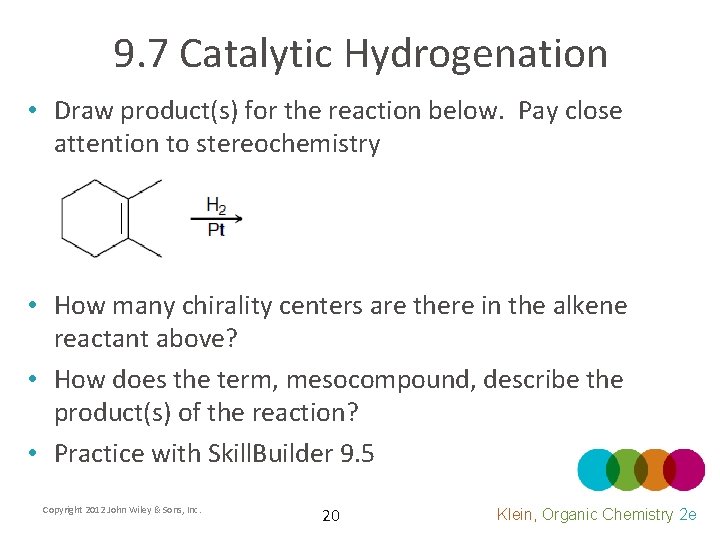
9. 7 Catalytic Hydrogenation • Draw product(s) for the reaction below. Pay close attention to stereochemistry • How many chirality centers are there in the alkene reactant above? • How does the term, mesocompound, describe the product(s) of the reaction? • Practice with Skill. Builder 9. 5 Copyright 2012 John Wiley & Sons, Inc. 20 Klein, Organic Chemistry 2 e
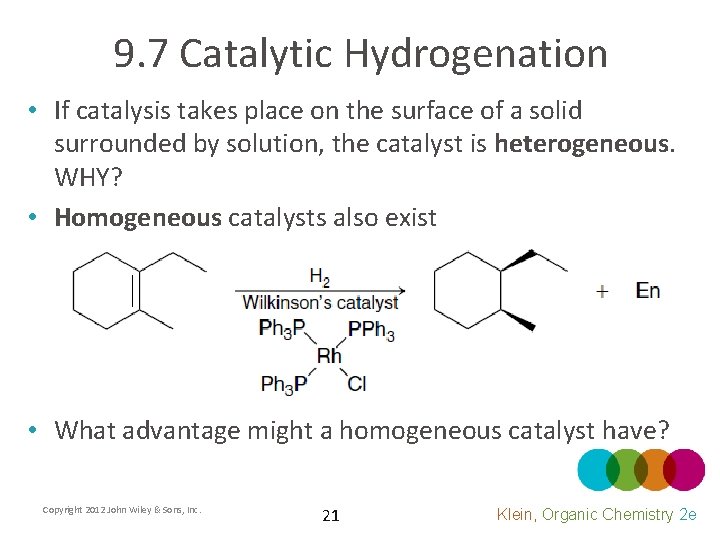
9. 7 Catalytic Hydrogenation • If catalysis takes place on the surface of a solid surrounded by solution, the catalyst is heterogeneous. WHY? • Homogeneous catalysts also exist • What advantage might a homogeneous catalyst have? Copyright 2012 John Wiley & Sons, Inc. 21 Klein, Organic Chemistry 2 e
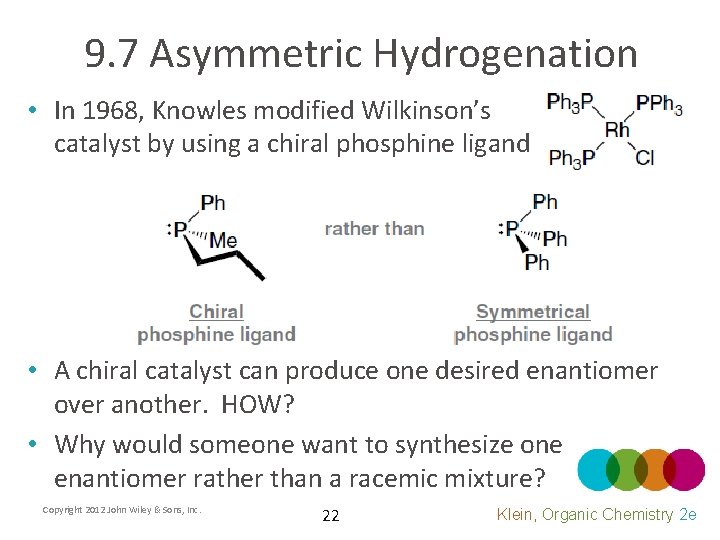
9. 7 Asymmetric Hydrogenation • In 1968, Knowles modified Wilkinson’s catalyst by using a chiral phosphine ligand • A chiral catalyst can produce one desired enantiomer over another. HOW? • Why would someone want to synthesize one enantiomer rather than a racemic mixture? Copyright 2012 John Wiley & Sons, Inc. 22 Klein, Organic Chemistry 2 e
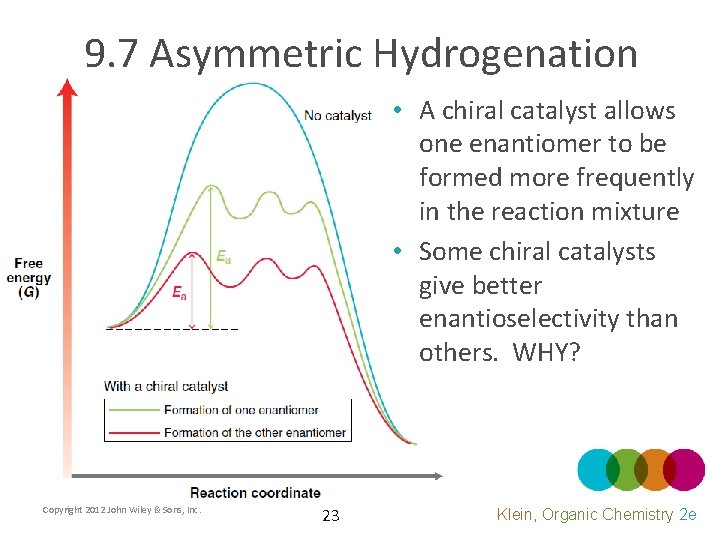
9. 7 Asymmetric Hydrogenation • A chiral catalyst allows one enantiomer to be formed more frequently in the reaction mixture • Some chiral catalysts give better enantioselectivity than others. WHY? Copyright 2012 John Wiley & Sons, Inc. 23 Klein, Organic Chemistry 2 e
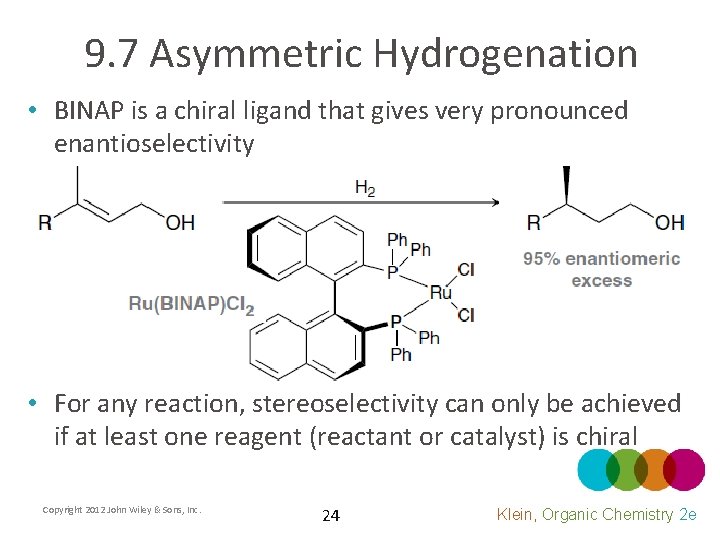
9. 7 Asymmetric Hydrogenation • BINAP is a chiral ligand that gives very pronounced enantioselectivity • For any reaction, stereoselectivity can only be achieved if at least one reagent (reactant or catalyst) is chiral Copyright 2012 John Wiley & Sons, Inc. 24 Klein, Organic Chemistry 2 e
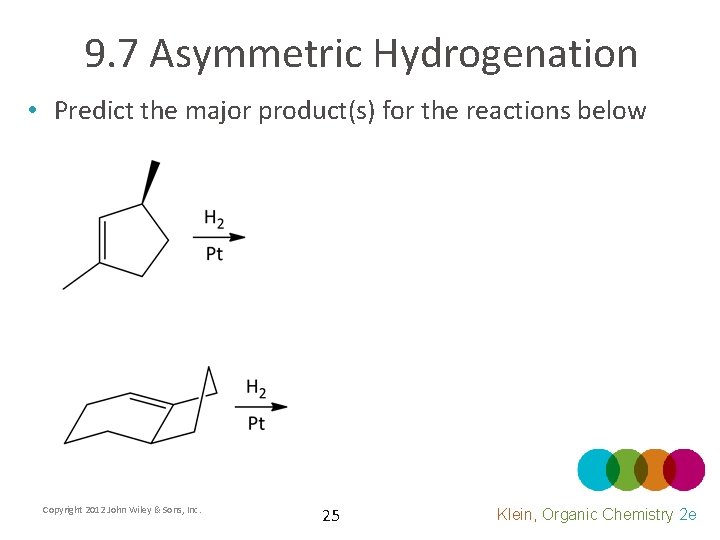
9. 7 Asymmetric Hydrogenation • Predict the major product(s) for the reactions below Copyright 2012 John Wiley & Sons, Inc. 25 Klein, Organic Chemistry 2 e
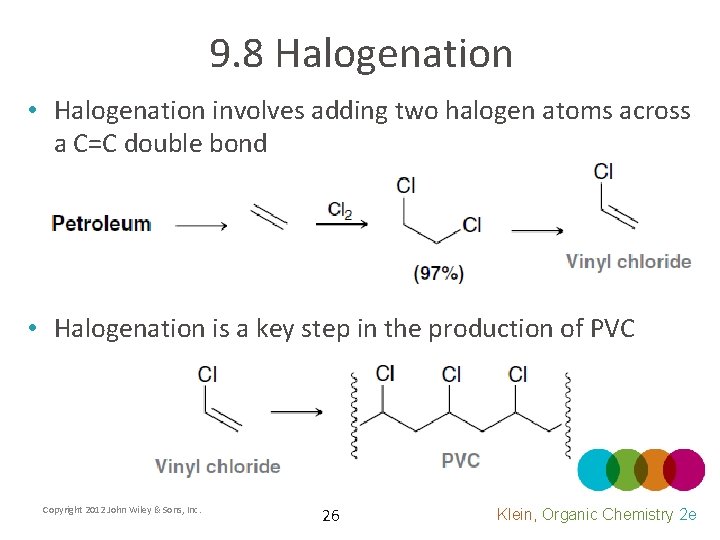
9. 8 Halogenation • Halogenation involves adding two halogen atoms across a C=C double bond • Halogenation is a key step in the production of PVC Copyright 2012 John Wiley & Sons, Inc. 26 Klein, Organic Chemistry 2 e
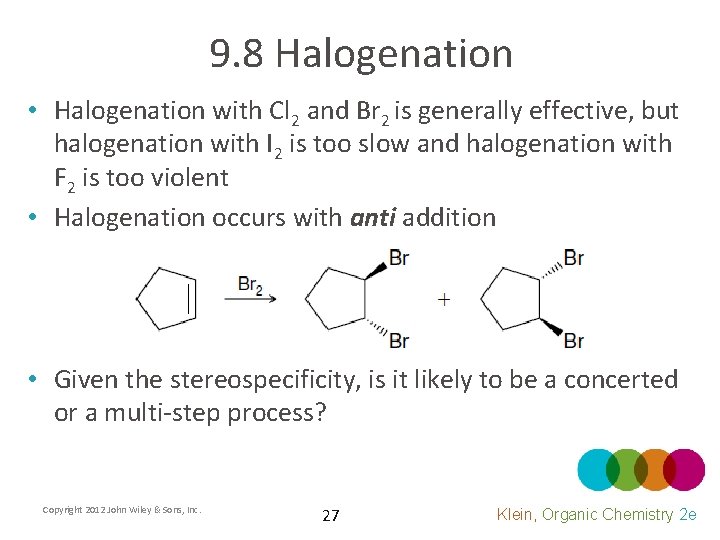
9. 8 Halogenation • Halogenation with Cl 2 and Br 2 is generally effective, but halogenation with I 2 is too slow and halogenation with F 2 is too violent • Halogenation occurs with anti addition • Given the stereospecificity, is it likely to be a concerted or a multi-step process? Copyright 2012 John Wiley & Sons, Inc. 27 Klein, Organic Chemistry 2 e
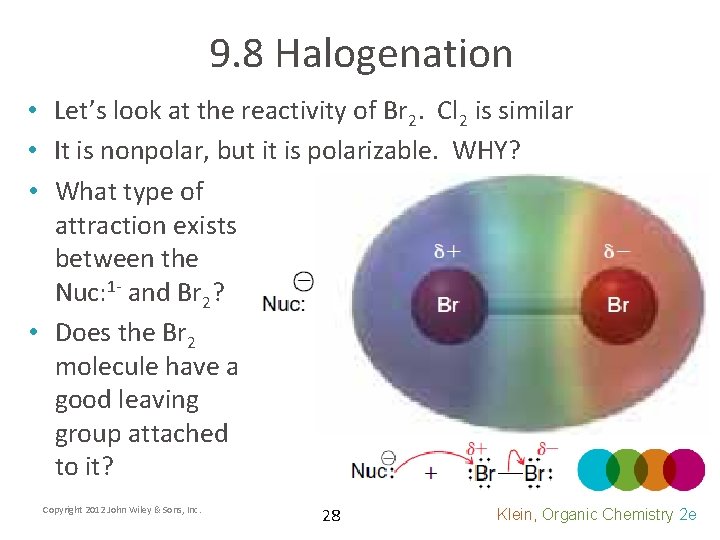
9. 8 Halogenation • Let’s look at the reactivity of Br 2. Cl 2 is similar • It is nonpolar, but it is polarizable. WHY? • What type of attraction exists between the Nuc: 1 - and Br 2? • Does the Br 2 molecule have a good leaving group attached to it? Copyright 2012 John Wiley & Sons, Inc. 28 Klein, Organic Chemistry 2 e
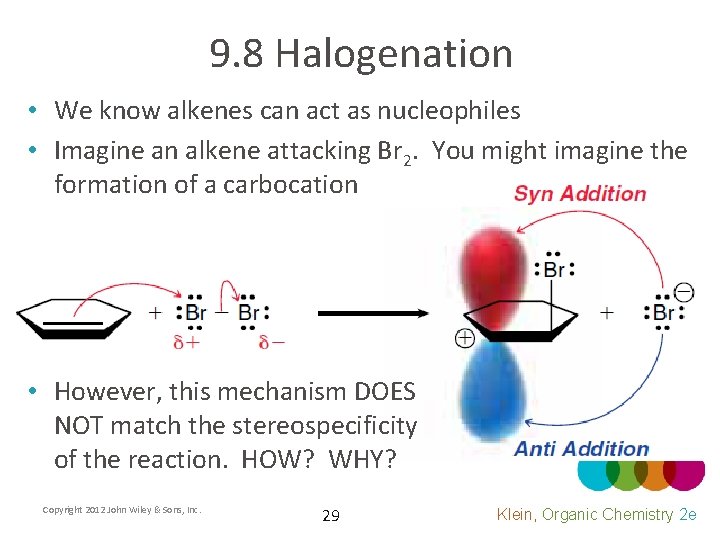
9. 8 Halogenation • We know alkenes can act as nucleophiles • Imagine an alkene attacking Br 2. You might imagine the formation of a carbocation • However, this mechanism DOES NOT match the stereospecificity of the reaction. HOW? WHY? Copyright 2012 John Wiley & Sons, Inc. 29 Klein, Organic Chemistry 2 e
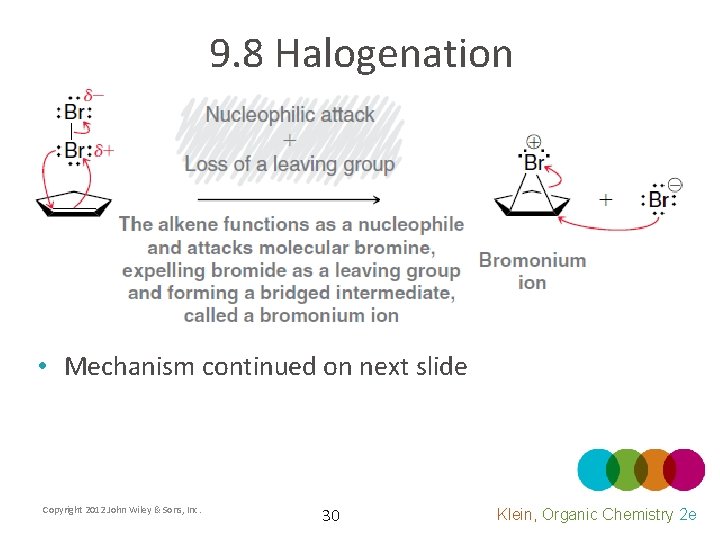
9. 8 Halogenation • Mechanism continued on next slide Copyright 2012 John Wiley & Sons, Inc. 30 Klein, Organic Chemistry 2 e
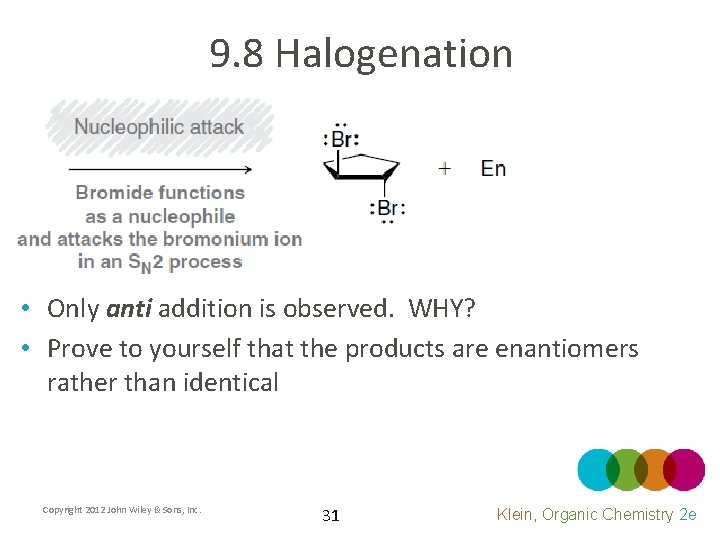
9. 8 Halogenation • Only anti addition is observed. WHY? • Prove to yourself that the products are enantiomers rather than identical Copyright 2012 John Wiley & Sons, Inc. 31 Klein, Organic Chemistry 2 e
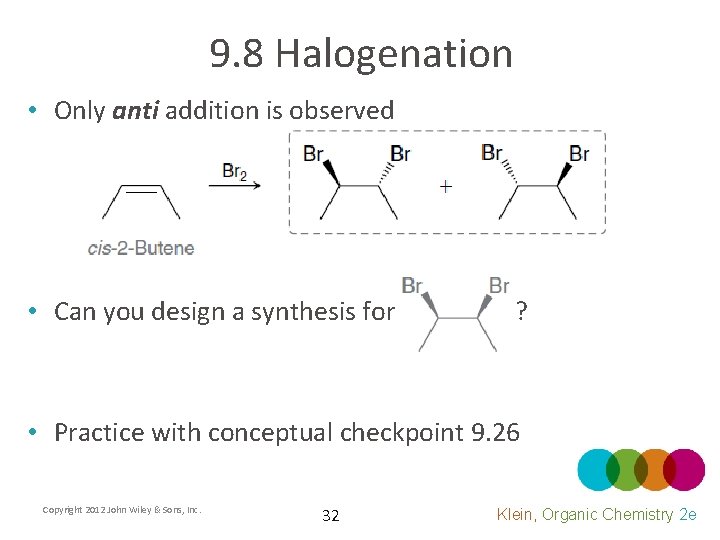
9. 8 Halogenation • Only anti addition is observed • Can you design a synthesis for ? • Practice with conceptual checkpoint 9. 26 Copyright 2012 John Wiley & Sons, Inc. 32 Klein, Organic Chemistry 2 e
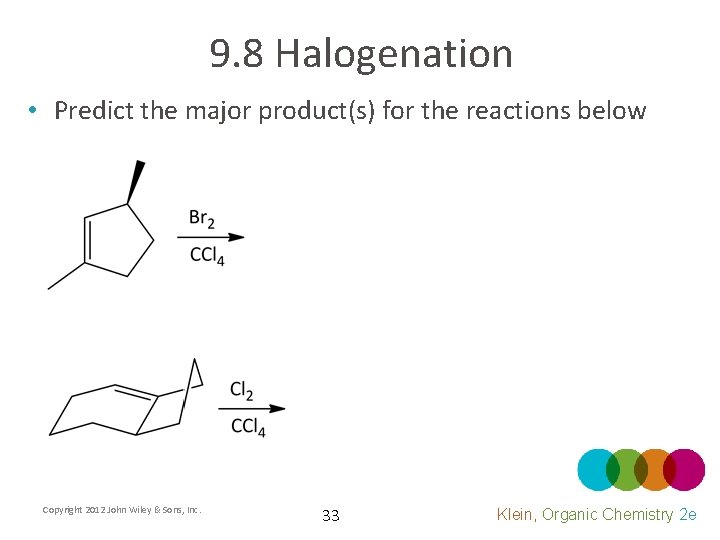
9. 8 Halogenation • Predict the major product(s) for the reactions below Copyright 2012 John Wiley & Sons, Inc. 33 Klein, Organic Chemistry 2 e
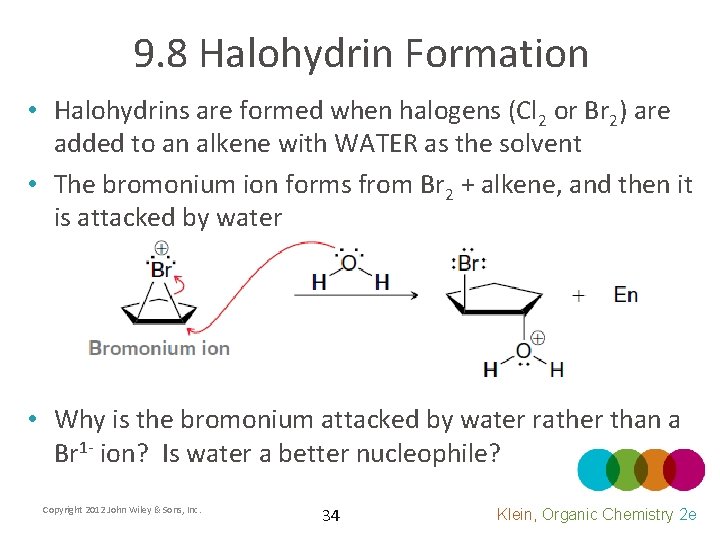
9. 8 Halohydrin Formation • Halohydrins are formed when halogens (Cl 2 or Br 2) are added to an alkene with WATER as the solvent • The bromonium ion forms from Br 2 + alkene, and then it is attacked by water • Why is the bromonium attacked by water rather than a Br 1 - ion? Is water a better nucleophile? Copyright 2012 John Wiley & Sons, Inc. 34 Klein, Organic Chemistry 2 e
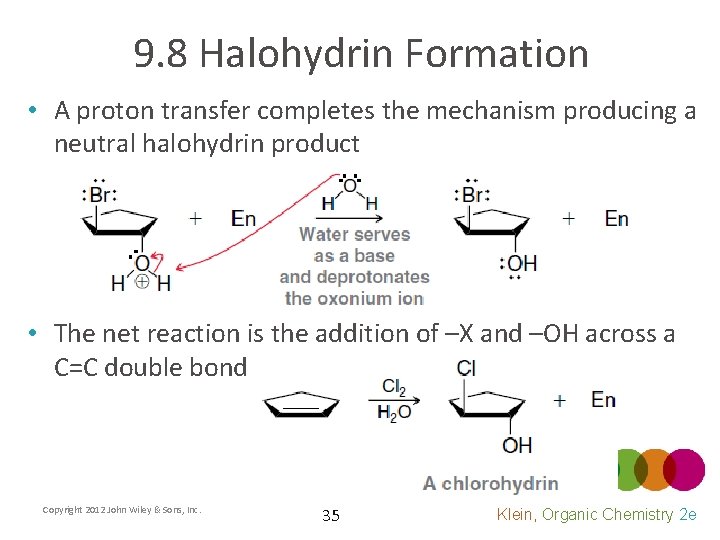
9. 8 Halohydrin Formation • A proton transfer completes the mechanism producing a neutral halohydrin product • The net reaction is the addition of –X and –OH across a C=C double bond Copyright 2012 John Wiley & Sons, Inc. 35 Klein, Organic Chemistry 2 e
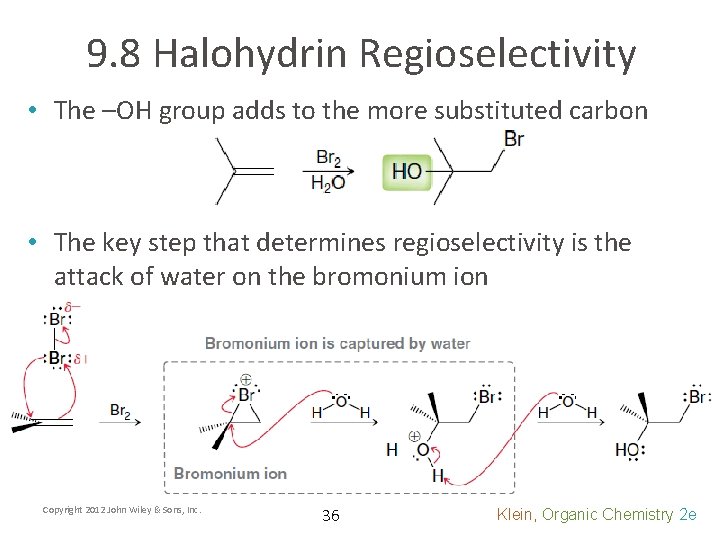
9. 8 Halohydrin Regioselectivity • The –OH group adds to the more substituted carbon • The key step that determines regioselectivity is the attack of water on the bromonium ion Copyright 2012 John Wiley & Sons, Inc. 36 Klein, Organic Chemistry 2 e
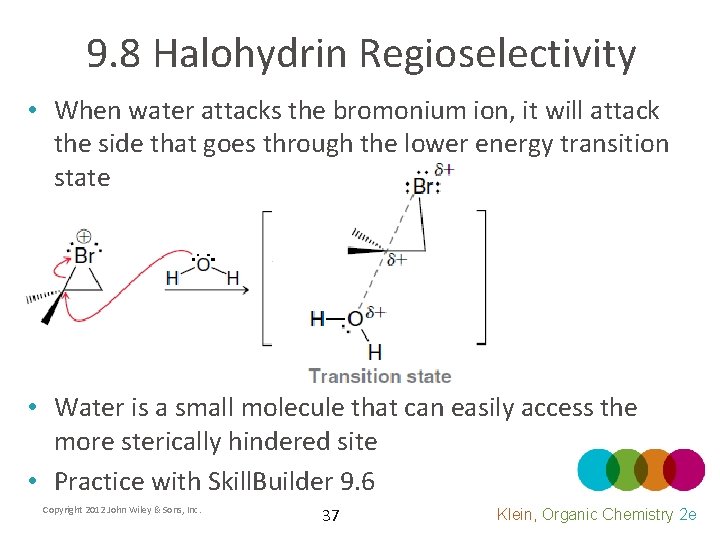
9. 8 Halohydrin Regioselectivity • When water attacks the bromonium ion, it will attack the side that goes through the lower energy transition state • Water is a small molecule that can easily access the more sterically hindered site • Practice with Skill. Builder 9. 6 Copyright 2012 John Wiley & Sons, Inc. 37 Klein, Organic Chemistry 2 e
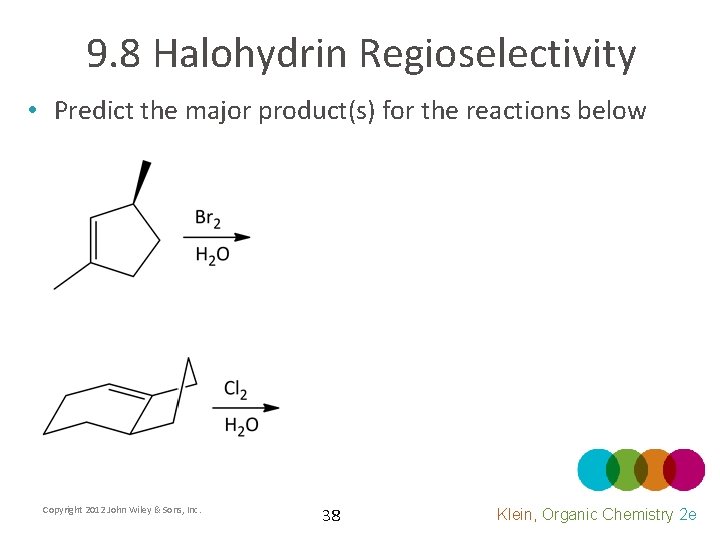
9. 8 Halohydrin Regioselectivity • Predict the major product(s) for the reactions below Copyright 2012 John Wiley & Sons, Inc. 38 Klein, Organic Chemistry 2 e
Study Guide for sections 9. 5 -9. 8 DAY 25, Terms to know: Sections 9. 5 -9. 8 Oxymercuration-Demercuration, Hydroboration-Oxidation, hydrogenation, halogenations, halonium ion, bromonium ion, halohydrin DAY 25, Specific outcomes and skills that may be tested on exam 4: Sections 9. 5 -9. 8 • Be able to give reasonable reagents and conditions including an alkene that could be used to produce a desired addition product. • Given an alkene and reaction conditions, be able to predict the product of an addition reaction including the proper stereochemistry and regiochemistry. • Be able to explain why borane conditions yield anti-Markovnikov hydration products using sterics and electronics to explain regioselectivity and stereoselectivity. • Be able to give the mechanism for each step of the Hydroboration-Oxidation reaction. • Be able to explain the role of the metal catalyst in hydrogenation reactions. • Be able to predict region- and steroselectivity in halogenation reactions. • Be able to predict region- and steroselectivity in halohydrin reactions. • Be able to draw a reasonable mechanism for each addition reaction mechanism covered in class. 39 Klein, Organic. Chemistry 2 e 2 e Klein, Organic
Practice Problems for sections 9. 5 -9. 8 Complete these problems outside of class until you are confident you have learned the SKILLS in this section outlined on the study guide and we will review some of them next class period. 9. 15 9. 16 9. 17 9. 18 9. 19 9. 20 9. 21 9. 23 9. 24 9. 25 9. 26 9. 27 9. 28 9. 52 40 Klein, Organic. Chemistry 2 e 2 e Klein, Organic
Prep for Day 26 Must Watch videos: https: //www. youtube. com/watch? v=Kf. Tosr. Ms 5 W 0 (anti dihydroxylation) https: //www. youtube. com/watch? v=76 Kt. DSf. Wnkw (syn dihydroxylation) https: //www. youtube. com/watch? v=b. Fj 3 Hpd. C 4 Uk (ozonolysis) https: //www. youtube. com/watch? v=k-gd 5 -4 wgl. Q (naming alkynes) https: //www. youtube. com/watch? v=_-I 3 Hdmy. Yf. E (reactions of alkynes) Other helpful videos: http: //ps. uci. edu/content/chem-51 b-organic-chemistry (lecture 9) Read sections 9. 9 -9. 13, 10. 1 -10. 3 41 Klein, Organic. Chemistry 2 e 2 e Klein, Organic
- Slides: 41