
9 5 Effects of Changing Dimensions Proportionally Objectives
9 -5 Effects of Changing Dimensions Proportionally Objectives Describe the effect on perimeter and area when one or more dimensions of a figure are changed. Apply the relationship between perimeter and area in problem solving. Holt Geometry
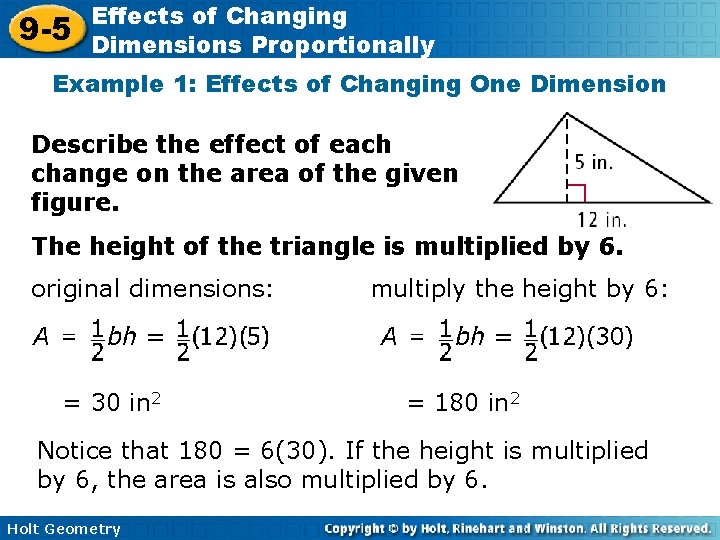
9 -5 Effects of Changing Dimensions Proportionally Example 1: Effects of Changing One Dimension Describe the effect of each change on the area of the given figure. The height of the triangle is multiplied by 6. original dimensions: = 30 in 2 multiply the height by 6: = 180 in 2 Notice that 180 = 6(30). If the height is multiplied by 6, the area is also multiplied by 6. Holt Geometry
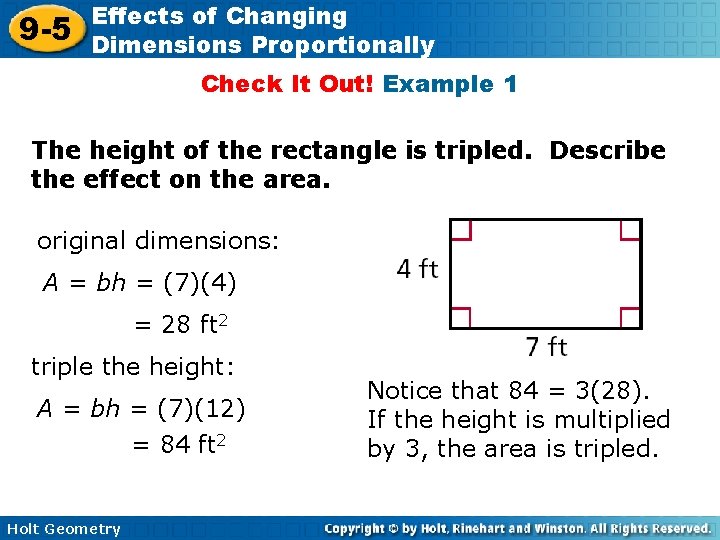
9 -5 Effects of Changing Dimensions Proportionally Check It Out! Example 1 The height of the rectangle is tripled. Describe the effect on the area. original dimensions: A = bh = (7)(4) = 28 ft 2 triple the height: A = bh = (7)(12) = 84 ft 2 Holt Geometry Notice that 84 = 3(28). If the height is multiplied by 3, the area is tripled.
9 -5 Effects of Changing Dimensions Proportionally Example 2 A: Effects of Changing Dimensions Proportionally Describe the effect of each change on the perimeter or circumference and the area of the given figures. The base and height of a rectangle with base 4 ft and height 5 ft are both doubled. Holt Geometry

9 -5 Effects of Changing Dimensions Proportionally Example 2 A Continued original dimensions: P = 2(4) + 2(5) = 18 ft P = 2 b + 2 h A = (4)(5) = 20 ft 2 A = bh dimensions doubled: P = 2(8) + 2(10) = 36 ft 2(4) = 8; 2(5) = 10 A = (8)(10) = 80 ft 2 The perimeter is multiplied by 2. 2(18) = 38 The area is multiplied by 22, or 4. 4(20) = 80 Holt Geometry
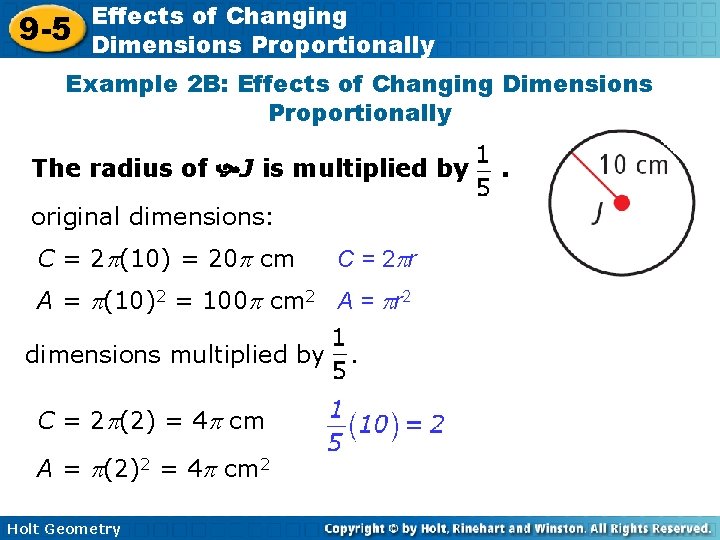
9 -5 Effects of Changing Dimensions Proportionally Example 2 B: Effects of Changing Dimensions Proportionally The radius of J is multiplied by original dimensions: C = 2 (10) = 20 cm C = 2 r A = (10)2 = 100 cm 2 A = r 2 dimensions multiplied by C = 2 (2) = 4 cm A = (2)2 = 4 cm 2 Holt Geometry . .
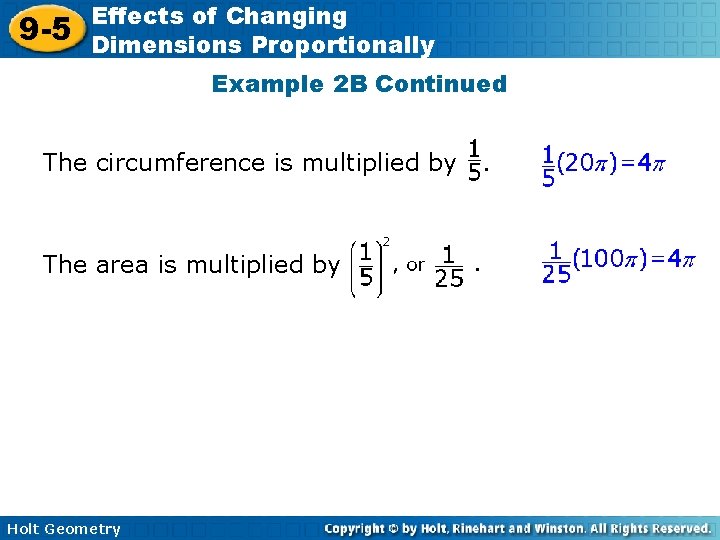
9 -5 Effects of Changing Dimensions Proportionally Example 2 B Continued The circumference is multiplied by The area is multiplied by Holt Geometry .
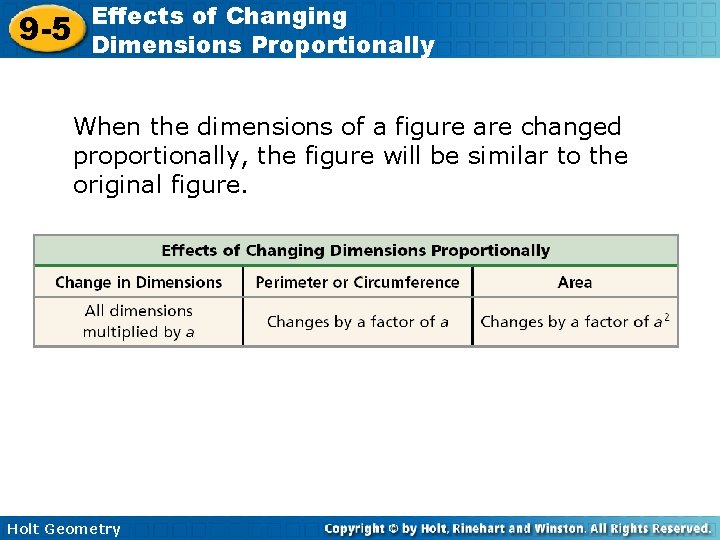
9 -5 Effects of Changing Dimensions Proportionally When the dimensions of a figure are changed proportionally, the figure will be similar to the original figure. Holt Geometry
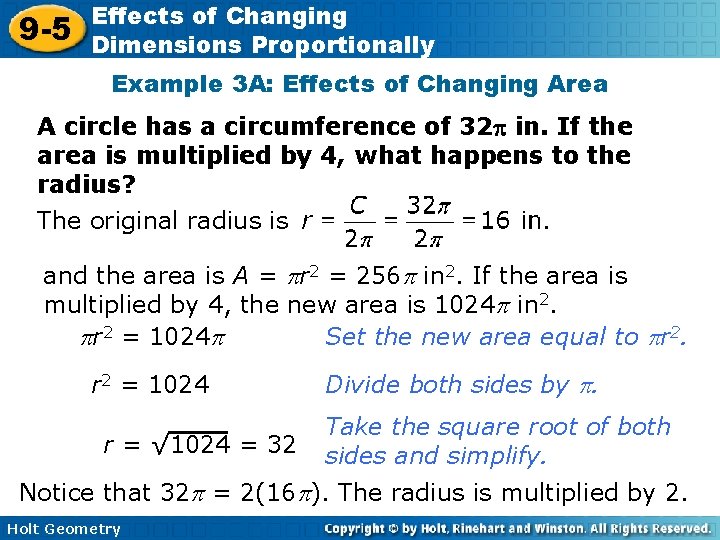
9 -5 Effects of Changing Dimensions Proportionally Example 3 A: Effects of Changing Area A circle has a circumference of 32 in. If the area is multiplied by 4, what happens to the radius? The original radius is and the area is A = r 2 = 256 in 2. If the area is multiplied by 4, the new area is 1024 in 2. r 2 = 1024 Set the new area equal to r 2 = 1024 r = √ 1024 = 32 Divide both sides by . Take the square root of both sides and simplify. Notice that 32 = 2(16 ). The radius is multiplied by 2. Holt Geometry
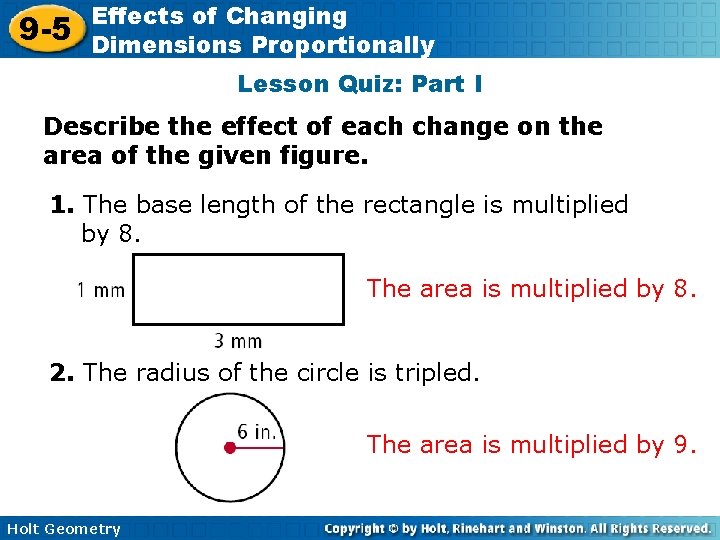
9 -5 Effects of Changing Dimensions Proportionally Lesson Quiz: Part I Describe the effect of each change on the area of the given figure. 1. The base length of the rectangle is multiplied by 8. The area is multiplied by 8. 2. The radius of the circle is tripled. The area is multiplied by 9. Holt Geometry
9 -5 Effects of Changing Dimensions Proportionally Lesson Quiz: Part II 3. A square has an area of 49 cm 2. If the area is quadrupled, what happens to the side length? The side length is doubled. 4. Rob had a 10 ft by 12 ft wall painted. For a wall twice as wide, the painter charged him twice as much. Is this reasonable? Explain. Yes; the second wall has twice the area of the first wall. Holt Geometry
- Slides: 11