
9 4 Compositions of Transformations I can draw

- Slides: 14
9. 4 : Compositions of Transformations I can draw glide reflections and other compositions of isometries in the coordinate plane.
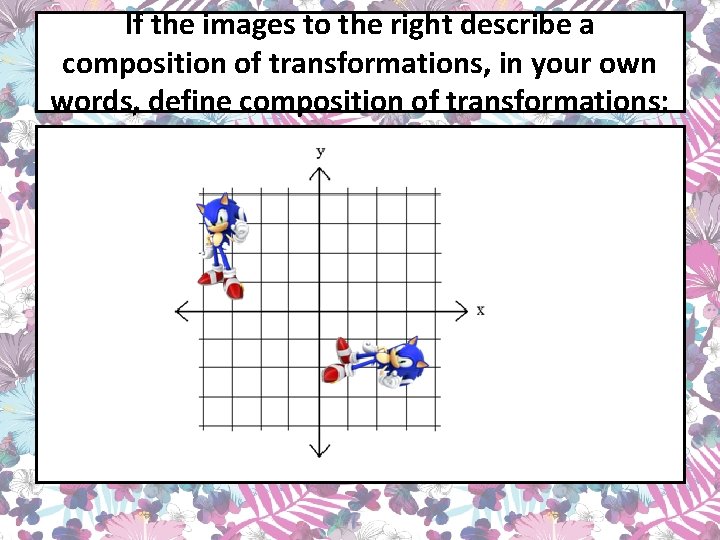
If the images to the right describe a composition of transformations, in your own words, define composition of transformations:
Vocabulary! Composition of Transformations Glide Reflection The resulting transformation when a transformation is applied to a figure and then another transformation is applied to the image. The composition of a translation followed by a reflection in a line parallel to the translation vector.
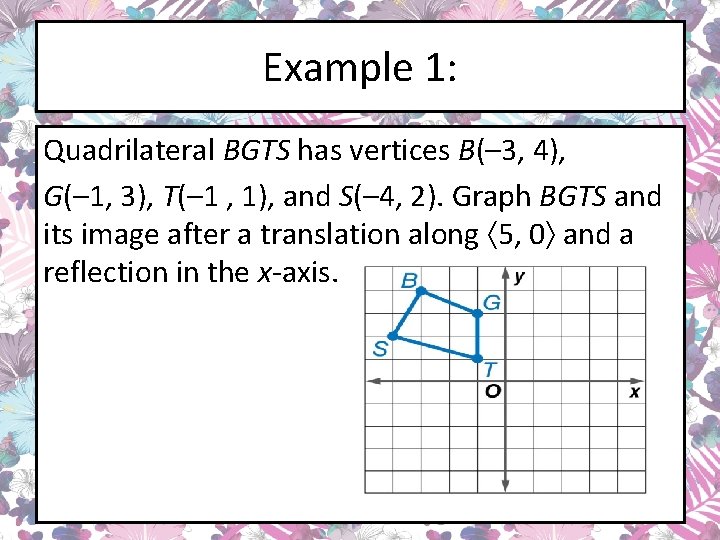
Example 1: Quadrilateral BGTS has vertices B(– 3, 4), G(– 1, 3), T(– 1 , 1), and S(– 4, 2). Graph BGTS and its image after a translation along 5, 0 and a reflection in the x-axis.
Vocabulary! Composition of Isometries (Transformations) The composition of two or more isometries is an isometry.
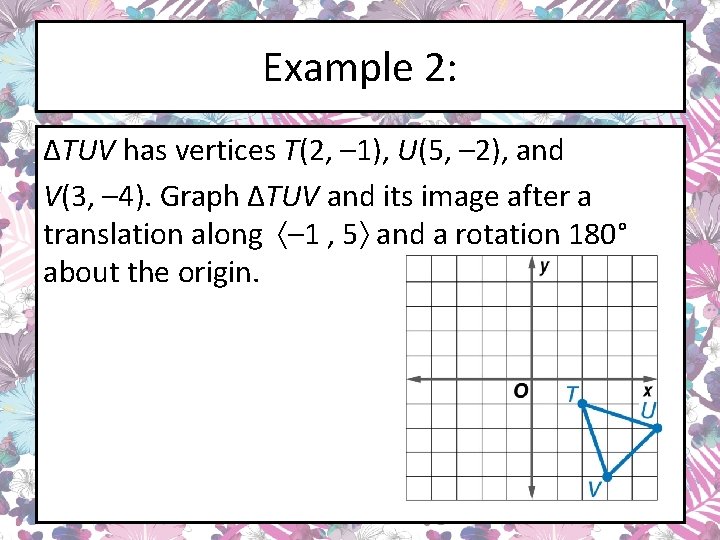
Example 2: ΔTUV has vertices T(2, – 1), U(5, – 2), and V(3, – 4). Graph ΔTUV and its image after a translation along – 1 , 5 and a rotation 180° about the origin.
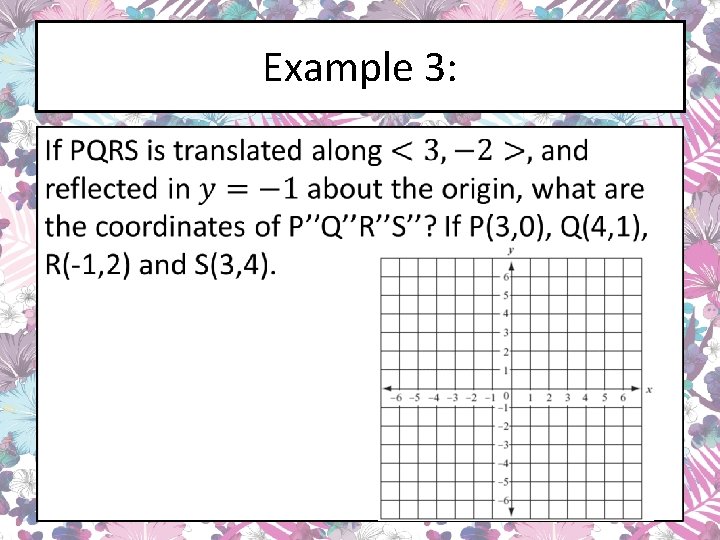
Example 3: •
Brain Break!
Example 4: Quadrilateral ABCD with A(1, 5), B(6, 2), C(-1, 3), D(-4, -2) is reflected in the line y = x and then rotated 90°. Find the coordinates of the image.
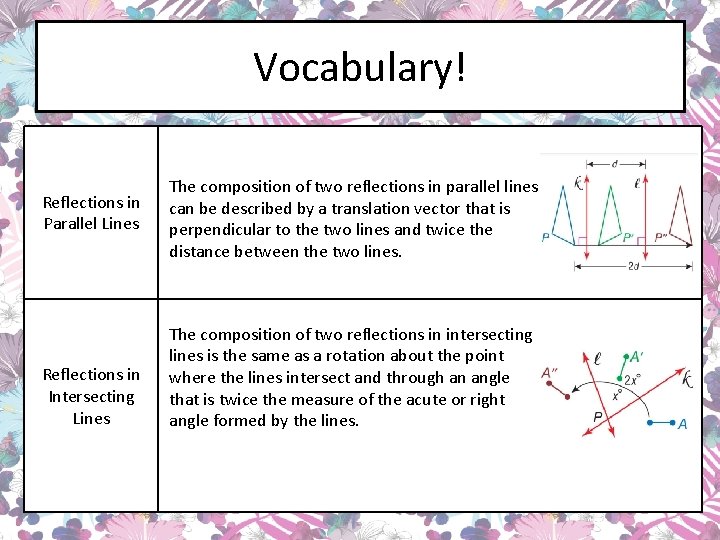
Vocabulary! Reflections in Parallel Lines Reflections in Intersecting Lines The composition of two reflections in parallel lines can be described by a translation vector that is perpendicular to the two lines and twice the distance between the two lines. The composition of two reflections in intersecting lines is the same as a rotation about the point where the lines intersect and through an angle that is twice the measure of the acute or right angle formed by the lines.
Example 6: (Skip!) A triangle is reflected in two parallel lines. The composition of the reflection produces a translation 22 centimeters to the right. How far apart are the parallel lines?
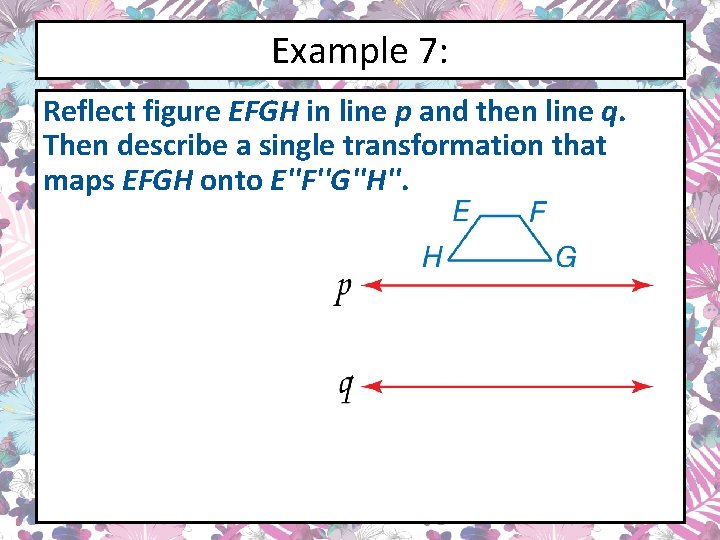
Example 7: Reflect figure EFGH in line p and then line q. Then describe a single transformation that maps EFGH onto E''F''G''H''.
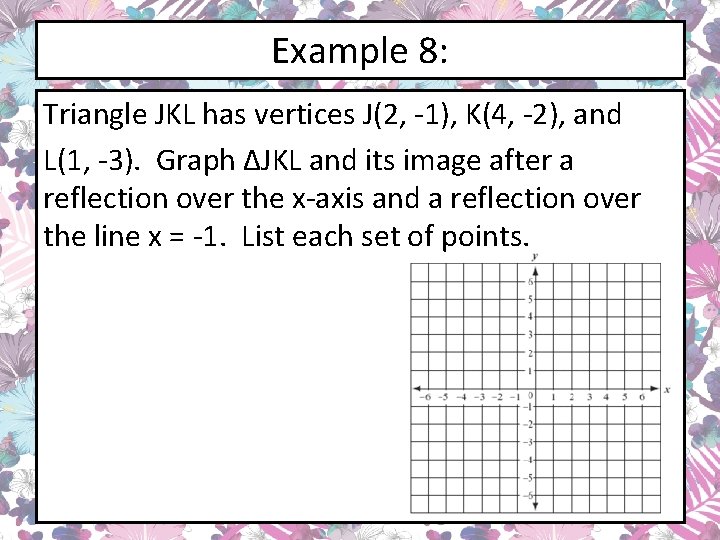
Example 8: Triangle JKL has vertices J(2, -1), K(4, -2), and L(1, -3). Graph ∆JKL and its image after a reflection over the x-axis and a reflection over the line x = -1. List each set of points.
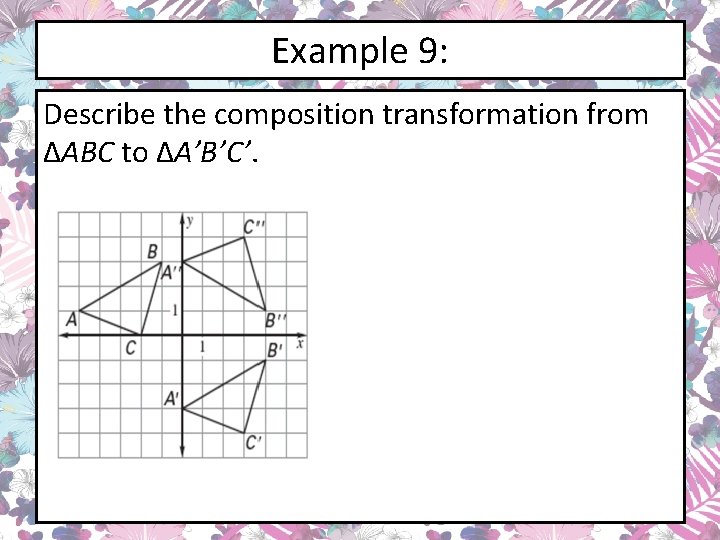
Example 9: Describe the composition transformation from ∆ABC to ∆A’B’C’.