
9 3 The Cell Cycle and Cancer Abnormal
9. 3 The Cell Cycle and Cancer • Abnormal growth of cells is called a tumor • Benign tumors are not cancerous • Encapsulated • Do not invade neighboring tissue or spread • Malignant tumors are cancerous • • Not encapsulated Readily invade neighboring tissues May also detach and lodge in distant places (metastasis) Results from mutation of genes regulating the cell cycle • Development of cancer • Tends to be gradual • May take years before a cell is obviously cancerous 1
The Cell Cycle and Cancer • Characteristics of Cancer Cells • Lack differentiation • Are non-specialized • Are immortal (can enter cell cycle repeatedly) • Have abnormal nuclei • May be enlarged • May have abnormal number of chromosomes • Often have extra copies of genes • Do not undergo apoptosis • Normally, cells with damaged DNA undergo apoptosis • The immune system can also recognize abnormal cells and trigger apoptosis • Cancer cells are abnormal but fail to undergo apoptosis 2
The Cell Cycle and Cancer • Characteristics of Cancer Cells • Form tumors • Mitosis is normally controlled by contact with neighboring cells – contact inhibition • Cancer cells have lost contact inhibition • Undergo metastasis • Original tumor easily fragments • New tumors appear in other organs • Undergo angiogenesis • Formation of new blood vessels • Brings nutrients and oxygen to the tumor 3
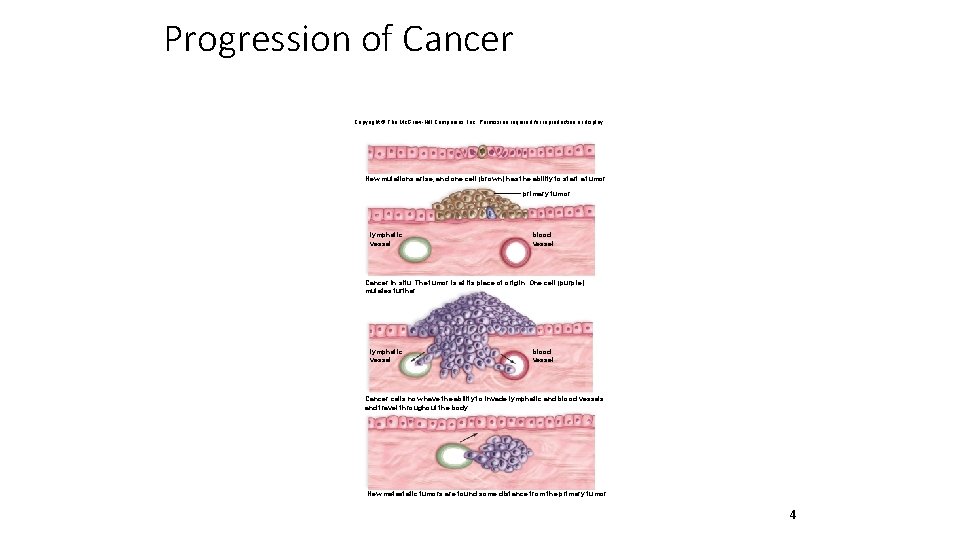
Progression of Cancer Copyright © The Mc. Graw-Hill Companies, Inc. Permission required for reproduction or display. New mutations arise, and one cell (brown) has the ability to start a tumor. primary tumor lymphatic vessel blood vessel Cancer in situ. The tumor is at its place of origin. One cell (purple) mutates further. lymphatic vessel blood vessel Cancer cells now have the ability to invade lymphatic and blood vessels and travel throughout the body. New metastatic tumors are found some distance from the primary tumor. 4
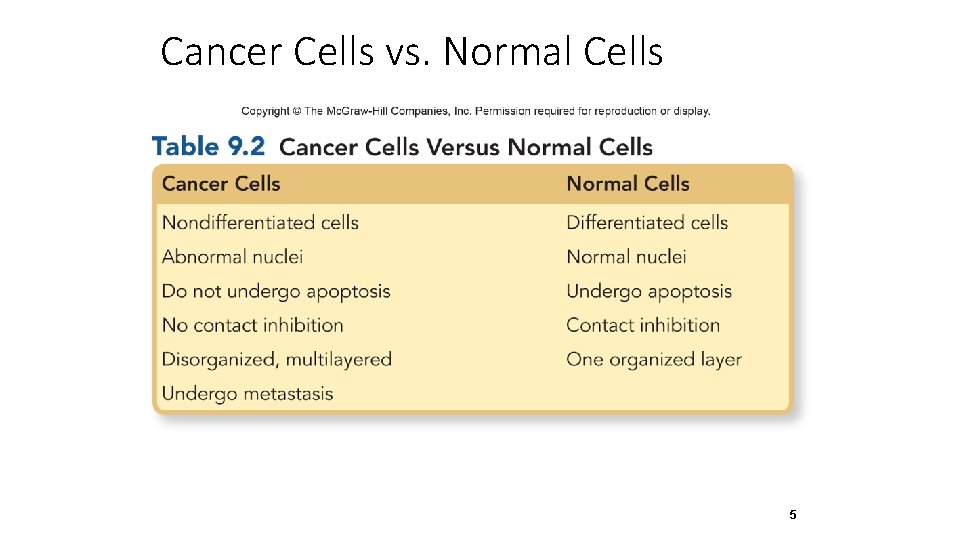
Cancer Cells vs. Normal Cells 5

The Cell Cycle and Cancer • Origin of Cancer • Oncogenes • Proto-oncogenes promote the cell cycle in various ways • If a proto-oncogene is mutated, it may become an oncogene • Tumor suppressor genes inhibit the cell cycle in various ways • If a tumor suppressor gene becomes inactive, it may promote cancer development • Both proto-oncogenes and tumor suppressor genes are normally regulated in coordination with organism’s growth plan 6
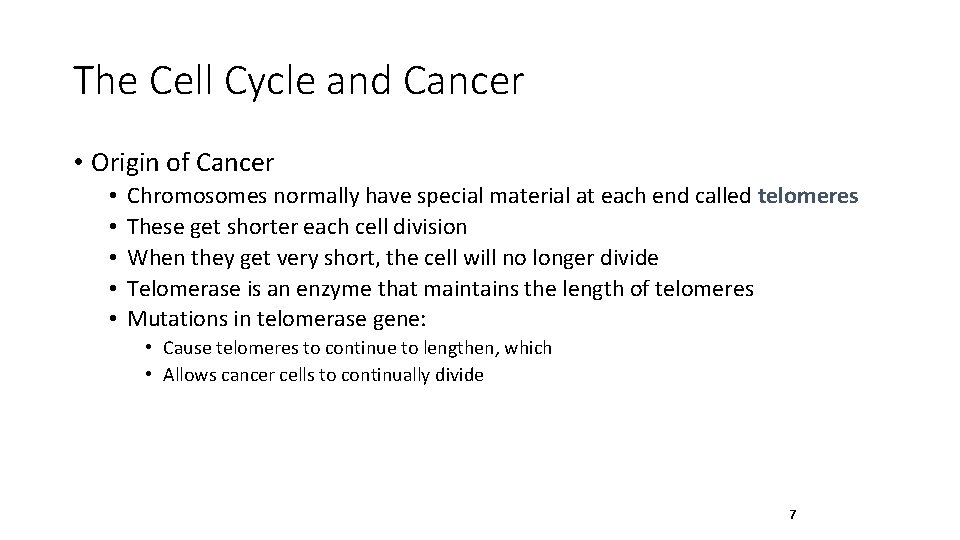
The Cell Cycle and Cancer • Origin of Cancer • • • Chromosomes normally have special material at each end called telomeres These get shorter each cell division When they get very short, the cell will no longer divide Telomerase is an enzyme that maintains the length of telomeres Mutations in telomerase gene: • Cause telomeres to continue to lengthen, which • Allows cancer cells to continually divide 7
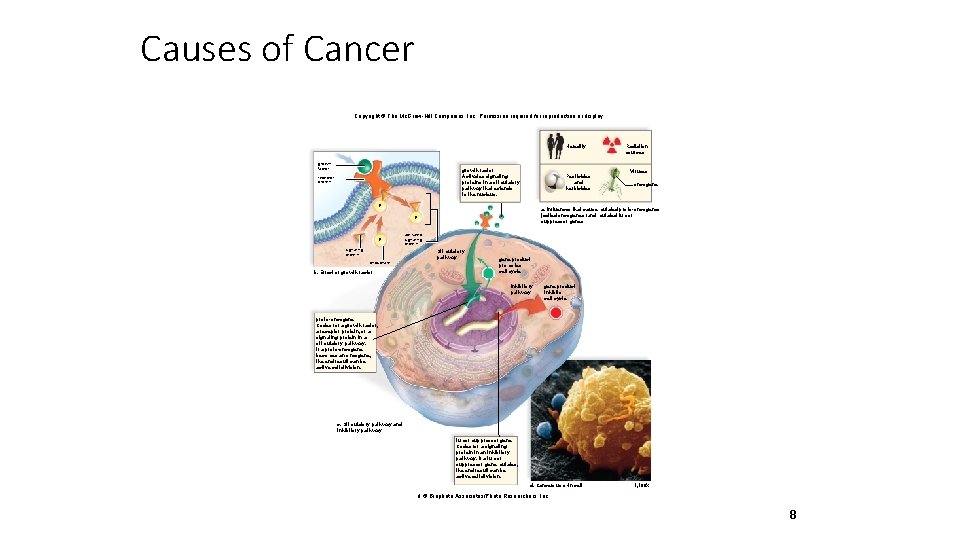
Causes of Cancer Copyright © The Mc. Graw-Hill Companies, Inc. Permission required for reproduction or display. Heredity growth factor Activates signaling proteins in a stimulatory pathway that extends to the nucleus. receptor protein Pesticides and herbicides P signaling protein phosphate b. Effect of growth factor Viruses oncogene a. Influences that cause mutated proto-oncogenes (called oncogenes) and mutated tumor suppressor genes P P Radiation sources activated signaling protein Stimulatory pathway gene product promotes cell cycle Inhibitory pathway gene product inhibits cell cycle proto-oncogene Codes for a growth factor, a receptor protein, or a signaling protein in a stimulatory pathway. If a proto-oncogene becomes an oncogene, the end result can be active cell division. c. Stimulatory pathway and inhibitory pathway tumor suppressor gene Codes for a signaling protein in an inhibitory pathway. If a tumor suppressor gene mutates, the end result can be active cell division. d. Cancerous skin cell 1, 100 X d: © Biophoto Associates/Photo Researchers, Inc. 8
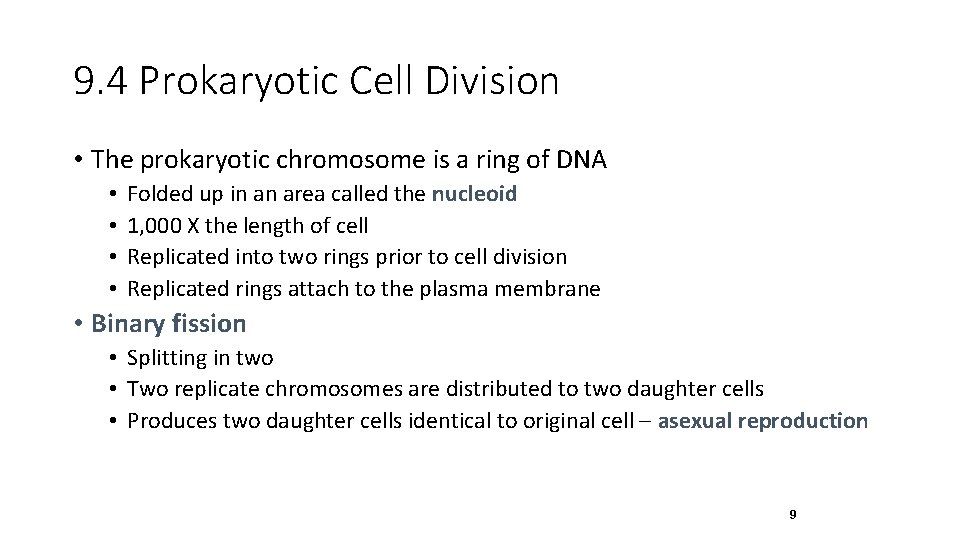
9. 4 Prokaryotic Cell Division • The prokaryotic chromosome is a ring of DNA • • Folded up in an area called the nucleoid 1, 000 X the length of cell Replicated into two rings prior to cell division Replicated rings attach to the plasma membrane • Binary fission • Splitting in two • Two replicate chromosomes are distributed to two daughter cells • Produces two daughter cells identical to original cell – asexual reproduction 9
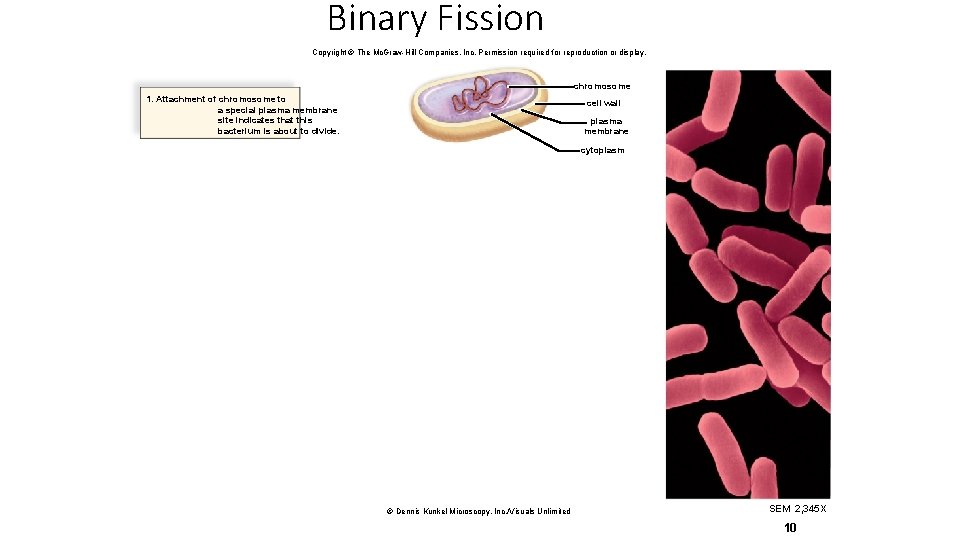
Binary Fission Copyright © The Mc. Graw-Hill Companies, Inc. Permission required for reproduction or display. chromosome 1. Attachment of chromosome to a special plasma membrane site indicates that this bacterium is about to divide. cell wall plasma membrane cytoplasm © Dennis Kunkel Microscopy, Inc. /Visuals Unlimited SEM 2, 345 X 10
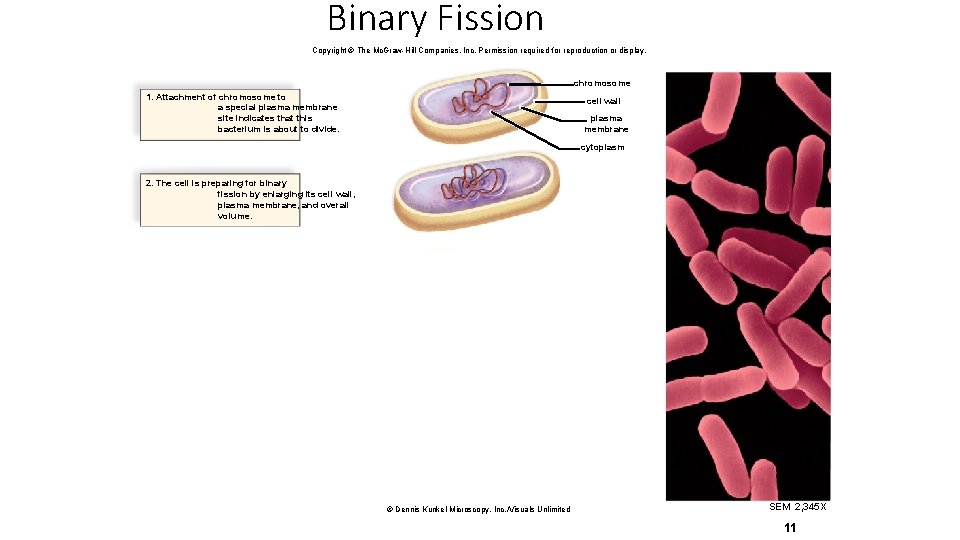
Binary Fission Copyright © The Mc. Graw-Hill Companies, Inc. Permission required for reproduction or display. chromosome 1. Attachment of chromosome to a special plasma membrane site indicates that this bacterium is about to divide. cell wall plasma membrane cytoplasm 2. The cell is preparing for binary fission by enlarging its cell wall, plasma membrane, and overall volume. © Dennis Kunkel Microscopy, Inc. /Visuals Unlimited SEM 2, 345 X 11
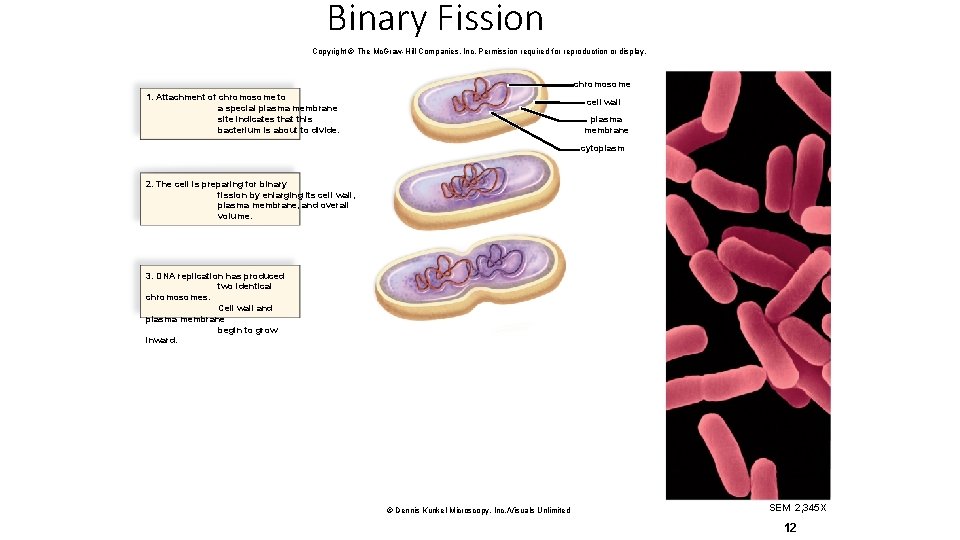
Binary Fission Copyright © The Mc. Graw-Hill Companies, Inc. Permission required for reproduction or display. chromosome 1. Attachment of chromosome to a special plasma membrane site indicates that this bacterium is about to divide. cell wall plasma membrane cytoplasm 2. The cell is preparing for binary fission by enlarging its cell wall, plasma membrane, and overall volume. 3. DNA replication has produced two identical chromosomes. Cell wall and plasma membrane begin to grow inward. © Dennis Kunkel Microscopy, Inc. /Visuals Unlimited SEM 2, 345 X 12
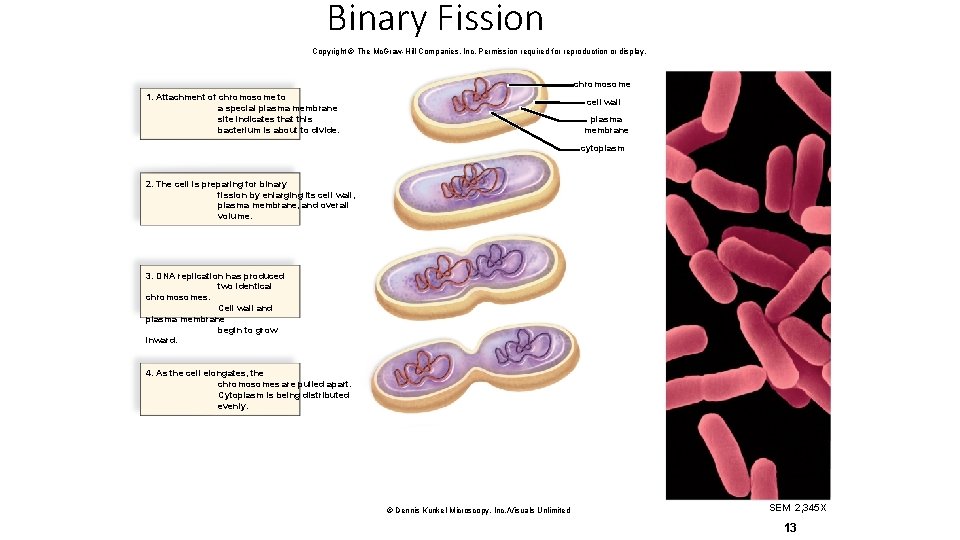
Binary Fission Copyright © The Mc. Graw-Hill Companies, Inc. Permission required for reproduction or display. chromosome 1. Attachment of chromosome to a special plasma membrane site indicates that this bacterium is about to divide. cell wall plasma membrane cytoplasm 2. The cell is preparing for binary fission by enlarging its cell wall, plasma membrane, and overall volume. 3. DNA replication has produced two identical chromosomes. Cell wall and plasma membrane begin to grow inward. 4. As the cell elongates, the chromosomes are pulled apart. Cytoplasm is being distributed evenly. © Dennis Kunkel Microscopy, Inc. /Visuals Unlimited SEM 2, 345 X 13
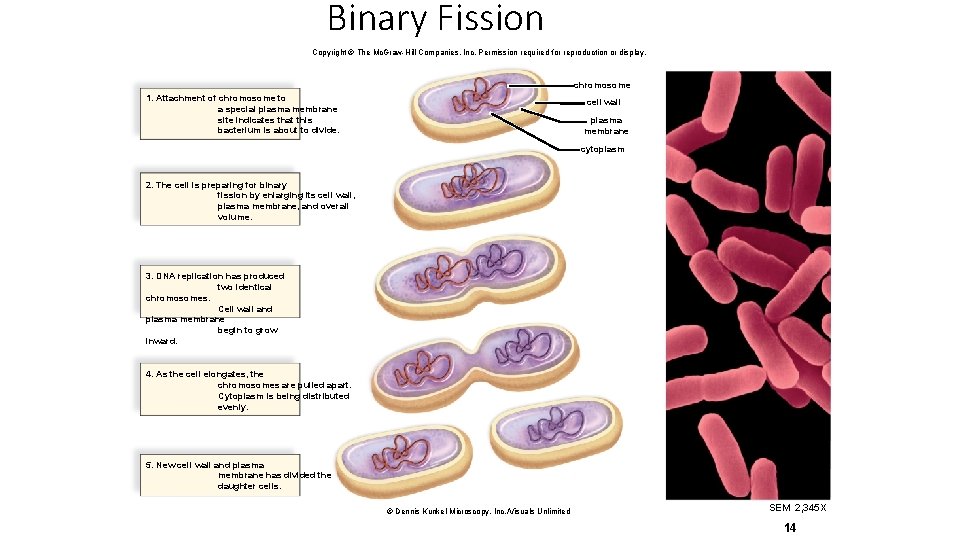
Binary Fission Copyright © The Mc. Graw-Hill Companies, Inc. Permission required for reproduction or display. chromosome 1. Attachment of chromosome to a special plasma membrane site indicates that this bacterium is about to divide. cell wall plasma membrane cytoplasm 2. The cell is preparing for binary fission by enlarging its cell wall, plasma membrane, and overall volume. 3. DNA replication has produced two identical chromosomes. Cell wall and plasma membrane begin to grow inward. 4. As the cell elongates, the chromosomes are pulled apart. Cytoplasm is being distributed evenly. 5. New cell wall and plasma membrane has divided the daughter cells. © Dennis Kunkel Microscopy, Inc. /Visuals Unlimited SEM 2, 345 X 14
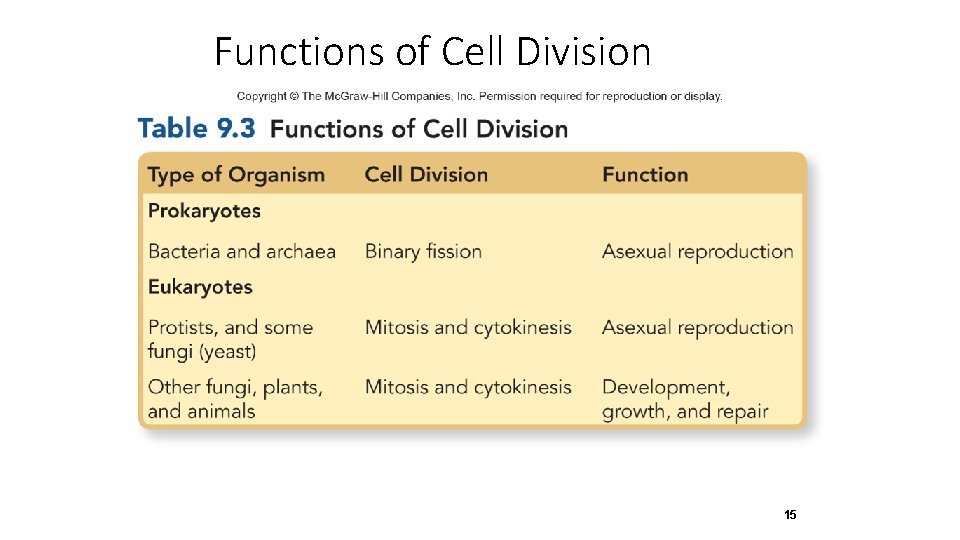
Functions of Cell Division 15
- Slides: 15