
9 3 Develop Project Team The process of
- Slides: 25
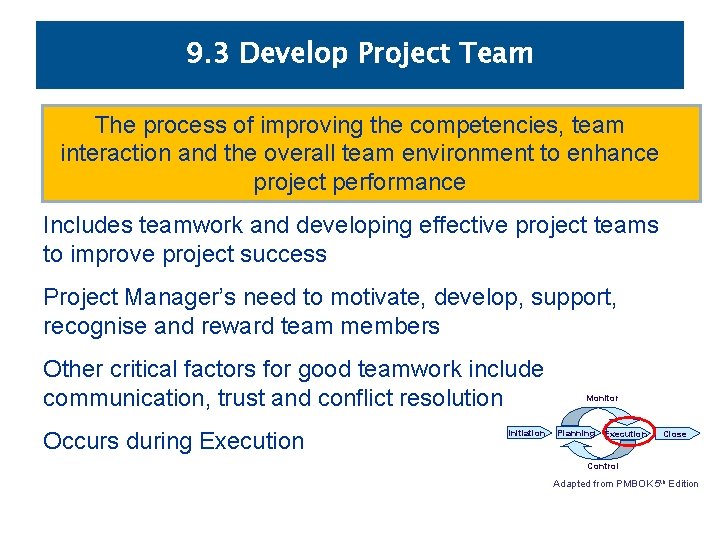
9. 3 Develop Project Team The process of improving the competencies, team interaction and the overall team environment to enhance project performance Includes teamwork and developing effective project teams to improve project success Project Manager’s need to motivate, develop, support, recognise and reward team members Other critical factors for good teamwork include communication, trust and conflict resolution Occurs during Execution Initiation Monitor Planning Execution Close Control Adapted from PMBOK 5 th Edition
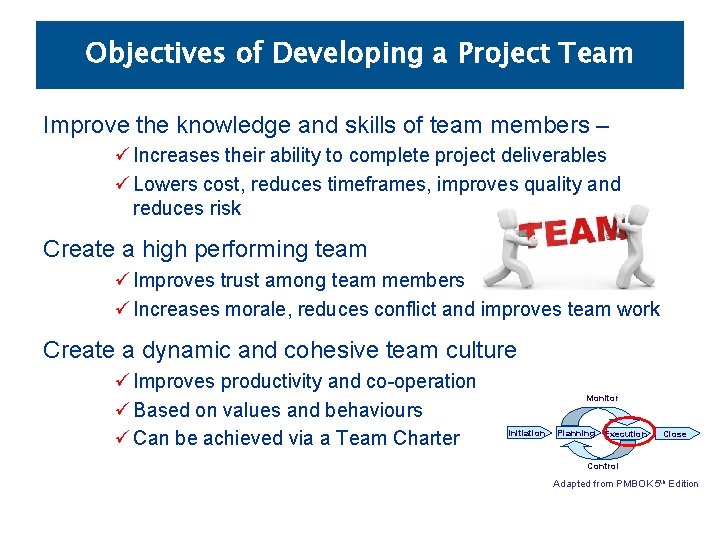
Objectives of Developing a Project Team Improve the knowledge and skills of team members – ü Increases their ability to complete project deliverables ü Lowers cost, reduces timeframes, improves quality and reduces risk Create a high performing team ü Improves trust among team members ü Increases morale, reduces conflict and improves team work Create a dynamic and cohesive team culture ü Improves productivity and co-operation ü Based on values and behaviours ü Can be achieved via a Team Charter Monitor Initiation Planning Execution Close Control Adapted from PMBOK 5 th Edition
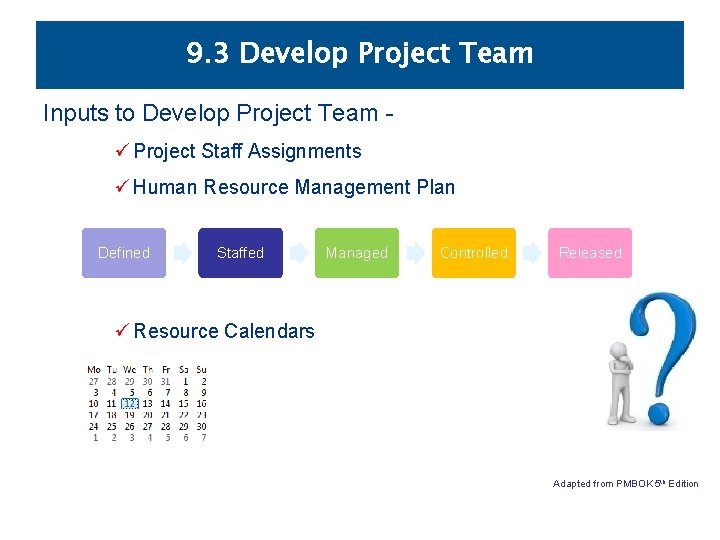
9. 3 Develop Project Team Inputs to Develop Project Team ü Project Staff Assignments ü Human Resource Management Plan Defined Staffed Managed Controlled Released ü Resource Calendars Adapted from PMBOK 5 th Edition
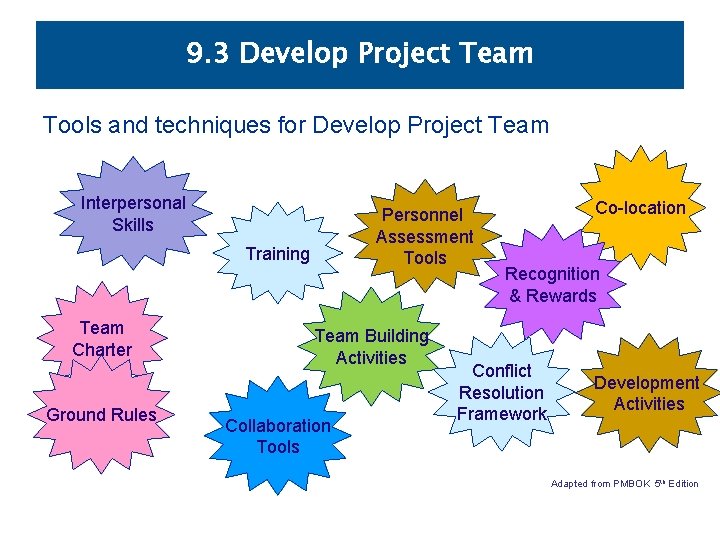
9. 3 Develop Project Team Tools and techniques for Develop Project Team Interpersonal Skills Personnel Assessment Tools Training Team Charter Ground Rules Team Building Activities Collaboration Tools Co-location Recognition & Rewards Conflict Resolution Framework Development Activities Adapted from PMBOK 5 th Edition
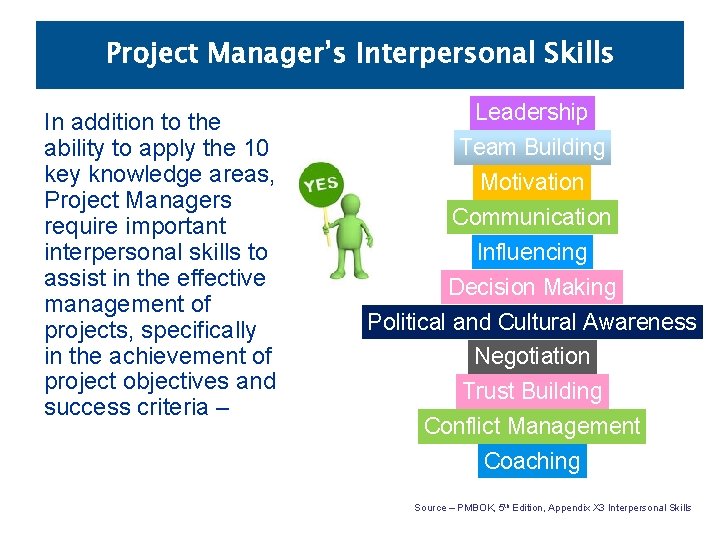
Project Manager’s Interpersonal Skills In addition to the ability to apply the 10 key knowledge areas, Project Managers require important interpersonal skills to assist in the effective management of projects, specifically in the achievement of project objectives and success criteria – Leadership Team Building Motivation Communication Influencing Decision Making Political and Cultural Awareness Negotiation Trust Building Conflict Management Coaching Source – PMBOK, 5 th Edition, Appendix X 3 Interpersonal Skills
Good Leaders • Provide clear direction and goals • Motivate the team to achievement the goals • Monitor performance • Recognise and reward high performance • Are charismatic and inspire people • Are flexible and adjust their style for the team and the individuals • Resolve conflict • Provide room for development and learning
Communication • Encourage clear and open communication between team members • Practice “active listening” to increase effectiveness of communication • Build rapport and spend some time getting to know each team member • Establish a common language or glossary • Set up rules on how the team wants to work together in a Team Charter
9. 3 Develop Project Team Training – ü One of the primary ways to enhance skills for team members and to address skill gaps for current positions ü Can be on-the-job style training or external courses, which are considerably more expensive Development Activities ü Alternative ways to fill skill gaps or to obtain new skills, includes mentoring and coaching, self study, secondments etc ü Often overlooked in development plans as most team members tend to look for external training opportunities (which are much more costly) Adapted from PMBOK 5 th Edition
9. 3 Develop Project Team-Building Activities – ü Can vary from a short kick off meeting for a project to off-site, to regular team drinks, to externally facilitated workshops ü Critical in the early stages of team formation to ensure that the team can become productive and needs to continue throughout the project ü Often includes setting of Ground Rules and common objectives, as well as mechanisms to discuss issues and to resolve conflict Team Charter or Ground Rules ü Formal document developed at the inception of the project team that defines behaviours and expectations for team members – decreases misunderstandings and increases productivity ü Needs to be consistent with the organisational culture Adapted from PMBOK 5 th Edition
9. 3 Develop Project Team Co-location – ü Where possible it is a good idea to place all of the active project team members in the same work place ü Greatly enhances team work but may not be possible due to distributed workforce, space limitations and virtual teaming Collaboration Tools ü Essential communication mechanisms and repository for all project deliverables, procedures and documentation ü Especially important where the team members cannot be colocated ü Includes tools such as Share. Point, Intranet etc Adapted from PMBOK 5 th Edition
9. 3 Develop Project Team Reward & Recognition – ü Involves recognising and rewarding desirable behaviours and results to encourage all team members to perform at a high level ü Often restricted by organisational performance management policies and procedures ü It is critical that poor performance is also addressed Conflict Resolution Framework – ü Often set up for a project team as part of the Ground Rules and Team Charter – provides depersonalised framework to discuss conflict ü May also have organisational procedures such as employee grievance processes for severe issues Adapted from PMBOK 5 th Edition
Conflict Resolution • When you manage a team there will be lots of opportunity to exercise conflict resolution and negotiation skills • Most of the conflict occurs in the “storming” phase • It is natural and can be positive if resolved well • Be open, focus on the issues and not the people • Concentrate on the present and not the past
9. 3 Develop Project Team Personnel Assessment Tools – ü Insight into areas of strength and weakness of the team ü Assess attitudes, team preferences, aspirations, how they work (decisions, interact, organise) ü Tools include attitudinal surveys, specific assessments, structured interviews, ability tests and focus groups. ü Provide improved understanding, trust, commitment and communication. Adapted from PMBOK 5 th Edition
9. 3 Develop Project Team Outputs of this process include – ü Team Performance Assessments – Formal and informal assessment of project team – Often governed by organisational performance management policies and procedures – Enables identification of training and development requirements, or assistance that may be required to improve effectiveness ü Enterprise Environmental Factors Updates – Personnel administration – Employee training records – Skill assessments Adapted from PMBOK 5 th Edition
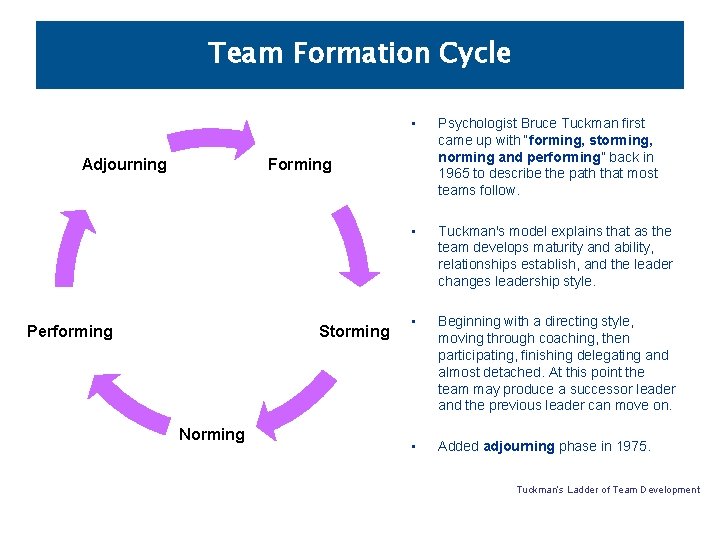
Team Formation Cycle Adjourning • Psychologist Bruce Tuckman first came up with “forming, storming, norming and performing” back in 1965 to describe the path that most teams follow. • Tuckman's model explains that as the team develops maturity and ability, relationships establish, and the leader changes leadership style. • Beginning with a directing style, moving through coaching, then participating, finishing delegating and almost detached. At this point the team may produce a successor leader and the previous leader can move on. • Added adjourning phase in 1975. Forming Performing Storming Norming Tuckman’s Ladder of Team Development
Forming • Team meets and learns about the project • Roles and responsibilities are assigned • Team members are positive and polite • There is some anxiety and excitement • Normally a very short phase of several weeks
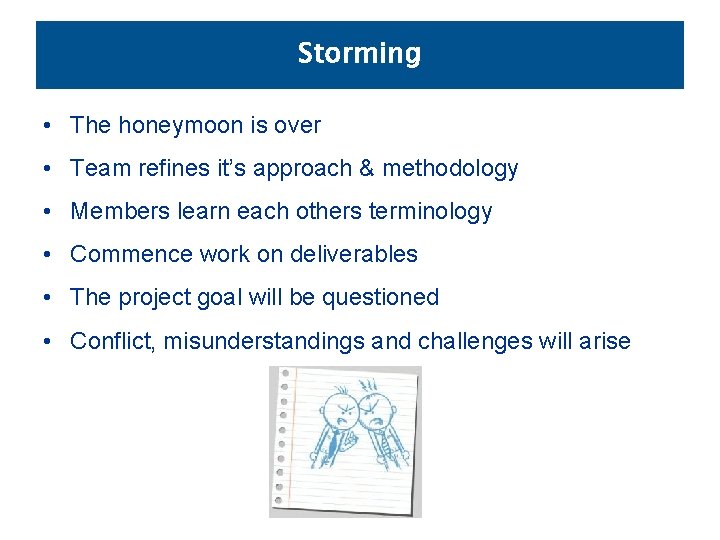
Storming • The honeymoon is over • Team refines it’s approach & methodology • Members learn each others terminology • Commence work on deliverables • The project goal will be questioned • Conflict, misunderstandings and challenges will arise
Norming • Team members adjust work habits and behaviours to work better together • Trust and respect should be evident • Start asking for help and providing constructive feedback • Commitment to the project goal should be improving • Often long overlap with Storming phase
Performing • Team functions as a well organised and cohesive unit • Issues are resolved smoothly and co-operatively • Good progress towards the shared vision of the project goal • More delegation is possible • Team culture is strong
Adjourning or Mourning • Project work is completed and the team moves on • Breaking up a team can be very stressful for the members • Particularly difficult for those with strong interpersonal relationships and a dislike of change
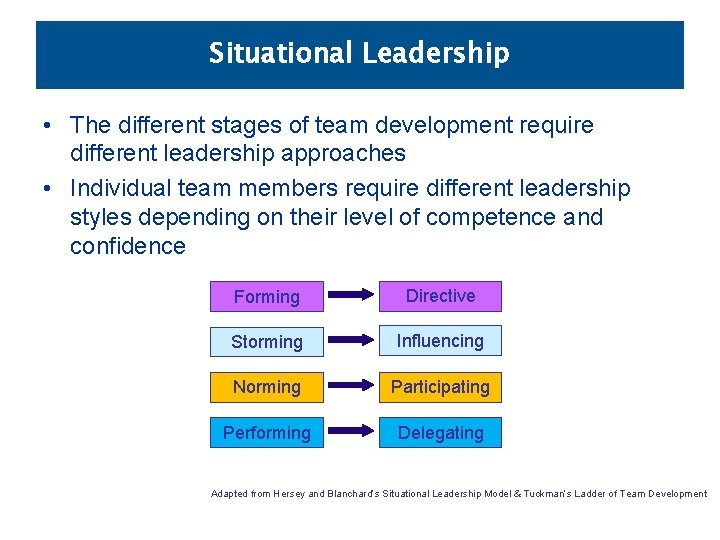
Situational Leadership • The different stages of team development require different leadership approaches • Individual team members require different leadership styles depending on their level of competence and confidence Forming Directive Storming Influencing Norming Participating Performing Delegating Adapted from Hersey and Blanchard’s Situational Leadership Model & Tuckman’s Ladder of Team Development
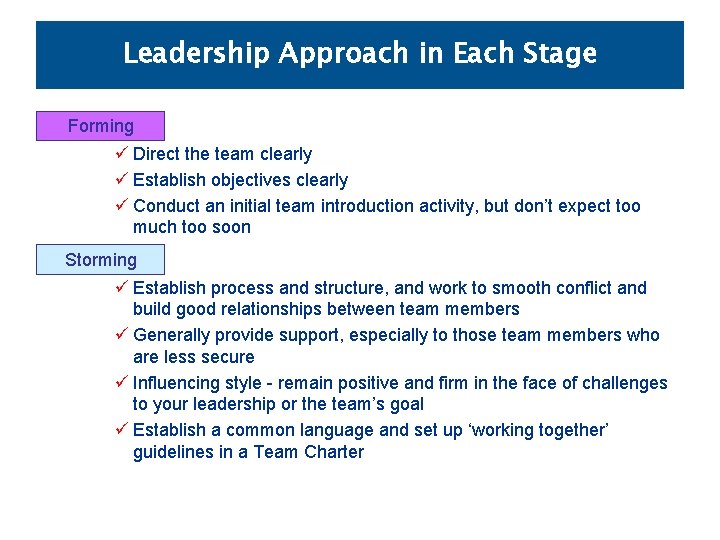
Leadership Approach in Each Stage Forming ü Direct the team clearly ü Establish objectives clearly ü Conduct an initial team introduction activity, but don’t expect too much too soon Storming ü Establish process and structure, and work to smooth conflict and build good relationships between team members ü Generally provide support, especially to those team members who are less secure ü Influencing style - remain positive and firm in the face of challenges to your leadership or the team’s goal ü Establish a common language and set up ‘working together’ guidelines in a Team Charter
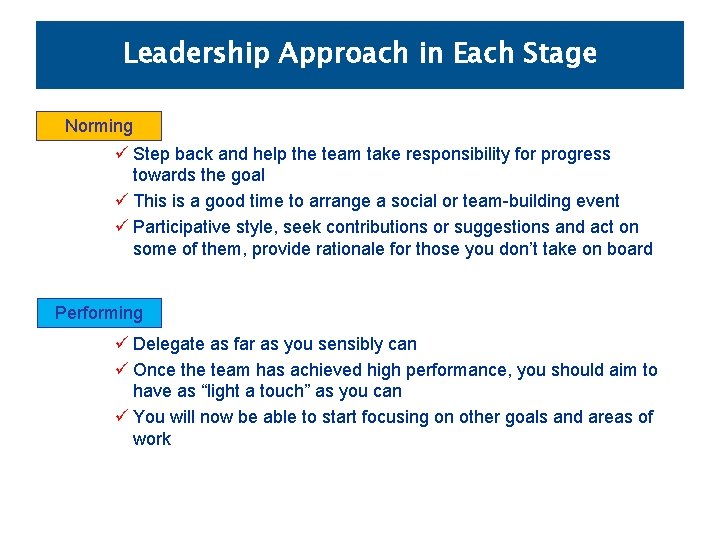
Leadership Approach in Each Stage Norming ü Step back and help the team take responsibility for progress towards the goal ü This is a good time to arrange a social or team-building event ü Participative style, seek contributions or suggestions and act on some of them, provide rationale for those you don’t take on board Performing ü Delegate as far as you sensibly can ü Once the team has achieved high performance, you should aim to have as “light a touch” as you can ü You will now be able to start focusing on other goals and areas of work
Leadership Approach in Each Stage Adjourning ü When breaking up a team, take the time to celebrate its achievements ü Provide assistance with moving to new roles within the organisation ü After all, you may work with some of these people again, and this will be much easier if people view past experiences positively Undertake regular reviews of the stage your team has reached. Adjust your behaviour and leadership approach to suit each stage and each team member
Plan for the Transition 1. Make sure that you leave plenty of time in your schedule to coach team members through the “Forming”, “Storming” and “Norming” stages. 2. Think about how much progress you should expect towards the goal and by when, and measure success against that. The Team must go through the “Forming”, “Storming” and “Norming” stages before they start “Performing”. There may not be much progress during this time. 3. Not all teams and situations will behave in this way, however many will – use this approach, but don’t try to force situations to fit it. Ensure that people don’t use knowledge of the “storming” stage as a license for unacceptable behaviour.